TL;DR
- A straight edge (also called an eased edge) is a 90-degree square cut with a very slightly softened top corner.
- It's the least expensive countertop edge profile, usually included in the base price of fabrication, and it fits modern, minimalist, and transitional kitchens.
- The main trade-off: a nearly sharp corner chips faster than a bullnose or beveled edge.
What exactly is a straight edge countertop profile?
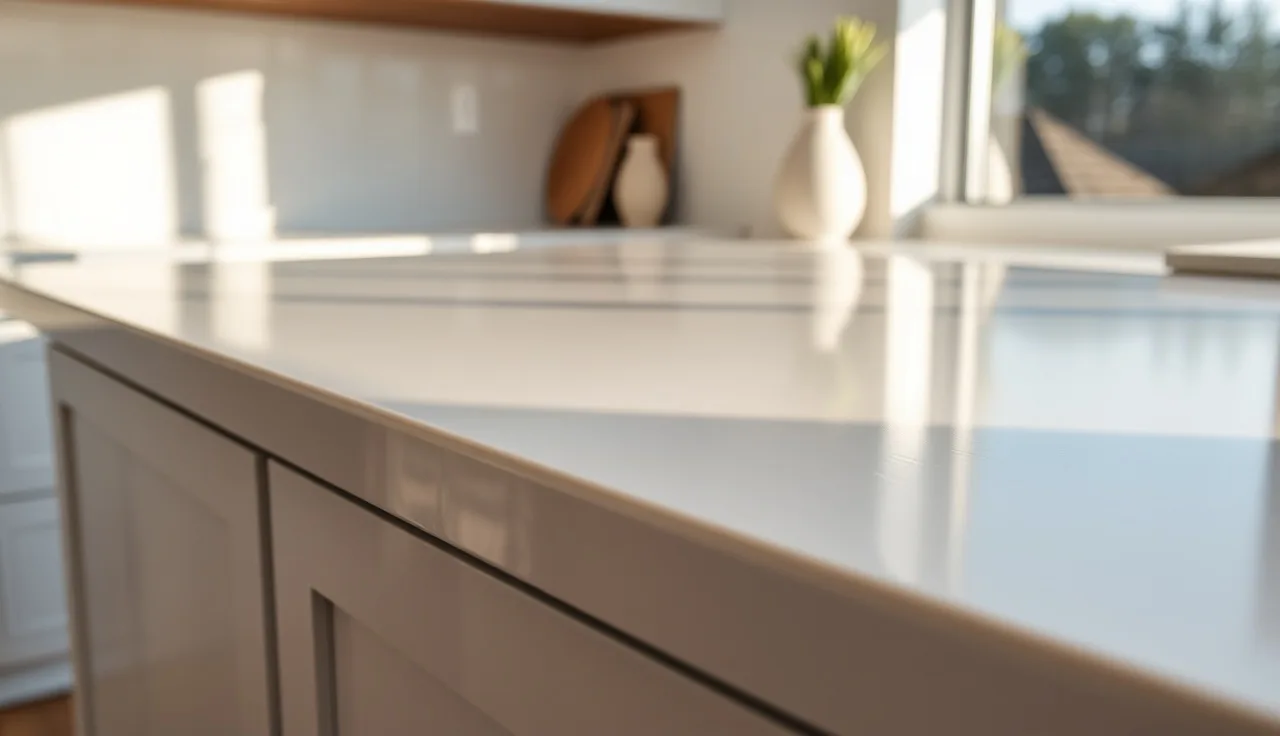
A straight edge countertop profile is exactly what it sounds like. The slab is cut square, and the visible front edge runs at 90 degrees to the countertop surface. Fabricators almost always ease the top corner by a millimeter or two on a polishing wheel, which is why you'll sometimes see it labeled an "eased edge" on a quote. That tiny softening is purely functional. It kills the razor-sharp arris a fresh saw cut leaves behind, the kind that nicks your hand every time you brush past.
The bottom corner usually stays square and raw, sitting on the cabinet face frame or overhang. The face of the edge is flat and vertical. No curve, no step, no bevel. Simple geometry.
People sometimes mix up the straight edge with a "flat polish" finish, but those are two different things. The profile describes the shape. The finish describes the surface treatment. You can have a straight edge polished to a mirror sheen, or a straight edge with a honed matte finish. Most shops polish the edge face to match the countertop surface unless you ask for something else.
Because nearly every countertop material gets cut square before any profile work starts, a straight edge skips most of the secondary machining. That's why it's cheap. On granite countertops and quartz, a fabricator might need zero extra passes on the CNC router to finish a straight eased edge. Every other profile adds machine time.
How much does a straight edge profile cost compared to other edge profiles?
Most fabricators fold the straight or eased edge into the base price of fabrication. You won't see a separate line item for it on most quotes. If a shop does charge, expect $0 to $5 per linear foot, which is rounding error on a job that might run $60 to $100 per square foot for granite or quartz [1].
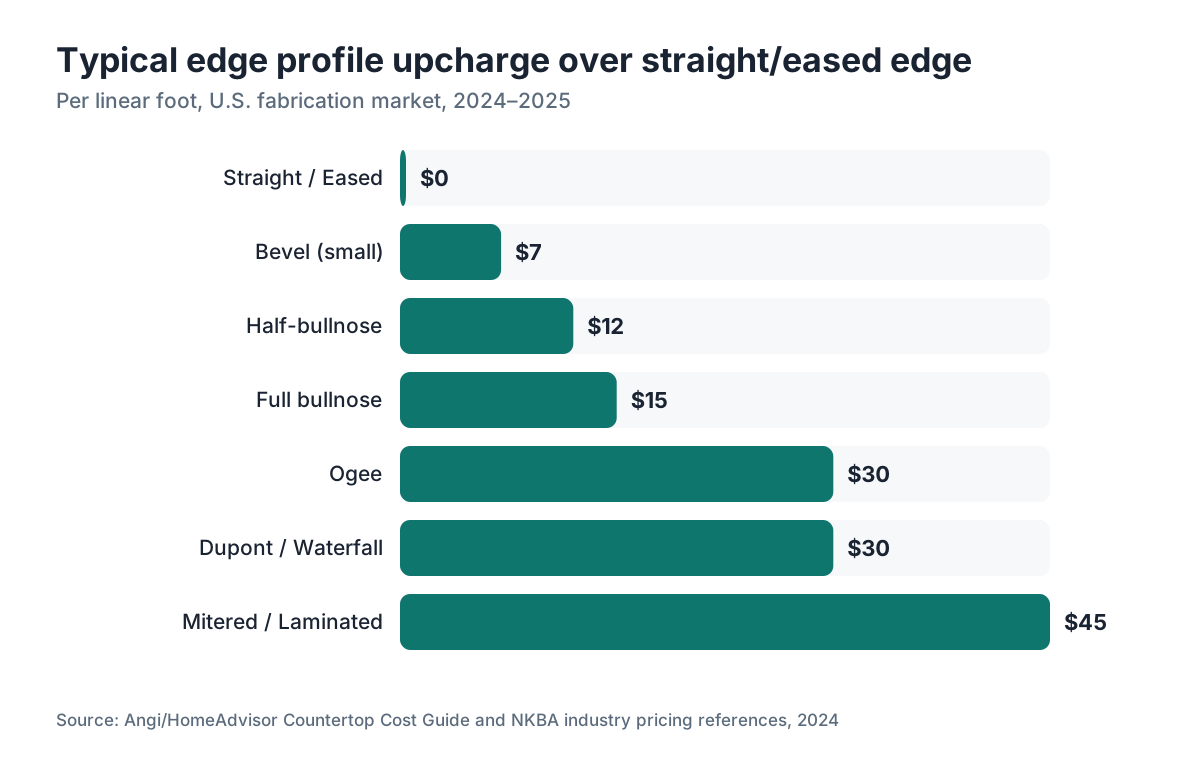
Every other profile costs more, because each one adds CNC router time, more profiling wheels, and sometimes multiple wheel passes. The table below shows typical upcharges over the straight/eased baseline, based on fabricator pricing common in the U.S. market through 2024 and 2025. These ranges come from fabricator price lists and industry cost guides. Your shop's exact prices will vary.
| Edge Profile | Typical Upcharge Over Straight Edge (per linear foot) |
|---|---|
| Straight / Eased | $0 |
| Bevel (small, 1/8") | $5, $10 |
| Bullnose (full) | $10, $20 |
| Ogee | $20, $40 |
| Dupont / Waterfall | $20, $40 |
| Mitered / Laminated | $30, $60+ |
| Custom / Decorative | $40, $100+ |
A standard kitchen runs 20 to 30 linear feet of edge. At the midpoint of a bullnose upcharge ($15/lf), that's $300 to $450 more than a straight edge. An ogee on all edges can add $600 to $900. Those numbers matter when you're already stretching a remodel budget [2].
For laminate countertops and Formica countertops, the math flips a little. Post-form laminate comes with a rounded front edge built into the sheet forming process, so a true square edge on laminate can require a different construction method and cost a bit more, not less.
What are the main types of countertop edge profiles, and where does straight fit in?
Edge profiles sort into a few natural families, and once you see the families, it's obvious why someone picks a straight edge over the alternatives.
The flat profiles are straight/eased, bevel, and chiseled. These keep the edge face largely flat. A bevel cuts the top corner at an angle (typically 45 degrees, sometimes a gentler 22.5) instead of just softening it. A chiseled or "raw" edge leaves an irregular, broken look that's popular on quartzite and marble. The straight edge is the cleanest member of this family.
The curved profiles are bullnose, half-bullnose, ogee, and dupont. These use convex or S-shaped curves on the edge face. They hide thickness and soften the look, and they're harder to keep clean because grime collects in the curve. Bullnose is the most common curved profile in residential kitchens.
The built-up profiles are mitered, laminated, and waterfall edges. These aren't really a profile on the edge face so much as a construction method. Two pieces of stone get mitered at 45 degrees and glued together to fake a much thicker slab. You can put a straight face on a laminated edge, which gives you the clean modern look of a thick slab with a flat front.
Decorative and specialty profiles include ogee, cove dupont, and step edges. Multiple routed passes build compound curves. These ran hot in traditional kitchens through the 2000s and have faded hard in the current design cycle.
The straight edge sits at the simple, affordable end. It belongs with the flat profiles but stands apart because it needs no machining beyond the initial cut and a light polish pass. Everything else on the spectrum climbs from there toward complex hand-tooled custom work.
What kitchen styles work best with a straight edge profile?
The straight edge is close to mandatory in true minimalist and contemporary kitchens. Flat-front slab doors, linear hardware, large-format backsplash tile: put an ogee edge in that room and it reads as a mistake. The straight edge fits because everything else in the design is about unbroken planes and honest material.
Transitional kitchens mix some traditional pieces (shaker doors, say) with cleaner finishes, and they take a straight edge without looking off. Transitional design leans toward restraint. A bevel might add enough interest without going full ogee, but a straight edge absolutely works too.
Industrial kitchens, where the counter might be butcher block countertops or concrete, lean on the straight edge because it backs up the utilitarian character of the room.
Where the straight edge fights the design: traditional and ornate kitchens with raised-panel doors, heavy crown molding, and detailed hardware. In those rooms a flat square edge can look unfinished instead of intentional. It's not technically wrong. It just doesn't carry the visual weight the rest of the room expects.
Scandinavian and Japanese-influenced interiors are probably the single strongest match. Both value material honesty and plain form. A flat-polished granite or marble countertops edge in those settings looks deliberate, not cheap.
Does a straight edge chip or damage more easily than other profiles?
Yes, and I'd rather say that plainly than bury it.
The top corner of a straight edge, even after easing, is the sharpest geometry you can have on a stone countertop. Stone chips at corners under point impact. Drop a cast iron pan so it clips the corner of a square-edge granite countertop and you've got a better chance of chipping it than you would with a bullnose, which spreads that impact across a rounded curve.
Here's the honest reality. Most people don't drop cast iron on their counter edges regularly, and a well-eased corner (versus a fully square arris) is meaningfully tougher than an uneased one. Still, if you have kids who'll collide with the counter over and over, or you're installing in a busy commercial kitchen, the durability case for a bullnose or a small bevel is real.
Material hardness matters too. Quartzite and granite are harder than marble, so a granite straight edge resists chips better than a marble straight edge of the same profile [3]. Engineered quartz (brands like Cambria, which you can read about at Cambria countertops) is built to resist chips somewhat better than natural stone at the edge, though no stone product is chip-proof.
Love the straight edge look but worried about chipping? Ask your fabricator for a slightly larger eased corner, maybe a 3mm radius instead of 1mm. You won't see the difference from across the room. The edge is more durable.
One more thing on safety. The eased straight edge is not dangerous. That small softening is enough that you won't cut yourself brushing against it. A fully square uneased edge, which essentially no fabricator delivers, would be a different story.
Is a straight edge harder or easier to clean than other countertop edges?
Easier. By a wide margin.
The flat vertical face of a straight edge wipes clean in one pass. No inside curves, no crevices where water and grease pool. A bullnose has a convex curve that traps grime where it meets the underside of the counter. An ogee has an S-curve with a concave section that's genuinely annoying to clean out. Cook a lot and you'll feel that difference fast, because grease splatter finds every curve.
For sealed stone, cleaning guidance from fabricators and groups like the Natural Stone Institute lands in the same place: mild pH-neutral cleaner and a soft cloth [4]. The straight edge makes that job as fast as it gets.
Bathroom vanities are a little different, since the edge sits above the floor and rarely sees cooking grease, but the logic holds. The straight edge is the easiest to maintain. If you're thinking about how to clean stone countertops over the long haul, the profile you pick is a small but real factor.
How do fabricators price and quote straight edge work on stone slabs?
From a fabricator's chair, the straight edge is the fastest profile to make and the simplest to quote. The CNC router path for an eased edge is basically a cleanup pass with a polishing wheel. No complex toolpath, no wheel change to a different profile head, and almost no risk of a machining error that ruins an expensive slab.
On most quoting systems, including software that handles countertop installation workflow end to end, the straight edge is the default that carries no charge. Other profiles pick up a per-linear-foot upcharge automatically when the edge type gets selected on the job.
Where straight edge work does take time: outside corners (the corner of an island, for instance), where the fabricator still has to make the two edge faces meet cleanly at 90 degrees and polish them to match. On inside corners (where the counter meets a wall), the edge terminates and usually gets a small polished return. Neither is hard. Both need attention.
Shops using quoting software like SlabWise can price edge profiles as line-item options that update automatically as customers pick different profiles, which makes it easy to show a homeowner exactly what an upgrade costs before anyone touches the slab.
If you're a homeowner comparing quotes from several shops, make sure every quote names the same edge profile. A quote that includes a bullnose edge at the same price as a competitor's straight edge quote isn't apples to apples.
Does the straight edge look good on thick slabs and waterfall islands?
This is where the straight edge earns its keep in contemporary kitchen design.
The waterfall island, where the countertop material runs vertically down the side of the island to the floor, almost always uses a straight edge or a mitered laminated edge. The whole point of a waterfall is the unbroken plane of material. Any curved profile on the top edge would interrupt that plane. A straight edge, mitered at 45 degrees where the horizontal surface meets the vertical drop, looks deliberate and architectural.
Thick-edge slab presentations, where the counter looks 4 to 6 centimeters thick (usually built by laminating a second piece of stone underneath), pair naturally with the straight edge too. The visual weight of the thick face is the statement. A bullnose on a thick laminated edge softens the geometry and waters down the effect.
Standard countertop slabs in the U.S. are typically 2 centimeters (3/4 inch) or 3 centimeters (1-1/8 inch) thick [5]. Three-centimeter stone is now the most common residential choice because it's stiffer and doesn't need a plywood sublayer for most spans. On 3cm stone with a straight edge, the edge face is a clean 1-1/8 inch band of polished stone. That's a substantial presence with zero ornamentation.
Two-centimeter stone with a straight edge can look thin. That's why fabricators sometimes laminate an extra strip underneath the front edge to build visual thickness. It's called a built-up or laminated edge, and it's effectively invisible from the front.
How does a straight edge compare to an eased edge, beveled edge, and bullnose?
People use "straight edge" and "eased edge" interchangeably, and at most shops they mean the same thing. Technically, a perfectly straight edge would have a sharp 90-degree arris at the top, while an eased edge has that corner softened. But no fabricator delivers a truly sharp arris. It would chip on day one and scratch anyone who touched it. So in the real world, straight equals eased.
The bevel cuts the top corner at a consistent angle, typically 45 degrees, sometimes a gentler pitch. That gives a slightly fancier look than a straight edge, adds a bit of visual complexity, and costs modestly more. A small bevel is a good compromise if you want a cleaner modern look than a bullnose but worry the straight edge will feel too plain in a kitchen that isn't fully minimalist.
The full bullnose rounds the entire top corner in a continuous convex curve, from the top surface down to the bottom of the edge face. It's soft, forgiving on contact, and reads traditional or transitional. It's been the single most popular residential profile for decades, though it's lost ground to straight and beveled edges as contemporary design spreads. The bullnose is harder to chip than the straight edge at the corner but collects more grime.
The half-bullnose (or half-round) rounds only the top corner and leaves the bottom square. It's a middle ground in both looks and durability.
A practical recommendation. If your kitchen is contemporary or transitional, start with the straight edge and only move to a bevel if the design feels like it needs more detail. If your kitchen is traditional, skip the straight edge and look at bullnose or ogee. No edge profile is universally right.
What materials are best suited to a straight edge profile?
Almost any countertop material takes a straight edge, but some wear it better than others.
Granite and quartzite are excellent candidates. Both are hard enough that the eased corner shrugs off everyday chipping, and both come in slabs with enough visual activity that a simple edge lets the stone do the talking. Busy patterns don't need ornamental edges.
Engineered quartz (quartz composite) works well too. The even color and pattern of most quartz products suits the clean geometry of a straight edge, and the material machines predictably, so shops get a very consistent polished edge face.
Marble is where you should think twice. It's softer (typically 3 to 4 on the Mohs scale versus granite's 6 to 7) [3], so corners chip more readily. A straight edge on marble is absolutely done in high-end kitchens, but it's a more fragile choice. In a hard-use kitchen, a small bevel or bullnose buys real durability. In a low-traffic bathroom vanity or butler's pantry, the risk drops way down.
Soapstone is another soft material (Mohs 1 to 2) that takes a straight edge in traditional and farmhouse kitchens, where the natural wear character is part of the appeal. See how to clean soapstone countertops for caring for it over time.
Concrete takes straight edges easily, and the industrial look suits the profile.
Laminate and solid surface materials like Corian countertops can be routed to any profile, but post-form laminate sheets usually come with a built-in rounded front edge. A true straight edge on post-form laminate needs a different approach (flat-lay laminate on a substrate) and costs more than the standard product.
How do fabricators machine a straight edge on CNC equipment?
For fabricators, the straight edge is the simplest CNC operation in the shop. After the slab is cut to the countertop shape on a bridge saw or waterjet, the CNC router takes over for edge profiling.
For a straight eased edge, the router runs a polishing wheel along the top arris in a very shallow pass. On most machines this is one step, at most two: one pass to shape the tiny eased radius, one pass with a finer grit wheel to polish. Total machine time for a straight edge on a typical kitchen, roughly 25 linear feet, might be 10 to 20 minutes, depending on the machine and setup.
A complex profile like an ogee needs three to six separate router passes with different shaped wheels, each one swapped and calibrated. That's why ogee and dupont profiles cost substantially more, and it's also where machine errors (a misregistered wheel, wrong depth) can wreck the slab. The straight edge gives error almost nowhere to hide.
High-volume shops love the straight edge's speed. A shop running 15 to 20 kitchen jobs a week clears edge work much faster on straight-edge jobs, which is part of why some budget fabricators build their packages around a straight edge standard and post a clear upcharge for everything else. That's honest pricing, not a limitation.
One workplace note worth flagging. Edge profiling with routers and grinding wheels generates respirable crystalline silica, and OSHA sets the permissible exposure limit at 50 micrograms per cubic meter as an 8-hour time-weighted average [8]. Shops running dry edge work without proper dust control are putting their people at risk. Quoting and shop-management tools that track machine time per edge type also help set accurate per-linear-foot pricing, so shops avoid undercharging on complex profiles while over-billing straight edge customers. Accurate job costing is one of the core problems fabrication software like SlabWise helps shops solve.
Are there any design trends pushing straight edge countertops out of favor?
Not really. If anything, the current trend runs in the straight edge's favor.
Contemporary kitchen design has drifted steadily toward minimalism over the past decade. Flat-front cabinetry now outsells raised-panel styles in many markets [7]. Large-format tile backsplashes with minimal grout lines are common. In that environment, the straight edge fits naturally.
The one area where something beyond a plain straight edge has grown is the mitered thick edge, that laminated-slab look with the 4-to-6 centimeter face. But it's often done with a straight face on the edge, just thicker. So it's technically still a straight edge profile, just on a beefier substrate.
Ogee and cove-dupont profiles, the prestige choice in traditional kitchens through the 1990s and 2000s, have faded. Many fabricators say ogee now reads as dated to a big share of homeowners under 45. That shift benefits the straight edge.
Bevel edges have gained ground as a middle option. They carry a little more detail than a plain straight edge and fit the contemporary look better than curved profiles. So the real competition for the straight edge in modern kitchens isn't the bullnose. It's the small bevel.
The kitchen countertops market is big enough that every profile stays in use at once. Traditional kitchens getting remodeled still take bullnose and ogee edges. Contemporary new builds go straight or beveled almost across the board.
Frequently asked questions
Is a straight edge the same as an eased edge?
Yes, in practice. A theoretically perfect straight edge would have a sharp 90-degree corner, but no fabricator delivers that because it chips immediately. Every shop eases the top corner slightly on a polishing wheel, so the terms are interchangeable on most quotes. If a quote says "eased edge," assume it means a straight edge with a softened top arris.
Does a straight edge cost extra on granite or quartz countertops?
Rarely. Most fabricators include the straight or eased edge in their base fabrication price, meaning there's no upcharge. If there is a charge, it's typically $0 to $5 per linear foot. Every other profile (bevel, bullnose, ogee) adds to the price from there. Always confirm with your specific shop, because pricing structures vary.
Will a straight edge countertop look cheap in my kitchen?
Not if your kitchen design is contemporary or transitional. In a modern flat-front cabinet kitchen, a straight edge looks intentional and architectural. In a traditional kitchen with ornate details, it can look unfinished. The profile isn't cheap or premium on its own; it depends entirely on whether it fits the overall design language of the space.
Is a straight edge safe? Will I cut myself on it?
A properly eased straight edge is safe for everyday kitchen use. The easing process removes the sharp arris left by the saw, rounding it just enough to eliminate the cut risk. A fully square uneased edge would be a problem, but no reputable fabricator delivers that. If you're concerned, ask your fabricator for a slightly larger ease radius.
Which edge profile is easiest to clean?
The straight edge. Its flat vertical face wipes clean in a single pass. Curved profiles like the bullnose and ogee collect grease and grime in their curves and concave sections. In high-use cooking kitchens, this is a real difference, not a minor one. The straight edge is the simplest profile to maintain over the life of the countertop.
Can I get a straight edge on marble countertops?
Yes, and it's common in high-end kitchens. The trade-off is that marble is softer than granite (roughly Mohs 3-4 vs. 6-7), so the corner is more vulnerable to chipping from impact. In a low-traffic bathroom or butler's pantry, the risk is minimal. In a hard-use kitchen, consider a small bevel or ask for a larger eased radius to improve durability.
What's the difference between a straight edge and a waterfall edge?
They describe different things. A straight (eased) edge is the profile on the front face of the countertop slab. A waterfall edge is a design construction where the countertop material continues vertically down the side of an island to the floor. Waterfall islands almost always use a straight edge profile on the top surface because any curve would interrupt the continuous vertical plane.
Does a straight edge work on thick 3cm stone slabs?
Yes, and it's actually a strong pairing. Three-centimeter (1-1/8 inch) stone is now the most common residential countertop thickness in the U.S. A straight edge on 3cm stone gives a clean 1-1/8 inch band of polished material, which looks substantial and deliberate without any additional ornamentation. Thicker stone pairs naturally with simpler profiles.
How does a straight edge hold up on a kitchen island that gets heavy use?
Reasonably well, with some caution. The top corner is the most vulnerable point, and heavy daily use including chopping near the edge, setting down heavy objects, or children repeatedly bumping the corner increases chip risk. Harder stones like granite and quartzite handle this better than marble or soapstone. If durability is the top priority, a small bevel adds meaningful protection at modest cost.
What edge profile do most fabricators recommend for a contemporary kitchen?
Most fabricators working in contemporary markets recommend either a straight (eased) edge or a small bevel. The straight edge is the baseline; the bevel adds a touch of detail without going traditional. Bullnose, once the dominant choice, has declined in contemporary design. Ogee and dupont profiles are now primarily specified for traditional kitchen styles.
Can laminate countertops have a true straight edge profile?
Post-form laminate, the most common type, comes with a built-in rounded front edge baked into the sheet forming process. Getting a true square straight edge on laminate requires flat-lay laminate bonded to a substrate with the edge either routed square or capped with a separate edge strip. That approach works and is used in contemporary laminate installations, but it's a different product than standard post-form.
How do I specify a straight edge when getting countertop quotes?
Simply write "eased edge" or "straight edge" in the profile field on the quote request. Confirm that it's included in the base price with no upcharge. Also specify the countertop thickness (2cm or 3cm) and whether you want any built-up edge on visible overhangs. Getting all three details in writing ensures every competitor quote covers the same scope.
Sources
- HomeAdvisor (Angi) -- Countertop Installation Cost Guide: Granite and quartz countertops typically cost $60, $100+ per square foot installed, depending on material and region
- National Kitchen & Bath Association (NKBA) -- Kitchen & Bath Market Index: Edge profile upcharges are a standard line-item in fabrication pricing; complex profiles can add hundreds of dollars to a kitchen job
- U.S. Geological Survey -- Mineral Hardness (Mohs Scale) reference: Marble (calcite-based) sits around Mohs 3 to 4, while granite ranges roughly Mohs 6 to 7, so granite resists edge chipping better than marble
- Natural Stone Institute -- Care and Cleaning of Natural Stone: The Natural Stone Institute recommends pH-neutral cleaners and soft cloths for maintaining polished stone surfaces and edges
- Natural Stone Institute -- Dimension Stone Design Manual: Standard countertop slab thicknesses in the U.S. residential market are 2 centimeters (3/4 inch) and 3 centimeters (1-1/8 inch); 3cm is now the dominant residential specification
- U.S. Census Bureau -- American Housing Survey: Kitchen remodeling is one of the most common home improvement projects in the U.S., with countertop replacement among the top cited upgrades
- NKBA -- Design Trends Report (annual): Flat-front (slab) cabinetry and contemporary design styles have grown in market share, supporting simpler edge profiles like straight and bevel
- Occupational Safety and Health Administration (OSHA) -- Crystalline Silica standard: Stone fabrication including edge profiling with CNC routers and grinding wheels generates respirable crystalline silica; OSHA sets the permissible exposure limit at 50 micrograms per cubic meter as an 8-hour time-weighted average
- National Institute of Standards and Technology (NIST) -- Weights and Measures: Referenced for standardized metric/imperial thickness equivalences used in slab specifications (2cm = approx 3/4 inch; 3cm = approx 1-1/8 inch)
- Hanley Wood / Zonda -- Remodeling Cost vs. Value Report: Kitchen remodeling projects, including countertop upgrades, are among the top projects tracked for return on investment in the annual Cost vs. Value Report
Last updated 2026-07-09