TL;DR
- Marble countertops run $40 to $200 per square foot installed, depending on variety and edge profile.
- They're beautiful, heat-resistant, and genuinely timeless.
- They also etch from acids, scratch more easily than granite or quartz, and need resealing every 6 to 12 months.
- Carrara is the cheapest; Calacatta and Statuario cost far more.
- Know the trade-offs before you buy.
What are marble countertops and how are they made?
Marble is metamorphic rock. Limestone gets buried under enormous heat and pressure over millions of years, and the calcite crystals recrystallize into a denser, more uniform material. The veining you see is impurities, typically clay minerals, iron oxides, or silica, that got caught up in that process. No two slabs are identical, which is either the whole appeal or a logistical headache depending on your perspective.
Quarries cut slabs roughly 3/4 inch (2 cm) or 1-1/4 inch (3 cm) thick from mountain faces, mostly in Italy, Greece, Turkey, Brazil, and India [1]. Those slabs ship to distributors, then to fabricators who template your space, cut the stone, profile the edges, and install it. The natural variation means your fabricator should always show you the actual slab, or a high-resolution photo of it, before cutting. What the sample tile looked like in the showroom often has little to do with what you get.
For kitchen countertops, marble competes directly with granite, quartz, and engineered surfaces, each with different trade-offs on durability, maintenance, and price.
How much do marble countertops cost?
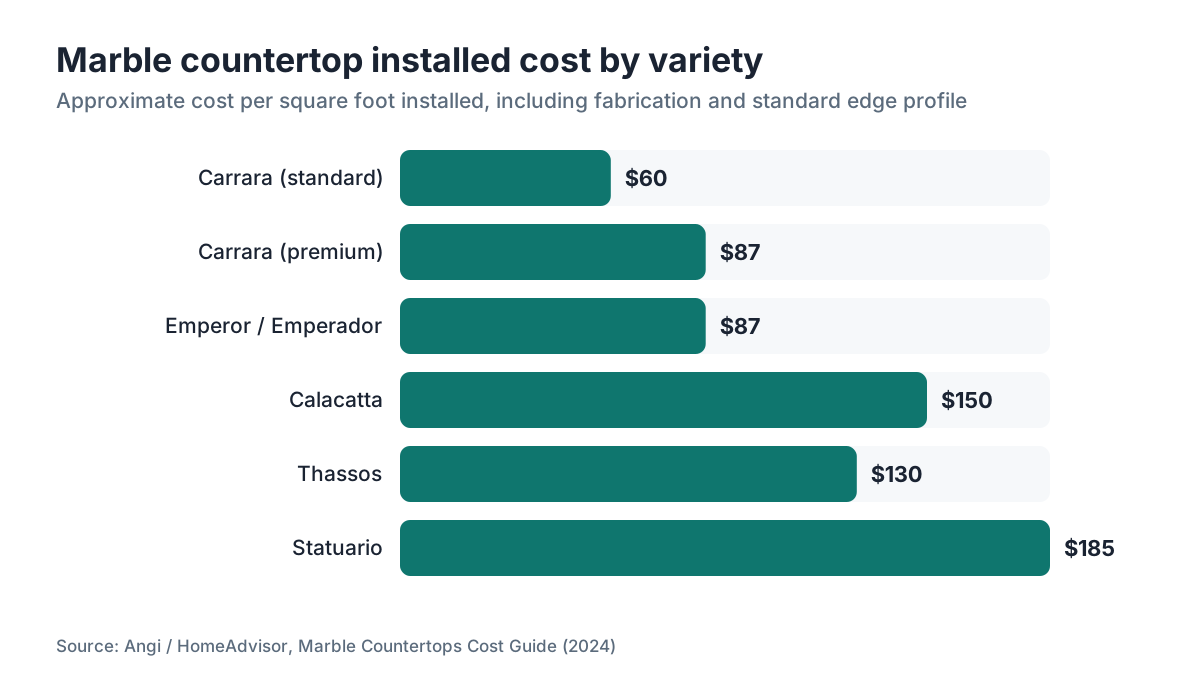
Installed marble runs $40 to $200 per square foot. The wide spread comes down to stone variety, slab origin, edge complexity, and your local labor market [2]. Here's how that breaks down in practice.
| Stone variety | Material only ($/sq ft) | Installed estimate ($/sq ft) |
|---|---|---|
| Carrara (standard) | $10, $30 | $40, $80 |
| Carrara (premium) | $25, $50 | $65, $110 |
| Calacatta | $60, $180 | $100, $200 |
| Statuario | $80, $200 | $120, $250+ |
| Thassos (Greek white) | $50, $120 | $90, $170 |
| Emperador (brown) | $20, $60 | $55, $120 |
Those installed figures include fabrication and a standard edge profile. Fancy edge work, like ogee or waterfall edges, adds $15, $40 per linear foot. Cutouts for sinks and cooktops typically run $50, $150 each depending on shape and complexity.
A typical kitchen with 50 square feet of counter space runs somewhere between $2,000 and $6,000 installed for entry-level marble. A showpiece kitchen with premium Calacatta or Statuario can easily hit $10,000 to $15,000 or more for material and fabrication alone, before installation labor [2].
For comparison, quartz countertops run roughly $55, $150 installed, and granite countertops typically land at $45, $120. Marble sits in the middle on price and at the top on maintenance.
Homeowners consistently underestimate one line item: sealer. Professional sealing at installation adds $1, $3 per square foot, and you'll reseal every 6 to 18 months. Over a decade, that adds up.
What are the different types of marble for countertops?
The variety you'll see most is Carrara, quarried near Carrara, Italy in the Apuan Alps. Carrara marble has a white to gray background with feathery gray veining. It's the most widely available and affordable Italian marble, which is exactly why it's the default pick for first-time buyers. Supply is relatively steady, fabricators know how to work it, and the price stays accessible.
Calacatta comes from a different part of the same mountain range but has bolder, more dramatic veining, often gold or thick white on a bright white background. It's rarer and quarried in lower volumes, which drives the premium. A lot of what gets sold as Calacatta in the US is actually high-end Carrara or a marble from somewhere else, so ask for a certificate of origin if the source matters to you.
Statuario is arguably the most prestigious Italian marble, extremely white with sparse, elegant gray veins. Historic sculptors, including Michelangelo, worked in Statuario. Supply is genuinely limited, and prices reflect that.
Beyond Italy, you have Thassos from Greece (nearly pure white, almost no veining), Volakas (white with subtle purple-gray veining), Nero Marquina (black marble from Spain), Danby from Vermont (one of the few US-quarried marbles), and dozens of Brazilian varieties [1][10]. Danby is worth noting because domestic sourcing can shorten lead times and sometimes reduce cost.
For fabricators: slab matching is much harder with Calacatta and Statuario than with Carrara because of lower quarry volume. If a client needs matched slabs for a large island plus perimeter, reserve them at the same time. Don't assume more will arrive from the same quarry batch.
Does marble etch, and how bad is the etching problem?
Etching is the honest reason to think hard before you put marble in a kitchen. Marble is calcium carbonate, and it reacts with acids. Lemon juice, vinegar, tomato sauce, wine, coffee, even sparkling water if it sits long enough. The acid dissolves the surface of the stone, leaving dull spots that look like water marks but won't wipe off. Polished marble shows etching almost instantly. Honed marble hides it better because the surface is already matte.
Etching is not the same as staining. A stain is a foreign substance soaked into the pores of the stone. A sealer helps prevent stains. Etching is a chemical reaction with the stone itself, and no sealer stops it. That distinction matters, because a lot of marble marketing implies sealing solves the acid problem. It doesn't.
How much does etching actually matter day to day? In a kitchen that sees regular cooking, honestly, quite a bit. Marble kitchen countertops develop a patina over time, and plenty of homeowners come to accept or even love that lived-in look. But if you expect your countertop to look showroom-perfect five years from now, marble in a working kitchen will disappoint you.
Bathroom vanities are a different story. Soap and water aren't acidic, exposure is limited, and marble vanities hold up beautifully for decades. Many designers who steer clients away from marble in the kitchen actively recommend it for baths.
For a kitchen where you want the marble look without the acid sensitivity, quartzite (a silica-based metamorphic rock, not calcium-based) and high-quality quartz are both worth considering. See how to clean quartzite countertops for a sense of what that maintenance looks like instead.
How do you seal marble countertops?
Sealing fills the microscopic pores in the stone with a penetrating impregnator, which slows liquid absorption and makes the surface easier to clean before stains set. It does not make marble bulletproof, and it does nothing for etching.
For most marble countertops, a penetrating impregnating sealer (not a topical coating) is the right product. Brands like Miracle Sealants, StoneTech, and Aqua Mix are common in the trade. The Natural Stone Institute recommends testing sealers on a small inconspicuous area first and following the manufacturer's directions on dwell time exactly [3].
The water test tells you when to reseal: put a few tablespoons of water on the surface and wait 5 minutes. If the stone darkens (absorbs the water), it's time to seal. If the water beads, you're still protected. High-traffic kitchen surfaces may need sealing every 6 months. A bathroom vanity might go 18 to 24 months between applications.
Application is simple. Clean the surface thoroughly, apply sealer evenly with a cloth or applicator pad, let it penetrate for the time specified (usually 3 to 15 minutes), then wipe off the excess before it dries. Letting sealer dry on the surface leaves a hazy residue that's a pain to remove. Two thin coats beat one heavy coat.
Sealers applied at installation often use commercial-grade products that penetrate deeper than consumer versions. If you're having marble installed, ask your fabricator to seal it as part of the job rather than doing it yourself right away.
For more on stone care routines, how to clean stone countertops covers daily maintenance across marble, granite, and other natural stones.
What's the difference between polished and honed marble?
Polish is a surface finish, built up by progressively finer abrasives until the stone reflects light. Honed means the process stops before that final buff, leaving a flat matte surface. Both finishes start from the same stone. The difference is entirely in fabrication.
Polished marble has a mirror-like sheen that makes colors and veining pop. It also shows fingerprints, water spots, and etching more readily than any other finish. In a high-use kitchen, polished marble is a daily reminder of every splash.
Honed marble has a softer, quieter look. It hides everyday marks better, though it can feel slightly more porous to the touch and may absorb stains a bit faster if it isn't sealed well. Many designers prefer honed for kitchen counters precisely because it ages more gracefully.
Leathered finish is a third option. After honing, the stone gets textured with diamond-tipped brushes, creating a slightly rough surface with small peaks and valleys. It hides fingerprints better than polished, has a tactile quality some people love, and is genuinely good at hiding etching. The downside is crumbs and fine debris collect in the texture.
For bathrooms and low-traffic spots, polished marble is often the right call. You get the full visual payoff with less daily abuse. For kitchens, honed or leathered finishes are more forgiving. There's no universally correct answer. It depends on how you use the space.
How does marble compare to granite, quartz, and other countertop materials?
A direct comparison sets expectations before you commit. Marble is the softest of the common stone options at 3 to 4 on the Mohs scale, well below granite (6 to 7) and quartz (7) [7].
| Material | Hardness (Mohs) | Acid resistant? | Heat resistant? | Approx. cost installed ($/sq ft) | Maintenance level |
|---|---|---|---|---|---|
| Marble | 3 to 4 | No | Yes | $40, $200 | High |
| Granite | 6 to 7 | Mostly yes | Yes | $45, $120 | Low-medium |
| Quartz (engineered) | 7 | Yes | Moderate | $55, $150 | Low |
| Quartzite (natural) | 7+ | Usually yes | Yes | $60, $150 | Medium |
| Soapstone | 1 to 2 | Yes | Yes | $70, $120 | Medium |
| Butcher block | N/A | No | No (scorches) | $30, $80 | High |
Marble scores worse on hardness than granite countertops and quartz. That means it's more susceptible to scratching from abrasive cleaners, knives dragged across the surface, or grit under dishes. In practice, scratches on polished marble show up; scratches on honed marble matter less.
The heat resistance is genuinely good. You can set a hot pan on marble without the thermal shock damage that can crack quartz resin binders. That said, extreme or repeated heat changes can cause hairline fractures in any natural stone over time, and most fabricators still recommend trivets as standard practice.
Quartz from brands like Cambria or Silestone has no acid sensitivity, needs almost no sealing, and resists staining well. If you want the white-veined look without the maintenance trade-offs, high-end quartz is the honest alternative. It won't have the natural variation of real marble, and designers can usually spot the difference, but for daily function it's far more forgiving [4].
Butcher block countertops are a completely different category, warm and food-safe but needing oil maintenance and vulnerable to water damage. Laminate countertops remain the budget option, with improved visuals but none of the resale cachet of natural stone.
How do you clean marble countertops without damaging them?
Daily cleaning is simple: warm water and a few drops of dish soap on a soft cloth, then dry the surface. The drying step matters. Standing water, especially hard water, leaves deposits on polished marble that look like spots.
Never use vinegar, lemon juice, or any acidic cleaner on marble. Never use abrasive scrubbing pads. Avoid hydrogen peroxide on colored marble; it can bleach the stone. Even many commercial bathroom cleaners are acidic and will etch marble on contact.
For spills, blot, don't wipe. Wiping spreads the liquid over a larger area. Blotting lifts it. This matters most with red wine, coffee, and oil-based cooking splatter.
For stubborn stains that have already set, a poultice works well. Mix a mildly alkaline or pH-neutral powder (diatomaceous earth, baking soda, or commercial stone poultice powder) with water, or with a small amount of hydrogen peroxide for organic stains, spread it over the stain about 1/4 inch thick, cover with plastic wrap, and let it sit for 24 to 48 hours. The poultice draws the stain out of the pores as it dries. The Natural Stone Institute publishes specific poultice recipes for different stain types [3].
For etching that's already happened, light etching on polished marble can sometimes be buffed out with marble polishing powder (tin oxide) and a soft cloth in a circular motion. Deep etching generally needs professional re-polishing or re-honing, which costs $3, $8 per square foot from a stone restoration contractor.
Is marble good for kitchen countertops specifically?
The honest answer: it depends on how you cook and what you care about.
If you bake, marble is exceptional. Pastry chefs have used marble work surfaces for centuries because the stone stays cool, which keeps butter from melting into pie dough and croissant layers. That's not a marketing claim, it's physics. Marble's thermal mass pulls heat from your hands and the dough, keeping the workspace cooler than room temperature for longer.
If you cook with high-acid ingredients daily, marble will etch. Period. You can manage it, seal it, choose a honed finish to hide it, but you can't stop the reaction. Some homeowners genuinely love the patina that develops. Others find it maddening. Before committing, look at photos of 5-year-old marble kitchens, not showroom-new ones, and decide honestly which camp you're in.
For a kitchen where marble will see heavy use, here's what experienced fabricators typically recommend: choose honed over polished, seal before installation and reapply every 6 to 12 months, always use cutting boards (not because marble scratches easily but because cutting on any stone wrecks your knives), and treat spills immediately.
For guidance earlier in the process, kitchen countertops covers the full decision framework across every material option.
Fabricators using quoting software like SlabWise can build marble-specific job templates that account for the longer seam-planning time marble takes, given the need to match veining across seams on large islands.
What should homeowners ask before buying a marble countertop?
The questions that actually matter before you sign off on a marble job:
-
Can I see the actual slab I'm buying? Photos are fine if they're high resolution and recent. Generic stock images of the variety are not enough.
-
What is the origin of this stone? Carrara from Carrara, Italy is a specific product. Many stones are sold under similar names but come from other regions and may have different porosity or vein structure.
-
Is the slab full-thickness 3 cm, or 2 cm with a laminated edge? Thinner slabs with laminated fronts look similar but are structurally different and may not suit every application.
-
What sealer will you apply and how long does it last? A fabricator who can't answer this specifically isn't someone you want sealing your marble.
-
How will seams be placed, and can I see the seam plan before cutting? Seams in marble require veining alignment, and a good fabricator walks you through the layout before any cutting happens.
-
What's the warranty on fabrication and installation? Natural stone can crack during or after installation from improper support. Know who's responsible if something goes wrong.
-
Is the marble I'm looking at actually marble? Quartzite, dolomitic marble, and some limestones get misrepresented or confused in the market. A quick acid test (a drop of vinegar in an inconspicuous spot; true marble fizzes slightly) confirms calcite content.
If you want a ballpark before talking to a fabricator, an instant quote tool that adjusts for material, edge profile, and square footage can save you from sticker shock during that first meeting.
How long does marble last and does it add home value?
Well-maintained marble countertops last decades. Historic homes with original marble surfaces from the early 20th century aren't rare, because the material itself doesn't degrade structurally. What changes is cosmetic: etching accumulates, polished surfaces lose their shine in heavy-use areas, and chips happen at edges if the stone takes a direct hit.
Re-polishing or re-honing by a stone restoration professional can refresh marble dramatically. Many fabricators recommend it every 10 to 15 years in a kitchen, or whenever the surface looks tired. The cost is far below replacement.
On home value, the National Association of Realtors periodically surveys buyers about kitchen features. Natural stone countertops consistently rank among the features that draw buyer attention in kitchen remodels [5]. Marble carries a luxury signal that lands with buyers in mid-to-upper price ranges, though the research on a dollar-for-dollar return on marble versus granite versus quartz is thin. Nobody has clean controlled data on this. The closest evidence is that kitchen remodels broadly return 60 to 80 cents on the dollar at resale, according to Remodeling Magazine's Cost vs. Value report [6].
For a rental or a flip, the maintenance and replacement cost of marble are hard to justify. For a forever home where you'll live with it and care for it, marble ages into something that looks richer over time rather than worn out. That's a real difference from engineered surfaces, which tend to look dated rather than classic as they age.
What do fabricators need to know when working with marble?
Marble fabrication has a few specific challenges that don't apply the same way to granite or quartz.
Vein matching comes first. A client who buys Calacatta for a large L-shaped kitchen expects the veins to flow across seams in a visually coherent way. That requires careful slab layout before cutting, and sometimes it means buying extra material. On a standard 30-square-foot island, you might need 40 or even 50 square feet of slab to get good vein direction and match. Build that into your estimate or you'll eat the cost.
Marble is more brittle than granite at the same thickness. Thin sections, like those around a farmhouse sink or a tight cooktop cutout, can crack during transport if they aren't supported. Many fabricators add mesh or fiberglass backing to marble sink cutouts as standard practice. Others use a slightly heavier saw blade and a slower feed rate to cut vibration. Either way, rushing marble fabrication costs more than taking it slow.
Polishing marble to a true mirror finish takes longer than polishing granite. The stone is softer and more reactive, so abrasives cut faster but also risk micro-scratches if you move through grits too quickly. A good marble polish job runs through more grit steps than you'd use on granite.
To price jobs accurately, fabricators need to account for the higher material cost, the extra vein-layout time, and the sealing step. Software that lets you set per-material cost inputs and add line items for sealing and vein-matching labor, like SlabWise's quoting tools, makes that easier than rebuilding it in a spreadsheet every time.
For comparison with another stone that needs specific fabrication care, granite kitchen countertops covers the overlapping skill set.
Frequently asked questions
How much does it cost to replace marble countertops?
Replacing marble countertops costs $40, $200 per square foot installed for new marble, plus $5, $15 per square foot to remove the existing surface if it's bonded to the substrate. A typical 50-square-foot kitchen runs $2,500, $12,000 for replacement depending on marble grade. Removal is usually a separate line item, so confirm with your fabricator whether it's included in their quote.
Can marble countertops be repaired if they chip or crack?
Yes, with limits. Small chips along edges can be filled with color-matched epoxy by a stone restoration professional. Hairline cracks can be injected with clear epoxy and polished over. Deep structural cracks, or a break that goes fully through the slab, usually can't be restored to a structurally sound state and mean the affected section needs replacement. Repair cost runs $100, $400 depending on damage size and location.
What is Carrara marble and why is it the most popular?
Carrara marble is quarried in the Apuan Alps near Carrara, Italy, and has been used in sculpture and architecture for over 2,000 years. It has a white-to-gray background with soft gray veining. Its popularity comes from steady supply, relatively accessible pricing ($40, $80 installed per square foot), and a classic look that works from traditional to contemporary. It's the default starting point for most marble projects.
Does sealing marble prevent etching?
No. Sealing fills the stone's pores and slows liquid absorption, which helps prevent staining from oil and pigmented liquids. Etching is a chemical reaction between acids and the calcium carbonate in marble; it eats the surface of the stone itself. No sealer stops that reaction. Choosing honed or leathered finishes makes etching less visible, but the only real prevention is keeping acidic liquids off the surface.
Is honed or polished marble better for a kitchen?
Honed marble is generally better for kitchen countertops. The matte finish hides etching, fingerprints, and everyday marks far more effectively than polished marble. Polished marble shows every drop and dulls unevenly in a high-use kitchen. Polished finish makes more sense in lower-traffic spots like bathroom vanities, where the visual payoff is worth it and daily acid exposure is minimal.
How heavy are marble countertops and do cabinets need reinforcement?
Marble at 3 cm (standard) thickness weighs roughly 18 to 20 pounds per square foot. A 30-square-foot island slab weighs 540 to 600 pounds. Most standard cabinet boxes handle this, but any span longer than 24 inches without support underneath benefits from added plywood substrate or corbel supports. Check with your installer. Older cabinetry or particle-board cabinet boxes sometimes need reinforcement before marble installation.
What household cleaners are safe for marble countertops?
Warm water and a small amount of pH-neutral dish soap (Dawn or similar) applied with a soft cloth works for daily cleaning. Products marketed as stone cleaners and labeled pH-neutral are also safe. Avoid anything acidic (vinegar, lemon, most bathroom cleaners), bleach, ammonia-based glass cleaners, and abrasive scrubbing pads. Always dry the surface after cleaning to prevent water spots on polished finishes.
Can marble countertops be used outdoors?
Marble can go outdoors in moderate climates, but it's problematic in freeze-thaw environments. Water penetrates the stone's pores, freezes, expands, and causes spalling or cracking over time. In warm climates without hard freezes, outdoor marble holds up better but still needs more frequent sealing from rain and UV exposure. Most fabricators recommend porcelain or granite for outdoor kitchens where freeze-thaw cycling is possible.
What is the difference between marble and quartzite countertops?
Marble is metamorphic limestone (calcium carbonate) and reacts to acids, causing etching. Quartzite is metamorphic sandstone (silica) and is essentially acid-resistant. Both are natural stones with similar veined looks, and they're frequently confused in showrooms. If acid resistance matters to you but you want the white-veined stone look, quartzite is worth the comparison. See how to clean quartzite countertops for daily maintenance differences.
How do I know if a slab is real marble and not quartzite or limestone?
The acid test is reliable: apply a small drop of vinegar or lemon juice to an inconspicuous area. True marble and limestone fizz or bubble within seconds because the acid reacts with calcium carbonate. Quartzite will not react. For definitive identification, a petrographic analysis by a stone testing lab can distinguish the minerals, though for most buying decisions the acid test is enough.
Do marble countertops increase home resale value?
Marble signals luxury to buyers and consistently ranks among kitchen features that draw buyer interest, per National Association of Realtors surveys. But kitchen remodels broadly return 60 to 80 cents on the dollar at resale according to Remodeling Magazine's Cost vs. Value data, and no clean study isolates marble versus other stone. The honest answer: marble helps in mid-to-upper-price-range markets but rarely recoups full cost in lower price tiers.
Can you cut food directly on marble countertops?
Technically yes, marble is hard enough that knives won't gouge it easily. But cutting directly on any stone counter is bad for your knives; the hardness dulls edges quickly. More practically, cutting boards are the standard recommendation because they protect the tool (the knife), not the countertop. Use a cutting board. It also cuts the chance of dragging a knife across a gritty section and scratching the finish.
What thickness of marble is best for countertops?
3 cm (about 1-1/4 inches) is the standard and preferred thickness for countertops. It's structurally stronger, spans farther without support, and looks more substantial at the edge. 2 cm slabs are cheaper and lighter but need a plywood substrate underneath and a laminated edge build-up to get a full-thickness look at the front [8]. For most residential kitchens, the strength and look of 3 cm is worth the modestly higher cost.
Sources
- United States Geological Survey, Mineral Resources Program: Stone (Dimension) statistics: Marble quarry origins and slab production globally, including Italy, Greece, Turkey, Brazil, India, and domestic Vermont quarries
- HomeAdvisor (Angi), Marble Countertops Cost Guide: Installed marble countertop costs ranging from $40 to $200 per square foot depending on variety and fabrication complexity
- Natural Stone Institute (formerly Marble Institute of America), Care and Cleaning Guidelines: Recommendations for penetrating sealers, sealer application procedure, and poultice formulas for different stain types on marble
- Cambria Surfaces, Product Technical Data: Engineered quartz surfaces do not require sealing and are resistant to acids compared to natural marble
- National Association of Realtors, Remodeling Impact Report: Natural stone countertops consistently appear among kitchen features that attract buyer interest according to NAR buyer surveys
- Remodeling Magazine, Cost vs. Value Report 2024: Kitchen remodels broadly return 60 to 80 cents on the dollar at resale
- Natural Stone Institute, Technical Manual: Marble: Marble hardness on the Mohs scale falls between 3 and 4, making it softer than granite (6 to 7) and quartz (7)
- ASTM International, Standard Specification C503 for Marble Dimension Stone: Standard thickness specifications for marble dimension stone used in countertop applications (2 cm and 3 cm)
- U.S. Geological Survey, 2023 Minerals Yearbook: Stone, Dimension: Marble and other dimension stone import statistics for the United States market
- Vermont Quarries Corporation, Danby Marble product information: Danby marble is quarried in Vermont and is one of the few commercially available US-domestic marble varieties for countertop use
Last updated 2026-07-09