TL;DR
- Butcher block countertops run $40 to $200 per square foot installed, set by wood species and grain style.
- End grain costs more than edge grain but takes a knife better.
- A motivated homeowner can install a prefab slab in a day.
- The wood wants oil or sealer every 6 to 12 months.
- It scratches and stains, but sandpaper brings it back.
What exactly is butcher block and how is it made?
Butcher block is a panel built from strips or blocks of wood glued together under pressure. Three constructions dominate: edge grain, face grain, and end grain. They behave very differently in a kitchen.
Edge grain is the most common. The strips run lengthwise with the narrow edge of each board facing up. It's stable, it's affordable, and it's the best all-around choice for a working countertop.
Face grain shows the wide, flat face of the plank. It looks like a hardwood floor laid on its side. Beautiful, yes. But face grain is the most prone to warping and cupping when moisture changes, so most fabricators keep it away from counters that sit near a sink.
End grain is the premium build. You're looking at the cut ends of the wood strips, which gives you that classic checkerboard or brick pattern. End grain is self-healing to a degree: knife cuts close up over time as the fibers compress and swell. It's also the priciest construction, usually 30 to 60% more than edge grain in the same species [1].
Species matters as much as construction. Hard maple is the industry default for commercial blocks because it's tight-grained, resists bacteria, and shrugs off daily abuse. Walnut is softer than maple but people love the dark color and warmth. Teak and acacia show up in budget prefab panels, though acacia hardness varies a lot by source. White oak is having a moment, and it machines beautifully.
How much do butcher block countertops cost?
Material only, prefab butcher block panels run roughly $10 to $80 per square foot at home improvement stores. Custom slabs from a local shop start around $60 per square foot and climb past $200 for wide end-grain walnut with a fancy edge profile [2].
Installed, meaning material plus labor, most residential projects land between $40 and $200 per square foot. That wide band reflects everything: species, construction, thickness (1.5 inches is standard, but 2.25 inches and 3 inches exist), edge profile, sink or cooktop cutouts, and local labor rates.
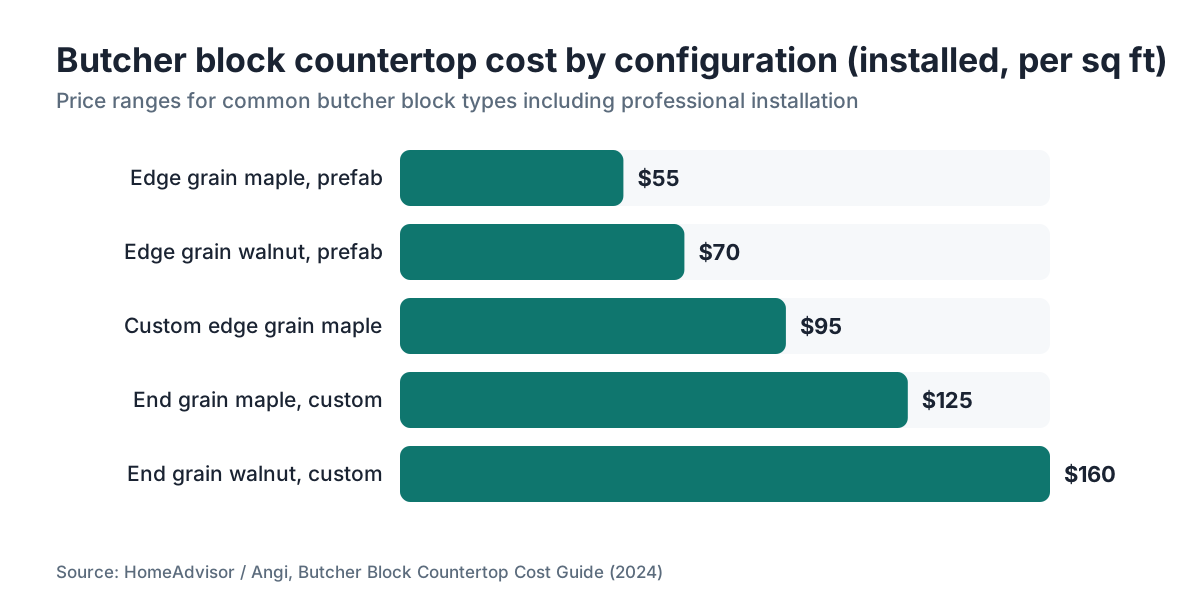
Here's a rough breakdown by configuration:
| Configuration | Material only ($/sq ft) | Installed ($/sq ft) |
|---|---|---|
| Edge grain maple, prefab | $10 to $30 | $40 to $70 |
| Edge grain walnut, prefab | $20 to $50 | $50 to $90 |
| Custom edge grain maple | $40 to $70 | $70 to $120 |
| End grain maple, custom | $60 to $120 | $90 to $160 |
| End grain walnut, custom | $80 to $200 | $120 to $200+ |
A 40-square-foot kitchen done DIY with IKEA prefab maple runs about $800 to $1,200 in materials. A fully custom end-grain walnut project in that same space can hit $6,000 to $8,000 installed. That gap is real, and it drives your budget.
For context, quartz countertops run $75 to $150 per square foot installed, and granite countertops fall in a similar range. Butcher block is one of the few countertop materials where a handy homeowner can do genuinely competitive work and pocket the labor savings.
Is IKEA butcher block countertop worth buying?
IKEA sells edge-grain wood countertops under names like KARLBY and SÄLJAN, mostly in birch, oak, and a walnut-effect laminate over a wood core. Prices have sat in the $150 to $600 range per panel depending on size and species, which pencils out to roughly $10 to $25 per square foot [3]. That's hard to beat for a budget kitchen.
Now the honest drawbacks. IKEA wood counters are thinner than most domestic prefab (some are 1.1 inches instead of 1.5), and the laminated-core products aren't solid wood all the way through. If your plan is to sand and refinish repeatedly over 20 years, a solid-wood panel gives you more material to burn. The all-wood IKEA options (solid birch, solid oak) refinish just like any other block.
Installation runs the same as any prefab panel: measure, cut to fit, secure from below, seal. IKEA's care sheet calls for regular oiling with food-safe mineral oil, which is exactly what every block manufacturer says.
Outfitting a rental? Testing whether you even like wood counters before you commit to a custom slab? IKEA panels are a smart call. For a forever kitchen with heavy daily use, buy thicker solid wood from a domestic supplier. You'll be glad at the 10-year mark.
How do you install butcher block countertops?
Installing a prefab butcher block countertop is one of the friendlier DIY countertop jobs. No wet saws, no diamond blades. A circular saw with a fine-tooth blade handles straight cuts. A jigsaw handles the sink cutout.
Here's the actual sequence:
1. Measure and template. Measure the opening at the front, middle, and back. Walls are almost never parallel, so you need all three. Add 1/16 inch to the depth so the slab overhangs the cabinet face. Mark cutout locations for any sink or cooktop.
2. Cut the slab. With a circular saw, cut finished-face-down to keep tearout on the underside. Score the line with a utility knife first for a cleaner edge. For the sink, drill a starter hole and then use a jigsaw. Support the cutout piece from below so it doesn't drop and splinter before you finish the cut.
3. Dry fit. Set the panel on the cabinets with no fasteners. Check the fit against the wall, confirm the overhang, mark anything that needs trimming. This step keeps you from fastening a slab that doesn't actually fit.
4. Seal the underside and all cut edges before install. This is the step beginners skip and then regret. Moisture from the cabinets below wicks up through unsealed end grain and cups the top. Put two coats of mineral oil or your chosen finish on every surface, bottom included, before the slab goes down for good.
5. Fasten from below. Do not drive screws straight up through the cabinet rail into the wood. Wood swells and shrinks with humidity, and a rigid connection cracks it. Use figure-8 fasteners or wooden clips seated in a routed slot on the underside. Those let the wood move with the seasons. Space them every 18 to 24 inches [4].
6. Handle the wall gap. Leave 1/8 inch between the countertop and the wall for movement. Fill it with flexible silicone caulk, never grout or rigid caulk.
7. Seal the top. Apply your finish (see the sealing section below) before you use the counter.
The whole install on a single-run kitchen takes 4 to 6 hours for a careful first-timer. L-shapes and islands add time because of the miter or butt joints. Getting an L-shape joint tight is the hardest part of a DIY install. A hairline gap filled with color-matched epoxy is fine. A visible open seam looks bad.
What finish should you put on butcher block countertops?
This choice drives everything downstream: how much maintenance you sign up for, how well the surface handles water, and whether it's food-safe.
Mineral oil is the simplest option. Food-safe, cheap, sold everywhere. The catch is that mineral oil never fully cures. It sits in the wood pores and needs regular reapplication. Oil a new counter weekly for the first month, monthly for the first year, then whenever the wood looks dry. The wood drinks oil until it's saturated, then you wipe off the excess. The look is natural and matte. It offers no real protection against water stains: any liquid that sits long enough will penetrate.
Beeswax or cutting-board blends (mineral oil plus beeswax or carnauba) build a slightly more water-resistant surface than plain oil. Still food-safe, and the standard pick for food-prep zones.
Hardening oils like tung and linseed polymerize inside the wood and build more protection than mineral oil. Pure tung oil is food-safe once cured. Raw linseed cures painfully slowly and can go rancid. Boiled linseed cures faster but carries metallic driers that make it questionable for food contact. Go with pure tung oil and let it cure fully before food touches the surface.
Waterborne polyurethane or varnish is the toughest option and the right call near a sink or in a heavy-use kitchen. It builds a hard film on top of the wood rather than soaking in. That film isn't food-safe until fully cured (figure about 30 days for full hardness), but once cured it's generally considered fine for incidental food contact. The trade-off: a film finish eventually peels or chips, and when it does, you strip it completely before refinishing. A penetrating oil finish just gets a light sand and a fresh coat.
My own take: for an island used as a prep surface, pure tung oil or a butcher block wax. For a perimeter counter that mostly holds appliances and gets wiped down, polyurethane buys you longer life with less fuss.
The FDA regulates food contact surfaces in commercial settings under 21 CFR Part 178, covering incidental food contact. Residential kitchens have no federal standard, so most finishing products just say "food safe when cured" on the label [5].
How do you maintain and repair butcher block countertops?
Maintenance follows the finish you picked. Oiled surfaces need periodic re-oiling. Film-finished surfaces need cleaning and the occasional touch-up.
Daily cleaning is warm water and dish soap. Don't let standing water pool. Don't drag a wet sponge back and forth for minutes: wipe, then dry. Bleach cleaners dry the wood and break down oil finishes, so keep them out of the routine.
Stains on an oiled surface are where sandpaper earns its keep. Fine grit (180 to 220) lifts surface stains, shallow knife cuts, and minor discoloration. Sand, clear the dust, re-oil. The wood looks new. This is butcher block's edge over marble countertops and concrete countertops: when it gets beat up, you fix it yourself with a $5 sheet of sandpaper.
Deep stains or burns on oil? Start at 80 grit and step up through 120, 150, 180, 220. You're removing material, so this isn't a weekly thing, but most counters survive 10 or more full sanding cycles before thickness becomes a worry.
A polyurethane surface is harder to spot-repair. You can sand the damaged patch, feather the edges, and recoat, but the fresh coat rarely blends with the aged finish around it. A full strip and recoat looks cleaner.
Blackening around a sink almost always means water got under the finish and into the wood. The only honest fix is to pull the sink, let the wood dry completely (days or weeks in a damp climate), sand to clean wood, and refinish with real attention to the cutout edges and the underside of the front lip.
One thing worth knowing. Butcher block in a kitchen does not hold more bacteria than other counter materials when it's maintained. A 1994 UC Davis study by Dean Cliver found bacteria pulled into the grain by knife scoring did not multiply and could not easily be recovered from wooden surfaces, unlike plastic [6]. You still clean it. But the "wood is unsanitary" claim has no research behind it.
What are the real pros and cons of butcher block countertops?
The upsides are genuine. Butcher block is warm and tactile, and it looks right in kitchens from farmhouse to modern. It's quiet: glasses and plates don't ring when you set them down. It's forgiving when you drop something. It's one of the few surfaces you can cut directly on (most people don't, because it dulls knives faster than a dedicated board). And it's repairable in ways quartz countertops and granite kitchen countertops simply aren't. A chip in quartz is permanent without a pro. A gouge in butcher block sands out.
The downsides are just as real. Wood moves with humidity. A slab that fit tight in dry January may show a small gap at the wall in humid August. That's physics, not a defect, but it startles people coming from stone or laminate countertops. Sustained water is the enemy: a sink area without good sealing and drying habits blackens and softens. And butcher block hates heat. A hot pan on oiled wood leaves a permanent scorch. A hot pan on polyurethane lifts the finish.
For a heavy cook who stays on top of maintenance, butcher block is excellent. For a busy family kitchen where the counters get wet and stay wet, and nobody wants to think about oiling anything, stone or Corian countertops cause less grief.
One honest middle path: butcher block on the island or a prep section, stone on the perimeter runs near the sink. Plenty of designers push this hybrid. It's the layout I'd pick for my own kitchen.
How long do butcher block countertops last?
Well-maintained butcher block lasts 20 years or more. Commercial butcher shops run the same tops for decades, sanded and re-oiled countless times. In a home, the things that kill it early are water damage near the sink, neglected maintenance, or a remodel (people move on, the wood doesn't fail).
Thickness drives longevity. A 1.5-inch slab can be sanded down a long way before structure becomes a concern. A thin prefab panel (some IKEA products at 1.1 inches) has a shorter sanding life. A 3-inch end-grain block can be resurfaced so many times it's basically a lifetime counter.
NSF International's NSF/ANSI 51 standard, which covers food equipment materials, has been used by some block makers to certify commercial-grade surfaces. Most residential products skip the certification, but the underlying species (hard maple especially) meet the hardness and porosity marks the standard addresses [7].
So the real longevity question is your maintenance commitment. Oil it when it looks dry, wipe it after cooking, and it lasts. Let water pool for weeks, and it fails early.
Can you put butcher block countertops near a sink?
Yes, but it demands more care than block away from water. The sink zone is where most butcher block failures happen, and nearly all of them are preventable.
The keys: seal the underside and every edge of the sink cutout before install. Use a film finish (polyurethane or varnish) in the sink zone instead of oil alone, because oil won't stop water from wicking in at a seam or cutout. Run silicone caulk around the sink perimeter and along the wall. Keep a dry towel handy and wipe standing water fast.
Under-mount sinks carry more risk than top-mount (drop-in) sinks, because water running off dishes and hands hits the raw wood edge at the cutout directly. The joint between sink and counter needs an unbroken bead of waterproof silicone.
Not willing to do any of that? Put Corian countertops or quartz on the sink run and save butcher block for a dry island. That isn't a compromise. It's smart allocation.
Fabricators who quote a lot of wood will tell you the sink-area callbacks come almost entirely from clients who didn't seal the cutout edges before install. The fix afterward is expensive, because the sink has to come back out. Do it right the first time.
How does butcher block compare to other countertop materials?
Every countertop material trades off somewhere. Butcher block trades maintenance and water sensitivity for warmth, repairability, and price flexibility.
Kitchen countertops in stone (granite, quartz) are harder, more heat-tolerant, and want less daily attention. But they cost more, they chip instead of dent, and chips don't sand out. Laminate countertops and Formica countertops are the cheapest and the lowest maintenance, but they scratch permanently and read as budget to most buyers.
Here's a direct comparison on the factors that matter:
| Material | Installed cost ($/sq ft) | Heat resistance | Water resistance | Repairability | Maintenance |
|---|---|---|---|---|---|
| Butcher block (edge grain) | $40 to $120 | Poor | Fair (sealed) | Excellent | Medium-high |
| Quartz | $75 to $150 | Fair | Excellent | Poor | Low |
| Granite | $60 to $140 | Excellent | Good (sealed) | Poor | Low-medium |
| Laminate | $20 to $50 | Poor | Fair | Poor | Low |
| Concrete | $70 to $150 | Excellent | Fair (sealed) | Fair | Medium |
| Corian/solid surface | $45 to $100 | Fair | Good | Good | Low |
On resale: wood counters read as a premium feature in listing photos and show well in mid-range to upper-mid kitchens. In ultra-luxury renovations, stone still rules. The National Association of Realtors periodically surveys which kitchen upgrades return the most, and countertop upgrades broadly show strong returns, though butcher block specifically isn't broken out [8].
Fabricators quoting mixed-material kitchens often find the most satisfied customers are the ones who put butcher block on an island next to stone perimeter counters. If you're comparing quotes for a whole-kitchen project, tools like SlabWise let fabricators price different material combinations side by side, so homeowners make the trade-off call with real numbers in front of them.
What wood species is best for butcher block countertops?
Hard maple is the default for good reason. Its Janka hardness is 1,450 lbf, which puts it above most woods used for counters [9]. Tight-grained, it doesn't leak tannins that stain easily, and it takes a finish predictably. Most commercial blocks and cutting boards use it.
Walnut (Janka 1,010 lbf) is softer, so it shows knife marks sooner, but a lot of people prefer that patina. Its dark brown color and wide grain variation make it among the most dramatic options. Expect a real premium: walnut lumber runs roughly 2 to 4 times the price of hard maple by board foot [10].
White oak (Janka 1,360 lbf) has taken off, partly for its open grain and gray-brown tones that suit modern kitchens. It's nearly as hard as maple and takes oil beautifully. That open grain does mean it needs more thorough sealing than maple to keep liquids out.
Cherry (Janka 950 lbf) is softer and shows wear. It darkens a lot with age and UV, which some people love. Not a great pick for heavy food prep.
Bamboo isn't technically wood (it's a grass), but bamboo counters get marketed alongside butcher block. Horizontal-grain bamboo Janka hardness runs about 1,000 to 1,400 lbf depending on processing. It has eco credentials (bamboo regrows faster than hardwood), but some panel adhesives raise VOC questions. Look for Greenguard or CARB Phase 2 certification if that matters to you [11].
For most homeowners: hard maple if you want performance, walnut if you want beauty and can live with more maintenance.
What should a fabricator know about cutting and pricing butcher block?
Butcher block fabricates differently than stone, and it doesn't need stone tooling. The practical concerns for a shop are tooling, movement allowance, and how you price it.
Tooling first. A good cabinet shop with a table saw, router, and belt sander can turn out quality block work. End-grain panels take far more labor to build from raw lumber, so most small fabricators buy them pre-laminated from a supplier like John Boos, Craft Art, or Teragren rather than gluing up from scratch. Edge-grain panels are easy enough to build in-house.
Movement next. Wood moves. The rule of thumb for cross-grain movement in hard maple is roughly 1% dimensional change per 4% change in equilibrium moisture content, which works out to about 1/8 inch per foot of width across a typical seasonal humidity swing [4]. Build that into your fastening and seam design. Never spec a tight butt against a wall without a flexible caulk joint.
Pricing last. Butcher block gets priced by the square foot like stone, but the variables shift. You're pricing species (pull current supplier quotes: lumber moves a lot by season and supply), thickness, grain orientation, edge profile, and cutout count. A complex edge profile on end grain means multiple passes and careful tearout control.
For shops adding wood counters to the quoting workflow, the headache is that lumber pricing swings harder than stone slab pricing year over year [12]. Build a buffer into your material estimate and re-price if a project slips more than 30 days. Quoting software that lets you update material costs and re-run margins fast, the kind of thing SlabWise is built for, saves a pile of manual re-quoting when lumber jumps.
Delivery and handling matter more with wood than stone. Store panels flat in a conditioned space. Lean them against a wall in a humid shop and they'll cup before they ever reach the install.
Frequently asked questions
How much does it cost to install butcher block countertops?
Installed butcher block countertops typically cost $40 to $200 per square foot, set by wood species, grain construction, thickness, and local labor rates. A prefab edge-grain maple panel from a home improvement store runs $10 to $30 per square foot in material; add $20 to $40 per square foot for professional installation. Custom end-grain walnut at the high end reaches $200 per square foot or more installed.
Can I install butcher block countertops myself?
Yes, and it's one of the more DIY-friendly countertop installs. Prefab panels cut with a circular saw and attach with figure-8 fasteners or clips that let the wood expand and contract. The common DIY mistakes are skipping the pre-install sealing of cut edges and undersides, and fastening too rigidly. Budget 4 to 6 hours for a single kitchen run and plan the sink cutout carefully.
How do you seal and oil butcher block countertops?
For a penetrating oil finish, apply food-grade mineral oil generously, let it soak 20 to 30 minutes, then wipe off the excess. Repeat weekly for the first month, monthly for a year, then as needed. For a durable film finish, apply 3 to 4 coats of waterborne polyurethane, sanding lightly between coats with 220-grit paper. The polyurethane needs roughly 30 days to reach full hardness.
Are butcher block countertops sanitary?
Yes, when maintained properly. A 1994 UC Davis study by Dean Cliver found bacteria drawn into wood grain by knife cuts did not multiply and were not easily recoverable, unlike on plastic cutting surfaces. Clean butcher block daily with warm soapy water, dry it promptly, and keep up the finish. Blackened or cracked wood near a sink can hold moisture and bacteria and should be sanded and refinished.
How long do butcher block countertops last?
With consistent maintenance, butcher block countertops last 20 years or more. Thickness sets the refinishing life: a 1.5-inch solid-wood slab sands many times; a thin laminated panel has a shorter useful life. The most common cause of early failure is water damage at the sink cutout from bad sealing, not normal wear.
What is the best wood for butcher block countertops?
Hard maple is the best all-around choice. Its Janka hardness of 1,450 lbf makes it durable for daily kitchen use, and its tight grain keeps out liquid better than open-grain species. Walnut is a popular alternative for its dark color, though it's softer (Janka 1,010 lbf) and shows wear faster. White oak is a strong mid-range option with a modern look.
How do you remove stains from butcher block countertops?
For oil-finished surfaces, light sanding with 180 to 220 grit lifts most surface stains and shallow cuts. For deeper stains, start at 80 grit and work up to 220, then reapply oil. A paste of baking soda and water can lighten some stains before sanding. For polyurethane-finished surfaces, spot repair works but is hard to blend; a full strip and recoat looks cleaner for widespread damage.
Is IKEA butcher block countertop good quality?
IKEA's solid wood countertop panels (birch, oak) are real butcher block at a hard-to-beat price, roughly $10 to $25 per square foot. They're thinner than most domestic prefab (some at 1.1 inches vs 1.5 standard), which shortens refinishing life. The all-wood options oil and refinish like any other solid-wood counter. A good pick for budget renovations; for a high-use forever kitchen, buy thicker solid wood from a domestic supplier.
Can butcher block countertops be used near a sink?
Yes, but it takes proper sealing. Coat all cutout edges and the underside of the sink opening with polyurethane or varnish before installation. Run continuous silicone caulk around the sink perimeter. Wipe up standing water fast and don't let wet sponges sit on the surface. Oil-only finishes aren't enough for the immediate sink zone; use a film finish there even if you use oil elsewhere.
What is end grain vs edge grain butcher block?
End grain shows the cross-section of the wood fiber (the top of a log), creating a checkerboard pattern. It's self-healing to minor knife cuts, extremely durable, and the priciest construction. Edge grain shows the side of the board running lengthwise; it's more affordable, very stable, and the standard choice for kitchen counters. Face grain shows the wide flat plank face and is least recommended for counters because it's most prone to warping.
Does butcher block increase home value?
Wood countertops read as a premium feature in mid-range to upper-mid kitchens and photograph well in listings. The National Association of Realtors notes that kitchen renovations broadly return strong value, though butcher block specifically isn't broken out in the data. In luxury kitchens where buyers expect stone, butcher block on a prep island next to quartz or granite perimeter counters is a well-regarded configuration.
Can you put hot pans on butcher block countertops?
You shouldn't. An oiled butcher block surface burns and leaves a permanent scorch mark from a hot pan. A polyurethane finish blisters or lifts. Always use a trivet or hot pad. This is butcher block's clearest disadvantage against granite or quartz, which handle heat without damage. For households that cook heavily and move hot pans around, a stone perimeter with a butcher block prep island is a practical layout.
How often do you need to oil butcher block countertops?
New countertops want oiling once a week for the first month, then once a month for the first year, then whenever the wood looks dry or water stops beading on the surface. In dry climates or with heavy use, that might be every 2 to 3 months. In humid climates with light use, twice a year can be enough. The wood tells you: gray and thirsty means oil it.
What thickness should butcher block countertops be?
1.5 inches is the standard residential thickness and handles most kitchens well. Thicker options at 2.25 and 3 inches give you more material for future refinishing and a more substantial look, but they cost more and add real weight to cabinet boxes. For a heavy-use prep island you plan to keep for decades, 2.25 or 3 inches earns the premium. For a lighter-use perimeter counter, 1.5 inches is fine.
Sources
- John Boos & Co., Butcher Block Construction Guide: End grain construction is typically 30 to 60% more expensive than edge grain in the same species
- HomeAdvisor / Angi, Butcher Block Countertop Cost Guide: Butcher block countertops cost $40, $200 per square foot installed depending on species and configuration
- IKEA USA, Wood Countertops product pages: IKEA sells wood countertop panels at roughly $10, $25 per square foot
- USDA Forest Products Laboratory, Wood Handbook: Wood as an Engineering Material (General Technical Report FPL-GTR-282, 2021): Wood expands and contracts with seasonal humidity; figure-8 fasteners or clips spaced every 18 to 24 inches are recommended to allow movement; cross-grain movement in hard maple is approximately 1/8 inch per foot per typical seasonal humidity swing
- U.S. Food and Drug Administration, 21 CFR Part 178, Indirect Food Additives: Adjuvants, Production Aids, and Sanitizers: FDA 21 CFR Part 178 addresses indirect food contact materials including incidental food contact surfaces
- Cliver, D.O., University of California Davis, Cutting Board Research (1994), published in Journal of Food Protection: Bacteria drawn into wood grain by knife cuts did not multiply and could not be easily recovered from wooden surfaces compared to plastic cutting surfaces
- NSF International, NSF/ANSI 51, Food Equipment Materials standard: NSF/ANSI 51 certifies food equipment materials; hard maple meets hardness and porosity requirements under this standard
- National Association of Realtors, 2022 Remodeling Impact Report: Kitchen renovations broadly return strong value on investment according to NAR survey data
- USDA Forest Service, Forest Products Laboratory, Janka Hardness Values for Commercial Lumber Species: Hard maple Janka hardness is 1,450 lbf; walnut is 1,010 lbf; white oak is 1,360 lbf
- National Hardwood Lumber Association, Hardwood Market Reports: Walnut lumber costs roughly 2 to 4 times more per board foot than hard maple depending on grade and market conditions
- California Air Resources Board (CARB), Airborne Toxic Control Measure for Composite Wood Products, CARB Phase 2: CARB Phase 2 certification limits formaldehyde emissions from composite wood products including bamboo panels
- U.S. Bureau of Labor Statistics, Producer Price Index, building materials component data: Lumber prices are more volatile than manufactured stone slab prices on a year-over-year basis
Last updated 2026-07-09