TL;DR
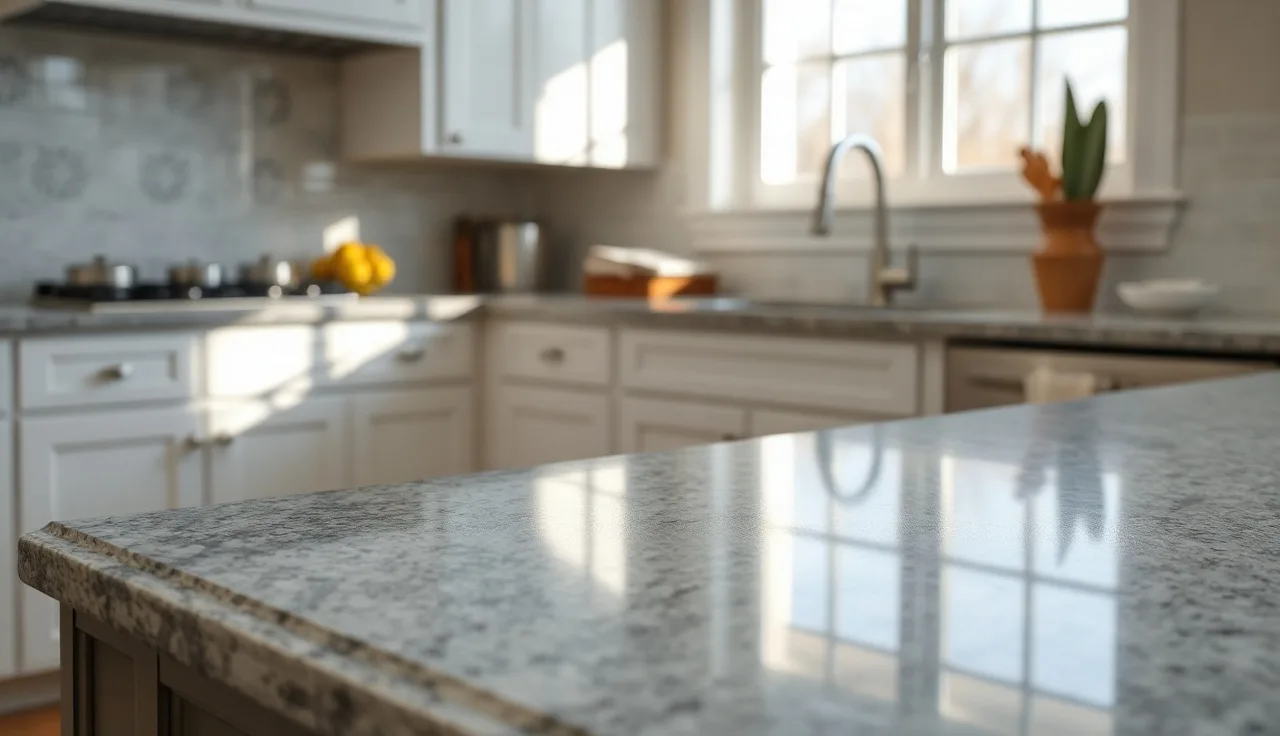
- A grey granite countertop with a cove dupont edge profile pairs a concave cove at the top with a rounded dupont nose at the bottom.
- It reads decorative without the bulk of a full ogee.
- Installed cost runs $60 to $120 per square foot depending on slab grade, shop location, and stone thickness.
- The edge itself adds about $12 to $25 per linear foot over a basic eased edge.
What exactly is a cove dupont edge profile?
The cove dupont profile is a two-part edge shape. At the top of the stone, a concave cove (sometimes called a cove or scotia) curves inward before meeting the field of the countertop. At the bottom, a rounded dupont nose curves outward. Together they create an S-like silhouette with more visual interest than a plain eased or bullnose edge, but less drama than a full ogee.
Fabricators mill it with a series of router bits, usually starting with a cove bit on the top and finishing with a dupont or roman ogee bit on the lower portion. On 3 cm (roughly 1.25 inch) granite the profile comes out crisply without laminating. On 2 cm material most shops laminate a second strip underneath to give the edge enough depth to carry the shape, which adds cost.
It sits in the middle of the pricing tier for decorative profiles. A straight eased edge is the cheapest option. A full ogee costs more and looks more ornate. The cove dupont lands between them, which is partly why it stays popular for traditional and transitional kitchens where homeowners want something finished-looking without going over the top.
One thing worth knowing: the name is not standardized across the industry. Some shops call it a cove dupont, others say dupont with cove, and a few list it under ogee-adjacent profiles. When you get quotes, ask the fabricator to show you a physical sample or a drawn cross-section, more than a name on a price sheet. Profiles with identical names can look noticeably different from shop to shop depending on which router bits the operator runs.
Why do grey granite and a cove dupont edge work well together?
Grey granite is one of the more forgiving stone colors a homeowner can pick. The mid-tone neutrality of most grey granites means they pair with white, cream, charcoal, navy, and wood cabinet finishes without fighting any of them. That flexibility is the main reason light grey granite countertops have stayed popular through multiple kitchen design cycles.
The cove dupont edge adds a shadow line that grey stone shows off better than very light or very dark stone. On a near-white granite the shadow in the cove looks muddy. On a near-black granite it largely disappears. On a medium grey, particularly stones with slight movement or veining like Viscount White, Colonial White, or Steel Grey, the carved edge catches light in a way that makes the whole slab look more expensive than it is.
Steel Grey granite from India is a good example. It has a fine, consistent grain and a blue-grey tone that reads almost neutral in most lighting. When it gets a cove dupont edge the profile shows the curve cleanly, and the polished face reflects enough light to make the shape pop. Luna Pearl and Bianco Sardo are two other grey granites in a similar price band that work equally well with this edge.
If you are looking at light grey granite specifically, Kashmir White and White Ice are worth a look. They have enough grey undertone and enough movement to give the cove dupont something to work with visually, while still reading light in a smaller kitchen. See our broader guide on granite countertops for a full comparison of granite types and grades.
How much does a grey granite countertop with a cove dupont edge cost?
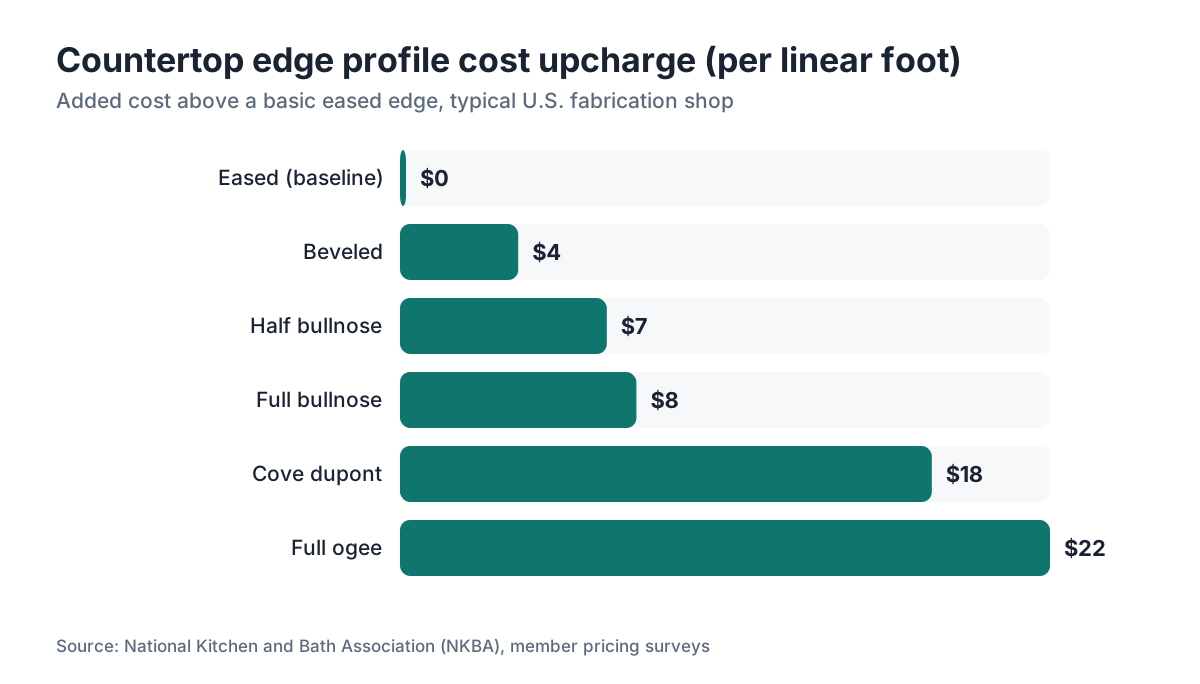
Material and installation for a grey granite countertop typically runs $40 to $100 per square foot for the slab itself, then another $10 to $35 per square foot for fabrication and installation. The cove dupont edge adds $12 to $25 per linear foot over what a shop charges for an eased edge, based on pricing ranges reported by National Kitchen and Bath Association member firms [1].
Here is a rough breakdown for a typical kitchen with 40 square feet of countertop and 20 linear feet of exposed edge:
| Line item | Low estimate | High estimate |
|---|---|---|
| Grey granite slab (2 cm, mid-grade) | $1,200 | $1,800 |
| Grey granite slab (3 cm, mid-grade) | $1,600 | $3,000 |
| Fabrication and installation | $800 | $1,800 |
| Cove dupont edge upcharge (20 LF) | $240 | $500 |
| Sink cutout | $150 | $350 |
| Total installed, rough range | $2,400 | $7,500 |
The wide range reflects real variation. A local shop in a lower cost-of-living market using a domestically sourced mid-grade slab is a very different job from a high-end shop in a coastal metro using imported premium granite. Remodeling Magazine's Cost vs. Value report puts a midrange kitchen remodel (which includes countertops) at $26,790 nationally, with significant regional spread [2].
Thickness matters more than most homeowners expect. A 2 cm slab costs a fraction of a 3 cm slab, but the fabricator has to laminate the edge to carry the cove dupont profile properly. That lamination labor and material often eats up the slab savings, so a 3 cm slab is usually the better economic choice if the cove dupont edge is a priority. Ask your fabricator for a side-by-side quote before assuming thinner is cheaper.
What grey granite slabs are best for this edge profile?
Three things make a grey granite slab work well with a cove dupont edge: enough thickness to hold the profile without laminating, a consistent enough grain that the cove curve shows cleanly, and enough surface polishability to reflect the shadow line.
For 3 cm material, Steel Grey (India), Viscount White (Brazil), Colonial White (India), and Baltic Brown are frequently used. Steel Grey has the most consistent grain of the group and holds a mirror polish that makes the carved edge look precise. Colonial White has more movement and occasional veining, which gives a softer look to the same profile.
Luna Pearl is a slightly lighter option. It is a Norwegian granite with a salt-and-pepper pattern that reads as a medium cool grey in most kitchens. It machines cleanly and is widely available from distributors in the United States, which keeps lead time short. India and Brazil are the leading sources for grey granite sold in the U.S., according to the U.S. Geological Survey's dimension stone data [8].
If you are specifically after a light grey granite look, White Ice from Brazil and Bianco Romano are worth considering. Both have a light base with grey and occasionally warm veining. Neither is technically a pure grey, but in a kitchen with warm wood cabinets they read grey rather than white.
For fabricators: stones with micas and fine interlocked grain (Steel Grey being the textbook example) take cove bits more cleanly than coarser-grained granites. Uba Tuba and Absolute Black also cut cleanly but they are not grey. If a customer brings in a slab with visible fissures near the edge zone, run a test cut on the offcut before committing to the profile, because the cove transition point concentrates stress during the routing pass.
How does the fabrication process for a cove dupont edge actually work?
Fabricating a cove dupont edge on granite takes a CNC router or a skilled hand fabricator with the right profile bits and a steady hand. Most modern shops use CNC because consistency across 20 linear feet of kitchen edge is hard to hold by hand without visible variation.
On a CNC router, the operator programs two separate tool paths: one for the cove portion at the top of the edge and one for the dupont or rounded lower profile. The bits are typically diamond-impregnated or carbide tipped, and they run wet to keep the stone cool and hold down dust. After roughing, the edge goes through a series of polishing pads, usually starting around 50 grit and finishing at 3,000 grit or higher for a mirror polish that matches the face of the slab. Dry cutting and routing of stone falls under OSHA's respirable crystalline silica standard, so wet processing protects the shop as well as the finish [9].
Hand fabricators run the same sequence but with angle grinders and handheld profile wheels. A good hand fabricator can produce a result indistinguishable from CNC at normal viewing distance, but it takes more time and the consistency is harder to guarantee on long runs. Most high-volume shops moved to CNC for this reason.
The critical zone is the transition between the cove and the flat field at the top, and the transition between the dupont nose and the bottom of the stone. These transitions need to be sharp enough to read as intentional but not so abrupt that they create a stress riser. If a shop rushes the polishing steps at these transitions, the edge looks dull or uneven in raking light. Always look at a completed sample edge in direct sunlight or under a bright light before signing off on fabrication.
Shops quoting this job through software that handles edge-profile line items and linear-foot measurement will price it more accurately than shops still working from memory or spreadsheets. SlabWise, for example, lets fabricators set per-profile pricing that flows automatically into customer quotes, which cuts the chance of underbidding complex edge work.
How does a cove dupont edge compare to other popular profiles for grey granite?
The edge profile choices for granite are numerous and the naming is inconsistent, but a handful of shapes dominate residential kitchen work. Here is how the cove dupont sits relative to the most common options:
| Profile | Shape description | Relative cost | Best for |
|---|---|---|---|
| Eased (flat) | Square corners softened slightly | Base price | Modern, minimalist kitchens |
| Beveled | Angled cut at top | Base + $2 to 5/LF | Transitional kitchens |
| Bullnose | Full round on top | Base + $5 to 10/LF | Family kitchens, safety priority |
| Half bullnose | Round top, square bottom | Base + $5 to 8/LF | Versatile, widely available |
| Ogee | S-curve, full top and bottom | Base + $15 to 30/LF | Traditional, ornate kitchens |
| Cove dupont | Concave top cove, rounded dupont bottom | Base + $12 to 25/LF | Traditional, transitional kitchens |
| Waterfall (mitered) | Stone continues vertically to floor | Add $200 to 600/waterfall side | Modern, high-end kitchens |
The ogee and cove dupont are the closest relatives in this list. The ogee has a convex upper curve where the cove dupont has a concave one, and the visual effect is meaningfully different. The ogee is heavier and more classical. The cove dupont is a little lighter visually. On a grey granite slab with moderate movement, most homeowners find the cove dupont easier to live with over time because it does not compete as much with the stone's own pattern.
If you are comparing options for your kitchen countertops and have not settled on stone type yet, keep in mind that edge profiles which work on granite need separate consideration for softer stones. The same cove dupont bit can chip quartzite or certain marbles if feed rates are not adjusted, so profile availability is not universal across stone types.
What should you check during the template visit before fabrication starts?
The template is the most important step between signing a contract and getting a countertop that fits. For a grey granite job with a cove dupont edge, a few things deserve extra attention.
First, confirm which edges get the cove dupont profile and which do not. The back edge (against the wall) always gets a simple eased or straight cut. The exposed front edge and any peninsula or island edges get the decorative profile. If you have a peninsula with one side against a wall and one side open, make sure the template drawing clearly marks which side is exposed. Fabricators have cut cove dupont profiles on the wrong edge more than once because the drawing was ambiguous.
Second, note every sink, cooktop, and appliance cutout location. The cove dupont profile runs up to but not into sink cutouts. The inside edge of a sink cutout typically gets a simple eased or polished flat edge because decorative profiles on inside radii are hard to machine cleanly. Some homeowners are surprised to see a visual difference between the outer edge treatment and the sink cutout edge, so set that expectation early.
Third, check the reveal on cabinetry. A standard overhang for a kitchen countertop is 1 to 1.5 inches on the front. The cove dupont profile adds visual depth to the edge that makes smaller overhangs look cramped. If your cabinetry layout allows, 1.25 to 1.5 inches of overhang shows the profile more clearly than 3/4 inch.
Finally, confirm the seam locations if your run is long enough to need more than one slab. Seams should land in low-traffic areas away from the sink when possible. The cove dupont profile across a well-matched seam is nearly invisible. Done poorly, the seam catches light differently on each side and shows. Ask to see a seam sample from the shop before committing.
How do you care for and clean grey granite with a cove dupont edge?
Granite is one of the lower-maintenance natural stones for kitchen use. It is harder than marble, less prone to etching from acid contact, and holds a polish well over years of use [3]. The cove dupont edge does not change the basic care requirements, but the profile's geometry creates one practical wrinkle: the concave cove portion traps crumbs, grease, and cleaning-product residue more easily than a flat or bullnose edge.
For daily cleaning, a damp microfiber cloth with a small amount of dish soap works for the field of the stone. For the cove dupont edge itself, a soft-bristle brush (an old toothbrush or a dedicated grout brush) gets into the concave section without scratching. Rinse the edge afterward, because soap residue left in the cove dulls the polish over time.
Sealing is the other big maintenance item. Most grey granites do well with annual sealing using a penetrating impregnator sealer, though denser stones like Steel Grey may hold up with sealing every two to three years. The water test is reliable: put a tablespoon of water on the stone and watch. If it beads for 10 to 15 minutes the seal is fine. If it darkens the stone within a few minutes, reseal [4].
The cove profile's polished surfaces seal the same way as the face. Apply sealer to the edge with a brush or cloth, let it dwell for the manufacturer's specified time (typically 5 to 20 minutes), and wipe off. Do not let sealer dry on the stone surface.
For a broader reference on stone cleaning, the guide on how to clean stone countertops covers sealing schedules, acidic cleaners to avoid, and what to do about stains in more detail.
Are there building code or safety considerations for this edge profile?
The cove dupont edge is a decorative profile and does not by itself trigger residential building code requirements, but a few related considerations are worth knowing.
The International Residential Code (IRC) does not specify countertop edge profiles for typical kitchen applications [5]. Some local jurisdictions have requirements for ADA-accessible counter heights (34 inches maximum finished height for an accessible work surface) under the Americans with Disabilities Act Standards for Accessible Design, but those requirements address height and knee clearance, not edge shape [6].
For kitchen islands or peninsulas that overhang significantly (more than about 6 inches) without leg support, the weight of 3 cm granite can stress the cabinet below. This is not a code issue in most residential contexts, but it is a structural one. The Marble Institute of America's fabrication guidelines recommend support corbels or brackets for overhangs beyond 8 inches on 3 cm material, and beyond 6 inches on 2 cm laminated material [7].
The cove dupont profile is slightly less sharp than a square eased edge, which matters in households with young children or people who bump countertop edges. It is not as rounded as a full bullnose, but the lower dupont curve removes the square corner that is most likely to cause a cut or bruise. If child safety is a primary concern, a full bullnose or half bullnose is the more protective choice. If the look of the cove dupont is the priority, the profile is not unreasonably sharp by industry standards.
For countertop installation specifics including substrate requirements, adhesive types, and bracing, the full countertop installation guide has the details most homeowners need before contractors show up.
How do fabricators price cove dupont edge work accurately?
Pricing edge profiles accurately is one of the more common places shops leave money on the table. A cove dupont edge takes more bit changes, more polishing steps, and more operator attention than an eased edge. If a shop prices all decorative edges at a flat upcharge, the cove dupont work gets underpriced relative to a simpler beveled edge.
The variables that drive real cost: linear feet of edge, stone hardness (harder granites wear bits faster), whether the edge needs a lamination pass on 2 cm material, CNC time versus hand time, and polish grit sequence length. A shop running a full 7-step polish from 50 to 3,000 grit on a Steel Grey cove dupont edge has meaningfully more cost in the job than one stopping at 1,500 grit.
A reasonable starting point: measure true linear feet including all returns and exposed sides, then apply an upcharge of $15 to $25 per linear foot over your eased edge baseline. On a 25 linear foot kitchen that is $375 to $625 in extra edge revenue. Shops that do not break out edge pricing separately absorb this cost into their general fabrication rate, which works when volume is high but creates problems on jobs with long edge runs or complex island configurations.
Accurate nesting of the slab also affects profitability on grey granite jobs. Grey granite with subtle patterning needs careful orientation matching, especially around the seam, and that affects how efficiently the slab is used. NIST maintains the reference standards for the linear and square footage measurement that pricing depends on [10]. Fabrication software that handles both nesting and per-profile line item pricing, like SlabWise's quoting tools, shows shops in real time how edge choices and slab layout interact in the final job cost. A quote built from measured inputs rather than memory is a better quote.
Is grey granite with a cove dupont edge the right choice for your kitchen?
This combination earns its popularity. Grey granite is genuinely practical: it hides everyday debris better than white stone, it does not show fingerprints the way black stone does, and it pairs with more cabinet finishes than almost any other countertop material. The cove dupont edge adds enough detail to feel intentional and finished without crossing into overly ornate territory.
Where it falls short: if you want an ultra-modern kitchen with flat-panel cabinets and minimal hardware, the cove dupont profile will look out of place. It is a traditional profile and it reads that way. A simple eased or beveled edge on the same grey granite slab feels more contemporary.
Budget is the other honest check. If your countertop budget is tight, the edge upcharge on cove dupont work is real money. A 25 linear foot kitchen at $20 per linear foot upcharge is $500 more than an eased edge, and that money could go toward a better slab grade or a deeper overhang. On the other hand, if you are investing in grey granite for the long term, the edge profile is one of the few details people notice consciously when they look at a finished kitchen. It is not a place to cut corners if the look matters to you.
For context on what competing materials offer at different price points, the guides on marble countertops and cambria countertops cover options that take similar edge profiles and suit similar design tastes, so you can make a direct comparison before committing.
Frequently asked questions
What is a cove dupont edge profile on a countertop?
A cove dupont edge has two distinct curves. The top portion curves inward (the cove or concave cut) before meeting the countertop surface. The bottom portion curves outward with a rounded dupont nose. Together they form a gentle S-like profile that is more decorative than a flat or beveled edge but less heavy than a full ogee. It is popular on traditional and transitional kitchen countertops.
How much does the cove dupont edge add to the total countertop cost?
Expect to pay $12 to $25 per linear foot more than a basic eased edge. On a kitchen with 20 linear feet of exposed edge, that is $240 to $500 in extra edge fabrication cost. Thicker 3 cm granite handles the profile without laminating, so slab thickness affects whether the upcharge reflects edge work alone or includes a lamination step.
Which grey granite slabs work best with a cove dupont edge?
Steel Grey, Viscount White, Colonial White, and Luna Pearl are the most common choices. All are available in 3 cm thickness, which holds the cove dupont profile cleanly without lamination. Steel Grey has a fine, consistent grain that shows the carved edge sharply. Luna Pearl and Colonial White have more movement, giving the same profile a softer appearance.
Does a cove dupont edge require 3 cm granite, or can it be done on 2 cm?
It can be done on 2 cm, but the shop has to laminate a second strip of stone to the underside of the edge to give the profile enough depth. That lamination adds labor cost and a visible seam line on the bottom of the edge. For 3 cm granite, the cove dupont profile runs directly without lamination and the result looks cleaner. If the cove dupont edge matters to you, 3 cm is worth the premium.
How do you clean the cove and concave portion of a dupont edge profile?
The concave cove traps crumbs and grease more than a flat edge. Use a soft-bristle brush (an old toothbrush works well) with mild dish soap and warm water to reach into the curve. Rinse thoroughly, because soap residue left in the concave section dulls the polish over time. For daily maintenance a damp microfiber cloth handles the flat countertop surface and the rounded dupont nose fine.
How often does grey granite with this edge need to be sealed?
Most grey granites need sealing once a year, though denser stones like Steel Grey can go two to three years between applications. Test by dripping water on the surface: if it absorbs in less than a few minutes, seal now. Apply penetrating impregnator sealer to both the face and the edge profile with a brush, let it dwell per the manufacturer's instructions, and wipe clean before it dries.
Can a cove dupont edge be added to an existing granite countertop?
Generally no. Changing an edge profile on installed granite means removing the slab, taking it to a fabrication shop, re-routing the edge, re-polishing, and reinstalling. The removal and reinstallation risk cracking the slab, especially at seams and cutouts. In most cases the cost approaches or exceeds a new countertop. Edge profile changes work best when the countertop is being replaced anyway.
Is a cove dupont edge safe for households with children?
It is safer than a square eased edge because the dupont lower curve removes the sharpest corner. The upper cove transition, though, is not as rounded as a full bullnose or half bullnose. For households where young children regularly run into countertop edges, a full bullnose gives more protection. The cove dupont is a reasonable middle ground where aesthetics and safety are both priorities.
What cabinet styles pair best with grey granite and a cove dupont edge?
The cove dupont profile reads as traditional or transitional, so it pairs best with raised-panel, shaker, or beadboard cabinet doors in white, cream, navy, or warm grey. Flat-panel or slab-front cabinets in a modern kitchen will look mismatched with this profile. If your cabinets have ornate hardware and frame detailing, the cove dupont edge complements that language. If they are minimal, choose a simpler edge.
How long does fabrication and installation take for this type of countertop?
After the template visit, most shops need 5 to 15 business days to fabricate and schedule installation. High-demand periods (spring and fall remodel seasons) push lead times toward the longer end. The cove dupont edge does not change fabrication time much on CNC-equipped shops. Installation of a typical kitchen countertop takes 2 to 4 hours. Plan for water and plumbing to be disconnected the day of installation.
Does a cove dupont edge affect how a kitchen looks from a resale standpoint?
Traditional and transitional kitchens with decorative edge profiles tend to photograph well and read as finished to buyers. There is no published data specifically on cove dupont edge resale impact, but Remodeling Magazine's Cost vs. Value report consistently shows kitchen countertop upgrades recovering 60 to 80 percent of cost at resale. The edge profile matters less than stone type and overall kitchen condition for most buyers.
What is the difference between a cove dupont edge and a full ogee?
Both are decorative S-curve profiles, but the direction of the curves differs. An ogee has a convex upper curve and a concave lower curve. A cove dupont has a concave upper cove and a convex (rounded) lower dupont nose. The ogee looks heavier and more classical. The cove dupont is more understated. On grey granite with natural movement, the cove dupont typically lets the stone's pattern show more than the ogee does.
Can a cove dupont edge be used on a kitchen island in grey granite?
Yes, and it is a common application. On an island with all four sides exposed, the fabricator runs the cove dupont profile on every visible edge. This adds linear footage to the edge upcharge, so get an accurate LF measurement before finalizing your budget. A 4-by-5-foot island has 18 linear feet of exposed edge, which at $20 per LF upcharge adds $360 over a basic eased edge treatment.
How do I compare quotes from different fabricators for this edge profile?
Ask every shop to quote the same spec: slab grade by name, thickness in centimeters, total square footage, cove dupont edge in linear feet, sink cutout quantity, and sealing if included. Some shops bundle edge work into a per-square-foot price and others line-item it separately. Neither method is wrong, but you cannot compare quotes honestly unless they are built on the same line items. Request a sample piece of the cove dupont edge from each shop before committing.
Sources
- National Kitchen and Bath Association (NKBA), Design and Installation Standards: Edge profile upcharge ranges for decorative countertop edges including cove dupont, ogee, and bullnose are reported in NKBA member pricing surveys.
- Remodeling Magazine, Cost vs. Value Report 2023: A midrange kitchen remodel averages $26,790 nationally with significant regional variation, according to the 2023 Cost vs. Value report.
- Marble Institute of America, Natural Stone Industry Library: Granite rates higher than marble on Mohs hardness relevant to kitchen use, making it more resistant to etching from acid contact.
- Natural Stone Institute, Care and Maintenance of Natural Stone: The water bead test (tablespoon of water left for 10 to 15 minutes) is the recommended field method for determining whether granite sealer needs to be reapplied.
- International Code Council, International Residential Code (IRC): The IRC does not specify countertop edge profiles for standard residential kitchen applications.
- U.S. Department of Justice, ADA Standards for Accessible Design: ADA Standards for Accessible Design specify a maximum finished counter height of 34 inches and knee clearance requirements for accessible work surfaces, but do not regulate edge profiles.
- Marble Institute of America, Dimension Stone Design Manual: MIA fabrication guidelines recommend support corbels or brackets for granite overhangs beyond 8 inches on 3 cm material and beyond 6 inches on 2 cm laminated material.
- U.S. Geological Survey, National Minerals Information Center: Dimension Stone: USGS tracks domestic and imported dimension stone including granite by country of origin; India and Brazil are the leading sources for grey granite sold in the United States.
- Occupational Safety and Health Administration (OSHA), Crystalline Silica: OSHA's respirable crystalline silica standard applies to stone fabrication operations including dry cutting and routing of granite and other natural and engineered stone products.
- National Institute of Standards and Technology (NIST), Weights and Measures: NIST maintains standards for square footage and linear footage measurement relevant to countertop pricing accuracy.
Last updated 2026-07-09