TL;DR
- Cambria is an American-made engineered quartz brand.
- Countertops cost roughly $60 to $150 or more per square foot installed, depending on the design and your region.
- Cambria backs its slabs with a lifetime transferable warranty.
- The surface is non-porous, scratch-resistant, and never needs sealing, which puts it among the lowest-maintenance premium countertops you can buy.
What exactly is Cambria, and how is it made?
Cambria is a family-owned American company based in Le Sueur, Minnesota, and it makes engineered quartz slabs at its own plant in the US [12]. That's genuinely unusual in the countertop industry. Most quartz brands source slabs from overseas manufacturers, mostly in Spain, Israel, or China.
Engineered quartz is not natural stone. It's a manufactured product made from roughly 93% crushed natural quartz crystals bound together with a polymer resin [1]. The exact ratio varies slightly by manufacturer, but Cambria describes its product as made from "natural quartz, one of the hardest minerals on earth" and binders that hold the slab together. Because the surface is engineered rather than cut from a quarry block, you get consistent color and pattern across the entire slab. No natural veining surprises.
The manufacturing process also means the surface has essentially zero porosity. Natural stones like granite and marble have microscopic channels that soak up liquids, which is why they need periodic sealing. Cambria doesn't. Liquids sit on top instead of soaking in, which matters a lot in a kitchen that sees wine, coffee, and acidic food prep.
Cambria currently offers more than 200 designs, from solid whites and warm creiges to dramatic marble looks with thick veining. Its Brittanicca and Skara Brae lines are among the most popular because they mimic Calacatta and Carrara marble without the maintenance headaches that marble countertops carry.
How much do Cambria countertops cost?
Cambria countertops typically run $60 to $150 per square foot installed. The average kitchen lands somewhere between $2,500 and $6,500 total, depending on square footage, edge profiles, cutouts, and your region's labor costs [2]. The honest answer to "how much" depends on more variables than most people expect.
A basic 30-square-foot island with a simple edge and one sink cutout might run $2,000 to $2,500 installed. A full kitchen with elaborate edges, custom shapes, and multiple cutouts can pass $8,000 easily.
Design tier drives a lot of that range. Cambria splits its collection into standard and premium designs. Standard designs (generally solids and simpler patterns) sit at the lower end. Premium designs, especially the large-format marble looks like Brittanicca Warm or Skara Brae, sit higher because the pattern costs more to engineer and the slabs waste more material during fabrication.
Regional labor is the other big lever. Fabrication and installation in high-cost metros like New York, San Francisco, or Seattle often adds $40 to $60 per square foot on top of the material [11]. In lower-cost markets, that labor might be $20 to $35 per square foot. Material cost is fairly fixed, but labor can swing your total by thousands. That's exactly why three local quotes beats one.
Edge profiles add cost too. A basic eased edge is usually included. A mitered waterfall edge, where the slab wraps over the cabinet front, can add $800 to $2,000 or more to a project.
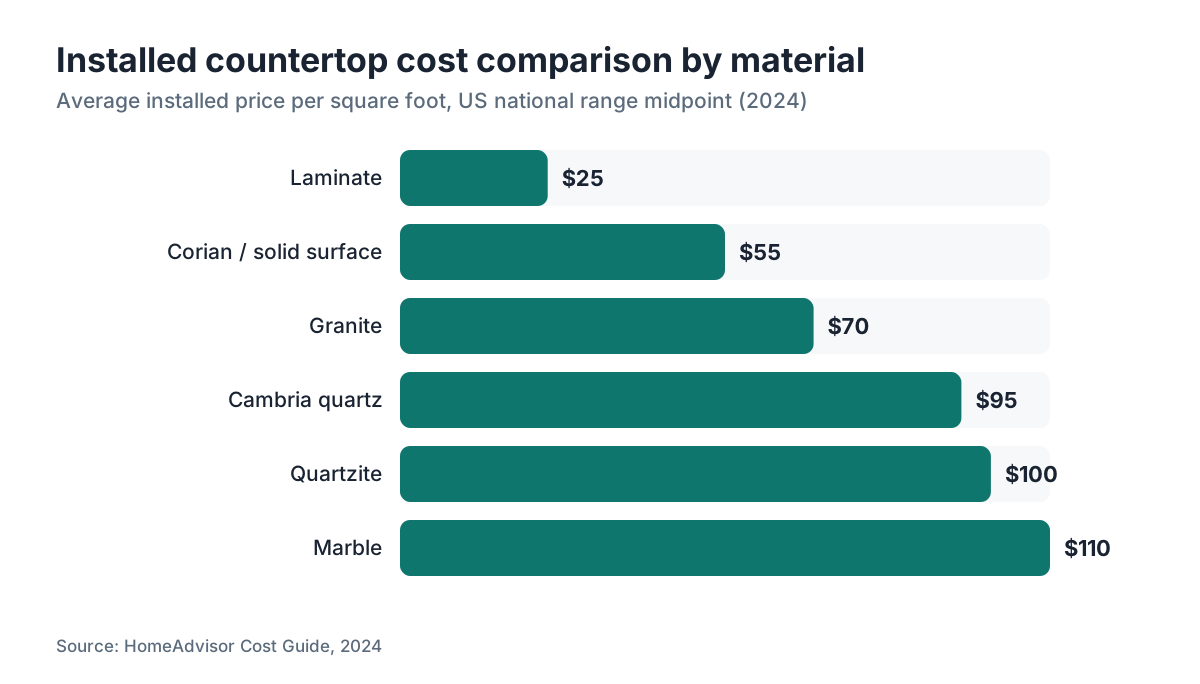
For context, granite countertops generally run $40 to $100 per square foot installed, and laminate countertops can come in under $30 per square foot. Cambria sits firmly in the premium tier.
How does Cambria compare to other quartz brands?
Cambria's main rivals in engineered quartz are Silestone (made by Cosentino in Spain), Caesarstone (Israel), and MSI Q Premium Natural Quartz (sourced from various manufacturers). All four make good products. The differences are real, but often smaller than the marketing suggests.
| Brand | Origin | Warranty | Approx. installed price/sq ft | NSF food-safe certified |
|---|---|---|---|---|
| Cambria | USA | Lifetime, transferable | $60, $150 | Yes [3] |
| Silestone | Spain | 25-year | $55, $130 | Yes |
| Caesarstone | Israel | Lifetime | $55, $120 | Yes |
| MSI Q Premium | Various | Limited lifetime | $45, $100 | Varies by product |
Cambria's real differentiators are domestic manufacturing, the transferable lifetime warranty, and NSF 51 certification (food-zone safe) on every product in the line [3]. Domestic production matters to some buyers for supply-chain reliability and the option to tour the factory. It doesn't change how the countertop performs in your kitchen.
Silestone has historically pushed harder on surface texture, offering suede and volcano finishes that other brands don't match well [9]. Caesarstone carries a lifetime warranty and a wide distribution network in some markets [10]. MSI is usually the value play, often $10 to $30 per square foot cheaper than Cambria with comparable quartz content.
Here's what I'd actually buy for a high-traffic kitchen: Cambria or Caesarstone would be my first calls. Both carry strong warranties from companies with long track records. After that, the choice is mostly personal preference on looks.
Is Cambria quartz durable enough for a busy kitchen?
Yes, with a few real caveats. Cambria scores about 7 on the Mohs hardness scale, the same as most engineered quartz [4]. Steel kitchen knives sit around 5.5 to 6.5, so quartz won't scratch from normal cutting board use. It's not scratch-proof, though. Drag a cast iron skillet across it carelessly and you can leave a mark. Cambria's literature says the surface resists scratching from normal use, which is accurate and carefully worded.
Heat is the real weakness of all quartz, Cambria included. The resin binder that holds the crystals together can discolor or crack under thermal shock. Cambria explicitly warns against setting hot pots and pans directly on the surface [5]. Always use trivets. This is a genuine limitation next to granite or quartzite, which shrug off heat.
The non-porous surface means bacteria and liquids don't soak in, which is why the NSF certification matters. Clean it with mild dish soap and a soft cloth. Concentrated bleach and abrasive scrubbers can dull the finish over time, but most all-purpose sprays are fine.
Edge chipping is possible, especially on aggressive profiles. A thin pencil or knife-edge looks beautiful and creates a fragile edge that chips more easily than a standard eased or beveled edge. Got kids or a very active kitchen? Stick with thicker, rounder edges.
For care guidance on related hard surfaces, how to clean stone countertops covers principles that apply to quartz too.
What are the most popular Cambria designs, and how do I choose?
Cambria's catalog sits above 200 designs as of 2024. That's too many choices, honestly, and most people narrow it to five or six finalists before they ever walk into a showroom.
The designs that move the most volume in kitchen remodels are in the white-and-gray marble-look category. Brittanicca, which mimics Calacatta marble, is probably Cambria's most recognized pattern. Brittanicca Warm adds gold and ochre undertones for kitchens with warmer wood tones. Skara Brae reads more dramatic and bookmatched. Torquay mimics Carrara marble with softer, more delicate veining.
For a warmer or earthier look, White Cliff, Ella, and Laneshaw (a concrete-look gray) do a lot of work. Blackpool is their true black, popular for islands and statement bathrooms.
A few practical tips for choosing.
First, see the actual slab, more than a sample chip. A 4-inch sample tells you almost nothing about how the pattern flows across 55 square feet of kitchen. Go to a distributor or showroom and look at full slabs. Cambria's website has a slab viewer tool, which helps but doesn't replace the real thing.
Second, think about how the veining runs. Fabricators can orient the slab to run the pattern horizontally or vertically, and bookmatching (mirroring two slabs so their patterns meet) is possible on some designs. Ask before templating.
Third, sort out your cabinet color and flooring before the showroom. Bring photos or, better, an actual door sample. The color relationships between stone, wood, and paint make or break the final look.
Does Cambria need sealing or special maintenance?
No sealing, ever. That's one of the core practical advantages of engineered quartz over natural stone.
Granite typically needs sealing every 1 to 3 years, depending on the stone's porosity and how hard it's used. Marble needs it more often and still stains from acids. How to clean quartzite countertops describes a similar maintenance cycle for quartzite. With Cambria, you skip all of that.
For daily cleaning, warm water and mild dish soap is genuinely all you need. A microfiber cloth avoids streaking. For dried or stuck-on food, a non-abrasive plastic scraper works fine, and Cambria's care guide specifically mentions this [5]. For stubborn residue, they recommend a surface-safe cleaner; products marketed for quartz surfaces work well.
The one real maintenance note: don't leave extremely acidic or alkaline substances sitting on the surface. The non-porous surface buys you time to wipe up spills, but prolonged contact with concentrated lemon juice, bleach, or high-pH drain cleaners can affect the finish. Wipe spills promptly and you'll have no issues.
Polishing is neither necessary nor recommended. Some people apply a quartz-specific polish once or twice a year for extra shine, but it's cosmetic, not protective.
How does the Cambria warranty work?
Cambria offers a lifetime warranty on all its products, and it transfers to the next owner when you sell your home [6]. That beats most competitors, where warranties are non-transferable or capped at 10 or 25 years.
The warranty covers manufacturing defects, which Cambria defines as issues in workmanship or materials that affect the product's structural integrity or intended use. It does not cover damage from misuse: chipping from impact, discoloration from heat, or damage from bad installation or harsh chemical exposure.
To keep the warranty valid, the countertop must be installed by a Cambria-authorized fabricator, and you need proof of purchase. Buy Cambria slabs from an unauthorized dealer and have a friend install them, and the warranty is void. So confirm your fabricator is authorized before you sign a contract.
Warranty claims go through Cambria directly, not the fabricator or retailer. Their customer service team assesses claims, which can include a site visit for significant issues. The company has a generally good reputation for honoring claims, though, like any warranty, the experience can vary.
What does the installation process look like?
Installing Cambria countertops usually takes 1 to 3 weeks from first contact to a finished kitchen, depending on the fabricator's schedule.
Templating comes first. After you pick your slab and sign a contract, the fabricator sends someone to measure your cabinets precisely. Most shops now do this with laser templating tools that capture exact dimensions digitally. This step happens after cabinets are fully installed and leveled, never before. Template before the cabinets are set and your measurements will be wrong.
The fabricator then programs the cuts with CAD software, pulling your pieces from the slab with minimal waste. A shop running quoting and nesting software like SlabWise can show you exactly how your pieces lay out on the slab, which helps you understand waste costs and how much of the slab's pattern you'll actually see. That step matters because quartz slabs run $300 to $800 each at wholesale, and poor nesting wastes material you pay for.
Cutting and fabricating takes a day or two in the shop. Edge profiles get machined, sink cutouts get cut, and every piece gets polished. Then installation, which usually runs 3 to 8 hours for a typical kitchen. Seams where two pieces meet get bonded with color-matched epoxy. The countertop gets siliconed to the cabinet, and sinks get undermounted at this stage.
For more on what to expect across the whole project, countertop installation walks through the process in detail.
How does Cambria hold up in bathrooms?
Cambria works well in bathrooms, and in one sense better than kitchens: bathrooms don't see cooking heat. The hot-pot problem disappears. You're left with a surface that resists moisture, needs no sealing, and holds up to the cleaning products most people use in bathrooms.
Vanity tops are a sweet spot for Cambria's more dramatic designs. The Skara Brae and Brittanicca patterns that might feel aggressive across a large kitchen can look exactly right on a 36-inch vanity in a primary bathroom. Thinner slab profiles (1.2 cm, sometimes called 3/8 inch) show up on bathroom vanities to save cost and reduce weight on wall-hung cabinets, though the standard 3 cm thickness is more common.
Some builders use Cambria for shower walls. It works, but it adds complexity. Grout lines at the seams need sealing, and the large panel cuts create more fabrication waste, pushing costs up. Cambria's warranty language specifically covers countertops, so review its coverage for shower applications carefully before committing.
Resale value is a secondary benefit worth mentioning. Buyers in the $400,000 and up price range often recognize Cambria by name, and the transferable lifetime warranty is a point you can document in listing materials [8].
Is Cambria a good investment compared to other countertop options?
Whether Cambria is the right call depends on what you're optimizing for.
Want maximum durability with minimal long-term maintenance, and willing to pay premium prices? Cambria is a strong choice. You get a non-porous surface, no sealing, a credible lifetime warranty, and domestic manufacturing. The aesthetic range covers almost any kitchen style.
On a tighter budget, you can get most of the same functional benefits from Caesarstone or MSI Q Premium for $10 to $30 per square foot less. The quartz composition and daily performance is similar. You'd give up the American manufacturing story and maybe some design exclusivity.
Love real marble or stone and can live with the upkeep? Marble countertops or granite kitchen countertops deliver a natural material no engineered product fully copies. Some people treat the unpredictability of natural stone as part of the appeal.
If budget is the main constraint, Corian countertops or Formica countertops offer respectable performance at a fraction of the cost, though they're not quartz and don't carry the same durability story.
A full kitchen in Cambria at $100 per square foot installed adds real value, and major kitchen remodels with premium finishes recoup roughly 60 to 80% of cost at resale in most US markets [8]. Still, run the math on your budget, how long you plan to stay, and what comparable homes in your market have. Cambria at $6,000 is a sound move in a $700,000 remodel. It's a bigger question in a $250,000 house.
For the full field of kitchen surfaces, kitchen countertops covers everything side by side.
Where can homeowners buy Cambria, and how do you find authorized fabricators?
Cambria sells exclusively through its authorized dealer and fabricator network [7]. You can't buy Cambria slabs at a big-box store directly, though some kitchen design showrooms carry them. Start with Cambria's dealer locator on their website, which searches by zip code.
Once you find a few authorized dealers, visit their showrooms to see full slabs in person. The showroom experience varies a lot by retailer. Some have extensive slab displays; others work mostly from small sample books. If a showroom only has chips, ask if they'll take you to their slab yard.
Get at least three quotes. Cambria's material cost is fairly standardized (dealers pay similar wholesale prices), but fabrication markup, edge profile pricing, and installation fees vary widely. A 30% gap between two quotes on the same Cambria design is not unusual, and it usually comes down to shop overhead and local competition.
Ask each fabricator three things directly. Are you Cambria-authorized? (This matters for warranty.) What's included in your square footage price? (Some quotes bundle template, fabrication, and installation; others break them out as line items.) What's the lead time from template to installation? (Anything under two weeks is fast; 4 to 6 weeks is more typical in busy markets.)
Fabricators who use professional quoting software can hand you itemized quotes fast and show you how your pieces nest on the slab. That transparency is a good sign. If a fabricator gives you a single lump-sum number with no line detail, push for a breakdown before you sign.
Frequently asked questions
How much does a Cambria countertop cost per square foot?
Cambria quartz countertops typically cost $60 to $150 per square foot installed, including templating, fabrication, and installation labor. Material alone runs roughly $35 to $85 per square foot at the wholesale/retail level. Premium designs like Brittanicca Warm or Skara Brae sit at the higher end. Total kitchen costs commonly land between $2,500 and $8,000 depending on size and complexity.
Is Cambria quartz better than granite?
Better depends on what matters to you. Cambria quartz is non-porous and never needs sealing, which granite does. Granite tolerates heat better; you can set a hot pan on most granites without damage. Granite offers true natural variation, while Cambria is engineered for consistency. Both are durable long-term surfaces. People who hate maintenance prefer quartz; people who cook heavily often prefer granite's heat tolerance.
Does Cambria quartz stain?
Cambria is highly stain-resistant because the surface is non-porous. Wine, coffee, oil, and most food liquids wipe off without staining if cleaned reasonably promptly. Prolonged exposure to very dark liquids or strong chemicals on a degraded finish can leave marks, but this is rare with normal use. It's meaningfully more stain-resistant than marble, granite, or quartzite.
Can you put hot pans on Cambria countertops?
No. Cambria specifically warns against placing hot pots, pans, or appliances directly on the surface. The polymer resin in engineered quartz can discolor or crack from thermal shock. Always use trivets or hot pads. This is a real limitation compared to granite or quartzite, which handle heat much better. It's the most common way people accidentally damage their quartz countertops.
Does Cambria need to be sealed?
Never. Cambria quartz is non-porous by design, so it doesn't need sealing when installed or ever afterward. This is one of its key advantages over granite, marble, and quartzite, all of which need sealing every one to three years depending on the stone. Clean Cambria with warm water and mild dish soap for daily maintenance.
How long does Cambria last?
Cambria backs the product with a lifetime warranty, and with proper care the countertop should last as long as the home. The main failure modes are edge chipping from hard impacts, discoloration from sustained heat, and surface dulling from abrasive cleaners or harsh chemicals. Avoid those three things and Cambria countertops from installations 20-plus years ago still look good.
Is Cambria made in the USA?
Yes. Cambria manufactures its quartz slabs at its facility in Le Sueur, Minnesota, which is unusual among quartz countertop brands. Most major quartz brands, including Silestone and Caesarstone, manufacture primarily in Spain or Israel. Cambria is family-owned and has consistently emphasized domestic production as a brand differentiator.
What is the most popular Cambria quartz design?
Brittanicca is widely cited as Cambria's most popular design. It mimics Calacatta marble with bold gray veining on a white background. Brittanicca Warm adds gold undertones and is particularly popular in kitchens with wood cabinetry. Skara Brae, Torquay, and White Cliff are also consistent high sellers. The marble-look white-and-gray category dominates Cambria's volume overall.
How does Cambria quartz compare to Silestone?
Both are premium quartz products with lifetime or long-term warranties and NSF food-safe certifications. Cambria is American-made; Silestone is produced in Spain by Cosentino. Silestone offers more surface texture variety, including suede and volcano finishes. Cambria has a wider US dealer network in some regions and is slightly more expensive on average. Daily kitchen performance is comparable between the two.
Can Cambria countertops be repaired if they chip?
Small chips and minor damage can sometimes be repaired with color-matched epoxy filler. For edge chips, a skilled fabricator can often grind and repolish the edge to remove the damage. Large cracks or significant surface damage generally require section replacement, which means re-templating and fabricating a new piece. This is why edge choice matters: thin aggressive profiles chip more easily than rounded eased edges.
Are quartz countertops safe for food prep?
Yes. Cambria holds NSF 51 certification for food-zone safety on every product in its line, meaning independent testing confirms the surface is safe for direct food contact. The non-porous surface also means bacteria and mold can't penetrate the material the way they can in porous natural stones. Standard sanitation with soap and water is enough for kitchen food prep areas.
How much does a Cambria quartz countertop cost for a small bathroom vanity?
A small bathroom vanity top in Cambria quartz, roughly 25 to 35 square feet, typically runs $800 to $2,200 installed depending on the design, edge profile, and your market. Standard designs at the lower tier price out cheaper. Premium marble-look designs with a mitered edge on a 36-inch vanity can approach or exceed $2,000. Bathroom vanities usually cost less per project than kitchens due to smaller square footage.
What thickness does Cambria come in?
Cambria's standard countertop thickness is 3 cm (about 1.25 inches), the industry standard for kitchen countertops and what most fabricators price by default. Some bathroom and furniture applications use 1.2 cm (about half an inch) slabs, which are thinner and lighter but need extra substrate support. The 3 cm thickness is more impact-resistant at edges and is almost always the right choice for kitchens.
How long does Cambria countertop installation take?
The installation day itself usually takes 3 to 8 hours for a typical kitchen. The full timeline from signing a contract to installed countertops is typically 2 to 6 weeks: a few days to schedule templating, a few days in the shop for fabrication, then installation day. Busy shops in active remodel seasons run longer. Rushing the timeline is a common cause of errors, so don't push a fabricator to skip proper templating time.
Sources
- Cambria, What Is Quartz?: Cambria quartz is made from approximately 93% natural quartz crystals and polymer binders, making it non-porous and harder than granite.
- HomeAdvisor, Quartz Countertop Cost Guide: Quartz countertops average $55 to $155 per square foot installed nationally, with typical kitchen projects ranging from $1,500 to $5,500.
- NSF International, Certified Products Listings: Cambria quartz is certified to NSF/ANSI 51, the food equipment materials standard, across its product line.
- USGS, National Minerals Information Center: Quartz has a Mohs hardness of 7, making it harder than most metals and resistant to scratching from typical kitchen tools.
- Cambria, Care and Maintenance Guide: Cambria's official care guide warns against placing hot cookware directly on quartz surfaces and recommends trivets to prevent thermal damage.
- Cambria, Warranty Information: Cambria offers a lifetime limited warranty on all its quartz products that is transferable to subsequent owners of the home.
- Cambria, Dealer Locator: Cambria sells exclusively through its authorized dealer and fabricator network, which can be searched by zip code on their website.
- Remodeling, Cost vs. Value Report: Kitchen remodels including premium countertop upgrades recoup roughly 60 to 80% of cost at resale in most US markets depending on region and home price tier.
- Silestone by Cosentino, Warranty and Product Info: Silestone offers a 25-year warranty on its quartz countertops; Cambria's lifetime warranty exceeds this coverage period.
- Caesarstone, Lifetime Warranty: Caesarstone offers a lifetime limited warranty on its quartz countertop products, comparable to Cambria's coverage.
- U.S. Bureau of Labor Statistics, Occupational Employment and Wage Statistics: Wages for stone and countertop fabrication and installation workers vary significantly by metro area, with high-cost regions running well above national averages.
- Minnesota Department of Employment and Economic Development: Cambria is headquartered in Le Sueur, Minnesota, and manufactures quartz slabs domestically, making it one of the only US-based quartz countertop producers.
Last updated 2026-07-10