TL;DR
- You can change a countertop edge profile on most stone and solid-surface tops by having a fabricator regrind or recut the edge.
- Expect $5 to $30 per linear foot depending on material and profile complexity.
- Laminate edges get updated with edge banding or trim.
- Not every profile change is possible on an installed top without pulling it.
What does changing a countertop edge profile actually mean?
An edge profile is the shaped cross-section that runs along the exposed front and sides of your countertop. It's the detail you run your hand along when you lean against the counter. An eased edge is a lightly softened 90-degree corner. A waterfall ogee is a flowing double-curve that adds about an inch of visual height to a 3 cm slab.
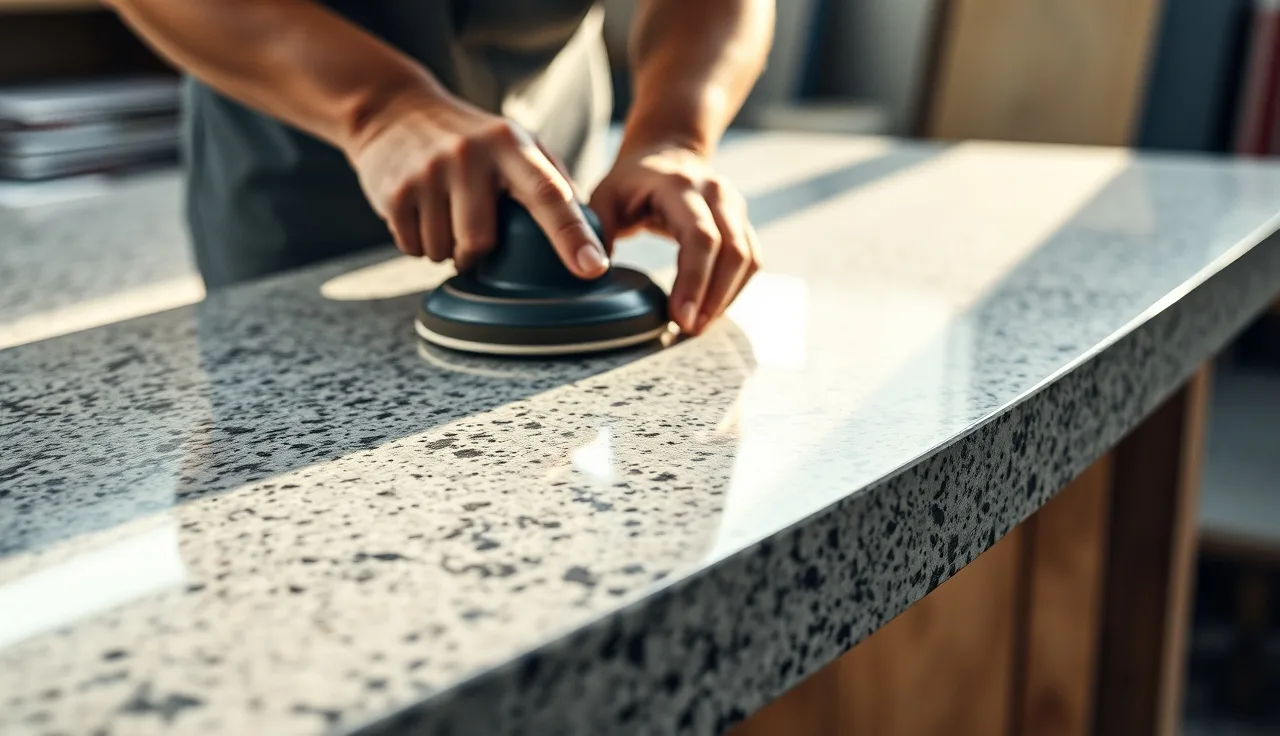
Changing the profile means reshaping that edge. You either grind and polish the existing stone into a new shape, or you remove the top entirely and run it through a CNC router or edge profiler back at the shop. That distinction drives both the price and what's even possible. In-place grinding handles certain transitions. Anything that pulls material off the face of the slab, or needs a thicker blank than you currently have, means shop work or a new top.
Fabricators split this into two buckets. Upgrades go from simple to complex: eased to bevel, eased to ogee, flat to bullnose. Downgrades go the other way, taking an existing shape down to something flatter. Downgrades are often easier to do in place, because you're mostly removing material instead of sculpting it.
Which countertop materials can have their edge profile changed?
Stone and solid-surface materials are candidates. Laminate and tile mostly are not.
Natural stone (granite, marble, quartzite, soapstone): All of these can be recut and repolished. Granite countertops are the most common candidate because they're everywhere and because granite's hardness means the original profile was precision-cut and can be precision-recut. Marble countertops work the same way but need careful matching of the finish level, since marble polishes differently than granite. Soapstone is softer and easier to work, so edge changes are straightforward for a competent fabricator.
Engineered quartz (Cambria, Silestone, similar): Yes, with one caveat. Quartz slabs carry a consistent color and pattern throughout, so a recut edge matches. Cambria countertops and other premium quartz brands use similar manufacturing, so the same rules apply. Some quartz has a slight color gradient from face to core, and a deep profile change can expose a slightly different tone at the edge. Ask your fabricator to do a test grind on a scrap piece before committing.
Solid surface (Corian, similar): Corian countertops are fully homogeneous, meaning the color and pattern run all the way through. Edge changes are easy and can often be done in place with a router. This is probably the most forgiving material for edge modification.
Butcher block: Butcher block countertops can have edges reshaped with standard woodworking tools and a router with a profile bit. The limiting factor is wood thickness and whether there's enough material to create the profile you want.
Laminate: Laminate countertops and Formica countertops are trickier. The substrate is particleboard or MDF, and the decorative surface is a thin sheet bonded on top. You can add edge banding in a different profile, replace the edge strip with a solid wood or metal edge treatment, or in some cases have the whole top rebuilt. You cannot regrind laminate into an ogee the way you would stone. If you want profile flexibility without full stone pricing, solid surface is the alternative worth pricing out.
Ceramic tile: Profile changes aren't really a thing with tile counters. The edge treatment comes from the tile layout and edge tile selection. Changing it means retiling.
How much does it cost to change a countertop edge profile?
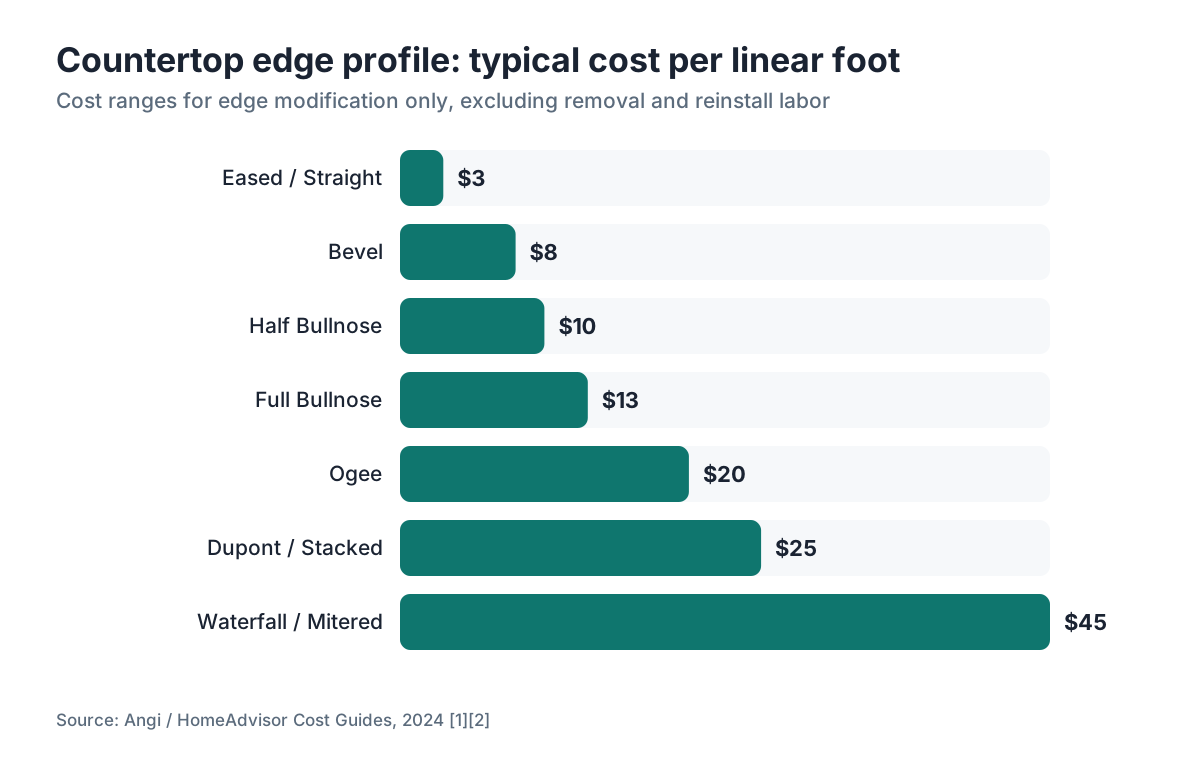
Pricing swings on region, material, profile complexity, and whether the top has to leave the kitchen. The industry runs on a per-linear-foot model for edge work, and the ranges hold reasonably steady across fabricator price lists and published cost guides [1].
| Profile Type | Typical Cost per Linear Foot | Notes |
|---|---|---|
| Eased / Straight | $0 to $5 | Often included in base price; minimal grinding |
| Bevel (1/8" to 1/4") | $5 to $10 | Simple one-pass grind |
| Full Bullnose | $10 to $15 | Requires removing significant material |
| Half Bullnose / Demi Bullnose | $8 to $12 | Common upgrade profile |
| Ogee | $15 to $25 | Complex double curve, more passes |
| Dupont / Stacked Profiles | $20 to $30+ | Decorative, requires skilled hand-finishing |
| Waterfall / Mitered Edge | $30 to $60+ | Usually requires full removal and shop work |
Those are edge-profile-only numbers, not full replacement costs. If your fabricator has to pull the top, transport it, rework it, and reinstall it, add $150 to $400 for the labor on a typical kitchen run, plus any plumbing or appliance disconnection fees when the sink area is involved [2].
For a standard kitchen with 30 linear feet of exposed edge, a mid-range upgrade from eased to ogee might run $15 to $20 per foot for the profile work, plus the removal and reinstall overhead. Realistic total: $600 to $1,000. A simple bevel upgrade done in place might land at $200 to $400 total.
Geography is real money here. Fabricators in high cost-of-living metros charge 30 to 50% more than rural shops, mirroring the labor cost spread that shows up in Bureau of Labor Statistics wage data for stone cutters and slabbers [3].
Can a countertop edge profile be changed without removing the countertop?
Sometimes. Three things decide it: the profile you're starting from, the one you want, and how good your fabricator is with in-place grinding gear.
In-place edge work runs on handheld angle grinders fitted with diamond profile wheels, then polishing pads. A skilled fabricator can produce a clean bullnose, bevel, or eased edge without touching the sink. The mess is the catch. Stone dust is a serious health hazard, and OSHA's silica standard (29 CFR 1910.1053) requires engineering controls or respiratory protection once workers are exposed to respirable crystalline silica above an action level of 25 µg/m³ as an 8-hour time-weighted average [4]. The rule sets a permissible exposure limit of 50 µg/m³ over the same period [5]. Reputable fabricators wet-grind or use vacuum shrouds. A contractor who shows up with a dry grinder and no dust control is a problem for their own lungs and for your kitchen.
What you can't do in place: any profile that adds thickness (you can't make a 2 cm slab behave like 3 cm), sculpted profiles that need CNC precision, or work close to a fragile undermount sink cutout where vibration is too risky. Most shops also won't attempt in-place ogee or dupont profiles, because the hand-finishing just doesn't match shop quality.
The rule of thumb is simple. Going simpler (removing an ogee to get a clean eased edge) is usually fine in place. Going more complex means shop work.
What are the most popular countertop edge profiles and how do they compare?
You'll see roughly a dozen profiles in a fabrication shop, but a handful cover the vast majority of installs. Picking a profile is part looks, part function, part budget.
Eased edge: A 90-degree corner with just the sharp arris knocked off. Reads clean and modern. Cheapest profile, easiest to maintain. If you're building a contemporary kitchen countertops layout with flat-front cabinetry, eased is probably your answer.
Beveled edge: A flat angled cut on the top corner, usually 45 degrees. Adds geometry without the softness of a curve. Works well on dark stones, where the lighter exposed core draws a visible line.
Full bullnose: A completely rounded, semicircular edge. Soft, kid-friendly, forgiving on hips. The downside is it exposes a lot of the slab's thickness, so any color or pattern variation shows prominently at the edge.
Half bullnose (demi bullnose): Only the top corner rounds over, the bottom stays flat. Probably the most common upgrade in mid-range remodels. Polished without being as imposing as a full bullnose.
Ogee: An S-curve. Traditional, ornate, tied to older kitchen styles. It's creeping back into some transitional designs, but it's a bad bet if your cabinets are anywhere near contemporary. Ogee needs more material removal and more polishing passes, so it costs more.
Mitered / waterfall edge: Two pieces of stone joined at a 45-degree miter at the front, faking a much thicker slab or a continuous flow down a cabinet face. Shop-only job, and the material cost tends to run higher than the edge labor. Genuinely expensive. Looks dramatic on a kitchen countertops island.
Dupont / Stacked profiles: Decorative combinations with a step or reveal. Common in traditional and craftsman kitchens. A clean result takes skilled hand-finishing.
One honest opinion. The ogee gets oversold to homeowners who read it as luxury, then regret it during a remodel when it collides with newer cabinet styles. Demi bullnose ages far more gracefully.
How does the edge profile change process work, step by step?
Knowing the process helps you ask sharper questions and dodge surprises.
Step 1: Assessment. A fabricator visits (or you send photos and measurements) to check the current edge, material, thickness, and whether in-place work is feasible. Good fabricators verify your slab has enough material to transition to the new profile without losing strength near cutouts.
Step 2: Quoting. You get a price per linear foot for the profile work, plus any removal and reinstall fees, plus material costs if you're doing laminated edges or building up thickness. Quoting software like SlabWise helps fabricators produce accurate edge-work quotes fast by separating profile pricing from slab pricing in the cost model. Fewer surprises on both sides of the table.
Step 3: Scheduling and prep. If the top is coming out, you disconnect the sink and faucet plumbing, pull the appliances sitting against the top (cooktop, undermount dishwasher), and clear the cabinets. Budget a half day of your own prep.
Step 4: Edge work. Shop work runs through a CNC profiling machine or a manual edge machine, then polishing wheels matched to the stone's finish. In-place work uses handheld gear. Either way, wet grinding is the professional standard for silica dust control [7].
Step 5: Reinstall and finishing. A pulled top goes back in with fresh adhesive and caulk at the backsplash joints and along the cabinet rails. Sink and plumbing get reconnected. Plan on a full day for a typical kitchen.
Timeline from first call to finished job: 1 to 3 weeks for most shops, depending on backlog. Busy shop? Expect 4 to 6 weeks out.
Does changing the edge profile affect countertop durability or cleanliness?
Yes, and meaningfully. Profile geometry has real consequences for how a counter wears and how easy it is to wipe down.
Sharp corners (like a straight eased edge) are more prone to chipping in brittle materials like granite and marble. A chip at a sharp corner on a 3 cm granite slab is a visible defect that's hard to repair invisibly. A bullnose edge spreads impact over a wider area and chips far less often, because the corner is rounded. That's one functional reason to upgrade off a basic eased edge if you have kids or heavy daily use.
Cleaning is the flip side. Ogee and dupont profiles have crevices and transitions that trap crumbs, grease, and water. A bullnose or eased edge wipes clean in one stroke. If you cook a lot and care about sanitation, the sculpted profiles make more work than they're worth. This matters even more if you're already fighting stains in a lighter material or thinking about how to clean stone countertops.
Waterfall and mitered edges carry a horizontal seam on the face of the counter apron. Even filled with color-matched epoxy, that seam can hold water when it sits near the sink. Fabricators handle it by fully epoxying and polishing the joint, but watch it during install.
For durability in brittle stone, demi bullnose or full bullnose beat eased corners. For cleanability, simpler wins every time.
Is it cheaper to change the edge profile or replace the whole countertop?
For most situations, edge modification costs far less than full replacement. The math shifts with your material and the profile you're chasing.
Full replacement for a typical kitchen (30 to 40 square feet of stone) runs $1,500 to $5,000 installed for granite or quartz, driven by slab selection, edge profile, and region [1][2]. A mid-tier Midwest fabricator might quote $2,500 all-in. A premium coastal shop could be $4,500 or more.
Edge modification on the same kitchen runs $300 to $1,200 for most upgrades. That's a real savings, assuming your slab is otherwise in good shape.
Replacement wins when your stone has heavy staining or etching an edge change won't touch, when you want a different material entirely (laminate to quartz, say), when you want to add thickness for a heavier look, or when the current top has multiple chips or cracks near the edge that a regrind can't clean up.
One hybrid move fabricators sometimes offer: keep your existing stone, but fabricate a new laminated front edge strip that builds up the visual thickness and creates a mitered waterfall look. It's not cheap. It still costs less than a full replacement, and it changes the edge dramatically.
What should you ask a fabricator before agreeing to an edge change?
The right questions upfront prevent job-site surprises and protect your counter.
First, ask whether the work can be done in place. Get a clear answer, not a hedge. If they say it depends, ask what they need to see to decide. A competent fabricator can answer definitively once they've looked at the edge condition and material.
Second, ask about silica dust control. Wet grinding or vacuum shrouding is required for in-place stone work under OSHA's respirable crystalline silica standard [4]. If they don't raise dust control, raise it yourself.
Third, ask for a profile sample. Any shop doing profile work regularly keeps sample pieces showing their finish on each profile. The polish on an ogee varies a lot between shops. A bad one has flat spots where the compound curve meets and the polish never got worked through.
Fourth, ask what happens if a chip occurs during the grind. Rare with experienced hands, not unheard of, especially near sink cutouts. Good shops repair it and don't charge extra. Get that understanding verbally at minimum, in writing if you're nervous.
Fifth, ask about the backsplash seam. When the top comes out and goes back in, the silicone caulk joint at the wall gets redone. Make sure they're using color-matched or clear silicone, not whatever white caulk is riding in the truck.
Fabricators running quotes through structured software can hand you a line-item breakdown: profile work, install labor, materials. That transparency is fair to expect from a professional shop. SlabWise produces exactly that kind of detailed quote, which keeps the customer conversation cleaner and more honest.
Can you change just part of an edge, like the island but not the perimeter?
Yes, and it happens more than people expect. Islands get the attention because they're viewed from all sides, while perimeter counters usually sit against a wall with only the front edge showing. Upgrading just the island edge, or only the run that faces the living room in an open plan, makes practical and financial sense.
Fabricators charge per linear foot, so a partial job on 10 feet of island edge is perfectly reasonable to quote. The minimum visit or mobilization charge varies by shop, typically $75 to $200, but the profile work itself stays linear-foot pricing.
One thing to plan. If a continuous run turns a corner and you're changing only part of it, you need a clean termination point. The profile transition has to end somewhere. On an inside corner, that transition hides. On an outside corner or a peninsula end, you'll see the change, and it can read as intentional or read as a mistake. Talk through the stopping point with your fabricator before the job starts.
What about changing edge profiles on laminate or tile countertops?
Laminate and tile work differently than stone, and the menu is shorter.
For laminate countertops like Formica countertops, the standard edge treatments are the post-formed radius (the soft curve built into pre-made laminate tops), a self-edge (laminate applied flat to a square substrate), or a solid wood edge strip. You can swap a post-formed edge for wood by having a carpenter or countertop shop cut off the formed edge and apply a hardwood nosing. That takes you from a curve to whatever profile you can rout into wood. It's reasonably affordable ($10 to $20 per foot for the wood nosing work) and completely changes the look.
Metal edge trim is another option for laminate, and it gives you a clean straight-line modern profile. Several companies make aluminum or stainless trim that routs into the substrate edge and delivers both a new profile and a durable edge.
For tile counters, the edge profile comes from the tile layout and your edge tile choices. Bullnose tile gives a rounded profile. Schluter metal edge strips give a clean linear edge. Switching from one to the other means pulling the edge tiles and any adjacent field tiles, which is a partial tile job. If the grout and tile are old, matching new tile to old is often tough, so partial tile edge changes sometimes end up needing a full countertop tile replacement to look right.
Frequently asked questions
How long does it take to change a countertop edge profile?
In-place edge work on a typical kitchen takes 2 to 4 hours for a straightforward profile change by an experienced fabricator. If the countertop has to come out for shop work, add time for removal, transport, shop work, and reinstall. A full pull-and-reinstall job usually runs 1 to 2 days total. Then factor the shop's scheduling lead time of 1 to 4 weeks depending on how busy they are.
Can I change my granite countertop edge profile myself?
Technically yes, practically not recommended for most homeowners. Diamond polishing wheels and angle grinders for stone run $200 to $600 in equipment, and the skill to produce a clean, fully polished granite profile takes years. Mistakes at the edge are visible and hard to fix. Dry-grinding silica dust is a serious respiratory hazard under OSHA 29 CFR 1910.1053. Leave stone edge work to a licensed fabricator with proper dust controls.
Will changing the edge profile lower my countertop resale value?
No published data shows edge profile choice materially affects home resale prices on its own. Overall countertop condition and material type matter far more. A clean bullnose on granite appeals to buyers; an ornate ogee in a modern kitchen can read as dated to some. Choose a profile that fits your kitchen style and you won't hurt resale value.
Can a quartz countertop edge profile be changed after installation?
Yes. Engineered quartz can be reground and repolished by a fabricator. The color runs throughout the slab, so the new edge should match the surface. One caveat: some quartz products have a very slight tonal difference between face and core. Ask your fabricator to test on a scrap piece of the same product before proceeding. In-place edge changes on quartz work the same way as granite.
What edge profile is easiest to keep clean?
Eased and demi bullnose edges are the easiest to clean because they have no crevices, grooves, or compound curves where food and grease collect. Ogee, dupont, and stacked profiles all have recessed areas that trap debris and need detailed wiping. If cleanliness is a top priority, especially in a heavy-use kitchen, the simplest profile available is genuinely the best choice.
How do I find a fabricator who can change my countertop edge profile?
Search for stone fabricators or countertop shops in your area, not general contractors. Look for shops that fabricate and install countertops as their primary business. Ask specifically whether they do edge modification on existing installed tops, and request to see sample pieces of the profiles you're considering. A shop that can't show you physical examples of its edge work is a shop to approach cautiously.
Does changing the edge profile void any warranty on my countertop?
For engineered quartz brands like Cambria, Silestone, or Caesarstone, any modification by someone other than an authorized fabricator can void the manufacturer's warranty. Check your warranty documentation before scheduling edge work. Natural stone countertops typically carry no manufacturer warranty (they're a natural material), so this is mainly a concern for engineered stone and solid-surface products.
Is there a standard countertop thickness that limits which edge profiles are possible?
Yes. The two standard stone thicknesses are 2 cm (about 3/4 inch) and 3 cm (about 1.25 inches). Full bullnose and most decorative profiles need at least 3 cm to look proportional and to leave enough material after grinding. A 2 cm slab limits you to simpler profiles like eased or bevel. Laminated edges (stacking two pieces) can give a 2 cm slab the visual depth of a 4 to 6 cm edge for certain styles.
Can a chip on a countertop edge be fixed as part of an edge profile change?
Sometimes. Small chips on an eased or bullnose edge can often be epoxy-filled and color-matched before or during a profile change. If the chip sits on the face of the profile being reground anyway, the grinding removes it entirely. Large or deep chips near sink cutouts or corners may not be fully fixable. A fabricator can assess whether a chip folds into the edge work or needs a separate repair.
What edge profile is best for a kitchen island?
Demi bullnose and full bullnose are popular on islands because the rounded edge is comfortable to lean against and reduces injury risk for kids. Mitered or waterfall edges look dramatic since all four sides are visible, but they cost significantly more. Eased edges read as contemporary and cost the least. The right choice depends on your kitchen style and how the island gets used, not on any single universal answer.
Can I change my bathroom countertop edge profile the same way as a kitchen countertop?
Yes, the same material rules and pricing apply. Bathroom counters are usually smaller (5 to 15 linear feet of edge), so total cost is lower, often $150 to $500 for an edge profile change. Bathroom tops frequently have integrated or undermount sinks, so ask your fabricator whether the top needs to come out and whether they handle sink reconnection or you need a plumber.
What's the difference between an eased edge and a beveled edge?
An eased edge is a 90-degree corner with only the sharp arris softened, leaving the edge essentially square. A beveled edge has a deliberate angled flat cut across the top corner, typically at 45 degrees, creating a visible geometric line. The bevel is more decorative and shows a contrast line where the cut exposes the stone's interior. An eased edge is subtler; a bevel makes a statement.
How do fabricators price edge profile changes, and what's included in the quote?
Most fabricators price edge changes per linear foot, with the rate rising by profile complexity. A typical quote covers the profile grinding and polishing labor. It may or may not include removal and reinstall, usually a separate line item of $150 to $400. Ask explicitly whether your quote covers the top coming out and going back in, sink disconnection, and resealing the backsplash joint. Surprises in countertop work almost always come from unclear scope.
Sources
- HomeAdvisor (Angi) – Countertop Installation Cost Guide: Countertop edge profile pricing ranges and full countertop replacement cost ranges of $1,500–$5,000 installed for granite or quartz
- HomeAdvisor (Angi) – Stone Countertop Cost Guide: Removal and reinstallation labor costs of $150–$400 for typical kitchen countertop work
- U.S. Bureau of Labor Statistics – Occupational Employment and Wage Statistics: Geographic wage variation for stone cutters and slabbers, supporting 30–50% cost differential between high-cost and low-cost metro areas
- OSHA – Occupational Exposure to Respirable Crystalline Silica (29 CFR 1910.1053): OSHA silica standard requires engineering controls or respiratory protection when workers are exposed above the action level of 25 µg/m³ as an 8-hour TWA; wet grinding and vacuum shrouds are listed engineering controls
- OSHA – OSHA Standard 29 CFR 1910.1053 full text: Action level of 25 µg/m³ and permissible exposure limit of 50 µg/m³ for respirable crystalline silica in general industry
- Natural Stone Institute: Standard stone slab thicknesses of 2 cm and 3 cm, and industry practice for edge profile fabrication on natural stone
- CDC / NIOSH – Silica Topic Page: Respirable crystalline silica from stone grinding is a confirmed occupational lung hazard; wet methods and local exhaust ventilation are primary controls
- Cambria – Product Warranty: Manufacturer warranty for engineered quartz may be voided by modifications not performed by authorized fabricators
Last updated 2026-07-10