TL;DR
- A double radius countertop edge has two opposing curved arcs ground into the slab edge, forming an S-shaped, rolled profile.
- Fabrication adds roughly $15, $30 per linear foot over a basic eased edge.
- It fits traditional and transitional kitchens, works in granite and quartz, and needs a CNC router or skilled hand profiling to cut cleanly.
What is a double radius countertop edge profile?
A double radius edge is exactly what the name says: two curved radii machined into the edge of a countertop slab, one concave and one convex, meeting in the middle to form a gentle S-curve. The top arc rolls toward the viewer. The bottom arc rolls away. The result is a smooth transition from the countertop surface down to the underside.
The profile sits between a plain bullnose (one convex curve) and a full ogee (a sharper S with a flat fillet and more vertical drop). The double radius is softer. It has no flat vertical section and no hard shadow line. That softness is why designers reach for it in transitional kitchens where the client wants something more decorative than an eased edge but less ornate than a full ogee.
You may also hear this profile called a double ogee countertop edge profile or a double ogee countertop edge. Fabricators use both terms interchangeably, though technically a classic ogee includes a flat fillet between the two curves. In practice, most shops and most customers treat 'double radius' and 'double ogee' as synonyms. [1]
The profile is cut from the full thickness of the slab. On a standard 3 cm (about 1.25 inch) slab, the two arcs share that thickness roughly equally, each curve taking about 5/8 of an inch of the edge height. On a mitered waterfall edge or a laminated edge built up to 6 cm, the double radius becomes more dramatic because there is more vertical height to work with.
How does a double radius edge differ from a single bullnose, ogee, and other common profiles?
Knowing the profile family helps you order the right thing and helps fabricators quote accurately.
| Profile | Curves | Typical feel | Relative cost* |
|---|---|---|---|
| Eased (slightly rounded top) | 0 true radii | Modern, minimal | Baseline |
| Bullnose | 1 convex | Soft, classic | +$4, $8/lf |
| Double radius / double ogee | 2 (convex + concave) | Transitional, flowing | +$15, $30/lf |
| Ogee | 2 + fillet | Formal, traditional | +$18, $35/lf |
| Dupont | 1 convex + flat step | Clean, contemporary | +$10, $20/lf |
| Waterfall / mitered | custom | Ultra-modern | varies |
*Upcharge ranges above a basic eased edge; exact figures depend on shop, region, and material. [2]
The bullnose is a single convex arc. It reads soft and simple. The double radius adds a second arc in the opposite direction underneath, which gives the profile its S-shape and more visual weight. The ogee and double ogee countertop edge profiles share the same S-curve idea, but a true ogee adds a flat vertical fillet between the curves, making the profile look more carved and architectural. The double radius skips that fillet for a smoother, more continuous flow.
If you want something between a bullnose and an ogee, the double radius is probably the right call. If you want drama and a shadow line, go ogee. If you want invisible edges, go eased.
How much does a double radius edge profile cost?
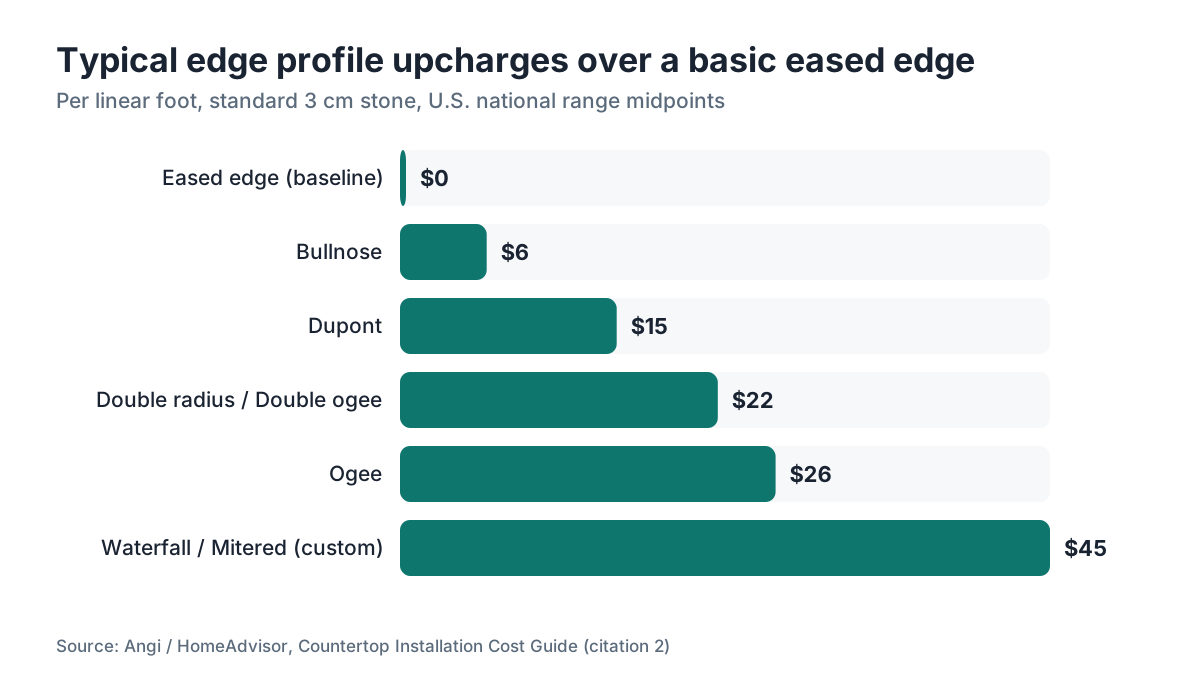
Fabricators price edge profiles by the linear foot of finished edge, on top of the slab and fabrication cost. The double radius typically runs $15, $30 per linear foot as an upcharge in most U.S. markets. That range is wide because it reflects real variation across shops and regions. [2]
A kitchen with 25 linear feet of exposed edge (a common amount for an L-shaped kitchen with an island) adds roughly $375, $750 to the total job cost just for the profile upgrade, compared to a basic eased edge.
What drives the spread:
Material hardness. Granite is harder than engineered quartz by a small margin, which puts more wear on diamond wheels and can add a few dollars per foot in shop overhead. Quartzite is often harder still. Marble and limestone are soft and profile quickly.
CNC vs. hand profiling. A shop running a CNC bridge saw or router with a pre-programmed double radius bit cuts the profile at a consistent, fast rate. A shop doing it by hand with cup wheels takes longer and charges more. CNC is almost always cheaper for the customer and more consistent in result.
Thickness. Standard 3 cm slabs are priced as above. A laminated or mitered edge that doubles or triples the apparent thickness adds fabrication time and therefore cost.
Region. Labor rates in New York City or the San Francisco Bay Area run meaningfully higher than in rural Midwest markets. The $15, $30 range is a national average band, not a guarantee. [2]
If a fabricator quotes you $50/lf for a double radius on standard 3 cm granite, ask them to break out why. That is high unless the slab is an exotic quartzite or the kitchen has unusual geometry. If they quote $8/lf, ask whether it is truly a double radius or just a softened eased edge.
For fabricators who want to price this accurately across multiple jobs, building a consistent edge upcharge table into your quoting system (rather than estimating per job) is the single best way to protect margin. Tools like SlabWise let you attach a per-linear-foot edge charge to every profile in your catalog, so the upcharge populates automatically when a customer picks double radius on a quote.
What materials can be cut with a double radius edge?
Any material thick enough to hold two curves can take a double radius. In practice that means:
Granite. The most common material for this profile. Granite has enough hardness to hold a crisp edge without chipping, and the natural variation in the stone reads beautifully on a flowing profile. Ogee granite countertop edge profiles, including the double radius variant, are a staple in traditional kitchen design. [3]
Engineered quartz (Silestone, Caesarstone, Cambria, etc.). Quartz profiles cleanly and consistently. The double radius looks crisper on quartz because the material is uniform. See our Cambria countertops guide for how that brand handles custom edge options specifically.
Marble. Soft enough to profile easily, but soft enough to chip at thin sections if the radius is tight. A generous radius on the curves prevents that. Marble also shows the profile in a particularly elegant way because the material polishes to a high sheen.
Quartzite. Harder than granite in some varieties, so it takes more time and more wheel changes, but it profiles fine.
Soapstone. Usually takes a softer profile like a bullnose or eased edge because of its layered grain structure, but a double radius with generous radii works.
Laminate and Formica. Thin laminate bonded to a substrate can take edge profiles, but the profile has to be formed in the substrate and then wrapped, or the laminate has to be thick enough to machine directly. A true double radius in standard laminate sheet is not practical; you'd use a post-formed bullnose instead. See our laminate countertops and Formica countertops pages for what edge options that material realistically supports.
Butcher block and solid wood. Wood profiles beautifully with a router bit. A double radius on a walnut or maple island top looks warm and traditional. Read more in our butcher block countertops guide.
Corian and solid surface. Thermoformable and easy to machine; holds a double radius well. Details on that material class at Corian countertops.
How is a double radius edge machined? (CNC vs. hand profiling)
Getting the double radius right is a two-pass operation in most shops. First pass: the fabricator profiles the convex (top) arc with a convex diamond wheel or router bit. Second pass: a concave wheel cuts the lower arc. The two curves have to meet at a tangent point where the direction of curvature reverses, or you get a flat spot or a visible inflection bump that looks amateurish once it's polished.
On a CNC router, the machine runs both passes with programmed precision. The operator sets the toolpath, picks the correct bits (typically 3/4-inch or 1-inch radius profile bits), and the machine runs. Repeatability is high. The finished edge on slab 1 and slab 20 look the same.
Hand profiling with angle grinders and cup wheels takes more skill. An experienced fabricator can produce a beautiful double radius by hand, but it takes more time, more passes, and more judgment to hit the tangent point. On exotic stone with strong movement, a hand-cut edge can actually look more natural than a CNC pass because the hand follows the material.
Polishing the profile matters as much as shaping it. Most shops polish in stages: 50 grit to shape, then 100, 200, 400, 800, 1500 grit, then buffing. Skip grits and you get swirl marks or dull patches in the curved sections. On a double radius, the concave lower arc is the hard part, because flat polishing pads do not conform to it; fabricators reach for flexible polishing pads or hand-held profile polishers there. [4]
For shop owners: CNC tooling for a standard double radius profile typically runs $80, $200 per bit set from major suppliers. Bits dull faster on granite and quartzite than on quartz or marble. Track your bit cost per linear foot; it usually lands at $0.50, $1.50/lf and should be baked into your edge upcharge calculation.
Is a double radius edge a good choice for my kitchen?
That depends on your cabinet style and what the rest of the room is doing.
The double radius is a transitional profile. It sits comfortably next to raised-panel cabinetry, shaker doors, and furniture-style islands. It pairs less naturally with ultra-flat, handle-free Euro-style cabinets (where an eased or waterfall edge reads better) and less naturally with ornate Victorian cabinetry (where a full ogee or a more elaborate profile holds its own).
For kitchen countertops in a remodel where the homeowner wants something more finished than a basic edge but does not want to commit to a heavily formal look, the double radius is often the right answer. It photographs well. It reads as quality without being showy. It does not date quickly.
Practical considerations:
Cleaning. The S-curve collects crumbs in the concave lower section. This is not a deal-breaker, but it is real. A quick wipe with a damp cloth handles it, but if you hate any surface irregularity, a bullnose or eased edge is simpler to keep clean.
Kid safety. The double radius has no sharp corners or edges. The convex top arc is smooth to the touch. This is one of the safer profile choices for households with young children.
Resale. Traditional edge profiles like the double radius and ogee have broad appeal. Design trends move toward minimalism, but the double radius is neutral enough that it does not read as a strong stylistic statement either way.
For granite countertops specifically, the double radius is a classic pairing that stone fabricators have been cutting for decades. The profile shows off the polished face of the stone without competing with the veining.
How does the double radius edge look on an island vs. perimeter counters?
Islands get the most attention because all four sides are exposed and people walk around them. A double radius on an island reads well because the eye follows the flowing S-curve continuously around the perimeter.
On perimeter counters where three of the four sides sit against a wall or backsplash, only the front edge is visible. The double radius still adds warmth and detail there, but the investment is smaller in absolute dollars because there are fewer linear feet of exposed edge.
Some designers specify a double radius on the island and a simpler bullnose or eased edge on the perimeter, then use a coordinating material. This saves money on the perimeter (which nobody sees) and puts the decorative profile where people interact with it. That is a legitimate approach, not a compromise in quality.
If you go this route, make sure the two profiles are on the same ticket with the same fabricator so they can template both at the same time. Matching slab material across separate fabrication orders is possible but harder.
What questions should I ask a fabricator before ordering a double radius edge?
Before you sign a contract, get clear on these points:
-
Can I see a sample? Every reputable shop has an edge sample board. Look at the actual double radius in your material, not a photo. Watch how the two arcs meet at the inflection and whether the polishing is even across both curves.
-
Is this done by CNC or by hand? Neither is automatically better, but you want to know. CNC means consistency. Hand means the result depends on who is on the floor that day.
-
What is the radius measurement on each arc? A 3/4-inch radius on each curve is standard for 3 cm stone. Ask if a smaller or larger radius is available; some shops can adjust.
-
What is the upcharge per linear foot, and how many feet are on my job? Get this in writing. Compare it against the $15, $30/lf benchmark. [2]
-
How do you handle the corners? Inside corners (where the countertop meets a wall at a 90-degree inside angle) cannot take a curved profile all the way to the corner. The fabricator cuts a small return or clips the corner square. Ask how they handle it so there are no surprises.
-
Is the edge polished to the same level as the face? This should be yes. The edge finish (level 1 through 5 in most shops) should match the face polish. Dull edges on a polished slab look wrong.
For marble countertops, also ask about edge sealing. Marble is porous and the edge profile exposes more surface area to staining agents.
How do I maintain a double radius edge after installation?
The curved surfaces are no harder to maintain than a flat face, but they have a bit more topography to work around.
Sealing. If your countertop is granite, marble, quartzite, or another natural stone, the edge needs sealing just like the top. The edge actually absorbs sealer faster than the face in many stones because it was freshly cut and polished, exposing raw mineral surfaces. Apply sealer to the edge and work it into both curves with a soft cloth. [5]
Daily cleaning. Mild dish soap and warm water. The concave lower arc is where debris settles; drag a damp cloth through that section. Skip the steel wool and abrasive scrubbers on polished stone edges.
Chip repair. The inflection point between the two curves is the most mechanically vulnerable section if something strikes the edge at just the right angle. Small chips can be filled with color-matched epoxy by a stone repair professional. Prevent chips by not setting heavy pots and pans down on the edge.
For engineered quartz, the edge needs no sealing but benefits from occasional polishing with a quartz-specific cleaner to restore the shine in the curved sections.
For more on keeping natural stone surfaces in good shape, our how to clean stone countertops guide covers the full routine for granite, marble, and quartzite.
How do fabricators price and template a double radius job efficiently?
Templating a double radius job is not fundamentally different from any other job, but the edge call has to be captured correctly at templating time so it flows into the fabrication ticket without ambiguity.
Template best practices: label each edge segment with its profile. A kitchen often has multiple profiles (double radius on front edges, eased on back edges against the wall, clipped corners). Mark these on the template drawing or in the digital template file so the CNC programmer knows which toolpath to apply where.
Quoting accurately: the double radius upcharge is a per-linear-foot line item. Measure exposed edge length precisely from the template. Round up to the nearest half-foot. Apply your shop's edge upcharge rate. If you do not have a standard rate, set one now based on your bit cost, machine time, and labor, then add your margin. Guessing on edge charges is how shops bleed margin on decorative profile jobs.
Shop software helps here. SlabWise, for example, lets fabricators build an edge profile library with per-linear-foot rates attached, so the double radius charge calculates automatically from the template measurements when the quote is built. That removes the mental math and the risk of forgetting to add it.
For nesting: the double radius does not change how the slab is nested, but the profile choice affects which face of the slab goes up. You want the best face exposed and the cleanest edge sections available for the exposed runs. Nest first, then assign edge profiles to the exposed perimeter of each piece.
Nesting efficiency directly affects material yield, which affects job profitability. A slab that comes in at 80% used versus 65% used on a $400 wholesale slab is $60 of recovered material per job. At 200 jobs per year, that is $12,000. [6]
Are there any building code or safety considerations for edge profiles?
There are no federal building codes in the U.S. that specify countertop edge profiles for residential kitchens. The International Residential Code (IRC) covers structural elements, egress, and mechanical systems, not countertop aesthetics. [7]
Commercial kitchens are a different matter. The FDA Food Code 2022 requires food contact surfaces to be "smooth... free of breaks, open seams, cracks, chips, inclusions, pits, and similar imperfections." [8] A well-finished double radius edge meets this requirement because it has no cracks or pits, but the key word is "well-finished." An edge with chipped polishing or rough grinding in the concave section would be a problem in a commercial kitchen inspection. Residential kitchens are not subject to this code.
ADA considerations. The Americans with Disabilities Act Standards for Accessible Design specify countertop heights and knee clearances for accessible design in commercial settings, but do not specify edge profiles. [9] For residential accessible design, a smooth, rounded edge like the double radius is actually better than a sharp eased edge for users with limited sensation in their hands.
Silica dust. If you are renovating an older home, know that stone fabrication kicks up respirable dust. OSHA's silica rule (29 CFR 1926.1153) requires dust controls during stone cutting; this is the fabricator's obligation, not the homeowner's, but it is worth knowing if you are managing the job site. [10]
Double radius vs. double ogee: are these the same edge profile?
In most shops, yes, they are used interchangeably. The distinction is academic.
A strict definition of ogee (from classical architecture) is an S-curve with both a concave and a convex arc, often with a small flat fillet between them. An ogee molding in woodworking has three elements: the concave cove, the fillet, and the convex ovolo. A 'double ogee' theoretically would have two such sequences.
In stone fabrication, the term has drifted. Most fabricators who say 'double ogee countertop edge profiles' mean an S-curve with two opposing radii and no fillet, which is identical to what others call a double radius. The profiles that show up under both names in stone supplier catalogs look the same. [1]
If you see a profile labeled 'double ogee' on a fabricator's sample board and want to know exactly what it is, ask them to show you the profile bit or the CNC toolpath file. That removes any ambiguity. What matters is the physical shape, not the name.
The one case where the name difference matters: if you are specifying a profile to match existing countertops in a kitchen addition or renovation, do not assume 'double radius' and 'double ogee' from two different shops will match perfectly. Get samples from both shops and hold them together before committing.
Frequently asked questions
How much does a double radius countertop edge cost per linear foot?
Most U.S. fabrication shops charge $15, $30 per linear foot as an upcharge over a basic eased edge for a double radius profile. Material hardness, shop equipment, and region all affect where in that range you land. A standard L-shaped kitchen with island might have 25 linear feet of exposed edge, so the profile upgrade adds roughly $375, $750 to the total job.
What is the difference between a double radius and a double ogee countertop edge?
In most stone fabrication shops, double radius and double ogee refer to the same S-curved profile: two opposing arcs (one convex, one concave) with no flat fillet between them. A strict architectural ogee includes a flat fillet, but that distinction has largely disappeared in the countertop trade. If you are matching an existing edge, get physical samples from both shops and compare them directly rather than relying on names.
Can a double radius edge be cut on quartz as well as granite?
Yes. Engineered quartz profiles cleanly with CNC router bits, and the double radius reads crisply on the uniform material. Granite, quartz, marble, quartzite, and solid surface all accept the profile. The main material that does not work well is standard laminate sheet, which is too thin to machine a true double radius; laminate countertops use post-formed bullnose edges instead.
Is a double radius edge hard to keep clean?
Not hard, but the concave lower arc collects crumbs and debris more than a flat eased edge does. A damp cloth pulled through the curve handles it easily in daily cleaning. For granite and marble, make sure the edge is sealed during the initial sealing of the countertop, because the freshly cut and polished edge surface absorbs liquids faster than the face.
What cabinet styles pair best with a double radius countertop edge?
The double radius is a transitional profile that pairs naturally with shaker-style cabinets, raised-panel doors, and furniture-style islands. It is too ornate for flat-front, handle-free Euro-style cabinetry, where an eased or waterfall edge reads better. It is softer than a full ogee, which makes it more flexible than many decorative profiles without being as assertive as a traditional carved molding look.
How do fabricators cut a double radius edge on a CNC machine?
A CNC router makes two toolpath passes: the first with a convex profile bit to cut the upper arc, the second with a concave bit to cut the lower arc. The two curves must meet tangentially at the inflection point. After shaping, the edge is polished through progressive grits from 50 up to 1500 and then buffed. The concave section requires flexible polishing pads because flat pads cannot conform to the curve.
Does a double radius edge cost more on granite than on quartz?
Slightly, in most shops. Granite is harder, which puts more wear on diamond profile bits and adds marginally more machine time. The difference is typically a few dollars per linear foot rather than a dramatic spread. Both materials fall within the $15, $30/lf upcharge range. Exotic quartzites, which can be very hard, sometimes push the price to the upper end or above it.
Can I put a double radius edge on a laminated or built-up countertop edge?
Yes, and the profile looks more dramatic on a thicker edge because there is more vertical height for the two arcs to develop. A 6 cm laminated or mitered edge gives each curve roughly twice as much height to work with compared to standard 3 cm, producing a bolder S-curve. Fabrication cost per linear foot is higher on laminated edges because of the additional material and joining work, separate from the profile upcharge.
Are there any building codes that require or restrict countertop edge profiles?
No federal residential building codes in the U.S. specify countertop edge profiles. The International Residential Code covers structural and mechanical systems, not countertop aesthetics. Commercial kitchens fall under FDA Food Code requirements for smooth, cleanable food-contact surfaces, which a properly finished double radius meets. ADA accessible design standards address counter height and reach ranges but do not specify edge profile shapes.
How do I know if my fabricator quoted the right edge upcharge?
Compare the per-linear-foot upcharge against the $15, $30/lf national benchmark for a double radius on standard 3 cm stone. Ask whether the shop uses CNC or hand profiling. Get the total exposed linear footage in writing and verify it against your kitchen dimensions. If the quote is significantly above $30/lf for standard granite or quartz without a clear explanation (unusual hardness, custom radius size, very small job), ask for a breakdown.
What is the most durable countertop edge profile?
A flat eased edge with a small chamfer is mechanically the strongest because it has the most material at the corner and no thin sections. Rounded profiles like the bullnose and double radius are nearly as durable because the curves distribute impact rather than concentrating it at a sharp corner. The most fragile profiles are those with thin overhanging lips or very tight radii, which can chip if struck at the right angle.
How does the double radius edge look on dark vs. light stone?
On dark stones like black granite or soapstone, the double radius creates a subtle shadow line at the inflection point between the two curves, which adds visual depth. On light stones like white marble or cream quartz, the profile reads mainly as texture and shape because the light tones do not create strong shadow. Both look good; the dark stone version is slightly more dramatic.
Can butcher block or wood countertops have a double radius edge?
Yes. A router with a double radius or Roman ogee bit cuts the profile cleanly in wood. The result looks warm and traditional. End-grain butcher block holds the profile especially well because it does not tear out the way face-grain wood can on tight curves. Finish the edge with the same oil or finish used on the face, making sure to coat the concave section thoroughly to prevent moisture intrusion.
What should I look for on a fabricator's edge sample board when evaluating double radius quality?
Look for a clean, consistent tangent point where the upper convex arc transitions to the lower concave arc. There should be no flat spot, bump, or visible grinding mark at the inflection. Polish should be even across both curves with no dull patches in the concave section. The top and bottom of the edge should be cleanly finished, not left rough. Ask to see samples in your actual material, more than in one test stone.
Sources
- Marble Institute of America (now Natural Stone Institute), Dimension Stone Design Manual: Industry terminology for stone edge profiles including ogee and double-radius variants; fabricators use the terms interchangeably in practice.
- HomeAdvisor / Angi, Countertop Installation Cost Guide: Edge profile upcharges for stone countertops range from approximately $15, $30 per linear foot for decorative profiles over a basic eased edge.
- Natural Stone Institute, Technical Bulletins and Design Guides: Granite is a standard material for decorative edge profiles including ogee and double-radius; the material's hardness holds a polished curve without chipping.
- Tile and Stone Foundation / Marble Institute, Fabrication Best Practices: Edge polishing for stone profiles proceeds through progressive grits; concave sections require flexible polishing pads because flat pads cannot conform to curved geometry.
- Natural Stone Institute, Care and Maintenance of Natural Stone: Freshly cut and polished stone edges absorb sealer faster than the face; edges should be sealed with the same product and schedule as the countertop surface.
- Georgia Institute of Technology, Lean Manufacturing and Material Yield in Stone Fabrication (industry reference): Improving slab utilization from 65% to 80% on a $400 wholesale slab recovers approximately $60 of material cost per job.
- International Code Council, International Residential Code (IRC) 2021: The IRC covers structural, egress, and mechanical systems in residential construction; it does not specify countertop edge profiles.
- U.S. Food and Drug Administration, FDA Food Code 2022: The FDA Food Code requires food contact surfaces to be smooth and free of breaks, cracks, chips, and similar imperfections.
- U.S. Access Board, ADA Standards for Accessible Design: ADA accessible design standards specify countertop heights and knee clearances but do not regulate edge profile shapes.
- U.S. Occupational Safety and Health Administration, Respirable Crystalline Silica Standard for Construction (29 CFR 1926.1153): OSHA's silica rule requires fabricators to implement dust controls during stone cutting operations; compliance is the fabricator's obligation.
- Marble Institute of America / Natural Stone Institute, Stone Edge Profile Terminology: A classic architectural ogee includes a flat fillet between the concave and convex curves; in stone fabrication the term has drifted to describe any S-curve profile.
- U.S. Census Bureau, American Housing Survey 2021: Kitchen remodels are among the most common home improvement projects; countertop replacement is a major component of kitchen renovation spending.
Last updated 2026-07-09