TL;DR
- Eased and flat-polished edges are the most durable countertop edge profiles.
- They expose the least geometry, so there's less stone to chip.
- Complex profiles like ogee and dupont have thin, vulnerable points that crack under impact.
- For busy kitchens, stick with eased, straight, or small bevel edges, especially on granite, quartzite, or quartz.
Why does edge profile affect durability at all?
Most people pick an edge profile for looks. That's fine. But the shape of that edge is also the main thing deciding how fast corners and lips chip, crack, or wear. Understanding why takes about two minutes.
Stone and engineered quartz are strong in compression and weak in tension. When something hits a thin, protruding lip, say the raised curl of an ogee, the impact stress piles up at the thinnest cross-section. That's where cracks start. A flat or gently curved edge spreads the same impact over a much larger contact area, so the stone survives.
Think of it this way. A thick rounded edge is like a crash barrier with gradual give. A sharp, complex profile is like a piece of pottery with a delicate rim. Same material, wildly different failure behavior.
Fabricators see this constantly. The warranty callbacks almost always involve ornate profiles on busy countertops, kitchen islands where people set down heavy pots, or edges right next to dishwasher doors that get bumped daily. Simple profiles just don't come back.
Which edge profiles are the most durable, ranked?
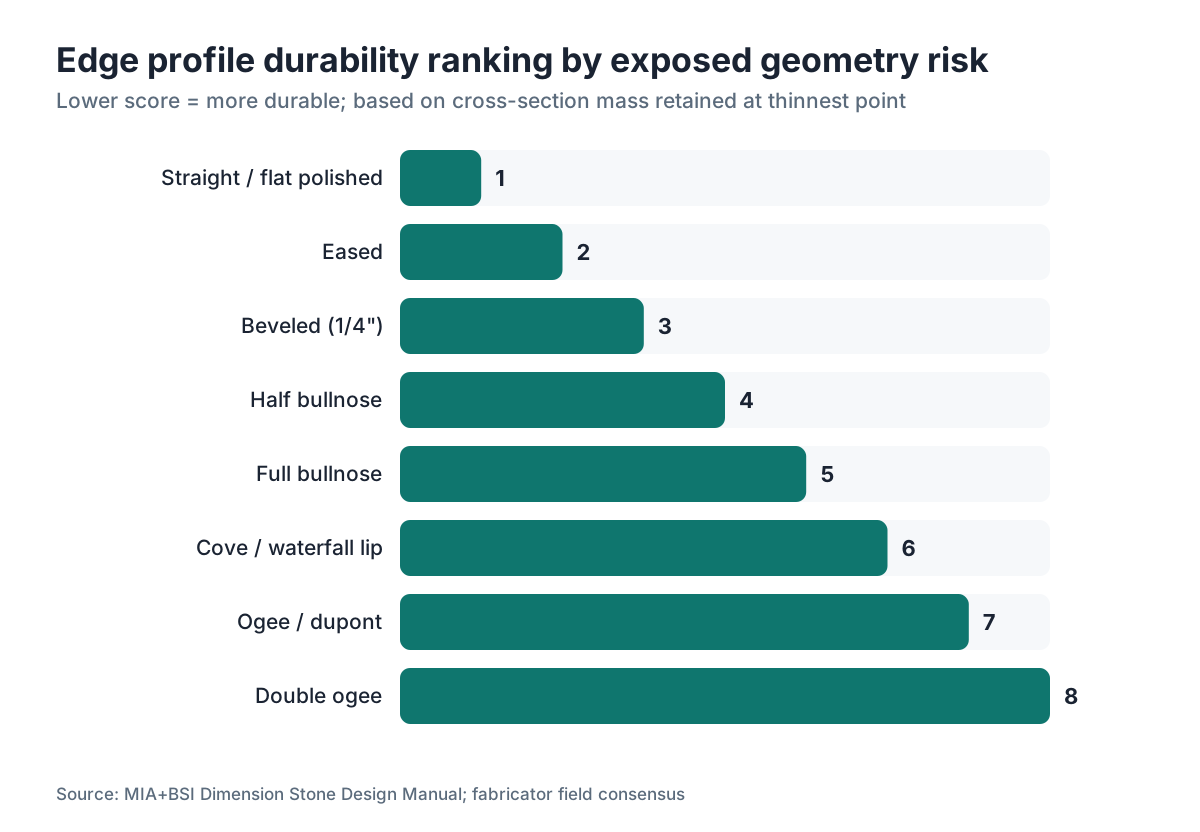
Here's a direct ranking from most to least durable, based on the geometry of how each profile handles impact and wear.
| Edge Profile | Durability Rank | Exposed Geometry | Notes |
|---|---|---|---|
| Straight / flat polished | 1 (best) | None, full thickness exposed | Zero thin points; maximum cross-section |
| Eased (slightly softened) | 2 | Minimal, tiny chamfer only | Industry workhorse; almost no chip risk |
| Beveled (1/8" to 1/4") | 3 | Small angled face | Clean look, very little liability |
| Half bullnose | 4 | Top rounded, bottom square | Rounded top survives; square bottom is the weak point |
| Full bullnose | 5 | Full round, both sides | Uniform curve spreads impact well; thinner stone = more risk |
| Cove / waterfall | 6 | Concave cut into stone | Concave geometry is inherently thinner at the lip |
| Ogee / dupont | 7 | S-curve with protruding lip | Thin raised tip is the most vulnerable point in residential use |
| Double ogee | 8 (worst) | Two stacked S-curves | Multiple thin lips; high chip probability over time |
Eased is the default recommendation from most fabricators for exactly this reason. It removes just enough of the sharp factory corner to eliminate the most fragile point (a truly square corner chips easily too) while keeping the cross-section as thick as possible.
Full bullnose used to be the standard safe pick, and it's still fine on thicker slabs. On a 3 cm slab (about 1.25 inch) it holds up well. On thinner 2 cm material, the rounded edge gets surprisingly thin on both sides, which cuts the mass available to absorb impact.
Ogee is the profile fabricators quietly dread quoting for clients with young kids or a busy commercial kitchen. The raised S-curve lip looks elegant, but it's basically a decorative overhang with minimal cross-section behind it. One dropped cast-iron pan can take off the tip cleanly.
Does the countertop material change which edge holds up best?
Yes, a lot. The material's hardness, brittleness, and internal grain structure all interact with edge geometry.
Granite scores 6 to 7 on the Mohs hardness scale [1]. It's hard, but it's also coarse-grained and slightly more likely to fracture along crystal boundaries when an edge is thin. Complex profiles on granite are a real gamble. Eased or beveled edges let the material's natural hardness work in your favor without exposing a fragile tip.
Engineered quartz (brands like Cambria, Silestone, Caesarstone) scores around 7 on Mohs and has a more uniform internal structure because it's a manufactured product [2]. That uniformity means it handles complex profiles slightly better than natural stone, but it still chips. Quartz has a particular failure mode where the resin binder at a thin lip cracks cleanly, leaving a sharp break that can't be easily repaired.
Marble and quartzite are softer (marble is around 3 on Mohs) and more porous, which makes thin edge profiles even riskier [3]. The surface near a carved ogee lip is thinner and more open to both impact and acid etching at once. If you have marble, flat or eased isn't just the durable choice, it's the only sensible one for a working kitchen. You can read more about protecting the surface itself in how to clean stone countertops.
Butcher block and laminate countertops play by different rules. Wood doesn't chip the way stone does. It dents and compresses. The edge profile on butcher block matters more for moisture trapping than impact resistance. Laminate profiles that wrap the substrate are limited by what the substrate will accept. Formica and similar materials often use a post-formed rounded edge that's actually quite durable, because the surface material bends rather than sits at a machined tip.
For granite countertops specifically, the mix of natural hardness and crystal structure makes eased or small beveled edges the practical sweet spot.
What's the difference between eased, beveled, and bullnose edges?
These three terms get mixed up constantly, even in showrooms.
An eased edge takes the sharp 90-degree corner and softens it with a very small radius, usually 1/16 to 1/8 of an inch. Run your finger across an eased edge and you barely feel the curve. It looks nearly flat from across the room. There's no beveled, no flat angled face.
A beveled edge replaces the corner with a flat angled cut, typically at 45 degrees and anywhere from 1/8 inch to 1/2 inch wide. Some people love the clean, modern look. It's more visually distinct than an eased edge but still leaves a good cross-section of material.
A bullnose edge rounds the entire top edge into a semicircle. A half bullnose rounds only the top, leaving the underside square. Full bullnose is warmer and more traditional-looking. Half bullnose is arguably the worst of both worlds for durability. The square bottom corner can still chip, and the rounded top is thinner than a flat edge at the same slab thickness.
If someone at a showroom is pushing bullnose as the safest profile, that advice is about 15 years old. Eased has taken over as the fabricator consensus for durability in modern kitchens.
How much more do complex edge profiles cost?
Edge profiles are priced per linear foot of countertop edge. Simple profiles are often baked into a base fabrication quote. Complex profiles add a line-item upcharge.
Typical market ranges (these vary by region and shop; get at least two quotes):
| Profile Category | Typical Upcharge (per LF) |
|---|---|
| Eased or straight polish | $0 (usually included) |
| Beveled (standard) | $0, $5 |
| Half bullnose | $5, $10 |
| Full bullnose | $5, $15 |
| Ogee | $15, $30 |
| Dupont | $20, $35 |
| Double ogee | $25, $45 |
| Waterfall / mitered | $50, $150+ |
A typical kitchen has 20 to 35 linear feet of exposed edge. Going from an eased to a double ogee profile can add $500 to $1,500 to the job, before any seam or cutout complexity. That's real money for a profile that is, by every mechanical measure, less durable than what you started with.
Fabricators who use shop management software like SlabWise can price edge profiles as standalone line items in each quote, which makes it easy for a homeowner to see exactly what the upgrade is costing them before they commit.
The waterfall edge (a mitered 90-degree turn where the slab continues down the side of the cabinet) is a different animal. It's more a design element than a profile, and the price reflects specialized cutting and installation work, not one more router pass.
For countertop installation, the edge profile choice is one of the few decisions that touches both your upfront cost and your long-term maintenance bill.
Do certain edge profiles collect more grime or bacteria?
Yes, and it's underappreciated. Hygiene and durability interact in a real way. A profile that traps crumbs, grease, and moisture eventually degrades faster, because water working into microfractures speeds up the damage.
Flat, eased, and beveled edges are the easiest to wipe clean. One pass with a cloth and the edge is done. Ogee and dupont profiles have concave sections that collect debris and need a toothbrush or cotton swab to clean properly. Over months and years, most homeowners simply don't clean those crevices well enough.
The FDA Food Code sets surface requirements for commercial food service, noting that food-contact surfaces must be "smooth and easily cleanable" [4]. That standard doesn't apply to residential kitchens, but the logic does. Complex carved edges are the opposite of smooth and easily cleanable.
For natural stone like marble countertops or quartzite, a carved ogee profile also concentrates cleaning products right at the thinnest part of the edge, where acid in cleaners can etch or degrade the stone over time. That's a slow process, but it's real.
Porosity at edge profiles runs higher than on polished faces, because grinding and polishing a complex profile perfectly is harder. A little edge microporosity means water infiltration, sealer exhaustion, and eventual staining all concentrate there first.
What edge profile do most fabricators actually recommend?
Ask ten experienced fabricators what profile they put in their own kitchens and nine will say eased or a small bevel. The tenth might say full bullnose out of a traditional preference, but they'll still tell you it's not the most practical.
The industry has moved hard toward eased edges over the past decade, driven by two things. The rise of thick quartz slabs, where simplicity reads as expensive rather than cheap. And the growth of modern design, where a clean straight edge looks intentional instead of basic.
There's a shop reason too. Eased edges are faster to produce, need fewer tool passes, and have a much lower callback rate. A fabricator running a tight shop has a real financial incentive to steer customers toward profiles that won't come back cracked in six months.
The exception is bathroom vanities and low-traffic surfaces. On a guest bath vanity that nobody pounds pots on, a full bullnose or a modest ogee is a reasonable aesthetic choice with manageable risk. The trouble starts when people fall in love with a complex profile in a showroom and spec it everywhere, including the main kitchen island where a Dutch oven lands twice a week.
If you're a fabricator pricing jobs, the edge profile talk is also a chance to flag slab thickness. A 2 cm slab with an ogee is a genuinely higher-risk combination worth documenting in writing.
Does slab thickness affect how durable an edge profile is?
Absolutely. Slab thickness is probably the single biggest multiplier on edge durability.
The two standard thicknesses are 2 cm (about 3/4 inch) and 3 cm (about 1 1/4 inch). Three centimeter is now the default for most residential countertop work in the U.S., partly because it looks more substantial and partly because it handles edge profiles better [5].
On a 3 cm slab, a full bullnose still leaves about 3/4 inch of stone at its thinnest cross-section after rounding. That's workable. On a 2 cm slab, the same bullnose leaves you with roughly 1/2 inch or less at the thinnest point. An ogee on 2 cm material is borderline reckless for a kitchen.
Some shops laminate 2 cm slabs at the edge to fake the look of a thicker profile without the full material cost. This creates a seam, which is its own maintenance question, but it does improve the structure. If you see a countertop quote that specifies 2 cm stone with a complex profile, ask whether the edge will be laminated.
Engineered quartz products tend to default to 3 cm for residential use. Cambria countertops, for example, come at 1 1/4 inch thickness as standard. That consistent thickness is part of why they handle profiles slightly better than thinner natural stone.
For fabricators, noting slab thickness alongside profile choice in every quote cuts down disputes later. If a client insists on ogee on 2 cm quartzite, document that conversation.
What's the most durable edge for a kitchen island specifically?
Kitchen islands take more abuse than any other surface in the kitchen. They're the landing zone for groceries, the prep area for messy tasks, the place where kids sit, and the spot where a pan gets set down harder than intended at 6:45 PM on a Tuesday.
For islands, the recommendation tightens. Eased edge is the right call in most cases. If the homeowner wants more visual presence, a 1/4-inch bevel gets a slightly more designed look without meaningfully raising chip risk.
The underside of the island overhang deserves a look too. If the island has a seating overhang (typically 12 to 15 inches [7]), the underside of that lip gets bumped by barstools, knees, and the occasional head. A square underside edge there is a chip waiting to happen. A small eased or chamfered underside on the overhang edge is a detail worth asking your fabricator about.
Avoid waterfall edges on islands unless the design is clearly modern and you understand the maintenance. The miter joint on a waterfall edge, if it isn't sealed perfectly, becomes a moisture infiltration point over years of kitchen use.
For kitchen countertops in general, the island edge is the one buyers put their hands on at resale, so durability and looks actually converge here. A well-executed eased edge looks intentional and holds up. That's the rare combination.
Are there any edge profiles that are genuinely hard to repair if they chip?
Yes. And repairability is a real part of total durability.
Simple flat profiles are the easiest to repair. A chip on a straight or eased edge gets filled with color-matched epoxy, then lightly re-polished, and the repair is nearly invisible. Fabricators do this routinely. It takes an hour and runs $100 to $300 depending on size and region.
Complex profiles are much harder to repair invisibly. An ogee or dupont tip that chips needs the profile re-cut on that section, which means removing the countertop or doing very careful in-place grinding. The geometry of a carved profile is hard to match on a spot repair, and the re-polished section can end up with a slightly different sheen than the original surface next to it.
Double ogee and similar multi-curve profiles are essentially irreparable in place if a significant section chips. Your options are replace the section or live with the damage. That's not a hypothetical. Fabricators hit this regularly on jobs a few years old.
For solid-surface materials like Corian countertops, edge repairability is better regardless of profile, because the material is uniform through its thickness and can be re-sanded. That's one genuine advantage of solid-surface over stone for complex profiles.
If you're set on a decorative profile but worried about chips, ask your fabricator what a repair would involve before you commit. A good fabricator gives you an honest answer.
How do you talk to your fabricator about edge profiles?
Most homeowners walk into a fabricator's shop, see a wall of profile samples, and make an aesthetic choice with no durability context. That's not wrong. You live with how it looks every day. But a five-minute conversation can prevent an expensive mistake.
Ask these three questions. What profile do you see come back for chip repairs most often? What do you put in your own kitchen? If I go with this profile on this material and thickness, what's the realistic risk over five years?
A fabricator worth working with answers all three directly. If you get a sales pitch instead of a real answer, that's information.
Bring photos of profiles you like and ask the fabricator to show you samples in the actual material you're using. A profile that looks great in a showroom sample of Calacatta marble can look completely different in a darker absolute black granite.
For fabricators running their shops, SlabWise lets you build edge profiles as individual line items in your quote template, so the price of each option is visible and the conversation with the client becomes about informed choices instead of surprises at the invoice stage. That transparency is genuinely good for both sides.
Get the edge profile specified in writing in your contract, including the exact name. "Eased" means different things to different shops, so confirm it's a 1/16" radius versus something larger. A photo reference attached to the contract is better still.
What about outdoor countertops or high-humidity areas?
Outdoor kitchens and high-humidity spaces like outdoor bars push the calculus further toward simple profiles.
Water infiltration at any edge imperfection speeds up dramatically outdoors. Freeze-thaw cycles in colder climates mean any microcrack in a complex profile expands each winter [8]. In warmer, humid climates, biological growth and mineral deposits collect in the concave sections of ornate profiles.
For outdoor countertops, the answer is nearly always straight or eased. Full stop. The durability edge of simple profiles is magnified outdoors, because the stressors that attack thin stone cross-sections are much stronger than inside.
Some fabricators use a slightly larger eased radius (1/4 inch instead of 1/16 inch) for outdoor work. That larger rounding sheds water more efficiently and gives a bit more mass at the edge.
Soapstone, which is naturally non-porous, handles outdoor use better than most stones. If you're interested in how to clean soapstone countertops, the same traits that make soapstone easy to maintain indoors make it practical outdoors, especially with a simple edge profile.
Frequently asked questions
What is the most durable countertop edge profile for everyday kitchen use?
Eased edge is the most durable for everyday kitchen use. It softens the factory corner with a tiny radius, leaving the maximum cross-section of stone intact. There are no thin protruding lips or concave sections to chip, and it's easy to wipe clean. Fabricators almost universally put eased edges in their own kitchens.
Does a bullnose edge chip more than an eased edge?
Full bullnose chips less than ornate profiles like ogee, but more than eased or flat edges. The rounding means any impact hits a curved surface rather than a sharp corner, which helps. The problem is that rounding cuts the cross-sectional thickness at the edge, leaving less material to absorb the hit. On 3 cm slabs it's manageable; on 2 cm slabs it's a real risk.
Is an ogee edge a bad choice for a kitchen?
For a busy kitchen, yes. The raised S-curve tip of an ogee profile is the thinnest, most exposed geometry on any standard edge. It piles up impact stress and chips under moderate abuse. It's also hard to clean in the concave section and very difficult to repair invisibly if it does chip. Better for low-traffic bathrooms or decorative uses than a working kitchen.
Which edge profile is easiest to repair if it chips?
Straight, flat-polished, and eased edges are easiest to repair. A chip on a flat edge gets filled with color-matched epoxy, lightly polished, and rendered nearly invisible. Complex profiles like double ogee or dupont require re-cutting the profile geometry to repair properly, which is often impossible in-place and may mean replacing the section of stone.
Does the edge profile matter as much for quartz as for granite?
Quartz handles complex profiles slightly better than natural stone because its manufactured composition is more uniform, with fewer crystal boundaries where cracks propagate. But quartz still chips at thin edges, with a characteristic clean break at the resin-bonded tip. The durability hierarchy of edge profiles applies to quartz too. Simple edges are safer, the risk gap is just somewhat smaller.
How much does upgrading to a decorative edge profile cost?
Eased and beveled edges are typically included in a base fabrication quote. Ogee profiles add roughly $15 to $30 per linear foot. Double ogee can add $25 to $45 per linear foot. A kitchen with 25 linear feet of exposed edge could see $375 to $1,125 in extra costs going from eased to ogee, for a profile that is measurably less durable.
What edge profile should I use for a kitchen island with seating?
Eased edge on the top, with a small eased or chamfered edge on the underside of any seating overhang. The underside of island overhangs gets bumped by barstools and knees and is often left with a sharp square edge that chips easily. Asking your fabricator to ease the underside as well as the top is a simple, low-cost durability upgrade.
Is a waterfall edge durable?
A waterfall (or mitered) edge is more a design element than a standard profile. The miter joint where the horizontal top meets the vertical side panel is the vulnerability. If it isn't sealed perfectly, it can admit moisture and crack over time. The individual edges themselves can be eased or flat, which keeps them durable. The joint maintenance is the real long-term consideration.
Does edge profile durability differ for marble versus quartzite?
Yes. Marble scores around 3 on the Mohs scale and is significantly softer and more porous than quartzite, which scores 7. On marble, even a modest beveled edge is a chip risk under normal kitchen use, so flat or eased is the only practical choice. Quartzite handles slightly more complex profiles, though still not ogee or dupont on a working kitchen surface.
What does 'eased' actually mean in countertop fabrication?
An eased edge is a 90-degree corner with a very small radius applied to the top edge, typically 1/16 to 1/8 of an inch. It removes the fragile sharp corner without creating a visible bevel or curve. From across the room, it looks essentially flat. Different fabricators use slightly different radii, so ask them to show you a sample piece so you know exactly what you're getting.
Are there edge profiles that collect bacteria or are harder to sanitize?
Complex concave profiles, like ogee, dupont, and cove, collect crumbs, grease, and moisture in their recessed sections. These are genuinely harder to wipe clean with a single pass. Flat, eased, and beveled edges clean with one cloth swipe. The FDA Food Code standard for commercial surfaces requires smooth, easily cleanable surfaces for this exact reason, and the same logic applies to home kitchens.
Should I choose the same edge profile for my bathroom vanity as my kitchen countertop?
Not necessarily. Bathroom vanities take far less mechanical abuse than kitchen countertops, with no heavy pots, no daily cutting, and less frequent cleaning with aggressive products. That lower-impact environment makes decorative profiles like full bullnose or a modest ogee more reasonable in a bathroom. It's a fair place to spend a little more on aesthetics without the durability tradeoff mattering much.
Can a fabricator change the edge profile after the countertop is installed?
Sometimes, but it's expensive and limited. A fabricator can re-profile an existing edge in place with hand-grinding tools for simple transitions, going from a bullnose to an eased edge, for example. Going the other direction (adding complexity to a simpler profile) is much harder and may require removing the slab. It's far better to decide on the profile before fabrication than to change it later.
What edge profile is best for outdoor countertops?
Straight or eased edge, with a slightly larger radius than you'd use indoors (around 1/4 inch). Outdoor conditions amplify every weakness in complex profiles. Freeze-thaw cycles crack thin stone lips, humidity encourages biological growth in concave sections, and UV exposure degrades the sealers that protect carved edges. Simple profiles shed water, resist freeze damage, and are easier to re-seal.
Sources
- USGS Minerals Information: Granite: Granite scores approximately 6 to 7 on the Mohs hardness scale due to its quartz and feldspar mineral composition.
- NSF International: Engineered Stone Certification Overview: Engineered quartz products typically score around 7 on the Mohs scale due to their high quartz aggregate content and uniform resin-binder matrix.
- Smithsonian Institution: Mineral Sciences, Marble: Marble is composed primarily of calcite or dolomite and scores approximately 3 on the Mohs hardness scale, making it significantly softer than granite or engineered quartz.
- FDA Food Code (surface material requirements for food-contact surfaces): The FDA Food Code requires food-contact surfaces to be "smooth and easily cleanable" in commercial food service.
- Marble Institute of America (now MIA+BSI): Dimension Stone Design Manual: Three-centimeter (1-1/4 inch) slabs are the predominant residential countertop thickness in the U.S. and provide greater structural integrity for edge profiling than 2 cm material.
- USGS Open-File Report 2004-1051: Hardness and Abrasion Resistance of Stone: Quartzite typically scores 7 on the Mohs scale due to its metamorphic quartz composition, making it harder and more abrasion-resistant than marble.
- National Kitchen and Bath Association (NKBA): Kitchen Design Guidelines: Standard kitchen island seating overhangs are 12 to 15 inches to accommodate standard stool heights comfortably.
- EPA: Indoor Air Quality and Hard Surface Materials in Residential Construction: Surface porosity and moisture infiltration into microfractures in stone surfaces can accelerate degradation over time in kitchen environments.
- MIA+BSI: Natural Stone Installation Specifications: Edge profile selection should account for slab thickness, with more complex profiles carrying higher risk of edge failure on 2 cm material compared to 3 cm slabs.
- Occupational Safety and Health Administration (OSHA): Silica Standard for Construction: Countertop fabrication involving grinding and cutting of stone is subject to OSHA silica exposure standards, with edge profiling generating significant respirable dust.
Last updated 2026-07-09