TL;DR
- Countertop edge profiles range from a flat eased edge (usually included in the base price) to decorative shapes like ogee or waterfall that add $10, $30 per linear foot.
- Your best choice depends on your material, cabinet style, household safety needs, and how much edge is even visible.
- Most kitchens do fine with an eased or slight bevel.
- Ornate edges are often a waste of money on busy counters.
What is a countertop edge profile and why does it matter?
The edge profile is the shape cut into the exposed perimeter of your slab, the strip of stone that faces you when you stand at the counter. It's one of the last decisions people make and one of the first they regret rushing.
A profile affects three real things: how the counter looks, how safe it is (sharp corners vs. rounded), and how much it costs. The shape is cut by a CNC router or a hand-held router with a diamond-profile bit, and the labor in the more complex shapes is what drives the price. An eased edge takes one pass. A full bullnose takes multiple passes plus hand-polishing on the curved face. An ogee or stacked profile can take four or five tool changes and a lot of hand-finishing.
For most homeowners, the edge is a purely aesthetic call. Fabricators know it also affects yield. A wide laminated edge, for example, means gluing a strip of stone under the slab, which costs extra material and labor and can show on light-colored stones if the grain doesn't match well.
What are the most common countertop edge profiles?
Here's a plain rundown of the profiles you'll actually meet at a fabricator's shop, roughly from simplest to most complex.
Eased (flat with a slight relief): The default. The top corner is broken just enough that it won't cut your hand, and the face stays flat. Most shops include this in the base slab price. Clean, modern, works on any material.
Beveled: The top corner is cut at an angle, usually 45 degrees, creating a small angled facet. A little more decorative than eased. Adds visual lightness to thick slabs. Usually a $2, $6 per linear foot upcharge.
Half bullnose: The top edge is fully rounded, the bottom stays flat. Softer than eased, still simple to fabricate. Good for families with young kids since there's no sharp top corner.
Full bullnose: Both top and bottom corners round into a continuous curve. The whole edge face is convex. Polishing the curved underside adds labor. Expect $6, $12 per linear foot over eased on natural stone.
Ogee: An S-curve, concave at the top then convex below. Classic and traditional. Looks great on thick slabs, fussy on thin ones. The profile needs multiple bit passes and finishing time, which is why it often adds $12, $20 per linear foot [1].
Dupont (DuPont): A step profile with a flat top and a quarter-round at the bottom of the step. People confuse it with ogee constantly. Common on laminate and engineered stone because the routed step helps hide the substrate.
Waterfall (mitered): The countertop surface continues straight down the cabinet end panel, so the stone runs from counter to floor in one visual line. This is not a routed edge profile. It's a separate slab mitered and joined at the corner. Material cost doubles for that panel and the labor is real. Budget $200, $500 or more for a single waterfall end depending on slab size and stone type.
Laminated (stacked): An extra strip of stone is glued to the underside of the slab edge to build a 2-inch or 3-inch thick edge on a material that's only 3/4 inch or 1.25 inches thick. The visual weight reads as a high-end thick countertop. The glue line shows on some stones, which is a real drawback.
Chiseled/Natural: The edge is left rough or hand-chiseled to mimic a raw stone break. Common on quartzite and some granites. Authenticity varies; some shops fake it with a mechanical textured bit.
For granite countertops, ogee and dupont are both popular because 3/4-inch or 1.25-inch granite has enough thickness to carry the profile without looking toy-like. For marble countertops, a full bullnose or eased edge tends to read as more refined. For laminate countertops, post-form edges are pre-shaped at the factory and your options are limited unless you're doing a custom laminate job.
How much does a countertop edge profile typically cost?
Fabricators price edges per linear foot of exposed edge. "Exposed" matters: the back edge against the wall and the edge hidden by the range don't get profiled and don't get charged.
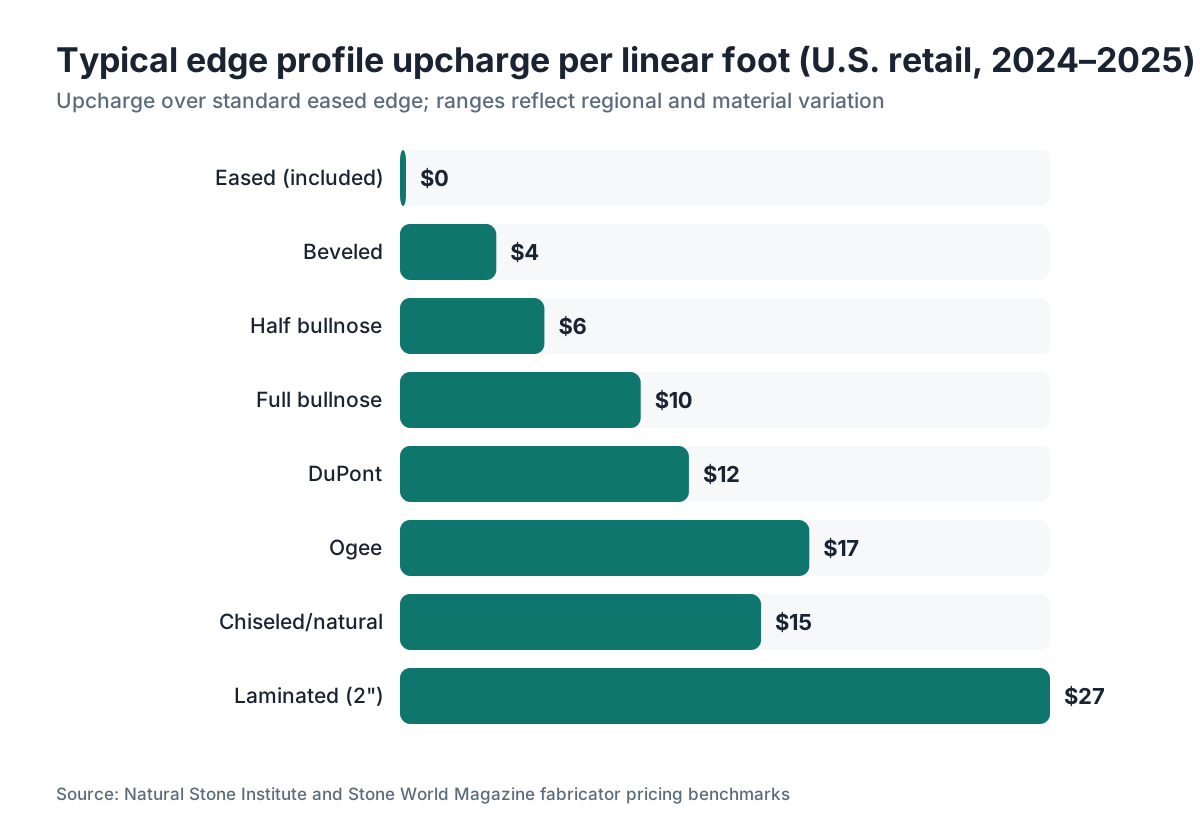
The table below shows typical retail upcharge ranges over a standard eased edge. These are fabricator-to-homeowner prices in the U.S. as of 2024 to 2025. Regional labor rates vary, so a shop in rural Oklahoma charges less than one in San Francisco for the same profile on the same material [2].
| Profile | Typical upcharge over eased (per linear foot) |
|---|---|
| Eased | $0 (usually included) |
| Beveled | $2, $6 |
| Half bullnose | $4, $8 |
| Full bullnose | $6, $14 |
| Ogee | $12, $22 |
| DuPont | $8, $15 |
| Laminated edge (2") | $18, $35 |
| Waterfall panel (mitered) | $200, $600 per panel |
| Chiseled/natural | $10, $20 |
A typical kitchen has 15 to 25 linear feet of exposed edge. Swapping from eased to ogee across a full perimeter could add $180, $550 to your total. On a $4,000 stone job, that's 5 to 14% more. Decide whether the upgrade is worth it before you sign. Edge changes after templating are sometimes possible, but some shops lock in the profile at template time.
Shops tracking edge upcharges at scale can build per-profile pricing rules into their quote templates with software like SlabWise, so the edge cost flows straight into the customer-facing number.
One honest caveat. These prices come from public fabricator price lists and industry discussion forums [2][3]. Nobody publishes a nationwide survey of edge pricing. The ranges above are real, but the midpoint in your market could land anywhere inside them.
Which edge profile works best for each countertop material?
Material thickness and hardness decide what profiles are physically possible and what looks good.
Natural stone (granite, quartzite, marble): Comes in 2 cm (3/4") or 3 cm (1.25") thickness. Three-centimeter slabs are thick enough to carry a full ogee or bullnose without looking stumpy. Two-centimeter slabs usually need a laminated edge if you want visual weight, because a 3/4" full bullnose looks thin and fragile. Most fabricators recommend 3 cm for any decorative profile.
Quartz (engineered stone): Quartz usually sells in 3 cm, so you get full profile options. Hard material, CNC-friendly, finishes cleanly. Cambria, for instance, publishes a profile menu for each collection; standard offerings include eased, bevel, half bullnose, and full bullnose, with ogee and dupont as upgrades [4].
Laminate: Post-form laminate comes pre-edged with a curved front. Custom laminate jobs can use wood edge banding, aluminum strips, or a beveled laminate edge, but routed stone profiles don't apply. If you're weighing budget options, laminate countertops have limited but workable edge choices.
Solid surface (Corian, etc.): Solid surface can be thermoformed into almost any shape, including curved edges and integral coved backsplashes. This is one area where solid surface genuinely beats stone on profile flexibility. It routes to custom profiles and sands smooth with no visible joint or color change.
Butcher block: Wood profiles just like stone. Many of the same shapes apply: eased, bullnose, bevel, ogee. The catch is the end grain. On butcher block countertops, a full bullnose edge means sanding the curved face across the grain, which can raise fibers and needs extra finishing passes. An eased or bevel edge is easier to maintain and refinish later.
Porcelain slab: Typically 6mm or 12mm thick, so profile options are limited. Most porcelain jobs use a mitered edge or laminated edge to add thickness, or the fabricator recommends an eased edge and lets the ultra-thin profile read as a design feature.
What edge profile is best for a modern or contemporary kitchen?
Flat. Full stop.
The eased edge and the straight-face bevel dominate modern and contemporary kitchens because the design language of those styles is horizontal planes, clean lines, and material honesty. An ogee or dupont in a flat-front slab-door kitchen looks like a category error, like Victorian crown molding on a Mies van der Rohe building.
For ultra-modern kitchens, some fabricators push the mitered 45-degree edge (not to be confused with a bevel), where two pieces of stone meet at the corner at a 45-degree angle. It makes the slab look even thinner and creates a razor-edge look. It's beautiful when done well and demands extremely precise CNC work.
The waterfall edge, where the stone runs down the island end panel, is popular in contemporary design and photographed constantly in shelter magazines. It's a big cost add, and it only looks right when the slab's veining is bookmatch-joined at the corner or when a plain stone is used. A heavily veined marble waterfall with mismatched grain at the miter looks bad.
For kitchen countertops in transitional kitchens, the half bullnose or an eased edge with a slight radius (sometimes called a 1/8" radius eased) is probably the single most popular choice in U.S. shops today, based on what fabricators report in industry forums [3].
What edge profile is safest for families with young children or older adults?
Sharp 90-degree corners on stone countertops are a real hazard, especially at island corners at toddler head height. This isn't hypothetical. The Consumer Product Safety Commission's emergency room data consistently shows kitchen furniture and fixtures as a source of head and facial injuries in children under 5 [5].
For households with young children, avoid any profile with a sharp top corner (beveled edges have a sharper angle at the bottom of the bevel, but the top corner is removed, which is the dangerous one). Profiles with fully rounded top edges: half bullnose, full bullnose, and ogee (the ogee has a gentle curved top section).
Corner radius matters too. Ask your fabricator to radius the inside and outside corners of islands to at least 1.5 inches. A square inside corner at an island is where most head strikes happen, because kids run into them.
For older adults or anyone with balance issues, the edge profile matters less than the overhang and whether there are sharp corners at standing height. The AARP HomeFit Guide recommends rounded edges and no sharp protrusions in accessible kitchen design [6].
The eased edge, despite being the default, still has a slightly sharp top corner. If safety is a priority, spend the $4, $8 per linear foot for a half bullnose. It's the best-value safety upgrade in countertop fabrication.
Does the edge profile affect how easy the countertop is to clean?
Yes, and this gets ignored more than it should. Flat eased edges wipe clean in one pass, no crevices. A full bullnose asks you to wipe around the curve, not hard but a bit more care. The real cleaning problem is ogee and dupont, because the concave section of an ogee makes a trough that collects crumbs, grease, and cleaning residue. If you cook seriously, that trough will irritate you within a month.
Laminated edges have a glue line, and that glue line can harbor bacteria if it opens even slightly. Epoxy used in stone lamination is food-safe once cured, but a gap from poor adhesion or thermal movement is a hygiene issue.
For kitchens that see heavy daily use, cleaning is a real vote for eased or half bullnose. For a bathroom vanity or a low-use prep area, it barely matters.
On porous stones like quartzite or leathered granite, the texture of the edge itself affects cleaning. A polished edge on a leathered top creates a visual and tactile mismatch, but that polished strip is actually easier to clean. For more on keeping stone surfaces clean, see how to clean stone countertops and how to clean quartzite countertops.
How does cabinet style affect which edge profile you should pick?
The edge profile needs to read as part of the same design vocabulary as the cabinet doors. This is the rule most homeowners forget.
Raised-panel cabinets (traditional, Shaker-plus, colonial styles) have three-dimensional relief on their door faces. An ogee, dupont, or beaded edge continues that language and looks intentional. A flat eased edge on a raised-panel kitchen looks underdressed.
Flat-panel or slab-door cabinets (modern, contemporary, minimalist) have zero relief. A decorative ogee edge above them looks grafted-on.
Shaker cabinets are a square-profile rail with a recessed panel. They're transitional. Both eased and half bullnose work well. A full ogee is usually too heavy.
Beaded-inset cabinets are traditional and pair well with an ogee or dupont.
The height of your upper cabinet doors from the counter also changes edge visibility. With 18 inches of backsplash tile between counter and uppers (standard), the edge is visible to anyone standing at the counter. When upper cabinets run all the way to the counter (rare, but it happens in some European-style kitchens), the front edge is the only profile anyone sees.
Does edge profile choice affect resale value?
Probably not in any meaningful way, and anyone who tells you a specific edge adds X percent to resale is making it up.
The National Association of Realtors publishes remodeling cost-vs-value data every year, but it doesn't break out edge profile as a line item [7]. The Remodeling Cost vs. Value report for 2024 shows a midrange kitchen remodel recoups about 49.5% of cost nationally, and an upscale remodel recoups about 38.7%, but neither number isolates edge choice.
What actually moves resale is whether the countertop is in good condition, whether the kitchen feels current, and whether the stone color and finish appeal broadly to buyers. A stunning ogee edge on a badly stained countertop doesn't help. A clean eased edge on a well-matched material in good shape does.
Save the fancy-edge money unless you love it for yourself.
How do you choose between a polished, honed, or leathered edge finish?
The edge finish (the surface texture) is a separate decision from the profile shape. You can have a honed surface with a bullnose profile, or a polished surface with an eased profile.
Convention says the edge finish should match the surface finish. A leathered countertop with a high-gloss polished edge looks wrong to most eyes because the light reflects so differently. Most fabricators default to matching, and you should let them unless you have a specific reason not to.
The one exception is a chiseled or natural edge finish, which stays intentionally rough-textured regardless of the surface finish.
Honed edges on granite or marble show water spots more readily than polished edges, worth knowing if the counter edge sits near a sink. For stones like soapstone that are naturally matte, the edge finish question resolves itself; see how to clean soapstone countertops for more on maintaining non-polished stone.
What questions should you ask your fabricator before finalizing an edge?
A good fabricator keeps profile samples in the shop, usually cut from scrap stone or mounted on a display board. Ask to see the profile on the actual material you're using, not on a sample board with a different stone. A full bullnose on black absolute granite looks nothing like the same profile on a white quartzite with heavy veining.
Ask these before signing the contract:
- What profiles are included in the base price? (Get this in writing.)
- What is the per-linear-foot upcharge for each upgrade profile I'm considering?
- How many linear feet of exposed edge does my layout have?
- Can I see the profile on a scrap piece of my actual slab?
- Will you radius the island corners, and is there a charge for that?
- For a laminated edge: where will the glue line fall, and can you show me a sample of the grain match?
Fabricators who use structured quoting software (like SlabWise, which builds edge profiles and upcharges into the job quote automatically) usually give you a cleaner line-item breakdown than shops still quoting by hand. Either way, the edge cost should be its own line item in your quote, not buried in a lump sum.
Ask about lead time too. Some decorative profiles need special bits the shop may not stock. An ogee on an unusual stone can require a bit order that adds a week to the timeline. Better to know upfront than after templating.
Finally, look at the countertop installation process for your material. Some edge profiles are fragile during transport and install: a full bullnose on a thin slab, for instance, can chip at the curved underside if the slab flexes during the lift.
What edge profile is the best overall choice for most kitchens?
If I had to pick one profile for the widest range of kitchens, it's the eased edge with a 1/8" or 1/4" radius on the top corner. It's included in the base price at most shops. It reads as current in both modern and transitional styles. It cleans easily. It's not precious. It doesn't fight the stone for attention.
The half bullnose is the upgrade I'd actually pay for, especially for households with kids or when the counter has a lot of exposed island edge that gets banged by hips and bags. The cost is small, the safety benefit is real, and it photographs well.
The ogee is the profile I'd talk most homeowners out of, unless they have traditional raised-panel cabinets and a stone thick enough to carry it (3 cm minimum). The cleaning crevice, the higher fabrication cost, and the period look make it a narrow recommendation.
Waterfall edges are worth the money when the stone and the design genuinely call for it. Just go in knowing you're adding $400, $1,000 or more to the job for what is essentially a visual choice.
For any kitchen countertops project, the edge is a long-term commitment. You live with it every day. Look at it on your actual stone in your actual shop before you sign.
Frequently asked questions
Is the edge profile included in the countertop quote or is it an add-on?
Most fabricators include a standard eased edge in the base price and charge a per-linear-foot upcharge for anything more decorative. Always confirm in writing what the base edge is before assuming. Some shops include a half bullnose as standard; others charge for even a bevel. The upcharge applies only to exposed edges, not to edges against the wall or backsplash.
Can I change my edge profile after templating?
Sometimes, but not always. Once the slab is cut to shape and a simple edge is routed, a fabricator can usually re-profile to a more decorative shape before polishing. But if the slab is already finished, or if the change would mean removing material (like going from ogee to a simpler profile), it may not be reversible. Ask at templating, not after.
What edge profile is most popular right now?
Based on what fabricators report in industry forums and what design publications feature, the eased edge with a slight radius and the half bullnose are the most common choices in U.S. kitchens for 2024 to 2025, particularly in new construction and renovations with transitional or contemporary cabinets. Ogee peaked in the 1990s and early 2000s and has fallen off since.
Does a thicker slab look better with a certain edge?
Yes. Decorative profiles like ogee and full bullnose look proportional on 3 cm (1.25-inch) slabs. On 2 cm (3/4-inch) slabs, those profiles look thin and unfinished. If you want the look of a thick slab with 2 cm material, ask your fabricator about a laminated edge, where a strip of stone is glued to the underside to build up visual thickness before profiling.
What edge profile works best on an island versus a perimeter counter?
Islands are seen from multiple angles and take more daily contact (hips, grocery bags, kids). A rounded edge like a half bullnose makes sense there. Perimeter counters along walls are seen mostly from one angle and touched less, so an eased edge is fine. Some homeowners run a decorative edge on the island only and save money with eased everywhere else. That's a reasonable compromise.
Can I get different edge profiles on different sections of the same countertop?
Yes, fabricators can run different profiles on different sections if you ask. A common choice is a decorative profile on the island (fully visible) and a plain eased edge on the perimeter runs (front visible, back against a wall). Confirm the shop will do this before assuming, and expect a modest setup charge if they have to change tooling mid-job.
What is a waterfall edge and how much does it cost?
A waterfall edge is when the countertop material runs vertically down the side of the cabinet or island end panel, making a continuous surface from counter to floor. It needs a separate slab panel mitered at 90 degrees and joined to the top. Cost runs $200, $600 per panel for the extra material and labor, sometimes more for large slabs or heavily veined stones that require book-matching.
Does edge profile affect how a countertop holds up over time?
Yes, in one specific way: sharp or thin edge profiles chip more easily than rounded ones. A pencil-thin razor-mitered edge on polished quartzite is beautiful but vulnerable if a pot or pan hits it. A full bullnose, fully rounded with no thin edge, is the most chip-resistant option. On busy cooking surfaces, a rounded profile is a durability choice as much as a style choice.
What edge profile should I choose for a bathroom vanity countertop?
Bathroom vanities see far less daily abuse than kitchen counters, so almost any profile works mechanically. The choice comes down to cabinet style. Traditional vanities with framed doors look good with an ogee or dupont. Modern floating vanities look better with an eased or slim bevel. Cleaning is less of a concern than in a kitchen, so decorative profiles are more defensible in the bathroom.
Is a chiseled or natural stone edge a good choice?
It depends on the stone and the context. A chiseled edge on a rustic quartzite or a leathered granite in a farmhouse or Mediterranean kitchen looks intentional and striking. On polished white marble in a modern kitchen, it reads as a mismatch. The textured edge is also harder to keep truly clean. Ask to see a real chiseled sample in your specific material, because quality varies a lot between shops.
Can laminate countertops have decorative edge profiles?
Standard post-form laminate has a pre-shaped rounded front edge that's part of the sheet. For custom laminate jobs built on a substrate, fabricators can add wood edge banding (routable to a bullnose or bevel), metal edge strips, or PVC edge tape. True stone-style routed profiles are not possible on laminate, but the alternatives give you some design flexibility beyond the standard post-form look.
How do I measure linear feet of exposed countertop edge for a cost estimate?
Measure the total perimeter of all countertop sections, then subtract the edges that sit against walls or the back of appliances. What's left is your exposed edge. For an L-shaped kitchen, this is typically the front and one or two end returns. For a kitchen island, all four sides are usually exposed. Most kitchens have 15 to 25 linear feet of exposed edge, though large islands can add another 12 to 16 feet.
Sources
- Stone World Magazine, edge profile pricing guide: Ogee and decorative profiles add $12, $22 per linear foot over eased edges in typical fabrication shop pricing
- Marble Institute of America (now Natural Stone Institute), countertop fabrication standards: Edge profile labor costs vary by regional market; pricing benchmarks reflect U.S. fabricator averages
- Natural Stone Institute, industry forums and fabricator resources: Eased and half bullnose are reported by fabricators as the most commonly sold profiles in U.S. residential countertop work
- Cambria Surfaces, edge profile options for quartz countertops: Cambria publishes a standard edge menu including eased, bevel, half bullnose, and full bullnose, with ogee and dupont as upgrades
- U.S. Consumer Product Safety Commission, National Electronic Injury Surveillance System (NEISS): CPSC emergency room data identifies kitchen furniture and fixtures as a source of head and facial injuries in children under 5
- AARP, HomeFit Guide for accessible home design: AARP HomeFit Guide recommends rounded edges and no sharp protrusions in accessible kitchen design for older adults
- Remodeling Magazine / Zonda, Cost vs. Value Report 2024: A midrange kitchen remodel recoups about 49.5% of cost nationally; an upscale remodel recoups about 38.7% in 2024
- National Kitchen and Bath Association (NKBA), kitchen design guidelines: Standard countertop overhang and edge treatment guidelines for kitchen and bath design
- Occupational Safety and Health Administration (OSHA), stone fabrication silica standards: CNC routing and profiling of natural stone generates silica dust; OSHA silica standard 29 CFR 1926.1153 applies to fabrication shops
- U.S. Census Bureau, American Housing Survey: Kitchen remodeling is among the most common home improvement projects tracked in American Housing Survey data
Last updated 2026-07-10