TL;DR
- Formica is a brand of plastic laminate countertop.
- Installed, it runs $15 to $40 per square foot, a fraction of quartz or granite.
- It comes in more than 180 patterns and takes several edge profiles.
- It scratches, it cannot be sanded out, and heat above 275F can wreck the bond.
- For a rental, a laundry room, or a tight remodel, it earns its keep.
What are Formica countertops, exactly?
Formica is a brand name, not a material category, the same way Kleenex means facial tissue. The material itself is high-pressure laminate (HPL): layers of kraft paper soaked in phenolic resin, topped with a decorative paper layer, fused under heat and pressure. Formica Corporation has made laminate since 1913, and it is the oldest and most recognized brand in the category [1].
The sheet is thin, usually 1/16 inch. It gets bonded to a substrate, almost always particleboard or MDF, to form the countertop. That substrate gives the top its thickness and stiffness. The laminate is the face you see and touch.
Because Formica is a brand, fabricators often use the word interchangeably with "plastic laminate" or "laminate countertops." Other companies make the same kind of product: Wilsonart, Pionite, and Nevamar all sell HPL sheets that install the same way [7]. From a fabrication standpoint they behave identically. If a contractor says "Formica," ask which brand they actually stock, because pattern selection and sheet pricing move around from one brand to the next.
For how laminate stacks against other surfaces, the laminate countertops overview covers the whole category.
How much do Formica countertops cost?
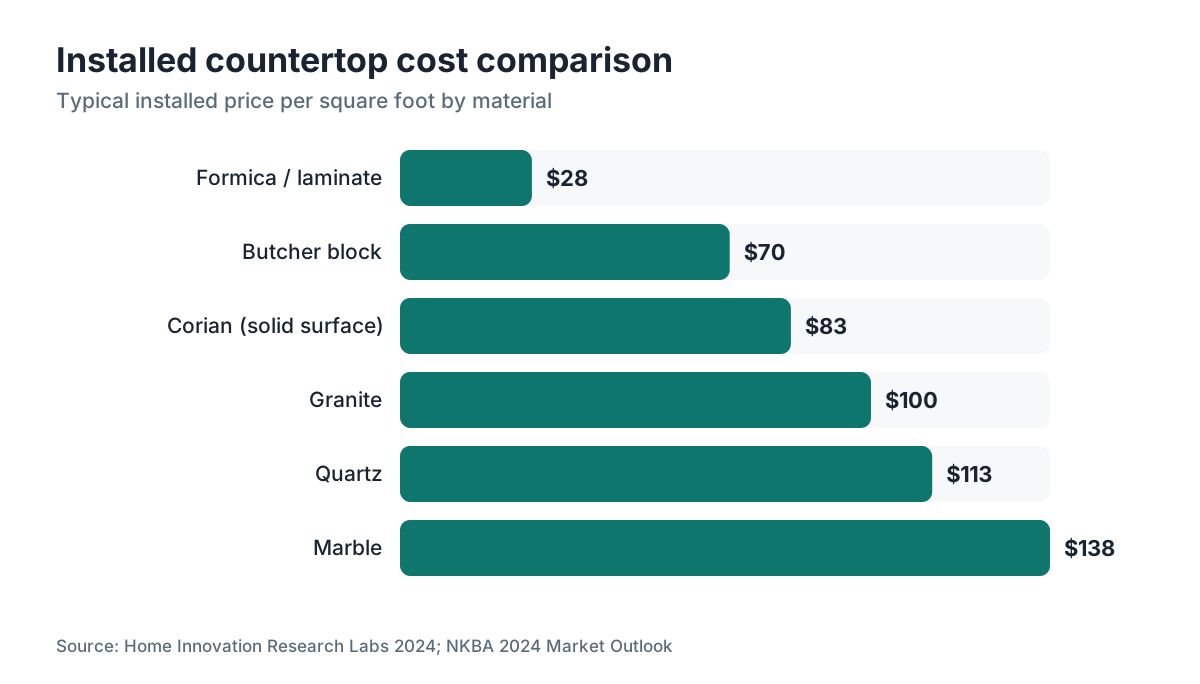
Installed Formica runs $15 to $40 per square foot, materials and labor together [2]. The range is wide because labor rates swing by region, edge choices add cost, and a few patterns carry a premium.
Here is how that stacks against the usual alternatives:
| Material | Installed cost (per sq ft) |
|---|---|
| Formica / laminate | $15, $40 |
| Butcher block | $40, $100 |
| Quartz | $75, $150 |
| Granite | $60, $140 |
| Marble | $75, $200 |
| Corian (solid surface) | $45, $120 |
Sources: Home Innovation Research Labs 2024 cost data and National Kitchen and Bath Association pricing surveys [2][3].
Take a basic kitchen with 30 square feet of counter. Formica installed lands around $450 to $1,200. The same kitchen in quartz runs $2,250 to $4,500. That gap is real money you can spend elsewhere.
DIY is possible and drops the cost to roughly $5 to $15 per square foot for materials only. But it takes a circular saw, a router for the edges, and contact cement applied right. One bad seam or a single air bubble in the bond shows immediately, and laminate cannot be re-bonded once the contact cement grabs. Most homeowners who try it once hire out the next project.
Fabricators know laminate carries thinner material margins than stone but can move in volume. Shops doing rental and multifamily work often find it steady bread-and-butter business. Quoting is where money leaks: substrate waste, edge banding, and seaming labor are all easy to underestimate. SlabWise handles laminate job costing and nesting alongside stone work, so a shop does not need a second workflow to price it.
What edge profiles are available for Formica laminate countertops?
The edge profile is one of the biggest visual calls in a laminate job, and there are more options than most homeowners expect. The profile is the shape you see looking at the counter edge straight on.
The choices fall into a few groups.
Self-edge (flush/square edge): A strip of the same laminate wraps the substrate edge. Simplest, cheapest, most common in builder-grade and rental work. The seam where the face meets the edge strip shows as a thin dark line. Some people find it clinical. Others like how clean it reads.
Beveled self-edge: Same build as a self-edge, but the top corner gets routed to a small angle before the edge laminate goes on. Cuts chip risk at the corner and looks a bit more finished for almost no added cost.
Eased edge (slightly relieved square): The square corner gets lightly broken with a sanding block or router pass. Standard on most fabrication as a safety measure even when the intended look is square.
Waterfall or no-drip edge: The face laminate wraps over the front and turns down, making a small lip that pushes spills off the edge instead of down the cabinet faces. This was everywhere in 1970s and 1980s kitchens. Still available. Reads dated to most buyers now.
Postformed edge: A postformed countertop is a single sheet of laminate bent around a curved substrate with heat. The standard version has a rounded front nose and an integrated backsplash that curves up at the wall, with no visible seam at the nose. These come off specialized forming equipment as continuous pieces. A fabricator doing custom work cannot postform in the field.
Wood edge banding: Solid wood (oak, maple, or an exotic) goes on the substrate edge before the top face gets laminated. The wood then routes to almost any profile: ogee, bullnose, roundover, cove. This is how you get a real edge detail on a laminate top without switching to stone. Add roughly $5 to $15 per linear foot depending on species and how complex the profile is.
PVC or ABS edge banding: Thermoplastic edge tape, iron-on or glued, applied to the substrate edge. Not as tough as wood or self-edge laminate, but cheap and fast. Common in cabinet shop work, less so in dedicated countertop fabrication.
Build-up edge: A second layer of substrate glued to the bottom of the edge before the self-edge laminate goes on, faking the look of a thicker top, often mimicking a stone slab with a 1.5-inch face. Adds labor and material, but it changes the visual weight of the counter a lot.
Formica Corporation's own installation documentation lists self-edge, postform, and wood-edge as the three main construction methods for HPL edges [1]. Fabrication standards from the International Surface Fabricators Association cover how each edge type affects substrate prep and bond integrity [8].
For most budget kitchens, a standard or beveled self-edge is the practical call. Want it to look heavier? A build-up with self-edge costs less than switching materials. Want real detail? Wood banding routed to an ogee or roundover is the move.
Which edge profile actually looks best on laminate countertops?
"Best" depends on the kitchen and what you are after, but there are honest picks to make.
For modern or transitional kitchens, a square self-edge with a barely-eased corner is clean and right. It does not fight the cabinetry and it ages well. The dark seam line on a self-edge disappears the moment the laminate has any pattern or grain direction.
For traditional kitchens, a wood-banded edge routed to a classic roundover or a simple ogee reads more like furniture. Costs more. But it keeps the practical laminate surface while giving the edge the weight traditional design wants.
Postformed edges work fine functionally, but they carry a strong era association. If a kitchen already has postformed counters, replacing in-kind makes sense. Installing new postformed work in a renovation reads as a cost-cut, not a design choice.
Wood banding adds a wrinkle. The wood needs sealing and upkeep, and the joint between the wood and the laminate face has to be tight and properly filled, or moisture gets in. A fabricator who rushes that detail creates a callback. Done right, it holds up fine.
One practical note for fabricators: when a client asks which edge looks best, keep physical samples on hand instead of catalog images. The apparent thickness of a build-up edge versus a standard self-edge is almost impossible to explain in words.
How durable is Formica compared to quartz or granite?
Honest answer: Formica loses to stone and solid surface on nearly every metric that matters for hard daily use.
Scratch resistance is the weak spot. Laminate rates roughly 1.5 to 2.5 on the Mohs hardness scale depending on the wear layer, while granite averages 6 to 7 and engineered quartz averages about 7 [5]. A key dragged across granite leaves little mark. The same key across Formica leaves a visible line. Once it is scratched, laminate cannot be polished or refinished. The damage is permanent short of replacement.
Heat is the other problem. Formica's product documentation says its surfaces are not recommended as a direct trivet, and prolonged exposure above 275F can break the bond between the laminate and the substrate [1]. A hot pan set straight on laminate can leave a white ring or cause bubbling. Stone shrugs off brief heat far better.
Moisture is a slow burn. The laminate face does not absorb water, but any penetration at seams, around the sink cutout, or at wall junctions reaches the particleboard, which swells and delaminates. A properly caulked laminate counter lasts decades. A poorly sealed one fails at the joints within a few years.
On impact, laminate chips at edges and corners under a sharp blow. Dropped cast iron near an edge can chip the face or break the edge banding.
Where Formica does well: chemical resistance (most household cleaners, acids, and oils will not stain or etch it the way they can marble), easy cleaning, an even surface, and stable color under normal indoor light.
Consumer Reports' 2024 countertop ratings put laminate high for ease of cleaning and stain resistance, and at the bottom of the category for scratch and heat resistance [6].
What colors and patterns does Formica come in?
Formica's current standard collection lists more than 180 patterns and colors, with premium and regional lines on top of that [1]. The categories cover solid colors, wood grains (including sharp digital-print reproductions of walnut, oak, and maple), stone looks (marble, granite, concrete), and abstract geometric prints.
The stone-look patterns deserve a straight assessment. Digital printing has come a long way. From across a kitchen, a well-chosen Formica marble pattern reads as convincing. Up close, or in strong raking light, the flat surface with no depth or movement reads as printed paper, which is what it is. If fooling guests is the goal, plan on good lighting and steering conversation away from the counters. If the goal is a clean, attractive kitchen on a budget, the stone-look patterns do the job.
Colors are lightfast for normal indoor use. UV fading rarely comes up as a complaint in home kitchens. Commercial spaces with heavy UV can fade over years. For a home, color longevity is a non-issue.
Sheet availability matters for renovation work. The catalog changes, and patterns get discontinued. If a homeowner needs to add a section to an existing laminate kitchen years later, matching the pattern can be hard or flat impossible. That is the argument for keeping a leftover partial sheet after install.
Fabricators quoting laminate should confirm pattern availability with the distributor before showing options. A pattern in the catalog PDF does not always mean it sits in stock at the regional warehouse.
How is a Formica countertop installed?
Standard laminate installation follows a set sequence. The substrate (usually 3/4-inch or 1-inch particleboard or MDF) gets cut to the finished dimensions along with any cutouts for sinks or cooktops. Edge build-up strips get glued and stapled to the perimeter if a thicker edge is called for. The surface gets cleaned, and the laminate sheet gets cut slightly oversized (about 1/2 inch on all edges). Contact cement goes on both the substrate face and the back of the laminate, gets left to tack (typically 10 to 20 minutes depending on the cement and conditions), then the two surfaces get pressed together. Because contact cement bonds on contact with no repositioning, most fabricators lay small dowels or thin strips across the substrate to hold the laminate off it while lining things up, then pull them out one at a time while pressing the laminate down.
A J-roller or a rubber mallet and block press the whole surface for a full bond. The laminate gets trimmed flush with a router and flush-trim bit. Edge work follows: edge strips get cemented, trimmed, and any corner joints filed smooth. The backsplash, if integrated, gets bonded and caulked.
Sink cutouts need particular care. The exposed particleboard at the cutout edge has to be sealed with a waterproof edge sealer, or the joint caulked completely with silicone, or moisture wicks into the substrate through the sink rim over time.
For countertop installation that starts with pulling an old laminate top, the process is simple: disconnect plumbing, remove the sink, cut the caulk bead at the wall, unscrew the top from the cabinet clips (usually reached from inside the cabinet), and lift it out. Most laminate tops weigh 40 to 80 pounds for a standard kitchen, so one person can handle it with no special gear.
Postformed countertops arrive as continuous pieces from a forming facility, so they get delivered and set in place rather than built up in the shop. The fabricator cuts the miter joints on-site for corner pieces and joins them with drawbolts under the counter.
How do you clean and maintain Formica countertops?
Laminate is one of the easiest countertop surfaces to keep up, which is part of why it stays popular in rentals and commercial food service.
For daily cleaning, warm water and a few drops of dish soap on a soft cloth does it. Formica recommends skipping abrasive cleaners, steel wool, and scouring pads, because they dull the surface and eventually cut through the wear layer [1]. Spray cleaners with ammonia or bleach are safe diluted for disinfection, but months of full-strength bleach can shift the color of some patterns.
For stains, most spills (coffee, wine, tomato sauce) wipe clean with no residue if you catch them promptly. Dried or set stains usually come off with a non-abrasive household cleaner or a paste of baking soda and water left on a few minutes. Acetone (nail polish remover) strips the surface finish and should never touch it.
There is no sealing, oiling, or periodic refinishing. That is a real advantage over stone (which may need sealing) or butcher block countertops (which need regular oiling). Yearly maintenance time on a laminate counter is close to zero.
The one thing to watch is the caulk lines. The joint at the wall backsplash and the joint around the sink deserve a look once a year. Any cracked or missing caulk needs redoing before water can reach the substrate.
What are the pros and cons of Formica versus quartz or granite?
Here is the direct comparison. It does not cover every surface, but the kitchen countertops guide walks the full landscape.
Formica vs. quartz: Quartz runs $75 to $150 installed per square foot against Formica's $15 to $40 [2][3]. Quartz is harder, scratch-resistant, non-porous, and reads as premium to resale buyers. Formica cannot match it on durability or resale perception. Formica wins on price, on the speed of a material change (re-laminating beats a stone tear-out), and where impact damage is a live risk (commercial kitchens, schools, rentals where abuse is likely). Planning to sell in five years? Quartz is probably worth the premium. Rental property or a tight remodel budget? Formica is the sensible call.
See the cambria countertops and granite countertops comparisons for stone-specific detail.
Formica vs. Corian (solid surface): Corian and similar solid-surface materials cost more, typically $45 to $120 installed, but they are repairable. A scratch in Corian sands out. A scratch in Formica does not. If a kitchen sees heavy cutting-board-free abuse, solid surface ages better over a decade. For a homeowner who uses cutting boards and keeps hot pans off the counter, Formica performs nearly as well at half the cost. The Corian countertops article covers that side.
Formica vs. granite: Granite is stone, naturally hard and heat-tolerant. A Formica kitchen will not hold value the way granite does in real estate. That said, for a basement kitchenette, a laundry counter, or a garage shop surface, nobody is running granite. Formica is the right material for those spots. See granite kitchen countertops if you want the stone side in detail.
How long do Formica countertops last?
With normal use and a proper install, Formica countertops last 15 to 30 years before they show real wear [2]. The 30-year figure takes careful use: consistent cutting boards, no direct heat, and no water intrusion at seams. The 15-year figure is more honest for a busy family kitchen with daily abuse.
The failure mode is rarely the laminate. Most early failures start with substrate moisture damage at the sink cutout, at the wall joint, or at seams. A counter with a swollen, peeling section at the sink looks like a bad product. The real cause was a caulk failure that let water reach the particleboard.
Edge chipping is the other common aging sign. The corners where drawers, appliances, and hips keep hitting the edge wear over years. Edge banding that never bonded fully starts to lift. Part fabrication quality, part use.
Replacement is simple when the day comes. Laminate needs no demolition tools or structural assessment the way a large stone slab can. The old top comes out in pieces and new substrate and laminate go in. Total downtime for a laminate countertop swap is typically one to two days.
For fabricators tracking longevity: NKBA survey data shows kitchen remodels happen on average every 15 to 20 years [3], which lines up with laminate's expected life. Owners tend to replace laminate as part of a full kitchen remodel rather than swapping the counter alone.
Is Formica a good choice for a bathroom or laundry room?
Yes, with caveats. Laminate has gone into bathroom vanities for decades and does fine as long as the substrate stays protected from moisture. Bathrooms run higher humidity than kitchens, which puts the seams around sinks and at walls at greater risk of penetration.
The practical answer: use a moisture-resistant substrate (exterior-grade plywood or moisture-resistant MDF rather than standard particleboard), coat all exposed substrate edges with a waterproof sealer before laminating, and caulk every joint at install. Do not skip any of those in a bathroom.
For laundry rooms, laminate is a strong choice. The surface takes detergent and cleaning products without staining. The low cost fits a utility space. Impact resistance is plenty for folding clothes. Nobody is setting a cast iron pan there.
Vanity options run a little tighter in laminate, because the integrated sink standard in most bathroom vanities usually gets cast from a different material. Custom laminate vanity tops with undermount sinks are possible but need more careful waterproofing at the cutout than a kitchen install.
What should fabricators know about quoting and estimating Formica jobs?
Laminate produces faster than stone but has its own estimating traps.
Substrate waste is real. Particleboard and MDF come in 4x8 sheets (sometimes 5x8). An L-shape or a peninsula throws off big offcuts. Quote substrate on actual sheet count, not finished square footage, or you lose margin on every job with a complex layout.
Edge material is a separate line item that is easy to forget. A kitchen with 20 linear feet of wood-banded edge needs 20 linear feet of hardwood stock, plus milling, routing, and finishing time. None of that lives inside a square-foot laminate rate.
Seaming costs labor. A laminate seam means fitting two substrate pieces, applying edge laminate to both faces of the joint, and routing a clean miter. Making it invisible takes time and skill. Charge for it.
Contact cement has a short working window and hates temperature and humidity swings. Jobs in cold or damp spaces run slower and carry higher bond-failure risk. Build the weather into your scheduling.
For shops running both stone and laminate, keeping both in the same quoting and nesting system saves real time. SlabWise handles laminate sheet nesting next to stone slab layouts, so estimators are not jumping between spreadsheets.
Delivery and install of laminate tops is usually a one-person job for a standard kitchen, but long runs (over 10 feet) may need two people to handle. Factor that into crew scheduling.
Frequently asked questions
How much does it cost to replace Formica countertops?
Replacing Formica typically costs $15 to $40 per square foot installed, including demo of the old top, new substrate, laminate, and labor. For a standard 30-square-foot kitchen, total cost runs $450 to $1,200. Metro areas cost more, rural markets less. Keep the same edge profile and a standard laminate pattern and you land at the lower end of that range.
Can you put Formica over existing countertops?
Yes, sometimes. You can bond new laminate directly over an existing flat laminate surface if the original is smooth, fully adhered, and has no edge build-up that creates fitting problems. The existing surface needs to be clean, lightly sanded for grip, and dead flat. Laminating over a textured or damaged surface does not work. Most fabricators recommend new substrate over an overlay for the best long-term result.
What is the difference between Formica and Wilsonart?
Both are high-pressure laminate (HPL) products that perform nearly identically in fabrication and use. Formica Corporation and Wilsonart are the two dominant brands in North America. Pattern selection differs: some colors and wood grains are exclusive to one. Sheet pricing is similar. The choice usually comes down to what your local distributor stocks and whether the specific pattern you want is available from one but not the other.
Can you cut directly on Formica countertops?
No. Cutting on laminate scratches and permanently damages the surface. Laminate is softer than stone or solid surface. Always use a cutting board. This is the single biggest durability complaint from owners who did not expect it, and it is worth stating plainly before purchase: treat it like a finished wood surface, not a stone one.
Can you put hot pans on Formica?
No. Formica's own product guidelines state that direct heat contact is not recommended and temperatures above 275F can cause bond failure or surface damage. A hot pan straight off the stove can leave a permanent white mark or make the laminate bubble and separate from the substrate. Always use a trivet or hot pad. This is the other big daily-use limit alongside scratch sensitivity.
How do you repair a chip or scratch in Formica?
You cannot fully repair a scratch or chip in laminate the way you can in solid surface. Color-fill markers (sold at hardware stores for laminate and furniture repair) reduce how much a scratch shows, and laminate repair paste can fill a chip so it catches the eye less. Neither is invisible. For major damage, the practical fix is replacing the section or the full top, which is cheap next to stone replacement.
What are the most popular Formica countertop colors right now?
White and light gray solids and concrete-look patterns have sold consistently since around 2018, tracking the broader shift toward clean, matte kitchen surfaces. Wood grains stay popular for warm kitchen styles. Formica's Calacatta marble-look patterns have grown a lot as stone-look printing improved. Dark solids (charcoal, black) are growing in modern and moody designs.
Do Formica countertops increase home resale value?
Laminate is generally not considered a value-add in resale compared to stone or quartz. Real estate agents typically note that buyers in mid-to-upper price segments expect stone surfaces. In entry-level homes, clean and intact laminate is not a detractor. If you plan to sell within a few years and your market's buyers expect stone, upgrading the countertops is probably worth it. For rentals and budget properties, laminate is the practical standard.
How do laminate countertop edge profiles affect price?
The simplest self-edge adds little, maybe $1 to $3 per linear foot over the base price. Postformed edges are baked into the countertop price since they need a formed substrate. Wood-banded edges add $5 to $15 per linear foot depending on species and routing. A kitchen with 20 linear feet of edge could see a $100 to $300 price difference between a square self-edge and a routed wood-band edge.
Is Formica the same as postform laminate?
No. Formica is a brand of laminate sheet. Postform is a manufacturing method where the sheet gets heated and bent around a curved substrate to make an integrated nose and backsplash with no visible seams. A postformed countertop can use Formica laminate or any other HPL brand. Most postformed tops sold at home improvement stores use major-brand laminate, but postform describes the construction, not the material.
Can you get an undermount sink with Formica countertops?
Technically yes, but it is not standard practice and most fabricators advise against it. An undermount sink exposes the substrate edge at the cutout to direct water contact, which leads to swelling and delamination over time even with sealing. Drop-in or top-mount sinks are the standard for laminate because the rim covers and protects the cutout edge. If you want an undermount sink, quartz, granite, or solid surface is the better material.
How thick is a Formica countertop?
A standard laminate substrate is 3/4-inch particleboard or MDF plus the 1/16-inch laminate face, so about 13/16 inch total. With a build-up edge strip on the perimeter, the edge face is typically 1-1/2 inches tall, the standard countertop look. Postformed tops vary a little by the forming profile. Thickness does not meaningfully change durability for laminate.
What is the best way to clean Formica countertops without damaging them?
Warm water and dish soap on a soft cloth handles daily cleaning. For set stains, a non-abrasive household cleaner or a baking soda paste works without scratching. Never use steel wool, abrasive pads, or harsh scouring powders. Diluted bleach is fine for disinfection, but avoid prolonged contact. Acetone, nail polish remover, and solvent-based cleaners damage the surface finish and should stay off it.
Sources
- Formica Corporation, Product and Installation Documentation: Formica has manufactured high-pressure laminate since 1913; product documentation covers installation methods, heat resistance limits (not recommended as direct trivet, above 275F bond failure risk), edge construction types, and cleaning guidelines.
- Home Innovation Research Labs, 2024 Builder Practices Survey and Cost Data: Installed laminate countertops run $15 to $40 per square foot; laminate tops last 15 to 30 years under normal residential use.
- National Kitchen and Bath Association (NKBA), 2024 Kitchen and Bath Market Outlook: Quartz installed pricing averages $75 to $150 per sq ft; kitchen remodels occur on average every 15 to 20 years per homeowner survey data.
- U.S. Geological Survey, Mohs Hardness Scale Reference: Granite averages 6 to 7 on the Mohs hardness scale; engineered quartz averages about 7; plastic laminate surfaces rate approximately 1.5 to 2.5.
- Consumer Reports, Countertop Ratings 2024: Consumer Reports 2024 ratings placed laminate countertops highly for ease of cleaning and stain resistance but at the bottom of the category for scratch resistance and heat resistance.
- Wilsonart International, Product and Specification Sheets: Wilsonart is a competing HPL manufacturer offering sheets that perform identically to Formica in fabrication; pattern selection and regional availability differ.
- International Surface Fabricators Association (ISFA), Countertop Industry Standards: ISFA publishes fabrication standards for laminate countertops including seam construction, substrate requirements, and edge profile specifications.
- National Association of Home Builders (NAHB), Remodeling Market Index: Entry-level and rental property countertop replacements remain dominated by laminate; laminate is standard specification in multifamily new construction.
- U.S. Environmental Protection Agency, Formaldehyde Emission Standards for Composite Wood Products (TSCA Title VI): Particleboard and MDF substrates used in laminate countertops fall under EPA TSCA Title VI formaldehyde emission standards; compliant substrates are required in residential construction.
- U.S. Department of Energy, Home Improvement and Remodeling Guidance: Kitchen and bath remodels are among the most common home improvement projects; countertop replacement is a frequent element of mid-cycle kitchen updates.
Last updated 2026-07-10