TL;DR
- Granite countertop installation costs $40 to $100 per square foot all-in, with most jobs landing near $55 to $65.
- The full run from template to usable counters takes 5 to 10 days.
- Labor alone is $10 to $30 per square foot.
- Budget separately for tearing out old tops, the plumber's return visit, and a backsplash gap if your walls aren't flat.
What does countertop installation actually involve?
Installation is not the couple of hours when a crew carries stone through your door. It starts days earlier. The install itself is the last act of a longer play.
The sequence goes: measure and template, then fabricate (cut, shape, polish edges, drill cutouts), then deliver and set. For granite, the templating visit is non-negotiable, because slabs get cut to your exact kitchen before they ever leave the shop. If your walls are out of square, that gets caught at templating, not on install day.
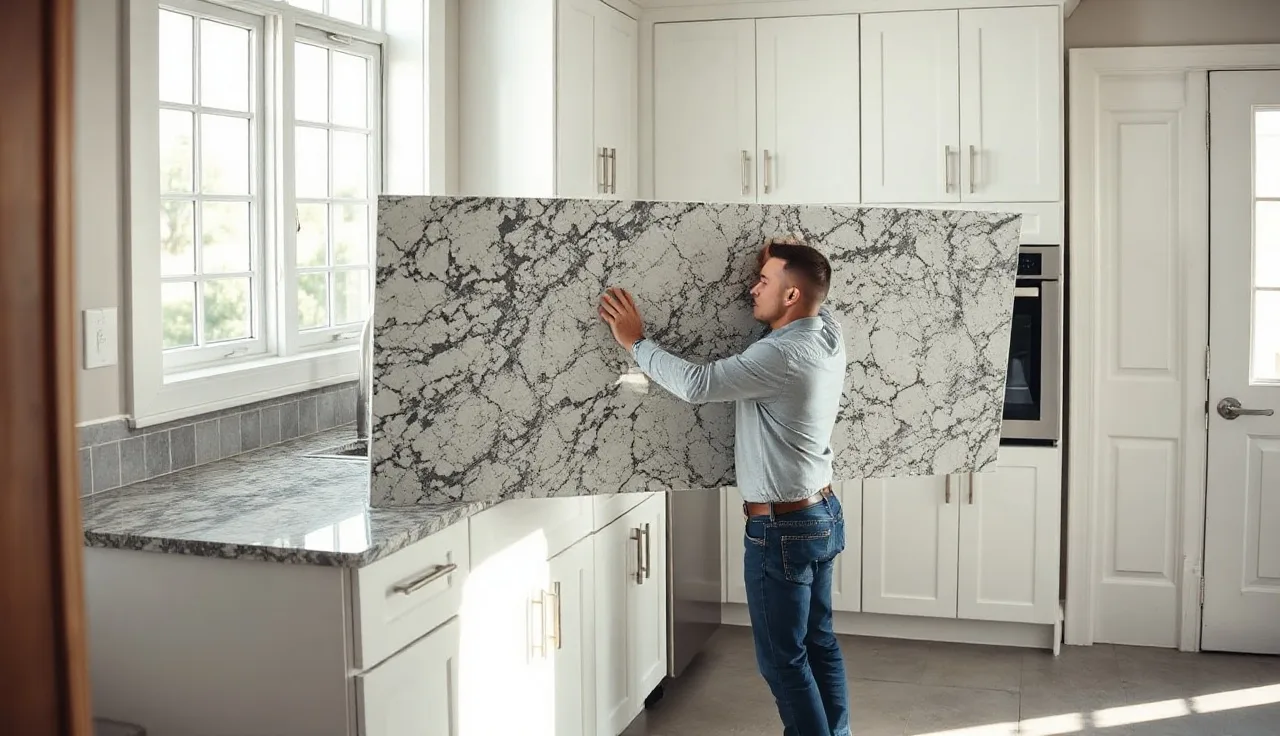
The physical install takes 2 to 5 hours for a standard kitchen. Crews come in pairs because full granite slabs are heavy. A 1.25-inch slab weighs roughly 18 to 20 pounds per square foot, so a 40-square-foot island top weighs 700 to 800 pounds before it's cut down. Pieces get sized to fit through doorways, then seamed on the cabinets with color-matched epoxy.
After the stone goes down, the plumber comes back to reconnect the sink and faucet. That's a separate trade call. Forget to budget for it and you'll get a $150 to $300 invoice you didn't see coming.
How much does a granite countertop cost, installed?
Granite countertop installation costs $40 to $100 per square foot all-in for most residential jobs, with the national midpoint around $55 to $65 [1]. The range is wide because three things drive most of the variance: stone tier, edge complexity, and the number of cutouts.
Here's how the per-square-foot math usually breaks out:
| Cost Component | Typical Range (per sq ft) |
|---|---|
| Material (stone slab) | $15, $50 |
| Fabrication (cutting, polishing) | $10, $25 |
| Installation labor | $10, $30 |
| Removal of old countertops | $3, $8 |
| Total installed | $38, $113 |
Entry-level granite, sometimes sold as "Level 1" or builder-grade, starts around $40 per square foot installed. Mid-grade granite with movement and color sits at $55 to $75. Exotic or rare granite, think book-matched Calacatta or Brazilian Blue Bahia, can run $100 to $200 per square foot once you factor in the slab premium and the extra fabrication care those stones need.
A typical kitchen has 50 to 70 square feet of countertop. At $55 per square foot, that's $2,750 to $3,850 for the counters alone. Add a full-height backsplash and the number climbs fast. Countertop material and installation together run roughly 10 to 15% of a full kitchen remodel budget, according to the National Kitchen and Bath Association's design guidelines [2].
For how granite slabs get graded and what drives price at the yard, see our deeper piece on granite countertops.
What affects granite countertop installation cost the most?
Five things move the price more than anything else.
Edge profile. A straight eased edge is usually in the base price. Ogee, waterfall, or dupont profiles add $10 to $20 per linear foot. On a kitchen with 30 linear feet of edge, that's $300 to $600 in upcharges. Some shops charge by the cutout, others bury it in a job total, so ask for an itemized quote.
Cutouts. Every hole cut reduces your net square footage (which trims material cost slightly) but adds labor. A standard undermount sink cutout runs $100 to $200. Each cooktop cutout adds $75 to $150. Faucet holes are usually $20 to $40 each. Three faucet holes plus a soap dispenser adds up quietly.
Seams. More seams mean more labor and more visible joints. Fabricators try to minimize them, but large islands and U-shaped kitchens almost always need at least one. A good seam in granite is nearly invisible. A bad one looks like a crack. Ask to see the shop's seam work before you commit.
Layout complexity. A galley kitchen with two straight runs is the easiest job there is. A kitchen with five corners, a peninsula, a window cutout, and a curved island takes three to four times the template and fabrication time.
Removal and disposal. Pulling out old laminate is quick and cheap. Demolishing tile counters with a tile backsplash is messy and slow. Expect to pay more when the old surface involves thin-set mortar and tile, especially if the cabinets need repair once everything comes off.
How long does countertop installation take from start to finish?
The physical install is 2 to 5 hours. The full run from template to usable counters is 5 to 10 calendar days, because the stone isn't ready the same day you template. Here's a realistic schedule.
Day 0: Demo. Old counters come out. From here until install, you have no sink and no counters.
Day 1: Template. The crew comes in with digital equipment or physical sticks and maps every inch of your cabinet layout. This visit takes 30 to 90 minutes.
Days 2 to 5: Fabrication. The shop programs the saw, cuts the slabs, profiles edges, drills holes, and polishes. Most residential shops quote 3 to 5 business days. Busy season (spring and fall remodels) pushes this to 7 to 10 days.
Days 6 to 8: Installation. The crew arrives, usually in the morning. Standard installs finish in 2 to 5 hours. They set the stone, seam it, and caulk edges.
Days 7 to 9: Plumber reconnects. Sink and faucet get hooked back up. Budget 1 to 2 hours of plumber time.
Plan for 5 to 10 days without a working kitchen sink. Set up a temporary dish-washing station and keep the coffee maker somewhere you can reach it.
What's the installation process step by step?
Knowing each step helps you catch trouble early and ask better questions.
Templating. The fabricator measures your cabinet box tops, not your old countertops. If appliances aren't in yet, this happens before they go in so the stone can be cut around them. Digital templating uses a laser arm or photogrammetry, which is faster and tighter than stick templates, though both work fine in skilled hands [3].
Slab selection. This usually happens at the stone yard around templating time. You pick the exact slabs. With granite, two slabs from the same quarry lot can look very different, so seeing the actual stone that gets cut for your job matters. For a large island you may need two slabs, and some shops will book-match them for a mirrored look.
Fabrication. The shop programs a waterjet or CNC bridge saw to rough-cut the pieces, then fine-cuts edges, drills sink and faucet holes with diamond-core bits, and polishes exposed edges to your chosen profile. This is where the gap between shops shows most. Quality equipment plus experienced operators produces tighter tolerances than a shop leaning on hand tools.
Delivery and dry-fit. On install day, the crew carries pieces in, dry-fits them without adhesive, checks the gaps at the wall, and marks seam locations. If something doesn't fit, this is when it gets adjusted, either with an angle grinder on site or, in bad cases, a trip back to the shop.
Setting. Pieces get adhered to cabinet tops with silicone (most common) or epoxy. Seams get pulled tight with suction clamps and filled with pigmented epoxy matched to the stone. Good fabricators spend 20 to 40 minutes getting a seam right. Rushing this step is the number one cause of visible seams.
Caulking and cleanup. Joints at the wall and the sink get caulked with color-matched or neutral silicone. Caulk at the backsplash line is correct and intentional. It makes a flexible joint that handles house settling without cracking the stone.
Can you install granite countertops yourself?
Technically, yes. For most people, it's a bad idea.
Weight is the first wall you hit. A 30-square-foot granite piece weighs 400 to 550 pounds. Moving it without breaking the stone, your back, or your cabinets takes at least three people and proper suction lifters. Rental gear for DIY stone work exists but is hard to find in most markets.
Precision is the second wall. Cutting granite needs a wet saw with a continuous-rim diamond blade, and finishing a cut edge to a real polish takes diamond hand pads from 50 grit up to 3,000 grit. Skip the polishing and cut edges look raw.
There's a middle path. Some homeowners do fine with prefabricated granite tile (12x12 or 18x18, not slabs), which is closer to floor tile work. Prefab tile counters cost less, around $10 to $30 per square foot installed, but you live with grout lines and a different look.
For full slab granite, DIY only makes sense if you already own or can rent a wet saw, have help lifting, and can accept a non-professional seam. Most fabricators won't sell you raw cut slabs for DIY anyway, so the supply chain works against you.
If money is the reason you're considering DIY, you'll save more by picking a lower-tier granite and having it installed professionally than by attempting a premium slab yourself and risking a $3,000 crack.
How does granite compare to other countertop materials for installation?
Every material carries different installation demands. Here's an honest comparison.
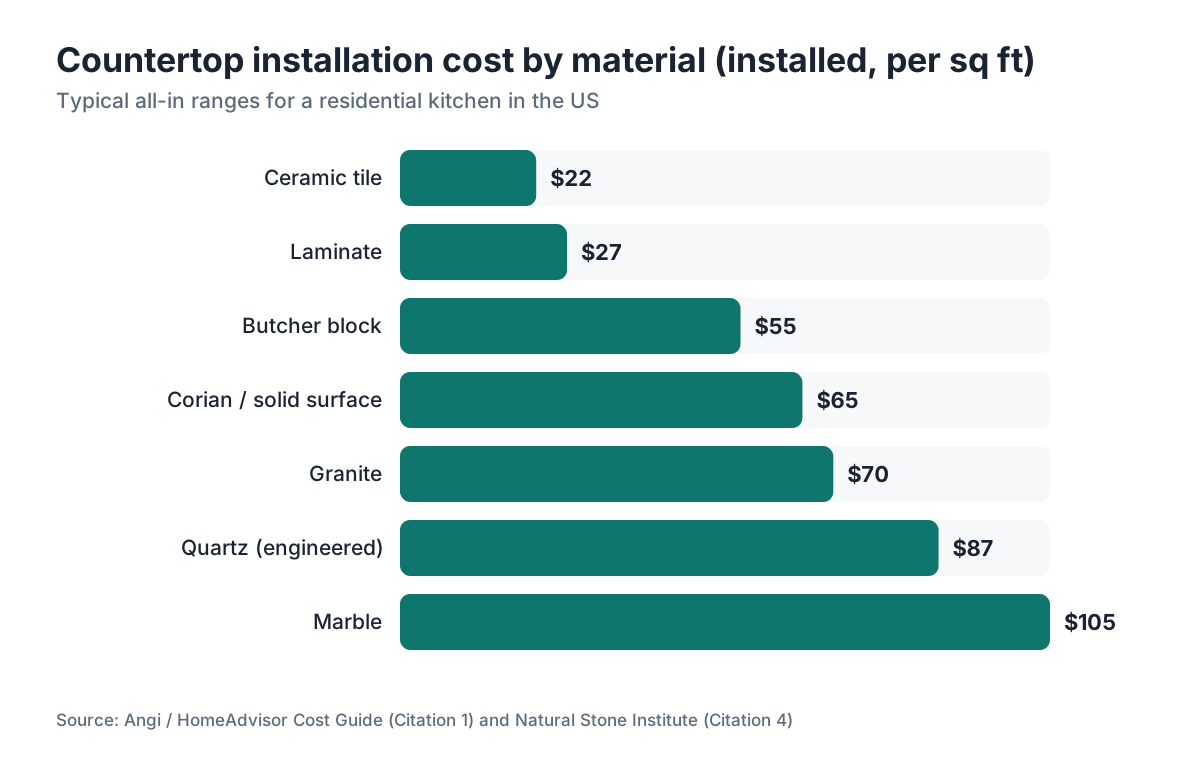
| Material | Installed Cost (per sq ft) | DIY Feasibility | Lead Time |
|---|---|---|---|
| Granite | $40, $100 | Low | 5 to 10 days |
| Quartz (engineered) | $55, $120 | Low | 5 to 10 days |
| Marble | $60, $150 | Low | 5 to 10 days |
| Laminate | $15, $40 | Moderate | 1 to 3 days |
| Butcher block | $30, $80 | Moderate | 1 to 3 days |
| Corian/solid surface | $45, $85 | Low (seaming) | 3 to 7 days |
| Tile (ceramic/porcelain) | $10, $35 | High | 2 to 5 days |
Granite and quartz share almost the same installation process, since both are heavy stone products that need templating, fabrication, and professional setting. Quartz is more dimensionally consistent as a manufactured product, so fabrication tolerances run tighter, but labor costs are similar [4].
Laminate countertops and Formica countertops cost far less and go in with basic woodworking tools. You give up durability and some resale appeal.
Butcher block countertops sit in the middle. You can cut them with a circular saw, but end-grain block still benefits from professional install to get flat surfaces and tight joints.
If you're weighing marble countertops against granite, the installation process is nearly identical. Marble is softer and more brittle during cutting, and some fabricators charge extra for the added care.
What questions should you ask a countertop installer before hiring?
Picking the fabricator matters as much as picking the stone. A bad shop can wreck beautiful material. These questions reveal shop quality.
Do you fabricate in-house or outsource cutting? Some dealers buy finished tops from a fabricator and just do the install. That's not automatically bad, but you want to know who's accountable when something goes wrong.
Can I see your seam work? Ask for photos of finished seams, ideally in granite with movement. Seams in a solid color are easy. Seams across veins in a busy stone show real skill.
What's in the quoted price? Ask specifically about edge profile, cutouts, tear-out of old counters, and reconnecting the sink. Fabricators often quote stone and labor but leave plumbing to you.
What's your warranty? The industry standard is 1 year on labor, with some shops extending to 3 years, according to the International Masonry Institute's installation standards [11]. Seam failure, cracking from installation stress, and delivery chips are the common claims.
Are you licensed and insured? Countertop installation doesn't require a specialty license in most states, but general contractor licensing and liability insurance protect you if a worker drops a slab on your hardwood. The U.S. Small Business Administration notes that licensing and insurance requirements vary by state and that you should verify current standing before hiring [5].
How do you handle out-of-square walls? The right answer is: we scribe the stone to fit, or we use a backsplash to cover the gap. Any answer that amounts to "it'll be fine" is a red flag.
How do you prepare for countertop installation day?
Good prep makes install day faster and cuts the risk of damage to your home.
Clear the cabinets completely. Every dish, pot, and small appliance comes out. The crew needs the cabinet boxes open from above, and installers move around constantly.
Protect your floors. The crew should lay down protection, but back it up yourself. Granite pieces get carried in and rested on the floor before they go up to the cabinets, and stone edges scratch hardwood and crack tile.
Confirm the plumber is scheduled. Don't let install day arrive without knowing exactly when the plumber returns. The best setup is the plumber coming that same afternoon, a few hours after the stone crew finishes. Your kitchen is dead until the sink is back.
Check cabinet level before templating, not after. If your cabinet run is more than 1/4 inch out of level over 8 feet, the stone will rock or crack under load. A good installer shims for small variations, but real level problems need a cabinet fix first.
Know where your water shutoff is. Every install carries some chance of a nicked line. It's rare, but you don't want to be hunting for the valve while water sprays the room.
For kitchen countertops generally, the prep is the same no matter the material. Getting the space ready before the crew shows up saves an hour of billable time.
What can go wrong with countertop installation and how do you fix it?
Problems happen. Knowing which are serious and which are cosmetic helps you respond right.
Visible seams. A seam that's raised, gapped, or color-mismatched is a workmanship defect. The fix is regrinding and re-epoxying, or in bad cases cutting a new piece. Push on this one. It should be on the installer under any reasonable warranty.
Gaps at the wall. A gap between stone and wall up to about 3/8 inch is normal and gets caulked. Larger gaps usually mean the template missed an out-of-plumb wall. The fix is scribing a filler strip or adding a backsplash that covers the gap.
Cracking. A crack found on install day is usually a pre-existing natural fissure that let go under installation stress. A fissure (natural, stable) and a crack (structural, unstable) are different things. If the crack opened during installation, the fabricator owns it. If it was pre-existing and disclosed, it's murkier. The Marble Institute of America publishes guidance on evaluating natural fissures versus installation-caused damage [6].
Unlevel surface. A counter that rocks when you press wasn't shimmed right. The fix is usually adding shims from below, through the cabinet interior.
Chip at an edge. Small chips at factory-cut edges are the most common install complaint. Fabricators carry color-matched filler for on-the-spot repair. A good fill is nearly invisible. A bad one is obvious. If you're not happy, ask for a redo before the crew leaves.
Shops running modern quoting and job management software, like SlabWise, capture template dimensions digitally and tie them to the CNC cutting file, which cuts the transcription errors behind most fit problems.
Does countertop installation affect your home's resale value?
Yes, and it can matter, but the return depends on what you're replacing and which market you're in.
Remodeling Magazine's annual Cost vs. Value report has consistently found that a mid-range kitchen remodel, which includes new counters, returns roughly 49 to 72% of cost at resale depending on region and year [7]. That's a partial return, not dollar for dollar.
Granite has strong name recognition with buyers. Agents often name granite and stainless appliances as easy checkbox items, though no rigorous peer-reviewed study has isolated the granite premium from the general kitchen-upgrade halo. The National Association of Realtors' 2023 Remodeling Impact Report found that kitchen upgrades ranked among the top interior projects for appeal to buyers [8].
In practice, swapping old laminate for new granite or quartz tends to help price or speed of sale in most markets. Swapping dated granite for new granite helps less.
One honest caveat. Very bold or unusual stone, intensely veined or off-color, wins some buyers hard and loses others. If resale is the goal, staying in the mainstream range of materials and colors is the safer play.
How do you maintain granite after installation?
Granite needs sealing after installation and again on a schedule. Most fabricators apply one round of sealer before delivery, but you should add a fresh coat once the sink is back and the counters have sat 24 hours.
Sealing granite takes about 20 minutes and uses a penetrating impregnator, not a topical coating. The product soaks in and slows liquid from getting into the stone. Most residential kitchens need resealing every 1 to 3 years depending on porosity, which varies by stone type. The water drop test is the simplest check: if water beads, the sealer is working; if water soaks in within 4 to 5 minutes, reseal, per the Marble Institute of America's care guidance [9].
For granite kitchen countertops, daily care is simple. Mild dish soap and water handles most cleaning. Skip acidic cleaners (vinegar, citrus products), because acid etches some finishes over time. Skip abrasive pads that scratch the polished surface.
Other stone types shift the rules. How to clean stone countertops covers the material-by-material breakdown, including softer stones like soapstone and quartzite with their own needs.
Don't set hot pots directly on granite, whatever you've heard. Thermal shock from a 500-degree cast iron pan hitting cooler stone can crack it, especially near seams or natural fissures. Use trivets.
Frequently asked questions
How much is granite countertops installed?
Granite countertops cost $40 to $100 per square foot installed, all-in. That covers the stone, fabrication (cutting and edge profiling), and installation labor. A typical kitchen of 50 to 70 square feet comes out to $2,000 to $7,000 depending on stone tier, edge profiles, and cutout count. Entry-level builder-grade granite sits at the low end; exotic imported granites with book-matching push toward or past the top.
How much does a granite countertop cost for just the material?
Material alone, the raw slab before cutting or polishing, runs $15 to $50 per square foot depending on grade. Entry-level granite starts around $15 to $20 per square foot at the slab yard. Mid-grade with visible movement and color runs $25 to $40. Rare varieties go higher. Fabrication and installation typically add $20 to $50 per square foot on top of material cost.
How long does countertop installation take?
The physical install takes 2 to 5 hours for a standard kitchen. The full process from template to finished, usable counters takes 5 to 10 calendar days. That window includes 1 to 2 days for templating and scheduling, 3 to 5 business days in the shop, then install day plus plumber reconnect. Busy seasons (spring and fall) can push shop lead times to 7 to 10 business days.
What's included in countertop installation cost?
A complete quote should include material (slab), fabrication (cutting, edge profile, cutout drilling), delivery, and installation labor. Often excluded: demolition and disposal of old counters, plumber reconnect for the sink, backsplash material, and permits if required. Always ask for an itemized quote. Surprise costs most often come from tear-out, extra cutouts, and the plumber's return visit.
Can I install granite countertops myself?
It's possible but genuinely hard. Full granite slabs weigh 18 to 20 pounds per square foot, need a wet diamond saw to cut, and require multi-stage polishing on cut edges. Most homeowners lack the equipment and the labor to do it safely. The more practical DIY option is granite tile, which installs like floor tile. For slab granite, professional installation is almost always the right call.
How much does granite countertop installation cost compared to quartz?
Granite runs $40 to $100 per square foot installed. Engineered quartz runs $55 to $120 per square foot installed. The installation labor is nearly identical, since both go through the same template-fabricate-install sequence. The price difference comes mainly from material cost and the stone grading system. Some budget granite is actually cheaper all-in than mid-grade quartz.
Do I need permits for countertop installation?
In most jurisdictions, no. Countertop replacement counts as a cosmetic remodel and doesn't trigger permit requirements. Exceptions come up if you're moving a sink, altering plumbing rough-in, or doing a full gut-remodel. The plumber reconnecting your sink may or may not require a permit depending on local code. Check with your local building department if you're unsure.
How do I find a good countertop installer?
Start with local stone yards. They fabricate and install directly, so they own both the material and the workmanship. Ask for photos of seam work in busy-pattern granite, get three itemized quotes, and verify general liability insurance. Online reviews help, but focus on complaints about seam quality and how the shop handled problems rather than star counts. Ask directly whether they fabricate in-house.
What's the difference between a fabricator and a countertop installer?
A fabricator cuts and shapes the stone. An installer sets it in place. Often they're the same company or crew. Some kitchen and bath dealers outsource fabrication to a third-party shop and do installation themselves. When you buy from a big-box store, fabrication often goes to a regional partner shop. Knowing who's accountable for each step matters when something goes wrong.
How soon can I use my countertops after installation?
For most adhesive and epoxy seams, 24 hours is the standard cure time before you put real weight or heat on the surface. Light use like resting items can happen sooner, but avoid soaking the area around seams for the first day. The plumber usually reconnects the sink the same day as installation or the next morning, so you're typically without a working sink for less than 24 hours.
What causes countertop seams to fail or look bad?
Most visible seam problems come from one of three causes: the epoxy color wasn't matched carefully, the two pieces weren't perfectly level when the epoxy set, or the seam sits in a high-traffic spot that flexes. Seams in granite should not be placed at the sink or directly in front of a cooktop. A good fabricator puts seams where cabinet support is strongest and the stone's movement lines up.
Does the type of edge profile affect granite countertop installation cost?
Yes, and it can add up. A straight eased or flat edge is usually in base pricing. Ogee, dupont, waterfall, and full bullnose profiles add $10 to $20 per linear foot. On a kitchen with 30 linear feet of exposed edge, upgrading from eased to ogee can add $300 to $600 to the job. Some profiles also need more passes on the polishing equipment, which adds shop time.
How do granite countertops hold up over time after installation?
Very well, with basic care. Granite ranks 6 to 7 on the Mohs hardness scale, so it resists scratches under normal kitchen use. Sealed every 1 to 3 years, it resists staining well. The long-term risks are edge chips (usually from impact), seam separation if the house settles unevenly, and etching from prolonged acid contact on softer varieties. Plenty of kitchens have granite surfaces 20-plus years old with no major issues.
What should I do if I notice a crack in my granite after installation?
First, tell a fissure from a crack. A fissure is natural, pre-existing, and usually runs with the crystal structure. An installation crack tends to run straight at seams or stress points. Run a finger across it: a true crack has a ridge or gap you can feel, while a fissure is usually flush. If it appeared during or shortly after installation, send your fabricator photos immediately. Most warranties cover installation cracks. Visible natural fissures usually aren't covered.
Sources
- HomeAdvisor / Angi, Countertop Installation Cost Guide: National average for granite countertop installation runs approximately $40, $100 per square foot all-in, with a midpoint around $55, $65.
- National Kitchen and Bath Association (NKBA), Kitchen Design Guidelines: Countertop material and installation together account for roughly 10 to 15% of a full kitchen remodel budget.
- Stone World Magazine, Digital Templating Technology Overview: Digital templating using laser or photogrammetry systems provides faster and more accurate measurements than traditional stick templates.
- Natural Stone Institute, Natural Stone vs. Engineered Stone Comparison: Quartz and granite have nearly identical installation processes; quartz is more dimensionally consistent as a manufactured product.
- U.S. Small Business Administration, Licensing and Permits for Contractors: Contractor licensing and insurance requirements vary by state; homeowners should verify current standing before hiring.
- Natural Stone Institute (formerly Marble Institute of America), Evaluating Fissures in Natural Stone: The Natural Stone Institute has published guidance on distinguishing natural fissures from installation-caused cracks in stone countertops.
- Remodeling Magazine, Cost vs. Value Report 2023: A mid-range kitchen remodel returns roughly 49 to 72% of its cost at resale depending on region.
- National Association of Realtors, 2023 Remodeling Impact Report: Kitchen upgrades ranked among the top interior remodeling projects for appeal to buyers in the 2023 Remodeling Impact Report.
- Natural Stone Institute, Natural Stone Care and Maintenance Guide: The water drop test is recommended to assess granite sealer effectiveness; if water soaks in within 4 to 5 minutes, resealing is needed.
- U.S. Geological Survey (USGS), Dimension Stone Statistics and Information: Granite is one of the most commonly quarried dimension stones in the United States, with significant domestic and imported supply.
- International Masonry Institute, Stone Installation Standards: Industry standard warranty on countertop installation labor is typically 1 year, with some shops extending to 3 years.
Last updated 2026-07-09