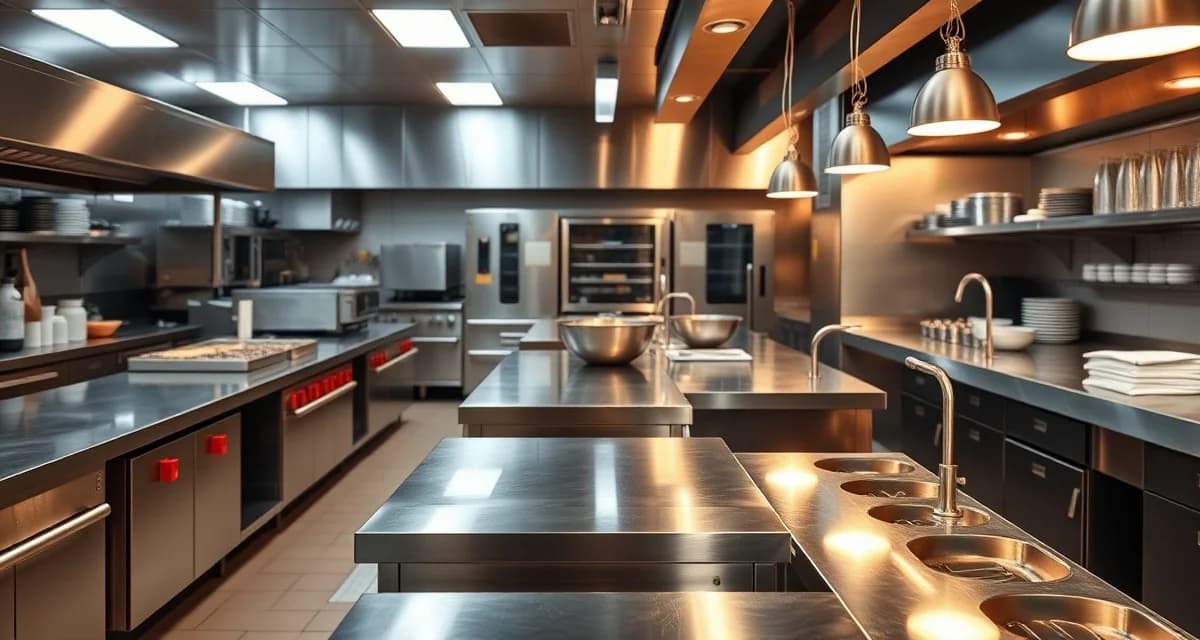
Commercial Kitchen Countertop Guide
Quick Definition
Commercial kitchen countertops must meet health codes, withstand heavy daily use, and survive constant cleaning with industrial chemicals. Stainless steel remains the standard for food prep surfaces, while stone and quartz are used for front-of-house areas (bars, serving counters, host stands). Material choice depends on whether the surface is in the kitchen (health code-regulated) or customer-facing (design-driven).
TL;DR
- Stainless steel dominates back-of-house - NSF-certified, heat-proof, chemically resistant, $50-$150/sq ft installed
- Quartz and granite are front-of-house choices - bar tops, host stands, buffet counters at $60-$120/sq ft
- Dekton and Neolith work in both zones - heat-proof sintered surfaces approved for food contact
- Health department requirements vary by state - always check local codes before specifying materials
- Commercial surfaces take 10-50x more abuse than residential - material selection is about survival, not aesthetics
- NSF/ANSI 51 certification is the standard for food contact surfaces - not all stone materials qualify
- Budget $8,000-$40,000+ for a commercial kitchen countertop package depending on size and material mix
Back-of-House vs. Front-of-House
The most important distinction in commercial countertop selection:
Calculate your material waste savings
See exactly how much slab material and money you could save with optimized cutting layouts.
Try the free Waste CalculatorBack-of-House (BOH) - The Working Kitchen
| Requirement | Why It Matters |
|---|---|
| NSF/ANSI 51 food contact certification | Health department requirement in most jurisdictions |
| Heat resistance | Pots, pans, and sheet trays placed directly on surfaces |
| Chemical resistance | Industrial degreasers, sanitizers, bleach solutions used daily |
| Non-porous surface | Prevents bacterial growth in food prep areas |
| Easy to sanitize | Must be cleanable to health code standards |
| Impact resistance | Heavy equipment, dropped pans, constant use |
| Moisture resistance | Standing water, steam, splashes all day |
Best BOH materials: Stainless steel (304 grade), Dekton, Neolith, butcher block (for specific prep stations only)
Front-of-House (FOH) - Customer-Facing Areas
| Requirement | Why It Matters |
|---|---|
| Visual appeal | Customers see and touch these surfaces |
| Durability | Bar patrons are hard on surfaces |
| Stain resistance | Spilled drinks, food, sauces |
| Easy to clean | Staff wipes down between customers |
| Design flexibility | Must match restaurant concept |
Best FOH materials: Granite, quartz, marble (sealed), Dekton, concrete (sealed), reclaimed wood (sealed, non-food-contact only)
Material Options in Detail
Stainless Steel (Type 304)
| Feature | Details |
|---|---|
| Cost | $50-$150/sq ft installed (gauge dependent) |
| Food safe | Yes - NSF/ANSI 51 certified |
| Heat tolerance | Unlimited (for kitchen purposes) |
| Maintenance | Wipe clean, occasional polish |
| Durability | 20-30+ years in commercial use |
| Appearance | Industrial, professional |
Stainless steel is the default material for commercial kitchens for good reason. It handles every abuse a kitchen throws at it: hot pans, acidic foods, industrial cleaners, constant moisture, and heavy impact. A well-maintained stainless countertop lasts the life of the restaurant.
Types of stainless for countertops:
- 16 gauge (1.5mm) - heavy-duty, minimal flex, $100-$150/sq ft
- 18 gauge (1.2mm) - standard commercial, $75-$110/sq ft
- 20 gauge (0.9mm) - light commercial, $50-$80/sq ft
Finish options: #4 brushed (standard kitchen), #8 mirror (decorative/front-of-house), bead-blasted (matte)
Granite
| Feature | Details |
|---|---|
| Cost | $50-$120/sq ft installed |
| Food safe | When sealed - check local health codes |
| Heat tolerance | Excellent (withstands direct heat) |
| Maintenance | Seal every 6-12 months in commercial settings |
| Durability | 15-25+ years |
| Appearance | Natural, premium, varied |
Granite works well for commercial bar tops, host stands, and serving counters. Its heat resistance and natural beauty make it a strong front-of-house choice. However, granite requires more frequent sealing in commercial settings (every 6-12 months vs. 1-3 years residential) due to higher use intensity.
Note: Some health departments don't approve natural stone for direct food prep surfaces. Always verify with your local code enforcement before specifying granite in food contact areas.
Quartz (Engineered Stone)
| Feature | Details |
|---|---|
| Cost | $60-$110/sq ft installed |
| Food safe | NSF-certified brands available |
| Heat tolerance | Moderate (300-400°F max - use trivets) |
| Maintenance | Wipe clean, no sealing |
| Durability | 15-25+ years |
| Appearance | Consistent, wide color range |
Quartz is gaining ground in commercial front-of-house applications. Its zero-maintenance surface and consistent appearance across large installations (hotel lobbies with 200+ sq ft of countertop, for example) make it practical for commercial use.
The heat limitation keeps quartz out of working kitchens. A line cook who sets a 500°F sheet pan directly on quartz will leave a permanent scorch mark.
Dekton / Neolith (Ultra-Compact Sintered)
| Feature | Details |
|---|---|
| Cost | $80-$130/sq ft installed |
| Food safe | Yes - NSF/ANSI 51 certified (Neolith specifically) |
| Heat tolerance | Excellent (direct flame safe) |
| Maintenance | None |
| Durability | 25+ years |
| Appearance | Modern, wide design range |
Sintered surfaces are the new option that bridges BOH and FOH. They handle hot pans, industrial cleaners, and UV exposure while offering the aesthetic range of quartz. The cost is higher, but for restaurants that want a single material flowing from kitchen to dining area, sintered stone eliminates the transition.
Concrete (Cast or Precast)
| Feature | Details |
|---|---|
| Cost | $70-$150/sq ft installed |
| Food safe | When sealed with food-safe sealer |
| Heat tolerance | Good (can discolor sealant) |
| Maintenance | Reseal every 6-12 months, wax monthly |
| Durability | 10-20 years (with maintenance) |
| Appearance | Industrial, artisan, unique |
Concrete appeals to brewpub, industrial, and artisan restaurant concepts. Each pour is unique. The downside: concrete requires significant ongoing maintenance in a commercial environment. Acidic spills (lemon juice, vinegar, wine) etch through sealant and stain the surface.
Butcher Block (Hardwood)
| Feature | Details |
|---|---|
| Cost | $40-$100/sq ft installed |
| Food safe | Yes - for non-meat prep (or with proper sanitization protocols) |
| Heat tolerance | Low (burns and scorches) |
| Maintenance | Oil monthly, sand and refinish periodically |
| Durability | 5-15 years depending on use intensity |
| Appearance | Warm, traditional, artisan |
Butcher block is approved for specific food prep applications in most jurisdictions. It's commonly used as a dedicated station for bread, pastry, or vegetable prep. Health codes typically require separate cutting surfaces for raw meat - stainless steel or approved plastic in those areas.
Health Code and Certification Requirements
NSF/ANSI 51
The key certification for commercial food contact surfaces. NSF/ANSI 51 evaluates:
- Cleanability - can the surface be sanitized to prevent bacterial growth?
- Chemical resistance - does it withstand commercial cleaning chemicals?
- Non-toxicity - does the material leach harmful substances into food?
- Surface quality - are there crevices, cracks, or porosity that harbor bacteria?
Materials that commonly hold NSF/ANSI 51 certification:
- Stainless steel (Type 304 and 316)
- Neolith (select products)
- Specific quartz brands (check individual certifications)
- Food-grade plastics (HDPE, polypropylene)
State and Local Health Department Requirements
Health codes vary significantly:
- Some states accept sealed granite for commercial food contact
- Others require non-porous, NSF-certified surfaces only for direct food prep
- Nearly all jurisdictions require stainless steel for surfaces adjacent to cooking equipment
- Bar tops and serving counters typically have fewer restrictions than prep surfaces
Always check with your local health department before finalizing material specifications. A beautiful granite prep counter that doesn't meet code will need to be replaced - at your cost.
Cost Budgeting for Commercial Projects
Small Restaurant (1,500 sq ft)
| Area | Material | Square Feet | Cost/sq ft | Total |
|---|---|---|---|---|
| Kitchen prep surfaces | Stainless (18ga) | 60 | $85 | $5,100 |
| Line counter | Stainless (16ga) | 30 | $110 | $3,300 |
| Bar top | Granite | 40 | $75 | $3,000 |
| Host stand | Quartz | 8 | $70 | $560 |
| Total | 138 | $11,960 |
Large Restaurant/Hotel Kitchen (5,000+ sq ft)
| Area | Material | Square Feet | Cost/sq ft | Total |
|---|---|---|---|---|
| Kitchen prep (multiple stations) | Stainless (16ga) | 200 | $100 | $20,000 |
| Bar top (main + service) | Dekton | 80 | $95 | $7,600 |
| Buffet/serving counters | Quartz | 60 | $80 | $4,800 |
| Host/reception | Quartz | 15 | $85 | $1,275 |
| Pastry station | Marble | 30 | $90 | $2,700 |
| Total | 385 | $36,375 |
Fabrication and Installation Considerations
Timing
Commercial kitchen countertop installation must coordinate with:
- General contractor schedule
- Plumbing rough-in completion
- Equipment delivery dates
- Health department inspection timeline
- Soft opening target date
Missing the countertop installation window can delay a restaurant opening by 2-4 weeks - costing the operator $10,000-$50,000+ in lost revenue and carrying costs.
Custom Fabrication Needs
Commercial kitchens require features residential kitchens don't:
- Integral backsplashes (coved stainless that meets the wall without a seam)
- Sink cutouts for commercial sinks (larger than residential, often triple-bowl)
- Equipment cutouts (steam tables, drop-in warmers, ice bins)
- Drain grooves (channels cut into the surface directing liquids to a sink)
- Marine edges (raised edges preventing liquid runoff onto floors)
Fabrication shops handling commercial work need accurate specifications from the kitchen designer and equipment vendor. A sink cutout that's 1/2" too small delays the project.
For fabrication shops managing commercial kitchen projects, SlabWise's template verification system is especially valuable. Commercial templates are more complex than residential - more cutouts, tighter tolerances, and higher remake costs. The 3-layer verification check catches errors that would turn a profitable commercial job into a loss.
FAQ
What countertop material is best for commercial kitchens?
Stainless steel (Type 304, 16 or 18 gauge) for food prep and cooking areas. Quartz, granite, or Dekton for customer-facing surfaces like bars and host stands. The best material depends on the specific area and local health code requirements.
Can you use granite in a commercial kitchen?
For front-of-house surfaces (bars, host stands), yes in most jurisdictions. For direct food prep surfaces, some health departments accept sealed granite while others require non-porous, NSF-certified materials. Always check local codes.
How much do commercial kitchen countertops cost?
Budget $50-$150/sq ft for stainless steel (depending on gauge) and $60-$130/sq ft for stone or sintered surfaces. A small restaurant's full countertop package runs $8,000-$15,000. Large operations can exceed $35,000.
What is NSF/ANSI 51 certification?
It's the food equipment material safety standard. Materials certified to NSF/ANSI 51 have been tested for cleanability, chemical resistance, and food safety. Health departments in most states require NSF-certified surfaces in commercial food prep areas.
How long do commercial countertops last?
Stainless steel: 20-30+ years. Granite and quartz: 15-25 years. Concrete: 10-20 years with maintenance. Butcher block: 5-15 years. Commercial use is 10-50x harder on surfaces than residential use.
Can quartz be used in restaurant kitchens?
In customer-facing areas (bars, dining counters), yes. In back-of-house cooking areas, quartz is generally not recommended due to heat limitations. A hot sheet pan will permanently damage quartz.
What countertop material resists bleach and sanitizer?
Stainless steel, Dekton, and Neolith handle commercial sanitizers without damage. Quartz tolerates dilute bleach but shouldn't be routinely exposed to concentrated sanitizers. Granite's sealant can break down with daily chemical exposure.
How often do commercial stone countertops need sealing?
Every 6-12 months for granite in high-use commercial settings. Quartz and sintered surfaces (Dekton, Neolith) never need sealing. Concrete needs resealing every 6-12 months and monthly waxing.
What thickness is recommended for commercial countertops?
3cm (1-1/4") minimum for stone countertops in commercial settings. Stainless steel at 16 gauge for heavy-use areas, 18 gauge for standard areas. Thicker materials resist impact damage from the daily abuse of commercial kitchen operations.
Do commercial countertops need special installation?
Yes. Commercial installation requires coordination with plumbing, equipment delivery, and construction schedules. Surfaces must meet health code specifications, and installation timing affects restaurant opening timelines.
Manage Complex Commercial Jobs Without the Chaos
Commercial kitchen projects have more moving parts than residential work: multiple materials, complex cutouts, tight deadlines, and health code requirements. SlabWise keeps commercial jobs on track with Quick Quote (3 minutes per estimate, even for multi-material projects), Customer Portal for contractor communication (70% fewer phone calls), and template verification that catches dimensional errors before fabrication.
Start your 14-day free trial - land more commercial work by quoting faster and delivering without callbacks.
Try These Free Tools
- Kitchen Visualizer -- Upload a kitchen photo and preview different countertop materials in place.
- AR Overlay -- See the actual stone pattern on your customer's cabinets using AR.
- Sink Finder -- Search compatible sink models by countertop dimensions and cutout specs.
Sources & Further Reading
- Natural Stone Institute - Bathroom Design Guidelines
- National Kitchen & Bath Association - Countertop Selection Guide
- Marble Institute of America - Bathroom Stone Applications
- International Surface Fabricators Association - Residential Bathroom Standards