TL;DR
- Marble look countertops come in four main materials: engineered quartz, sintered porcelain, laminate, and solid surface.
- Installed prices run from about $8/sq ft for laminate to $130/sq ft for large-format porcelain.
- Quartz is the popular kitchen pick.
- It needs no sealing, resists stains, and costs $60, $100/sq ft installed.
- Porcelain is thinner and heat-proof but harder to fabricate.
What are marble look countertops?
Marble look countertops are surfaces made from materials other than natural marble, manufactured or printed to mimic marble's veining, color gradients, and translucency. The underlying material is almost always quartz (engineered stone), sintered porcelain, high-pressure laminate, or solid surface like acrylic-based Corian.
Natural marble is calcium carbonate. It etches when acid touches it, stains if you leave olive oil on it long enough, and needs professional sealing every year or two. The appeal is obvious. Those gray-and-white Calacatta veins look extraordinary in a bright kitchen or bathroom. The maintenance is why most homeowners today pick a look-alike instead.
The category exploded after quartz makers figured out how to print and press convincing veining into slabs around 2012 to 2015. Digital inkjet printing has since gotten good enough that some porcelain slabs are genuinely hard to tell from the real thing at a glance. A professional fabricator spots the difference instantly. Your dinner guests probably cannot.
If you want actual marble, that's a different conversation covered in our marble countertops guide. This article covers the alternatives.
What materials make marble look countertops?
There are four categories worth knowing. Each has a different production method, durability profile, and fabrication requirement.
Engineered quartz leads the market. Manufacturers mix roughly 90 to 93% crushed quartz aggregate with polymer resins and pigments, press the mix under vacuum and vibration, then cure it [8]. The veining comes from layering pigmented binders before the press cycle. Calacatta Gold and Eternal Calacatta by Silestone, Arabescato by Cambria, and Calacatta Ultra by MSI are all engineered quartz with marble-inspired names. Cambria countertops has its own family of white-and-gray designs if you want a brand-specific breakdown.
Sintered porcelain (sometimes called ultra-compact surface or ceramic slab) is fired above 1200°C under extremely high pressure [7]. Brands: Dekton by Cosentino, Neolith, Lapitec. Slabs are usually 6mm to 20mm thick. The surface is essentially glass-like: UV stable, heat proof, acid-proof. Fabrication is harder because the material is brittle and wants diamond tooling run at slower feed rates.
High-pressure laminate (HPL) is a photograph of marble printed on paper, bonded under heat and pressure to layers of resin-soaked kraft paper, then glued to a particleboard or MDF substrate. Formica's Calacatta Marble and Wilsonart's Calcutta Tigris are examples. Laminate countertops is the full guide if you're going that route. The look holds up at a distance. The substrate edge gives it away unless you use a waterfall or mitered detail.
Solid surface (acrylic or polyester composite) like Corian countertops comes in marble-inspired colors. The veining looks less convincing than quartz or porcelain because the pigment runs uniformly through the material rather than mimicking natural geology. The upside is that scratches sand out and seams disappear.
| Material | Typical thickness | Sealing required | Heat resistance | Acid/etch resistance |
|---|---|---|---|---|
| Engineered quartz | 20mm, 30mm | No | Moderate (avoid direct heat) | High |
| Sintered porcelain | 6 to 20mm | No | Excellent | Excellent |
| High-pressure laminate | 25 to 38mm substrate | No | Poor | Moderate |
| Solid surface | 12 to 19mm | No | Poor | Moderate |
| Natural marble (reference) | 20 to 30mm | Yes, annually | Poor | Very poor |
How much do marble look countertops cost?
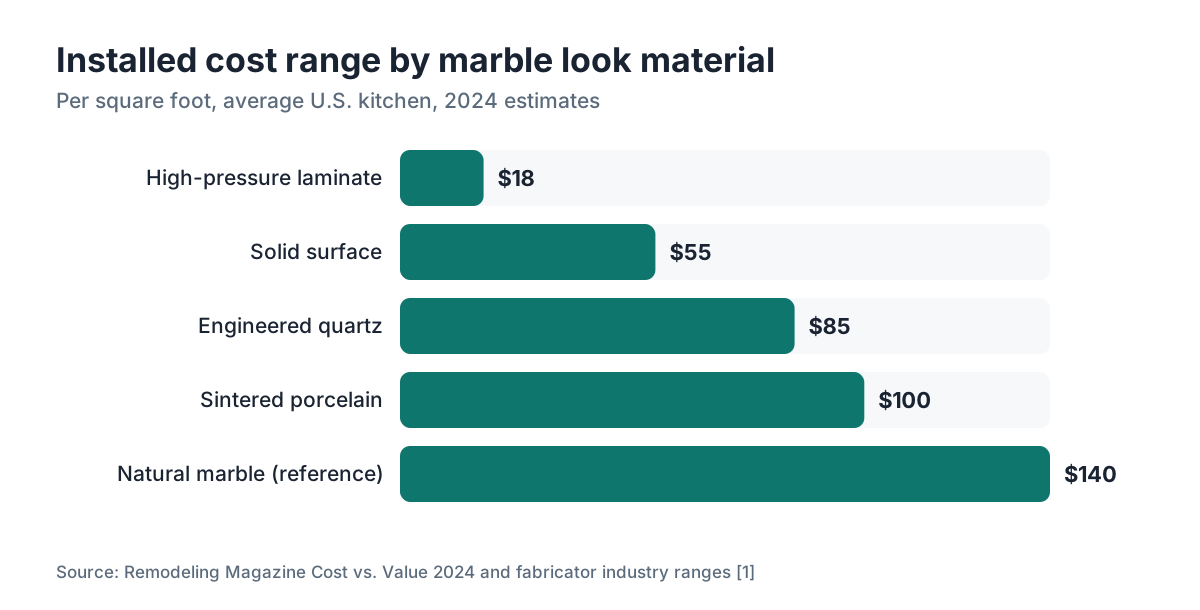
Prices swing hard by material, slab size, edge complexity, and local market. These are installed ranges (material plus fabrication and basic installation) for an average kitchen of 45 to 55 square feet.
| Material | Low end (installed) | High end (installed) | Why the range |
|---|---|---|---|
| High-pressure laminate | $8, $18/sq ft | $25/sq ft | Substrate and labor are cheap; fancy edges cost more |
| Solid surface | $35, $55/sq ft | $75/sq ft | Chemically welded seams add labor |
| Engineered quartz | $60, $80/sq ft | $100, $120/sq ft | Book-matched slabs and premium brands hit the top |
| Sintered porcelain | $65, $90/sq ft | $110, $130/sq ft | Slower fab time, higher breakage risk, specialty tooling |
| Natural marble (reference) | $75, $100/sq ft | $200+/sq ft | Rarity, veining match, ongoing sealing add cost |
A few things inflate that number fast. Book-matching two slabs so the veining mirrors across a seam is purely a design choice, and it adds 20 to 40% to material cost because you need slabs from the same batch, oriented correctly, and it wastes stone. Waterfall edges on an island add $400, $900 in labor alone depending on miter angle and material hardness [1].
Want a real number for your specific kitchen before calling a fabricator? The SlabWise instant quote tool takes your layout dimensions and material choice and returns a ballpark range from current regional pricing.
Don't forget the ancillary costs. Undermount sink cutouts typically run $100, $200 each. Cooktop cutouts are similar. Removing and hauling off old countertops is usually $50, $150. None of that shows up in the per-square-foot number most showrooms quote.
Which marble look material holds up best in a kitchen?
For kitchen use, engineered quartz wins for most homeowners. It's non-porous, so bacteria don't penetrate the surface the way they can with natural stone. OSHA and the International Agency for Research on Cancer have both flagged silica dust from cutting quartz as a serious occupational hazard [2][6], but that's a fabrication-shop problem, not a homeowner concern once the slab is installed.
Heat: never set a hot pan directly on quartz. The resin binder discolors or cracks under sudden thermal shock. Sintered porcelain has no such restriction. Drop a 500°F cast iron skillet on Dekton and nothing happens. That's a real difference for people who cook hard.
Scratches: quartz and porcelain both run harder than your knife (quartz is Mohs 7, sintered porcelain similar). You won't scratch them cutting on the surface, though you'll dull your knives faster than on a wood board.
Etching: quartz and porcelain don't etch. Lemon juice, wine, vinegar, none of it matters. Laminate resists most acids until a deep scratch breaks the surface layer. Solid surface lands somewhere between.
Seams: quartz and porcelain both show seams. A good fabricator minimizes them; a great one hides them where you'll never look. Solid surface welds seams chemically to near-invisibility. Laminate seams are always visible.
Here's the honest bottom line. Quartz is the best all-around kitchen surface for most people. Porcelain wins if you cook with extreme heat regularly or need a thin profile for a furniture-look installation. Laminate is fine if budget rules and you're careful with knives and heat.
Is quartz better than porcelain for a marble look?
The visual question is close. Both can look extremely convincing. The real difference is how the veining gets made, and it shows up at the edge.
Engineered quartz uses pigmented resin layered into the press mold. The veining runs through the material, so when a fabricator cuts and polishes the edge, the vein pattern continues into the stone. That's exactly what natural marble does, and it's one reason quartz edges look more real.
Sintered porcelain veining is a surface print. It doesn't run through the full thickness. So on an eased or beveled edge, you see the body color of the tile, not the printed marble pattern. Some makers now wrap the print onto a short edge reveal, but a 3cm bullnose on porcelain usually looks different from the face. This matters less on thin-slab installs where a waterfall edge gets mitered at 45 degrees.
Quartz is also more forgiving to fabricate. Porcelain slabs crack if support isn't perfect during handling, and cutting them takes water-cooled diamond blades at slower speeds. Waste rates run higher. That's why porcelain quotes tend to land $10, $20/sq ft over comparable quartz, even when the raw slab price is similar.
For bathrooms and low-traffic kitchens where the look is the priority, and you want to set a hot flat iron on the vanity without a trivet, porcelain earns its premium. For families cooking daily in a busy kitchen, quartz is the easier, safer call.
Can you tell the difference between marble look and real marble?
In a finished kitchen, usually no. Most people can't tell engineered quartz or high-quality porcelain from natural marble at normal viewing distance. Designers and fabricators can. The tells are repetition in the vein pattern, an edge that looks too perfectly consistent, and the absence of the random micro-variation that geology produces.
A few practical tests. Run a fingernail along the surface: real marble feels cool and slightly crystalline, quartz feels smooth. Put a drop of lemon juice on the surface for 5 minutes, then wipe. Real marble etches into a dull spot. Quartz and porcelain won't. Real marble also glows slightly more at the edge when held to a bright light because calcium carbonate is semi-crystalline.
For resale, listing your countertops as "marble look" or "quartz with Calacatta finish" is accurate and honest. Calling it "marble" when it's quartz is misrepresentation. Buyers doing due diligence will figure it out, and it creates legal exposure during a sale.
The more interesting question is whether real marble earns its premium. For most kitchens, no. For a statement bathroom vanity where you'll keep acidic liquids off it and you want the genuine material, maybe yes. See our marble countertops guide for that tradeoff in full.
What are the best brands for marble look countertops?
No objective ranking authority exists for countertop looks, so take brand lists with appropriate skepticism. That said, a few manufacturers have earned steady respect from fabricators for print quality, slab consistency, and warranty support.
Quartz brands with strong marble lines:
- Cambria (U.S.-made, lifetime warranty, sells only through fabricators) [3]
- Silestone by Cosentino (Spanish, HybriQ+ tech reduces silica content)
- Caesarstone (Israeli, widely available, good mid-range options)
- MSI Q Premium Natural Quartz (budget-friendly, wide distribution)
- Viatera by LX Hausys (Korean, underrated in the U.S.)
Porcelain/sintered brands:
- Dekton by Cosentino (most widely fabricated, 25-year warranty on many products) [7]
- Neolith (Spanish, thin formats for furniture-look installs)
- Lapitec (Italian, full-body sintered, good for outdoor use)
Laminate:
- Formica (widest U.S. distribution, Calacatta Marble pattern is a classic) [4]
- Wilsonart (comparable quality, slightly different color palette)
A note on warranty: manufacturer warranties on quartz usually cover defects, not damage you cause. They won't cover heat damage from a pan set directly on quartz, or chips from impact. Read the warranty document before you buy. Cambria's lifetime warranty is unusually strong in this industry [3].
For a kitchen countertops overview that lines up all material types side by side, that article gives the full picture.
What should homeowners know before buying marble look countertops?
The step most homeowners skip is getting eyes on the actual slab they're buying, more than a small tile chip. Veining in quartz and porcelain is not uniform across the slab. A 3-inch chip might show a subtle gray vein while the slab carries a bold, dramatic movement you weren't expecting. Go to the slab yard or the fabricator's showroom and look at the full slab.
Second: measure your square footage honestly. Include island overhangs (usually 1.5 inches for seating, sometimes up to 12 inches for bar-height). Include the backsplash if it's the same material. Fabricators template after cabinets go in, but you need a rough number to get accurate quotes.
Third: ask about seam placement before you sign anything. In a long run of counter you'll likely have at least one seam. Where it goes is negotiable. The inside corner of an L-shape is usually the least visible spot.
Fourth: understand lead times. Popular quartz slabs are usually in stock at regional distributors and fabricate in 2 to 4 weeks. Special-order colors or large-format porcelain can take 6 to 12 weeks, occasionally longer if shipping from overseas. If your remodel has a hard completion date, lock in the slab before the cabinets go in.
For the countertop installation process itself, that guide covers install day, how long to wait before using the sink, and how to punch-list your fabricator's work.
Fabricators who want a faster way to quote marble look jobs with accurate material and labor costs can look at how SlabWise handles material pricing and nesting for quartz and porcelain slabs.
How do you clean and maintain marble look countertops?
This is dramatically simpler than caring for real marble, and it's one of the strongest arguments for the alternatives.
Quartz: wipe with a damp cloth and mild dish soap. That's basically it for daily cleaning. For dried-on food, a plastic scraper works without scratching. Skip abrasive pads. Skip bleach-based cleaners or anything with a pH above 8.5 or below 4, because sustained exposure to extreme pH can affect the resin over time. No sealing, ever.
Sintered porcelain: even easier. It's essentially glass. You can use bleach, acidic cleaners, even acetone on most sintered surfaces without damage. Check your manufacturer's care guide, since some have proprietary surface treatments.
Laminate: wipe clean with mild soap. Keep standing water away from seams, because the wood-based substrate swells when wet. Once water infiltrates a laminate seam and the substrate swells, the countertop is toast.
Solid surface: soap and water daily. Light scratches buff out with a Scotch-Brite pad because the material is consistent all the way through.
For stone-adjacent surfaces like quartzite or soapstone that are actual natural stone (not look-alikes), the cleaning rules are genuinely different. See how to clean quartzite countertops and how to clean stone countertops for those.
One thing no manufacturer will tell you: quartz near a south or west-facing window can discolor over years of UV exposure. The resin binders yellow slightly. It's slow, and most people never notice, but if intense direct sun hits the counter all afternoon, sintered porcelain (which is UV-stable) is the smarter call [7].
How does marble look compare to other countertop alternatives?
If marble look isn't right for your space or budget, the realistic alternatives each make a different pitch.
Granite countertops give you natural stone variation at a price similar to quartz ($55, $100/sq ft installed), with better heat resistance. Granite doesn't etch because it's silicate-based rather than carbonate. It does need periodic sealing, maybe every 1 to 3 years depending on porosity. The look is completely different: granite looks like granite, not marble.
Laminate countertops are the right call when budget is under $25/sq ft and the kitchen isn't high-traffic. Modern laminate patterns are genuinely good. The catch is longevity. Laminate doesn't last as long as stone, can't be refinished, and doesn't add resale value the way quartz or granite does.
Butcher block countertops are the opposite of a marble look: warm, organic, a completely different aesthetic. They're real wood and need oiling and eventual refinishing, but they repair in ways stone never will. Good for islands where you actually cut.
Formica countertops covers the brand name that became a category. The full laminate breakdown lives there.
For a bathroom vanity, marble look quartz or porcelain both shine. UV and heat concerns are lower, traffic is lighter, and the visual payoff per square foot is high. You're covering less total square footage in a bath, so a premium material is easier to justify.
What do fabricators need to know about working with marble look materials?
This section is for shop owners and fabricators, not homeowners.
Quartz marble-look slabs are well-understood material at this point. The main fabrication concern is consistency. Veining in premium marble-look quartz is directional, and the customer almost always wants it running the same way across every piece. That means planning your cuts carefully and being straight about where a seam or directional break will show. Nesting software helps: lay out all pieces on the slab virtually before cutting, rotate them to match vein direction, and calculate exact yield. Waste on a premium veined quartz slab with one dominant direction can run 30 to 40% higher than a solid or minimally-patterned material.
Silica dust is the biggest occupational safety issue in the shop. OSHA's permissible exposure limit for respirable crystalline silica is 50 micrograms per cubic meter as an 8-hour time-weighted average [2]. In OSHA's words, the standard requires employers to "limit worker exposures to respirable crystalline silica." Wet cutting, vacuum-coupled tools, and proper respirators are not optional. Fabricators in California and Australia have faced serious enforcement actions and lawsuits over silicosis cases linked to quartz fabrication [5].
For sintered porcelain, the issues are brittle fracture and blade life. Porcelain slabs must be fully supported during cutting. Any unsupported span jacks up crack risk. Carbide tooling wears faster on sintered surfaces, so budget for it. Mitered edges on 12mm or 6mm porcelain need a stable bridge saw setup and a patient operator.
The other thing fabricators underquote is book-matching. If a client wants two slabs to mirror, you have to source sequential slab numbers from the same production batch, flip and align them physically at the slab yard before delivery, then cut carefully. Factor that handling time into your quote. Shops without digital quoting and layout tools often underestimate this labor by 20 to 30%.
Frequently asked questions
Are marble look quartz countertops worth it compared to real marble?
For most kitchens, yes. Engineered quartz needs no sealing, resists acids and stains, and costs $60, $100/sq ft installed versus $75, $200/sq ft for real marble. Real marble etches from lemon juice and wine, needs annual sealing, and demands careful daily use. The one place real marble wins clearly is a low-use bathroom vanity where the authenticity and translucency matter to you.
What is the most realistic looking marble countertop alternative?
High-quality engineered quartz and sintered porcelain are the two most convincing options. Both use digital printing to create veining. Quartz has an edge for edges: the vein pattern runs through the material, so cut edges look like natural stone. Porcelain veining is a surface print, so mitered edges reveal the body color unless the slab is made with a wrapped print. At the slab face, both fool most guests.
Does marble look quartz scratch or chip easily?
Quartz scores around 7 on the Mohs hardness scale, harder than most metals and comparable to kitchen tools. Normal cooking won't scratch it. Dropping a cast iron skillet from counter height onto an edge can chip the corner, which is a brittleness issue, not a hardness one. Chips repair with color-matched epoxy filler, though the fix is visible on close inspection. Sintered porcelain chips similarly. Neither material is indestructible.
Can marble look countertops be used in a bathroom?
Absolutely, and a bathroom is arguably the best application. UV exposure is lower than a kitchen facing a window, heat from flat irons is an occasional concern (quartz can discolor; porcelain is fine), and the visual payoff per square foot is high in a small space. Quartz and porcelain both need no sealing and clean easily, which matters in a room that gets humid and needs regular wiping.
How long do marble look quartz countertops last?
Quartz countertops are generally warranted for 10 to 15 years by most manufacturers, with Cambria offering a lifetime warranty. The material doesn't degrade under normal use. Practical lifespan is limited by chips, style changes, or remodels rather than material failure. Sintered porcelain lasts similarly. Laminate has a shorter run, typically 10 to 20 years before seams, chips, or substrate swelling become a problem.
What edge profiles look best on marble look countertops?
Eased (slightly softened square) and mitered profiles work well for a contemporary marble look. Ogee and dupont profiles are common on real marble, and some fabricators offer them on quartz to reinforce the marble aesthetic. On porcelain, stick to simpler profiles (eased or bevel) because complex ones need more material removal and raise crack risk. Waterfall edges on islands are popular and need careful seam planning at the floor.
Is sintered porcelain better than quartz for outdoor countertops?
Yes, clearly. Sintered porcelain is UV-stable and shrugs off freeze-thaw cycles in most climates. Quartz resins can yellow with prolonged UV exposure and may crack under extreme thermal cycling. For an outdoor kitchen in a sunny climate, sintered porcelain is the right call. For covered outdoor spaces with minimal direct sun and moderate climate, quartz can work but carries more long-term risk.
How much does it cost to install marble look countertops in an average kitchen?
For an average kitchen of about 50 square feet, expect $1,500, $3,000 for laminate installed, $3,000, $5,000 for solid surface, $3,500, $6,000 for engineered quartz, and $4,000, $7,000 for sintered porcelain. Those ranges include material, fabrication, and basic installation. Add $100, $200 per sink cutout and $50, $150 for old countertop removal. Book-matched or large-format slabs push toward the high end.
Can you put hot pans on marble look quartz countertops?
No. This is the most common mistake quartz owners make. The polymer resin binders in engineered quartz can discolor, crack, or blister under sudden heat above roughly 300°F. Always use a trivet or hot pad. Sintered porcelain and natural marble both handle direct heat without damage. If you cook in ways that involve moving hot pots straight from stove to counter, sintered porcelain beats quartz.
Do marble look countertops add value to a home?
Remodeling Magazine's Cost vs. Value Report consistently finds kitchen and bath remodels recoup 60 to 80% of their cost at resale, with mid-range upgrades often recovering more than upscale ones on a percentage basis [1]. Most agents treat quartz as a neutral-positive feature in mid-to-upper markets. Laminate can hurt perceived value in high-end markets. Condition matters more than material: new laminate beats old, chipped quartz every time.
How do I choose between Calacatta and Carrara marble look countertops?
This is mostly aesthetic. Calacatta marble has bold, dramatic veining on a bright white background and is the rarer, pricier of the two in natural stone. Carrara has softer, more diffuse gray veining on a slightly warmer white. In quartz and porcelain, manufacturers make versions of both. Calacatta-inspired designs run bolder and work well on islands. Carrara-inspired designs are quieter and work well in bathrooms or busier kitchens.
What is the thinnest marble look countertop available?
Sintered porcelain comes in 6mm (about 1/4 inch) thickness, sometimes called ultra-thin or slim format. These go into furniture-look applications, overlays on existing countertops, and wall cladding. They need a plywood or substrate layer for support on horizontal surfaces and are typically not recommended for undermount sink cutouts at 6mm. The 12mm thickness handles most standard applications, and 20mm is standard for countertops with undermount sinks.
Are there low-cost marble look countertop options under $20 per square foot?
Yes: high-pressure laminate is the realistic option. Brands like Formica and Wilsonart make Calacatta and Carrara-inspired patterns that install for $8, $20/sq ft including labor in most markets. The look is convincing from a few feet away, the surface resists most stains, and it needs no maintenance. The limits are heat sensitivity, visible seams, and the substrate edge reveal that gives it away up close. For a rental or a tight budget, laminate is an honest choice.
Sources
- Remodeling Magazine, Cost vs. Value Report 2024: Kitchen and bath remodels typically recoup 60 to 80% of cost at resale; countertop material condition affects perceived value.
- OSHA, Occupational Exposure to Respirable Crystalline Silica (29 CFR 1910.1053 and 1926.1153): OSHA's permissible exposure limit (PEL) for respirable crystalline silica is 50 micrograms per cubic meter as an 8-hour time-weighted average; quartz fabrication generates silica dust.
- Cambria, Product Warranty: Cambria offers a lifetime warranty on its quartz countertops, one of the strongest in the engineered stone industry.
- Formica Corporation, Product Catalog: Formica produces Calacatta Marble and other marble-look high-pressure laminate patterns widely distributed in the U.S.
- CDC, NIOSH Silicosis and Engineered Stone: U.S. public health agencies have documented cases of accelerated silicosis among engineered stone (quartz countertop) fabricators, prompting regulatory action.
- IARC Monographs, Volume 100C: Silica Dust, Crystalline, in the Form of Quartz or Cristobalite: The International Agency for Research on Cancer classifies crystalline silica inhaled from occupational sources as a Group 1 carcinogen (sufficient evidence of carcinogenicity in humans).
- Cosentino, Dekton Technical Data Sheet: Dekton sintered porcelain is fired above 1200°C under high pressure; the resulting surface is heat-proof and UV-stable.
- USGS, Mineral Commodity Summaries: Silica: Engineered quartz surfaces typically contain roughly 90 to 93% crushed quartz aggregate bound with polymer resins.
- U.S. Geological Survey, Mineral Commodity Summaries: Stone (Crushed and Dimension): USGS tracks production and pricing of quarried stone including marble and engineered stone inputs.
- Mineral hardness reference, U.S. Geological Survey: Quartz ranks 7 on the Mohs hardness scale, harder than most common metals and kitchen cutting tools.
Last updated 2026-07-09