TL;DR
- Solid surface countertops (Corian, Wilsonart, Avonite, and similar) run $45 to $150 per square foot fully installed in 2025.
- Most homeowners pay $2,000 to $6,000 for a typical kitchen.
- Price depends on brand tier, edge profile complexity, sink cutouts, and your region.
- Budget options start near $40/sq ft; designer lines push past $120/sq ft.
What does solid surface actually mean, and why does it affect price?
Solid surface is an engineered material made mostly from acrylic or polyester resins blended with mineral fillers, usually aluminum trihydrate. DuPont invented it in 1967 under the Corian brand, and the core chemistry has not changed much since [1]. The name means what it says. The color and pattern run all the way through, so a scratch or small gouge sands out without hitting a different-colored core underneath.
That repairability is why solid surface costs more than laminate countertops and Formica countertops, which have a thin decorative layer over a particleboard substrate. Scratch laminate through that layer and you are replacing the top, not fixing it.
Price tracks three things: material cost, fabrication labor, and installation complexity. Solid surface fabrication needs specialized router bits, adhesive seaming, and thermoforming gear for curved edges. That is more shop time than laminate and less raw material cost than granite or quartz, which parks solid surface in the middle of the countertop market.
Not every shop fabricates it well. Bad joints show up as visible lines and can crack over time. Good fabricators charge for the skill to make a joint disappear, and they should.
What is the average installed price per square foot in 2025?
The honest range is $45 to $150 per square foot installed, with most residential projects landing between $55 and $90 per square foot [2]. The spread is wide because it covers everything from builder-grade acrylic sheets to thick designer slabs with elaborate edge profiles.
Breaking it down by tier:
| Tier | Typical brand examples | Installed cost (per sq ft) |
|---|---|---|
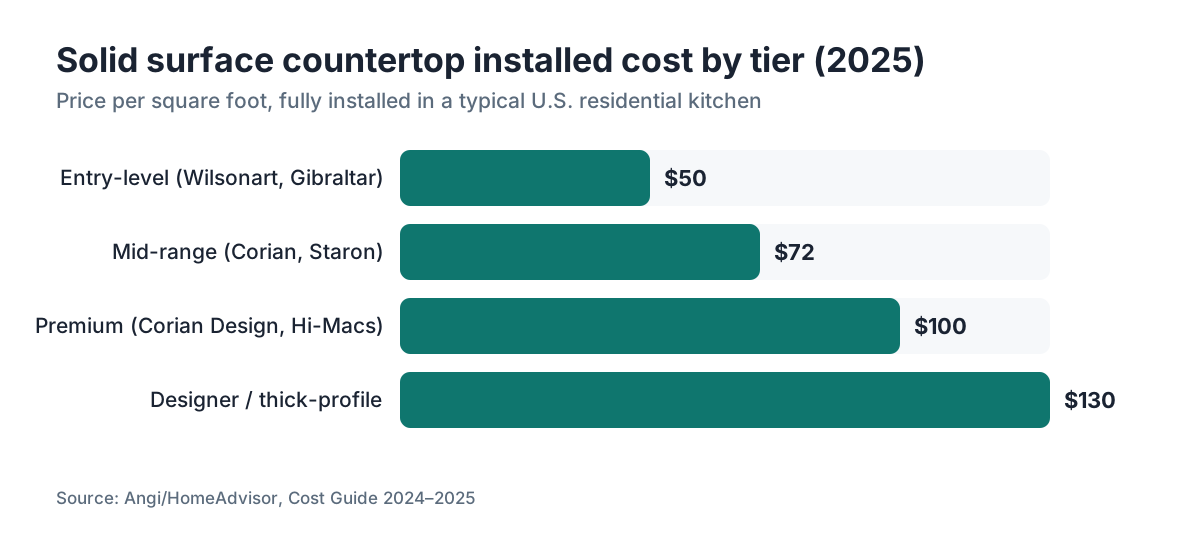
| Entry-level | Wilsonart, Gibraltar (polyester-blend) | $40, $60 |
| Mid-range | Corian, Avonite, Staron | $55, $90 |
| Premium | Corian Design collections, Hi-Macs | $80, $120 |
| Designer/thick-profile | Custom thermoformed, Corian Endura | $110, $150+ |
These are installed prices. Material-only pricing, if you are buying sheets for a DIY or contractor install, runs $25 to $75 per square foot depending on the line [2].
The national median kitchen countertop area is around 30 to 40 square feet, so a typical kitchen runs $1,650 to $6,000 installed at mid-range prices. A large kitchen with an island can hit $8,000 to $10,000 if you pick a premium line with full-height backsplashes and integrated sinks [3].
What factors push your quote up or down?
Square footage is just the starting point. Every one of these line items moves your total.
Edge profiles. A standard eased edge comes with most base quotes. Bullnose, dupont, and ogee profiles add $10 to $25 per linear foot because they need multiple router passes and hand-finishing. A full perimeter of 20 linear feet at $20 per linear foot adds $400.
Sink cutouts and integrated sinks. A simple undermount cutout costs $75 to $150. An integrated solid surface sink, one piece with the countertop and no visible joint, adds $300 to $800 depending on bowl depth and configuration. They are genuinely nice for hygiene and resale. They are not cheap [4].
Number of seams. Every seam takes 30 to 60 minutes of skilled labor and color-matched adhesive. Complex layouts with corners, peninsulas, or islands mean more seams. Good fabricators make joints nearly invisible. Bad ones cannot. Ask to see sample joints.
Cooktop cutouts. Add $75 to $200 per cutout.
Backsplash. A 4-inch scribing strip is often included. A full 18-inch tile-height backsplash in matching material adds $15 to $35 per linear foot.
Removal of old countertops. Most fabricators charge $150 to $400 to demo and haul. Some include it. Some do not. Ask.
Region. Labor rates in San Francisco or New York run 30 to 50 percent higher than the rural Midwest [5]. The same Corian job that costs $3,200 in Omaha might cost $4,800 in the Bay Area.
How does solid surface compare to other countertop materials in total installed cost?
Here is where solid surface sits in the broader market. Prices are fully installed averages based on industry surveys [2][3].
| Material | Installed cost range (per sq ft) | Key trade-off vs. solid surface |
|---|---|---|
| Laminate | $20, $40 | Cheaper, not repairable, visible seams |
| Solid surface | $45, $150 | Repairable, integrated sinks, mid durability |
| Quartz (engineered) | $70, $130 | Harder, scratch-resistant, no thermoforming |
| Granite | $60, $150 | Unique stone, needs sealing, heavy |
| Marble | $75, $250 | Looks great, etches easily |
| Porcelain slab | $80, $200 | Extremely durable, difficult to cut |
| Butcher block | $40, $100 | Warm look, requires oiling, can stain |
Solid surface is not the cheapest or the most premium option. Its real advantages are repairability, integrated sinks and coves that hide every joint, and a smooth non-porous face that is easy to keep clean. Healthcare and food service facilities pick it for exactly those reasons [6]. For a home kitchen, whether those benefits beat laminate countertops or granite countertops depends on how you cook and how long you plan to stay.
Want the look of natural stone? Price out marble countertops or granite countertops. Want less daily maintenance? Solid surface beats both on upkeep.
Which solid surface brands are worth knowing about?
Corian, made by Corian Design (formerly a DuPont division, now independent), is still the dominant brand and the one most fabricators know cold. It runs $55 to $110 per square foot installed for standard lines [1]. The Corian Endura line uses a modified chemistry for better heat and scratch resistance and runs at the high end.
Staron, made by Samsung, is a strong mid-market pick at $50 to $85 installed. Broad color choice, tight thickness tolerances, and fabricators tend to like working with it [10].
Hi-Macs (LG Hausys) competes in the same mid-range as Staron, with good translucency for lit countertop applications.
Wilsonart Solid Surface and Gibraltar (also Wilsonart) are entry-level to mid-market, popular for commercial renovations and budget residential jobs. Installed cost: $40 to $70 per square foot.
Avonite (Aristech Surfaces) has been around since the 1970s and has a reputation for consistency in the commercial market. Pricing is close to Staron.
For a deeper look at one brand's pricing and product line, the Corian countertops guide goes further on Corian specifically.
The honest take: for a kitchen used every day, mid-range Corian or Staron from a skilled fabricator beats entry-level material from an inexperienced shop. The fabricator matters more than the brand.
How do fabricators price solid surface jobs, and what is the markup?
Fabricators price solid surface jobs on three components: material cost, fabrication labor, and installation labor. Sheet stock costs fabricators $18 to $50 per square foot at wholesale, depending on brand and line [2]. They mark that up 40 to 100 percent to cover overhead, waste (cutouts and drops), and profit. Fabrication labor (cutting, routing, seaming, polishing) runs $15 to $40 per square foot of job at typical shop rates. Installation labor adds another $5 to $20 per square foot.
Lots of smaller shops quote one all-in price per square foot instead of itemizing. That is standard practice, not a red flag. What matters is whether the quote spells out material brand and line, included edge profile, number of sinks and cutouts, whether demo is included, and any travel or fuel charges.
Fabricators who quote off real sheet yield rather than nominal square footage tend to give cleaner bids. Software like SlabWise helps shops calculate true material yield and job cost before the quote goes out, which cuts the surprise charges that ambush homeowners on install day.
Waste factors on typical kitchen layouts run 15 to 25 percent [9]. An L-shape kitchen usually wastes more than a straight run because the corner drop is too small to reuse.
What does installation of solid surface actually involve?
Solid surface installation happens in two parts: the top is fabricated in the shop (cut to template, edges routed, joints prepped), then trucked to the site and set in place.
Templating comes first. A fabricator or a dedicated template crew visits your home and takes precise measurements, usually with a digital templating arm or a laser system. Templating takes 30 to 60 minutes for a typical kitchen. Some shops charge $75 to $200 for the visit. Others fold it into the job price. Ask upfront.
Fabrication follows. Shop time for a standard kitchen is 4 to 8 hours of labor. Complex curves or integrated sinks take longer and sometimes need thermoforming, where the sheet is heated and shaped around a mold.
Install day usually takes 2 to 4 hours for a kitchen. The crew sets the pieces, glues the joints, screws or clips the tops to the cabinet substrate, and caulks the wall lines. Solid surface is lighter than granite or quartz (roughly 3 to 4 pounds per square foot for 1/2-inch material versus 18 to 20 pounds per square foot for 3cm stone), so a two-person crew handles it without mechanical lifts [7].
For a broader look across materials, the countertop installation guide covers the full process.
Is solid surface durable enough for a kitchen, and how do repairs work?
Solid surface is harder than laminate and softer than quartz or granite. On the Mohs scale, typical acrylic solid surface lands around 2 to 3 [7], which means knives scratch it and a cast iron pan dropped from height can chip an edge. It is not the surface for chopping directly on the counter or setting hot pans down without a trivet.
The upside is real: scratches and minor burns are repairable in place. Light scratches come out with a Scotch-Brite pad and a mild abrasive in a circular motion. Deeper gouges need a belt or random orbit sander working through progressively finer grits from 80 to 400, followed by a polishing compound. Corian Design's care guide says: "Minor damage, such as scratches, cuts, burns, and stains, can usually be repaired by the homeowner" [1].
Heat resistance is the real limitation. Prolonged direct contact above 212 degrees Fahrenheit can discolor or warp the surface. A few seconds from a warm pan usually does no lasting harm, but a roasting pan fresh from a 450-degree oven absolutely can.
Solid surface is non-porous by nature, which is the actual hygiene argument. The NSF/ANSI 51 standard covers food equipment materials, and solid surface products can be certified under it for commercial food preparation surfaces [6]. That matters if you are designing a professional kitchen or a facility that gets health department inspections.
How can homeowners get an accurate quote and avoid overpaying?
Get at least three quotes from fabricators certified or authorized by the material manufacturer. Corian, for one, keeps a network of authorized fabricators who have passed training on seaming and installation. A non-authorized shop is not automatically worse, but authorization is a reasonable filter.
Make sure every quote covers the same scope. Ask each fabricator: Is demo included? What edge profile is in the base price? Is the template visit included? What is the warranty on fabrication and installation, separate from the material warranty?
Corian Design offers a 10-year limited warranty on Corian Solid Surface material for residential use [1]. That covers manufacturing defects, not misuse, so it will not touch the gouge from your kid's pocket knife. The fabricator's labor warranty is separate and usually runs 1 to 2 years for joints and installation.
Homeowners sometimes save 10 to 20 percent by going straight to a fabricator instead of through a kitchen design showroom. Showrooms mark up fabrication. Nothing wrong with that (they give you design help and a single point of contact), but if cost is the priority, calling a fabricator directly usually gets a better number.
The SlabWise instant quote tool lets homeowners enter kitchen dimensions and get a ballpark based on real regional pricing before they ever call a shop. Use it as a sanity check, not a final number.
One more thing: square footage is almost never what you think it is. Measuring a kitchen right means accounting for overhangs, the actual cabinet footprint, and deductions for sink and cooktop areas. A few wrong measurements shift a quote by $300 to $600.
What questions should you ask a fabricator before signing a contract?
These questions separate good quotes from bad ones.
- Are you an authorized fabricator for this material? Who certifies you?
- Can I see examples of joints you have done, in person or in recent photos?
- What is included in the edge price? Show me the profile options and their upcharges.
- Is demolition and haul-away included? What is the charge if not?
- How do you handle templating, and is there a charge?
- What is your lead time from template to install? (Solid surface is usually 5 to 14 business days.)
- What does your labor warranty cover, and for how long?
- How do I care for and repair this surface if it gets scratched?
- What is the brand and product line in this quote? (More specific than "solid surface.")
- If I change the edge profile or add a second sink after the template, how is that priced?
A fabricator who bristles at these questions is telling you something. A good shop answers all of them without hesitation and often hands you a printed spec sheet.
Are solid surface countertops worth it compared to quartz or laminate?
It depends on what you actually need. Solid surface fills a real niche, and it is not right for everyone.
Choose solid surface if you want an integrated sink with no visible joint (the best option for this outside of stainless steel), a curved or thermoformed shape that stone cannot do, or a surface that repairs in place without replacement.
Choose quartz if scratch and heat resistance are the priorities, you want a harder surface for heavy use, and you can live with visible seams. Cambria countertops and similar quartz products rate about 7 on the Mohs scale versus 2 to 3 for solid surface.
Choose laminate if budget is the main constraint and you are not staying in the home long-term. Modern laminate with a tight post-form edge looks far better than it did 20 years ago.
Choose butcher block countertops if you want warmth and character and will keep it oiled.
Solid surface is the right call for maybe 20 to 25 percent of residential kitchen projects, in my view. It wins on repairability and integrated-sink design. It loses on heat resistance and raw hardness. Be honest with yourself about how you cook before you commit.
For more material comparisons, the kitchen countertops overview covers the full landscape.
Frequently asked questions
How much does it cost to replace kitchen countertops with solid surface?
Replacing kitchen countertops with solid surface runs $2,000 to $6,000 for a typical 30 to 40 square foot kitchen at mid-range prices ($55 to $90 per sq ft installed). A larger kitchen with an island and integrated sink can reach $8,000 to $12,000. Demo and haul-away of the old tops adds $150 to $400 if the fabricator does not include it.
Is Corian the same as solid surface?
Corian is a brand of solid surface, the original one, invented by DuPont in 1967. Solid surface is the material category, which also includes Staron, Hi-Macs, Wilsonart, Avonite, and others. Saying 'Corian' when you mean solid surface is like saying 'Band-Aid' for adhesive bandage. Corian is now made by Corian Design as an independent company.
Can solid surface countertops be installed over existing countertops?
Technically yes, but most fabricators will not recommend it. Installing over existing tops creates height issues at appliances, can trap moisture, and risks adhesion failures if the old substrate moves. The right approach is removal. A few fabricators do overlay installs on a case-by-case basis when the substrate is perfectly flat and stable.
How long does solid surface installation take?
Template to install typically takes 5 to 14 business days at a well-run shop. The template visit takes 30 to 60 minutes. Fabrication takes 1 to 3 shop days depending on complexity. Installation day runs 2 to 4 hours for a typical kitchen. You can use the counters the same day after installation, though seam adhesive needs 24 hours to fully cure before stressing the joints.
What is the difference between 1/2-inch and 3/4-inch solid surface, and does thickness affect cost?
Most residential solid surface uses 1/2-inch sheet stock (12mm). A 3/4-inch option (19mm) is thicker, heavier, and costs 15 to 25 percent more in material. Some fabricators build up the edge with a stacked laminate strip to simulate a thicker profile without using full-thickness sheet. 3/4-inch is more common in commercial and healthcare settings.
Do solid surface countertops increase home value?
There is no solid data specifically on solid surface resale value. Remodeling Magazine's Cost vs. Value report tracks kitchen remodels broadly, not by countertop material. The general consensus among appraisers is that countertop material affects buyer perception but rarely drives a dollar-for-dollar return on premium materials. You are unlikely to recoup more than 50 to 70 percent of the cost at resale.
Can you put hot pans on solid surface countertops?
Brief contact with warm cookware is fine, but solid surface is not heat-proof. Prolonged contact above 212 degrees Fahrenheit can cause discoloration or surface distortion, and a hot roasting pan from a 450-degree oven can permanently damage the surface. Always use a trivet or hot pad. This is a real limitation compared to quartz, granite, or porcelain, which handle heat much better.
How do you clean and maintain solid surface countertops?
Daily cleaning with a damp cloth and mild dish soap is all most solid surface needs. For matte finishes, a Scotch-Brite pad in a circular motion removes light scratches. Avoid harsh abrasives on high-gloss finishes. Do not use bleach-based cleaners regularly; they can dull the surface over time. Solid surface is non-porous, so no sealing is required, unlike granite or marble.
What warranty comes with solid surface countertops?
Corian Design offers a 10-year limited warranty on Corian Solid Surface for residential installations. Most other brands offer 5 to 15 year material warranties. These cover manufacturing defects, not damage from misuse. The fabricator's labor warranty (covering seams and installation quality) is separate and usually runs 1 to 2 years. Always get both warranties in writing.
What is the cheapest solid surface countertop option?
Entry-level polyester-blend solid surface from brands like Wilsonart or Gibraltar runs $40 to $60 per square foot installed. These are thinner (typically 1/2-inch), have fewer color options, and may have slightly more visible seams than premium acrylic lines. For a budget kitchen that needs the repairability advantage of solid surface, they are a reasonable choice.
How does solid surface compare to quartz countertops on price?
They overlap a lot. Entry solid surface starts cheaper (around $40/sq ft installed) than most quartz (around $70/sq ft). At the mid-range, both run $55 to $100/sq ft. Premium solid surface and premium quartz both push past $120/sq ft. Quartz is harder and more heat-resistant. Solid surface allows integrated sinks and thermoformed curves with no visible joint that quartz cannot do.
Are there solid surface options for bathrooms, and do they cost the same?
Yes, and bathroom vanity tops are one of the strongest use cases for solid surface because the integrated sink kills the caulk line that collects mold. Pricing per square foot is similar to kitchen work, but total project cost is lower because vanities are smaller (8 to 15 square feet typically). A solid surface vanity top with integrated sink runs $400 to $1,200 installed.
Can a homeowner install solid surface countertops themselves?
Possible but not recommended unless you have router experience and access to color-matched adhesive. Seaming is the hard part: the adhesive must be color-matched and the joint must be clamped perfectly flush. A bad joint is worse than no joint. Edge routing and sink cutouts also need a trim router and specific bits. Material suppliers can sell direct to consumers, but fabrication skill is the limiting factor.
Sources
- Corian Design, Corian Solid Surface Product and Care Information: Corian was invented by DuPont in 1967; Corian Design offers a 10-year limited warranty for residential use; care guide states minor scratches and burns can usually be repaired by the homeowner
- HomeAdvisor (Angi), Countertop Installation Cost Guide: Solid surface countertops installed cost $45 to $150 per square foot; material-only pricing runs $25 to $75 per square foot depending on line
- Remodeling Magazine, Cost vs. Value Report 2024: National median kitchen countertop area and typical total project cost ranges for kitchen remodels
- Corian Design, Integrated Sink and Bowl Product Information: Integrated solid surface sinks are seamed into the countertop as one piece with no visible joint; pricing varies by bowl depth and configuration
- U.S. Bureau of Labor Statistics, Occupational Employment and Wage Statistics: Labor rates for construction and installation trades vary 30 to 50 percent between high-cost metros (San Francisco, New York) and lower-cost regions
- NSF International, NSF/ANSI 51 Food Equipment Materials Standard: Solid surface products can be certified under NSF/ANSI 51 for use as food equipment materials in commercial food preparation surfaces
- Aristech Surfaces (Avonite), Technical Data and Physical Properties: Solid surface acrylic material weighs approximately 3 to 4 pounds per square foot at 1/2-inch thickness; Mohs hardness approximately 2 to 3
- U.S. General Services Administration, Federal Supply Schedule for Solid Surface: Federal procurement data on solid surface material used in government facilities confirms commercial-grade use cases including healthcare and food service
- International Surface Fabricators Association (ISFA), Solid Surface Fabrication Guidelines: Solid surface fabrication requires color-matched adhesive seaming and certified fabricator training; waste factors on typical kitchen layouts run 15 to 25 percent
- Samsung Staron, Staron Solid Surface Technical Guide: Staron solid surface installs at $50 to $85 per square foot; manufactured to tight thickness tolerances
- U.S. Consumer Product Safety Commission, Kitchen Safety Guidelines: Heat resistance ratings and surface safety standards for kitchen countertop materials
Last updated 2026-07-09