TL;DR
- Quartz engineered to mimic marble gives you the white-and-veined Carrara or Calacatta look without the sealing, staining, or etching.
- Installed cost runs $50 to $120 per square foot depending on brand and edge profile.
- Strong options include Brittanicca by Cambria, Calacatta Gold by Caesarstone, and Calacatta Laza by MSI.
- The illusion holds from two feet away.
- Up close, trained eyes still catch it.
What exactly is marble-look quartz and how is it made?
Marble-look quartz is engineered stone, not a quarried material. About 90 to 94% of the slab by weight is ground quartz crystal. The rest is polymer resin binders plus pigments [1]. Manufacturers press that mixture under heat and vacuum into slabs roughly 120 inches by 55 inches, then cure and polish them. What comes out is non-porous and consistent from one slab to the next.
The marble look comes from the pigment layer. Makers inject different-colored resin flows into the mix before pressing, and those flows read as veins. Early slabs from the 1990s looked obviously fake, with thick blocky veins and no translucency. Current slabs from Cambria, Caesarstone, and MSI use photographic printing layers or hand-poured pigment to copy the feathery, branching veins of natural Carrara or Calacatta [2].
The one thing quartz cannot fully copy is depth. Light passes slightly into natural marble and bounces back differently than it does off a resin surface. Hold a flashlight at a low angle and you can usually see it. Under normal kitchen lighting, most homeowners never do.
How much do marble-look quartz countertops cost compared to real marble?
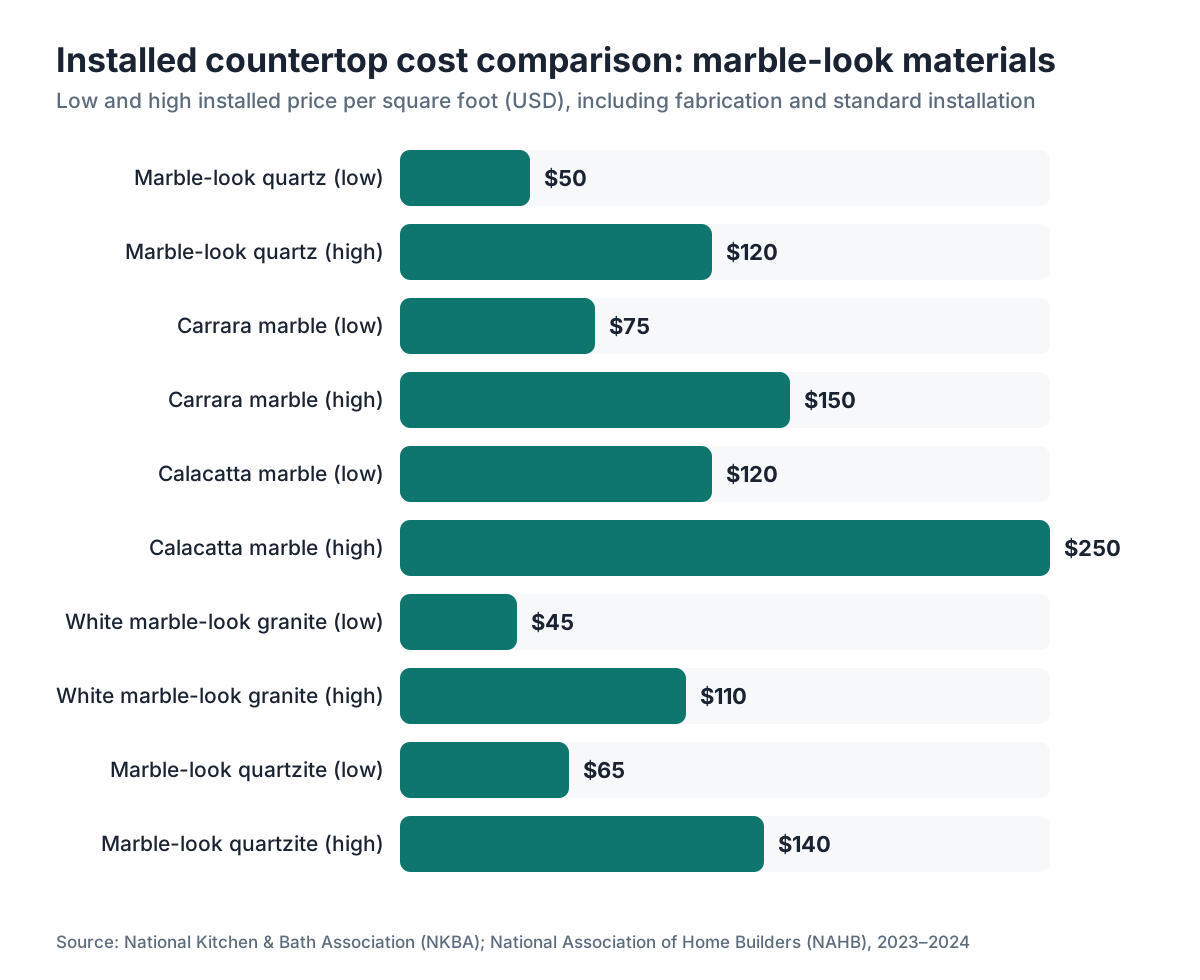
Installed marble-look quartz runs about $50 to $120 per square foot, depending on brand tier, thickness, and edge profile [3]. Basic big-box slabs (MSI's Q Premium whites, Silestone's mid-tier lines) land near the low end. Designer collections from Cambria or Caesarstone's Calacatta series push toward $100 to $120 installed before extras. Real marble installed runs $75 to $250 per square foot, with Italian Calacatta Gold reliably at the top and domestic or Chinese Carrara at the bottom [4].
On a typical 40-square-foot kitchen, that gap is real money:
| Material | Low installed $/sq ft | High installed $/sq ft | Sealing required | Etch risk |
|---|---|---|---|---|
| Marble-look quartz | $50 | $120 | No | No |
| Carrara marble | $75 | $150 | Yes (annually) | High |
| Calacatta marble | $120 | $250 | Yes (annually) | High |
| Granite (marble look) | $45 | $110 | Yes (every 1 to 3 yr) | Low |
| Quartzite (marble look) | $65 | $140 | Yes (annually) | Medium |
Installed price covers template, fabrication, and standard drop-in installation. Waterfall edges, mitered aprons, and specialty profiles add $15 to $50 per linear foot on top of that [3].
Edge-profile math is where fabricator margin quietly slips. Tools like SlabWise's quoting software fold edge pricing into the job total so it never gets left off the quote.
Over a ten-year horizon, quartz is the more honest money choice for anyone who wants the white-marble look without maintenance anxiety. Marble that etches or stains from daily cooking can cost several hundred dollars per repair or resurfacing visit [4].
Which quartz brands make the most realistic marble look?
A handful of brands come up again and again when fabricators talk about veining realism. Cambria, Caesarstone, MSI, and Silestone lead the pack, and each has a signature line worth knowing by name.
Cambria's Brittanicca and Ella are probably the most recognized. Brittanicca copies Calacatta marble with bold grey veining on bright white. Ella runs softer and more linear, closer to Statuario. Cambria is made in Le Sueur, Minnesota, and markets a lifetime limited warranty, though the terms need a careful read [2].
Caesarstone's Calacatta Gold (code 5131) has been a designer favorite for years. The veining is less dramatic than real Calacatta but very clean. Caesarstone also makes Calacatta Nuvo and Calacatta Maximus for bolder patterns [8].
MSI's Q Premium Natural Quartz line includes Calacatta Laza and Calacatta Botanica [9]. These skew lower in price but hold up well in fabrication, and MSI stocks them widely, which helps if you need a fast match for a repair.
Silestone's Eternal Calacatta Gold and Eternal Statuario are worth a look. Silestone uses a slightly different process that folds in some recycled material and antimicrobial silver ions, which the brand markets as a hygiene feature [10].
One thing to watch. A few budget brands sell slabs with Italian-sounding marble names that look great on a phone screen but show visible pixel-pattern repetition once installed. Ask your fabricator to lay two consecutive slabs face up before you sign off. If the veining repeats identically, you're looking at a low-end digital-print product.
See also: Cambria countertops for a full breakdown of that brand.
Is marble-look quartz better than real marble for a kitchen?
For most kitchens, yes. That's not a knock on marble. It's a recognition of what kitchens do to stone.
Marble is calcium carbonate, and acids etch it: lemon juice, tomato sauce, wine, coffee, vinegar cleaners, even some hand soaps. Etching isn't a stain you wipe off. It's chemical erosion of the polished surface that leaves dull spots. On a busy cooking surface, it shows up within months [4]. Quartz is non-porous and acid-resistant because the resin seals the surface completely.
Marble also scratches more easily than quartz under a knife, and it needs annual sealing to slow staining (sealing won't stop etching, only slow how fast liquid soaks in). Quartz needs neither.
Where marble wins is heat. You can set a hot pan directly on natural stone. You should not do that on quartz, because sudden thermal shock can discolor or crack the resin, which is why every quartz maker specifies trivets [1][6]. For bathroom vanities and other low-traffic spots, the performance gap shrinks and marble's visual authenticity gets more tempting.
For the full picture on marble countertops, including sourcing and sealing schedules, that guide goes deeper on the natural stone side. If you're comparing surface types more broadly, the kitchen countertops guide covers the whole field.
What is the difference between marble-look quartz and quartzite?
Quartz is manufactured. Quartzite is natural rock. That one distinction causes more countertop confusion than almost anything else, partly because some suppliers have sold quartzite as quartz on purpose.
Quartzite is a metamorphic rock, formed when sandstone gets compressed under heat until it recrystallizes [5]. Some quartzite slabs look strikingly like Carrara marble: white or light grey with natural flowing veins. Taj Mahal, Super White, and Sea Pearl are popular marble-lookalike quartzites.
Quartzite is harder than marble on the Mohs scale, around 7 versus marble's 3 to 4, so it resists scratching better [5]. But it's still porous and still etches from acids, just less aggressively than marble. It needs sealing, usually once a year. The how to clean quartzite countertops guide covers frequency and products.
Engineered quartz needs no sealing and won't etch. Quartzite is the most convincing natural-stone stand-in for marble if you want real authenticity, but you're signing up for maintenance.
White granite belongs in this conversation too. Alaska White, White Ice, and River White carry flowing grey veining that reads as marble at a glance. Granite that looks like Carrara is common in mid-range kitchens. It's harder, more heat-resistant, and less prone to etching than marble, though the veining runs coarser than true Calacatta. See the granite countertops guide for white granite options.
Can experts tell the difference between quartz and real marble?
Fabricators can tell immediately. Most homeowners and guests can't, under normal indoor lighting.
The giveaways for someone who knows: quartz has a very even gloss across the whole surface because the factory polishes it uniformly. Real marble has micro-variation in sheen. Quartz veins are a touch too consistent in color saturation, while marble veins fade and intensify on their own. Under strong raking light, quartz reads slightly plastic.
The other tell is uniqueness. Quartz is never truly one of a kind. Two homeowners can own the exact same slab pattern if they ordered from the same production run. Marble slabs are geologically unique. For design clients who care about a surface nobody else has, that matters.
For everyone else buying a kitchen and not a gallery piece, quartz is close enough that the difference is academic.
What thickness and finish options are available for marble-look quartz?
Quartz slabs come in 2 cm (about 3/4 inch) and 3 cm (about 1-1/4 inch). For countertops, 3 cm is the US standard today. It looks substantial, skips the plywood buildup under the slab, and holds up better to heavy daily use [3].
2 cm slabs still show up on vertical work like cabinet doors and some bathroom vanities, but most fabricators won't quote 2 cm for a horizontal kitchen surface unless you ask.
Finish options break down like this:
Polished is the standard. High gloss, veining shows most vividly, reads most like marble. It also shows fingerprints and water spots more than matte finishes.
Honed is flat and matte, no sheen. It copies unsealed or hand-finished marble convincingly and is the finish to consider if you want the antique-marble look. Honed quartz can show oil more visibly, even though the surface stays non-porous.
Leathered finishes show up on some lines, adding a slightly dimpled feel. Rare in white marble-look patterns.
Most designers default to polished for marble-look work because it reads most marble-like. Honed is the interesting alternative that gets underused.
How do you pick the right marble-look quartz slab in a showroom?
Go to the slab yard, more than the showroom sample board. A 3-by-3-inch tile tells you almost nothing about how a marble-look slab reads at full kitchen scale. Veining that looks bold and dramatic on a small chip can turn overwhelming or oddly subtle across 10 linear feet.
Ask to see two or three consecutive slabs from the same lot. Lay them flat, side by side, and step back six feet. That's your kitchen. Look for pattern repetition. Premium brands engineer variation between slabs. Budget slabs often repeat the same vein every 60 inches or so, and that becomes obvious after install.
Light matters enormously. Ask to see the slab under both showroom fluorescents and, if you can, daylight. White quartz can look cold and blue-grey under fluorescent light and warmer in daylight. If your kitchen gets a lot of sun, the daylight reading is the one that counts.
Check the background white against your cabinet samples. Bright white quartz (Silestone Eternal Calacatta) can clash with warm cream cabinetry. Warmer white quartz (Caesarstone's Misty Carrera) sits better with off-white or greige cabinets.
Last, ask your fabricator which slabs they've cut before. Some brands fabricate cleaner, with less edge chipping during the cut. That preference is worth something.
What are the limitations of marble-look quartz you should know before buying?
Heat is the biggest practical limit. Quartz makers uniformly say hot pots and pans should not touch the surface directly [1]. Sudden thermal shock, like a cast-iron skillet straight from a 500-degree oven, can crack or discolor the resin [6]. This actually happens. Use a trivet.
Outdoor use is off the table for most quartz. Prolonged UV exposure breaks down the polymer resin and causes yellowing or fading over the years [10]. A few brands sell UV-stable lines, but standard quartz is an indoor product.
Mitered and waterfall edges cost more on quartz than on solid natural stone. Quartz is a layered product, so a mitered waterfall means aligning the vein pattern across the joint, which eats fabricator time and adds cost. Expect a premium, and ask to see photos of the shop's previous waterfall jobs before you commit.
Repairs are harder than on natural stone. A chip in marble fills with stone-colored epoxy and polishes back to near-invisible. A chip in quartz is trickier, because matching the factory polish and color is difficult. That's exactly why getting the install right the first time matters more with quartz.
For how installation shapes long-term performance, the countertop installation guide covers what to watch during the install.
How do you clean and maintain marble-look quartz?
Maintenance is where quartz earns its price premium. You don't seal it. You don't need special pH-neutral cleaners. Most mild household cleaners are fine, with no etch risk.
Daily cleaning is warm water and a few drops of dish soap on a soft cloth. That handles 95% of kitchen messes. Dry with a second cloth to skip water spots, which show up on polished white quartz more than on darker surfaces.
For tougher stains, use a paste of baking soda and water, leave it a few minutes, then wipe. Or a diluted isopropyl alcohol solution (no stronger than 70%). Brief bleach contact is generally fine, but don't let it sit.
Stay away from concentrated bleach, oven cleaner, paint remover, and anything with methylene chloride. Those attack the resin [8]. Skip abrasive scrubbing pads too, since they scratch the polished surface.
For stone-care principles that apply across harder surfaces, the how to clean stone countertops guide has good baseline info, though quartz asks less of you than the natural materials covered there.
How do fabricators quote and nest marble-look quartz efficiently?
Marble-look quartz with bold veining creates a shop problem that plain solid-color quartz doesn't: vein matching. On a large L-shaped or U-shaped kitchen, the seam between two slabs ideally has veins running through continuously, or at least not fighting each other.
That means planning which slab section comes from where on the raw slab, and it cuts yield hard on dramatic vein patterns. A shop that estimates material by square footage alone will underbid these jobs.
Good nesting software fixes this by letting fabricators rotate and place job pieces on the slab digitally before cutting, so they get the most out of each slab while respecting vein direction. SlabWise builds this nesting and quoting into one workflow, which pays off most on exactly these white marble-look slabs where every offset costs material.
On premium collections like Cambria Brittanicca or Caesarstone Calacatta Gold, expect 65 to 75% yield on complex kitchens with vein matching, versus 80 to 85% on non-directional patterns [3]. Quote accordingly.
What are good alternatives if marble-look quartz doesn't feel right?
Marble-look quartz doesn't suit everyone. Some people want natural-stone authenticity and will accept the upkeep. Others want the look but can't get past the plastic undertone.
White quartzite (Super White, Taj Mahal, Sea Pearl) is the closest natural alternative. You get real stone variation and depth, plus better hardness than marble. You still seal it yearly and still carry some etch risk, though less than true marble.
White marble-look granite (Alaska White, White Ice, Colonial White) gives you natural stone with very low etch risk and moderate sealing needs. The veining reads coarser than marble to a trained eye, but in a finished kitchen most people read it as marble-adjacent.
Laminate has come a long way. Current Wilsonart and Formica marble-look laminates print at high resolution and cost $10 to $30 per square foot installed. From standing height, they're surprisingly convincing. They won't fool anyone who touches them, but for a rental or a budget kitchen, it's a real option. See the laminate countertops and Formica countertops guides.
Corian and other solid surfaces offer marble-pattern options too. They're fully repairable and non-porous, with a plastic feel that's distinct from stone. The Corian countertops guide covers solid surface in depth.
For some kitchens, a different aesthetic is more honest than chasing the marble look at all. The butcher block countertops guide covers wood surfaces that pair well with marble-look islands.
Frequently asked questions
Does marble-look quartz yellow over time?
Standard white quartz can yellow from prolonged UV exposure outdoors or under uncovered skylights. Indoors under normal lighting, yellowing is rare and usually traces to chemical contact, like leaving a bleach solution too long or using a strong oxidizer. Reputable brands haven't had widespread indoor yellowing complaints. Check the manufacturer's warranty for yellowing coverage before you buy.
Can quartz that looks like marble be used in a bathroom?
Yes, and it works very well. The non-porous surface resists mold and mildew better than natural marble in high humidity [11]. Heat is less of a concern in bathrooms than kitchens, so quartz's main limitation matters less. Honed-finish marble-look quartz is popular for vanity tops because it copies antique stone without any of the upkeep.
Which quartz looks most like Carrara marble specifically?
Caesarstone's Misty Carrera (code 9141) and Silestone's Lyra are widely cited as the closest Carrara matches: soft white background, delicate light grey veining, no dramatic movement. MSI's Calacatta Laza runs slightly bolder but sits in the same family. If you're matching against real Carrara, bring an actual marble sample to the slab yard and compare under the same light.
Is marble-look quartz good for outdoor kitchens?
Generally no. Most quartz makers explicitly exclude outdoor use from their warranties because UV radiation degrades the polymer resin over time, causing color shift or surface breakdown [10]. A few brands make UV-stable outdoor lines, but those are the exception. For outdoor kitchens, granite, quartzite, or porcelain tile are better picks. Always check the specific product's outdoor warranty before specifying.
How do seams look on marble-look quartz?
Seams are visible on marble-look quartz, especially on dramatic vein patterns. A skilled fabricator can align veins across a seam to soften the break, but the seam itself still shows on close inspection. On solid-white or fine-vein patterns, seams read less obvious. For an island with a waterfall edge, seam placement and vein matching take real fabricator skill and add cost.
What edge profiles work best to make quartz look like real marble?
Eased or slightly beveled edges look clean and contemporary. For an authentic marble read, an ogee or full bullnose copies the hand-cut edges of antique marble. A mitered edge that thickens the apparent slab to 3 inches or more is increasingly popular on premium jobs because it gives the same visual weight as a thick marble slab. Each upgraded profile adds $15 to $50 per linear foot [3].
Can I cut food directly on marble-look quartz?
Quartz is hard enough to resist knife scratches, but cutting directly on it dulls your knives much faster than a wood board, because quartz is harder than steel. Manufacturers and fabricators recommend always using a cutting board. Bacteria can't penetrate the non-porous surface, so hygiene isn't the issue here. Protecting your knives is.
How long does marble-look quartz last?
With normal indoor use and basic care, quartz lasts 25 years or more without meaningful degradation. The resin holds up under normal conditions. The main failure modes are thermal-shock cracking near stoves, chips at edges from impact, and discoloration from harsh chemicals. Cambria offers a lifetime limited residential warranty [2], though it has exclusions worth reading before you use it as a selling point.
Is granite that looks like marble cheaper than marble-look quartz?
Roughly comparable. White marble-look granites (Alaska White, White Ice) run about $45 to $110 installed, overlapping the lower half of marble-look quartz pricing. Granite beats quartz on heat resistance and feels more natural. It needs sealing, usually every one to three years. In a kitchen where hot pans land near the stove, granite's heat tolerance is a real advantage over quartz.
What is the resale value impact of marble-look quartz versus real marble?
No peer-reviewed study has isolated resale value for quartz versus marble specifically [12]. National Association of Realtors remodeling surveys show kitchen countertop upgrades returning roughly 60 to 80% of cost at resale on average, but the data doesn't split by material finish [7]. In practice, buyers in most markets can't tell marble-look quartz from real marble during a home tour, so the resale impact is probably similar.
How thick should marble-look quartz countertops be?
3 cm (about 1-1/4 inch) is the US standard for kitchen countertops today. It's thick enough to skip a plywood buildup in most applications and reads as substantial and stone-like [3]. 2 cm shows up occasionally on bathroom vanity tops, case by case. Going thicker than 3 cm is done mainly for visual effect on waterfall edges or island aprons, using lamination.
Do I need to seal marble-look quartz countertops?
No. Sealing is one thing you never do with quartz. The polymer resin makes the whole surface non-porous from the factory. A topical sealer adds nothing, and some sealers actually cause cloudiness or uneven sheen on polished quartz. This is one of the main practical advantages over marble, quartzite, and granite, all of which need periodic sealing.
Can marble-look quartz be repaired if it chips?
Small chips can be filled with color-matched epoxy or acrylic, but matching the factory polish is difficult, so the repair usually shows on close inspection. Larger cracks or breaks generally mean section replacement. Prevention beats repair: protect edges during installation (the most common chip location) and avoid heavy-pot impact. Keep the warranty documents, since some cover fabrication-related damage.
Sources
- Occupational Safety and Health Administration (OSHA), Crystalline Silica page: Engineered quartz countertops are 90 to 94% crystalline silica by weight, bound with polymer resin; manufacturers specify avoiding thermal shock from direct heat contact.
- Cambria, Product & Warranty Information: Cambria produces quartz surfaces in Le Sueur, Minnesota, and markets a lifetime limited warranty on residential installations; Brittanicca and Ella are Calacatta and Statuario marble-look collections.
- National Kitchen & Bath Association (NKBA), industry cost data: Installed quartz countertop prices range from roughly $50 to $120 per square foot; edge profiles add $15, $50 per linear foot; 3 cm is the US standard thickness; yield on vein-matched marble-look slabs is approximately 65 to 75% on complex kitchen layouts.
- National Association of Home Builders (NAHB), kitchen materials cost data: Marble countertops installed run $75, $250 per square foot; etching from acids is a chemical erosion of the polished surface; marble resurfacing repair costs several hundred dollars per visit.
- U.S. Geological Survey (USGS), Minerals: Quartzite is a natural metamorphic rock formed when sandstone recrystallizes under heat and pressure; it ranks approximately 7 on the Mohs hardness scale compared to marble at 3 to 4.
- U.S. Department of Energy, Building Technologies Office: Polymer-resin binders in engineered quartz can discolor or crack from sudden thermal shock such as direct contact with cookware from high-temperature ovens.
- National Association of Realtors, Remodeling Impact Report: Kitchen countertop upgrades return approximately 60 to 80% of cost at resale on average across US markets.
- Caesarstone, Product Technical Data Sheets: Caesarstone Calacatta Gold (5131), Calacatta Nuvo, and Calacatta Maximus are marble-look quartz collections; cleaning recommendations exclude bleach on extended contact and methylene-chloride-based products.
- MSI Surfaces, Q Premium Natural Quartz Product Guide: MSI's Q Premium Natural Quartz includes Calacatta Laza and Calacatta Botanica; budget quartz lines may show repeating vein patterns due to digital-print manufacturing methods.
- Silestone by Cosentino, Product & Warranty Documentation: Silestone Eternal Calacatta Gold and Eternal Statuario incorporate antimicrobial silver ions; UV exposure is listed as an exclusion from outdoor residential warranty coverage.
- U.S. Environmental Protection Agency (EPA), Mold: Non-porous surfaces like engineered quartz resist mold and mildew colonization better than porous natural stone in high-humidity environments such as bathrooms.
- National Association of Realtors, Home Staging & Remodeling research: No peer-reviewed data isolates the specific resale premium of marble-look quartz versus real marble; countertop upgrades are grouped as a general kitchen improvement category.
Last updated 2026-07-09