TL;DR
- Brown marble countertops run $40 to $200 per square foot installed, depending on variety and edge profile.
- The most-stocked options are Emperador Dark, Tobacco Brown, and Portoro.
- Marble needs sealing every 6 to 12 months and etches from acids like lemon and wine.
- The brown tone hides everyday wear better than white marble, but it still demands real maintenance.
What exactly is brown marble and why does it come in so many shades?
Brown marble is metamorphic rock, limestone that recrystallized under heat and pressure deep in the earth's crust. The brown, tan, and tobacco tones come mostly from iron oxide minerals and organic compounds locked into the stone during that change [1]. The exact shade, from pale beige to nearly black espresso, tracks the specific mineral mix at the quarry.
That's why two slabs both labeled "brown marble" can look almost unrelated. Emperador Dark from Spain reads as deep chocolate laced with white veining. Tobacco Brown from Turkey runs warmer, almost caramel, with quieter movement. Portoro from Italy is nearly black with dramatic gold veining. These are separate stones from separate geology, not marketing names slapped on one material.
The variation is the appeal and the headache at once. Fall in love with a slab at the yard? Buy the exact slabs you inspected, not the same lot number from a later shipment. Color and pattern consistency across a quarry batch is loose at best.
Brown marble also lives on a hardness spectrum. Calcite-dominant marble sits around 3 on the Mohs scale, so a steel knife can scratch it [2]. Some stones sold as brown marble are actually dolomitic marble or even quartzite, which test harder. Ask your fabricator or supplier for the actual mineral composition, more than the trade name.
Which brown marble varieties are most popular for kitchen countertops?
A handful of stones run the brown marble market in North America right now. Here's what you'll actually see at the yard.
Emperador Dark is probably the most recognized. It comes from Alicante, Spain, has a deep chocolate ground color, and shows fine white veining that looks almost like lacework when polished. It is a true marble (calcium carbonate dominant), so it etches readily from acids. Fabricators like it because it cuts clean and takes a high polish.
Tobacco Brown (sometimes sold as "Brown Fantasy" from Turkish quarries) is softer in tone, closer to warm amber or toffee. The veining is more pronounced than Emperador, which makes large islands pop. Pricing usually lands mid-range.
Portoro is the showstopper. Quarried near the Gulf of La Spezia in Italy, it is essentially black marble with bold gold and white veining, and it reads brown-black in certain light. It is expensive, quarried in small quantities, and has sat in luxury interiors for centuries. Real Portoro runs toward the top of the price range, and imitations are everywhere. Ask for the quarry certificate [3].
Walnut Brown and Brown Onyx sometimes get grouped with brown marble in showrooms. Onyx is a different mineral entirely (banded chalcedony or aragonite, depending on the source), and it is softer and more porous than marble. It is gorgeous for backlit panels or a low-traffic bath. A kitchen counter in onyx will not survive unless you treat it like furniture, not a work surface.
Travertino Noce is travertine, not marble, but it shares the warm brown tones and shows up in the same design category. It has natural voids that fabricators fill with epoxy, and it etches from acid the same way marble does [4].
For marble countertops in general, the same care rules apply no matter the color. The brown category just hides etching and daily residue a bit more forgivingly than white Carrara.
How much do brown marble countertops cost installed?
Installed pricing covers the stone, fabrication (cutting, edging, polishing), and installation labor. It does not include demo of old counters, plumbing reconnection, or tile backsplash work. The range is genuinely wide.
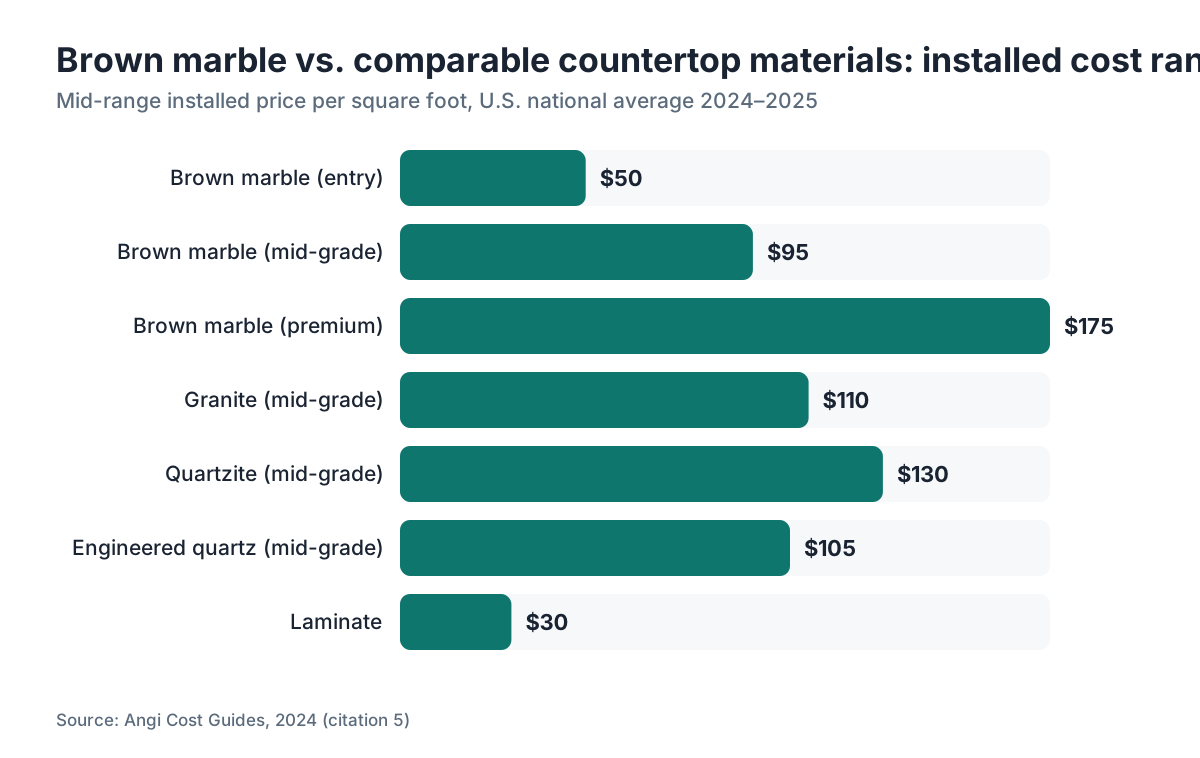
Budget brown marble (some imported Emperador look-alikes or lower-tier Tobacco Brown) starts around $40 to $60 per square foot installed in many U.S. markets as of 2024 to 2025. Mid-grade stone like standard Emperador Dark runs $70 to $120 per square foot installed. Premium and rare material, like authentic Portoro or book-matched Emperador, pushes $150 to $200 per square foot or higher at specialty shops [5].
A typical kitchen has 40 to 60 square feet of countertop. At mid-grade pricing, that puts a full brown marble kitchen at $3,500 to $7,200 for most homeowners. An island-heavy kitchen with 80 square feet lands at $6,000 to $10,000 at the same rates.
Factors that move the number:
- Edge profile. A simple eased edge is included in most base quotes. Ogee, waterfall, mitered, or double-radius profiles add $15 to $40 per linear foot at many shops.
- Thickness. 3 cm (about 1.25 inches) is the industry standard for countertops now. Some designers spec 2 cm with a built-up edge for a classic look, which actually costs more in labor. 4 cm or mitered waterfall edges cost more still because they eat material.
- Cutouts. Each sink cutout typically adds $100 to $250. Cooktop cutouts are similar. Outlet cutouts vary by shop.
- Seams. More seams mean more labor and more caulk lines to babysit over the years. A good fabricator hides seams where they read least and hold structurally.
- Region. Fabrication labor swings hard by metro. San Francisco and New York shops charge more than rural Midwest shops for the exact same stone.
Want a ballpark on your own project? Fabricators increasingly run online quoting tools. If your shop uses SlabWise, you can often get an instant estimate before you ever drive to a yard.
Compare brown marble to nearby stones: granite runs roughly $45 to $175 installed [see granite countertops], quartzite $60 to $200, engineered quartz $55 to $155. Brown marble is not dramatically pricier than granite at matched quality. You pay for rarity at the top end, not across the board.
Does brown marble etch and stain, and how bad is it really?
Yes, it etches. That's the single most important fact to understand before you buy marble for a kitchen.
Etching happens when an acid touches calcium carbonate (the main mineral in marble) and dissolves a thin layer of the polished surface. You get a dull, slightly rough spot that looks like a water ring but won't wipe away. Lemon juice, wine, tomato, vinegar dressings, even carbonated water can etch if they sit [6]. Brown marble hides etching noticeably better than white or pale marble because the tonal contrast is lower. It does not prevent it.
Staining is a different mechanism. A stain is a substance absorbed into the pores, not surface dissolution. Oil, grease, coffee, and dark liquids are the usual culprits. Sealing slows absorption but never makes marble stain-proof.
Here's the honest reality in a working kitchen. If you cook often and you don't wipe spills the second they happen, brown marble develops a patina. Some homeowners love that lived-in look and think it adds to the stone. Others find the upkeep stressful. Be honest with yourself about your habits before you commit.
Honed finishes (matte) hide both etching and scratches better than polished ones, because the surface is already flat and new etch marks blend in. Polished Emperador in high-use zones shows etch patterns more over time. For a busy island in brown marble, honed is the more forgiving call.
The USGS describes marble as calcium carbonate metamorphic rock with a Mohs hardness of 3, well below steel kitchen tools and many cleaning products [2]. That physical reality doesn't change with color or price.
How do you seal and clean brown marble countertops?
Sealing is not optional for marble in a kitchen. A penetrating (impregnating) sealer soaks into the pores and builds a barrier that slows liquid absorption. It does not stop etching, because etching is a chemical reaction at the surface, not absorption.
Stone industry sources recommend sealing marble countertops every 6 to 12 months, depending on use and the specific product [7]. A water-bead test tells you when: pour a tablespoon of water on the surface and wait 10 minutes. Beads up? The seal holds. Soaks in and darkens the stone? Reseal.
Application is straightforward. Clean the surface, let it dry completely (some fabricators want 24 hours after cleaning), apply the sealer per the label, let it penetrate, then buff off the excess before it dries sticky. Most penetrating sealers don't change how the stone looks.
Daily cleaning is dead simple. Warm water and a few drops of dish soap on a soft cloth, then a dry wipe. That's it. Skip vinegar, citrus cleaners, bleach, and ammonia on marble. All of them etch or damage the surface over time [7]. A stone-specific pH-neutral cleaner is worth buying; a 32-oz bottle runs $10 to $20 and lasts forever.
For how these rules carry over to other natural stones, the how to clean stone countertops guide covers granite, soapstone, and quartzite side by side.
An etch mark is not a stain. Marble polishing powder, from a stone supplier, rubbed with a damp cloth can often bring back the sheen on a mild etch. Deeper etches need professional honing. Don't try to sand or refinish marble with household abrasives.
How does brown marble compare to quartzite, granite, and quartz?
This comparison comes up constantly, because the alternatives look similar in showroom photos and behave very differently in a kitchen. The short version: marble is the softest and least acid-resistant of the group, and you're buying it for looks, not toughness.
| Material | Hardness (Mohs) | Acid resistance | Heat resistance | Approx. installed cost | Sealing needed |
|---|---|---|---|---|---|
| Brown marble | ~3 | Poor | Good | $40 to $200/sq ft | Yes, 6 to 12 mo |
| Granite | 6 to 7 | Good | Excellent | $45 to $175/sq ft | Yes, 1 to 2 yr |
| Quartzite (true) | 7 | Good to excellent | Good | $60 to $200/sq ft | Yes, 1 to 3 yr |
| Engineered quartz | 7 | Good | Poor (resins) | $55 to $155/sq ft | No |
Granite is harder, more acid-resistant, and easier to maintain than marble, and it still offers natural-stone variation [see granite countertops]. Love the warm brown tones but have kids and a chaotic kitchen? Granite in a brown or coffee tone (Tan Brown, Coffee Brown, Giallo Ornamental) gets you a similar palette with far better durability.
True quartzite in warm browns (Fantasy Brown is the famous example, though labs have confirmed it's sometimes actually marble or dolomite, so test it) gives better scratch and acid resistance, if you actually have a silica-dominant stone. The quartzite confusion in the trade is real. Ask for a certified mineralogy test if you're paying quartzite money for what might be soft marble [8].
Engineered quartz (Cambria, Silestone) has strong scratch and acid resistance because it's roughly 90 to 95% ground quartz bound with polymer resin. The catch is heat: a hot pan can yellow or crack those resins. Cambria countertops carry a limited lifetime warranty, which marble can't match. If a brown look-alike in quartz fits your eye, the maintenance trade is worth weighing.
Soapstone is another dark natural stone with charcoal-brown tones. It's soft like marble but acid-resistant, because it's silica-dominant rather than carbonate-dominant. See how to clean soapstone countertops for that comparison in full.
What kitchen styles work best with brown marble countertops?
Brown marble is not a neutral the way beige laminate is. It makes a statement. The depth and movement in a polished Emperador slab or a dramatic Portoro surface grabs the eye the second you walk in.
Where it tends to shine:
Traditional and Mediterranean kitchens. Warm wood cabinetry (walnut, cherry, cognac-stained oak), bronze or brass hardware, and brown marble have a long history together. The stone grounds the warmth of the wood instead of fighting it.
Modern contrast kitchens. White or bright gray cabinets against Portoro or very dark Emperador create a sharp, contemporary contrast. The dark stone becomes the focal point, which can be striking on a large island.
Transitional designs. The most common American kitchen style right now blends traditional cabinetry with cleaner lines. Mid-tone brown marble in Tobacco Brown or Brown Fantasy pairs well with greige, cream, and natural wood.
Where it gets tricky: all-dark kitchens where the cabinetry is already very dark, so the stone just disappears. Same problem in kitchens heavy on warm reddish-orange tones, where brown marble can read muddy instead of rich.
For kitchen countertops generally, the countertop should contrast or complement the cabinetry. Never match it so closely that the two surfaces blur into one.
Edge profiles set the register too. A flat polished edge reads contemporary. A beveled or eased edge reads transitional. An ogee edge reads traditional. Let the edge follow the overall kitchen style rather than picking it in isolation.
Are brown marble countertops a good choice for bathrooms?
Marble in bathrooms has a long, successful record, and the stakes are lower than in a kitchen. The acid exposure in a bathroom is mostly from toiletries, which hit marble much more gently than food acids do.
Brown marble vanity tops read warm and spa-like. Emperador Dark on a vanity with an undermount sink, polished to a high shine, ages beautifully. It's also one of the cheaper applications, since a vanity uses far less material than a full kitchen.
The things to watch in a bathroom: standing water and soap scum. Marble around a sink dulls over time from soap deposits and mineral buildup. Clean it regularly with a pH-neutral stone cleaner, not tile spray, since most tile sprays carry acids or bleach.
Showers are possible but take more planning. Marble tile or slabs in a shower need to be sealed well, and grout (if tiled) has to stay clean and get resealed. A walk-in shower surround in Tobacco Brown with a rain head is genuinely beautiful. It also needs monthly attention to stay that way.
For a low-traffic powder room, brown marble is nearly risk-free. You're not cooking there, contact is minimal, and the visual payoff per dollar of material is excellent.
What questions should you ask a fabricator before buying?
The gap between a great brown marble install and a disappointing one usually opens up in the conversation before you sign. Ask these five things.
First: has the stone been tested or certified for mineral composition? Trade names like "Fantasy Brown" have been sold as quartzite when lab testing shows dolomitic marble or true marble. That distinction drives durability expectations and pricing fairness [8].
Second: can you see the actual slabs you're buying, more than a sample? Brown marble varies a lot within a single lot. Matching slabs for multi-piece counters (islands especially) means seeing the full layout laid out.
Third: how does the shop handle seams? On a big island, a seam may be unavoidable given slab size (most slabs run 55 to 65 inches wide and 110 to 130 inches long). Seam placement in brown marble should follow the veining so the seam breaks the pattern as little as possible.
Fourth: what's the sealing protocol after installation? Many shops apply sealer before delivery, but the stone may need a fresh coat within 6 months depending on how soon the initial seal went on after fabrication.
Fifth: what's actually in the quote? Demo, plumbing disconnect and reconnect, and hauling off old counters often add $200 to $600, and shops differ on whether those are bundled or line items. See countertop installation for a full breakdown of the process.
Shops running structured quoting software (like SlabWise) tend to produce itemized quotes where you can see what each line costs. That makes these conversations far easier than a single number scrawled on a napkin.
How do you repair chips, scratches, or deep etches in brown marble?
Minor marble damage is DIY-fixable. Anything visible, though, comes out better in the hands of a skilled stone restorer.
Small edge chips are the most common brown marble injury. Color-matched epoxy filler gets worked into the chip, left to cure, then leveled and polished. It won't vanish under a close look, but it's hard to spot in normal use. Matching epoxy to brown marble is easier than to white or heavily veined stone, because the darker background is forgiving.
Surface scratches in polished marble can be buffed out if they're shallow, sitting in the polish layer rather than the stone itself. Marble polishing compounds handle those. Deeper scratches that reach the stone face need professional honing.
Deep etch marks, the kind you get when something acidic sits on polished marble for hours, need mechanical honing to remove. That means wet sanding with progressively finer diamond pads, then repolishing. On a full counter, it's a multi-hour professional job. Honing and repolishing a 40-square-foot kitchen countertop typically runs $300 to $800 depending on market and severity [9].
One quiet advantage of dark varieties: the depth of color in Emperador absorbs light more than white marble, so shallow scratches and mild etching reflect less and read less obvious. It's a real practical edge over lighter marble, even though the underlying vulnerability is identical.
What does the fabrication process look like for brown marble?
Knowing how the slab travels from a quarry in Spain or Turkey to your kitchen helps you make better calls and have sharper conversations with your fabricator.
It starts at the slab yard. Most U.S. fabricators either stock inventory at their own warehouse or pull from a nearby stone distributor. You pick the specific slabs. Brown marble almost always needs a yard visit for accurate color selection, because screen photos flatten the depth of these stones.
Digital templating is the standard at most professional shops now. A laser or structured-light device scans your counter space and produces a precise digital file, replacing old cardboard or plywood templates. It's more accurate, usually within 1/16 inch. Tight templates mean tighter seams and less waste on expensive stone.
Fabrication runs on a CNC bridge saw, or a waterjet for complex shapes, followed by CNC router work on the edges. Brown marble cuts well and takes edge profiles cleanly. The one caution: darker varieties (Portoro especially) can show the white calcium carbonate interior at cut edges if the polishing is rushed, so very dark stone needs extra polishing passes on the edge.
Installation usually takes a half-day to a full day for a kitchen. The crew dry-fits, checks levels, applies silicone adhesive and shims as needed, sets the stone, then caulks joints at walls and sinks. For a full walkthrough of every stage, see the countertop installation guide.
Is brown marble a good long-term investment in a home?
This one is genuinely hard to answer with precision, because countertop material ROI data is thin. Remodeling Magazine's Cost vs. Value Report tracks kitchen remodel returns broadly, not by countertop material [10]. The National Association of Realtors' 2022 Remodeling Impact Report found kitchen upgrades recoup roughly 67 cents on the dollar nationally, but stone type isn't isolated in that data [11].
What the real estate and design world broadly agrees on: natural stone signals quality to buyers and can support a higher listing price in mid-to-upper tier markets. Brown marble in a well-kept kitchen reads premium. Brown marble that's heavily etched and neglected reads as a maintenance headache waiting for the next owner.
The honest take is that ROI depends more on overall kitchen quality and local market conditions than on the choice between brown marble and granite. If your kitchen is dated everywhere else, the marble counter won't rescue it. If the kitchen is well-appointed, premium stone adds to the impression.
On durability, marble that's sealed and used thoughtfully lasts generations. The Parthenon is marble. Longevity as a material isn't in question. The real question is how you treat it day to day in a modern kitchen.
If budget drives the decision and you want the brown-stone look without the upkeep, look at laminate countertops in a stone-print finish (modern laminate photography has gotten genuinely good at faking marble) or formica countertops in a brown stone pattern. The real-stone feel is gone, but at arm's length the effect holds up, and the maintenance is nothing.
Frequently asked questions
What is the most popular brown marble for kitchen countertops?
Emperador Dark from Spain is the most widely stocked and recognized brown marble in the U.S. market. It has a deep chocolate ground color with fine white veining, takes a high polish well, and sells through most major stone distributors. Tobacco Brown (Turkish) is a close second for homeowners who want a warmer, more golden-brown tone.
How much does a brown marble kitchen countertop cost per square foot?
Installed pricing runs $40 to $200 per square foot depending on the variety, edge profile, and regional labor. Entry-level Emperador and similar imports start around $40 to $60. Mid-grade stone typically lands at $70 to $120 installed. Premium varieties like authentic Portoro push $150 to $200 or more per square foot.
Does brown marble stain easily in a kitchen?
Brown marble is porous and will absorb oils, dark liquids, and dyes if left unsealed or if spills sit too long. A penetrating sealer applied every 6 to 12 months slows absorption a lot. The brown tone hides everyday staining better than white marble, but dark oils like cooking oil and coffee can still soak in if you don't wipe them up fast.
Can you use brown marble around a kitchen sink?
Yes, but that zone gets the most acid and water in any kitchen. Around a sink, brown marble etches from citrus, soap, and cleaners faster than the rest of the surface. Keeping a cutting board for acidic prep, rinsing and drying the sink area after use, and sealing on schedule are the habits that make it work without constant visible damage.
Is Fantasy Brown really marble or quartzite?
This is a documented issue in the stone trade. Fantasy Brown sells under both names, and petrographic testing has confirmed that slabs labeled Fantasy Brown range from soft calcite-dominant marble to harder dolomitic stone to true quartzite. Price and maintenance expectations differ for each. Always request a mineralogy certification if you're paying quartzite prices.
How often do you need to seal brown marble countertops?
Every 6 to 12 months for kitchen counters in active use. You can check the current seal anytime with a water-bead test: if water beads up after 10 minutes, the seal holds. If the stone darkens and absorbs the water, reseal. High-use areas around the sink and cooktop may need sealing more often than the rest of the surface.
What is the difference between brown marble and brown quartzite?
True brown quartzite is a metamorphic rock dominated by silica (quartz grains recrystallized under pressure), giving it a Mohs hardness around 7. It resists acid and scratches well. Brown marble is calcium carbonate dominant with a Mohs hardness of about 3, making it softer and prone to acid etching. The two look similar in some slabs but perform very differently as countertops.
Can brown marble countertops be honed instead of polished?
Yes, and for kitchens, honed (matte) is often the smarter choice. A honed finish already has a flat, non-reflective surface, so new etch marks and shallow scratches hide better because the contrast between the damaged spot and the surrounding finish is lower. Polished brown marble looks more dramatic but shows wear more plainly over time in a working kitchen.
What cabinet colors go well with brown marble countertops?
Cream, white, and warm gray cabinets all pair well with brown marble by giving contrast that lets the stone read clearly. Natural wood tones, especially walnut and white oak, complement it by echoing the warmth without competing. Very dark cabinetry with dark brown marble can work in a high-contrast contemporary kitchen but risks looking heavy if the room lacks natural light.
Is brown marble good for a bathroom vanity countertop?
Brown marble works very well for vanities. Acid exposure is far lower than in a kitchen, the maintenance stakes are lower, and warm brown tones create a spa-like feel. Polished Emperador Dark on a vanity with an undermount sink is a classic pairing. Still seal it every 12 months and clean with a pH-neutral stone cleaner rather than standard bathroom spray.
How do you remove water spots or soap scum from brown marble?
Water spots and soap scum on marble are usually mineral deposits, not etches or stains. A soft cloth dampened with warm water and a little stone-safe cleaner usually clears them. For stubborn buildup, a small amount of marble polishing powder rubbed gently with a damp cloth restores the surface without the acid risk of typical bathroom descalers.
What is Portoro marble and why is it so expensive?
Portoro is a black-ground marble with gold and white veining, quarried mainly near the Gulf of La Spezia in Italy. It has sat in luxury European interiors for centuries and comes out of the ground in limited quantities, which drives the price. Authentic Portoro can cost $150 to $250 per square foot installed. Turkish and other imitations are common, so request a quarry certificate at premium prices.
Can you put hot pots directly on brown marble countertops?
Marble tolerates heat better than engineered quartz, which can yellow or crack at its resin binders. But repeated thermal shock from very hot pots can crack marble over time, especially near seams or veining. Use a trivet. It's a simple habit that protects a significant investment no matter the material.
Sources
- USGS Minerals Information: Brown and tan tones in marble come from iron oxide minerals and organic compounds present during metamorphic recrystallization of limestone
- USGS (Mohs hardness reference): Calcite, the dominant mineral in marble, has a Mohs hardness of 3, below common steel kitchen implements
- Natural Stone Institute (formerly Marble Institute of America): Portoro marble is quarried in limited quantities from the Gulf of La Spezia, Italy, and is frequently imitated with lower-cost Turkish or other black marbles
- Natural Stone Institute: travertine care guidance: Travertine shares acid-etching vulnerability with marble because it is also predominantly calcium carbonate
- Angi: Countertop Installation Cost Guide: Installed marble countertop costs range from approximately $40 to $200 per square foot depending on material grade and region
- Natural Stone Institute: Care and Maintenance of Natural Stone: Acids including lemon juice, vinegar, wine, and carbonated beverages cause etching on marble and limestone surfaces
- Natural Stone Institute: sealing and cleaning guidance: Penetrating sealers on marble countertops in kitchen use should be reapplied every 6 to 12 months, and pH-neutral cleaners are required to avoid surface damage
- Natural Stone Institute: stone identification guidance: Fantasy Brown and similar trade-named stones have been tested and found to include marble, dolomitic marble, and true quartzite within the same trade name; laboratory petrographic testing is recommended
- Angi: Marble Polishing and Restoration Cost Guide: Professional honing and repolishing of a marble countertop typically costs $300 to $800 depending on market and scope
- Remodeling Magazine Cost vs. Value Report: Major kitchen remodels nationally recoup roughly 49 to 67 percent of their cost at resale; stone countertop type is not isolated as a separate variable
- National Association of Realtors: research and statistics (Remodeling Impact Report 2022): Kitchen upgrades recoup roughly 67 cents on the dollar nationally according to NAR survey data; no breakdown by countertop material is provided
Last updated 2026-07-09