TL;DR
- Blue marble countertops run $60 to $250 per square foot installed, depending on the specific stone and your region.
- True blue marbles etch and stain like any marble and need sealing every one to two years.
- Some stones sold as blue marble are actually quartzite or sodalite, which resist etching and behave very differently.
- Always confirm the mineralogy before you buy.
What exactly is blue marble, and which stones actually qualify?
Blue marble is calcite or dolomite rock, recrystallized under heat and pressure, tinted blue by trace minerals like glaucophane or lazurite. That calcite matrix gives true marble its translucency and veining. It also makes marble react to acids. So a lot of what gets sold as blue marble is not marble at all.
Here's where it gets complicated. The stone trade uses the word marble loosely. Any stone that takes a mirror polish and isn't granite can end up with a marble label, even when its mineralogy says otherwise. ASTM C119 actually defines marble in trade usage to include certain crystalline limestones and other polishable stones, which is why quartzites get marketed as marble [10].
Three distinct categories sell under the blue marble banner.
True blue marbles. Calcite-based, genuine veining, and reactive to acid. Azul Imperiale from Brazil and certain Turkish blue-grey marbles sit here. The U.S. Geological Survey defines marble as metamorphic rock derived from limestone or dolomite, recrystallized into a calcite or dolomite matrix [4]. These etch and stain like any marble.
Blue quartzites. Azul Macaubas is the common one. It's silica-based, harder, and much less porous than limestone marble. Plenty of fabricators still call it blue marble because that's the name clients recognize. It can etch slightly where calcite veins run through it, but the maintenance profile is far better.
Blue semi-precious stones. Blue Bahia (sodalite) and lapis aggregates get sold as exotic marble slabs. Sodalite is a feldspathoid mineral: very dense, doesn't etch, but brittle and heavy. These cost far more and machine differently in the shop.
Ask the fabricator for the quarry certificate or origin documentation. The name on the slab yard ticket doesn't always match what's in the stone.
What are the most popular blue marble varieties and how do they compare?
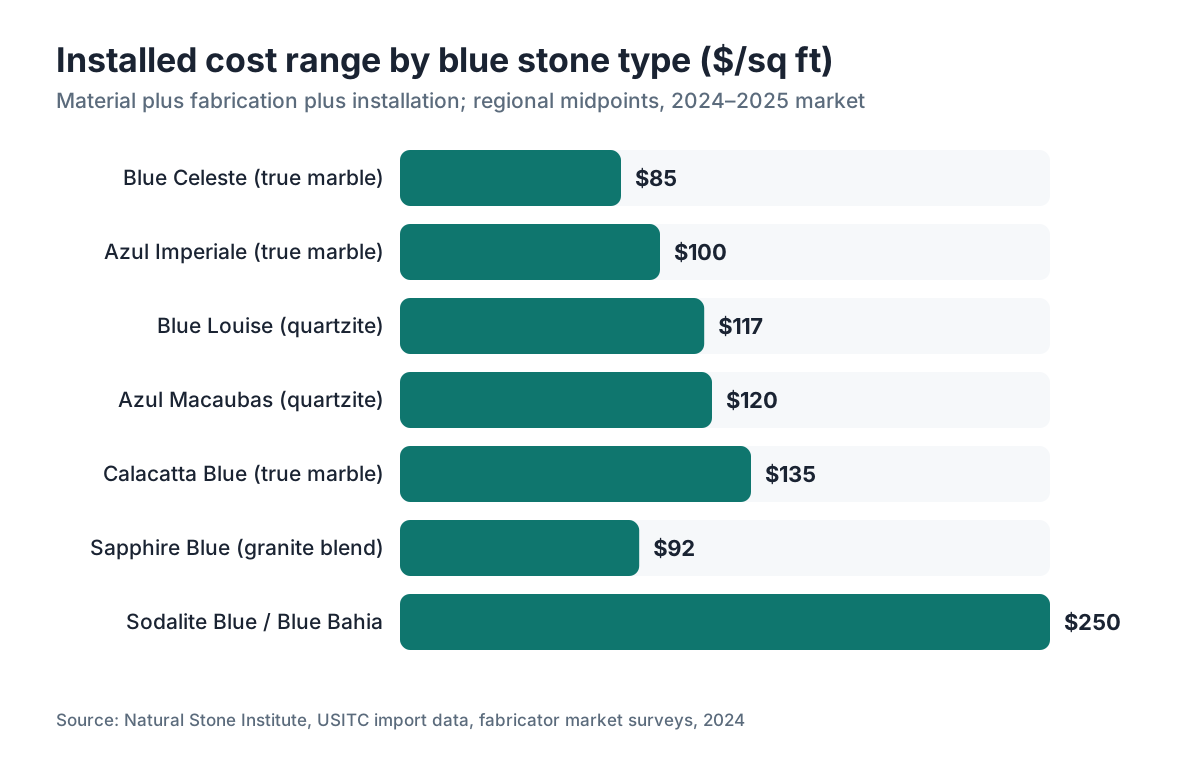
The table below covers the blue stones you'll actually find at a North American slab yard. Prices are installed finished countertop costs from fabricator surveys and current import pricing. Regional variation can push these 20 to 30 percent either way.
| Stone name | True type | Hardness (Mohs approx.) | Etching risk | Installed cost ($/sq ft) |
|---|---|---|---|---|
| Azul Macaubas | Quartzite | 6.5 to 7 | Low to moderate | $80 to $160 |
| Azul Imperiale | True marble | 3 to 4 | High | $70 to $130 |
| Sodalite Blue (Blue Bahia) | Sodalite/semi-precious | 5.5 to 6 | None | $150 to $350+ |
| Calacatta Blue | True marble | 3 to 4 | High | $90 to $180 |
| Blue Celeste | True marble | 3 to 4 | High | $60 to $110 |
| Blue Louise | Quartzite | 6 to 7 | Low | $85 to $150 |
| Sapphire Blue | Granite blend | 6 to 7 | None | $65 to $120 |
Azul Macaubas is the highest-volume blue stone in American shops right now. It's quarried in Minas Gerais, Brazil, and imported in quantity. Brazil ranks among the top exporters of quartzite and decorative stone to the United States, with Minas Gerais producing the material sold commercially as Azul Macaubas [12]. Supply stays more predictable than true marbles from smaller Turkish or Italian quarries. Color runs from pale steel-blue to deep navy with white quartzite veins.
Calacatta Blue and Azul Imperiale look dramatic and behave like any marble in a kitchen. A lemon wedge left for ten minutes leaves a dull ring. That's not a defect. That's chemistry. If you love the look and you cook, plan to accept some patina or treat the surface more like furniture than a worktable.
Sodalite Blue slabs are stunning, and the price says so. Material alone hits $500 to $800 per square foot at the high end. Fabrication runs harder because sodalite is dense and brittle in thin sections, so edge profiles need extra care and CNC speeds drop. Some shops add a machining premium for it.
How much do blue marble countertops actually cost?
The honest installed range is $60 to $350 per square foot. The middle of the market sits around $90 to $160 for Azul Macaubas and similar quartzites. That covers material, fabrication (cutting, edge profile, polishing), and basic installation by a two-person crew.
Here's what moves the number.
Slab origin and rarity. Imported stone from limited quarries costs more. A quarry making 1,000 slabs a year prices differently than one making 100,000.
Thickness. 2 cm slabs are cheaper on material but need plywood substrate reinforcement. 3 cm (roughly 1.25 inches) is the fabrication standard for kitchens. It costs 15 to 25 percent more on material alone, but you skip the lamination labor.
Edge profile complexity. An eased or beveled edge is usually in the base quote. Waterfall edges, mitered edges, and ogee profiles add $15 to $40 per linear foot depending on the shop.
Cutouts. Each sink cutout runs $100 to $200 on average. Cooktop, outlet, and farmhouse sink fitting add up fast.
Region. Labor in San Francisco or New York runs 30 to 50 percent above the national average. BLS occupational wage data shows tile and stone setters earn median hourly wages that swing 30 to 50 percent between low- and high-cost metros, which tracks with the install pricing gap [8]. The Azul Macaubas slab costs about the same everywhere (freight is freight), but the fabrication and install markup follows local wages.
A typical 40-square-foot kitchen with one sink cutout and an eased edge: budget $3,600 to $6,400 installed for mid-range blue quartzite. True blue marble in the same layout runs $2,800 to $7,200, with wide variation by stone. Sodalite or semi-precious starts at $8,000 and climbs.
Shops quote differently, too. Some quote by the slab (better when you cover a lot of square footage from one slab), others by the square foot. Always ask what the waste assumption is. A kitchen with an island might need 55 square feet of stone to cover 40 square feet of counter, and the quote structure decides whether you pay for the offcuts.
If you're a fabricator pricing a job with complex nesting or multiple cutouts, software that handles slab yield calculations decides whether the job is profitable. SlabWise's quoting tools are built for that kind of stone complexity.
See also our breakdown of general kitchen countertops pricing for how blue marble sits in the broader landscape.
Does blue marble hold up in a kitchen, or is it a bad idea?
It depends on the stone. The question sounds simple, but blue marble is three material categories with three durability profiles.
True blue marble in a kitchen is a choice, not a mistake, as long as you go in clear-eyed. Marble etches from acids (coffee, citrus, wine, some cleaning products) and stains from oils and pigmented liquids if left unsealed or unwiped. The Natural Stone Institute puts marble at 3 to 4 on the Mohs scale, softer than granite or quartzite [1]. For someone who uses a cutting board religiously, wipes spills right away, and actually likes aged, patinated stone (plenty of designers do), marble works fine. For someone who sets a wine glass down and forgets it, the surface keeps score.
Blue quartzite forgives much more. At Mohs 6.5 to 7, it sits close to granite in surface hardness and shrugs off scratches. The USGS describes quartzite as a silica-based metamorphic rock harder and more resistant to chemical weathering than calcite marble [5]. It's still porous compared to engineered stone, so sealing matters, but etch risk is minimal to none in most quartzites. The catch: some Azul Macaubas slabs carry calcite-heavy veins that do etch. You can't make a blanket promise without knowing your slab.
Sodalite doesn't etch from household acids at all, and it's harder than marble. The Smithsonian lists sodalite at roughly Mohs 5.5 to 6, chemically resistant to acids, and denser than calcite marble [6]. It is brittle in thin sections, though, and at its weight, seismic or settling movement can crack it along natural cleavage planes. Rare, but not unheard of.
For bathrooms and low-traffic surfaces, true marble works beautifully with far less fuss about etching. A vanity sees water, hand soap, and toothpaste, not red wine and lemon zest. That's where the marble tradeoff genuinely pays off for most people.
Against engineered options, real blue marble shows wear over decades. That reads as beautiful (think old European floors) or frustrating, depending on your relationship with your countertop. See how blue marble stacks up against marble countertops generally.
How do you seal and maintain blue marble countertops?
Sealing is not optional with true marble and strongly recommended for blue quartzite. An impregnating sealer (not a topical coating) soaks into the pore structure and repels liquids from below the surface, buying you time to wipe up spills before they absorb. It does not stop etching, which is a surface chemical reaction, not absorption.
Most blue marbles want a reseal every 12 to 24 months. Dense quartzites can stretch to three years. The field test takes ten minutes: drop a tablespoon of water on the surface and wait. If the stone darkens where the water sat, it's absorbing and needs sealer. If the water beads and the color holds, you're covered.
Daily care is simpler than most homeowners expect. Warm water and a few drops of dish soap handle 95 percent of cleanup. Dry the surface after cleaning instead of letting water pool. Skip anything acidic (vinegar-based cleaners, citrus sprays) and anything alkaline and abrasive (powdered scrubs). The Natural Stone Institute recommends pH-neutral cleaners formulated for natural stone plus periodic impregnating sealers [2].
Already have an etch? Light etching on polished marble sometimes buffs out with a marble polishing powder and a soft cloth. Deeper etches need professional honing and re-polishing, which runs $200 to $600 for a typical countertop section depending on the damage and local labor. Factor that into the long-term ownership picture, because it's a real number.
Blue quartzite follows the same protocol. Our guide on how to clean stone countertops walks the specifics step by step.
What kitchen and bathroom styles work best with blue marble?
Blue stone is not subtle. It anchors a room, which means the design around it has to be intentional.
White or light grey cabinetry is the most common pairing, and for good reason: it lets the stone read without competing. Shaker or flat-panel cabinets in off-white or dove grey, with brushed gold or matte black hardware, make Azul Macaubas or Calacatta Blue the clear focal point. That combination shows up constantly in high-end residential kitchens where designers want drama without clutter.
Warm wood cabinetry (natural oak, walnut) pairs well with grey-blue quartzites that lean warm. The contrast works when the stone has cream or brown veining rather than pure white. Deep walnut next to navy sodalite can look like a jewel box, but scale matters. That pairing in a small kitchen feels heavy fast.
Bathrooms are where blue marble earns its price. A vanity top, a master bath floor, or a shower bench in Azul Macaubas or Blue Celeste translates well because the scale stays manageable and the stakes drop (less cooking acid, less heavy use). Paired with white plaster walls and brass fixtures, it reads genuinely luxurious without trying too hard.
Outdoor kitchens are possible but demand specific stone. True marble outdoors is a bad idea: freeze-thaw cycles in cold climates chew up the calcite over time, and constant UV and moisture speed surface breakdown. Dense quartzites and sodalite handle exposure better. Confirm with the fabricator and the slab supplier before you commit.
How do fabricators work with blue marble, and what should you ask your shop?
In the shop, blue marble and blue quartzite run differently. Quartzite is harder and needs diamond tooling rated for that hardness, running at lower speeds with more water to avoid burning or microcracking the edge. Marble cuts faster but chips if the tooling is worn or the feed rate is too aggressive. Sodalite needs slow, careful passes and real attention at inside corners, where brittleness causes the most trouble.
Waterjet cutting for sink and cooktop openings is standard on high-value blue slabs because the water-only process skips the vibration a router bit introduces. CNC routers are faster and cheaper but carry a bit more risk on brittle or veined material. Ask which method your shop uses on high-value stone. Industry fabrication standards for natural stone cover digital templating tolerances and edge profile specs for kitchen installs, which is worth having on file [11].
Questions worth asking any fabricator before you sign.
How do you handle remnant and offcut accounting? On a $150-per-square-foot stone, the waste math changes your final price.
Do you template in person or digitally? Laser measuring is more accurate and cuts callbacks. A laser template takes 20 to 30 minutes versus about an hour for a physical one, and the dimensional accuracy is measurably better.
What edge profile is included, and what are the upcharges? Get it in writing.
Can I see my specific slab before you cut? With patterned stone, you want to approve the veining layout before the saw runs. Most reputable shops will do this.
Do you carry the stone on a dedicated vehicle with proper support? Slabs hauled vertically without crating can crack in transit. Sodalite is heavy enough that bad transport becomes a field problem.
For fabricators quoting these jobs, the nesting and yield calculation is where margin lives. A slab with directional veining that the client wants matched across a seam means you can't cut purely for efficiency. Seam placement is a design decision as much as a fabrication one, and your quote needs to say so.
See our countertop installation guide for what install day looks like from both sides of the project.
How does blue marble compare to engineered and alternative options?
Love the look of blue stone but nervous about marble's upkeep? You have real alternatives. None are identical, but some get close.
Engineered quartz with blue coloring. Cambria and Silestone make blue-toned slabs. Quartz is non-porous, doesn't etch, and needs no sealing. The tradeoff: it looks engineered. The veining repeats across slabs, and the depth of real stone (the way light moves through calcite) isn't there. For a family kitchen with young kids, quartz is the smarter call if marble's maintenance reality worries you. See Cambria countertops for their blue options.
Granite with blue or grey tones. Some granites (Blue Pearl from Norway, for one) throw deep blue iridescence from labradorite feldspar. Granite is harder than marble, close to non-porous in the dense varieties, and priced near mid-range marble. It won't read like veined marble, but the durability beats it across the board. Our granite countertops piece covers how granite pricing and fabrication compare.
Laminate in blue patterns. Yes, laminate. The new high-definition products mimic stone surprisingly well at $10 to $30 per square foot installed. It won't fool anyone up close, but in a rental or a secondary bathroom, it does the job. Laminate countertops covers the current product landscape.
Solid surface (Corian). Corian comes in custom colors including blues. Scratches sand out, it's non-porous, and it costs a lot less. It also lacks the visual weight and market perception of stone. Corian countertops lays out the tradeoffs.
What are common mistakes buyers make with blue marble countertops?
Buying from a photo. Blue marble photographs beautifully and dramatically. The slab you actually buy may have different coloration, more or less veining, or undertones that shift under your kitchen lighting. Visit the slab yard, see your actual slabs, and bring a cabinet door sample if you can.
Confusing stone types. Buying what you think is a durable quartzite and getting a soft marble because you didn't ask for documentation. The names are not regulated, and ASTM C119 permits the loose usage on purpose [10].
Underestimating total cost. Material, fabrication, installation, sealing supplies, edge upgrades, sink cutouts, and pattern-match waste all stack up. Homeowners get a per-square-foot quote and then flinch at the invoice because the extras weren't itemized. Get a fully itemized quote before you commit to a stone.
Skipping the seam conversation. Dramatic veining makes seam placement a serious design call. A seam through the middle of a striking vein is jarring. A seam at a break in the pattern or a low-visibility spot barely registers. Have this talk before templating, not after the saw runs.
Using the wrong cleaner. Acidic cleaners, vinegar sprays, and many natural cleaning products etch marble on contact. This is the number one avoidable maintenance mistake. Read the how to clean stone countertops guide before install so you have the right products ready on day one.
Choosing honed when you want easy maintenance. Honed (matte) finishes hide etching better, because on a polished surface an etch shows as a dull spot against a mirror, while on honed it blends into the matte. But honed absorbs stains faster, because the micro-texture holds more. You trade one maintenance headache for another.
What should fabricators know about quoting and nesting blue marble jobs?
Blue marble jobs are premium jobs, and premium jobs are where shops make real money or give it away. A few operational realities.
Pattern matching costs time. When a client wants continuous veining across a mitered waterfall island, you're cutting for visual continuity, more than yield. Your nesting software or layout process has to account for the constraint before you commit to a slab count. A job that should take 1.5 slabs often takes 2 because of directional matching.
Material cost exposure is real. At $150 to $200 per square foot for material alone on some blue quartzites, a mis-cut is a serious dollar loss. Digital templating, confirmed layouts before cutting, and a client signature on slab placement are not optional here.
Edge profiles on harder quartzites wear tooling faster. If you run a lot of Azul Macaubas, track your tooling cost per linear foot separately from softer stone. Your blanket edge pricing may need to move.
Sodalite is a specialty job. If you haven't cut sodalite before, shadow a shop that has before you quote one. The weight per slab (heavier than most granites), the brittleness at edge details, and the value at risk make it a different category than even high-end marble.
For fabricators juggling multiple blue marble quotes at once, software that handles slab-level nesting and per-job material cost tracking pays for itself fast at these price points. SlabWise is built for exactly this: jobs where yield and material cost decide profit versus break-even.
The Marble Institute of America (now the Natural Stone Institute) publishes installation and handling guidelines worth keeping on file for any premium stone job [2].
What are realistic resale and ROI expectations for blue marble countertops?
Countertop ROI is genuinely hard to pin down. The National Association of Realtors 2022 Remodeling Impact Report found kitchen upgrades recoup roughly 67 percent of their cost at resale on average [3]. Stone countertops tend to land at the higher end of that range compared to laminate or tile [9], but nobody separately tracks blue marble's ROI in any study I've seen.
What real estate people generally say (qualitative, not a cited stat): premium natural stone in move-in condition adds buyer enthusiasm that outruns its dollar contribution. Blue marble is memorable in a listing. A buyer who tours ten houses that week remembers the one with the striking blue quartzite island. That memorability is real and hard to quantify.
Condition matters enormously. A blue marble counter that's well-sealed, etch-free, and in good repair adds to a sale. One that's stained, etched, and neglected can hurt it by signaling deferred maintenance. Buyers see a damaged expensive countertop and start wondering what else got ignored.
Installing blue marble as a pure investment play? The math rarely pencils at the premium end (sodalite at $200-plus per square foot). Installing it because you love it and plan to enjoy it for a decade before selling? The enjoyment years count toward the value, and the stone holds up in resale if you maintain it.
Frequently asked questions
Is Azul Macaubas a marble or a quartzite?
Azul Macaubas is quartzite, not marble, despite the blue marble label it usually carries. It's silica-based, harder than true marble (Mohs 6.5 to 7), and far more resistant to etching. Some slabs have calcite-heavy veins that can etch slightly, so the specific slab matters. Ask your supplier or fabricator for origin documentation and confirm the mineralogy before buying.
How often do blue marble countertops need to be sealed?
True blue marble needs sealing every 12 to 24 months under normal kitchen use. Dense blue quartzite can go two to three years. Test by dropping water on the surface and waiting 10 minutes: if the stone darkens where the water sat, reseal it. Use a penetrating impregnating sealer, not a topical coating, and follow the manufacturer's dwell time instructions exactly.
Does blue marble scratch easily?
True marble rates 3 to 4 on the Mohs hardness scale, so a stainless steel knife (Mohs 5.5) can scratch it if dragged across the surface. Always use a cutting board. Blue quartzite at Mohs 6.5 to 7 resists scratching much better and holds up to daily kitchen use. Sodalite sits around Mohs 5.5 to 6, tougher than marble but prone to chipping at edges if struck.
Can blue marble be used outdoors?
True calcite-based blue marble is a poor choice for outdoor countertops in climates with freeze-thaw cycles. Water that enters the pore structure and freezes expands, causing micro-cracking that compounds over years. Dense blue quartzite handles outdoor exposure much better. Sodalite is also fine outdoors in most climates. Confirm with your fabricator and supplier before committing any stone to an outdoor kitchen in a cold region.
What is Blue Bahia stone, and is it really marble?
Blue Bahia is sodalite, a feldspathoid mineral quarried in Bahia, Brazil. It's not marble. It doesn't etch from acids, it's harder than true marble, and it's dense enough that slabs weigh notably more than granite or marble at the same thickness. It sells in slab form for countertops at $150 to $350 per square foot installed at the lower end, with premium material running much higher.
How do I remove an etch mark from a blue marble countertop?
Light etches on polished marble sometimes buff out with marble polishing powder (tin oxide or similar) and a soft cloth in a circular motion. That works on minor surface dullness. Deeper etches need professional honing and re-polishing, typically $200 to $600 depending on the area and your region. No household cleaner removes etching, because etching is a chemical change to the calcite surface, not a stain.
Are there blue quartz countertop options that look like marble?
Yes. Cambria, Silestone, and MSI all offer blue-toned engineered quartz slabs with veining that references blue marble. They're non-porous, etch-resistant, and need no sealing. The visual depth doesn't fully replicate real stone, but the maintenance advantages are real. If you want the look with less upkeep, engineered quartz is worth a hard look, especially for a busy kitchen.
How much does it cost to fabricate and install blue marble countertops?
Fabrication and installation for blue marble or blue quartzite typically runs $40 to $80 per square foot on top of material. Material for blue quartzite like Azul Macaubas runs $40 to $100 per square foot. True blue marble material is $30 to $120 per square foot depending on rarity. Total installed lands at $60 to $350 per square foot across the range. Sodalite and semi-precious stones push past that ceiling.
What edge profiles work best with blue marble?
Eased and beveled edges stay clean and let the stone carry the visual weight, usually the right call with dramatic blue stone. An ogee or bullnose can look ornate against bold veining. Mitered waterfall edges are popular on islands and show the stone's cross-section on the side panel. For harder quartzites, some profiles cost more to machine because of tooling wear. Get the upcharge in writing before committing.
Is blue marble a good choice for a bathroom vanity?
Bathroom vanities are one of the best uses for true blue marble. There's no cooking acid, daily cleaning is simpler, and the scale lets the stone read beautifully without overwhelming the room. Etching can still happen from toothpaste (slightly alkaline) and some soaps over time, but far slower than a kitchen counter. Seal it on installation and reseal every two years.
What's the difference between a honed and polished finish on blue marble?
A polished finish is mirror-like and intensifies the color and depth of blue marble, but it makes etching very visible (etch spots read dull against the shine). A honed finish is matte, hides etching better, but absorbs stains faster because the micro-texture is more open. There's no universally better choice; it depends on your habits and taste. Most blue quartzites come in both.
How heavy are blue marble countertops, and does my cabinet need reinforcement?
Marble and quartzite at 3 cm thickness weigh roughly 18 to 20 pounds per square foot. A 40-square-foot kitchen in blue marble is 720 to 800 pounds of stone, not counting cabinets and substrate. Standard frameless and face-frame cabinets handle this without reinforcement if they're in good condition. Sodalite is denser, closer to 22 to 25 pounds per square foot. If your cabinets are older or worn, have your fabricator or a contractor check them before installation.
Can blue marble countertops be repaired if they crack or chip?
Chips on marble and quartzite fill with color-matched epoxy or acrylic compound and buff flush. Small edge chips are the most common repair and usually disappear after a professional fill. Cracks running through the slab are more serious: epoxy injection can stabilize them, but the crack line usually stays visible. Sodalite is brittle enough that edge chips need careful fill work from someone who knows the material.
Where is blue marble quarried, and does origin affect quality?
Azul Macaubas comes from Minas Gerais, Brazil, quarried at commercial scale, so supply stays reasonably consistent. Blue Celeste comes from Turkey. Calacatta Blue varieties come from Italy. Sodalite Blue (Blue Bahia) is from Bahia, Brazil. Origin affects color consistency, vein character, and price, but not quality by itself. Stones from smaller quarries show more color variation between slabs, which matters when you're matching across a large kitchen.
Sources
- Natural Stone Institute, Stone Hardness Reference: Marble rates 3 to 4 on the Mohs hardness scale, making it softer than granite, quartzite, and most engineered countertop materials.
- Natural Stone Institute, Care and Maintenance Guidelines: The Natural Stone Institute recommends pH-neutral cleaners formulated for natural stone and periodic impregnating sealers for marble and quartzite surfaces.
- National Association of Realtors, 2022 Remodeling Impact Report: Kitchen upgrades recoup roughly 67 percent of their cost at resale on average, according to the 2022 NAR Remodeling Impact Report.
- U.S. Geological Survey, National Minerals Information Center: USGS defines marble as metamorphic rock derived from limestone or dolomite, recrystallized under heat and pressure into a calcite or dolomite matrix.
- U.S. Geological Survey, National Minerals Information Center: Quartzite is a silica-based metamorphic rock harder and more resistant to chemical weathering than calcite marble, with Mohs hardness typically 6.5 to 7.
- Smithsonian National Museum of Natural History, Mineral Sciences: Sodalite is a feldspathoid mineral with Mohs hardness of approximately 5.5 to 6, chemically resistant to acids, and notably denser than calcite marble.
- ASTM International, ASTM C503 Standard Specification for Marble Dimension Stone: ASTM C503 sets physical property minimums for marble dimension stone including absorption, density, compressive strength, and modulus of rupture for commercial applications.
- U.S. Bureau of Labor Statistics, Occupational Employment and Wage Statistics: BLS occupational wage data shows tile and stone setters earn median hourly wages that vary 30 to 50 percent between low- and high-cost metro areas, supporting the regional labor cost variation in countertop installation pricing.
- National Association of Realtors, Home Remodeling Cost vs. Value Data: NAR data consistently shows natural stone kitchen upgrades recoup a higher percentage of cost at resale than laminate or tile alternatives.
- ASTM International, ASTM C119 Standard Terminology for Dimension Stone: ASTM C119 defines marble in trade usage as including certain crystalline limestone and other stones capable of taking a polish, explaining why quartzites are commercially labeled as marble.
- Marble Institute of America (now Natural Stone Institute), Fabrication Standards: Industry fabrication standards for natural stone countertops include digital templating tolerance requirements and edge profile specifications for kitchen installations.
- U.S. International Trade Commission, DataWeb Import Statistics: Brazil is among the top exporters of quartzite and decorative stone to the United States, with Minas Gerais producing significant volumes of the material commercially sold as Azul Macaubas.
Last updated 2026-07-09