TL;DR
- Black marble countertops run $60 to $200 per square foot installed, depending on the variety and your region.
- They're stunning.
- They also etch from acids, scratch easier than granite, and need sealing every one to two years.
- Understand that trade and want one anyway?
- Buy it.
- Want a counter you can ignore?
- Buy something else.
What exactly is black marble, and which stones actually qualify?
Marble is a metamorphic rock that forms when limestone recrystallizes under heat and pressure. The black color comes from carbon, graphite, or bituminous inclusions locked in during that change. True black marble is rare next to white or gray, which is part of why it costs more.
The slabs sold as "black marble" cover a lot of ground. Some are real calcitic marble. Some are dolomitic marble, which runs a touch harder. A few are limestone that never fully metamorphosed, and some are entirely different dark stones wearing a marble label. Those distinctions decide how the stone handles hardness, porosity, and acid.
Here are the stones you'll actually run into under the black marble umbrella:
| Stone Name | Type | Veining | Acid Sensitivity | Hardness (Mohs) |
|---|---|---|---|---|
| Nero Marquina | True marble (calcitic) | Bold white | High | ~3 |
| Portoro | True marble | Gold/white | High | ~3 |
| Black Forest | Dolomitic marble | Subtle gray | Moderate | ~3.5 |
| Absolute Black | Granite (often mislabeled) | None | Low | ~6-7 |
| Black Slate | Metamorphic (non-marble) | None | Low | ~2.5-4 |
| Black Limestone | Sedimentary | Faint fossils | High | ~3 |
The mix-up between Absolute Black and true black marble trips up a lot of buyers. Absolute Black is a fine-grained granite from India. It's far more durable and acid-resistant, and it gets shelved next to marble at some retailers. Ask for the quarry name and country of origin. If you can, request the stone's water absorption result per ASTM C97 [1]. That number tells you more about porosity than any marketing name does.
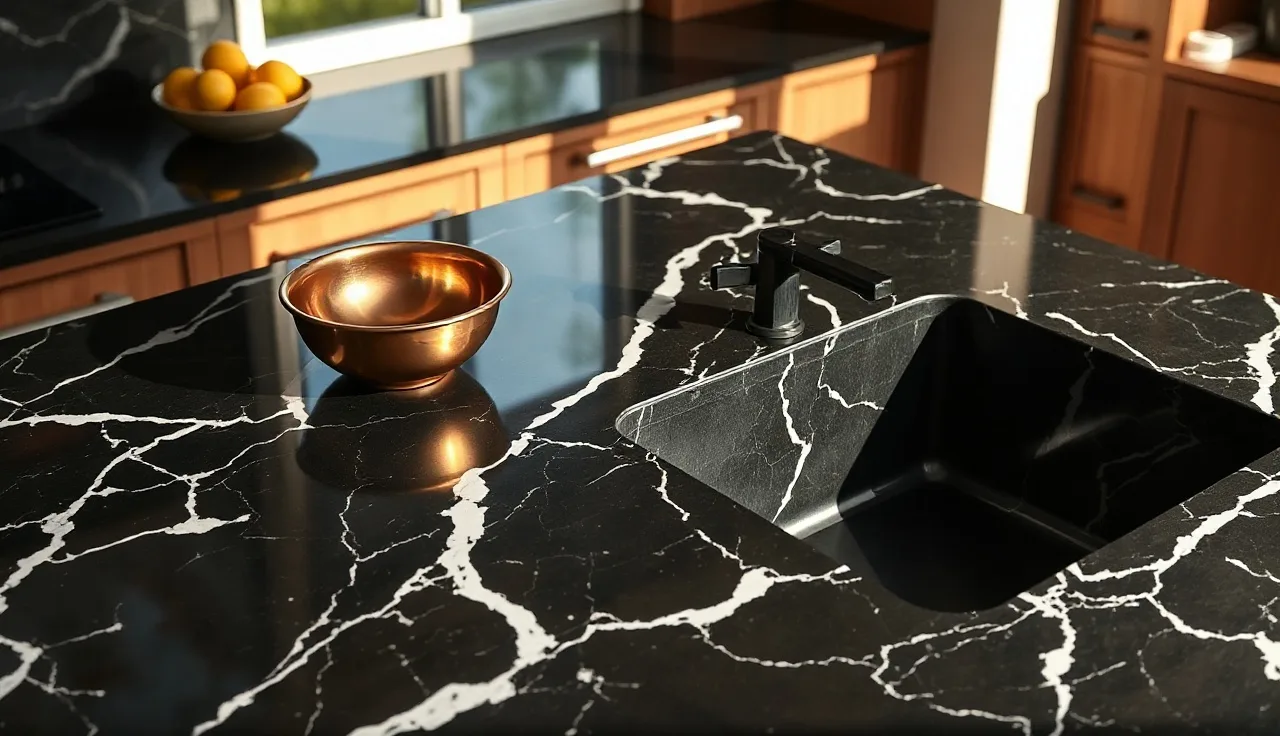
Nero Marquina from Spain is the icon. Deep black base, crisp white veining, and it photographs beautifully. Portoro, from the Ligurian coast of Italy, swaps in gold veining and is genuinely dramatic. Both are true calcareous marble. Both etch. There's no version of either stone that doesn't [5].
How much do black marble countertops cost?
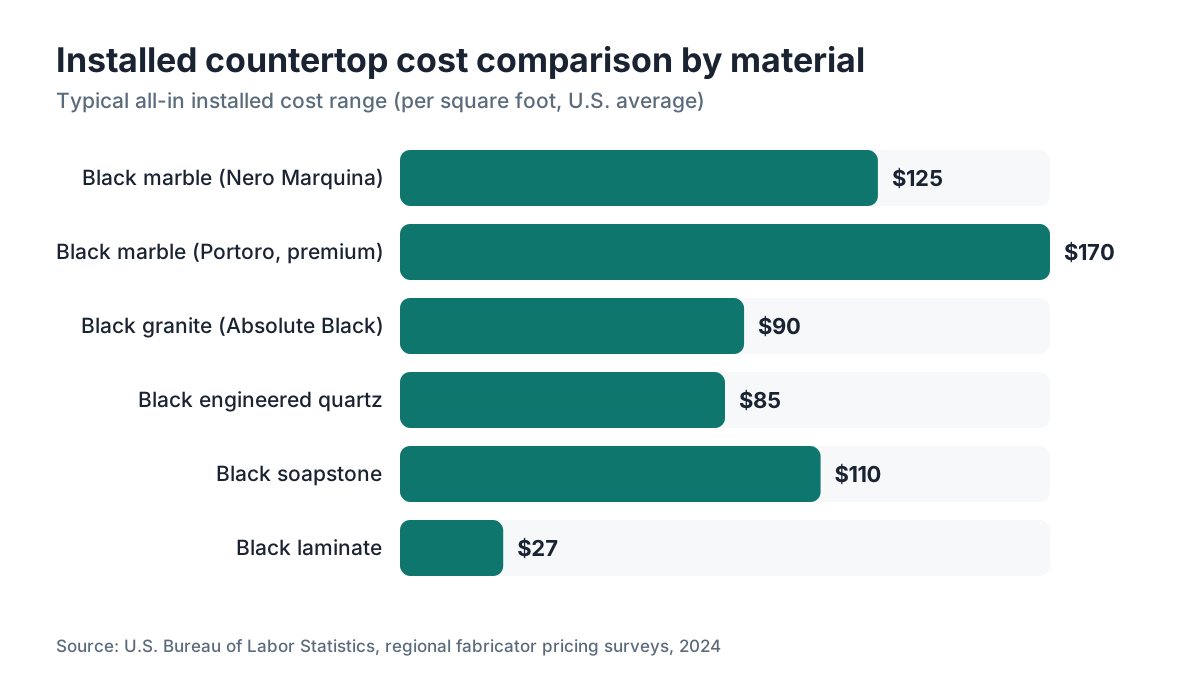
Material and installation together run roughly $60 to $200 per square foot for most homeowners in the continental U.S. [2]. That spread is wide because it holds everything from entry-level Black Forest marble at a regional distributor to bookmatched Portoro flown in from Italy.
Here's the breakdown.
Material only (slab cost): Figure $10 to $90 per square foot for the raw slab, driven by origin, quality grade, and how tight your local market is. Nero Marquina commercial grade usually runs $15 to $35 per square foot. Premium Portoro can hit $80 to $120 per square foot direct from an importer.
Fabrication: Cutting, edging, and polishing black marble costs roughly $30 to $65 per square foot at most shops. Dark stone shows every saw mark and scratch, so fabricators slow their cutting speeds and use finer polishing grits, which adds time. A detailed edge like an ogee or a mitered waterfall pushes you toward the high end.
Installation: Templating, delivery, setting, and the sink cutout add another $10 to $30 per square foot in most markets [9].
Run the math on a real kitchen. Fifty square feet of black marble counter lands at $3,000 to $10,000 installed. A 15-square-foot bathroom vanity runs $900 to $3,000. Coastal cities push both numbers higher.
Shops that quote with software like SlabWise can hand you an itemized breakdown: material cost, waste factor, and each edge foot priced on its own. That makes bids easy to compare side by side. If a quote is one lump number, ask for the line items.
Set those figures against granite countertops at $40 to $140 per square foot installed, and laminate countertops at $15 to $40. Marble sits mid-to-upper on price and top of the pile on maintenance.
Does black marble etch, stain, and scratch? An honest look at durability
Yes, black marble etches. That's the biggest durability problem and the thing that blindsides homeowners most.
Etching is a chemical reaction, not a stain. When an acid (lemon juice, vinegar, wine, tomato sauce, even some sparkling water) touches the calcium carbonate in marble, it dissolves a microscopic layer of the surface [8]. You're left with a dull, lighter spot sitting slightly below the polished finish. On white marble, etches hide. On polished black marble, they read as grayish rings or cloudy patches, and they're very visible against the dark background.
You can't seal etching away. Sealers slow liquid from soaking into the stone, which helps with staining. They do nothing to protect the finish from acid. Etches need mechanical correction: re-honing or re-polishing the spot, which usually means a stone restoration pro. Budget $4 to $12 per square foot for professional re-honing.
Staining is a separate story, and black marble does well here. The dark base masks discoloration far better than light stone. A coffee stain that screams on Calacatta barely registers on Nero Marquina. Oily stains can still soak in and leave a slightly different sheen, so wipe them fast.
Scratching tracks the Mohs scale. Marble sits around 3 to 3.5. A steak knife runs 5.5 to 6.5, which means it can scratch the surface, and most kitchen knives leave fine marks over time [3][12]. Those marks hide better on a honed matte finish than on a polish, which is exactly why plenty of fabricators steer kitchen clients toward honed black marble.
Heat resistance is decent. Marble won't crack the instant a hot pan lands the way some engineered stones can, but repeated thermal shock can open micro-fractures over time. The Marble Institute of America recommends trivets on all natural stone regardless of type [4].
Polished vs. honed vs. leathered black marble: which finish should you choose?
Finish changes both the look and the daily behavior of black marble more than it does on lighter stones. Pick it with your lifestyle in mind, more than a showroom photo.
A polished finish gives you maximum depth and reflection. On a true Nero Marquina, a high polish makes the black look almost liquid and the white veining jump. It's the most dramatic option. It also flags every fingerprint, water spot, and etch. In a kitchen where hands hit the counter all day, polished black marble looks smudged between wipe-downs.
A honed finish is matte or satin, made by stopping the polishing sequence before the final buffing steps. Honed black marble reads softer and shows fewer water spots and fingerprints. The catch: it's a bit more porous than polished because the micro-pores stay open, so it can drink up staining liquids marginally faster. Most stone care pros say seal honed marble more often, roughly every 12 months against 18 to 24 for polished.
A leathered finish uses a diamond-tipped brushing process to create a lightly textured, low-sheen surface. It hides fingerprints even better than honed and gives the stone a feel people love running a hand across. Cleaning is a touch harder because you have to work the cloth into the small depressions. Expect $5 to $15 per square foot extra at fabrication.
For a kitchen, honed or leathered beats polished for real daily use. For a bathroom vanity with light acid exposure, polished is fine and looks spectacular.
How do you maintain and seal black marble countertops?
The routine isn't hard. You just have to actually do it.
Day to day: wipe with a damp cloth and a pH-neutral stone cleaner, or plain warm water. Skip vinegar cleaners, citrus cleaners, bleach, and any general-purpose kitchen spray you haven't pH-checked. Most of those run slightly acidic and etch the surface with repeated use. The Marble Institute of America warns against acidic cleaners and points you to stone-specific products [4].
Sealing: apply a penetrating (impregnating) sealer every 12 to 24 months. It soaks into the pores and slows liquid penetration. It won't change how the stone looks, and it wears off gradually with cleaning. Check timing with a water bead test. Drop a tablespoon of water on the surface. Beads up? Still protected. Soaks in within 3 to 4 minutes? Reseal.
Consumer-grade sealer runs $20 to $60 for a bottle that covers a typical kitchen. Professional sealing services charge $1 to $4 per square foot if you'd rather hand it off.
For technique that carries over here, the how to clean stone countertops guide goes deeper. To see how a comparably acid-sensitive stone behaves in practice, compare how to clean quartzite countertops and how to clean soapstone countertops.
Etching gets its own plan. Minor etches on a honed surface can sometimes be rubbed out with a marble polishing powder. On a polished surface, etches almost always need a pro to match the surrounding gloss. If you cook actively on black polished marble, budget for one professional restoration visit every two to five years.
Is black marble a good choice for a kitchen countertop?
Honest answer: it depends on how you cook and how much a dull spot would eat at you.
Cook daily with acidic food, squeeze lemons straight onto the counter, and hate imperfection? Black polished marble will frustrate you. Etching isn't a worst-case scenario here. It's the guaranteed result of normal kitchen use.
Light cook, quick to wipe spills, drawn to the idea of a stone that ages and shows its life, fine with occasional pro maintenance? Then it works. Plenty of people run black marble kitchens for 10 to 20 years without regret.
The honed finish genuinely moves the needle. On honed black marble, etches are far harder to spot because you're not breaking a mirror finish. Many fabricators will suggest honed for kitchens before you even ask.
Islands are where the argument gets strong. Where prep is limited and the whole point is the look, black marble earns it. A bookmatched Nero Marquina or Portoro island with a prep sink makes a kitchen look extraordinary in a way no engineered stone quite hits.
Want the look without the upkeep? Engineered quartz gets close. Cambria countertops sells several dark, veined patterns that copy the aesthetic with much better acid resistance. They won't fool a stone person up close. From across the room they read similar, and they don't etch.
Black marble countertops and black granite are the common natural-stone picks in this color range. The kitchen countertops comparison lays out the wider material-by-material view [7].
How do fabricators cut and work with black marble, and why does it affect your quote?
Black marble is harder to fabricate cleanly than most homeowners guess, and those extra steps land in your price.
The dark color forgives nothing. On light stone, a slightly rough edge or a micro-chip at the sink cutout can vanish once polished. On black marble, those flaws pop because the dark surface throws high contrast against any lighter scratch or chip. Experienced fabricators often drop cutting speed 10 to 20 percent on black stone and run more passes with progressively finer grits to kill visible tool marks.
Veining creates structural headaches. Nero Marquina and other heavily veined stones have veins with slightly different hardness than the surrounding matrix. The blade hits those transitions, and aggressive feed rates can open micro-cracks. A good fabricator reads the slab first and lays out the cuts so veins run parallel to the longest passes where possible.
Mesh-backed slabs exist for a reason. Some black marble varieties are fragile enough that importers glue fiberglass mesh to the back at the quarry to hold the slab together through shipping and fabrication. If your slab is mesh-backed, confirm your fabricator knows how to work it. Sand through the mesh on the bottom and it stops reinforcing anything.
Yield matters a lot with expensive stone. Because black marble slabs can run $40 to $90 per square foot before fabrication, sloppy layout wastes real money. Nesting software that optimizes how parts sit on a slab, like the tools SlabWise gives fabrication shops, can cut waste on a big kitchen job. On a $3,000 slab, a 10 percent yield gain saves $300 in material.
Before your fabricator shows up, the countertop installation guide walks through what to expect.
What are the best black marble varieties, and how do you choose between them?
The pick among black marble varieties comes down to three things: veining drama, budget, and how sound the specific slab in front of you is.
Nero Marquina is the benchmark. It comes from Markina-Xemein in the Basque Country of Spain and has been quarried there for centuries. Deep, consistent black with sharp, graphic white veins. It's widely stocked across major U.S. distributors. Commercial grade runs about $15 to $35 per square foot. Bookmatched premium pairs cost more.
Portoro (also called Porto Oro) comes from the island of Palmaria in Liguria, Italy [6]. The black looks close to Nero Marquina, but the veining mixes gold and white for a richer feel. The quarry puts out limited volume, so supply swings and pricing stays high, often $60 to $120 per square foot for quality material.
Black Forest Marble comes from several places, including India and China, with a quieter, more muted vein pattern. It's the budget-friendly pick that still reads refined. Figure $12 to $25 per square foot.
Toros Black from Turkey has grown common in the U.S. over the past decade as Turkish quarrying expanded. Soft white and gray veins sit on a dark gray-to-black base. It tends to run more consistent than Nero Marquina, which can swing hard between slabs.
At the yard, pull every slab from the rack and look at each one standing fully open. Variation inside a single variety can be enormous. Two Nero Marquina slabs from different quarry blocks can look like different stones. Approve the specific slab, not the variety name [11].
How does black marble compare to other black countertop materials?
Black marble is one of several ways to get a dark counter. Knowing what you're trading against turns a guess into a decision.
| Material | Installed Cost/sq ft | Acid Resistant | Scratch Resistant | Maintenance | Look |
|---|---|---|---|---|---|
| Black marble (Nero Marquina) | $70, $180 | No | No | High | Authentic, veined |
| Black granite (Absolute Black) | $50, $140 | Yes | Yes | Low | Uniform, no veining |
| Black quartz engineered | $55, $120 | Yes | Moderate | Low | Artificial, consistent |
| Black soapstone | $70, $150 | Yes | No | Moderate | Soft, develops patina |
| Black slate | $30, $80 | Yes | No | Low-moderate | Textured, matte |
| Black laminate | $15, $40 | Yes | No | Low | Flat, non-stone look |
Granite is the closest comparison. A true Absolute Black gives you the dark, dramatic look with none of the acid sensitivity. It lacks the veining that makes Nero Marquina special, but it's far easier to live with. The granite countertops article breaks it down in full.
Soapstone is an interesting swap. It's inert to most household chemicals, so acid isn't a problem, but it's soft (Mohs 1 to 2) and scratches easily. A lot of soapstone owners oil the surface and treat the scratches as patina. The how to clean soapstone countertops guide covers that mindset.
Black engineered quartz is the low-maintenance choice. Cambria countertops and similar brands won't etch or stain, but they can discolor under long UV exposure and they lack the depth of real stone. Stand in the kitchen for 30 seconds with both and you'll feel the difference. Scroll photos on your phone and you won't.
On a tight budget, formica countertops and other laminates copy a dark stone look for a fraction of the money. They're not stone and won't fool anyone up close. They're also not a bad call when natural stone is out of reach.
What questions should you ask your fabricator before ordering black marble?
The talk with your fabricator before you sign is where you protect yourself. Here's what actually matters.
Which slab specifically gets cut for my job? Get a slab number and confirm you've seen it in person or in a high-resolution photo. Variation in black marble is enormous, and you don't want to approve one Nero Marquina and receive something that looks nothing like it.
Is this slab mesh-backed? Mesh backing changes which edge profiles finish cleanly and whether a mitered waterfall edge is even structurally possible on that piece.
What's the yield on this slab? Ask how much you'll actually use versus what goes to scrap. On expensive stone, a smart layout saves hundreds. If the shop runs nesting software, that number comes straight out of the system.
What edge profiles work with this stone? Crisp, thin profiles like a pencil edge are harder to pull off cleanly on black marble than a standard eased edge. Some decorative profiles that look fine on granite chip at the thin edges of dark marble.
How do you handle seaming, and where do the seams fall? Seams in black marble show more than in many lighter stones because the dark color and veining create obvious breaks. Ask to see seam placement on a layout drawing before fabrication starts.
What's the warranty on fabrication? Chips during installation are the fabricator's problem. An etch from the orange juice glass you set down is not. Get the line drawn in writing.
Compare multiple bids. The countertop installation guide spells out what a complete scope of work looks like, so you can check whether every bid covers the same services.
Where does black marble work well in a home besides kitchens?
Bathrooms are where black marble shines. Acid exposure is minimal: hand soap is pH-neutral, most bathroom products aren't acidic enough to etch fast, and daily use is gentle. A Nero Marquina or Portoro vanity top looks exceptional and skips the sacrifices a kitchen demands.
Shower walls and floors are a different story. Black marble in a wet shower is beautiful but needs excellent ventilation and disciplined sealing. Hard water leaves deposits that build up and dull the surface, and a lot of shower cleaners are acidic enough to etch. Commit to a black marble shower and you're committing to pH-neutral cleaners only and resealing every 6 to 12 months.
Fireplace surrounds might be the best home for black marble. No acid, no food prep, and the stone gets to do the one thing it does best: look dramatic. Heat from a properly working fireplace with a glass door usually doesn't reach a temperature that damages marble at the surround face. An open-face fireplace that runs very hot at the surround should use a different material.
Bar tops earn mixed marks. Serve wine, citrus cocktails, and fizzy drinks regularly and etching stacks up. A honed finish plus real discipline about coasters makes it workable. A polished black marble bar with no coasters looks weathered inside a year.
Entry floors are an old, legitimate use. Portoro and Nero Marquina have run through European and American entries for centuries. Foot traffic doesn't etch marble, though it dulls the polish over many years. Stone floors are usually honed from the start, which makes them realistic for high traffic.
For how an adjacent non-stone option handles these same rooms, the Corian countertops article is a useful comparison.
Frequently asked questions
How much do black marble countertops cost installed?
Most homeowners pay $60 to $200 per square foot installed, all in. A typical 50-square-foot kitchen runs $3,000 to $10,000. The range is wide because Nero Marquina commercial grade costs far less than bookmatched Portoro, and fabrication rates vary by region. Material alone runs $10 to $90 per square foot for the slab; fabrication and installation add $40 to $100 per square foot on top.
Does black marble scratch easily?
Yes. Marble sits around 3 to 3.5 on the Mohs hardness scale, and most kitchen knives register between 5.5 and 6.5. A knife dragged across the surface leaves a mark. Honed and leathered finishes hide scratches better than polished. On a polished black surface, scratches show hard because the dark color creates strong contrast with any lighter abrasion.
Does black marble etch?
It does, and this is the main practical problem in a kitchen. Acids like lemon juice, wine, vinegar, tomato sauce, and some cleaning products react with the calcium carbonate in marble and dissolve a tiny layer of the surface. The result is a dull, slightly lighter spot. Sealing does not prevent etching; sealer only slows staining. Etches need mechanical correction, usually professional re-honing.
What is the best finish for black marble in a kitchen?
Honed is the most practical choice for a kitchen. A matte honed finish makes etches far less visible than a polished surface, and it hides fingerprints and water spots better. Leathered is another strong option, hiding imperfections even more with a subtle texture. Polished finishes look spectacular but flag every flaw and are hard to keep looking clean in an active cooking kitchen.
How often do you need to seal black marble countertops?
Plan on sealing every 12 to 24 months, depending on use and finish. Honed marble usually needs it closer to every 12 months because it's slightly more porous than polished. Check readiness with a water bead test: place a tablespoon of water on the surface. If it absorbs within 3 to 4 minutes, reseal. Consumer-grade penetrating sealers cost $20 to $60 per bottle.
Is Nero Marquina the same as all black marble?
No. Nero Marquina is one specific true calcitic marble from the Basque Country of Spain. Other stones sold as black marble include Portoro from Italy, Black Forest marble from multiple origins, and Toros Black from Turkey. Some materials sold as black marble are actually granite, limestone, or slate, with meaningfully different porosity and acid resistance. Always ask for the specific quarry name and country of origin.
Can you use black marble in a shower?
You can, but only with real commitment to maintenance. A shower needs excellent ventilation to control moisture, pH-neutral cleaning products to avoid etching, and resealing every 6 to 12 months. Hard water deposits build up and dull the surface. Stone restoration pros field a steady stream of black marble shower calls, which tells you what you're signing up for.
How do you clean black marble countertops day to day?
Use a damp cloth and a pH-neutral stone cleaner, or plain warm water. Wipe spills right away, especially anything acidic like juice, wine, or coffee. Skip vinegar cleaners, citrus cleaners, bleach, and general-purpose kitchen sprays unless they state they're safe for natural stone. The Marble Institute of America recommends stone-specific products and warns against anything acidic or abrasive on marble.
Is black marble more expensive than black granite?
Generally yes. Black marble, especially premium Portoro, runs $70 to $200 per square foot installed. Black granite, including Absolute Black, typically runs $50 to $140 installed. Beyond cost, granite is much harder, acid-resistant, and lower maintenance. The premium for marble is almost entirely aesthetic: the veining and depth that uniform black granite simply doesn't have.
What's the difference between black marble and black quartz countertops?
Black marble is natural stone, porous, acid-sensitive, and unique in its variation. Black quartz (engineered stone) is roughly 90 to 93 percent ground quartz bound with polymer resins. Quartz doesn't etch, resists staining, and needs no sealing. The trade: it lacks the depth and natural variation of real marble, can show heat damage from prolonged hot pan contact, and may discolor with long UV exposure near windows.
How do fabricators price black marble differently from other stones?
Most shops charge more per square foot for black marble because dark stone needs slower cutting speeds, more polishing passes to kill visible tool marks, and more care around seams where veining makes breaks obvious. Edge profiles are trickier because the stone chips at thin edges more readily than granite. Expect fabrication at the top end of the typical $30 to $65 per square foot range.
Can you put hot pans directly on black marble?
You shouldn't. Marble tolerates moderate heat, but repeated thermal shock from very hot pans can open micro-fractures over time. The Marble Institute of America recommends trivets on all natural stone regardless of material. A hot cast iron skillet straight off the burner is exactly the kind of extreme heat that risks any stone surface, marble included.
Does black marble work well as a bathroom vanity top?
Yes, and it's arguably the best home application in most houses. Acid exposure in a bathroom runs much lower than a kitchen: hand soap is pH-neutral, most bathroom products won't etch marble, and daily use is gentle. A black marble vanity top with a polished or honed finish looks exceptional and asks for far less daily vigilance than the same stone in a kitchen.
Is bookmatched black marble worth the extra cost?
For a statement piece like a kitchen island or fireplace surround, yes. Bookmatching opens two adjacent slabs like a book so the veining mirrors symmetrically. On Nero Marquina or Portoro with strong graphic veining, the effect is dramatic and clearly intentional. The premium over non-matched slabs typically runs 20 to 40 percent on material cost, plus extra fabrication time for precise alignment at the seam.
Sources
- ASTM International, Standard Test Methods for Absorption and Bulk Specific Gravity of Dimension Stone (ASTM C97): ASTM C97 is the standard test method for water absorption in dimension stone, used to assess porosity of marble and other countertop materials.
- U.S. Bureau of Labor Statistics, Consumer Price Index for Home Improvement Materials: Installed natural stone countertop costs in the U.S. broadly range from $60 to $200 per square foot across material and installation, reflecting regional labor variation.
- U.S. Geological Survey, Mineral Resources Program: Industrial Minerals: Marble has a Mohs hardness of approximately 3 to 3.5; granite rates 6 to 7 on the same scale, making granite far more scratch-resistant than marble.
- Marble Institute of America (MIA), Care and Cleaning for Natural Stone Surfaces: MIA recommends pH-neutral stone cleaners, advises against acidic cleaning products on marble, and recommends using trivets on all natural stone countertops.
- Natural Stone Institute, Dimension Stone Design Manual: Nero Marquina is classified as a true calcitic marble with high acid sensitivity due to its calcium carbonate composition; Portoro is similarly classified.
- U.S. Geological Survey, 2022 Minerals Yearbook: Stone, Crushed and Broken: Italy and Spain are major sources of high-value decorative marble exported to the U.S. market, including Portoro and Nero Marquina varieties.
- National Kitchen and Bath Association (NKBA), Consumer Countertop Study: Natural stone remains among the premium-tier countertop selections for kitchen and bath installations in U.S. residential remodels.
- Marble Institute of America, Etch Marks on Marble Technical Bulletin: Etching in marble is a chemical reaction between acids and calcium carbonate that removes microscopic surface material; penetrating sealers do not prevent etching.
- U.S. Department of Labor, Occupational Outlook Handbook: Tile and Stone Setters: Labor costs for stone installation vary by region; BLS data tracks prevailing wages for tile and stone setters across metropolitan areas.
- Natural Stone Institute, Sustainability and Sourcing Standards for Dimensional Stone: Stone distributors should be able to provide country of origin and quarry documentation for dimension stone; buyers should request this to confirm whether a stone is true marble or a mislabeled product.
- University of Minnesota Extension, Understanding Stone and Mineral Hardness for Consumers: The Mohs scale measures resistance to scratching; kitchen knife steel (5.5 to 6.5) exceeds marble hardness (3 to 3.5), meaning knives can scratch marble surfaces.
Last updated 2026-07-09