TL;DR
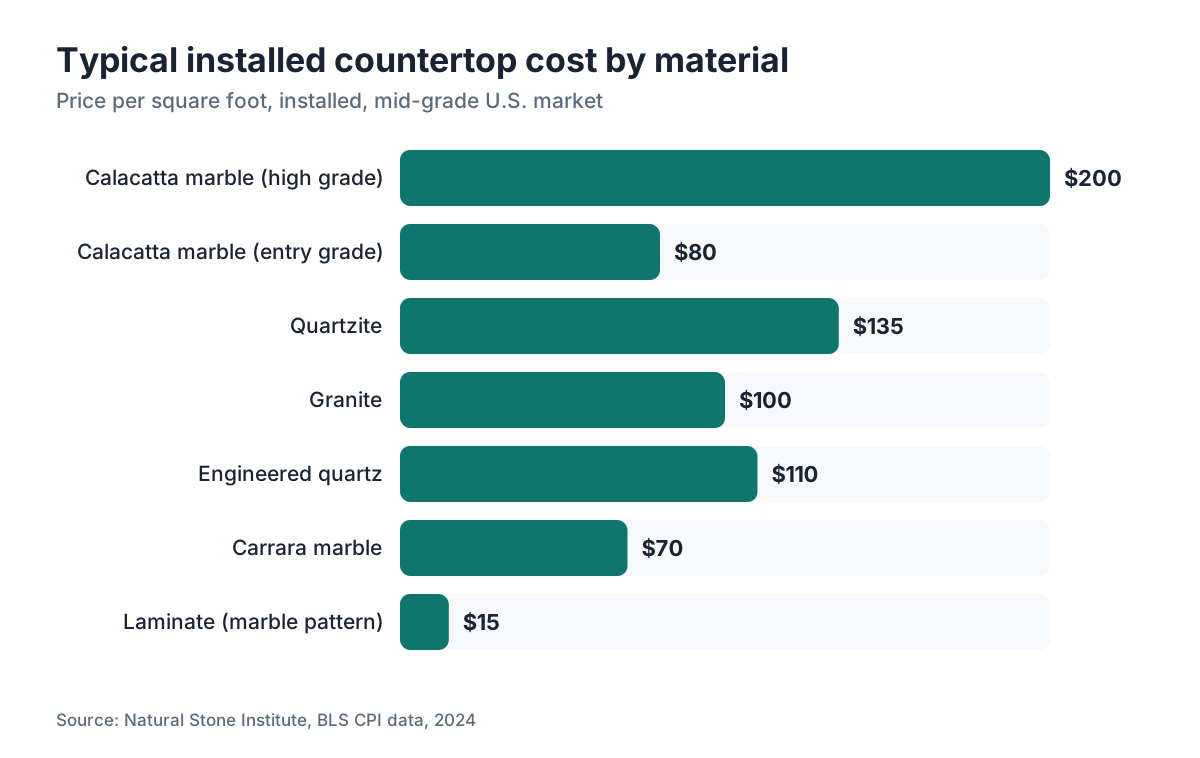
- Calacatta marble countertops run $80 to $200 per square foot installed, depending on slab grade and region.
- Most of it comes from a small quarry zone near Carrara, Italy, which makes it rarer and pricier than Carrara marble.
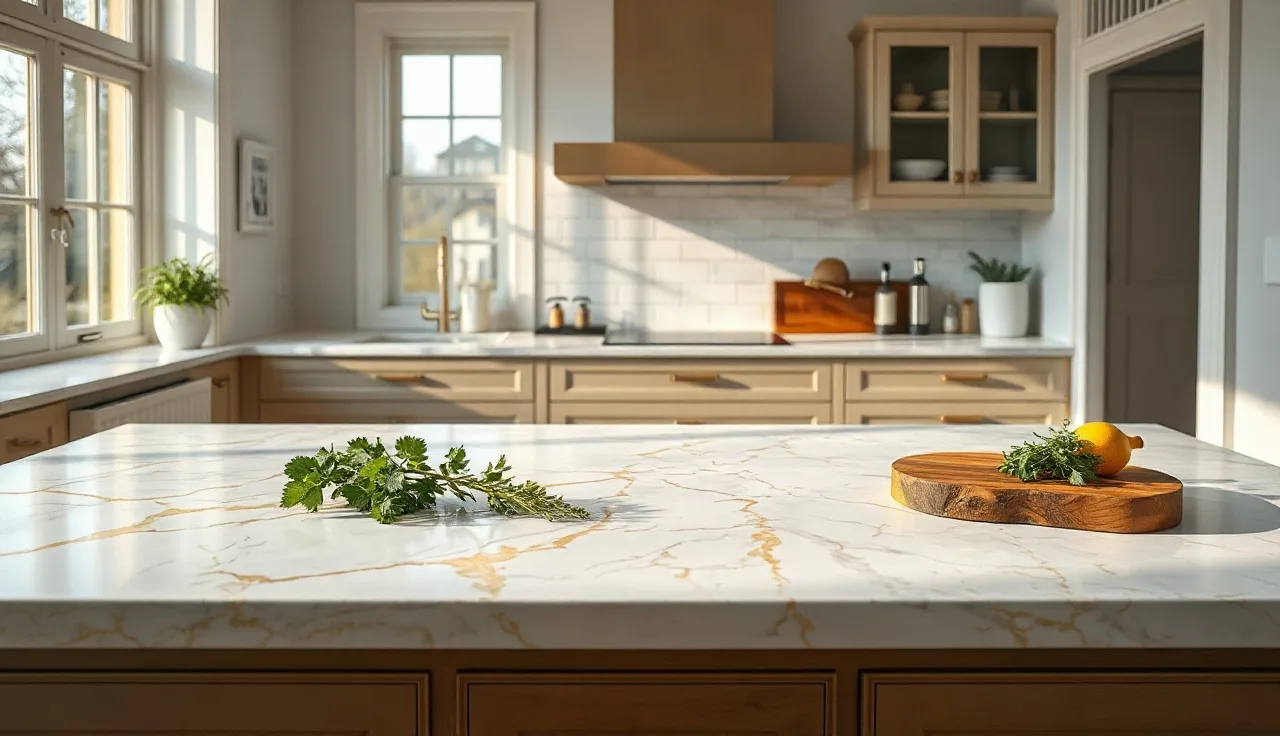
- The bright white background with bold gold or gray veining looks stunning.
- It also etches and stains fast.
- Seal it every 6 to 12 months, keep acids off it, and it lasts decades.
What exactly is Calacatta marble, and how is it different from Carrara?
Calacatta marble comes from a small cluster of quarries in the Apuan Alps near Carrara, Italy, around Monte Altissimo and the Fantiscritti basin [1]. The name is an Italianization of the quarry zone, and only stone pulled from those specific sites earns it. That geographic limit is the whole reason authentic Calacatta is rarer than Carrara. Carrara comes from a much broader quarrying area in the same mountains.
The visual difference is easy to remember. Carrara has a gray or blue-gray background with fine, wispy veining that runs in fairly consistent patterns. Calacatta has a brighter, colder white background, and the veining is bolder and more irregular. Veins in a Calacatta slab can be thick ribbons of gold, amber, or gray, sometimes running the full width of a 5-foot slab.
Calacatta Gold marble countertops are the variety everyone wants. The gold-toned veining reads warm against that bright white base, which is why you see it in high-end kitchen photography and luxury hotel lobbies. Calacatta Viola marble countertops are a separate, rarer subtype with veining that shifts toward violet and mauve. Both are natural stone, not engineered, so no two slabs match.
Here's what trips people up. "Calacatta" is not a quality grade. It's a place of origin. You can buy a plain Calacatta slab with thin, muted veining, or a spectacular one, and both are equally "Calacatta." Fabricators who sell it by grade (commercial, select, extra) are layering on their own classification. There's no universal standard behind those words.
How much do Calacatta marble countertops cost?
Expect $80 to $200 per square foot installed for genuine Calacatta [2]. That range is wide because slab quality, thickness, edge profile, cutouts, and regional labor all move the number hard.
The slab is the biggest cost driver. Raw slab prices at a stone yard usually run $60 to $150 per square foot for material only, before fabrication and installation. Calacatta Gold sits toward the top because demand for the gold-veined variety outpaces supply. A tamer Calacatta with thin gray veining might start closer to $60 per square foot for material.
Fabrication adds $20 to $50 per square foot depending on complexity. A straight run of perimeter counter with a simple eased edge is cheap to cut. An island with a waterfall edge, an integrated sink cutout, mitered corners, and a book-matched seam on a dramatic slab pushes to the top.
Here's a rough breakdown for a typical 40-square-foot kitchen:
| Cost component | Low estimate | High estimate |
|---|---|---|
| Slab material (40 sq ft + overage) | $2,400 | $6,000 |
| Fabrication | $800 | $2,000 |
| Installation | $400 | $800 |
| Sink cutout | $150 | $300 |
| Edge upgrade (ogee, waterfall) | $0 | $600 |
| Total | $3,750 | $9,700 |
Those numbers leave out sealing. Most fabricators seal as part of installation, but some charge $50 to $150 extra.
One note for fabricators building quotes. Calacatta has low yield on tight layouts because you're chasing veining direction for visual continuity. Budget 15 to 25 percent material waste above net square footage, more on book-matched or mitered jobs. Tools like SlabWise help optimize nesting to cut that waste before you commit to a slab.
Is Calacatta marble good for kitchen countertops?
Honest answer: it depends entirely on what you'll do to maintain it, and how much imperfection bothers you.
Calcite-based marble, which includes every Calacatta variety, has a Mohs hardness of about 3 [3]. Granite runs 6 to 7 on the same scale. So marble scratches more easily, and it etches. Etching is chemical erosion. Acids react with the calcite and leave dull, lighter spots in the polish. Lemon juice, vinegar, wine, tomato sauce, even orange juice can etch Calacatta in seconds. You won't always see it right away. Over time a kitchen Calacatta that gets daily cooking picks up a soft patina of micro-etches.
Some people love that. Aged Calacatta with a honed finish and natural patina has a warmth polished engineered stone never gets. Other people are horrified to watch their $8,000 counter lose its shine from a splash of kombucha. Figure out which camp you're in before you buy.
For kitchens, a honed or leathered finish is more practical than polished. Polished Calacatta shows every etch because the dull spot breaks the gloss. A honed surface is already matte, so light etching barely registers. The tradeoff: honed stone soaks up stains faster and needs sealing more often.
Calacatta works beautifully in bathrooms, where acid exposure is rare and traffic is lower. It's also great for baking or pastry counters, because the cool stone helps when you're working dough. For a main cook surface that sees daily prep, you'll either accept some wear or commit to real daily care.
If you love the look but not the upkeep, engineered quartz with Calacatta-style veining is a fair swap. Brands like Cambria make Cambria countertops with Calacatta-inspired patterns, and the performance is a completely different animal from natural stone.
How does Calacatta compare to other countertop materials?
One table, all the differences. Below compares Calacatta marble against granite, quartzite, and quartz on the factors that decide a kitchen counter.
| Property | Calacatta marble | Granite | Quartzite | Quartz (engineered) |
|---|---|---|---|---|
| Mohs hardness | ~3 | 6 to 7 | 7 | 7 |
| Etching risk | High | None | Low to medium | None |
| Stain resistance (sealed) | Moderate | Good | Good | Excellent |
| Heat resistance | Good | Excellent | Good | Poor (can crack) |
| Typical installed cost | $80, $200/sq ft | $50, $150/sq ft | $70, $200/sq ft | $70, $150/sq ft |
| Slab uniqueness | Unique | Unique | Unique | Repeating patterns |
| Maintenance | High | Low | Medium | Very low |
Granite countertops are harder, more stain-resistant, and easier to maintain, usually at a lower price. They don't have the crisp white background that defines Calacatta. If performance is the priority, granite wins on most practical numbers.
Quartzite gets confused with quartz constantly, and it's often mislabeled as marble or the other way around. True quartzite is a metamorphic rock that can look a lot like Calacatta, with white to gray backgrounds and veining, but it's much harder and shrugs off etching. If someone quotes you "Super White" or "Fantasy Brown" as quartzite, ask for a scratch test. Some slabs sold under those names are dolomitic marble, not real quartzite. The article on how to clean quartzite countertops breaks down the material differences.
Engineered quartz has no porosity, resists staining completely, and never etches. The cost overlap with Calacatta is real. A top-tier quartz can cost as much as entry-level Calacatta. The catch is that quartz is manufactured, with repeating patterns visible up close, and it's damaged by prolonged heat.
What sealer does Calacatta marble need, and how often should you apply it?
Calacatta needs a penetrating (impregnating) sealer, not a topical or film-forming one. A penetrating sealer soaks into the pores and repels liquids from below the surface without changing the look or feel. A topical sealer sits on top and peels over time into a sticky mess.
Most stone care pros recommend resealing every 6 to 12 months for polished Calacatta in a kitchen, and every 3 to 6 months for honed finishes because they're more porous [4]. The honest check is the water bead test. Pour a small puddle of water on the counter and wait 15 minutes. If it beads, the sealer still works. If the stone darkens under the puddle, it's drinking moisture and needs resealing.
Miracle Sealants 511 Impregnator and Tenax Proseal are widely used in the trade. Both are solvent-based impregnators that push into tight marble pores. Water-based sealers work too, but they usually need more frequent reapplication.
Sealing is a 30-minute job. Clean the surface, apply the sealer with a clean cloth along the veining, let it penetrate for 5 to 10 minutes (or per the label), then buff off the excess before it dries. Dried sealer leaves a white, sticky film that needs a stripper to remove. Don't skip the buffing.
Here's the part almost everyone gets wrong. Sealing does not prevent etching. Sealer blocks liquid from soaking in, which stops staining. Etching happens on the surface of the calcite crystals, not inside the pores. Drop an acid on a freshly sealed Calacatta and it still etches. For the full cleaning and protection playbook, the how to clean stone countertops guide covers products and technique.
How do you remove stains and etch marks from Calacatta marble?
Stains and etch marks are different problems with different fixes. Get that straight first.
A stain is discoloration that soaked into the pores, usually from oil, coffee, wine, or rust. The fix is a poultice: a paste of an absorbent material mixed with a chemical matched to the stain type. For oil stains, mix diatomaceous earth or whiting powder with a few drops of acetone or mineral spirits into a paste. Spread it over the stain, cover with plastic wrap, tape the edges, and leave it 24 to 48 hours. The poultice pulls the stain out of the stone as it dries. The Natural Stone Institute (which absorbed the Marble Institute of America) describes poulticing as "one of the most effective methods for removing deep-seated stains from porous stone" [5].
An etch mark is physical damage to the polished surface. The acid dissolved some calcite, and no poultice touches that. Light etch marks on polished stone buff out with marble polishing powder (tin oxide or oxalic acid based), applied with a damp cloth in circular motions until the gloss returns. It takes patience and some arm. Big or deep etching needs professional honing and re-polishing from a stone restoration company.
On honed Calacatta, light etching is usually invisible. Deep etching still needs a pro, but you'll probably never notice the minor stuff.
Daily cleaning is dead simple. Warm water and a few drops of pH-neutral dish soap. Wipe spills fast, especially acids. Skip bathroom cleaners, bleach, ammonia, and anything with vinegar. The how to clean stone countertops article lists everything that's safe.
What's the difference between Calacatta Gold and Calacatta Viola?
Both are genuine Calacatta, but they look different and price differently.
Calacatta Gold marble countertops have the warm amber-to-yellow veining most people picture. The veins are thick and irregular, sometimes with secondary gray veins running alongside the gold. The background is a cold, bright white. This is the variety design media loves, and demand has pushed prices up over the last decade. It's also the one quartz and porcelain makers copy most.
Calacatta Viola marble countertops have veining that shifts toward violet, lavender, and mauve, sometimes mixed with gray. The background is similarly white but can carry a slightly warmer cast than Gold. Viola comes out of the ground in smaller volumes, so it's genuinely harder to source. Designers reach for it precisely because it's unexpected, and the purple tones sit well next to warm wood cabinetry and brass fixtures.
Calacatta Borghini is another sub-variety worth knowing. Very bold, large-scale gray veining with occasional gold. Dramatic, a bit more available than Viola, less common than Gold.
From a care standpoint, all three are mineralogically identical. Same calcite base, same hardness, same etching behavior, same sealing routine. The differences are purely visual.
How do fabricators source and verify authentic Calacatta marble?
This is where fabricators and stone yard buyers have to stay sharp. "Calacatta" has turned into a marketing word, slapped on any white marble with dramatic veining regardless of where it came from. Some stone sold as Calacatta comes from Turkey, China, or Brazil. That doesn't make it bad stone. It just isn't the same product and shouldn't carry the price of Italian Calacatta.
The most reliable way to verify origin is the quarry certificate of origin from the supplier. Legitimate Italian Calacatta ships with documentation, and the Italian stone industry federation, Confindustria Marmomacchine, backs that paper trail [6]. Not every slab will have paperwork in hand at a U.S. stone yard, but a reputable importer can produce it on request.
Second, buy from importers with real relationships with Italian quarries. Several major U.S. distributors source directly and can name the specific quarry. "Which quarry did this come from?" is a fair question, and hesitation is a tell.
Third, learn what authentic Calacatta looks like in person. Turkish white marbles (sometimes sold as "Calacatta Turkey") tend toward cooler, more uniform backgrounds and thinner veining. Brazilian equivalents often have a slightly cream-colored background. Neither quite matches Apuan Calacatta under good light.
For high-volume shops: a digital quoting and material management tool tracks slab provenance next to pricing, so you never quote a Turkish white as Italian Calacatta by accident. SlabWise lets you attach supplier documentation to individual slabs in your inventory. That helps with client transparency and kills quoting errors on premium material.
What edge profiles work best on Calacatta marble countertops?
Edge choice on Calacatta is part looks, part engineering.
The classic pick is a simple eased or straight edge with a small chamfer on the top corner. It shows the white stone cleanly, reads modern or transitional, and it's the easiest for a fabricator to run without chip-out. Calacatta is harder to edge than granite because the calcite is more brittle. Tight inside curves like a full bullnose or an ogee need a skilled hand and carry real chip risk.
Mitered waterfall edges are hugely popular on Calacatta islands. The veining runs continuously down the side panel, which looks spectacular on a high-veining slab like Calacatta Gold. The fabrication demand is serious. The slab gets cut at a precise 45-degree miter, then glued with color-matched epoxy, with the veining lined up across the joint. Done well, the seam nearly vanishes. Done poorly, the mismatch screams. Ask to see the fabricator's previous waterfall work before you sign.
For bathrooms, a pencil edge or beveled edge is common on vanity tops. Those thin profiles suit the thinner (3/4 inch or 2 cm) slabs often used in baths.
On thickness: kitchen Calacatta usually comes in 3/4 inch (2 cm) or 1-1/4 inch (3 cm). The 3 cm is heavier, stronger, and skips the plywood substrate on most cabinetry, which simplifies installation [9]. For an island that takes hard use, 3 cm earns its extra cost.
How is Calacatta marble installed, and what should homeowners watch for?
Calacatta installation follows the same general path as any stone counter, but the slab's price and brittleness make a few steps demand extra attention.
After templating (digital or physical, usually 1 to 2 weeks before install day), the fabricator cuts and finishes the stone. On install day, the old counters come off and the cabinet bases get checked for level. Marble has to sit on a flat, level surface. A cabinet run out of level by more than 1/8 inch over 10 feet can create a stress point that cracks the stone down the line.
Pieces get set with silicone adhesive in most cases, not epoxy, which allows slight movement and comes off easier if a piece ever needs replacing. Seams get glued with color-matched two-part epoxy and held with seam clamps until cured. On a dramatic slab, seam placement deserves planning. Put seams where veining breaks naturally, or where the eye doesn't land first.
Homeowners, watch three things. First, confirm seam locations before any cuts. Once the slab is cut, there's no undo. Second, have the fabricator seal the stone before installation if they haven't, since the underside and the edges near the sink are hard to reach afterward. Third, check the overhang on any unsupported span. The Natural Stone Institute's dimension stone standards recommend that unsupported spans in 3 cm marble not exceed 24 inches without added support [7].
For the full walkthrough, the countertop installation guide covers templating, delivery, and day-of steps.
Are there good lookalike alternatives to real Calacatta marble?
Yes, and several are genuinely good.
Engineered quartz is the most practical stand-in. Silestone, MSI, and Caesarstone all make Calacatta-pattern slabs. The veining is printed or pressed into the material and repeats across slabs, but high-end versions hold up at normal viewing distance. Quartz doesn't etch, doesn't stain, and needs no sealing. The tradeoff is heat. Set a hot pan on quartz and you risk cracking the resin binders, a repair that usually means replacing the whole piece.
Porcelain slabs (also called sintered stone or ultra-compact surfaces) sell under names like Dekton and Laminam. Porcelain has essentially zero porosity, handles heat better than quartz, and has no etching risk. It's very thin, typically 6 to 12 mm, so edges and cutouts need skilled fabrication. Cost overlaps with natural Calacatta at the high end.
Laminate with Calacatta patterns has come a long way. Formica countertops and Wilsonart both offer marble-look laminates that convince from a few feet away. They're the cheapest by far, roughly $5 to $15 per square foot installed, and obviously not stone. For a rental, a tight budget, or a secondary space, there's nothing shameful about them.
Want natural stone with lower maintenance and a similar white look? Consider quartzite. True white quartzite is harder than marble and resists etching better, though it can still stain and still needs sealing. The marble countertops article compares the natural stone options in more depth.
What questions should you ask a fabricator before buying Calacatta marble?
The right questions upfront save real money and disappointment. Ask these.
First, country of origin, and request documentation. Italian Calacatta costs more and has specific visual traits. If you're paying Italian prices, confirm you're getting Italian stone.
Second, ask to see the actual slab you'll get, not a sample chip. Calacatta varies enormously slab to slab. Approve the specific slab in person or by high-resolution photo before fabrication starts.
Third, ask where seams go and how the fabricator plans to match veining across them. On a dramatic Calacatta Gold slab, seam placement is a big decision.
Fourth, ask whether the price includes sealing and how many coats. Some quotes include one coat. Some include none.
Fifth, ask about the warranty on fabrication and installation. Cracks, transit chips, or install errors should land on the fabricator, not get blamed on the stone.
Sixth, for waterfall edges or book-matched work, ask how much extra material it needs and whether the per-square-foot price accounts for waste. On a $100-per-square-foot slab, a 25 percent waste factor adds $25 per usable square foot to your real cost.
Seventh, ask about edge profile lead time. Complex profiles like ogee or mitered waterfall eat more shop time. If you have a hard install date, confirm the shop can finish in time.
For kitchen countertops in general, get at least three quotes from fabricators who've actually worked Calacatta. The time is worth it.
Frequently asked questions
Is Calacatta marble more expensive than Carrara marble?
Yes, consistently. Carrara marble typically runs $40 to $100 per square foot installed, while Calacatta runs $80 to $200. The gap comes from rarity: Calacatta quarries cover a much smaller geographic area, and the dramatic white-and-gold veining that defines top-grade slabs is genuinely hard to find. Calacatta Gold, the most sought-after variety, sits at the top of the range.
Does Calacatta marble scratch easily?
Relative to most countertop materials, yes. Calacatta marble has a Mohs hardness of about 3, which means a steel knife, a metal utensil dragged across it, or a rough ceramic dish can scratch it. Using a cutting board is non-negotiable. A honed finish hides light scratches better than a polished one, and professional re-polishing removes significant surface damage.
Can Calacatta marble be used in a bathroom?
Absolutely, and it's arguably a better fit for bathrooms than kitchens. Bathrooms see much less acid (no lemon juice, vinegar, or tomato sauce), so etching is rarely a problem. Traffic is lighter, cleaning is simpler, and the marble's visual impact in a bathroom or shower is hard to beat. Seal it twice a year and clean with a pH-neutral product.
How can I tell if a slab is real Calacatta or an imitation?
Ask for a quarry certificate of origin from the supplier. Authentic Italian Calacatta has a bright white background with bold, irregular veining in gold, gray, or both. Turkish and Chinese white marbles sold as Calacatta tend to have slightly creamier backgrounds and more uniform veining. If the price looks suspiciously low for claimed Italian Calacatta, ask more questions.
What is Calacatta Gold marble, and why is it more expensive?
Calacatta Gold marble countertops have warm amber and yellow-gold veining against a crisp white background. The gold veining comes from specific mineral deposits within a limited section of the Calacatta quarrying zone, making it harder to source than gray-veined Calacatta. It's consistently the most photographed and most imitated variety, which drives demand and price. Expect $100 to $200 per square foot installed for top-grade Calacatta Gold.
How long does Calacatta marble last?
With proper sealing and care, Calacatta marble countertops last for decades, often the life of the home. The stone itself is extremely durable structurally. What changes is the surface finish: a polished Calacatta in an active kitchen develops a patina of micro-etches and subtle scratches over 5 to 10 years. That patina can be professionally restored, or embraced as character. Honed finishes age more gracefully in high-use settings.
Is honed Calacatta marble better than polished for kitchens?
For most kitchen users, yes. Honed Calacatta has a matte or satin finish that doesn't show etch marks the way a polished surface does. Light spills and minor scratches barely register. The tradeoff is that honed stone is slightly more porous than polished and absorbs stains faster, so it needs sealing every 3 to 6 months rather than every 6 to 12. Most designers now recommend honed for kitchen Calacatta.
What is Calacatta Viola marble?
Calacatta Viola marble countertops have veining that runs toward violet, lavender, and mauve rather than the typical gold or gray. It comes from the same Apuan Alps quarrying zone as other Calacatta varieties but gets extracted in smaller volumes, so it's rarer and harder to source. It's mineralogically identical to other Calacatta marbles, with the same hardness, etching behavior, and sealing needs. Designers reach for it when they want drama without the expected gold veining.
Can you put hot pans on Calacatta marble?
Marble handles heat better than engineered quartz or laminate, and the stone won't melt or crack from a normal hot pan. But sudden temperature swings can cause thermal shock cracking, and repeated heat can dull a polished finish over time. Using trivets is still the right habit. The bigger hot-pan risk is on quartz countertops, which can crack from heat damage to the resin binders.
How do I clean Calacatta marble countertops daily?
Warm water and a few drops of pH-neutral dish soap on a soft cloth. Wipe spills immediately, especially anything acidic. Never use vinegar, bleach, ammonia, or commercial bathroom cleaners on marble. Dry the surface after cleaning rather than letting it air-dry, which can leave mineral deposits in hard water areas. A microfiber cloth works well for both cleaning and buffing dry.
What causes white rings or dull spots on Calacatta marble?
White rings or dull spots are almost always etch marks, not stains. Acidic liquids (lemon juice, wine, coffee, soda, cleaning products) react with the calcite and dissolve a thin layer of the polished surface. Sealing does not prevent this. Light etching buffs out with marble polishing powder; deeper etching needs professional honing. Switching to a honed finish eliminates visible etching almost entirely.
Is Calacatta marble worth the money over quartz?
It depends on your priorities. Quartz is more durable, lower maintenance, and often cheaper. Calacatta marble has genuine beauty engineered stone doesn't quite replicate, and it ages well for buyers who accept the patina. If you cook heavily, have young kids, or don't want to think about maintenance, quartz is the smarter practical choice. If natural stone matters to you and you'll care for it properly, Calacatta is worth it.
Does Calacatta marble add resale value to a home?
Real estate appraisers don't break out countertop material in valuation models, so there's no published data on Calacatta specifically adding resale value. What appraisers do recognize is overall kitchen quality and condition. A well-maintained Calacatta kitchen photographs beautifully and draws buyers in the luxury tier. An etched, stained, or cracked marble counter does the opposite. Condition matters more than material.
Sources
- Natural Stone Institute, Dimension Stone Design Manual: Calacatta marble is quarried in the Apuan Alps near Carrara, Italy, in a geographically restricted zone distinct from the broader Carrara quarrying area.
- U.S. Bureau of Labor Statistics, Consumer Price Index: Installed stone countertop prices vary significantly by region, material grade, and fabrication complexity; natural marble ranges from roughly $80 to $200 per square foot installed at the high end.
- U.S. Geological Survey, Mineral Resources Program: Calcite: Calcite, the primary mineral in marble including Calacatta, has a Mohs hardness of approximately 3.
- Natural Stone Institute, Care and Cleaning for Natural Stone: Penetrating sealers for marble in kitchen use should be reapplied every 6 to 12 months for polished finishes and more frequently for honed finishes due to increased porosity.
- Natural Stone Institute, Removing Stains from Natural Stone (Stone Care Technical Bulletin): Poulticing is described as one of the most effective methods for removing deep-seated stains from porous stone.
- Confindustria Marmomacchine (Italian marble and stone industry federation): The Italian marble industry trade organization supports quarry certificates of origin for authentic Italian stone, including Calacatta from the Apuan Alps.
- Natural Stone Institute, Dimension Stone Design Manual: Countertop Fabrication Standards: Unsupported spans in 3 cm marble countertops should not exceed 24 inches without additional structural support to prevent cracking.
- U.S. Geological Survey, Mineral Commodity Summaries: Marble and Dimension Stone: Italy is consistently among the world's top exporters of finished marble and dimension stone, with significant production from the Carrara region.
- National Institute of Standards and Technology, Weights and Measures Division: Standard slab thickness designations of 2 cm (3/4 inch) and 3 cm (1-1/4 inch) are the industry norms for natural stone countertop applications in the U.S. market.
- Marble Institute of America (now Natural Stone Institute), Marble Industry Standards: The Marble Institute of America established technical standards for marble grading, installation, and care that are widely referenced by U.S. fabricators and specifiers.
Last updated 2026-07-09