TL;DR
- A marble epoxy countertop is either a cast epoxy surface with marble-look pigments, or real stone with an epoxy coating or crack fill.
- The cast version costs about $45 to $150 per square foot installed, lasts 10 to 20 years with care, and shrugs off acid stains that would etch real marble.
- It scratches easier than stone.
- Real marble sealed with epoxy is a different product with different tradeoffs.
What exactly is a marble epoxy countertop?
The phrase "marble epoxy countertop" covers two genuinely different things, and mixing them up sends you down the wrong road fast.
The first is a cast epoxy countertop with a marble-look finish. A two-part epoxy resin gets poured directly onto a substrate (usually MDF, plywood, or an existing countertop) in multiple layers. Pigments, metallic powders, and white veining compounds get swirled into patterns that mimic Carrara, Calacatta, or similar white marble. The result is 100% synthetic. No stone in it anywhere.
The second is real marble that's been coated, sealed, or had cracks and chips filled with a clear or tinted epoxy. Fabricators do this to repair damaged slabs, and some sealant products are epoxy-based rather than the more common penetrating silane or siloxane sealers. This is standard shop work, not a style category.
There's a third, less common version: a "marble chip" or terrazzo-style epoxy, where real crushed marble aggregate sits suspended in clear resin. That one gives you actual stone content in a poured format.
Most people typing "marble epoxy countertops" into a search bar want the first version, the decorative poured surface. That's what this article covers, with comparisons to real stone where the difference matters.
How much does a marble epoxy countertop cost?
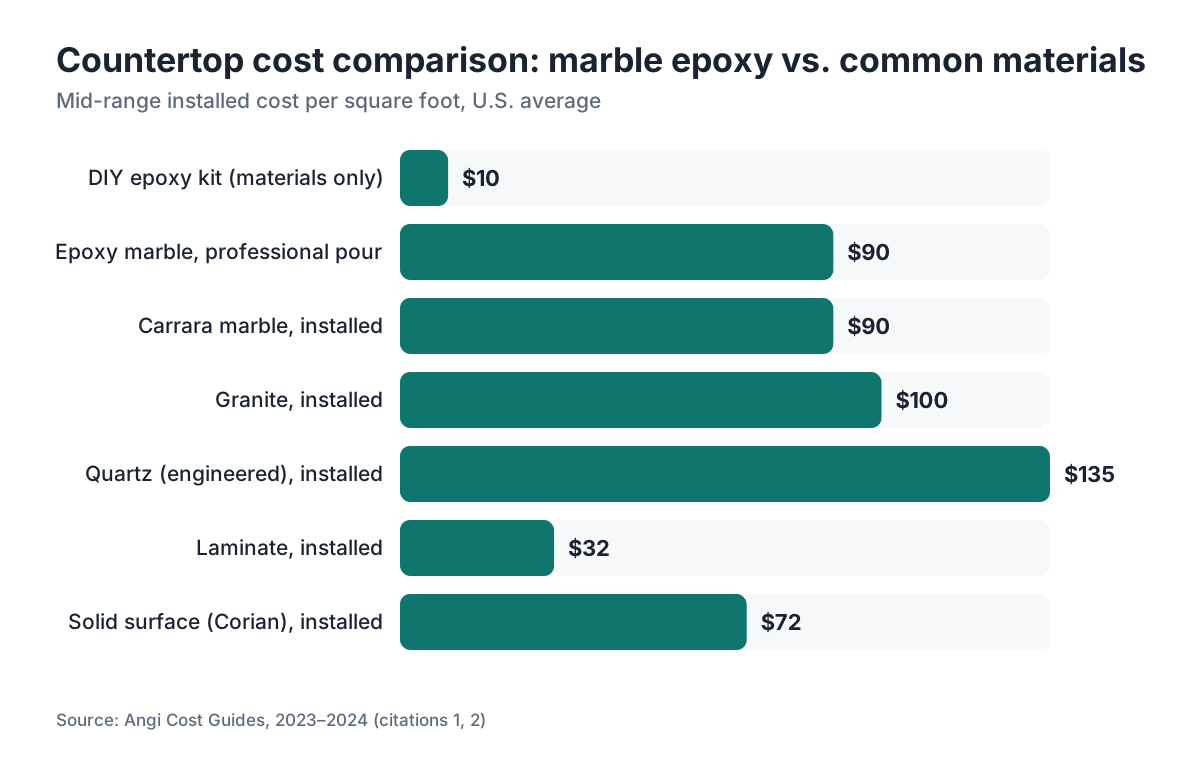
Installed cost for a cast epoxy countertop with a marble finish runs roughly $45 to $150 per square foot [1]. The spread is wide because labor drives the price, not materials. Epoxy product for a typical 30-square-foot kitchen costs $200 to $600. Everything above that number is skill and hours.
Here's how the pricing breaks down by scenario:
| Scenario | Typical cost per sq ft | Notes |
|---|---|---|
| DIY epoxy kit over existing countertop | $5, $15 | Kit only; no labor; prep time 8 to 16 hrs |
| Pro pour, basic marble look | $45, $75 | 1-2 color layers, standard veining |
| Pro pour, high-detail Calacatta look | $80, $120 | Multiple pigment passes, gold veining |
| Custom artist / luxury finish | $120, $150+ | Hand-painted veins, onyx or geode effects |
| Real Carrara marble slab, installed | $60, $120 | For comparison; varies by region [2] |
DIY kits from Rust-Oleum, Countertop Transformations, and Leggari look tempting at $5 to $15 per square foot in materials. The failure rate on first attempts is high, though. Bubbles, fish-eyes, and uneven self-leveling show up fast without controlled temperature, good surface prep, and some feel for pot-life timing. When a pour goes wrong, stripping cured epoxy off a substrate is a miserable job.
Fabricators pricing epoxy work should treat it as labor-heavy relative to stone. A skilled installer might spend 6 to 10 hours on a 30-square-foot kitchen across two or three sessions: pour, cure, sand, topcoat. That time is why a professional epoxy finish isn't cheap just because the raw material is.
How durable is epoxy compared to real marble?
This is where epoxy earns real points, and also where it disappoints in ways buyers don't see coming.
On stain resistance, epoxy wins clean. Real marble is calcium carbonate, and it etches from acid contact. Lemon juice, vinegar, coffee, and wine don't just stain marble. They dissolve the surface polish and leave dull spots that no amount of scrubbing fixes. You have to re-hone or re-polish the stone [3]. Epoxy is inert to most household acids. A glass of orange juice left overnight does nothing to it.
On scratch resistance, marble wins. Marble sits around Mohs 3 to 4. Cured epoxy surface hardness varies by formulation but usually lands in the 2H to 4H pencil hardness range, roughly Mohs 2 to 3 equivalent. Drag a cast iron pan or a knife across an epoxy top and it leaves a mark. Keys, knife tips, and abrasive cleaners scratch it more readily than stone.
Heat is where epoxy really struggles. Most poured epoxy countertops have a heat deflection temperature around 150 to 200 degrees F depending on the resin system [4]. A pan straight off the burner can top 400 degrees F, and that will yellow, cloud, or permanently damage the surface. Marble handles heat better mechanically, though thermal shock can still crack any stone. The rule for epoxy is simple. Always use a trivet. No exceptions.
UV stability matters for any counter near a window. Standard epoxy resins yellow over time under sunlight. UV-stable topcoats (often polyurethane or polyaspartic) help, but "UV resistant" and UV-proof are not the same thing. A south-facing kitchen full of natural light will shift color faster than a shaded one.
Expected life for a professionally installed epoxy countertop with proper care is 10 to 20 years before it needs refinishing or replacement [1]. Real marble, sealed and maintained, can last a lifetime. That gap belongs in your cost math.
What are epoxy marble countertop finishes actually made of?
The chemistry matters when you're choosing a product or trying to figure out why a pour went sideways.
Most decorative countertop epoxies are two-part systems: a Part A epoxy resin and a Part B hardener (amine or amide based). Mix them in the right ratio by volume or weight and a crosslinking reaction kicks off. The mixture self-levels, then cures to a solid polymer over 24 to 72 hours at room temperature, reaching full hardness at 7 days or more [4].
The marble look comes from layering. A base coat, usually white or light gray, goes down first. Then pigmented epoxy in gray, gold, charcoal, or black gets dropped, swirled, blown with a heat gun or torch, and worked with palette knives or feathers into vein patterns. That artistic layer gets sealed under a clear topcoat, which is often a different chemistry: polyurethane, polyaspartic, or a UV-resistant clear epoxy that protects the color and adds scratch resistance.
Pot life, the working time before the mix gels, runs 20 to 45 minutes for most consumer and pro countertop epoxies [10]. Heat speeds the reaction. A 10-degree rise roughly halves the pot life. Work in a shop above 85 degrees F and you risk premature gelling and surface defects. The American Chemistry Council describes these two-part systems as crosslinking "via reaction between the epoxide resin and the amine or amide hardener," with pot life shortened by temperature [10].
One thing to know for fabricators: some shops run polyaspartic coatings over or instead of epoxy for the topcoat. Polyaspartics cure faster (sometimes 1 to 3 hours), hold up better under UV, and resist abrasion more than standard epoxy. The catch is that the fast cure compresses your work window. That tradeoff is real.
Can you put marble epoxy over an existing countertop?
Yes, and it's one of the main reasons homeowners go this route instead of a full tear-out.
Epoxy bonds to laminate, tile grout, existing stone (with prep), concrete, wood, and MDF. Prep is the whole game. It separates a finish that lasts from one that peels in a year. The existing surface has to be clean of all grease and residue (TSP or degreaser), scuff-sanded to 120 to 220 grit so the epoxy has mechanical tooth, and primed if it's porous. Fill any cracks or deep chips before you pour, because epoxy telegraphs surface defects rather than hiding them.
With laminate, re-adhere and clamp flat any edges or seams that are lifting before epoxy goes over them. Cured epoxy is rigid. If the substrate underneath moves, the epoxy cracks.
With tile countertops, grout lines show through a thin pour. A skim-coat filler pass to level the tile surface first is standard for professional results.
Existing laminate countertops and formica countertops are the most common substrates here because they're flat and bond well once scuffed.
How does epoxy marble compare to real marble countertops?
This one comes up constantly, and the honest answer is that neither is strictly better. They solve different problems.
Real marble countertops are natural stone with genuine pattern variation. No two slabs match. The surface can be polished, honed, or leathered, and repolished if it gets damaged. Marble etches from acid and needs sealing every 1 to 3 years for kitchen use, but it's a repairable material over a very long life. If you have an old marble slab and want to sort out cleaning and upkeep, our guide on how to clean stone countertops walks through it.
Epoxy marble doesn't etch from acid, but it scratches easier and can't be repolished the same way. It's also not unique in the same sense. The "Calacatta" look from an epoxy kit is a reproducible pattern, not a one-off slab pulled from the earth.
Cost at the midrange is close. Good epoxy work runs $60 to $100 per square foot installed. Carrara marble runs about the same in most U.S. markets [2]. The exotics (Statuario, Arabescato) push to $150 to $250 per square foot or more, and that's where epoxy turns into a real cost alternative.
Love marble's look and cook hard every night? Epoxy marble is a sensible functional stand-in. Love the idea of real stone as a lasting, repairable material? Epoxy is a workaround, not a replacement.
For the full menu of options, kitchen countertops covers the whole material landscape.
How does marble epoxy compare to quartz, granite, and other alternatives?
The table below uses mid-range costs and the industry consensus on durability. "Etch resistance" means resistance to acid-caused surface dulling specifically, which is a different thing from staining.
| Material | Cost installed ($/sq ft) | Scratch hardness | Etch resistance | Heat resistance | DIY-able? |
|---|---|---|---|---|---|
| Epoxy marble (cast) | $45, $150 | Low (Mohs ~2 to 3) | High | Low (<200F) | Yes (high risk) |
| Real marble | $60, $250 | Medium (Mohs 3 to 4) | None | Medium | No |
| Granite | $50, $150 | High (Mohs 6 to 7) | High | High | No |
| Quartz (engineered) | $70, $200 | High | High | Low (resin content) | No |
| Laminate | $15, $50 | Low | Medium | Low | Yes |
| Butcher block | $40, $100 | Low-medium | High | Low-medium | Yes |
| Corian/solid surface | $45, $100 | Low-medium | High | Low | Partial |
Granite is the material epoxy marble loses to hardest on pure durability. Granite countertops run harder (Mohs 6 to 7 versus epoxy's 2 to 3 [9]), take more heat, and cost about the same at the mid-tier. The case for epoxy over granite is budget (entry-level DIY) or a specific white-marble look that granite doesn't offer naturally.
Quartz engineered stone (brands like Cambria) is worth the comparison too. Quartz is non-porous, consistent, hard, and acid-resistant. It shares epoxy's weak spot on high direct heat, since the polymer binder in quartz can scorch. Quartz is harder to DIY and costs more at the top end, but it lasts longer and has more fabricator support behind repairs.
For fabricators sizing up the workflow: epoxy pours ask for different skills than stone fabrication. Stone shops that bolt on epoxy sometimes find the artistic and chemistry side unfamiliar. Tools that track material usage and quote variable labor time matter more here, because epoxy jobs aren't per-linear-foot simple. SlabWise's quoting tool handles variable labor and material inputs for exactly these non-standard jobs, worth a look if you're adding the service.
What are the pros and cons of marble epoxy countertops?
Pros:
Acid and stain resistance is the real one. Unlike actual marble, an epoxy surface won't etch from citrus, wine, or coffee. That's the single most practical edge for a busy kitchen.
The look has huge range. You can copy white Carrara, gold Calacatta, black nero marquina, or make up something that doesn't exist in any quarry. Geode pours, river effects, and backlit translucent panels all work in epoxy and none of them work in stone.
Pouring over an existing surface skips demolition and disposal. A remodel that leaves the old countertop in place saves $200 to $500 in labor and dump fees.
Surface-level repair is straightforward. Small chips or scratches sand out and re-coat without replacing the whole counter.
Cons:
Scratch sensitivity is real and daily. Cut directly on epoxy and it marks fast, permanently. Most epoxy countertop owners keep cutting boards within arm's reach everywhere.
Heat is the enemy. One forgotten trivet can cloud or yellow the surface for good. Marble and granite don't punish a brief lapse the same way.
UV yellowing on white or light finishes creeps in over years, worst near windows. That $10 hardware-store kit yellows faster than a professionally UV-topcoated pour.
The DIY failure rate is high. Bad temperature control, wrong mix ratios, thin prep, and rushed topcoating all cause problems, some cosmetic and some structural.
It isn't natural stone. If you love stone as a material, epoxy is an imitation, and some buyers feel that difference more as the years pass.
How do you care for and clean a marble epoxy countertop?
Daily cleaning is mild dish soap and warm water. Skip abrasive scrub pads (they scratch) and any cleaner with bleach, ammonia, or acetone. Acetone dissolves many epoxy topcoats. pH-neutral cleaners are the safe choice [6].
For stuck-on food, let warm soapy water soak a few minutes, then use a soft silicone scraper or a non-abrasive cloth. No metal scrapers.
Don't reach for vinegar or lemon juice as cleaning agents, even though epoxy doesn't etch the way marble does. Repeated acid exposure can dull a polyurethane topcoat over time.
For disinfecting, 70% isopropyl alcohol wiped on briefly and then off is safe on most epoxy topcoats. Don't let it pool and sit, because long contact hazes some formulations.
Long-term, most epoxy countertops benefit from an annual coat of countertop wax or carnauba polish to bring back the sheen and add a thin protective layer. This isn't sealing stone. It's closer to waxing a car.
If the surface picks up fine scratches over years, wet-sanding with 400 to 800 grit followed by polishing compound restores clarity. A full refinish (a fresh topcoat) is possible but takes stripping or scuff-sanding the old surface first.
For how this stacks up against caring for natural stone like quartzite or soapstone, see how to clean quartzite countertops and how to clean soapstone countertops.
Can a DIYer do a marble epoxy countertop, and what goes wrong?
Yes, it's technically DIY-able. Whether it's a good idea depends on how you'd feel about a redo.
The common failure modes:
-
Bubbles. Epoxy releases gas as it cures. A propane torch or heat gun passed quickly over the surface right after pouring pops the surface bubbles. Miss that window, or move too slow, and you get a surface that looks like it has acne. Once cured, bubbles mean sanding down and recoating.
-
Fish-eyes and craters. Usually silicone contamination on the surface from a prior cleaner or polish. Silicone repels epoxy. Wiping with denatured alcohol before the pour helps, but one missed spot leaves a crater.
-
Uneven thickness and drips. Epoxy self-levels only if the substrate is level and the pour is controlled. Edges drip. Most pours need edge forms or tape dams to catch runoff, and pulling those cleanly is all about timing.
-
Amine blush. In humid conditions, some hardeners leave a waxy film overnight. Wipe it off with water before the next coat. Topcoat over it and adhesion fails.
-
Wrong mix ratio. Epoxy won't fully cure if the A:B ratio is off by more than 5 to 10%. The surface stays tacky forever. The only fix is scraping it off and starting over.
For homeowners: if this is your first pour, run a test panel on a scrap of MDF before you touch the kitchen. That panel teaches you more in two hours than any video.
For fabricators weighing the service: the artisan epoxy skill is a real specialty. Plenty of shops partner with a dedicated epoxy artist rather than retraining stone fabricators in a different craft. Consumer epoxy products need adequate ventilation and PPE during use, and bad application conditions raise exposure risk [11].
Is marble epoxy a good investment for resale value?
Honestly, nobody has reliable data on this specific question. Appraisers don't break out countertop material as a line item, and the studies that exist on kitchen remodel returns are broad.
The National Association of Realtors' 2023 Remodeling Impact Report found a complete kitchen renovation returns roughly 67 cents on the dollar at resale [7]. That's a full remodel, not a countertop swap, so the countertop-specific number is buried inside that figure.
What realtors and stagers say (anecdotally, not in published data) is that buyers notice countertops and react to the overall visual impression. A well-done epoxy marble finish reads as "renovated kitchen" and is basically indistinguishable from real stone in listing photos. A DIY pour that yellowed or shows scratches reads as a negative.
The real resale risk with epoxy is longevity. A kitchen done 5 years before sale with real Carrara marble looks nearly identical to install day. A 5-year-old epoxy pour might show UV yellowing, micro-scratches, or finish wear that stone wouldn't. If you're renovating specifically to sell soon, that durability gap matters.
For a kitchen you plan to live in for 10-plus years, epoxy marble is a reasonable pick if you like the look and keep up the maintenance. For a quick flip, the odds of premature aging make stone or a durable engineered surface the safer bet.
What do fabricators need to know before adding epoxy countertops to their services?
Epoxy work fits a stone shop's menu differently than most people expect.
The revenue model is labor-hour based, not per-slab. Stone fabrication has a fairly predictable cost structure: material, cut time, edge profile, install. Epoxy pours act more like custom painting. The job takes as long as it takes, and complexity scales with the design. Quotes need to reflect actual hourly labor at your shop's rate, material cost (which is modest), and a setup and cleanup allowance.
Software that handles variable labor inputs makes a difference here. SlabWise's quoting tool lets you build line items with different labor rates and time estimates per job type, so an epoxy pour doesn't get jammed into the same template as a granite edge profile.
Ventilation requirements are real. OSHA guidance on epoxy resins calls for enough ventilation to keep vapor below the threshold limit value for the specific resin and hardener components [5]. Shops taking on regular epoxy work should look hard at their ventilation setup first.
Cure time drives shop scheduling. A poured countertop needs 24 hours before it can be handled and 7 days before full service. Stone is ready to install the day you finish fabrication. Plan your job queue around that difference.
Subcontracting is worth a thought. Some fabricators offer epoxy as a brokered service. They handle customer contact, countertop removal, and install, and they bring in a specialist for the pour. The margin is thinner, but so is the liability and skill risk.
For countertop installation detail on prepping and leveling a substrate for a pour, the principles hold across any surface install. Level it, secure it, clean it.
Frequently asked questions
How long does a marble epoxy countertop last?
A professionally installed epoxy countertop with a UV-resistant topcoat and proper maintenance typically lasts 10 to 20 years before needing refinishing. DIY pours and kits without UV protection can show yellowing and surface wear in 3 to 5 years. The main life-shorteners are direct heat, abrasive cleaners, and UV exposure from nearby windows.
Does marble epoxy scratch easily?
Yes, more than real stone. Cured epoxy has a surface hardness around Mohs 2 to 3, softer than marble at Mohs 3 to 4 and much softer than granite at Mohs 6 to 7. Cutting directly on epoxy, dragging cast iron, or using abrasive pads leaves permanent scratches. Cutting boards are not optional on an epoxy surface.
Can you put hot pans on a marble epoxy countertop?
No. Most epoxy resins have a heat deflection temperature around 150 to 200 degrees F. A pan from the stove or oven can top 400 degrees F and will cause permanent yellowing, cloudiness, or deformation. Always use trivets or hot pads. This is the biggest practical difference between epoxy and natural stone for kitchen use.
Can marble epoxy countertops be repaired?
Small scratches and chips can be wet-sanded and re-coated with a clear topcoat. Deeper damage may need a partial or full pour over the affected area. The repair is easier than fixing chipped stone, but color-matching an existing epoxy pour is hard. The best repairs happen when the original installer kept some of the mix formula on file.
Is epoxy marble food safe once cured?
Fully cured epoxy resin is generally considered safe for incidental food contact. The FDA covers certain epoxy formulations for food contact under 21 CFR 175.300. Curing takes 7 days for most consumer products, though, so confirm the specific product's food contact compliance with the manufacturer before using a fresh pour for food prep.
How does a marble epoxy countertop compare to Carrara marble?
Epoxy marble doesn't etch from acids the way Carrara does, which is a real daily-use advantage. Carrara is harder, takes more heat, and can be repolished if damaged. Both run $60 to $120 per square foot installed at mid-range. Carrara is a natural material that can last a lifetime; epoxy needs refinishing after 10 to 20 years.
How long does it take to install a marble epoxy countertop?
A professional pour for a typical 30-square-foot kitchen takes 2 to 3 sessions over 3 to 5 days: surface prep and primer, the color and vein pour, and the clear topcoat. Each layer needs cure time between sessions. Add 7 days before full use. DIY timelines are similar but often stretch from first-time errors and troubleshooting.
Does marble epoxy yellow over time?
Standard epoxy resins yellow under UV exposure, and white or light finishes show it most. UV-stabilized topcoats (polyaspartic or aliphatic urethane) slow this a lot but don't stop it over many years. South-facing kitchens with big windows are the highest risk. If yellowing resistance matters to you, ask your installer exactly what UV-protection topcoat they use.
What's the difference between epoxy and resin countertops?
In everyday use the terms overlap. Strictly, epoxy is one type of thermosetting resin (an epoxide polymer crosslinked with an amine hardener). Other resin countertop products use polyester, polyurethane, or UV-cure acrylics. All share the poured, pigmented look. Epoxy is the most common for DIY and professional countertop pours because it self-levels well and is widely available.
Can you pour marble epoxy over tile countertops?
Yes, but grout lines telegraph through a thin pour. Professional results over tile need a skim-coat leveling pass (a thin filler layer) before the decorative pour. The tile surface needs thorough degreasing and light sanding. Deep-set grout lines can still show as faint shadows even after leveling. Most pros want at least two pre-pour leveling coats on tile substrates.
How do you clean marble epoxy countertops without damaging them?
Use mild dish soap and warm water with a soft cloth daily. Avoid abrasives, bleach, ammonia, and acetone. For disinfecting, 70% isopropyl alcohol wiped on briefly then dried works on most formulations. Don't let acidic or solvent-based cleaners pool on the surface. An annual light wax or carnauba polish helps keep the finish looking right.
Is marble epoxy cheaper than quartz?
At the low end, yes. A DIY epoxy kit runs $5 to $15 per square foot in materials alone. Professional epoxy installs run $45 to $150 per square foot, overlapping quartz's $70 to $200 installed range. For comparable quality, the prices are close. The tradeoff is epoxy's shorter life and lower scratch resistance against quartz's longer service life and harder surface.
What primer or surface prep do you need before an epoxy pour?
The substrate must be clean, dry, and free of grease, silicone, and wax. Scuff-sand to 120 to 220 grit for mechanical adhesion. Fill cracks and low spots. Most professional pours use a dedicated epoxy primer coat before the color layers; it seals porous substrates and prevents outgassing bubbles. Keep the temperature at 70 to 80 degrees F and relative humidity below 85% during application.
Can you use marble epoxy in a bathroom?
Yes, and bathroom vanities are lower-risk than kitchens because there's less direct heat, less cutting, and less daily acid exposure. The same prep and topcoat rules apply. Bathrooms run humid, so confirm your product's amine blush resistance for humid curing. UV yellowing is less of a worry in bathrooms with little direct sun.
Sources
- HomeAdvisor / Angi, Epoxy Countertops Cost Guide: Installed cost for epoxy countertops ranges approximately $45, $150 per square foot; expected lifespan 10 to 20 years with care
- HomeAdvisor / Angi, Marble Countertop Cost Guide: Carrara marble countertops installed cost roughly $60, $120 per square foot in most U.S. markets
- Natural Stone Institute, Care and Maintenance of Natural Stone: Marble is calcium carbonate and will etch from acidic contact; etching requires mechanical polishing to restore, not just cleaning
- U.S. Department of Energy, Office of Scientific and Technical Information: Epoxy Resin Systems Technical Overview: Standard epoxy systems have heat deflection temperatures around 150 to 200°F and require 7 days for full cure at room temperature
- Occupational Safety and Health Administration, Epoxy Resins Safety and Ventilation Guidance: Epoxy resins and amine hardeners require adequate ventilation to keep vapor concentrations below the threshold limit value during application
- U.S. Environmental Protection Agency, Safer Choice Program: Cleaning Product Formulation Standards: pH-neutral cleaners are recommended for chemically sensitive surfaces; bleach and ammonia can degrade polymer coatings
- National Association of Realtors, 2023 Remodeling Impact Report: A complete kitchen renovation returns approximately 67 cents on the dollar at resale, per 2023 NAR survey data
- U.S. Food and Drug Administration, 21 CFR 175.300: Resinous and Polymeric Coatings for Food Contact: FDA 21 CFR 175.300 covers food contact compliance for certain resinous and polymeric coatings including epoxy formulations
- Natural Stone Institute, Hardness and Durability of Natural Stone: Marble has a Mohs hardness of approximately 3 to 4; granite has a Mohs hardness of approximately 6 to 7
- American Chemistry Council, Epoxy Resins: Product Stewardship Summary: Two-part epoxy systems crosslink via reaction between epoxide resin (Part A) and amine or amide hardener (Part B); pot life is typically 20 to 45 minutes and is accelerated by temperature
- U.S. Consumer Product Safety Commission, Chemical Hazards in DIY Home Improvement Products: Consumer epoxy and coating products require adequate ventilation and PPE during use; improper application conditions increase exposure risk
Last updated 2026-07-09