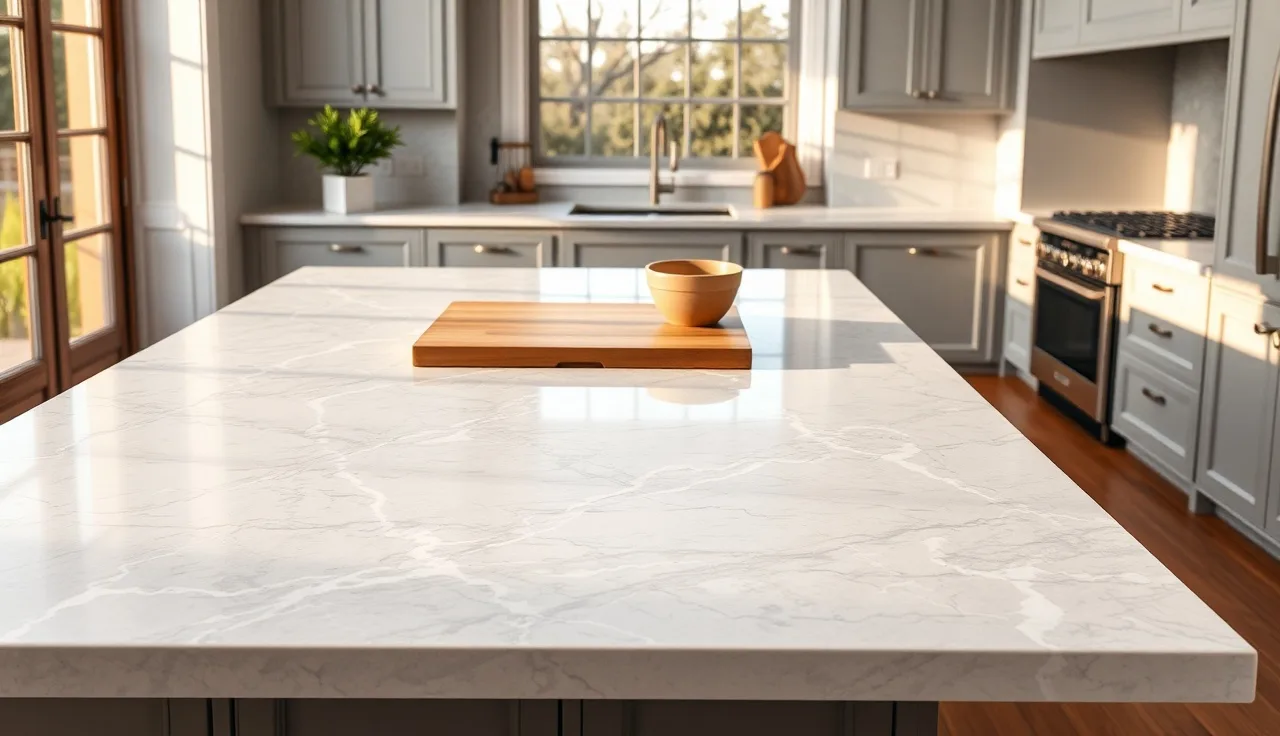
TL;DR
- Gray marble countertops run $40 to $200 per square foot installed, depending on variety and edge profile.
- Marble is softer and more porous than granite or quartz, so it etches and stains without regular sealing.
- The look is unmatched.
- The upkeep is real.
- This guide covers every major gray marble variety, honest maintenance demands, and how to price a project before you sign.
What is gray marble and why is it so popular for countertops?
Marble is a metamorphic rock that forms when limestone recrystallizes under heat and pressure. That process produces the veining people pay a premium for: minerals like graphite, clay, and iron oxide get folded into the calcite matrix and show up as streaks of gray, gold, or black. Gray marble gets its color mainly from graphite and other dark minerals worked in during metamorphism.
The popularity comes down to one thing. It looks like nothing else. The veining on a slab of Calacatta Viola or Bardiglio isn't reproducible by any factory process, and that uniqueness is the whole point. You don't buy gray marble because it's practical. You buy it because the slab you pick is the only one that exists.
Gray also happens to be the most forgiving marble colorway for kitchens. White marble shows every crumb and water spot. True black marble shows every fingerprint. Gray sits in the middle: light enough to read as bright, dark enough to hide daily grime between cleanings. That's a real advantage, more than a decorating preference.
Marble has been a work surface for centuries, from Renaissance sculpture studios to Parisian boulangeries where the cold stone genuinely helps with pastry. The baker's preference is legitimate. Calcite pulls heat away from dough better than most countertop materials. A home kitchen is not a patisserie, though, and most homeowners will notice the first etch mark long before they notice the thermal properties.
What are the main types of gray marble for countertops?
Gray marble is not one material. The variety you pick changes cost, sealing frequency, and how loudly wear announces itself over the years.
Bardiglio. Quarried in Tuscany. Dense, dark blue-gray, with fine tight veining. It's among the harder marbles (Mohs 3 to 4), which helps a little with scratch resistance, though it's still far softer than granite. The tight veining hides etch marks better than a white background does. This is the one I'd point a busy-kitchen homeowner toward if they refuse to give up marble.
Grigio Carnico. A warmer gray with irregular brown and white veining, from the Carnic Alps of Italy. Softer than Bardiglio. It photographs beautifully and shows wear faster in a high-traffic kitchen.
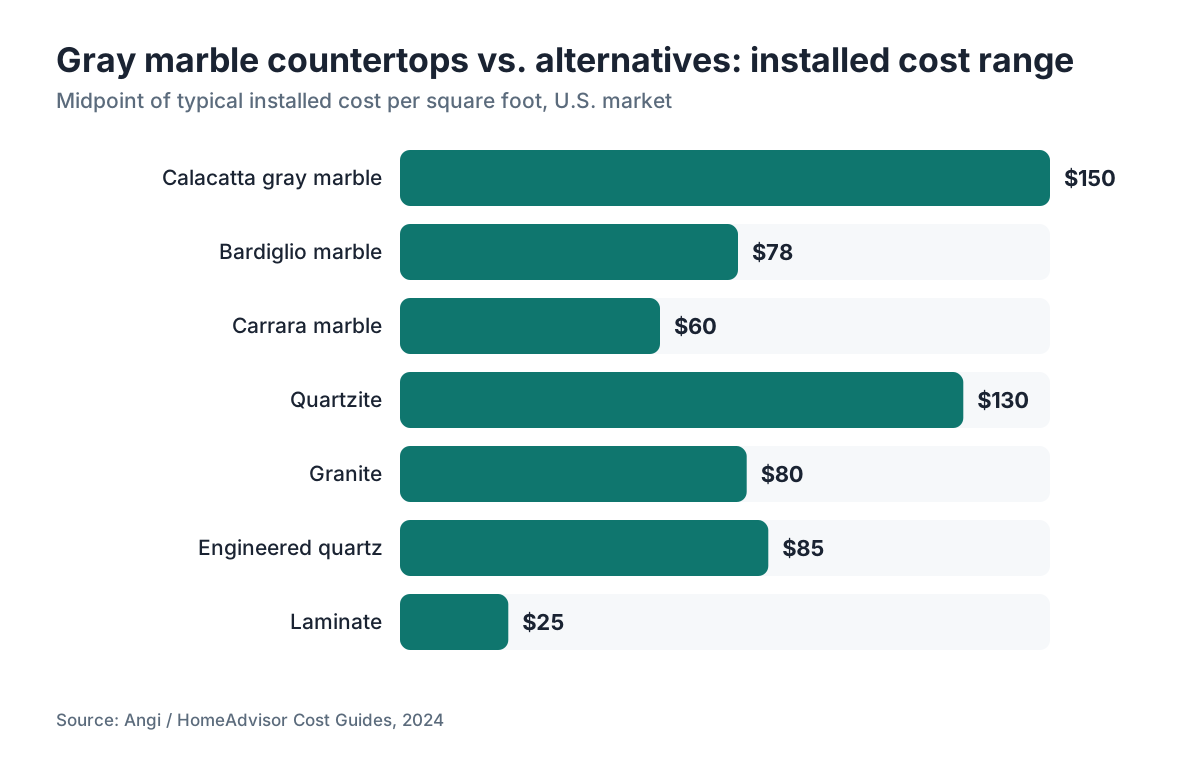
Carrara. The most common marble in the U.S. market. True Carrara runs white to light gray with soft feathery gray veining. It's widely stocked and the cheapest genuine Italian marble, usually $40 to $100 per square foot installed [1]. It also etches most visibly, because the light background reads every dull spot.
Calacatta. People confuse it with Carrara constantly. Calacatta comes from a smaller, higher stretch of the Apuan Alps and has bolder veining, often gold or taupe on a whiter background. Not inherently gray, but gray-veined slabs exist. Genuine material runs $100 to $200 per square foot installed [1].
Nero Marquina. Technically a black marble with white veining, but slabs carry gray undertones and fabricators sometimes market them as gray. Quarried in Spain. Very dense and relatively forgiving.
Pietra Serena. A fine-grained blue-gray sandstone the trade sometimes lumps in with marble. Harder and less prone to etching than true marble, though less dramatic. Worth knowing about if you love the color family and dread the upkeep.
For how marble sits inside the wider stone category, the marble countertops guide covers all colors and varieties in more depth.
How much do gray marble countertops cost?
Gray marble runs $40 to $200 per square foot installed. Most kitchen projects land between $60 and $130 per square foot with a mid-grade slab and a standard edge [1][2]. The range is wide because the category spans mass-market Carrara and rare book-matched Calacatta, and because fabrication costs swing by region, edge profile, and cutout complexity.
A typical 30-square-foot kitchen island, a common standalone job, runs $1,800 to $3,900 at that midrange.
| Marble variety | Material only (per sq ft) | Installed estimate (per sq ft) |
|---|---|---|
| Carrara (standard grade) | $20 to $45 | $40 to $80 |
| Bardiglio | $30 to $60 | $55 to $100 |
| Grigio Carnico | $35 to $65 | $60 to $110 |
| Calacatta (gray-veined) | $60 to $120 | $100 to $200 |
| Book-matched exotic gray | $120+ | $200+ |
Those material-only figures come from slab yards. Fabrication (cutting, polishing, edge work, templating, and installation) usually adds $30 to $55 per square foot on top of material [2]. Edge profiles move the number too: a simple eased edge might add $10 per linear foot, while a waterfall ogee can add $25 to $40 per linear foot.
Here's a cost factor people forget. Seams. Gray marble's bold veining makes a seam far more visible than it would be on a solid-color surface. A good fabricator spends extra time on seam placement and mitering, and that skill costs money. If a quote for a large kitchen says nothing about seam strategy, ask.
Another one: slab waste. Marble slabs aren't shaped like kitchen layouts, and the stone left over from sink and cooktop cutouts is usually non-returnable. On a complex layout, waste can hit 20 to 35 percent of purchased material [3]. Nesting software trims that figure, and shops that use layout tools like SlabWise to plan cuts can pass some of that saving back to you in the quote.
To compare against other premium materials, see the granite countertops and kitchen countertops guides.
Is gray marble durable enough for a kitchen countertop?
Marble is less durable than granite, quartzite, or quartz for kitchen use. Anyone who tells you otherwise is selling something. It scratches easier, etches from acid, and needs sealing that the harder stones can skip. It still works in plenty of kitchens. You just have to know what you're signing up for.
Marble scores 3 to 4 on the Mohs hardness scale [4]. Granite scores 6 to 7. That gap matters, because harder minerals (including the quartz particles floating around in household dust and grit) can scratch marble during normal cooking. The effect builds slowly. Some owners call it patina. Others call it damage.
The bigger issue for most people is etching. Marble is mostly calcite, a carbonate that reacts with acid. Lemon juice, tomato sauce, wine, vinegar, even some cleaning sprays leave a mark where the acid dissolves a thin layer of stone. It looks like a dull spot or a ghost ring. It's not a stain, so sealing won't stop it. It's a physical change to the surface. Polishing removes an etch, but you can't polish a countertop every week.
The real question is how much this bothers you. Marble has topped Italian and French kitchens for generations. Plenty of owners watch the surface soften into a lived-in honed look and stop noticing individual marks. Others find the first etch unbearable. There's no test for which camp you land in until you're living with the stone.
If durability is your top concern, look hard at quartzite (real quartzite, not marble mislabeled as quartzite). The how to clean quartzite countertops guide explains why the two get marketed side by side.
Want the gray stone look with more forgiveness? Porcelain slabs and engineered quartz with marble-style printing won't etch. The cambria countertops guide covers one major quartz brand that pulls off convincing gray marble looks.
Does gray marble need to be sealed, and how often?
Yes, gray marble needs sealing, usually every 6 to 12 months in a kitchen. Understand what sealing does before you set your expectations, though, because it solves one problem and does nothing for the other.
A penetrating sealer (also called an impregnating sealer) fills the pores with a water-repelling compound, usually a silane or siloxane resin. That slows how fast liquids soak in, which buys you time to wipe a spill before it stains. The Natural Stone Institute recommends testing your specific stone's absorption before you choose a sealer, since marble porosity varies a lot by variety [5].
The test is simple. Put a few tablespoons of water on the surface. If it soaks in and darkens the stone in under 4 minutes, seal right away. If it takes 10 minutes or more, you have low-porosity stone that needs sealing less often. If the water just sits there indefinitely, the stone may not need sealing at all.
For typical kitchen gray marble, plan to reseal every 6 to 12 months with a quality impregnating sealer [5]. The area around the sink may need it more often. The job is easy: clean the surface, apply the sealer per the label (usually wipe on, wait 10 to 15 minutes, wipe off the excess), then let it cure overnight.
Here's what sealing does not do. It does not prevent etching. Acid etching is a chemical reaction with the calcite, not an absorption event, and no sealer stops it. Some fabricators offer topical coatings that slow etching, but they change how the surface looks and wear unevenly. Most stone pros keep them off polished marble.
The how to clean stone countertops guide goes deeper on sealer products and frequency across all natural stone.
How do you clean and maintain gray marble countertops daily?
Daily care is easy. The product choices matter more than the effort. Use a soft cloth or sponge, warm water, and a pH-neutral dish soap or a cleaner made for natural stone. Skip anything acidic or abrasive.
The Natural Stone Institute specifically warns against cleaners with acid (vinegar, lemon) or grit [5]. That rules out most all-purpose kitchen sprays, including popular ones like Method All-Purpose Cleaner, which is citric-acid based. Read the label. If it lists citric acid, lactic acid, or any "scrubbing" agent, keep it off the marble.
For spills, wipe up anything acidic fast. Coffee, orange juice, tomato products, wine, and sparkling water (carbonic acid) all etch. "Fast" means within a minute or two, not at the end of cooking. A spill that sits five minutes on polished marble will probably leave a mark.
Hard water buildup around the faucet puts you in a bind. Those deposits are calcium carbonate, which acid dissolves easily, but the same acid etches the marble underneath. The safe move is a poultice of baking soda and water (mildly alkaline) or a hard-water remover labeled safe for marble. Never reach for Bar Keepers Friend, CLR, or white vinegar on marble, no matter what a general cleaning guide tells you.
For deeper cleaning across stone types, see how to clean stone countertops and how to clean soapstone countertops. Soapstone shrugs off acid far better than marble, which is good to know if you're still choosing materials.
How does gray marble compare to granite, quartz, and quartzite?
This is the comparison that should drive your decision. Marble wins on looks and loses on toughness. Granite and quartz win on durability. Quartzite tries to give you both, if you can confirm it's actually quartzite. Here's the straight version.
| Property | Gray marble | Granite | Quartzite | Quartz (engineered) |
|---|---|---|---|---|
| Mohs hardness | 3 to 4 | 6 to 7 | 7 | 7 |
| Etch resistance | Poor | Excellent | Good to excellent | Excellent |
| Stain resistance (unsealed) | Poor | Good | Good | Excellent |
| Heat resistance | Good | Excellent | Excellent | Poor (damages resin) |
| Appearance | Unique, natural veining | Unique, natural | Unique, natural | Consistent, printed pattern |
| Typical installed cost | $40 to $200/sq ft | $40 to $150/sq ft [2] | $60 to $200/sq ft | $50 to $120/sq ft [2] |
| Repairability | Good (can polish) | Limited | Limited | Poor (hard to patch) |
Granite wins on toughness and value. For a busy kitchen with kids, granite is the better call most of the time. The granite countertops guide has detailed pricing and variety data.
Quartzite is a real alternative if you want the marble look with more durability. Be careful, though. Many slabs sold as quartzite are actually marble or dolomitic marble. Ask for a mineralogy report or a scratch test before you pay quartzite prices.
Engineered quartz (Cambria, Silestone, Caesarstone) gives you a consistent gray marble look with zero maintenance anxiety. You lose the one-of-a-kind character of natural stone. You also lose the etch marks. Between gray quartz and gray marble, quartz is the practical winner for a kitchen. Marble is the aesthetic winner, full stop.
Laminate has come a long way on gray marble printing too. It's worth a look for rentals or tight budgets. See laminate countertops for a realistic read.
What edge profiles work best with gray marble countertops?
Edge profile is both a look and a structural call with marble, and it matters more than it does with harder stone. Marble chips. The calcite crystal structure leaves edges vulnerable, especially thin, sharp ones, so the profile you pick affects how the counter ages, more than how it looks.
A straight eased edge (a slight softening of the 90-degree corner) is more chip-prone than a bullnose or ogee, because there's less stone at the corner to absorb a knock. That's not a reason to avoid it. It's a reason to talk it through with your fabricator.
The most popular edges for gray marble, especially kitchens going for a European look, are the eased edge and the mitered waterfall, where the slab wraps 90 degrees down the cabinet side. Waterfall edges look incredible with high-contrast veining. They demand precise grain matching and add real fabrication cost, often $200 to $500 extra for a single panel depending on your market.
A standard 3 cm (1.18 inch) slab handles most countertop work. Some designers spec 2 cm slabs with a laminated edge to fake the visual heft of 3 cm at lower material cost, but that needs careful support to avoid cracking. Marble is more brittle than granite across an unsupported span.
For a bathroom vanity, a polished edge with a minimal profile usually looks cleanest against bold veining. In a kitchen, a slightly larger profile (a 1/4-inch bevel or soft bullnose) hides minor chipping better over the years.
For templating and install logistics, see the countertop installation guide.
Where is gray marble quarried, and does origin affect quality?
Origin affects quality in real ways, though the link isn't simple. What matters more is whether your fabricator knows the specific quarry's stone and how it behaves.
Italian gray marbles (Bardiglio, Carrara, Calacatta) come from the Apuan Alps in Tuscany, worked continuously for over 2,000 years [6]. The geological consistency there produces stone fabricators understand well. They know how it cuts, how it seals, how it ages. That institutional knowledge has value on your job.
Turkish gray marbles moved into the market hard since the 2000s and now make up a big share of U.S. slab imports. Turkish quarries push out large, consistent volumes, which keeps Carrara-style prices lower than they'd otherwise be. Quality varies more than with Italian material. Some Turkish "Carrara" is genuinely excellent. Some runs softer and more porous than the label suggests. Ask which country the slab came from and whether your fabricator has worked that quarry's stone before.
Brazil, Greece, and India produce gray marbles too. Indian gray marble (sometimes sold as "Indian Bardiglio" or under trade names) can be very good and often prices attractively. Greek Volakas runs lighter gray-white with fine veining, competitive with Italian Carrara.
The U.S. produces marble as well, mainly from Vermont and Georgia. Vermont Danby is a dense, fine-grained white-to-gray stone with very low absorption and good freeze-thaw resistance, which suits it to exterior work as well as countertops. Vermont Quarries Corp. has produced Danby since the 1800s [7].
For the practical shopper, origin matters less than seeing and testing the actual slab. You can judge light absorption, veining, and color match at the yard. Origin is context. It's not a substitute for standing in front of the stone.
Can gray marble countertops work in bathrooms and outdoor kitchens?
Bathrooms are the best case for gray marble. Outdoor kitchens are the worst. The difference is acid exposure and weather, and both point the same direction.
In a bathroom, the acid that makes marble hard in a kitchen is mostly gone. Toothpaste and most hand soaps are mildly alkaline or neutral. Water is the main threat, and sealing handles that fine. The payoff on a master bath vanity is hard to beat, and the maintenance load is far lighter than in a kitchen. Honed marble (matte instead of polished) shines here, because fingerprints and water spots read less, and the surface feels good under your hand.
Outdoor kitchens are a different story. Marble is a carbonate rock, and rain is slightly acidic (pH around 5.6) [8], so an outdoor marble surface etches and dulls over time. Thermal cycling between hot days and cold nights stresses the calcite. UV won't bleach stone the way it fades some polymers, but organic staining from leaves and bird droppings is aggressive outdoors. Want gray stone outside? Concrete or porcelain slab is the better choice.
For shower walls and floors, marble is common and appropriate, but grout lines and constant water need attention. Larger-format tile cuts grout lines, which cuts the points where water gets in. In a steam shower the standing humidity is brutal on any porous stone, so ventilate well and keep a good penetrating sealer on any marble in there.
How do you choose and buy a gray marble slab?
Go to the slab yard and pick the exact slab yourself. This is the single thing that matters most. Never let a showroom or fabricator choose for you off a photo or a sample chip. Gray marble varies wildly slab to slab, even within one variety and one quarry.
A Bardiglio chip may look perfectly neutral while the slabs in stock that month run blue-green or brownish. You need eyes on the specific stone headed for your kitchen.
Bring your cabinet door, a flooring sample, or a paint chip. Judge the slab in daylight, since natural light reveals undertones that showroom lighting hides. Look at the full slab standing on the A-frame, which is roughly how it reads on a wall. Then look at it flat, which is how you'll actually live with it.
Check for fissures. Marble often has hairline fissures, which are natural and different from cracks (structural damage). Fissures run along the crystalline plane and are normal. A fissure running through a planned sink cutout is a problem, so flag it with your fabricator before you buy.
Measure thickness with a tape. Standard is 3 cm (about 1 3/16 inches) for countertops. Some imported material is 2 cm and labeled 3 cm, and the difference is real: thinner slabs crack easier across unsupported spans.
Get the specific slab and bundle numbers written into your contract. When you come back for templating, confirm the same slabs get pulled. Slab swaps happen at busy yards. They're rarely malicious, but they happen.
Shops that quote digitally can show you a rendered layout of your actual slab before cutting, so you see exactly where the veining lands. That step, now common in shops running layout and nesting software, is worth asking for by name.
How do you repair etches and scratches on gray marble?
Marble is one of the more repairable countertop surfaces, which is a genuine consolation. Because it's relatively soft, it polishes back to a finish with abrasive compounds, so scratches and etch marks can be reduced or erased without replacing the slab.
For light etching on a polished surface, a marble polishing powder (tin oxide or aluminum oxide based) rubbed in with a soft cloth and circular pressure usually restores the shine. Tenax and similar professional compounds are sold through stone supply houses. This is a real DIY repair for minor etching.
For deeper etches or scratches, you're into wet diamond polishing, which needs a variable-speed angle grinder, diamond pads (50-grit through 3,000-grit in sequence), and water cooling. It takes practice. An amateur attempt on a polished counter can leave swirl marks worse than the original etch. For anything past light surface work, hire a stone restoration pro.
Honed marble hides etching better than polished, because the surface is already non-reflective. An etch on honed marble shows as a slight change in sheen, far subtler than the dull spot an etch leaves on a mirror finish. If you're picking a finish and you're worried about etching, honed is the practical answer.
Edge chips get repaired with a two-part epoxy or polyester adhesive tinted to match, then sanded and polished. A skilled fabricator can make an edge repair nearly invisible on gray marble, because the natural veining variation helps hide the repair zone.
Frequently asked questions
How much does a gray marble countertop cost per square foot?
Installed gray marble runs $40 to $200 per square foot, depending on variety, edge profile, and regional labor. Standard Carrara costs $40 to $80 installed. Rarer varieties like book-matched Calacatta can pass $200. Material alone runs $20 to $120 per square foot before fabrication and installation fees get added on top.
What is the most popular gray marble for kitchen countertops?
Carrara is the most widely available and most commonly installed gray marble in U.S. kitchens, mostly because of lower cost and steady supply. Bardiglio is the smarter pick for heavy-use kitchens, since its darker background and tighter veining hide etch marks better. Gray-veined Calacatta is the premium choice when the budget allows.
Does gray marble stain easily?
Unsealed gray marble is fairly porous and will stain from oil, wine, and pigmented liquids if a spill sits more than a few minutes. A quality penetrating sealer applied every 6 to 12 months slows absorption and buys cleanup time. Sealing does not prevent etching from acids, which is a separate chemical reaction with the calcite in the stone.
Is gray marble good for a kitchen with kids?
It's a tough choice for a high-traffic family kitchen. Kids mean juice spills, sticky hands, and adults too distracted to wipe right away. Those are exactly the conditions where marble etches and stains fastest. Engineered quartz in a gray marble pattern gives you a nearly identical look with none of the acid sensitivity. If you want natural stone anyway, Bardiglio takes abuse better than Carrara.
What is the difference between gray marble and gray quartzite?
Marble is a metamorphic rock made mostly of calcite, which reacts with acid and etches. Quartzite is a metamorphic rock made mostly of quartz, which resists acid and is much harder (Mohs 7 versus 3 to 4). The confusion matters because many slabs sold as quartzite are actually marble or dolomitic marble. Ask for a scratch test or mineralogy confirmation before paying quartzite prices.
How do I remove etch marks from gray marble countertops?
Light etch marks on polished gray marble buff out with a tin-oxide marble polishing powder applied on a soft cloth using circular pressure. Deeper etches need wet diamond polishing through progressively finer grits, which is best left to a stone restoration pro. Honed marble shows etching far less than polished, so switching to a honed finish at refinishing time is worth considering.
What kind of sealer should I use on gray marble?
Use a penetrating impregnating sealer based on silane or siloxane chemistry, not a topical coating. Topical coatings change the look and wear unevenly. Test absorption first: water beading on the surface within 10 minutes means low-urgency sealing, while water absorbed within 4 minutes means seal now. Reapply every 6 to 12 months on kitchen counters. Never use a sealer marketed for ceramic tile or grout.
Can I put hot pans on gray marble countertops?
Marble handles heat better than engineered quartz, which can delaminate above roughly 150 C, and a hot pan won't crack a properly installed slab. Sudden thermal shock to a cold slab, or a pan left sitting on a fissure, is a genuine risk though. Use a trivet as a habit. The bigger concern is steam from a very hot pan opening sealed pores and letting stains into the contact zone.
Is gray marble or gray granite better for a kitchen countertop?
Granite wins on durability for a kitchen. It scores 6 to 7 on the Mohs scale versus marble's 3 to 4, resists acid without etching, and needs sealing less often. Gray granites like Steel Grey or Alaska White offer similar cool tones at comparable or lower cost. Gray marble wins only on the character of its veining. Both are legitimate. Granite is just more forgiving.
How thick should gray marble countertops be?
Standard kitchen thickness is 3 cm (about 1 3/16 inches). Thinner 2 cm slabs exist and sometimes get used in bathrooms or with added substrate support, but they crack easier across unsupported spans like sink cutouts. Measure slab thickness with a tape at the yard before you buy, since some imported material is mislabeled 3 cm when it's really 2 cm.
Can gray marble countertops be used outdoors?
Outdoor use is not recommended for polished gray marble. Rain is mildly acidic (pH around 5.6), and prolonged exposure etches and dulls the surface within a single season. Thermal cycling stresses the stone. For outdoor kitchens, concrete, porcelain slab, or granite are much better. Gray marble is ideal for sheltered indoor use: bathroom vanities, fireplace surrounds, and low-traffic kitchen work areas.
What backsplash works best with gray marble countertops?
Gray marble pairs well with a backsplash that either continues the stone (same marble in subway or brick format for one cohesive surface) or gives clean contrast. Glossy white subway tile keeps the countertop as the focal point. Matte white zellige adds texture without fighting the veining. Avoid busy patterned tile behind heavily veined gray marble, since the two compete for attention.
How long do gray marble countertops last?
Marble countertops can last the life of the house with proper care. Ancient marble surfaces stay in daily use across European homes and institutions. The material doesn't structurally degrade. What changes is the surface: polished marble develops a honed patina and minor etching over 5 to 15 years. Many owners find that patina beautiful. Others read it as failure. Expectations matter more than longevity.
Is honed or polished gray marble better for kitchens?
Honed (matte) gray marble is the practical pick for kitchens. It hides etch marks better because the surface is already non-reflective, so an acid dull spot barely shows. Honed surfaces do reveal fingerprints and water spots more than polished, but that's a quick daily wipe rather than a polishing project. Most stone pros recommend honed for kitchen marble for exactly this reason.
Sources
- Angi (HomeAdvisor), Marble Countertop Cost Guide: Installed marble countertops typically range from $40 to $200 per square foot depending on variety and region
- Angi (HomeAdvisor), Countertop Installation Cost Guide: Fabrication and installation adds roughly $30 to $55 per square foot on top of material cost; granite and quartz installed cost ranges
- Natural Stone Institute, Stone Industry Technical Resources: Slab waste from cutouts and layout inefficiency on complex kitchen projects can represent 20 to 35 percent of purchased material
- U.S. Geological Survey, Mineral Hardness and the Mohs Scale: Marble (calcite) scores 3 to 4 on the Mohs hardness scale; granite and quartz score 6 to 7
- Natural Stone Institute, Care and Cleaning of Natural Stone: Recommends testing stone absorption before sealing, resealing periodically, and avoiding acidic or abrasive cleaners on marble
- Smithsonian Magazine, The Carrara Marble Quarries of Tuscany: The Apuan Alps marble quarries of Tuscany have been continuously worked for over 2,000 years
- Vermont Quarries Corp., Vermont Danby Marble: Vermont Danby marble has been continuously quarried since the 1800s and has very low absorption compared to many Italian marbles
- U.S. Environmental Protection Agency, What Is Acid Rain?: Normal rain has a pH of about 5.6 due to dissolved carbon dioxide forming carbonic acid
- National Park Service, Preservation Briefs: NPS preservation guidance on calcite stone weathering and acid sensitivity of carbonate stone
- USGS National Minerals Information Center, Dimension Stone Statistics and Information: U.S. dimension stone imports including marble and granite by country of origin
- ASTM International, ASTM C503 Standard Specification for Marble Dimension Stone: ASTM C503 sets minimum physical property requirements for marble dimension stone used in construction
Last updated 2026-07-09