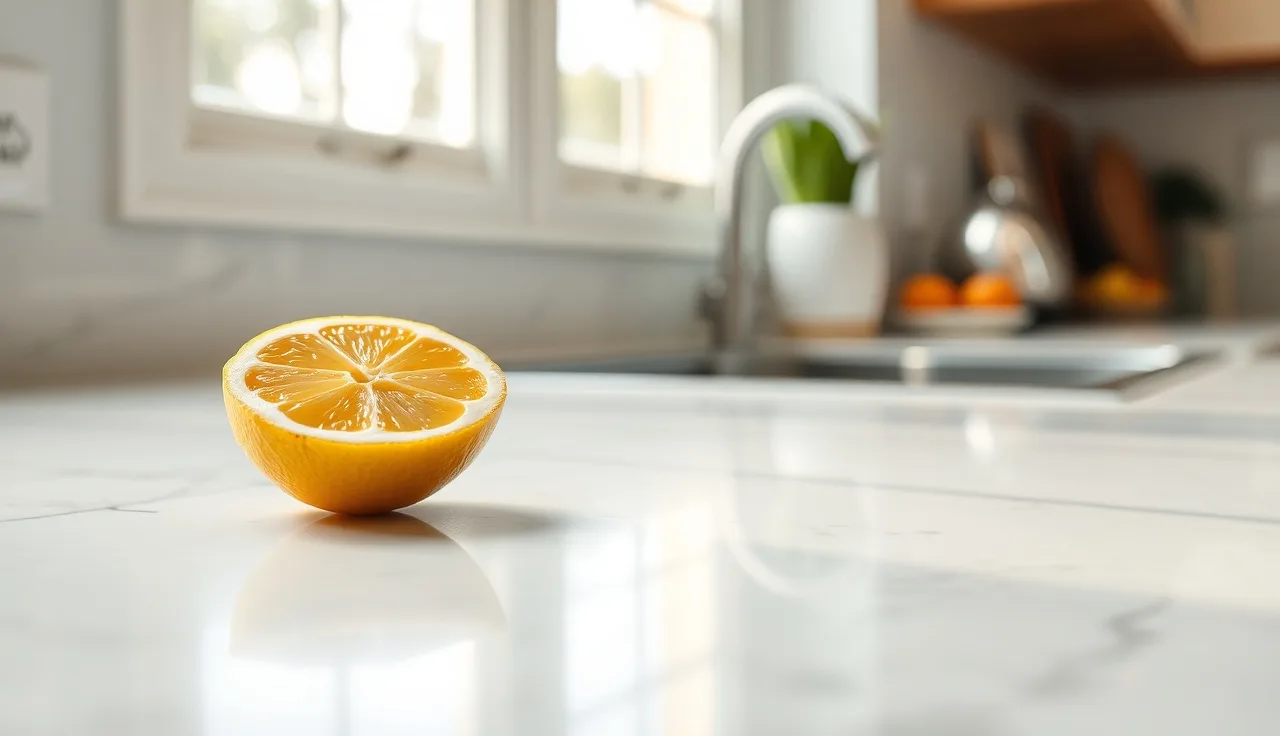
TL;DR
- Calcite-based stones etch because acid dissolves calcium carbonate.
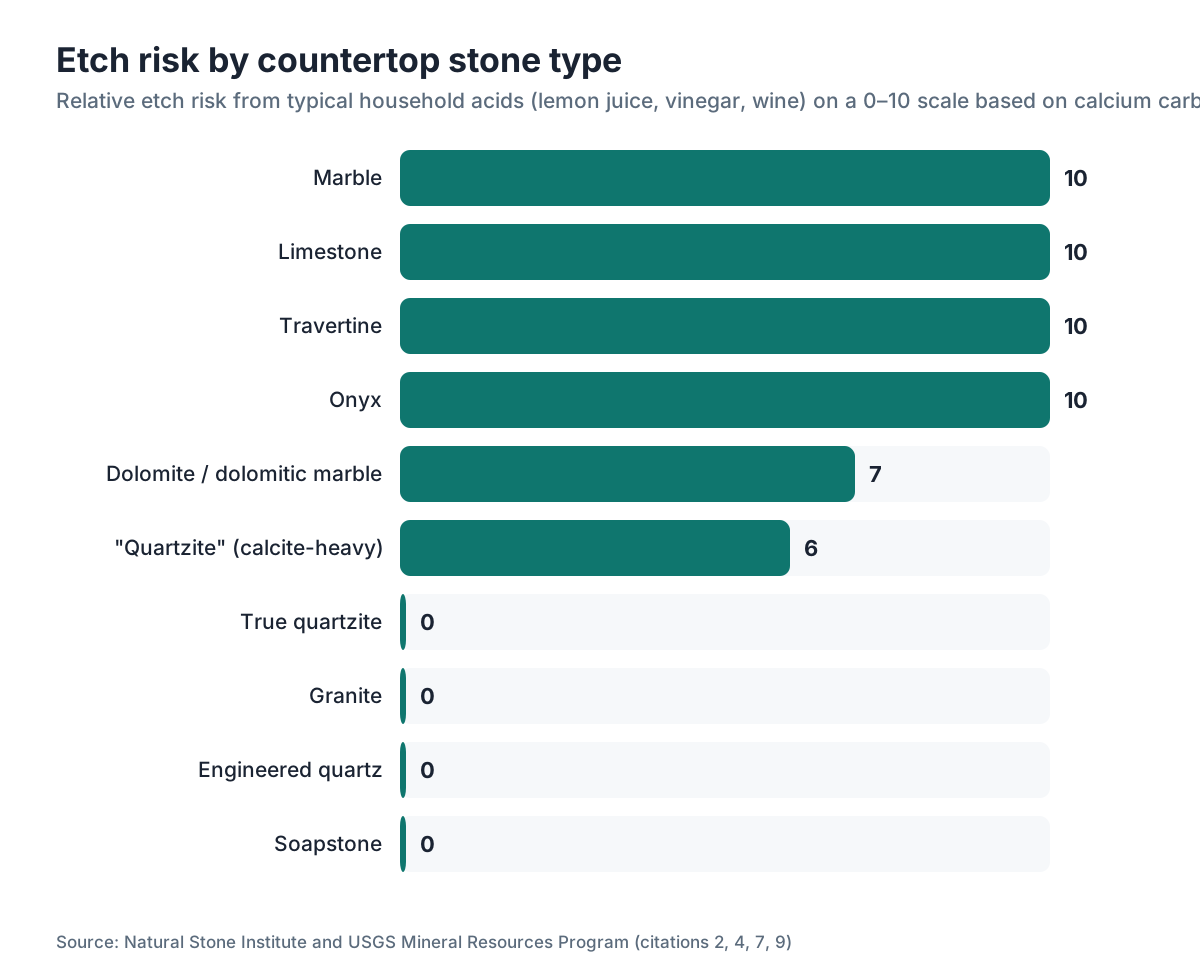
- Marble, limestone, travertine, and onyx are the most prone.
- Some quartzite contains enough calcite to etch too.
- Granite and true engineered quartz do not etch.
- Etching is a surface chemical reaction, not a stain, and sealing does not prevent it.
What actually causes etching in stone countertops?
Etching is a chemical reaction, not a scratch and not a stain. When an acidic liquid touches a stone that contains calcium carbonate, the acid dissolves the mineral at the surface. The result is a dull, sometimes slightly rough patch that changes how light reflects off the stone. Lemon juice, vinegar, wine, tomato sauce, coffee, and even sparkling water are acidic enough to do it.
The key mineral is calcite (CaCO3). The National Park Service, in its technical guidance on stone preservation, describes calcite as "soluble in weak acid" and identifies this as the primary reason carbonate stones deteriorate when exposed to acidic rain or cleaners [1]. The same chemistry runs on your kitchen counter. Hydronium ions from the acid react with carbonate ions in the stone, releasing carbon dioxide and leaving a microscopically eroded surface behind.
Polished surfaces show etching most dramatically because the polish depends on tight, flat mineral crystals reflecting light at the same angle. Once those surface crystals dissolve away, light scatters. Honed surfaces still etch, but the damage is often less visible because there is no high-gloss layer to compare it against.
Sealing does not stop etching. A sealer fills the pores of stone to slow liquid absorption, which helps with staining. Acid reacts with the surface minerals on contact, before any liquid has a chance to soak in. That distinction matters enormously when you explain countertop care to homeowners.
Which stones etch the most easily?
Any stone with significant calcite content will etch. The more calcite, the more vulnerable the surface.
Marble comes up most often because it is also one of the most popular premium countertop choices. Marble is almost entirely calcite or dolomite, a closely related carbonate mineral. Even a few drops of lemon juice left on a polished marble surface for 30 seconds can produce a visible etch ring. Carrara, Calacatta, and Statuario marbles all behave the same way regardless of how they are sealed or finished [2].
Limestone is similar in composition and often more porous than marble, which means acids can spread laterally as they react. Limestone countertops are less common in kitchens for exactly this reason.
Travertine is a form of limestone with a distinctive pitted surface. The pits fill with grout or epoxy in most countertop applications, but the surrounding stone is equally reactive to acid.
Onyx is a banded calcite stone, sometimes called calc-sinter. It is gorgeous, dramatic, and extremely reactive to acids. Most onyx applications belong in low-use areas for this reason.
Some quartzite is worth singling out because the name causes enormous confusion. True quartzite is metamorphic rock made of interlocked quartz grains and will not etch. But many stones sold as "quartzite" in slab yards are actually calcite-heavy marble or dolomitic marble. A simple acid test (a few drops of muriatic acid or even lemon juice on an inconspicuous spot) will foam on calcite and do nothing on true quartzite [3]. If you are helping a client pick stone and etching resistance matters to them, do the test before committing.
Dolomite and dolomitic marble deserve a separate mention. Dolomite (CaMg(CO3)2) reacts more slowly than pure calcite, so dolomitic stones like Super White or Fantasy Brown etch less quickly, but they still etch. The difference is speed, not immunity.
Which stones do not etch?
Stones and surfaces that contain little or no calcium carbonate will not etch from common household acids.
Granite is made primarily of quartz, feldspar, and mica. None of those minerals dissolve in weak acids. Granite can stain if unsealed, but it will not produce the dull chemical etch rings you see on marble [4]. This is one of the main practical advantages granite has over marble in a working kitchen.
Engineered quartz (brands like Cambria, Silestone, Caesarstone) is roughly 90 to 93 percent ground quartz bound with polymer resin. Quartz does not react to household acids. The resin can be damaged by prolonged exposure to very strong chemicals, but lemon juice and vinegar will not etch the surface [5].
Soapstone is a talc-based stone. Talc is not affected by acid. Soapstone scratches relatively easily but stays chemically inert in a kitchen environment.
Porcelain tile and sintered surfaces (like Dekton or Neolith) are fired ceramic or glass-ceramic materials with essentially no mineral reactivity to household acids.
Non-stone surfaces like laminate countertops, Formica countertops, and Corian countertops do not etch from acids because they contain no carbonate minerals. They have their own vulnerabilities, heat and scratch damage mainly, but etching is not among them.
For homeowners who love the look of marble but want a lower-maintenance kitchen, Cambria countertops and other engineered quartz products are the most direct visual substitutes without the etch risk.
How bad is etching, really? Does it ruin the stone?
Etching is real damage but it is not catastrophic and it is often repairable.
A light etch on polished marble looks like a water ring or a dull cloud. Buffed out by a professional stone restorer, or sometimes by the homeowner using a marble polishing powder, it disappears or fades to nearly invisible. A deep etch from a strong acid left on the surface for a long time may need wet diamond polishing to resurface the area.
The Marble Institute of America (now the Natural Stone Institute) has documented that most kitchen etching is superficial, affecting the top few microns of the polished surface, and that proper restoration can return the stone to its original finish [6]. Etching does not compromise the structural integrity of the slab.
Honed marble is a practical choice for households that cannot tolerate visible etch rings. The matte surface disguises them because the starting finish is already diffuse. You will still feel the texture difference with your fingers on a bad etch, but you will not see it across the room the way you would on a high-polish surface.
Some owners of marble in active kitchens simply accept light etching as patina, the way butcher block owners accept knife marks. That is a completely legitimate position if the client walks into it with eyes open. The mistake is buying polished marble expecting it to perform like engineered quartz.
How do you explain etching to a homeowner before they buy?
This is where fabricators, designers, and stone yard staff earn trust or lose it. A client who discovers etching on their new marble countertop with no prior warning will be angry, possibly litigious, and almost certainly will not refer anyone to you.
The conversation has to happen before the sale. Here is the substance of what to cover.
First, show a sample. Most stone showrooms have demo pieces of marble that have been etched on purpose. A lemon half pressed on polished Carrara for one minute produces a visible etch every time. Seeing it happen on a small sample beats any verbal explanation.
Second, explain the difference between etching and staining clearly. Etching is a chemical reaction that removes material. A sealer cannot stop it. Staining is absorption of a colored liquid into the pores. A sealer slows staining. Many homeowners assume that "sealed = protected from everything." Clarifying this saves an enormous number of callbacks.
Third, be specific about what causes it. Lemon juice, vinegar, citrus cleaners, wine, tomato products, and sparkling water are the most common culprits. Coffee and tea are mildly acidic and will etch over time with repeated exposure.
Fourth, explain what to do when it happens: blot immediately, rinse with water, do not scrub. And explain that a stone restoration professional can repair most etching.
Fifth, offer the alternative. If the client's lifestyle involves a lot of cooking, children, or general counter chaos, marble or limestone may genuinely be the wrong stone for them. Pointing them toward granite or engineered quartz is a service, not a lost sale. A happy client who bought the right stone comes back and sends friends.
Fabricators who quote a lot of natural stone jobs often track which materials generate the most post-installation calls. Stone selection and client education directly move that number.
Does sealing prevent etching?
No. This is the most persistent misconception in countertop care, and it causes real problems.
A penetrating sealer (impregnator) soaks into the pores of the stone and deposits a hydrophobic or oleophobic barrier inside. Liquids bead on the surface and absorb more slowly, giving you more time to wipe up a spill before it stains. The Marble Institute of America and the stone care product manufacturers who make sealers agree on this point: sealers are stain inhibitors, not acid barriers [6].
Acid reacts at the very surface of the mineral crystal, not inside the pore. By the time any liquid moves into the pore, the surface reaction has already happened. A topical sealer (a coating, like a wax or lacquer) can physically separate the acid from the stone for a while, but topical coatings on countertops wear off quickly under normal use and need reapplication every few months.
The practical upshot: seal your marble anyway. Sealing prevents staining, which is a real and separate problem. Just do not sell a client on sealing as the solution to etching, because it is not.
What is the acid test for identifying calcite stones, and is it safe to use?
The acid test is simple, fast, and cheap. A small drop of 10 percent muriatic acid (hydrochloric acid, available at hardware stores) placed on the stone surface will fizz visibly if calcite is present. The fizzing is CO2 escaping as the acid dissolves the carbonate. Pure quartzite, granite, and quartz-dominant stones show no reaction [3].
For a gentler test, undiluted white vinegar or even lemon juice will produce a faint fizz or foam on calcite within 30 to 60 seconds. This works well as a showroom demonstration because vinegar is safe to handle and convincing to watch.
Where to test: always in an inconspicuous spot. On a slab at the yard, the bottom edge or back corner. On an installed countertop, inside a cabinet behind the sink. The test will leave a small etch mark, which is the point.
The acid test is the only reliable field test for telling true quartzite from calcite-heavy stones that are sold under quartzite names. Stone identification guides from the U.S. Geological Survey describe effervescence in hydrochloric acid as one of the diagnostic properties of calcite and the carbonate mineral group [7]. No lab equipment needed.
How does etch severity compare across the most common stone types?
The table below compares the most common countertop stone types by etch risk, the mineral responsible, and whether sealing helps with the specific etch problem.
| Stone | Primary mineral | Etch risk | Sealing prevents etching? | Notes |
|---|---|---|---|---|
| Marble | Calcite | Very high | No | Polished finish shows etching most visibly |
| Limestone | Calcite | Very high | No | Often more porous than marble |
| Travertine | Calcite | Very high | No | Pitted surface can trap acid |
| Onyx | Calcite | Very high | No | Translucent; usually decorative use |
| Dolomite / dolomitic marble | Dolomite | Moderate to high | No | Slower reaction than calcite; still etches |
| "Quartzite" (calcite-heavy) | Calcite + quartz | Moderate to high | No | Test with acid to confirm |
| True quartzite | Quartz | None | N/A | Does not react to household acids |
| Granite | Quartz + feldspar | None | N/A | Acid resistant; can stain if unsealed |
| Engineered quartz | Quartz + resin | None | N/A | Resin can be damaged by strong solvents |
| Soapstone | Talc | None | N/A | Scratches easily; chemically inert |
| Porcelain / sintered | Fired ceramic | None | N/A | Heat and impact are the main risks |
Etch risk ratings reflect typical household acid exposure (lemon juice, vinegar, wine) rather than industrial chemicals.
Can etching be repaired, and what does it cost?
Yes, etching is repairable. The method and cost depend on severity.
Light surface etching on polished marble can often be handled with a marble polishing powder (sometimes called etch remover). Products like Tenax Ager or similar formulations use very fine abrasives to mechanically repolish the surface. A homeowner with some patience can knock out minor etching this way for under $30 in materials. Results vary by the depth of the etch and the skill of the person applying it.
Moderate to severe etching needs professional stone restoration. A stone restoration contractor uses diamond-abrasive polishing pads, starting with a coarser grit to remove the damaged layer and progressively refining to restore the original polish level. Prices for professional stone polishing and etch repair typically run from $5 to $15 per square foot depending on the severity, the stone type, and your region. A full kitchen countertop restoration might run $300 to $800 or more [8].
Honing a previously polished surface is another option after significant etching damage. Some owners decide they prefer the matte finish anyway and have a professional hone the entire surface to a uniform satin or flat finish, erasing the visible contrast between etched and non-etched areas.
For context on overall countertop costs and where repair fits into the broader picture, kitchen countertops pricing guides are worth reviewing alongside stone-specific care information.
How should fabricators explain etching to clients during the quote process?
The quote stage is the right time. Not installation day, not a callback six weeks after the countertops go in.
A few practical habits that experienced shops use:
Include a one-page stone care sheet with every estimate for marble or calcite stone. List what causes etching, what to do immediately after a spill, and who to call for restoration. Attach it to the estimate rather than handing it over at installation, so the client reads it before they sign.
Get a signature. Some fabricators put a brief acknowledgment line on their contracts for marble or limestone jobs: the client confirms they were told these stones etch from acidic contact and that sealing does not prevent etching. This protects the shop and reinforces the education moment.
Do a material review during template. When your templater is at the home measuring, that is a natural moment to show the client a quick demo on a corner of a sample tile you bring. Seeing it in their own kitchen context sticks better than anything in a showroom.
For shops quoting high volumes of stone jobs, tracking which material types generate post-installation service calls surfaces patterns quickly. Software that logs job details alongside customer interactions makes that pattern visible. SlabWise includes job history tracking alongside quoting, which gives shops a way to correlate material selection with callback rates over time.
For care guides specific to other stone types your clients ask about, how to clean stone countertops and how to clean quartzite countertops are good references to keep on hand.
Does the finish (polished vs. honed) change etch risk?
The finish does not change the chemistry. Polished and honed marble both etch at the same rate from the same acid exposure. The finish changes how visible the damage is.
Polished marble has a high-gloss, mirror-like surface. When acid dissolves the surface crystals, the dull patch contrasts sharply against the surrounding gloss. Even a faint etch ring from a wine glass shows up.
Honed marble has a matte or satin surface to begin with. The etch changes the texture in the affected area, but the visual contrast against the rest of the surface is much smaller. Many people who want marble in a working kitchen go honed specifically to reduce visible etch evidence.
Leathered and brushed finishes behave like honed in terms of etch visibility. The textured surface hides the damage further.
The trade-off is that honed surfaces often stain more readily than polished ones because the surface is more open to liquid absorption. For marble countertops in a busy kitchen, honed with regular sealing is generally a more practical choice than polished, but it still demands the same careful acid avoidance.
Are there any quartzite stones that actually do etch?
Yes, and this is one of the most confusing things in the natural stone trade right now.
The word "quartzite" gets applied to many different stones in the slab market, and not all of them are true quartzite. True quartzite is a metamorphic rock formed when sandstone (originally made of quartz grains) is exposed to heat and pressure. The quartz grains recrystallize into a tight, interlocked matrix. The result is very hard and does not react to household acids [3].
But many slabs sold as "quartzite" are actually marble that has been partially metamorphosed, or dolomitic marble, or a calcium-silicate stone with significant calcite veining. The names used in the trade, Super White, Sea Pearl, Fantasy Brown, and others, do not reliably indicate mineral composition. Different slab lots from the same quarry can vary. The only way to know for sure is to test the actual slab.
The Natural Stone Institute has published guidance warning designers and fabricators about this naming problem [6]. If a client is choosing a stone specifically because they want etch resistance and they are choosing something called "quartzite," test it. Use the lemon juice or vinegar method on a scrap piece before installation.
For clients who want the veined, pale look of quartzite or marble without etch risk, the only truly reliable option in that aesthetic is engineered quartz.
Frequently asked questions
Will lemon juice etch granite countertops?
No. Granite is made primarily of quartz and feldspar, neither of which reacts to household acids. Lemon juice on granite can leave a residue that looks like a mark if it dries, but wiping it with water removes any trace. There is no chemical etching reaction. Granite can stain if unsealed, but it will not etch.
How long does acid need to sit on marble before it etches?
It depends on the acid concentration. Undiluted lemon juice or vinegar can produce a visible etch on polished marble in under 60 seconds. Wine takes a few minutes. Sparkling water, which is only mildly acidic, may take longer repeated exposure. The practical rule is to blot any liquid off marble immediately rather than wiping, which spreads the acid.
Does quartzite etch like marble?
True quartzite does not etch. It is a quartz-dominant stone and resists household acids completely. The problem is that many stones sold as quartzite contain significant calcite and will etch. Always do a simple acid test with lemon juice or vinegar on the actual slab before purchase if etch resistance matters to you.
Can I use Windex or a vinegar-based cleaner on marble?
No. Vinegar is acetic acid and will etch marble on contact. Many glass cleaners are also acidic or alkaline at levels that damage polished stone. For marble, use a pH-neutral stone cleaner or plain water. Dish soap diluted heavily in water is acceptable for general cleaning. Check the label of any cleaner before using it on natural stone.
Is an etch mark permanent?
Light etching is repairable with marble polishing powder for polished surfaces, or by accepting a change to the honed-finish look. Deeper etching requires professional diamond-pad resurfacing. Neither is permanent in the sense that the stone is ruined. Stone restoration contractors deal with etch repair routinely. Costs typically range from $5 to $15 per square foot for professional polishing.
What is the difference between an etch and a stain on stone?
A stain is pigment or oil absorbed into the stone's pores. A sealer slows staining by filling pores. An etch is a chemical reaction that dissolves surface minerals. Sealing cannot prevent etching. Stains are usually colored. Etches are usually dull or lighter patches. A professional stone cleaner can often remove stains; etches require physical resurfacing.
Does sealing marble prevent etching?
No. Penetrating sealers reduce staining by slowing liquid absorption into the pores. They do not create an acid barrier on the surface. Acid reacts with marble crystals on contact, before any liquid moves into the pores. Seal marble to protect against staining, but tell clients explicitly that sealing will not protect against etch marks from lemon juice, wine, or vinegar.
Is honed marble better than polished marble for kitchens?
Honed marble etches at the same rate chemically. The advantage is that etch marks are far less visible on a matte surface than on a high-gloss one. Most design professionals recommend honed finishes for marble in working kitchens for exactly this reason. The trade-off is that honed surfaces can be slightly more prone to staining because the surface is more open.
What household products are most likely to etch stone?
Lemon juice, vinegar, wine, tomato products, citrus-based cleaners, sparkling water, and many bathroom tile cleaners. Coffee and tea cause slower, cumulative etching with repeated contact. Any product with a pH below roughly 7 is suspect on calcite stones. Even some supposedly "natural" cleaners contain citric acid and will etch marble.
Can engineered quartz etch?
Standard household acids will not etch engineered quartz. The surface is roughly 90 to 93 percent quartz, which is acid-resistant, bound with polymer resin. The resin can be damaged by prolonged contact with very strong solvents or highly concentrated chemicals, but lemon juice, vinegar, and wine cause no etching reaction on engineered quartz surfaces.
How do fabricators identify whether a slab will etch before installation?
The simplest method is the acid test. Apply a few drops of lemon juice, white vinegar, or diluted muriatic acid to an inconspicuous corner of the slab. If it fizzes or foams, calcite is present and the stone will etch. No reaction means the stone is likely quartz-dominant and etch-resistant. Test every slab labeled quartzite, because trade names are not reliable indicators of mineralogy.
Is soapstone resistant to etching?
Yes. Soapstone is composed primarily of talc, which does not react to household acids. It is one of the most chemically inert natural stone options for countertops. Soapstone scratches and dents relatively easily because talc is soft, but acids have no effect on it. This makes it a genuinely low-chemical-maintenance option for busy kitchens despite its softness.
How should I clean marble countertops to avoid making etching worse?
Use a pH-neutral cleaner or plain water. Blot spills rather than wiping to avoid spreading acid across a larger area. Rinse with water after any spill. Never use vinegar, lemon, or citrus-based cleaners. Avoid abrasive scrubbers on polished surfaces. For detailed daily care, a stone-specific cleaning guide covers product choices and technique.
Sources
- National Park Service, Technical Preservation Services: Preservation Briefs: Calcite described as soluble in weak acid; primary reason carbonate stones deteriorate on exposure to acidic precipitation or cleaners
- Natural Stone Institute, Marble Countertop Care and Maintenance Guidance: Marble composed primarily of calcite or dolomite; reactive to acid contact regardless of sealing status
- U.S. Geological Survey, Rocks and Minerals FAQ and Identification Resources: True quartzite is a quartz-dominant metamorphic rock that does not react to household acids; acid test distinguishes it from calcite-bearing stones
- U.S. Geological Survey, National Minerals Information Center: Granite composed of quartz, feldspar, and mica; none of these minerals dissolve in weak acids
- Natural Stone Institute, Engineered Stone Technical Information: Engineered quartz surfaces are 90 to 93 percent quartz by weight; quartz is not affected by household acids
- Natural Stone Institute, Specifier's Guide and Care and Cleaning Resources: Penetrating sealers are stain inhibitors, not acid barriers; most kitchen etching is superficial and repairable by professional restoration; quartzite trade naming inconsistencies documented
- U.S. Geological Survey, Rocks and Minerals FAQ: Effervescence in hydrochloric acid is a diagnostic property of calcite and the carbonate mineral group
- Angi, Stone Countertop Repair Cost Guide: Professional stone polishing and etch repair typically costs $5 to $15 per square foot depending on severity and region
- USGS, Dimension Stone Statistics and Information: Marble, limestone, travertine, and granite are among the primary dimension stone categories tracked; mineralogical composition data used for acid reactivity comparisons
- University of Minnesota Extension, Home and Countertop Care: Marble and limestone countertops require pH-neutral cleaners; acidic substances including vinegar and citrus juice cause etching on calcite-based stone
Last updated 2026-07-10