TL;DR
- Carrara marble countertops usually cost $40 to $200 or more per square foot installed.
- The biggest price drivers are slab grade, kitchen square footage, edge profile complexity, cutout count, fabricator labor rates, and sealer choice.
- Regional pricing spreads top 40 percent.
- Simple layouts with standard edges sit near the low end.
- Large kitchens with waterfall islands push to the top.
What does Carrara marble countertop installation actually cost?
The honest range is wide. Carrara runs $40 to $200 per square foot installed, and both ends are real numbers depending on your situation [1]. A 30-square-foot bathroom vanity in commercial-grade Carrara with a straight eased edge lands around $1,200 to $1,800 total. A 60-square-foot kitchen with a waterfall island, multiple sink cutouts, and Calacatta-grade Carrara hits $8,000 to $12,000 before specialty sealers or a honed finish.
For planning, most homeowners with mid-size kitchens (45 to 60 square feet of countertop) pay $3,500 to $7,000 installed using a solid mid-grade Carrara slab. That assumes one undermount sink cutout, a standard 1.5-inch mitered edge, and a local fabricator running normal lead times.
The per-square-foot number in ads usually covers material only, before fabrication labor, templating, delivery, and installation. Ask for an all-in price in writing before you sign anything. That one habit prevents most of the sticker shock people hit after the slab is already cut.
How does slab grade change the price of Carrara marble?
Slab grade is probably the single largest lever on your final bill. Carrara is not one uniform product. It's a category of white marble quarried from the Apuan Alps in Tuscany, and the quarries produce everything from heavily veined commercial slabs to near-pristine Calacatta material with tight, dramatic veining [2].
Commercial or "C" grade Carrara, the stuff in a lot of builder-grade bathrooms, runs roughly $5 to $15 per square foot for the raw slab. Standard Carrara Bianco with consistent gray veining is $15 to $40 per square foot. Premium grades, including Calacatta Carrara and rare Statuario material from the same region, start around $60 per square foot for the slab alone and can pass $150 [1].
Higher grades often come in larger format slabs (up to 120 by 60 inches), which cuts seam count on big islands and can save fabrication time. The savings rarely offset the material premium, but the look is different enough that it's worth pricing both.
One practical note on matching slabs across a kitchen. If your design calls for continuous veining across an island and perimeter, you need sequential slabs from the same lot. That matching premium adds 10 to 20 percent to raw material cost.
How much does square footage affect the total installed price?
More square footage means more stone and more labor. But the relationship isn't linear, and understanding that saves money.
Fabricators quote in square feet, yet their fixed costs (showing up, templating, hauling the slab, setting up in your kitchen) don't scale down to zero on small jobs. A 15-square-foot bathroom vanity often carries a minimum charge of $500 to $800 no matter the square footage. That inflates the effective per-square-foot cost hard on tiny projects.
Very large jobs (over 80 square feet) sometimes earn a small volume discount because the shop can maximize slab yield. Nesting software helps here. Better yield from a single slab means less wasted stone charged back to you. Some shops using tools like SlabWise cut slab waste by 8 to 15 percent through optimized nesting, which shows up as savings when the quote is material-inclusive.
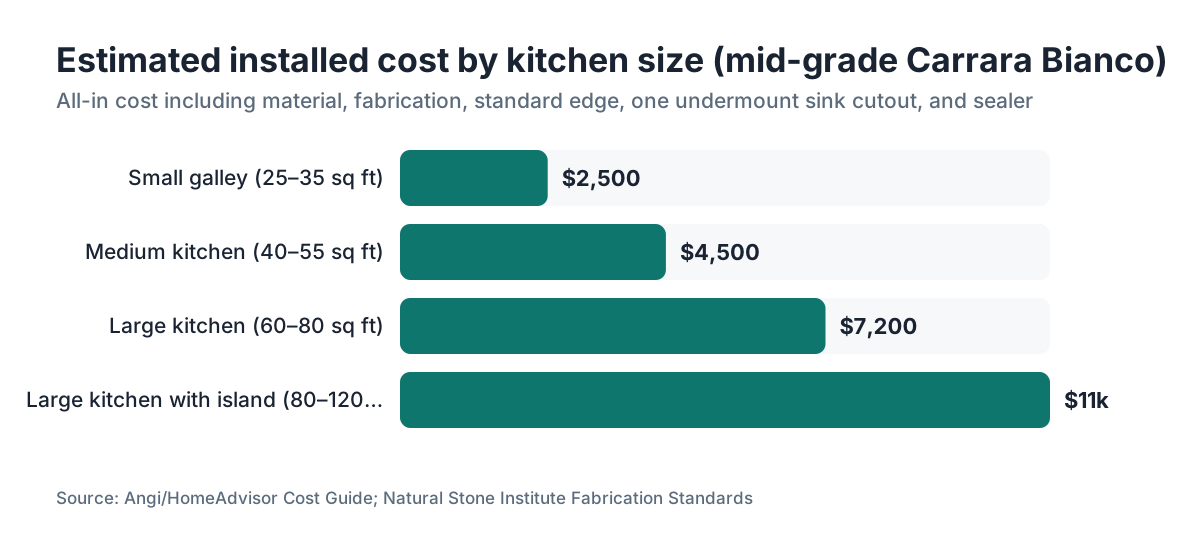
A rough guide:
| Kitchen Size | Approx. Sq Ft | Estimated Installed Cost (mid-grade Carrara) |
|---|---|---|
| Small galley | 25 to 35 sq ft | $1,500 to $3,500 |
| Medium kitchen | 40 to 55 sq ft | $3,000 to $6,000 |
| Large kitchen | 60 to 80 sq ft | $5,000 to $9,500 |
| Large with island | 80 to 120+ sq ft | $7,500 to $15,000+ |
These ranges assume mid-grade Carrara Bianco, an undermount sink, a standard edge, and typical labor rates for the continental U.S. [1].
Which edge profiles cost the most, and by how much?
Edge profile is where fabricators make incremental margin, and it's the easiest cost to control once you know what you're looking at. Edges price per linear foot of exposed edge, and the complexity of the cut sets the number [3].
An eased edge (a 90-degree corner with a slight softening) or a straight flat polish usually comes in the base fabrication price or adds $5 to $10 per linear foot. A beveled or bullnose edge runs $10 to $20 per linear foot. A full ogee, dupont, or stacked mitered detail runs $30 to $80 per linear foot, and a custom carved or hand-finished profile can pass $100.
On a typical kitchen with 20 linear feet of exposed edge, the gap between a standard eased edge and a full ogee is $500 to $1,500. That's real money. For most kitchens the simpler profile looks better anyway, because it lets the stone carry the room instead of the edge.
Mitered waterfall edges on islands deserve their own callout. A true mitered waterfall wraps the slab face down the side of the island, which needs precise 45-degree cuts matched perfectly on both pieces. Expect $200 to $600 per waterfall side on top of the island material cost. A large island with two waterfall sides adds $1,000 or more before you count the extra stone for the vertical faces.
What do cutouts and sink openings add to the installation price?
Every hole cut through a marble slab adds fabrication time and fracture risk, so shops charge separately for cutouts. The standard charges:
- Undermount sink: $150 to $400 depending on shape (rectangular undermounts cost less than apron-front or radius-corner cuts)
- Cooktop cutout: $75 to $200
- Faucet hole (per hole): $25 to $75
- Soap dispenser or filtered water tap hole: $25 to $50
Marble is more brittle than granite and much more brittle than engineered quartz, so complex cutout shapes carry higher fracture risk and some shops charge a premium for them [4]. A farmhouse sink with a thin marble ledge between the apron face and the counter edge is the highest-risk cut in residential marble work. Ask your fabricator directly about the fracture warranty on that specific cut.
Got a cooktop, a large undermount sink, and four faucet holes? Budget an extra $350 to $700 in cutout charges on top of the per-square-foot quote.
How much does fabricator labor rate vary by region?
Labor is the most opaque line item in a countertop quote. It varies more than almost any other factor, and shops rarely split it out from the total. Bureau of Labor Statistics data shows stone cutters and tile and marble setters earning median wages of roughly $19 to $28 per hour across U.S. regions, with the highest pay in Hawaii, New York, and California [5].
In practice, the all-in fabrication and installation labor charge is $35 to $100 per square foot in high-cost metros (New York City, San Francisco, Boston) and $20 to $55 per square foot in mid-cost markets (Dallas, Phoenix, Atlanta). Rural markets can go lower, but material freight often eats the savings [12].
The practical move is to get three local quotes and ask each shop to itemize material separately from fabrication labor. Most will resist. The ones who do it are usually more transparent across the board. A 20 to 30 percent spread between three local quotes on the same project is normal. A spread over 40 percent usually means one shop is cutting corners on slab quality or padding a job they'd rather not take.
Does the thickness of the marble slab affect cost?
Yes, and more than most homeowners expect. Marble slabs come in three standard thicknesses: 1 cm (roughly 3/8 inch), 2 cm (roughly 3/4 inch), and 3 cm (roughly 1 1/4 inch).
3 cm is the residential standard now. It's stiff enough to span cabinet openings without a plywood substrate and looks proportionally right against typical 34.5-inch base cabinets [11]. 2 cm material needs a plywood backer to prevent flex and fracture, which adds $3 to $8 per square foot to the install. 1 cm is a tile or furniture material, not a structural countertop.
The stone itself costs more for 3 cm than 2 cm, roughly 25 to 40 percent more per square foot for the raw slab. Factor in the substrate that 2 cm demands, and the real installed cost gap narrows to 5 to 15 percent in most markets. The performance gap matters more. 3 cm marble cracks less over cabinet seams and handles thermal shock from hot pans better (you should still use trivets on marble regardless of thickness).
For waterfall islands, 3 cm is effectively mandatory for visual weight. A 2 cm waterfall edge looks thin and cheap no matter how beautiful the stone is.
What does sealing and finishing add to the total cost?
Carrara is a calcium carbonate stone with moderate porosity, so it absorbs liquids and etches (loses surface polish) from acidic contact like lemon juice, wine, and vinegar [6]. Sealing doesn't stop etching. It slows liquid absorption and staining.
Most fabricators include one application of a penetrating sealer in the install price. That sealer, usually an impregnating silane or siloxane product, adds $0.50 to $2 per square foot to their cost and is worth doing at installation while the stone is clean and dry.
Want a premium sealer? An applicator-grade fluoropolymer runs $2 to $5 per square foot applied. Some premium products claim 10 to 15 year protection. The reality, per Marble Institute of America guidance, is that resealing every 1 to 3 years is prudent depending on kitchen use [7].
Finish choice moves the price too. Polished is the default and cheapest because it comes off the factory line that way. Honed (matte) is more popular for kitchen marble because it hides etching better than polished. Honing adds $5 to $15 per square foot to fabrication cost. Leathered or brushed finishes are less common on Carrara but available at $10 to $20 per square foot extra.
Honed Carrara is the honest pick for most kitchens. You spend more upfront and spend less time agonizing over every water spot.
How do removal of old countertops and other site conditions affect the price?
The quote you get assumes a clean, plumb, level substrate. Reality is often messier.
Removing existing countertops, whether laminate, tile, or old stone, runs $3 to $10 per square foot in labor, plus disposal fees that vary by municipality [8]. Tile bonded to drywall or plaster is the worst case, because pulling the tile often tears up the substrate and forces drywall repair before the new stone goes in.
Out-of-level cabinets are a silent cost driver. Stone fabricators normally accept up to 1/8 inch of variance across a run. Beyond that, shims come out, and in bad cases the cabinet faces need re-leveling, a carpenter charge separate from the stone quote. Old houses with settled foundations often have cabinet runs 1/2 inch or more out of level end to end.
Other site conditions that add cost:
- Limited access (narrow doorways, stairs, no elevator) can add $100 to $500 for carrying heavy slabs
- Plumbing disconnect and reconnect for sink removal is usually a licensed plumber charge separate from the stone work ($150 to $400)
- Window sills, tile backsplashes, or appliances that need removal for accurate templating add 1 to 2 hours of fabricator time
Get a site-assessment visit before signing if your home is older than 30 years or has any feature that might complicate access.
Does the number of seams change the cost and how?
Yes. Seams are where two slab pieces meet, usually because the run is longer than a single slab or because an L-shape corner forces a joint. Seams in marble show because the stone is white and light, and the epoxy fill tends to reveal itself over time even when color-matched well [4].
Fabricators charge $100 to $300 per seam for the epoxy, color-matching, and polishing. The bigger seam cost is the design cost. Buying extra material to align the vein pattern across a seam (book-matching or vein-matching) can require 20 to 40 percent more stone than the raw square footage demands, because the match needs specific cut placement on the slab.
For L-shaped kitchens with a run longer than 8 to 9 feet, a seam is basically unavoidable unless you source an unusually large slab. A good fabricator places it at a corner or a low-visibility transition near a wall, not in the middle of a straight run. Ask to see the layout plan before templating wraps up so you can weigh in on seam placement.
For design reference and comparisons with other stones that seam differently, see our overview of granite countertops and marble countertops.
How does Carrara marble compare in cost to alternative countertop materials?
Carrara isn't the cheapest stone and isn't the most expensive. Knowing where it sits helps you have an honest talk about tradeoffs.
| Material | Installed Cost (per sq ft) | Etch/Stain Risk | Durability |
|---|---|---|---|
| Laminate/Formica | $15 to $40 | Low | Moderate |
| Butcher block | $35 to $75 | Medium (water) | Moderate |
| Carrara marble | $40 to $200 | High | Lower |
| Granite | $45 to $200 | Low | High |
| Cambria quartz | $60 to $150 | Very low | Very high |
| Calacatta marble | $100 to $250+ | High | Lower |
Granite usually costs about the same as mid-grade Carrara installed, with far better stain and etch resistance [1]. Engineered quartz like Cambria countertops gives you a marble look at similar or slightly lower cost without the maintenance burden. Laminate countertops and Formica countertops cost a fraction of marble and have improved a lot in realistic stone appearance, though they don't hold resale value or tactile quality the same way.
For most kitchens where the owners cook regularly, granite or a quality engineered quartz is the smarter buy. Carrara makes the most sense in lower-traffic spots (bathroom vanities, butler's pantries, pastry stations) or in homes where the owners genuinely welcome the patina a living stone develops.
For more comparisons across stone surfaces and maintenance, see kitchen countertops and countertop installation.
What questions should you ask before getting a Carrara marble quote?
A good quote protects you from surprise charges after the stone is already cut. Here's what to ask, in the order that matters.
First, ask what slab grade is included and whether you can visit the stone yard to pick your specific slab. Commercial-grade Carrara and premium Carrara Bianco can look nearly identical in a catalog photo and sit $20 per square foot apart in cost.
Second, ask for an itemized breakdown: material, fabrication labor, edge work (by linear foot), cutouts (by type), delivery, and sealing. A shop that refuses to break it out is showing you a yellow flag.
Third, ask the lead time from template to install. Most shops run 7 to 14 business days from templating. Rush timelines under 5 days often cost a 10 to 20 percent premium.
Fourth, ask who performs the install. Some shops subcontract it to a separate crew. That's not automatically a problem, but you want one party responsible for the full result.
Fifth, ask about the warranty on fabrication defects and what happens if a slab cracks during cutting or install. Standard trade practice is that the fabricator replaces the slab at no cost for shop-caused damage, but get it in writing.
Shops that use digital quoting tools (like SlabWise, which generates itemized quotes with yield calculations) can usually give you this breakdown faster and with fewer surprises. If your shop uses one, ask for the digital quote document so you can review the line items yourself.
For care after installation, how to clean stone countertops covers marble-safe products and technique.
Frequently asked questions
What is the average cost to install Carrara marble countertops in a kitchen?
Most mid-size kitchens (40 to 60 square feet) with mid-grade Carrara Bianco, a standard edge, and one undermount sink run $3,500 to $7,000 installed. Smaller bathrooms or vanities can come in under $2,000. Large kitchens with premium stone and complex edges can pass $12,000. The wide range traces back to slab grade, regional labor rates, and layout complexity.
Is Carrara marble more expensive than granite for countertops?
At comparable quality they're usually close, both running $45 to $200 per square foot installed. Entry-level granite can run slightly cheaper than entry-level Carrara because granite supply is broader. Premium Carrara and premium granite overlap a lot. The real difference is maintenance cost: marble etches and needs resealing more often, which adds lifetime expense.
How much does a Carrara marble waterfall island cost?
A waterfall island in Carrara adds real cost beyond the flat surface price. Expect $200 to $600 per waterfall side for the mitered cut and finishing, plus the extra stone for the vertical faces (typically 8 to 15 square feet per side). A large island with two waterfall sides can add $2,500 to $5,000 over a standard island quote.
Does marble countertop thickness affect price significantly?
Yes. Standard 3 cm marble costs 25 to 40 percent more per slab square foot than 2 cm, but 2 cm needs a plywood substrate that adds $3 to $8 per square foot installed. The real installed cost difference between 2 cm and 3 cm is typically 5 to 15 percent, and 3 cm is the right call for structural reasons in most kitchens.
How much does sealing add to the installation cost?
One application of a standard penetrating sealer at install time usually adds $0.50 to $2 per square foot and is often included in the quote. A premium fluoropolymer sealer applied by the installer runs $2 to $5 per square foot extra. Ongoing resealing every 1 to 3 years costs $100 to $400 depending on kitchen size and whether you DIY or hire out.
What is the cost difference between polished and honed Carrara marble?
Honed marble adds $5 to $15 per square foot to fabrication cost versus polished. For a 50-square-foot kitchen that's $250 to $750 more. Most pros recommend honed for kitchen Carrara because the matte surface is less likely to show etch marks from acid contact, so the finished result looks better longer despite the higher upfront cost.
How much does removing old countertops add to the total cost?
Removing existing countertops runs $3 to $10 per square foot in labor plus disposal fees. Tile bonded to drywall is the worst case because substrate repair is often needed afterward, adding another $3 to $8 per square foot. Budget $300 to $800 for removal and disposal on a typical kitchen if you're replacing tile or old stone.
Can I install Carrara marble countertops myself to save money?
Fabrication (cutting, edging, polishing) needs specialized diamond tooling and a water table, so that part isn't a realistic DIY project. Installing the finished slab is technically possible but risky: marble slabs weighing 10 to 20 pounds per square foot can fracture without even support during placement. Most fabricators won't warranty slabs they didn't install. Stick with professional installation.
How does the number of seams affect the final price?
Fabricators charge $100 to $300 per seam for epoxy fill and polishing. The bigger factor is material: vein-matching across a seam can require 20 to 40 percent extra stone. A kitchen with two necessary seams might need half a slab more than raw square footage suggests, adding $500 to $2,000 depending on slab price.
Does regional location affect Carrara marble countertop prices significantly?
Yes. Median wages for stone fabricators range from roughly $19 to $28 per hour across U.S. regions per BLS data, and that spread turns into 20 to 40 percent variation in installed cost between low-cost and high-cost markets. Materials are more consistent nationally, though shipping from port cities (New York, Los Angeles) to inland areas adds freight cost.
Is Carrara marble a good investment for home resale value?
Marble generally adds perceived value in listing photos and appeals to buyers in mid-to-high price tiers. Full dollar-for-dollar return is unlikely: kitchen remodel ROI nationwide averages 60 to 80 percent on resale, and that applies to countertops within a full remodel context. A marble countertop upgrade alone is hard to isolate in appraisal data. The honest answer is it helps aesthetically but rarely pays back completely.
How long does Carrara marble countertop installation take from start to finish?
Templating takes 1 to 2 hours on-site. Fabrication (cutting, edging, polishing) runs 7 to 14 business days at most shops. Installation day is typically 4 to 8 hours depending on kitchen complexity. Rush fabrication under 5 days is possible at some shops for a 10 to 20 percent premium. Plan on 2 to 3 weeks from template appointment to finished countertop under normal conditions.
What factors make Carrara marble countertop quotes vary so much between contractors?
Slab grade differences (commercial vs. premium Carrara can vary $20 to $50 per square foot in material alone), labor overhead, whether templating and delivery are included, edge profile assumptions, and whether the quote covers one or two coats of sealer all contribute. A 30 percent spread between three honest local quotes on identical work is normal. Anything over 50 percent usually means the specs differ.
Sources
- HomeAdvisor (Angi), Marble Countertops Cost Guide: Installed Carrara marble countertop costs range from approximately $40 to $200+ per square foot depending on grade, complexity, and region
- Marble Institute of America, Marble Stone Resource: Carrara marble is quarried from the Apuan Alps in Tuscany, Italy, and ranges widely in grade from commercial to premium Calacatta and Statuario material
- Natural Stone Institute, Fabrication Standards and Specifications: Edge profile complexity is a standard line-item charge in stone fabrication, priced per linear foot of exposed edge
- Natural Stone Institute, Understanding Stone Performance: Marble is more brittle than granite and engineered quartz, making complex cutout shapes higher risk; seams in light-colored marble are more visible than in darker stones
- U.S. Bureau of Labor Statistics, Occupational Employment and Wage Statistics, Tile and Stone Setters (47-2044): Median wages for stone cutters and tile and marble setters range from approximately $19 to $28 per hour across U.S. regions, with highest wages in Hawaii, New York, and California
- U.S. Geological Survey, Marble Mineral Resources: Marble is a calcium carbonate metamorphic rock with moderate porosity that makes it susceptible to acid etching and liquid staining
- Marble Institute of America, Care and Maintenance Guidelines: Resealing marble countertops every 1 to 3 years is prudent depending on kitchen use and sealer type applied
- U.S. Environmental Protection Agency, Sustainable Materials Management: Construction and Demolition Debris: Countertop removal generates construction and demolition debris subject to municipal disposal fees that vary by locality
- National Association of Home Builders, Cost of Constructing a Home: Kitchen remodels nationally average 60 to 80 percent ROI on resale, with countertop upgrades contributing to perceived value in listing presentations
- Remodeling Magazine, Cost vs. Value Report: Mid-range kitchen remodel ROI averages in the 60 to 80 percent range nationally, with significant regional variation
- Natural Stone Institute, Dimension Stone Design Manual: 3 cm stone is the residential standard for structural countertop applications; 2 cm requires a plywood substrate to prevent flex and fracture over cabinet openings
- U.S. Bureau of Labor Statistics, Producer Price Index: Stone product input costs vary by region due to freight from import ports, contributing to geographic variation in installed countertop pricing
Last updated 2026-07-10