TL;DR
- Connemara marble is a rare green metamorphic stone quarried only in County Galway, Ireland.
- Countertop slabs run $120 to $300 per square foot installed, depending on availability and fabrication.
- It etches and scratches like any marble, so kitchens need sealing and care.
- Supply is genuinely limited, which keeps prices high and lead times long.
What exactly is Connemara marble?
Connemara marble is not a true marble in the strict geological sense. It's a metamorphic rock, a dolomitic limestone or serpentinite altered under heat and pressure, and that process produced the green color that ranges from pale sage to deep forest with cream, white, and sometimes gray veining [1]. The color comes from serpentine minerals and chlorite inside the rock matrix.
The stone belongs to the Dalradian Supergroup, a sequence of metamorphic rocks running through western Ireland and Scotland. The Connemara quarries sit around the Clifden and Streamstown Bay area of County Galway and have been worked since at least the early 1800s. The rock is old. Estimates put it at over 600 million years [1].
Get one thing straight early. Connemara marble sold in Irish tourist shops is almost entirely jewelry, trinkets, and small decorative pieces. Countertop-grade slabs are a different product, cut from specific quarry runs and exported in tiny volumes. When you see "Connemara marble" on a countertop quote, ask for the slab's country of origin and the quarry documentation, because lookalike green stones from China and Brazil do get sold under similar names.
On hardness, Connemara marble sits around 3 to 4 on the Mohs scale [2]. That's softer than granite (around 6 to 7) and close to Italian Carrara. It etches when acidic liquids touch it, and it scratches under knife blades or abrasive cleaners.
How much does a Connemara marble countertop cost?
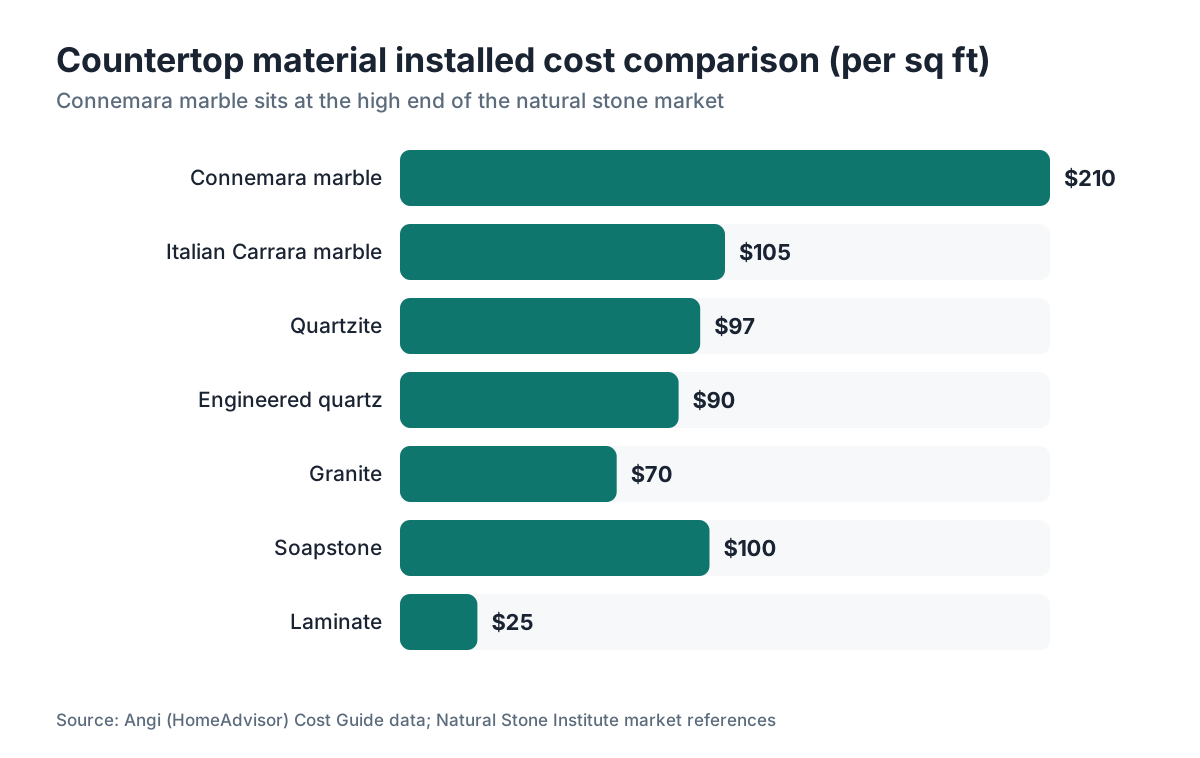
Installed Connemara marble countertops run $120 to $300 per square foot. The wide range comes almost entirely from slab availability and sourcing, not fabrication difficulty [3]. The stone itself is the expensive part.
Here's a rough breakdown across the main line items:
| Cost component | Typical range |
|---|---|
| Slab material (per sq ft) | $70, $180 |
| Fabrication (cutting, edging, polishing) | $25, $55 |
| Installation | $15, $30 |
| Sealing (first application) | $5, $15 |
| Template / site visit | $75, $200 flat fee |
A standard kitchen with 40 square feet of counter surface runs $4,800 to $12,000 installed at those rates. That's the high end of the natural stone market. For comparison, domestic granite typically runs $40 to $100 per square foot installed, and engineered quartz runs $55 to $125 [3].
The scarcity premium is real. Connemara quarrying is regulated, the active extraction sites are few, and export quantities are small. When a slab yard has it in stock, expect to pay well above commodity stones. If they have to source it for your project, plan for longer lead times (sometimes 8 to 14 weeks) and possible added freight from Ireland or a European distribution hub.
Some fabricators who quote Connemara marble are actually quoting a Chinese or Brazilian green serpentinite that looks similar. If that's disclosed and priced accordingly, it may be fine, but you should know what you're buying. Authentic Irish Connemara sits at the top of that price range.
How does Connemara marble hold up in a kitchen?
No marble is ideal for a hard-working kitchen, and Connemara is no exception. The softness that makes it beautiful, with those flowing veins of color, is the same property that makes it vulnerable.
Acid etching is the main issue. Wine, lemon juice, tomato sauce, vinegar-based cleaners: each of them dulls the polished surface on contact. An etch mark looks like a lighter, slightly hazy spot. It's not a stain you can wipe off. It's a chemical change to the surface. On Connemara's green background, etching can show more than on white Carrara, because the contrast between polished and etched areas is stark.
Scratching is real but manageable. At Mohs 3 to 4, a steel knife dragged across unsealed marble leaves a mark. That almost never happens in normal use because people use cutting boards. It does happen with ceramic dishes slid across the surface.
Staining is possible but easier to prevent than etching. A penetrating sealer fills the stone's pores and buys you time to wipe up spills before they soak in. Most fabricators apply a sealer at installation. Plan to reapply every 12 to 18 months in an active kitchen [4].
Plenty of homeowners put Connemara marble in lower-traffic spots where these concerns shrink: bathroom vanities, fireplace surrounds, wet bars, butler's pantry surfaces. In those settings the maintenance burden stays small. Some use it in primary kitchens and accept the patina that builds over time. That's a legitimate choice. Plenty of people love the lived-in look of marble that's been used.
For more on caring for natural stone, the guides on how to clean stone countertops and how to clean quartzite countertops cover the sealing and daily care that applies to Connemara too.
What does Connemara marble actually look like in a kitchen or bathroom?
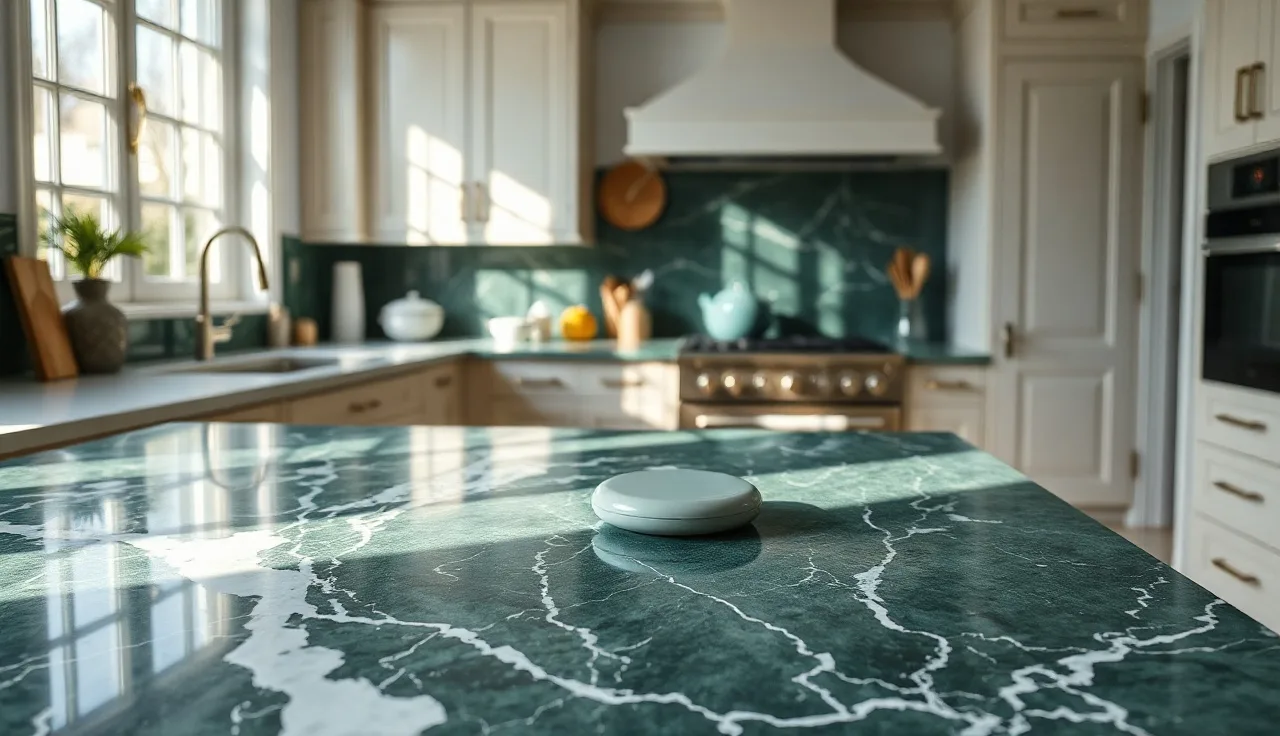
The green is the whole point. Not the uniform pale green of soapstone or the grayish green of some quartzite. Connemara marble has a medium-to-dark green base with irregular white and cream veining, sometimes gray or black mineral inclusions, and occasional patches shifting toward jade or olive [1].
No two slabs match, which is both the appeal and the headache. If you need matched slabs for a large island plus perimeter counters, you may not get them from a single quarry run. Bookmatching (two slabs opened like a book to mirror each other) is possible in theory but rare in practice, because supply is limited.
Finish choice matters a lot here. A high polish brings out the depth of the green and makes the veining pop, but it also makes etch marks more obvious, since the contrast between polished and etched is sharp. A honed finish (flat, matte, no shine) hides etching better and gives the stone an almost velvet quality. Some fabricators offer a leather or brushed finish, which adds texture and further masks surface wear.
In kitchens, Connemara pairs well with warm wood cabinetry, white shaker cabinets (where the green is the star), and brass or unlacquered bronze hardware. It's a bold material. If you want a neutral, quiet countertop, this isn't it.
In bathrooms, the green works with natural materials, linen, and muted earth tones. It photographs exceptionally well, which is part of why it shows up so often in high-end residential design publications.
How is Connemara marble fabricated and installed?
Fabrication follows the same general process as any natural stone countertop, with a few specifics worth knowing.
Templating comes first. A fabricator visits your kitchen and builds an exact template of your cabinets, either physical (thin strips of material taped together) or digital laser templating. For a stone this expensive and scarce, digital templating is the better call, because it shrinks the margin for error before anyone touches the slab [5].
Nesting the cuts on the slab is where skill and software earn their keep. Connemara slabs are rare and costly, so minimizing waste is both a money issue and an aesthetic one. You want the veining to flow correctly across the counter, and that means planning before the first cut. Fabrication software like SlabWise lets a shop lay out exact cut positions on a digital slab image before any stone gets touched, which pays off on a material this expensive.
Edge profiles add to both cost and visual impact. Connemara marble takes a clean eased, beveled, or ogee edge. More complex profiles (double ogee, dupont) cost more in labor and demand careful work, because the stone's softness means it can chip at thin edges when the router speed and tooling are wrong.
Installation means setting the cut pieces, applying silicone at seams and cabinet tops, shimming to level, and cleaning the joints. Put seams where traffic and sightlines are lowest: inside corners, away from the main prep zone. Color-matched epoxy seam filler is available from suppliers, but a good fabricator can also tint filler on-site to match the slab's dominant tone.
Moving slabs this size takes experience. A full slab weighs 600 to 800 pounds [6]. Drop it, and the cost of a replacement (if one even exists) is brutal. Hire a fabricator with real natural stone experience, not a shop that mostly runs quartz or laminate.
For a broader look at the process, see our guide on countertop installation.
How do you seal and maintain a Connemara marble countertop?
Sealing is not optional on Connemara marble anywhere near food, liquids, or cosmetics. The stone is porous enough that unsealed marble will absorb oil, wine, and coffee over time [4].
The standard choice is a penetrating (impregnating) sealer. It sinks into the pores and coats them from the inside without changing the look or adding a plastic-feeling topcoat. Brands like Miracle Sealants 511, Aqua Mix Sealer's Choice Gold, and StoneTech BulletProof get used constantly in the trade. Apply per the manufacturer's instructions, usually wiping on, letting it dwell 5 to 10 minutes, and buffing off the excess before it hazes.
For an active kitchen, reseal every 12 to 18 months. For a bathroom vanity, every 2 to 3 years is usually enough. A quick test: put a few drops of water on the surface. If they bead up, the sealer still works. If they soak in and darken the stone within 4 to 5 minutes, reseal.
Daily cleaning means a pH-neutral stone cleaner or plain warm water with a soft cloth. Skip anything acidic (vinegar cleaners are sold for stone, and that's a trap: they etch it). Skip bleach, ammonia, and anything labeled "multi-surface" unless it's explicitly stone-safe.
Etch marks can sometimes be reduced but not fully erased at home. A marble polishing powder (tin oxide based) applied with a felt buffing pad can restore some shine to shallow etches on a polished surface. Deep etches need professional re-polishing. On a honed surface, etching shows less, and shallow marks tend to blend in over time.
For detailed daily care, our guide on how to clean stone countertops covers the specifics.
How does Connemara marble compare to other countertop materials?
It helps to see this against the materials most homeowners weigh.
| Material | Installed cost (per sq ft) | Hardness (Mohs) | Etches? | Quarry location |
|---|---|---|---|---|
| Connemara marble | $120, $300 | 3 to 4 | Yes | County Galway, Ireland |
| Italian Carrara marble | $60, $150 | 3 to 4 | Yes | Tuscany, Italy |
| Granite | $40, $100 | 6 to 7 | No | Global |
| Engineered quartz | $55, $125 | 7 | No | Manufactured |
| Quartzite | $65, $130 | 7 | No (usually) | Global |
| Soapstone | $70, $130 | 1 to 2 | No (oxidizes) | Global |
On maintenance, Connemara's closest cousin is Italian Carrara marble countertops. Both etch, both scratch, both need sealing, and both reward homeowners who accept how natural material behaves. Carrara is widely available and cheaper. Connemara charges a premium for the color and the provenance.
Granite is the more practical pick if you want natural stone with less worry. At Mohs 6 to 7, granite countertops resist scratching and don't etch from kitchen acids. The tradeoff is that granite doesn't have Connemara's green character.
Engineered quartz is the worry-free option. It won't etch, won't scratch easily, and needs no sealing. The tradeoff is it's manufactured, not a geological artifact, and it lacks the visual depth of real stone. See cambria countertops for one of the premium quartz lines.
If cost is the driver, materials like laminate countertops and formica countertops sit at $10 to $40 per square foot installed and come in green tones, though the material story is completely different.
For the kitchen broadly, kitchen countertops walks through the decision across all material categories.
Is Connemara marble sustainable or ethically sourced?
Fair question, and one people don't always ask. Ireland's quarrying industry runs under EU environmental rules, including the EU Environmental Impact Assessment Directive (Directive 2011/92/EU, as amended) and national Irish planning law under the Planning and Development Act 2000 [7][8]. Large quarry operations need environmental impact assessments, and there's regulatory oversight on extraction.
Connemara marble supply is limited for two reasons: the deposits are finite (geological) and extraction is controlled (regulatory). That limits environmental impact compared to high-volume commodity stone, but it also means the stone's long-term availability is genuinely uncertain.
Transportation carbon is real. Slabs travel from County Galway to North America by container ship across the Atlantic. A full slab weighs 600 to 800 pounds [6], and ocean freight from Europe carries a meaningful footprint. If embodied carbon matters to you, domestic stone (granite, quartzite) will generally have a lower transportation footprint [9].
Longevity cuts the other way. Natural stone countertops can last the life of the building if maintained. A slab installed in 1990 is often still in service, which beats materials swapped out every 10 to 15 years.
There's no widely recognized third-party certification specific to Connemara marble right now. If certification matters (LEED, living building credits), work with a supplier who can provide chain-of-custody documentation from the Irish quarry.
Where can you buy Connemara marble slabs in the United States?
This is the practical question that stops a lot of projects. Connemara marble isn't stocked at Home Depot or Lowe's, and you won't find it at most regional stone yards either.
The reliable path runs through specialty natural stone importers who deal in European stones. Yards in major metros, especially ones serving the high-end residential market in New York, Chicago, Los Angeles, and Miami, are more likely to have contacts or occasional inventory. Searching slab databases like SLABMARKET or asking an architect who works with premium materials can turn up current availability.
Some Irish stone companies export directly. Connemara Marble Industries (Moycullen, Co. Galway) is the most historically significant producer [1], though their main retail business has been small decorative items. For slab-grade material, direct outreach to Irish quarry operations or their European distributors is sometimes the only route.
Lead times run long. If a yard has to source a slab from Ireland, 8 to 14 weeks is realistic, and that assumes the quarry has a slab of the right size and quality. For large jobs needing multiple matched slabs, add more time and more uncertainty.
When you find a supplier, ask for the full slab, not a tile or cut section, so you and your fabricator can read the veining and plan the layout. Take photos and measurements. If your fabricator uses digital layout tools, load high-resolution slab images before you commit, because it prevents expensive surprises.
Fabricators quoting rare stone benefit from accurate job costing. SlabWise's quoting software lets shops account for scarcity pricing and minimized-waste layouts, which matters most on high-cost slabs like this.
What are the pros and cons of Connemara marble as a countertop?
A direct summary, because this is the actual decision point.
The case for it: Connemara marble is one of the most visually distinctive countertop materials you can buy. The color is unique. The geological and cultural provenance is real. It suits anyone who wants natural stone, doesn't mind maintenance, and has the budget. In the right setting (bathrooms, butler's pantries, bars, show kitchens where a statement material is the whole idea) it's exceptional.
The case against: it's expensive, supply is unreliable, and it etches and scratches like all marble. You can get the same maintenance behavior from Carrara at a lower price. If you're drawn mostly to the green and don't care about Irish provenance, serpentinite or green quartzite from other origins can hit a similar look for meaningfully less money.
The honest middle ground: if the budget is there, if you found a slab you love, and if you'll do the maintenance, there's nothing irresponsible about choosing it. Go in with accurate expectations. Seal it. Use cutting boards. Don't leave lemon juice sitting on it. Accept that it develops a patina, and decide in advance whether you're fine with that.
For lower-maintenance natural options, butcher block countertops offer a very different look with a similar accept-the-patina philosophy, and how to clean soapstone countertops covers another natural stone with its own character.
Frequently asked questions
Is Connemara marble really from Ireland, or is it a marketing name?
Authentic Connemara marble is quarried only in County Galway, Ireland. Its green color comes from serpentine and chlorite minerals in the Dalradian metamorphic sequence. Some suppliers sell visually similar green stones from China or Brazil under similar names. Always ask for quarry documentation and country of origin when you buy slab-grade material.
Can you use Connemara marble in a kitchen?
Yes, but it takes committed maintenance. Like all marble, it etches when acids touch the surface and scratches under abrasive materials. Sealing every 12 to 18 months reduces staining risk. Many homeowners use it in kitchens successfully and accept the patina that builds. Lower-traffic spots like bathroom vanities and butler's pantries are more forgiving.
How often does Connemara marble need to be sealed?
In an active kitchen, reseal every 12 to 18 months with a penetrating stone sealer. In a bathroom vanity or bar, every 2 to 3 years is typically enough. Test by dropping water on the surface: if it soaks in and darkens the stone within 4 to 5 minutes rather than beading up, it's time to reseal.
What causes the green color in Connemara marble?
The green comes from serpentine minerals and chlorite formed during metamorphic alteration of the original carbonate rock. The specific geological conditions in County Galway, Ireland, produced this color over roughly 600 million years of metamorphic activity. No other quarry location produces the identical mineral composition.
How does Connemara marble compare to green granite?
Green granites (like Ubatuba or Verde Butterfly from Brazil) are much harder at Mohs 6 to 7, won't etch from kitchen acids, and cost far less at $40 to $100 per square foot installed. Connemara marble has softer, more flowing veining and a cultural provenance those granites lack. For a high-traffic kitchen where low maintenance matters, green granite is the more practical choice.
Why is Connemara marble so expensive?
Supply is genuinely limited. The quarries are few, extraction is regulated under Irish and EU planning law, and export quantities are small next to commodity stones. Transport from County Galway to North America adds freight cost. When slab-grade material reaches a US yard, it carries the full premium of scarcity plus international logistics. Prices run $120 to $300 per square foot installed.
What edge profiles work best with Connemara marble?
Eased, beveled, and ogee profiles all work well and highlight the veining without much chip risk. Very thin or sharp profiles (like a raw knife edge) are more vulnerable, because Connemara marble sits at Mohs 3 to 4. Decorative profiles like dupont or double ogee are possible but add fabrication cost and need careful tooling to avoid edge chipping.
Can Connemara marble be used as a bathroom vanity countertop?
Bathroom vanities are an ideal application. Less acid contact (no tomato or citrus), less cutting, less daily traffic. The stone's visual impact is fully present, the maintenance is lighter, and a quality penetrating sealer applied every 2 to 3 years handles the main staining risk from cosmetics and personal care products. Honed finishes are especially popular in bathrooms.
How do you remove etch marks from Connemara marble?
Shallow etch marks on polished Connemara marble can sometimes be reduced with a marble polishing powder (tin oxide) applied with a felt buffing pad, following the manufacturer's instructions. Deep etch marks need professional re-polishing by a stone restoration specialist. On honed surfaces, etching is much less visible and minor marks often blend in over time. Sealing and quick spill cleanup is the better strategy.
How long does it take to get Connemara marble slabs in the US?
If a domestic yard has inventory, you could have slabs in 1 to 3 weeks. If slabs must come from Ireland or a European distributor, expect 8 to 14 weeks minimum, sometimes longer depending on quarry availability and ocean freight scheduling. For large projects needing multiple matched slabs, lead time uncertainty is higher, so build in extra schedule buffer.
Is Connemara marble heat resistant?
Natural stone tolerates moderate heat better than engineered quartz or laminate. Still, setting very hot pots directly on marble is a bad idea. Thermal shock can open hairline cracks in stone with existing micro-fissures, and repeated heat contact can degrade the sealer layer. Use trivets. Heat isn't the main practical concern with Connemara marble; acid etching is.
What is the difference between Connemara marble and serpentinite?
Geologically, they overlap. Connemara marble is a metamorphic rock containing serpentine minerals, which places it closer to serpentinite than to calcite-based true marble. The trade uses 'marble' loosely for any rock that takes a polish. Green stones marketed as 'verde marble' or 'green marble' from other origins are often serpentinites too, but not from the Connemara quarries.
Sources
- Geological Survey Ireland, Connemara Marble overview: Connemara marble is a metamorphic dolomitic limestone/serpentinite from the Dalradian Supergroup, quarried in County Galway, Ireland, estimated at over 600 million years old
- Natural Stone Institute, Dimension Stone Design Manual: Marble and serpentinite-based stones sit around Mohs 3 to 4, softer than granite at Mohs 6 to 7
- HomeAdvisor (Angi), Stone Countertop Cost Guide: Natural stone countertop installation costs range broadly: granite $40, $100/sq ft installed, quartz $55, $125/sq ft installed, premium imported marbles at the high end of the market
- Natural Stone Institute, Care and Maintenance of Natural Stone: Penetrating sealers are recommended for porous natural stone countertops to reduce staining risk; reapplication frequency depends on use intensity
- Natural Stone Institute, Fabrication Standards and Best Practices: Digital laser templating reduces measurement error compared to physical templates, particularly important for expensive or scarce stone materials
- Natural Stone Institute, Slab Handling Guidelines: Full natural stone slabs commonly weigh 600 to 800 pounds depending on thickness and size, requiring proper handling equipment
- European Union, Environmental Impact Assessment Directive 2011/92/EU (as amended by 2014/52/EU), via EUR-Lex: EU Directive 2011/92/EU requires environmental impact assessments for large-scale extraction projects, including quarrying operations in EU member states including Ireland
- Irish Planning and Development Act 2000, Government of Ireland: Large-scale quarry operations in Ireland require planning permission and environmental assessment under the Planning and Development Act 2000
- USGS National Minerals Information Center, Dimension Stone Statistics: Imported dimension stone (including marble from European sources) represents a significant share of US stone countertop supply; import prices vary substantially by origin and material
- Natural Stone Institute, Dimension Stone Design Manual: Seam placement, edge profile selection, and proper substrate support are critical fabrication factors for natural stone countertop installations
Last updated 2026-07-09