TL;DR
- Leathered granite is granite brushed with diamond-tipped tools after honing, which leaves a low-sheen, slightly textured surface.
- It costs roughly $60, $120 per square foot installed, about $10, $20 more than a polished version of the same slab.
- It hides fingerprints and water spots well, needs sealing once or twice a year, and suits busy kitchens where a mirror polish feels too formal.
What is leathered granite and how is it made?
Leathered granite starts as an ordinary granite slab that gets honed flat, then runs under a series of rotating diamond-tipped brushes. Those brushes follow the natural crystal structure of the stone, raising its micro-texture while keeping the pores tighter than a raw sawn finish. The result is a matte-to-satin surface with soft undulations you can feel under your hand.
The process is different from polishing, which uses progressively finer abrasives until the surface is optically flat and reflective. It is also different from honing alone, which leaves the stone flat and matte but still smooth to the touch. The leather finish sits between those two: more visual interest than honed, far less glare than polished.
Fabricators call the tooling a leather brush or bush-hammer attachment, and the machine looks like a wide belt sander with rotating drum heads. Processing a full slab takes 20 to 40 minutes depending on the stone's hardness and the machine's power. Harder granites like Black Pearl or Ubatuba take longer and produce a subtler texture. Softer stones with larger mineral crystals, like Absolute Black or many Brazilian blues, come out with more pronounced surface movement. [1]
Not every granite species works well leathered. Very fine-grained stones can look almost unchanged. Stones with dramatic veining or large feldspar crystals show the most character. Ask your fabricator to run a small corner sample before committing to the full slab.
How does leathered granite compare to polished and honed finishes?
The three main granite finishes differ across the factors that matter most in a kitchen or bath. The table below lays them out side by side.
| Feature | Polished | Honed | Leathered |
|---|---|---|---|
| Sheen level | High gloss | Flat matte | Low satin |
| Texture feel | Smooth, glassy | Smooth, matte | Slightly rough |
| Fingerprint visibility | High | Moderate | Low |
| Water spot visibility | High | Moderate | Low |
| Color depth | Maximum | Slightly muted | Slightly muted |
| Upcharge over polished | Base price | +$5, $10/sq ft | +$10, $20/sq ft |
| Sealing frequency | 1x/year | 1 to 2x/year | 1 to 2x/year |
| Ease of cleaning | Easy, wipes fast | Easy | Slightly harder (texture traps crumbs) |
Polished granite is still the most popular finish because it saturates the stone's color and wipes clean fast. But a polished surface shows every water drop and fingerprint, which some homeowners find exhausting in a busy kitchen. [2]
Honed granite kills the glare but trades one problem for another. Honing opens the stone's surface more than polishing does, so honed slabs absorb liquids faster and need sealing more often. Leathering does the opposite. The brushes compact the surface minerals and close the pores slightly, which puts leathered granite's porosity closer to polished than to honed even though it looks matte.
For fabricators, the real difference is labor and tooling. A polished slab arrives from the quarry already polished, so no extra shop time is needed. A leathered finish means the shop owns or leases leather-brush attachments and runs the slab through again after cutting. That extra step is where the upcharge comes from, and it is a fair one.
How much do leathered granite countertops cost?
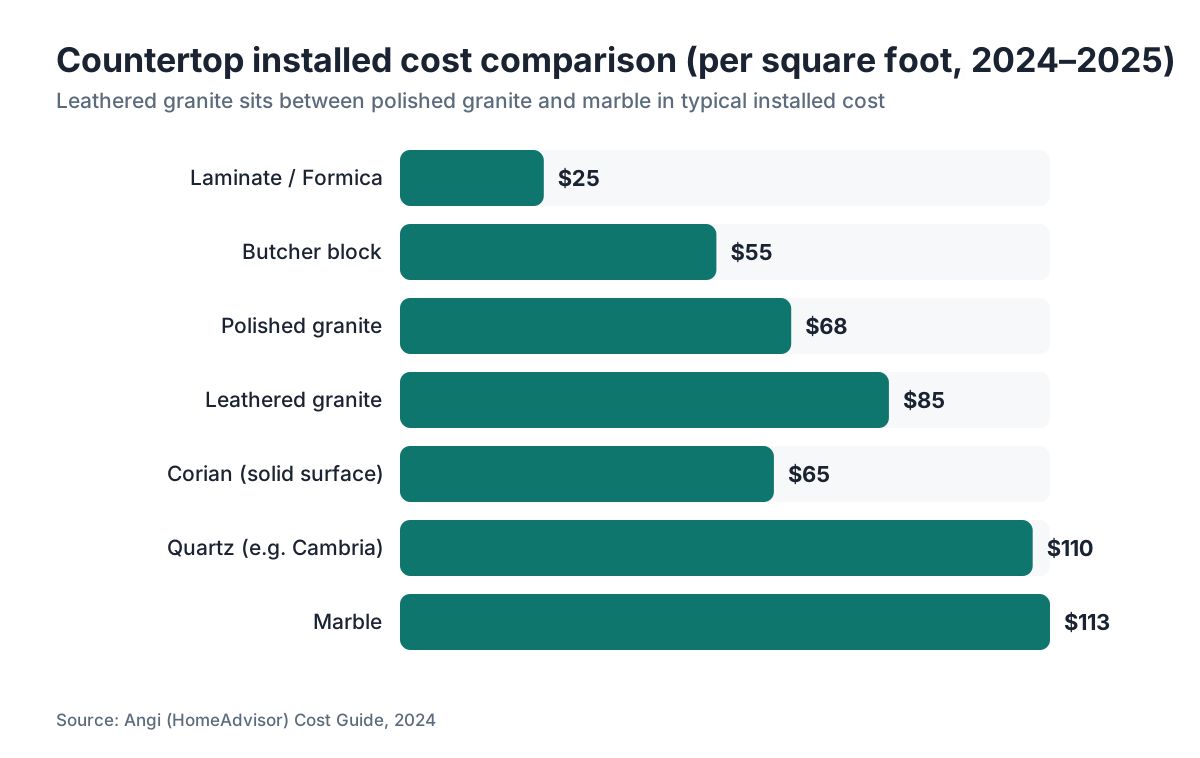
Leathered granite runs $60, $120 per square foot installed for most residential projects in 2025. The wide range comes from slab material cost, project complexity, and regional labor rates. [3] That puts it roughly $10, $20 per square foot above the same granite in a polished finish, purely for the leathering step.
Here is how the cost breaks down by component:
- Slab material: $15, $50/sq ft depending on granite variety and rarity
- Leathering upcharge: $10, $20/sq ft (shop labor and tooling)
- Fabrication (cutting, edging): $20, $35/sq ft
- Installation: $10, $20/sq ft
- Edge profile: $10, $30 per linear foot for anything beyond a standard eased edge
A typical kitchen with 45 square feet of countertop area costs $2,700, $5,400 installed. A large kitchen at 60 to 70 sq ft can reach $7,000, $8,400 with premium slab material.
For comparison, marble countertops run $75, $150 per square foot installed for common Carrara and Calacatta varieties, so leathered granite generally costs less than marble at equivalent material grades. Standard polished granite countertops average $45, $90 per square foot installed. Leathered granite sits between polished granite and marble in both cost and visual impact. [3]
Here is a claim worth quoting: for $10, $20 per square foot extra, leathering gives you a finish most people find more distinctive than polished granite while dodging the high-maintenance anxiety of honed marble. If you are already spending $80 per square foot on material and labor, the extra $15 for leathering is a small slice of the total.
The cost of granite countertops tracks stone grade more than anything else. Leathering does not change the material cost. It only adds the finishing step. Choose a premium imported granite at $50/sq ft for material and your leathered total lands at the high end. Choose a domestic or common Brazilian granite at $15, $20/sq ft for material and the leathered installed cost can land closer to $55, $70/sq ft.
Is leathered granite actually more durable than polished?
Durability comes from the stone, not the finish. Granite is one of the hardest common countertop materials, ranking 6 to 7 on the Mohs hardness scale, which means everyday knives and cookware will not scratch it. That holds whether the finish is polished, honed, or leathered. [4]
Where the finish does matter is stain resistance. Polished granite's glassy surface resists liquid penetration well. Honed granite's open pores drink liquids faster, so it stains more readily without fresh sealer. Leathered granite, because the brushing compacts the surface, performs closer to polished in absorption. The Natural Stone Institute notes that surface processing affects porosity, with polished and leathered finishes generally showing lower absorption than honed finishes on the same stone. [5]
The texture carries one trade-off. The small peaks and valleys in a leathered surface can collect fine grit over time. Dragged across the stone by a cutting board or a pot, that grit acts like sandpaper and can slowly dull the texture. This plays out over years, not months, but it is worth knowing. Wipe the surface clean before sliding heavy objects across it and you sidestep most of it.
Edge chipping is the same risk as any granite finish. A leathered edge profile does not change chip risk compared to the same profile polished. Bullnose and eased edges are the most chip-resistant for any stone countertop.
Does leathered granite need to be sealed?
Yes, leathered granite needs sealing. The good news is that most leathered granites need it less urgently than honed, and roughly as often as polished.
The standard recommendation is once a year for most granites, or every 6 months in high-use kitchens. [6] The actual interval depends on the stone's porosity, not the finish type alone. A dense Black Absolute in any finish absorbs almost nothing and can go two years between seals. A lighter-colored granite with higher quartz content absorbs more and needs annual attention.
The lemon test tells you when to reseal. Put a few drops of lemon juice or water on the surface and wait 10 minutes. If the stone darkens where the liquid sits, sealer is due. Most leathered granites pass this test easily for the first 12 to 18 months after installation.
Use a penetrating impregnating sealer, not a topical coating. Impregnating sealers soak into the pore structure and do not change the look or texture of the leathered finish. Topical coatings sit on top of the surface, build up over time, and flatten the texture you paid extra to create. [6]
Application is simple. Clean the surface thoroughly, apply sealer per the product directions (usually wipe on, wait, wipe off), and let it cure for 24 hours before normal use. For care on similar natural stones, the guidance in how to clean stone countertops applies directly to leathered granite.
How do you clean leathered granite countertops?
Daily cleaning is easy. Warm water and a few drops of dish soap on a soft cloth handles most messes. Wipe down, rinse with a clean damp cloth, and dry. That is the whole routine.
The texture traps crumbs and fine debris more than a polished surface, so a soft-bristle brush (a silicone dish brush works well) helps dislodge anything wedged in, especially near sinks and around the stove. A microfiber cloth picks up what the brush loosens.
What to avoid:
- Acidic cleaners: Vinegar, lemon juice, and any cleaner with citric or hydrochloric acid will etch the stone's minerals over time. Even on leathered surfaces, repeated acid exposure dulls the finish and degrades the sealer.
- Abrasive scrubbers: Steel wool or abrasive pads scratch the stone and flatten the texture permanently.
- Bleach: Strong oxidizers degrade sealers and, on lighter granites, can affect mineral color.
- Wax-based products: They build up in the texture and are hard to remove.
For tough stains, a poultice made from baking soda and water (about the consistency of peanut butter) drawn over an oil stain for 24 hours is safe and effective. [7] The same approach used for quartzite works here; see how to clean quartzite countertops for a step-by-step method that transfers well to granite.
One note specific to the leathered texture. After heavy cooking, steam and grease mist settle into the texture's valleys and polymerize over time into a dull film. A monthly wipe with a stone-safe degreaser stops that buildup and keeps the finish looking intentional rather than grimy.
What are the main advantages of leathered granite?
Fingerprints and water spots are nearly invisible on a leathered surface. That alone is why many homeowners choose it. On polished granite, every touch leaves a print, every glass leaves a ring, and every splash shows until you wipe it. The leathered texture scatters light instead of reflecting it, so minor marks simply do not register.
It reads more like natural stone. Polished granite can look almost synthetic because the mirror surface flattens depth. Leathering brings back the sense that this material came out of the ground rather than off a factory line. Designers specify it for kitchens built around warmth and natural materials rather than a slick, reflective look.
Color payoff stays strong. Unlike honing, which can noticeably lighten a stone's apparent color, leathering keeps most of the color depth. The stone looks a touch more muted than polished but never washed out.
It is also satisfying to touch in a way that is hard to describe until you run a hand across it. People who feel a leathered sample in a showroom often pick it over polished on the spot.
On the fabricator side, leathered finishes hide minor processing marks that would show on a polished surface. Small grinder marks near cutouts, for example, are far less likely to be noticed on a leathered edge or face. SlabWise's quoting workflow lets shops add a line item for the leathering upcharge so the cost is captured explicitly in the quote instead of buried in a vague fabrication total, which keeps margins clean on these jobs.
And it is distinctive without being risky. Leathered granite is available from most major distributors and has been in residential use long enough that it is a safe choice. It is genuinely different from polished without being trendy.
What are the drawbacks and who should avoid it?
The texture traps crumbs. Full stop. Anyone who wants a completely wipeable, smooth surface for a high-traffic kitchen with young kids will find the texture annoying. Crumbs nest in the valleys near the stove and sink and need a brush, not a quick wipe.
It costs more. The $10, $20 per square foot upcharge is real and adds up on a large kitchen. If budget is tight and the stone is already at the top of the range, that extra $600, $900 on a 60-square-foot kitchen is worth a second look.
Not every stone looks good leathered. Some granites with very fine grain or very uniform color never develop an interesting texture. They just look matte and slightly rougher. Always see a sample of that specific stone leathered before buying.
Edge profiles get tricky. A polished edge on a leathered surface is standard and looks fine, but if you want the whole piece leathered including the edge, some profiles are hard to leather evenly. Thick ogee or waterfall edges can come back looking inconsistent. Simple eased or beveled edges leather better. Talk to your fabricator before specifying an elaborate profile.
Showroom color can mislead. A leathered sample under showroom lighting may look very different from the same stone installed under kitchen task lighting. Ask for a larger sample to take home if you can.
One more thing if you are weighing leathered granite against marble countertops at similar prices: marble etches from acids regardless of finish. Leathered granite does not etch. If you want the matte, textured look that leathered marble delivers, leathered granite gives you that aesthetic with far better stain and etch resistance.
Which granite colors and patterns work best with a leathered finish?
Granites with large, dramatic mineral crystals and high color contrast show the most benefit from leathering. Blue Bahia, Marinace, and Volga Blue develop a texture that accentuates their crystal patterns. Black Pearl and Black Cosmic create a subtle, almost three-dimensional texture against the dark background. These are among the most commonly specified leathered stones in the U.S. market. [1]
Earthy browns and grays like Tan Brown, Tropical Brown, and Santa Cecilia leather beautifully and feel right at home in warm, rustic, or transitional kitchens. The texture brings out the amber and burgundy mineral flecks that polishing tends to flatten.
White and light gray granites are hit-or-miss. Alaska White and White Ice leather adequately, but the texture is subtle and the finish can read as unkempt rather than intentional to untrained eyes. If you want a light-colored countertop with texture, honed marble or quartzite may give a more refined result.
Skip leathering on very uniform granites like Absolute Black (it leathers decently thanks to its density but offers little visual interest) or extremely fine-grained stones where the surface looks the same before and after.
Ask your stone distributor which slabs in their yard are popular for leathering. Good fabricators have usually leathered many of the stones in a yard and can show you finished examples or photos. Do not rely on polished samples to predict how a stone will look leathered.
How does leathered granite compare to other countertop materials?
Leathered granite holds a specific spot in the countertop landscape: more distinctive than standard polished granite, more durable than marble, more natural than engineered options.
Marble countertops cost $75, $150 per square foot installed, more than most leathered granite. The bigger issue is that marble etches from acidic foods and drinks, a problem granite simply does not have. Honed marble often gets specified for a matte look similar to leathered granite, but any lemon juice or vinegar leaves a permanent dull patch on honed marble. Leathered granite shrugs off the same spills with no permanent damage after proper sealing.
Engineered quartz like Cambria countertops runs $80, $140 per square foot installed, needs no sealing, and offers consistent patterning. But leathered quartz products have not matched the texture depth and naturalness of leathered granite, and quartz cannot be leathered by your fabricator. It arrives from the factory with whatever finish the manufacturer produced.
Butcher block countertops are a different category at $30, $80 per square foot installed. They bring warmth and renewability but need regular oiling and tolerate no standing water.
Laminate countertops and Formica countertops are the budget picks at $15, $35 per square foot installed. Leathered granite costs three to five times more but does not chip at the edges, does not scorch, and does not develop the worn look laminate picks up after a few years.
Corian countertops (solid surface) run $45, $85 per square foot and offer a smooth, repairable seam that hides joints well, but they scratch more easily than granite and cannot reach a true stone texture.
If you want a natural stone look, lower maintenance than marble, and a surface that does not flash every fingerprint, leathered granite answers strongly. The premium over polished granite is modest against the difference in look.
What should fabricators know about quoting and producing leathered granite jobs?
Leathering shifts a few variables in the quote and the production workflow that are easy to miss if you treat it as a simple add-on.
Start with material yield. The brushes remove a small amount of surface material, and on thin slabs or slabs near a surface flaw, that matters. A 3cm slab is fine for leathering. A 2cm slab that is already close to finished thickness deserves a careful look before it goes through the leather brushes.
Next, edge coordination. If the customer wants a leathered face and a polished edge (the most common spec), that is straightforward. If they want the edge leathered too, factor in the extra time. Leathering a routed edge with drum-shaped brush attachments is slower and less consistent than face leathering on a flat surface. Add 15 to 20 minutes per linear foot to your labor estimate for leathered edges on shaped profiles.
Then timing in the workflow. Leathering should happen after the slab is cut to shape but before final edge polishing. Some shops leather the full slab first, then cut. Others cut first, then leather. Cutting first wastes less time if the stone hides voids that reveal themselves during cutting, but leathering a full slab is faster on the machine. Pick a standard sequence and stick with it.
Quote the upcharge explicitly. Bury the leathering cost in a vague fabrication line and you lose the ability to track margins by finish type over time. Quote it as a named line item. Shops running fabrication software like SlabWise can add it as a custom operation so it shows up in job costing reports, which tells you whether leathered jobs are actually as profitable as standard ones once tooling wear is counted. countertop installation logistics do not change for leathered material, but scheduling the extra machine time does.
Last, tool cost is real. Leather brush attachments wear out, especially on hard granites. Track brush life by slab count and build replacement cost into your overhead rate. A mid-grade brush set rated for granite lasts 200 to 400 square meters before noticeable degradation on average, but that varies widely by stone hardness and machine speed.
Frequently asked questions
Is leathered granite harder to keep clean than polished?
Yes, slightly. The texture catches crumbs and fine debris that a smooth polished surface would not. Daily cleaning takes a soft brush plus a cloth rather than just a cloth. That said, leathered surfaces hide fingerprints and water spots far better than polished, so overall visual maintenance is lower. Most homeowners find the trade-off worth it.
Does leathered granite still need to be sealed?
Yes. The leathering process compacts the surface and lowers porosity compared to honed granite, but it does not make the stone impervious. Annual sealing with a penetrating impregnating sealer is standard for most leathered granites. Dense black granites can go longer. Test with water or lemon juice: if the surface darkens under the liquid after 10 minutes, it is time to reseal.
How much does leathered granite cost compared to polished granite?
Leathered granite runs about $10, $20 per square foot more than the same stone polished. Total installed cost for leathered granite is typically $60, $120 per square foot depending on material grade and region. The upcharge reflects shop labor and tooling time to run the slab through diamond brush equipment after cutting.
Can any granite be leathered?
Most granites can be leathered, but the results vary by stone. Granites with large crystals and high mineral contrast (Blue Bahia, Black Pearl, Tan Brown) produce the most dramatic texture. Very fine-grained or uniform-colored stones develop little visible texture and may not be worth the upcharge. Always ask to see a leathered sample of the exact stone before ordering.
Is leathered granite heat-resistant?
Granite as a material handles heat well. The stone tolerates temperatures well above normal cooking ranges. Still, placing very hot pots directly on any countertop is not recommended, because thermal shock can cause micro-cracking over time and it risks degrading the sealer. Use a trivet for anything coming off the stovetop or out of the oven.
Does leathered granite scratch easily?
Granite rates 6 to 7 on the Mohs hardness scale, which makes it scratch-resistant against most kitchen objects. Normal knives, cookware, and appliances will not scratch it. Very hard abrasives (like diamond or silicon carbide in some cleaning pads) can mar the surface. The texture adds no vulnerability to scratching; scratch resistance is a property of the stone, not the finish.
How does leathered granite compare to leathered quartzite?
Both materials leather well and look similar when finished. Quartzite is typically harder than granite (7 to 8 on Mohs) and even more resistant to etching. But quartzite pricing varies widely, and some stone sold as quartzite is actually a soft marble-like stone that performs poorly. If you are choosing between the two, confirm the quartzite's true mineral composition before buying.
Will leathered granite work in a bathroom?
Yes, leathered granite is a good bathroom countertop choice. The fingerprint resistance is especially useful around sinks. The texture is slightly harder to clean around faucets and fixtures, but the low visual maintenance offsets that. Seal it on the same schedule as a kitchen install: annually for most granites, more often if the stone is lighter or more porous.
Is leathered granite a good choice for outdoor kitchens?
Granite is a common outdoor kitchen countertop material because of its hardness and UV stability. The leathered finish works outdoors without concern; UV does not degrade the texture or the stone's color the way it can with synthetic materials. Seal it more often outdoors (twice a year) because outdoor environments expose the stone to more moisture cycling and temperature swings.
How is leathered granite different from brushed granite?
The terms are often used interchangeably in the U.S. market, and the process is nearly identical. Some fabricators use 'brushed' for a lighter, less-pronounced texture from fewer brush passes, while 'leathered' implies a more developed surface movement. In practice, ask to see a finished sample, because the terminology is not standardized across the industry.
Can you polish leathered granite back to a shiny finish?
Yes. A fabricator can re-polish a leathered granite countertop using the same progression of diamond abrasive pads used to polish it originally. This is rarely done after installation because it requires removing the countertop or working in place with hand polishers, both labor-intensive. It is reassuring that the change is reversible, but budget for shop labor if you ever want it done.
Does leathered granite cost more than marble?
Generally no. Leathered granite typically runs $60, $120 per square foot installed. Marble countertops, including installation, typically run $75, $150 per square foot for common varieties like Carrara and Calacatta. Leathered granite delivers a similar matte, natural-stone look at lower cost, with better resistance to acid etching and staining.
What edge profiles work best with leathered granite?
Simple profiles work best. Eased, beveled, and straight edges leather consistently and look clean. Bullnose is also reliable. Complex profiles like ogee, dupont, or waterfall edges are harder to leather evenly, especially on rounded transitions. If you want the edge leathered rather than polished, discuss the specific profile with your fabricator and ask to see a sample before committing.
Sources
- Natural Stone Institute (formerly Marble Institute of America), Natural Stone Finishes Technical Bulletin: Leather/brushed finish process uses diamond-tipped brushes following stone's crystal structure; harder stones produce subtler texture
- National Kitchen & Bath Association, Consumer Survey on Kitchen Surfaces: Polished granite is the most commonly specified stone finish in residential kitchens; fingerprint visibility cited as primary complaint
- Angi (formerly HomeAdvisor), Granite Countertop Cost Guide: Granite countertop installed cost averages $45, $90/sq ft polished; premium finishes add $10, $20/sq ft; marble runs $75, $150/sq ft installed
- U.S. Geological Survey, Granite and Other Crustal Rocks: Granite is composed primarily of quartz and feldspar; quartz rates 7 on Mohs hardness scale, making granite resistant to surface scratching from most kitchen utensils
- Natural Stone Institute, Porosity and Absorption in Natural Stone (Technical Bulletin): Polished and leathered finishes generally show lower absorption rates than honed finishes on the same stone due to surface compaction during processing
- Natural Stone Institute, Sealing Natural Stone (Care & Maintenance Guide): Penetrating impregnating sealers recommended for granite; topical coatings not recommended; typical sealing interval is annually for kitchen countertops
- Natural Stone Institute, Stain Removal Guide for Natural Stone: Baking soda and water poultice is recommended for oil-based stains on granite; leave 24 hours and remove with plastic scraper
- U.S. Geological Survey National Minerals Information Center, Dimension Stone Statistics: Granite accounts for the largest share of dimension stone used for countertops in U.S. residential construction
- National Institute of Standards and Technology, Standard Test Methods for Stone: ASTM C1353 and related standards govern abrasion resistance testing of dimension stone surfaces; finish type affects measured abrasion resistance
- Natural Stone Institute, Dimension Stone Design Manual (8th ed.): Leather and brushed finishes defined in design manual; finish process described as mechanical brushing post-honing; suitable for most granite species
Last updated 2026-07-09