TL;DR
- Granite countertops cost $40 to $200 per square foot installed, and most kitchens land at $2,000 to $4,500 total.
- Basic Level 1 slabs start near $40 per square foot.
- Exotic or book-matched granite tops $200.
- After the stone itself, the biggest price movers are labor, edge profiles, cutouts, and slab grade.
What is the average cost of granite countertops per square foot?
Most homeowners pay $40 to $200 per square foot installed, material and labor together. The spread is real, not a dodge. Granite is a natural stone quarried in dozens of countries, and a basic Level 1 slab from India looks almost nothing like a rare Blue Bahia from Brazil. Those two live in different price universes.
Here is a tighter target. Level 1 and Level 2 granite, the grades big-box stores and regional fabricators sell most, install for $40 to $75 per square foot. Level 3 and up, including the big-movement exotics you see on design blogs, runs $75 to $150 or more. Truly rare material, think Calacatta-look granites or large quartzite slabs sold as granite, tops $200 per square foot installed [1].
Those numbers come from aggregated contractor-reported data, not manufacturer sticker prices. Your real quotes will land higher or lower based on your city, the shop's overhead, and the slab tier you pick. Get three quotes from local fabricators before you trust any single number.
How much does granite countertop installation cost for a typical kitchen?
A standard kitchen with 30 to 45 square feet of counter, one sink cutout, and a basic edge costs $1,200 to $3,375 in Level 1 or Level 2 granite. Add an island or peninsula and most people land at $2,000 to $4,500 total [1].
For kitchen countertops in larger open-concept layouts, 60 to 80 square feet is common. At $55 per square foot installed that is $3,300 to $4,400 before any upgrades. A waterfall edge or an under-mount double sink adds $400 to $800 more.
There is no single "average" number because square footage swings so hard house to house. The honest shortcut: measure your countertop run, multiply by your fabricator's installed price per square foot, then add $150 to $300 per sink cutout, $50 to $200 per cooktop cutout, and your edge profile upcharge (see the edge section below).
Small kitchens change the math. Under 25 square feet of counter, most fabricators apply a minimum job charge, usually $800 to $1,500, even when the square-footage math comes out lower. Ask about it before you fall in love with a slab. In a small kitchen, that minimum, not the stone price, often sets your bill.
What are granite countertop grades and how do they affect price?
Granite grades are set by individual fabricators and distributors, not by any industry-wide standard. Most shops run a 1-4 or 1-5 level system, but a Level 3 at one yard can cost what a Level 2 costs at another. The labels describe visual rarity and the shop's acquisition cost, not stone quality in any structural sense.
| Grade | Typical installed price / sq ft | What you get |
|---|---|---|
| Level 1 | $40, $55 | Solid colors, consistent pattern, high supply. Common in rental builds. |
| Level 2 | $55, $75 | More movement, speckle variation. Still widely available. |
| Level 3 | $75, $100 | Exotic patterns, less common colors. Imported slabs common. |
| Level 4 | $100, $150 | Statement pieces, rare origins, larger veining. |
| Level 5+ | $150, $200+ | Matched slabs, book-matched pairs, ultra-rare material. |
Those ranges point the right direction, nothing more. In a high-cost metro like San Francisco or New York, add 20 to 40 percent across every row. In a lower-cost Midwest or Southeast market, the bottom end drops 10 to 15 percent [2].
Renovating on a real budget? Level 1 and Level 2 are completely fine. The stone is the same geological material top to bottom. The only difference is visual rarity. Spending $40 versus $150 per square foot does nothing for how the granite performs once it is on your cabinets.
How does granite compare in cost to quartz countertops?
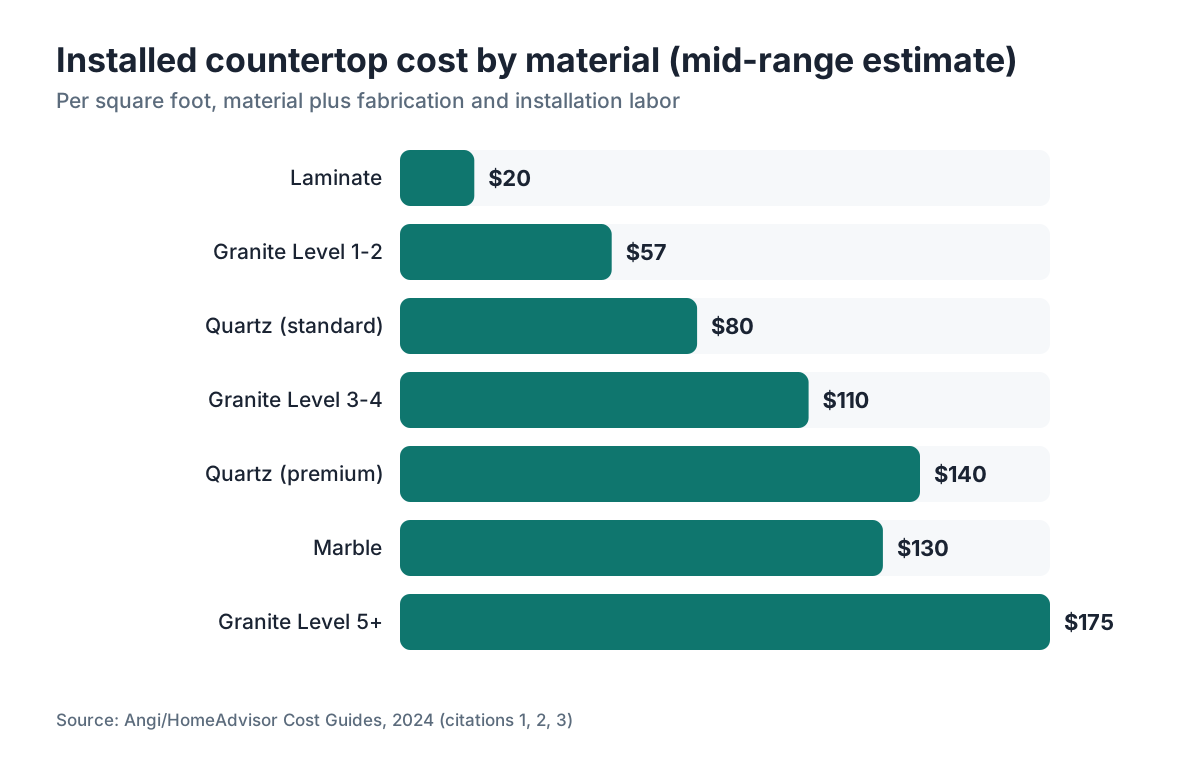
Quartz installs at $50 to $150 per square foot, which overlaps granite's range heavily [1][3]. At the entry level, granite beats quartz on price by $5 to $15 per square foot in most markets. In the mid range, they are close to identical. At the high end, exotic granite can run pricier than premium engineered quartz, but designer quartz from brands like Cambria (see Cambria countertops) hits $90 to $200 per square foot installed and closes that gap fast.
Labor follows the same structure for both. The fabricator cuts, edges, and sets the slab, and that labor is often $10 to $15 per square foot regardless of material because the process barely changes. Quartz is a touch easier to cut because it lacks the natural fissures and voids some granite slabs carry, but that rarely shows up as a real dollar difference on a quote.
Bottom line: the two materials cost close enough that preference should drive the choice, not price. Granite needs periodic sealing (once a year or every few years, depending on porosity). Quartz needs none. If you hate maintenance, the small quartz premium may be worth paying.
| Material | Low installed ($/sq ft) | Mid installed ($/sq ft) | High installed ($/sq ft) |
|---|---|---|---|
| Granite (Level 1-2) | $40 | $55 | $75 |
| Granite (Level 3-5) | $75 | $120 | $200+ |
| Quartz (standard) | $50 | $80 | $120 |
| Quartz (premium) | $90 | $130 | $200 |
| Laminate countertops | $10 | $20 | $40 |
| Marble countertops | $60 | $100 | $200+ |
Sources: National contractor-reported cost aggregates [1][3].
What installation costs are included (and what gets added on)?
A quoted installed price usually covers the slab, fabrication (cutting to your template), polishing the edges to your chosen profile, one standard sink cutout, delivery, and setting the stone on your cabinets with adhesive and silicone. That is the base. The extras are where quotes drift apart.
Edge profiles. A standard eased edge is usually included. Ogee, waterfall, triple pencil, and other decorative profiles add $10 to $30 per linear foot. A 40-linear-foot kitchen perimeter at a $20 upcharge is $800. That is not pocket change.
Cutouts. One sink cutout is sometimes included. A second cutout or a cooktop opening runs $100 to $300 each, depending on shape and material.
Demolition and removal of old countertops. Most fabricators do not pull your old tops by default. Expect $150 to $500 depending on material and access.
Plumbing reconnection. Disconnecting and reconnecting the sink is usually a plumber's job, not the fabricator's. Budget $150 to $400 for a licensed plumber.
Backsplash. Granite backsplash tile or a full-height slab backsplash gets priced separately. A 4-inch granite strip adds $8 to $15 per linear foot.
Sealing. Some shops seal the stone as part of the install. Others charge $100 to $200. Ask specifically. See how to clean stone countertops for the ongoing maintenance side.
Stacked together, these line items can add $1,000 to $2,000 to a job that looked simple on the square-footage math. Good countertop installation quotes break every one of them out.
What factors drive the price of granite countertops up or down?
Slab origin and rarity move the price most. Brazilian granites like Fantastico and Azul Bahia command premiums because the quarries produce limited volume and shipping runs high. Indian granites like Tan Brown and Black Galaxy are everywhere, which keeps Level 1 prices competitive [4].
Thickness comes next. Standard residential granite is 3/4 inch (2 cm). Three-centimeter (1.2-inch) slabs are heavier and stiffer, need no plywood substrate on most cabinet runs, and cost 15 to 25 percent more per square foot. Most fabricators now default to 3 cm because it cracks less and generates fewer callbacks.
Layout complexity. Lots of corners, odd angles, or an L-shape that forces extra seams all eat fabrication time. An island with mitered waterfall edges on two sides adds $500 to $1,500 over a straight run.
Local labor markets. Fabrication labor in San Jose, California runs higher than in Tulsa, Oklahoma, full stop. Distributor stone cost is roughly the same in both. The labor delta is what separates coastal and interior quotes.
Shop overhead and margin. A lean independent shop may quote 10 to 20 percent under a big showroom carrying commission salespeople and a financing desk. Both can do great work. Reading Google reviews and asking to see recent jobs matters more than chasing the lowest number.
Season plays a small part too. Busy spring and summer renovation months push quotes up because shops are backed up and not hungry for every job. Mid-winter in cold climates is often the best time to price a job.
How much does a granite countertop cost for different kitchen sizes?
The table below uses a mid-range installed price of $65 per square foot and a typical countertop footprint for each kitchen size. Treat these as rough estimates. Your real square footage depends on cabinet layout, island size, and how much perimeter sits under upper cabinets.
| Kitchen size | Est. countertop sq ft | Low estimate ($40/sq ft) | Mid estimate ($65/sq ft) | High estimate ($100/sq ft) |
|---|---|---|---|---|
| Small (under 150 sq ft floor) | 20 to 30 | $800, $1,200 | $1,300, $1,950 | $2,000, $3,000 |
| Medium (150-300 sq ft floor) | 30 to 50 | $1,200, $2,000 | $1,950, $3,250 | $3,000, $5,000 |
| Large (300+ sq ft floor) | 50 to 80 | $2,000, $3,200 | $3,250, $5,200 | $5,000, $8,000 |
| Large with island | 70 to 100 | $2,800, $4,000 | $4,550, $6,500 | $7,000, $10,000 |
A small kitchen with granite lands between $1,300 and $3,000 in most markets once the fabricator minimum kicks in on low square footage. Across all sizes, granite kitchen countertops average about $3,000 to $4,500 with a mid-tier slab and standard installation [1][2].
Can you save money buying granite from a big-box store?
Home Depot and Lowe's both sell granite through installed-services programs, and both usually subcontract to local fabricators. The price can look sharp up front, but selection tends to stay inside Level 1 and Level 2. You pick from what is on the display and remnant floor, not from a full distributor yard holding hundreds of slabs.
The real trade-off is selection versus convenience. Big-box programs run the project management and offer financing, which some buyers value. Independent fabricators open up a much wider slab selection and usually flex more on edge profiles and scheduling. On raw price, the gap is modest, maybe $3 to $8 per square foot either direction, and it hangs entirely on the local subcontractor's pricing [2].
For small kitchens where the minimum charge applies either way, a big-box program's convenience can be worth the slight premium. For bigger or more custom jobs, walking two or three independent yards almost always buys you better value and a better result.
Remnants are the actual money-saver. If your countertop run is short, a fabricator's leftover piece from a bigger job (a remnant) can cut your material cost 30 to 50 percent. Ask every shop you visit whether they have remnants that fit your layout. For a bathroom vanity or a single-wall galley, a remnant is often the smartest buy in the building.
How does granite hold up compared to other countertop materials?
Granite scores 6 to 7 on the Mohs hardness scale, so most kitchen knives (Mohs 5.5 to 6.5) will not scratch it under normal use [4]. It takes heat well, though thermal shock from years of repeated extreme heat cycling can leave hairline cracks near seams. Setting a hot pan down now and then is fine. Doing it in the same spot every single day is not.
Granite is porous, and the degree varies by stone. High-porosity granites absorb liquids and stain if the sealer wears off or was never applied. A quick water-bead test tells you where you stand: pour a few tablespoons of water on the surface and wait 15 minutes. Beads mean you are sealed. Soaks in and darkens means reseal.
Against marble countertops, granite is harder and more stain-resistant. Marble etches from acids like lemon juice and vinegar. Granite usually does not, though it can still stain. Against butcher block countertops, granite is harder to fix if it chips and it will not forgive a dropped glass, but it needs no oiling and lasts indefinitely with normal care.
Against quartz, granite is slightly more variable on maintenance because porosity shifts slab to slab. Quartz is non-porous by construction. Against laminate countertops or Formica countertops, granite wins on durability and resale perception and loses on low-end cost and DIY repairability.
Does installing granite countertops increase home resale value?
Probably yes, but the return is not dollar-for-dollar and the evidence is soft. Remodeling Magazine's 2024 Cost vs. Value report puts a mid-range kitchen remodel at about 49 cents on the dollar at resale nationally, and a major kitchen remodel lower, around 38 cents [5]. Countertops are one slice of that remodel, not a stand-alone investment.
What the data does support is that stone countertops sit high on buyers' most-wanted lists in survey after survey, which tends to help a home sell faster rather than for a higher price. The National Association of Realtors' 2023 Remodeling Impact Report ranked kitchen upgrades, countertops included, among the features buyers notice most [6].
Doing the work purely to sell? Keep the slab conservative. A bold Level 5 exotic you love may leave your buyer pool cold. Neutral granite in Level 1 or Level 2 does the resale job at the lowest cost.
Staying put? Buy the slab you actually want. A countertop you live with for 15 to 20 years costs a few dollars a day either way. Getting the material right for daily use beats optimizing for a sale that may be a decade out.
How do fabricators actually price granite jobs, and what should you know before getting quotes?
Most fabricators quote granite per square foot installed, but the math behind that number stacks slab cost, waste factor, fabrication labor, edge work, delivery, and margin. A shop paying $18 per square foot for a Level 2 slab, running a 30 percent waste factor in cutting, is already at roughly $26 per square foot on raw material before any labor or overhead touches it.
That is why quoting granite accurately is harder than it looks. Shops running quoting software, like SlabWise, model slab yield and waste far more precisely than hand estimates, which tends to produce tighter quotes with less contingency padding. When a fabricator has real yield data, you get a sharper price instead of one carrying a 15 percent cushion for surprise waste.
When you collect quotes, ask for itemized breakdowns: material cost per square foot, fabrication labor, edge charges, cutout charges, delivery. A quote that shows one total number is harder to compare and easier to pad. Most reputable shops itemize without a fight.
Bring your own measurements when you can. Measure your countertop run in inches, sketch the layout with cabinet depths, mark where the sink sits. Shops that template before fabrication (most do) will capture exact numbers, but your sketch speeds the quote and helps you catch errors before anyone cuts stone.
What questions should you ask a fabricator before signing a granite contract?
A handful of things are worth nailing down before any money changes hands.
Ask to see and approve your actual slab before fabrication. Granite is natural stone and no two slabs match. A small showroom sample may look nothing like the full run across your counter. Visiting the yard and marking your slab with chalk is standard practice at good shops.
Ask exactly which edge profiles are included and which cost extra. This is where quotes surprise people at the contract stage.
Ask whether demolition and removal of your old countertops is included. Usually it is not.
Ask about the sealer and whether it is in the job price. Some shops use a consumer-grade sealer good for one year. Others use a penetrating impregnator that lasts five to ten. The cost difference to the shop is maybe $30. The difference to you, in years of maintenance, is real.
Ask for references or photos of finished jobs, specifically kitchens laid out like yours. Cutting around a farmhouse apron sink or working a tight inside corner are skills that vary shop to shop. You want someone who has already solved your exact problem.
For a deeper look at the material itself, granite countertops covers properties, care, and slab selection in detail.
Frequently asked questions
What is the average cost of granite countertops for a kitchen?
For a medium kitchen with 30 to 50 square feet of counter, granite installed runs $1,950 to $5,000 depending on grade and market. Level 1 or Level 2 granite in a mid-cost U.S. market usually totals $2,000 to $3,500 all-in for a standard kitchen, before edge upgrades or a second sink cutout.
How much does granite cost per square foot installed versus material only?
Material-only slabs from a distributor run roughly $5 to $40 per square foot by grade. Fabrication and installation labor adds $25 to $45 per square foot on top. So an installed price of $40 to $100 per square foot usually breaks down as about one-third material and two-thirds fabrication and labor at the low-to-mid tier.
Is granite cheaper than quartz countertops?
At the entry level, granite is often $5 to $15 per square foot cheaper installed than comparable quartz. In the mid range they are nearly identical. At the high end, premium engineered quartz can exceed $150 to $200 per square foot installed, similar to exotic granite. Quartz installed averages $50 to $150 per square foot, overlapping granite's range almost entirely.
What is the average cost for granite kitchen countertops in a small kitchen?
A small kitchen with 20 to 25 square feet of counter costs $800 to $2,500 in granite installed. Many fabricators apply a minimum job charge of $800 to $1,500, so very small kitchens often pay more per square foot in practice than the standard rate suggests. That minimum, not the square-footage math, usually sets the price.
How much does granite countertop installation cost including labor?
Labor for granite installation (templating, cutting, edging, delivery, setting) typically runs $25 to $45 per square foot. For a 40-square-foot kitchen that is $1,000 to $1,800 in labor alone before material. Some shops bundle everything into one installed price. Others quote material and labor separately. Always ask which format you are looking at.
Can I get granite countertops installed for under $2,000?
Yes, with a small kitchen (under 30 square feet), a Level 1 slab, a basic eased edge, and one standard sink cutout. In lower-cost markets that combination can hit $1,500 to $1,800. In high-cost metros, getting a full kitchen under $2,000 is tough unless you find a remnant slab or negotiate with a shop during slow season.
What does a granite countertop edge profile cost?
A standard eased or straight edge is usually included in the base price. A beveled edge might add $5 to $10 per linear foot. A full ogee or waterfall profile adds $15 to $30 per linear foot. On a kitchen with 40 linear feet of perimeter, an ogee upcharge can add $600 to $1,200. Pick your edge before you sign.
How do granite countertop prices compare to marble or quartzite?
Marble and quartzite both run $75 to $200 or more per square foot installed for mid-to-high grades, putting them at the top of granite's range or above it. Entry-level marble can approach granite Level 1 pricing, but marble etches from acids, which limits where it works. Quartzite is harder than marble but often pricier than similar-looking granite because supply is tighter.
Does granite countertop thickness (2 cm vs 3 cm) change the price much?
Yes. Three-centimeter (1.2-inch) slabs cost 15 to 25 percent more per square foot than 2 cm material, but they usually skip the plywood subtop, which saves install time and materials. Most fabricators default to 3 cm for residential work. If a shop quotes 2 cm, ask whether a subtop is included and add that cost to your comparison.
What additional costs should I budget for beyond the per-square-foot price?
Budget separately for demolition and old countertop removal ($150 to $500), plumber disconnect and reconnect ($150 to $400), cooktop cutouts beyond the first ($100 to $300 each), decorative edge profiles ($10 to $30 per linear foot), backsplash if you want it ($8 to $15 per linear foot for a 4-inch granite strip), and initial sealing if not included ($100 to $200). Together these routinely add $500 to $1,500 to a mid-size job.
How long does granite countertop installation take?
Template to finished install typically takes 5 to 10 business days. The fabricator templates your cabinets on one visit, sends measurements to the shop for cutting and polishing (3 to 7 days), then returns to install. Install day is usually 2 to 4 hours for a standard kitchen. Complex layouts with multiple cutouts or seams take longer in both fabrication and install.
Is granite a good choice for bathroom countertops too?
Granite works well in bathrooms. The square footage is small, usually 5 to 15 square feet for a vanity, so total cost stays low even with mid-grade material. Remnant slabs from a kitchen job are a common and cheap source for bathroom tops. Make sure the fabricator seals the stone properly since bathrooms see frequent water and soap.
How often does granite need to be resealed and what does that cost?
It depends on porosity. Dense granites like Black Galaxy may never need sealing in practice. More porous stones do better resealed every one to three years. Professional resealing runs $100 to $200 for a kitchen. DIY sealers from a hardware store cost $20 to $40 and take about 30 minutes to apply. The water-bead test tells you when the current sealer is due.
What is the cost difference between buying granite at a big-box store versus an independent fabricator?
Smaller than most homeowners expect, roughly $3 to $8 per square foot either direction. Big-box stores offer convenience and financing but limit you to their inventory, which skews toward Level 1 and Level 2. Independent fabricators open a full distributor yard and more room for custom work. For unusual layouts or higher grades, an independent shop almost always wins on selection and value.
Sources
- HomeAdvisor (Angi), Granite Countertops Cost Guide: Installed granite countertop prices range from $40 to $200 per square foot; average kitchen project costs $2,000 to $4,500
- HomeAdvisor (Angi), Cost to Install Countertops: Regional labor cost variations and big-box vs independent fabricator price comparisons for countertop installation
- HomeAdvisor (Angi), Quartz Countertops Cost Guide: Average cost to install quartz countertops is $50 to $150 per square foot installed
- U.S. Geological Survey, National Minerals Information Center (Dimension Stone): Granite Mohs hardness 6 to 7; granite quarried internationally including Brazil and India; production and trade statistics
- Remodeling Magazine, 2024 Cost vs. Value Report: Mid-range kitchen remodel returns approximately 49 cents on the dollar at resale; major kitchen remodel returns about 38 cents
- National Association of Realtors, Research and Statistics (2023 Remodeling Impact Report): Kitchen upgrades including countertops rank among the top features buyers notice and desire at resale
- U.S. Bureau of Labor Statistics, Consumer Price Index: Labor cost benchmarks for construction trades including countertop installation labor rates by region
- Natural Stone Institute: Natural stone grading and classification; granite hardness, porosity, and fabrication specifications for residential use
- U.S. Geological Survey, Mineral Commodity Summaries: U.S. dimension stone production, imports, and pricing data including granite categories and international supply origins
- University of Minnesota Extension: Comparative durability, maintenance, and cost characteristics of granite versus quartz, laminate, and other countertop materials
Last updated 2026-07-09