TL;DR
- Affordable granite countertops run $40 to $75 per square foot installed for entry-level and mid-grade slabs.
- The biggest cost drivers are slab grade, edge profile, and cutouts.
- Buying remnants, choosing a simpler edge, and skipping exotic colors can cut your total by 30 percent or more.
- This guide explains every lever.
What does affordable granite actually mean in terms of price?
Affordable granite is real, and it starts around $40 per square foot installed. Entry-level granite, often called Level 1 or commercial-grade, typically runs $40 to $60 per square foot installed, meaning the slab material, fabrication, and basic installation are bundled into that number. Mid-grade granite (Level 2) lands around $55 to $80 installed. Premium and exotic slabs climb from $80 to well over $150 per square foot once you factor in edge profiles, sink cutouts, and delivery.[1]
The word "affordable" means different things depending on who's quoting you. A fabricator in rural Ohio operates with lower overhead than a shop in San Francisco, so the same Level 1 slab might be $45 installed in one market and $65 in another. Labor costs vary by region, and slab prices at the distributor level track import tariffs and fuel costs.
For a typical kitchen with 30 square feet of countertop, you're looking at $1,200 to $1,800 for affordable granite at the low end, and $2,400 to $2,500 at the mid range. That's before any backsplash or specialty work. A bathroom vanity with 10 square feet can cost $400 to $700 all-in if you keep it simple.
Those numbers are real-world ranges, not manufacturer suggested prices. Get at least three quotes from local fabricators. The spread will surprise you. See our broader guide on kitchen countertops for a full cost comparison across all materials.
What is granite grading and which grades are the most affordable?
No single international standard grades granite. Most fabricators and stone yards use a tiered system (Level 1, 2, 3, or sometimes labeled Commercial, Standard, Premium, Exotic) that reflects thickness, the consistency of veining, origin country, and rarity of color. The grading is commercial, not geological. One shop's Level 2 is another shop's Level 3.
Level 1 granite is usually 3/8 inch thick, cut from high-volume quarries in Brazil, China, or India, and tends to have relatively uniform, simple patterns in colors like black, beige, tan, or speckled gray. Uba Tuba, Giallo Ornamental, Baltic Brown, and New Venetian Gold are classic examples that appear on every "affordable" list. They're genuinely attractive stones. Their price is low because the quarries produce massive volumes and the patterns are consistent enough to minimize waste in fabrication.[2]
Level 2 stones are usually 2 cm or 3 cm thick, come from a broader range of quarries, and have more movement or variation in the pattern. They cost more because they're heavier (more shipping cost), and because more slab goes to waste matching patterns across a kitchen.
Want the lowest material cost? Ask specifically for 2 cm slabs in the most common colors from high-volume South American or Asian quarries. You may need to add a plywood substrate if your cabinets are older, but the stone price can drop 20 to 30 percent compared to 3 cm.
Here's a rough comparison of material-only slab costs per square foot (before fabrication and install):
| Grade | Typical thickness | Material cost/sq ft | Common examples |
|---|---|---|---|
| Level 1 | 2 cm | $8, $15 | Uba Tuba, Baltic Brown, Giallo Ornamental |
| Level 2 | 2 to 3 cm | $15, $25 | Santa Cecilia, Alaska White, New Caledonia |
| Level 3 (premium) | 3 cm | $25, $50 | Typhoon Bordeaux, Blue Pearl, Lemurian Blue |
| Exotic/rare | 3 cm | $50, $100+ | Blue Bahia, Van Gogh, Super White quartzite (often mislabeled) |
How does granite compare in cost to other countertop materials?
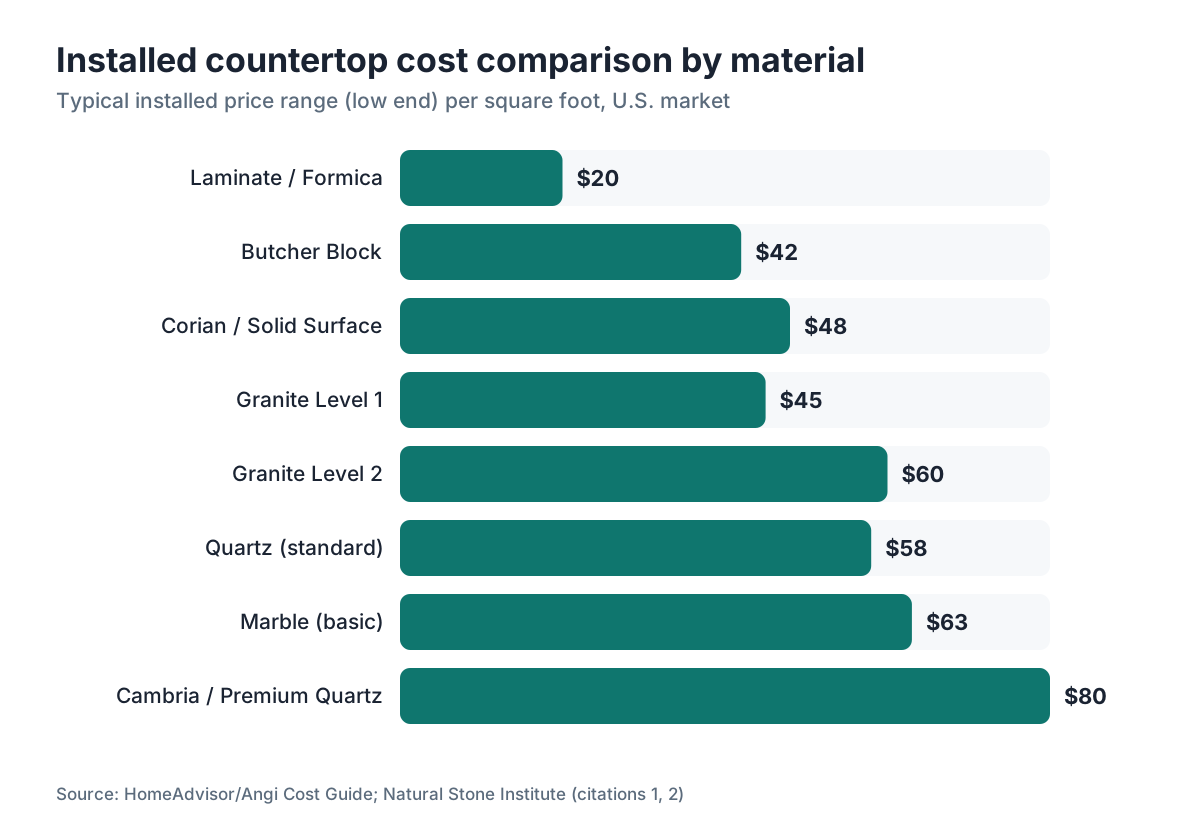
Granite isn't always the cheapest countertop, but it's often the cheapest natural stone that holds up for decades. Here's how it stacks up against the main alternatives.
Laminate countertops are the lowest-cost option at roughly $15 to $40 per square foot installed. Formica countertops are in the same range. They've gotten much better aesthetically, but they don't add the same resale value and they can't be refinished once scratched deeply.
Butcher block countertops run $40 to $65 installed and are warm and repairable, but they need regular oiling and don't love water near the sink.
Corian countertops and similar solid surfaces sit at $45 to $65 installed. They can be sanded and repaired, and joints disappear when done right, but the matte look isn't for everyone.
Quartz engineered stone, often confused with quartzite (which is natural), typically costs $55 to $90 installed. Cambria countertops, a premium quartz brand, run $75 to $120.
Marble countertops start around $60 installed for basic Carrara, but maintenance costs are higher because marble etches easily.
Affordable granite sits in a genuinely competitive spot. For $40 to $60 installed, you get a natural stone that's harder than marble, doesn't etch from acids, and will outlast the kitchen if sealed periodically. That's a hard combination to beat at that price point.
The National Kitchen and Bath Association tracks remodel costs and consistently places granite among the top-return surface upgrades, though ROI numbers vary by market.[3]
What are the biggest cost drivers when buying granite?
Slab grade is only one piece of the total. Several other factors move the number hard, and knowing them lets you make smart trade-offs.
Edge profiles add $10 to $25 per linear foot on top of the base fabrication price for anything beyond a simple eased or straight edge. Ogee, dupont, and waterfall edges can add $300 to $600 to a standard kitchen project. If budget is tight, pick a straight eased edge. It looks clean, and many designers prefer it anyway.
Sink cutouts typically add $75 to $150 per cutout. An undermount sink costs more than a drop-in because the granite has to be precisely routed and polished underneath. Cooktop cutouts are similar.
Thicker slabs (3 cm vs. 2 cm) cost more per square foot at the material level and more to ship and handle. On a typical kitchen, the difference might be $200 to $500. Some fabricators won't work with 2 cm on large kitchens because it requires a plywood backer, adding labor.
Waste and overage matter. Standard estimating adds 10 to 20 percent to your measured square footage to account for cuts, corners, and matching veins. Unusual kitchen shapes, like an L with a deep peninsula, can push waste higher. You pay for the full slab, more than what ends up on your counter.
Delivery and tear-out are sometimes bundled and sometimes not. Ask explicitly. Removing old laminate or tile counters can add $50 to $200 depending on how they were installed.
Fabrication software used by many shops (SlabWise is one option) automates the nesting of your template across the slab to minimize waste, which can translate directly to lower material cost on a quote. Worth asking your fabricator whether they're optimizing layouts or just quoting a flat overage percentage.
What are granite remnants and can they save you real money?
A remnant is the leftover piece of a slab after a larger job has been cut. A 10-foot kitchen might use 60 square feet of a 90-square-foot slab, leaving a 30-square-foot piece the fabricator now has to store, sell, or discard.
Remnants are sold at deep discounts, typically 30 to 70 percent off the per-square-foot slab price, because the shop just wants to clear inventory. For small projects like bathroom vanities, laundry room tops, a bar, or an island, a remnant is often the smartest buy in stone fabrication.
The catch: what you see is what you get. You can't order a different size or color. The piece has to fit your project with some margin for cutting. Measure your project before you visit a yard, add 10 percent, then go look at what's available.
Many fabricators keep a remnant pile in the yard or warehouse. You can also check with local stone distributors directly. Some run remnant sales. It's informal and takes legwork, but for a 15-square-foot bathroom vanity, you might pay $100 to $200 in material instead of $500.
Remnants from premium slabs are especially good value. A piece of a $90-per-square-foot exotic granite sitting in the remnant pile might go for $20 to $30 per square foot. The quality of the stone doesn't change because it's a leftover.
Which granite colors are consistently the most affordable?
Color and pattern availability track quarry production volume directly. The most affordable granites are the ones where millions of square feet get quarried every year, keeping supply high and prices down.
Black granite is a reliable budget pick. Black Pearl, Absolute Black (which is sometimes gabbro rather than true granite, though the distinction matters only to geologists), and Black Galaxy are produced in high volume from South Indian quarries. They run $40 to $60 installed in most U.S. markets and look striking against white or light cabinets.[2]
Golden and beige tones: Giallo Ornamental, Santa Cecilia, and Venetian Gold from Brazilian quarries are perennial favorites in the entry-level tier. They've been popular for decades, which means fabricators have lots of experience with them and distribution is efficient.
Speckled gray and white: New Caledonia, Bianco Romano, and Cristallo White are cooler-toned options in the $45 to $65 installed range. They pair well with gray or navy cabinet trends.
Colors that tend to cost more: anything with deep blue (Blue Bahia, Azul Aran), dramatic white-with-veining (often mislabeled as quartzite), or stones from low-volume European quarries. Also be careful with anything listed as "exotic" without an explanation. Sometimes exotic just means the importer bought an unusual lot; sometimes it means there's genuinely limited supply.
Want to see how granite compares to other natural stones? The granite countertops guide covers the full spectrum.
How do you negotiate or get a better price from a fabricator?
Fabricators run businesses with real overhead: saws, templating equipment, delivery trucks, and skilled labor. You're not going to talk someone below their cost. But there's legitimate room to get a better price through smart buying.
Get three quotes minimum. Prices vary more than you'd expect for identical work. A 20 percent spread between the lowest and highest bidder on the same stone is common. The lowest isn't always the best (check reviews and whether they're licensed and insured), but three quotes calibrate you to the real market.
Ask about remnants explicitly. Even if the fabricator doesn't advertise them, most have inventory. For small projects, this is the single highest-leverage move.
Simplify the edge. Dropping from an ogee to a straight eased edge saves $10 to $20 per linear foot. On a kitchen with 20 linear feet of edge, that's $200 to $400.
Time your purchase. Many fabricators are slower in January and February than in spring and summer. Off-peak projects sometimes get a better price because the shop wants to keep crews busy.
Ask if they'll bundle with other jobs. If a fabricator is already doing three kitchens in your neighborhood, a fourth might get a delivery discount.
Don't ask for a discount on labor or fabrication quality. Ask about material options. Fabricators have flexibility in what slab they source. They have very little flexibility in the skilled labor it takes to cut and polish it.
For a clear view of how the full installation process works, see the countertop installation guide.
What should you watch out for when buying cheap granite?
Not all low-priced granite is a good deal. There are a few genuine red flags.
Thin or poorly finished edges. Some discount operations sell 2 cm slabs without telling you, then laminate a second strip of stone to the front edge to fake the look of 3 cm. This isn't inherently wrong if done well, but it can look off and the lamination can separate over time.
Misidentified stone. "Granite" is used loosely in the trade. Some materials sold as granite are quartzite, gabbro, basalt, or marble. This matters because each has different hardness and porosity. Actual granite (an igneous rock with interlocking crystals) is harder and less porous than marble. If someone is selling you "white granite" with dramatic gray veining, ask them to confirm it isn't quartzite or marble. True quartzite is actually harder than granite; marble is softer. Misidentification matters most when you're expecting low maintenance.[4]
Radon off-gassing from granite gets mentioned occasionally and deserves an honest answer. The EPA has stated that while some granite can emit radon, the levels in normal kitchen use are generally low and consistent with background levels found in most homes. The EPA's guidance says, "The amount of radon released by granite used in countertops is extremely small."[5] If you're concerned, buy a simple radon test kit.
Unlicensed or uninsured fabricators. The biggest risk with the cheapest shops isn't the stone, it's the installation. A slab weighs 700 to 1,000 pounds. Improper support, bad substrate prep, or careless seaming can lead to cracked counters or damaged cabinets. Always verify the fabricator carries general liability insurance and check their local reviews.
Sealing upsells. Some shops charge $100 to $200 for "premium sealing" that you can do yourself with a $20 bottle of penetrating sealer. Ask exactly what product they use and whether it's included in the base price.
How do you maintain affordable granite so it lasts?
Granite is genuinely low maintenance compared to most natural stone alternatives. But "low maintenance" doesn't mean zero maintenance.
Sealing is the main task. Granite is porous to varying degrees depending on the stone. A quick test: drop a tablespoon of water on the surface and wait 30 minutes. If it darkens or absorbs, the stone needs sealer. If it beads up, you're fine. Most entry-level granites should be sealed once a year with a penetrating (impregnating) sealer. Premium granites with tighter crystal structures may only need it every few years.[6]
Daily cleaning is just warm water and mild dish soap. Avoid acidic cleaners (vinegar, lemon juice, citrus-based sprays) not because they etch granite the way they etch marble, but because over time they can degrade the sealer. For more detailed cleaning guidance, see how to clean stone countertops.
Heat resistance is a genuine selling point. A hot pan from the stove won't crack or discolor granite the way it can laminate or solid surface. That said, thermal shock from an extremely cold stone to an extremely hot pot is theoretically possible. In practical kitchen use, it essentially never happens.
Chipping at edges is the most common damage. Granite edges are vulnerable to sharp impacts, especially on the overhang. Don't lean heavily on unsupported overhangs or bang heavy pots against the edge.
Cracks from inadequate support are rare but real. The stone needs continuous support along cabinets and bracing on spans over 24 inches. A good fabricator builds this into the install.
Is affordable granite worth it for a home resale or rental property?
Here the math gets genuinely interesting. Granite has been on the "buyer expectation" list for mid-range homes in most U.S. markets for the past 15 years. In a $300,000 to $600,000 home, buyers notice the absence of stone countertops more than they value their presence. In a $150,000 home, laminate is fine. In a $700,000 home, they expect quartz or better.
The National Association of Realtors' 2023 Remodeling Impact Report lists a minor kitchen remodel (which includes countertops) as recovering roughly 85 percent of its cost at resale on average, with significant regional variation.[7] That's better than a bathroom addition but below curb appeal projects.
For rental properties, granite is durable enough to survive tenant turnover better than laminate, which chips and scratches, requiring replacement every 5 to 8 years. If you buy Level 1 granite at $50 per square foot installed and the laminate alternative was $25 per square foot installed, you're paying $25 more per square foot upfront. On a 30-square-foot kitchen that's $750 extra. If granite saves you one laminate replacement over 15 years, you've roughly broken even before accounting for the rental premium granite might support.
For a vacation rental or Airbnb, granite consistently photographs well and shows up in positive guest reviews. The durability argument is especially strong there.
Nobody has perfect data on granite-specific ROI by market. The closest real data comes from the Remodeling Impact Report and local MLS analysis. What you can say with confidence: affordable granite is cost-competitive with alternatives that depreciate faster.
How do you get an accurate quote for affordable granite countertops?
Most fabricators quote by the square foot, but the way they measure can vary. Some measure to the inside of the sink opening; others quote gross square footage including the sink hole. Ask which method they use.
You need an accurate template. Before fabrication, a professional templater (or the fabricator's crew) measures your cabinets in detail, accounting for walls that aren't square, appliance gaps, and overhangs. Templating typically costs $50 to $150 and is usually credited back if you order. Don't skip it. Measuring yourself with a tape measure is fine for budgeting. It's not fine for ordering a $2,000 granite project.
A complete quote should itemize: material (slab cost), fabrication (cutting, polishing, edge work), cutouts, delivery, installation, and tear-out of existing countertops if needed. If you get a single-line quote, ask for the breakdown. It's harder to compare fabricators if you can't see where the money goes.
Online instant quote tools have gotten good enough for ballpark estimates. Tools built on platforms like SlabWise let fabricators offer real-time quotes based on your square footage and material grade, which is a useful sanity check before you call anyone. Always confirm with an in-person template before signing anything.
For a broader view of all your countertop options and what they really cost, kitchen countertops is a solid next read.
Frequently asked questions
What is the cheapest type of granite countertop?
Level 1 or commercial-grade granite is the least expensive. Stones like Uba Tuba, Baltic Brown, Giallo Ornamental, and Black Pearl from high-volume Brazilian or Indian quarries consistently run $40 to $55 per square foot installed. Choosing a simple straight or eased edge and avoiding extra cutouts keeps the total even lower. Remnants of these same stones can be found for $20 to $35 per square foot in material alone.
Can you get granite countertops for under $1,000?
For a full kitchen, that's very difficult. A typical kitchen has 25 to 40 square feet of counter, and even at $40 per square foot installed that comes to $1,000 to $1,600. For a small bathroom vanity with 8 to 12 square feet, or a laundry room top, you can come in under $1,000 if you use remnants. Some fabricators sell remnant pieces for $50 to $200 depending on size, then charge $150 to $300 for fabrication and install.
Is granite cheaper than quartz?
Entry-level granite is usually cheaper than entry-level quartz. Level 1 granite runs $40 to $60 installed; basic quartz runs $55 to $75 installed. At the premium end they converge, and exotic quartz brands like Cambria cost more than most mid-grade granite. Granite's lower entry cost, combined with comparable durability, makes it the better value at the affordable tier for most homeowners.
How long does affordable granite last?
Granite is a geologic material. With basic annual sealing and normal use, it will outlast the rest of the kitchen. The limiting factor is usually chips on unsupported edges or cracks from inadequate cabinet support during installation, not the stone itself wearing out. Level 1 granite is not lower quality stone in terms of hardness or durability; it's simply a more common color and pattern from a high-volume quarry.
Do granite countertops need to be sealed?
Most do, at least initially. The frequency depends on the stone's porosity. Do the water test: pour a small amount on the surface and wait 30 minutes. If it absorbs, seal it. Many entry-level granites need sealing once a year. Denser darker stones like Absolute Black may rarely need it. A quality penetrating impregnating sealer costs $15 to $25 at any hardware store and takes 20 minutes to apply.
What questions should I ask a granite fabricator before hiring them?
Ask: Are you licensed and insured? What does the quote include and exclude? Which granite grade am I looking at, and can I see the actual slab? Do you measure with a digital template or tape? What's the lead time? How do you handle damage during install? Can I visit your shop? A fabricator who hedges on insurance or won't let you see the actual slab is a red flag worth heeding.
What edge profile is included in a standard granite quote?
Most fabricators include a straight eased edge or a simple beveled edge in the base price. Anything more complex, including bullnose, ogee, dupont, or waterfall edges, typically costs extra. Expect to pay $10 to $25 per linear foot for upgraded profiles. On a kitchen with 20 linear feet of exposed edge, that adds $200 to $500. The eased edge looks clean and modern; there's no functional reason to upgrade.
Are granite remnants a good deal?
Yes, for small projects. Remnants are leftover slab pieces sold at 30 to 70 percent off normal material pricing because fabricators want to clear inventory. A bathroom vanity, laundry top, bar, or island can often be cut from a remnant. You need to measure your project first and then find a piece large enough. Call fabricators and stone yards directly; many don't advertise remnants publicly.
Is granite safe to use as a kitchen countertop?
Yes. The FDA has not flagged granite as a food safety concern. The EPA has noted that granite can emit trace radon but states that levels from countertops are "extremely small" and consistent with normal background levels in most homes. Granite is non-reactive with food. It's harder and less porous than many alternatives, making bacterial growth on the surface less likely than on wood or damaged laminate.
How much does it cost to install granite in a small bathroom?
A standard bathroom vanity with 8 to 12 square feet costs $300 to $700 installed with entry-level granite, including a single sink cutout. Using a remnant piece from a fabricator's inventory can cut material cost significantly, potentially bringing the total under $400 if you find the right piece. Add $75 to $150 for an undermount sink cutout if you're upgrading from a drop-in.
Can I install granite countertops myself to save money?
Technically possible for someone with construction experience, but not recommended for most people. A full granite slab weighs 700 to 1,000 pounds. Moving, cutting, and setting it requires specialized equipment and at least two strong people who know what they're doing. A mistake means a cracked $800 slab. The savings on labor ($150 to $300 typically) rarely justify the risk. Templating and cutting are the parts you really can't DIY without a bridge saw.
What is the difference between granite and quartzite?
Granite is an igneous rock formed from cooled magma, with a speckled crystalline appearance. Quartzite is a metamorphic rock formed from sandstone under heat and pressure, often with dramatic veining that looks like marble. Both are natural stone and hard, but quartzite is actually harder than granite and less porous. Many "white granite" slabs are actually quartzite. The practical difference is that quartzite often costs more and may require different sealing frequency.
How do I compare granite quotes from different fabricators?
Ask every fabricator to quote the same scope: the same square footage, the same edge profile, the same number of cutouts, and whether tear-out and delivery are included. A quote that looks 20 percent cheaper might exclude delivery and tear-out. Also confirm you're looking at the same slab grade. One fabricator's Level 2 may be another's Level 1. Visiting the yard to see the actual slab before you sign anything is the cleanest way to compare apples to apples.
Does the thickness of granite matter for price and durability?
Thickness affects price, not durability in normal kitchen use. Two-centimeter (3/4 inch) slabs are less expensive because they're lighter and cheaper to ship and handle. They require a plywood substrate for support, which adds labor cost. Three-centimeter (1.25 inch) slabs are self-supporting and more common in the U.S. market. For a typical kitchen, 3 cm is the safer and more common choice; 2 cm makes sense mainly when budget is very tight and your fabricator is experienced with laminating the edge.
Sources
- HomeAdvisor (Angi), Granite Countertops Cost Guide: Installed granite countertop prices typically range from $40 to over $100 per square foot depending on grade, edge, and region.
- Natural Stone Institute, Natural Stone Glossary and Specifications: Granite grade designations (Level 1, 2, 3) are commercial classifications based on thickness, color consistency, and quarry origin; they are not standardized across the industry.
- National Kitchen and Bath Association, Cost vs. Value and Remodeling Data: The NKBA tracks kitchen remodel costs and places granite among common high-return surface upgrades in mid-range kitchen projects.
- USGS, Granite: A Natural Dimension Stone: True granite is an intrusive igneous rock; gabbro, basalt, and some quartzites are sold commercially as 'granite' but have different mineralogical properties including varying hardness and porosity.
- Marble Institute of America (now Natural Stone Institute), Care and Maintenance of Natural Stone: Penetrating sealers are recommended for granite maintenance; frequency depends on the stone's absorption rate, and the water test is the standard field method to assess sealing needs.
- National Association of Realtors, 2023 Remodeling Impact Report: A minor kitchen remodel recovers approximately 85 percent of its cost at resale on average, with significant regional variation, according to the 2023 NAR Remodeling Impact Report.
- USGS Mineral Resources Program, Dimension Stone Statistics and Information: Brazil and India are among the largest exporters of dimension granite to the United States, accounting for the high-volume supply that keeps entry-level granite prices lower than European-quarried stones.
- U.S. International Trade Commission, Tariff and Trade Data for Dimension Stone (HS 6802): Import tariffs on dimension stone from various countries affect the landed cost of granite slabs in the U.S. market, contributing to regional price variation.
- Consumer Product Safety Commission, Countertop Material Safety Overview: Granite countertops are not listed among hazardous household materials; the CPSC has not issued safety alerts specific to residential granite countertop use.
Last updated 2026-07-09