TL;DR
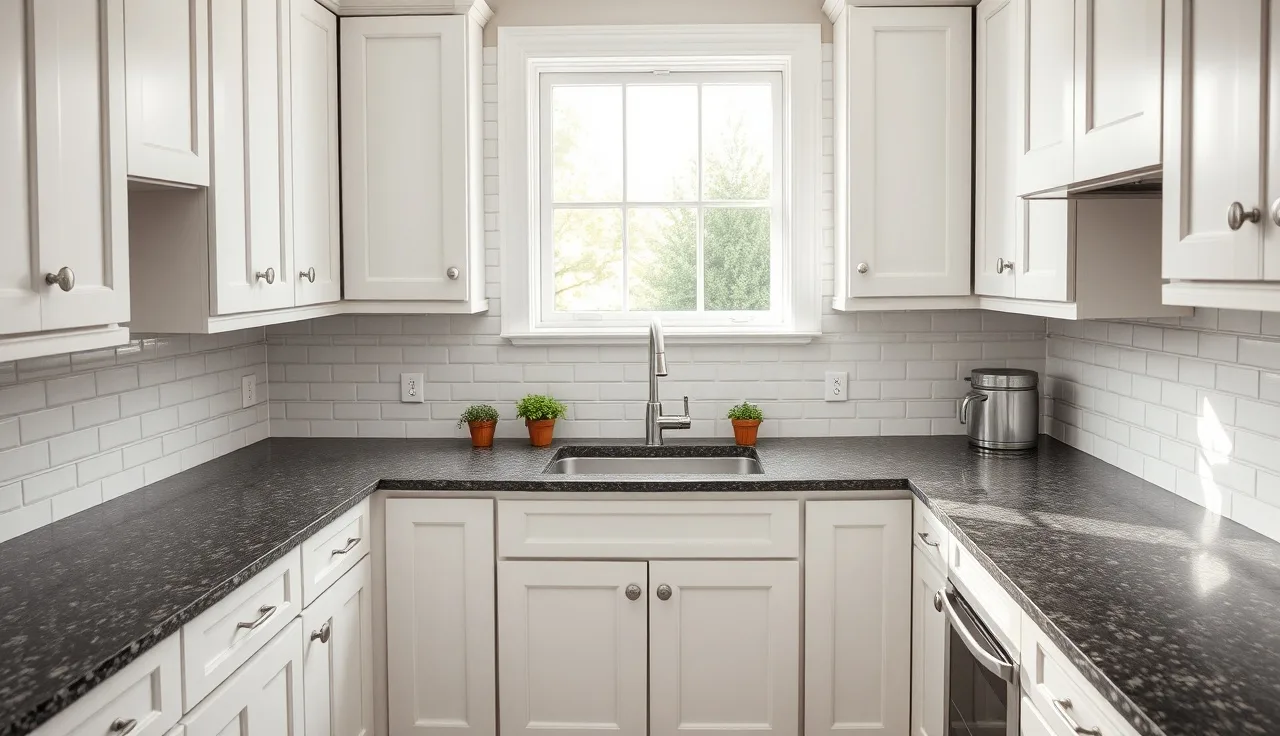
- White cabinets pair best with a backsplash that pulls one color from the granite instead of competing with it.
- Subway tile, natural stone, and glass mosaic all work.
- Budget roughly $10 to $40 per square foot installed.
- The most common mistake is picking the backsplash before the granite slab, which reverses the correct order.
Why does the backsplash selection order matter so much?
Pick the granite first. The slab drives everything else.
Granite is quarried, not manufactured, so every slab has a fixed color story. Your white cabinets are neutral, but the granite has veining, flecks, or a dominant ground color that will either fight or cooperate with whatever goes on the wall behind it [9]. Choosing a backsplash tile before you have a confirmed slab is like buying a belt before you know what pants you own.
The correct order goes like this. Select and reserve your granite slab. Bring a large sample to the tile showroom, ideally a 12x12 remnant or at least a high-resolution photo printed at scale. Hold candidate tiles against the sample in the actual lighting of your kitchen. Showroom fluorescents lie to you. Warm incandescent and cool LED read very differently on both stone and glass tile.
One practical note. If your granite has complex movement like Fantasy Brown or Typhoon Bordeaux, you almost always want a simpler backsplash. A busy tile behind a busy stone makes the space feel smaller and louder. Plain 3x6 subway tile or a solid-field natural stone reads better than a patterned mosaic in those cases, nearly every time.
What backsplash materials work best with granite and white cabinets?
The material question is really three questions. What looks right, what holds up to cooking, and what it costs.
Ceramic and porcelain tile are the workhorses. They handle heat, oil, and cleaning products without complaint. A 3x6 white or off-white ceramic subway tile costs roughly $2 to $6 per square foot for materials [1], and an installer typically charges $6 to $20 per square foot for labor depending on pattern complexity and your region. Simple grid-set subway tile sits at the low end of that labor range. Herringbone sits at the high end because the miter cuts multiply.
Natural stone tile (travertine, slate, quartzite, marble) can look stunning behind granite because the materials speak the same visual language. The tradeoff is maintenance. Stone backsplash tile needs sealing and is more vulnerable to acidic splatters from tomatoes or citrus. If you cook heavily, porcelain that mimics stone is a smarter call. You get the look without the upkeep.
Glass mosaic tile reflects light and can make a narrow galley kitchen feel brighter, which matters where the white cabinets are the only bright surface. The drawback is that glass shows grease fingerprints and water spots more readily than ceramic. It also chips if something hard hits it squarely.
Metallic tile and metal inserts (stainless, brushed brass, copper) photograph well but need more wiping. Behind a range, grease builds up in the texture of a hammered metal tile faster than most people expect. Save the metal tile for accent rows rather than a full field if cooking volume is high.
A full slab of natural stone (marble, quartzite, even a matching piece of the granite itself) as a backsplash is a premium option many fabricators now offer as an add-on. You get zero grout lines behind the range, which is easier to clean. Material costs run higher, but if your fabricator is already templating and cutting your countertop, adding a slab backsplash often costs less than you'd expect because the setup is already absorbed. Ask your fabricator for a remnant price. A full guide to granite countertops covers slab selection and remnant purchasing in more detail.
Large-format porcelain slabs (24x24 or 24x48) have gained ground the last few years. Fewer grout lines behind the range, a modern look, and porcelain's hardness means it survives heavy use. Installation is more demanding because large sheets need a flatter substrate and a skilled installer, so labor runs higher.
How do you match backsplash color to different granite types?
This is where most homeowners get stuck. The answer depends on what the granite is actually doing colorwise.
White or light granite (White Ice, Colonial White, Arctic White) has soft gray, silver, or cream movement. With white cabinets, there's a real risk of the whole kitchen going monochromatic and flat. A backsplash with a little warmth (cream, greige, soft sage, or light taupe) adds dimension. Bright white subway tile against white granite against white cabinets often reads as a single undifferentiated wall. That can work in a very modern space with strong black hardware, but in most kitchens it feels unfinished rather than clean.
Black or very dark granite (Absolute Black, Black Pearl, Ubatuba) already gets its contrast from the white cabinets. The backsplash should bridge, not add a third competing tone. White, off-white, light gray, or pale sage all work. White subway tile with gray grout often reads as the most balanced option here. Avoid a second dark tone unless the kitchen has very high ceilings and strong natural light.
Beige or tan granite (Santa Cecilia, Venetian Gold, Giallo Ornamental) has warm undertones, often with burgundy, rust, or gold flecks. White cabinets are cool. The backsplash reconciles the two temperatures. Cream, ivory, or a warm-tinted travertine-look tile pulls the warmth from the granite without making the white cabinets look dingy. Skip cool-toned gray tile here unless you want the contrast tension on purpose.
Blue or green granite (Blue Pearl, Emerald Pearl, Verde Butterfly) is a statement stone. Keep the backsplash neutral almost always. White, light gray, or a very pale glass tile that picks up one undertone from the stone. Trying to match the blue or green with a similar tile color tends to look costume-y rather than coordinated.
Multi-color granite (Labrador Antique, Multicolor Red, Fantasy Brown) rewards restraint. Pick one color from the stone and pull it into the backsplash in muted form. If the stone has warm gold and burgundy, a cream or mushroom backsplash that whispers those tones beats a tile that shouts them.
What tile patterns work well in this combination?
Pattern complexity should run inverse to the granite's visual complexity. That single rule saves most kitchens.
Running bond (classic subway, offset half-brick) is the default for good reason. It draws the eye horizontally, making kitchens feel wider. It works with every granite type. It's also the most forgiving pattern for a homeowner doing a DIY install.
Vertical stack bond is the same tile, rotated 90 degrees, stacked straight up. It creates a taller, more contemporary feel and works especially well in kitchens with lower ceilings where you want to draw the eye upward.
Herringbone adds movement and craft. Use it behind a simple granite, where the pattern itself becomes the visual interest. A 2x8 or 3x9 tile in herringbone is cleaner than the smaller 1x3 versions, which look busy at scale.
Large-format single tile (12x24 or bigger) is maximum contemporary. Virtually no grout lines. It reads as a slab rather than a tile field, and it pairs with slab-style countertops and frameless cabinetry.
A mosaic accent strip is a field of plain tile with a single row of mosaic or decorative tile at countertop height or eye level. It adds interest without overwhelming the granite. The strip works best when it picks up a color already in the stone.
Decorative patterned tile (Moroccan, encaustic-look, hand-painted) is beautiful but demands a quiet granite partner. It does not belong behind Fantasy Brown, Venetian Gold, or any other high-movement stone. Behind Absolute Black granite, a black-and-white encaustic pattern can be striking. Know what you're committing to.
What does a backsplash cost for a typical kitchen?
A standard kitchen has roughly 30 to 50 square feet of backsplash area once you subtract cabinets, windows, and outlets. The range is wide because kitchen layouts vary enormously.
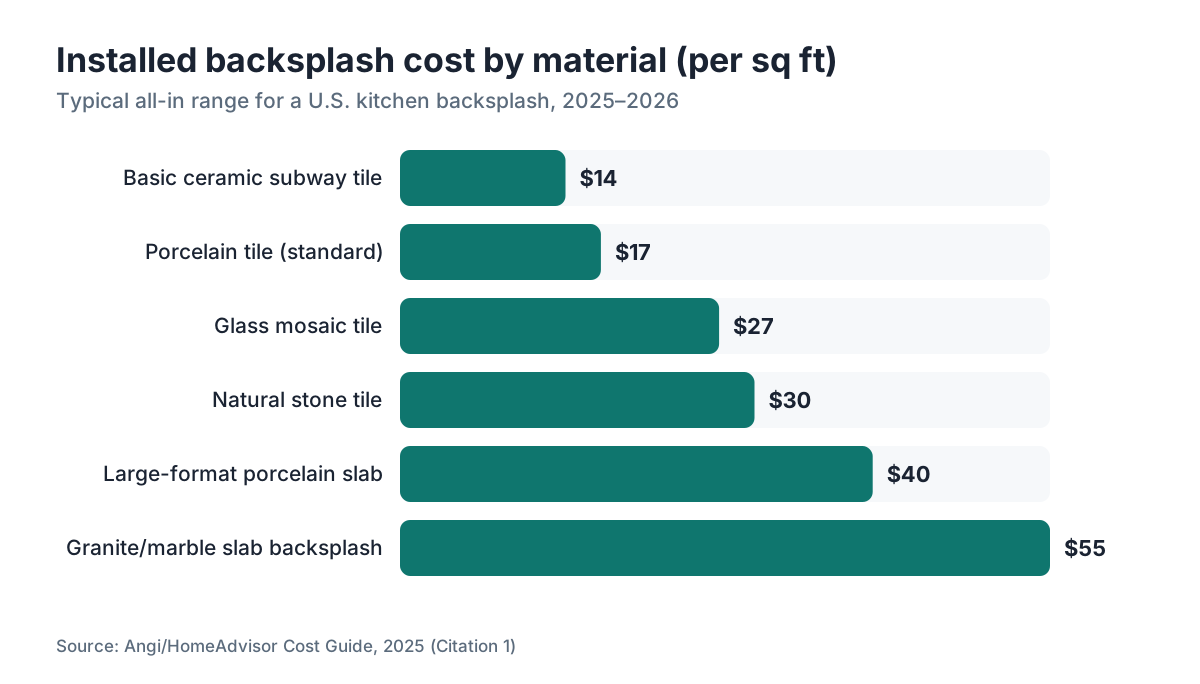
The table below shows realistic all-in installed cost ranges for common backsplash materials as of 2025 to 2026. These are material plus labor, not DIY.
| Material | Low ($/sq ft installed) | High ($/sq ft installed) | Notes |
|---|---|---|---|
| Basic ceramic subway tile | $10 | $18 | Most affordable; wide installer availability |
| Porcelain tile (standard size) | $12 | $22 | More durable than ceramic; slightly harder to cut |
| Glass mosaic tile | $18 | $35 | Higher labor due to small pieces and weight |
| Natural stone tile | $20 | $40 | Add sealing cost and ongoing maintenance |
| Large-format porcelain slab | $25 | $55 | Premium labor; fewer grout lines |
| Granite/marble slab backsplash | $30 | $80 | Usually priced per linear foot by fabricator |
For a 40-square-foot backsplash, expect $400 to $720 for basic ceramic subway tile, $1,200 to $1,600 for glass mosaic, and $1,200 to $3,200 for a full natural stone slab, roughly. Labor rates vary a lot by market. Metro areas run 20 to 40 percent higher than rural or mid-size city markets [2].
Here's a cost factor people miss. Grout color affects long-term maintenance cost more than it affects looks. White grout on a backsplash behind the range will stain and discolor. Matching or slightly darker grout (medium gray with white tile, for example) reads nearly as clean but is far easier to maintain. Epoxy grout costs more upfront, around 30 to 50 percent more than cement grout, but it resists staining and doesn't need sealing [3].
If you're already working with a fabricator on your countertop, ask about bundling the slab backsplash into the same job. SlabWise's quoting tools let fabricators price remnant slab backsplashes alongside the countertop, which sometimes surfaces pricing more competitive than a separate tile installer would quote.
For the bigger picture on kitchen countertops budgets, a separate guide covers the full scope of countertop costs.
Grout color: does it really matter that much?
Yes. More than most people realize until after they've grouted.
Grout lines create a visual grid across your backsplash. Light grout with light tile reads as a unified surface, which is usually what you want when the granite is the visual anchor. Dark grout with light tile creates a grid pattern, which emphasizes the individual tiles. That grid can be a design choice, like classic black-and-white bistro tile, but it's often an accident.
With white cabinets and white or off-white subway tile, an off-white or light gray grout reads as almost one continuous surface. True bright white grout looks great for about six months behind the range before it grays and yellows from cooking residue. Almost every professional installer will tell you the same thing: don't use bright white unsanded grout behind a cooking surface.
Epoxy grout is two-part and harder to work with, but it resists stains far better than standard cement grout and never needs sealing [3]. The National Tile Contractors Association recommends epoxy grout for areas exposed to grease and heavy use. For a backsplash directly behind a range, it's worth the extra cost and the fussier installation.
For colored granite, pull the grout tone from the stone itself. A Santa Cecilia granite often looks best with a warm linen grout rather than a cold gray, because the warm tone echoes the stone without fighting the white cabinets.
What should go behind the range specifically?
The wall directly behind the range is a different environment than the rest of the backsplash. It sees flame radiation, grease splatter, and high heat. The material choice here matters more.
Natural stone and most porcelain tile handle the heat fine. Glass tile does too, though thermal cycling (the rapid heating and cooling from stovetop burners) can stress glass tiles bonded with the wrong adhesive over time. Make sure your installer uses a heat-rated thinset, not standard mastic, behind the range [4].
Mastics (organic adhesives) are not recommended behind ranges and other heat sources. The Tile Council of North America's TCNA Handbook specifies that in areas exposed to high heat, a Portland cement-based thinset mortar must be used rather than an organic adhesive [4].
For cleaning, simpler is better behind the range. A full slab of the granite itself, with no grout lines, is the easiest to wipe. Large-format tiles with minimal grout come next. Small mosaic tiles behind the range are beautiful and a maintenance headache, because grease works into every joint. If you love a mosaic, use it on the lower field between the countertop and upper cabinets, and use a simpler tile behind the range.
A trim piece at the top of the backsplash (a pencil liner, a bullnose tile, or a metal edge strip) gives a cleaner finish at the wall-ceiling transition. It also makes future painting of the wall above easier without damaging the tile.
Are there backsplash materials that don't work with granite?
A few combinations look fine in photos and cause problems in real kitchens.
Tongue-and-groove or shiplap wood behind a range is not code-compliant in most places. The International Residential Code requires non-combustible materials on the wall behind cooking surfaces [5], and combustible materials near cooking surfaces are a leading cause of kitchen fires [10]. White-painted shiplap looks charming in farmhouse photos but it's a photo-shoot kitchen, not a cooking kitchen. If you want a wood look away from the range, a porcelain tile with a wood-grain texture gets you there safely.
Wallpapered backsplashes are not made for the wet, greasy zone behind a sink or range. They can survive on a section of wall between upper and lower cabinets where there's no direct moisture, but they're fragile and hard to repair.
Plastic laminate backsplash panels (the same material as laminate countertops) can work in lower-budget kitchens, but they look out of place next to granite. The material mismatch reads as an afterthought. If budget is tight, a simple ceramic subway tile is both cheaper and more coherent with granite than a laminate panel.
Mirror backsplash tiles were popular in the 1990s and create the impression of more space, but they show every smudge and water spot, which is brutal behind a kitchen sink. They also amplify the visual noise of a complex granite, which is rarely what you want.
How does lighting affect backsplash color in a kitchen?
Tile showrooms are lit to make tile look good. Your kitchen may be lit very differently, and the same tile can read almost as a different color under different light.
The technical concept is color rendering index (CRI) and color temperature. Standard incandescent bulbs (warm, about 2700K) make warm-toned tiles look richer and cool-toned tiles look slightly gray or green. Cool LED (4000K or higher) makes whites pop and brings out blue or green undertones. This matters most for tiles with any gray in them, because cool LED can push a soft gray tile toward blue-green in person.
The US Department of Energy recommends a CRI of 90 or higher for spaces where accurate color rendering matters [6]. For a kitchen where you're making design decisions, that's useful guidance. If your kitchen runs cool-white LEDs and you're choosing tile under warm incandescent showroom lighting, you may end up surprised.
The fix is simple. Bring a sample tile home, prop it against your counter, and look at it under your actual kitchen lighting at several times of day, including evening when only artificial light is on. Natural light shifts through the day and with the weather, which is why a backsplash that looked perfect on a sunny showroom morning can look different on a cloudy afternoon.
In north-facing kitchens with limited daylight, reflective materials like glass tile or polished stone can brighten the space by bouncing what light there is. In south-facing kitchens with strong sun, matte finishes often look richer because the glare doesn't wash out the surface.
What's the best backsplash for resale value?
Don't chase resale value with backsplash design. Chase timelessness.
Buyers touring a kitchen aren't thinking about the backsplash specifically unless it actively bothers them. The kitchen has to read as clean, updated, and coherent. An unusual or trendy backsplash can hurt resale by making a buyer think they'll need to redo it, even if it's in perfect shape.
The National Association of Realtors 2023 Remodeling Impact Report found that a kitchen upgrade recouped roughly 67 percent of its cost at resale on average [7]. The report doesn't break out backsplash on its own, and the honest industry read is that any single cosmetic element rarely drives resale in isolation. What matters is whether the whole kitchen reads as coherent and maintained.
For the broadest appeal, go with white or light gray subway tile, a classic pattern (running bond or vertical stack), and a grout color that doesn't dominate. That combination photographs well, is easy for buyers to imagine keeping, and is cheap to replace if a future owner wants a change. Skip highly personalized patterns, unusual colors, or trend-specific designs if you plan to sell in the next five to seven years.
One underrated move. A very simple white tile backsplash with a striking slab behind the range (a single piece of your granite, or a complementary marble) gives the kitchen a focal point without locking the whole wall into a pattern that may date. It photographs exceptionally well too.
DIY vs. professional installation for tile backsplash
A tile backsplash is one of the more approachable DIY projects in a kitchen. Subway tile in a running bond on a flat wall, with no elaborate cuts around windows or outlets, is genuinely learnable in a weekend.
Some things push homeowners toward a pro. Complex patterns like herringbone or Moroccan. Natural stone tile that needs wet-saw cuts to avoid chipping. Large-format tile that needs a flatter substrate and more precise thinset. And any area directly next to the range, where heat-rated installation methods are required [4].
Here's a practical consideration. Incorrect installation voids most tile manufacturer warranties. If the tile went up with the wrong adhesive (mastic instead of thinset behind the range, for example), or if the substrate wasn't prepped right, tiles may come loose within a year or two and the manufacturer won't cover it.
If you want to DIY but you're unsure about prep, the Tile Council of North America's TCNA Handbook is the industry's main reference for installation standards [4]. The Ceramic Tile Education Foundation also publishes free technical bulletins on substrate prep, adhesive selection, and grouting.
Labor to have a pro install a standard subway tile backsplash runs $200 to $600 for the labor portion alone, based on kitchens of 30 to 50 square feet and labor rates of $6 to $15 per square foot for basic patterns [2]. On a granite kitchen where the countertop and cabinets are a big sunk cost, that's often money well spent.
For related work, a guide to countertop installation covers sequencing, including the order backsplash tile and countertop should be installed (countertop first, almost always).
What are the most common backsplash mistakes with granite and white cabinets?
These come up over and over, usually in renovation-regret threads.
Choosing the backsplash before confirming the slab. Covered above, but worth repeating: the slab is the fixed variable. Everything else adjusts to it.
Matching too precisely. Pulling the exact gray from a gray-veined white granite and putting it in the backsplash sounds logical, but it often makes the kitchen feel like everything came from one catalog. A slight step in value, lighter or darker by a half-step, reads more natural.
Ignoring the grout line width. A 1/16-inch grout line on subway tile reads very differently from a 1/8-inch line. Narrower lines look contemporary and almost continuous. Wider lines look more traditional and handmade. Your installer will have a preference based on tile tolerances, but specify it if it matters to you.
Forgetting about outlets. A tile backsplash with outlets on top looks fine if the covers are swapped for low-profile ones that sit flush against the tile. Original plastic covers standing proud of the tile look sloppy. Budget $5 to $15 per outlet for oversized cover plates made for tiled surfaces.
Stopping the backsplash at a random height. The tile should run to a defined stopping point: the bottom of the upper cabinets, a window sill, or the wall edge with a proper bullnose or edge trim. A backsplash that quits mid-wall because someone ran out of tile or estimated short looks unfinished.
Skipping the backer board behind the range. Drywall, even moisture-resistant greenboard, is not an appropriate substrate behind a range. Cement board or a comparable tile backer is necessary for longevity and for compliance with installation standards [4].
Frequently asked questions
What color backsplash goes with white cabinets and black granite?
White, off-white, or light gray tile almost always reads best. White cabinets plus black granite is already high-contrast, so the backsplash should bridge the two rather than add a third competing tone. A white 3x6 subway tile with medium gray grout hits the neutral zone cleanly. Avoid anything too dark, which makes the space feel heavy, or too colorful, which distracts from the granite.
What backsplash goes with white cabinets and white granite?
Add some warmth or texture so the kitchen doesn't read as one white mass. A cream, greige, or very light sage tile prevents the monotone effect. White-on-white can work if the tile has a matte finish against a polished granite, or the reverse, because the finish contrast reads as intentional. Strong hardware and light fixtures matter a lot in an all-white palette.
Can I use marble tile as a backsplash behind granite countertops?
Yes, and it often looks excellent. Both are natural stone, so they share a visual language. Use marble tile that picks up a tone from the granite rather than fighting it. The catch is that marble is more porous and acid-sensitive than granite and needs regular sealing. Behind a sink or range, plan on resealing every one to two years to prevent staining. See our guide on how to clean stone countertops for sealing context.
How high should a backsplash be behind the range?
In most kitchens the backsplash runs from countertop to the bottom of the upper cabinets, typically 15 to 18 inches. Behind the range, if there are no upper cabinets, the tile should run at least to the height of the range hood, and preferably to the ceiling or a defined stopping point. A tile field that ends mid-wall with no upper cabinet to cap it needs proper edge trim or bullnose to look finished.
Should the backsplash match or contrast with the granite?
Neither extreme is right. The backsplash should coordinate with the granite, not match it exactly and not contrast so hard it fights. The most reliable move is to pull one secondary color from the granite's veining or flecks and use that as a muted tone in the tile or grout. This creates continuity without the kitchen feeling like it came from a single vendor's catalog.
Is subway tile outdated for granite kitchens?
No. Subway tile has been a kitchen standard since the early 1900s and stays popular because it works. What reads as dated is 3x6 white ceramic in a plain running bond with bright white grout at bargain quality, not the format itself. A 4x12 or 3x9 tile, a matte finish, a slightly warm color, or a vertical stack pattern reads contemporary while keeping the simplicity that pairs well with busy granite.
What backsplash looks best with Santa Cecilia granite?
Santa Cecilia has warm gold, cream, and burgundy tones. A warm-tinted cream, ivory, or light taupe tile bridges the granite's warmth with white cabinets without making the cabinets look dingy. Travertine-look porcelain tile in a light beige is a common, successful pairing. Skip cool gray tile here; it fights the stone's warm undertones. Warm-toned grout in linen or pale tan also echoes the granite without competing.
Can I use a piece of my granite countertop as the backsplash?
Yes, that's a slab backsplash, and fabricators offer it regularly. You get zero grout lines, matched material, and a surface that's very easy to clean behind the range. It's priced differently than tile, usually per linear foot, and your fabricator may cut it from the same slab or from remnants of your countertop job. Ask when you're getting your countertop priced. Adding it to an existing job often costs less than a separate mobilization.
What is the easiest backsplash to clean near the range?
Large-format porcelain tile or a full slab (granite, quartz, or marble) with minimal grout lines. Less grout means less surface for grease to colonize. If you use standard tile, epoxy grout is far easier to maintain than cement grout behind the range because it resists staining and never needs sealing. Polished surfaces wipe faster than textured or matte ones, though they show fingerprints more readily away from the range.
How do I know if my backsplash tile is installed correctly?
The TCNA Handbook is the authoritative reference for installation standards. Practically, look for consistent, even grout lines and no hollow or loose tiles (tap with a knuckle; solid sounds good, a hollow thud means poor adhesion). Check for proper edge treatment at stopping points and heat-rated thinset behind the range rather than mastic. Confirm outlet covers sit flush or nearly flush with the tile. Cracked or chipped tile at cuts usually signals a blade that needed replacing.
Does the backsplash go in before or after the countertop?
The countertop goes in first, almost always. The bottom edge of the backsplash tile sits on top of the countertop and is typically caulked rather than grouted at that joint, which allows slight movement without cracking. If tile goes up first, the countertop edge may not sit cleanly against the wall, and the tile may need cutting or removal. Countertop, then backsplash, then caulk the joint between them with matching-color silicone.
What grout color should I use with white tile and granite countertops?
Light gray or off-white grout is the practical choice for white tile in a kitchen. It reads nearly as clean as bright white but stains and yellows far more slowly from cooking residue. For tiles with warm tones near a Santa Cecilia or Venetian Gold granite, a warm linen grout echoes the stone. Epoxy grout costs more but is the most stain-resistant option for the area behind a range, where grease is the main adversary.
How long does a tile backsplash installation take?
A standard kitchen backsplash takes one to two days for a pro: one day to set the tile and one day to grout after the thinset cures, usually 24 hours. Complex patterns, natural stone tile needing wet-saw work, or large kitchens can push it to two or three days total. Keep the area dry and light-use for 72 hours after grouting to allow full cure, and seal cement grout within the first week.
Sources
- HomeAdvisor (Angi), Tile Backsplash Cost Guide: Basic ceramic tile for backsplash costs roughly $2, $6 per square foot for materials; installed costs range from $10 to $40 per square foot depending on material and complexity.
- U.S. Bureau of Labor Statistics, Occupational Employment and Wage Statistics, Tile and Stone Setters: Labor rates for tile installation vary by region; metro areas typically run 20 to 40 percent higher than national median rates.
- National Tile Contractors Association, Technical Bulletin on Epoxy Grout: Epoxy grout is recommended for areas exposed to grease and heavy use; it resists staining and does not require periodic sealing.
- Tile Council of North America, TCNA Handbook for Ceramic, Glass, and Stone Tile Installation: In areas exposed to high heat such as behind a range, Portland cement-based thinset mortar must be used rather than organic mastic adhesive; cement backer board is required as substrate.
- International Code Council, International Residential Code (IRC), Section R302: The IRC requires non-combustible materials on wall surfaces behind cooking appliances in residential construction.
- U.S. Department of Energy, Office of Energy Efficiency and Renewable Energy, Lighting Basics: DOE recommends a color rendering index (CRI) of 90 or higher for spaces where accurate color rendering is important.
- National Association of Realtors, 2023 Remodeling Impact Report: A kitchen upgrade recoups roughly 67 percent of its cost at resale on average, according to the 2023 Remodeling Impact Report.
- U.S. Geological Survey, National Minerals Information Center: Granite is a quarried natural stone with variable mineralogy; each slab has a unique color and pattern determined by its mineral composition and quarry source.
- U.S. Consumer Product Safety Commission, Kitchen Safety: Combustible materials near cooking surfaces are a leading cause of kitchen fires; non-combustible backsplash materials are a safety requirement in residential kitchen construction.
Last updated 2026-07-10