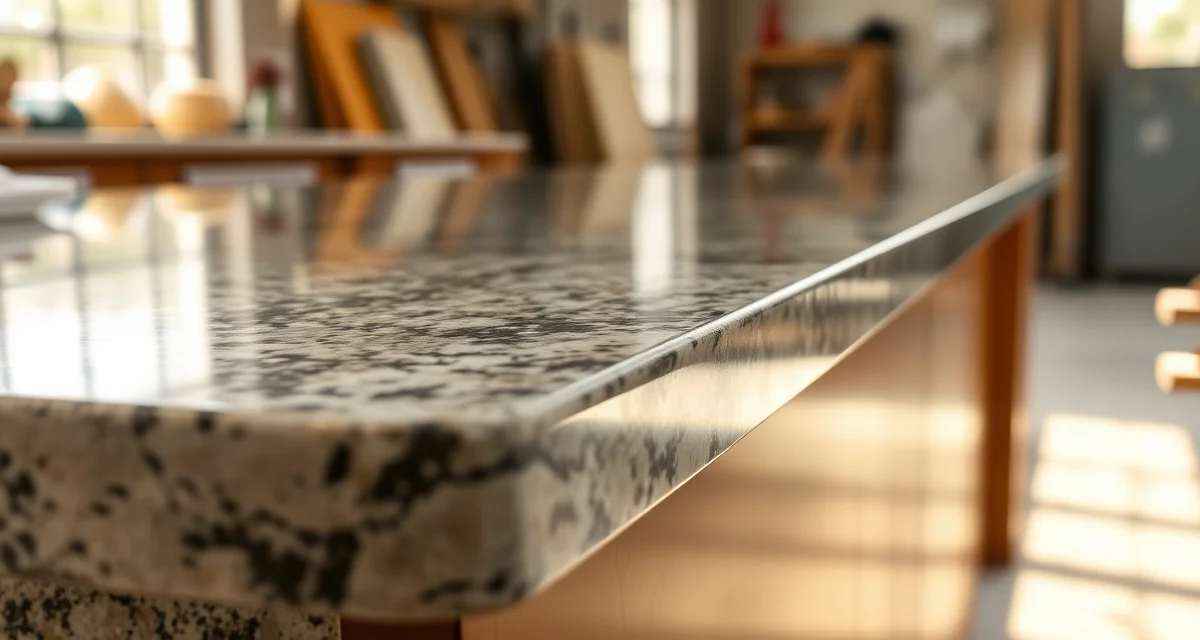
What Is Dupont Edge Profile?
Quick Definition
A Dupont edge is a decorative countertop edge profile featuring a flat ledge (step) at the top, followed by a concave curve that flows into a straight or slightly rounded bottom. It creates a clean, architectural look that is more structured than an ogee but more decorative than a simple beveled or eased edge. The Dupont profile typically costs $15-$30 per linear foot and works best on 3 cm thick material.
TL;DR
- Dupont has a flat step at the top followed by a concave curve and a straight drop to the bottom
- It costs $15-$30 per linear foot - similar to ogee pricing but slightly less for most fabricators
- Best suited for traditional to transitional kitchens - more structured and architectural than ogee
- Requires 3 cm material for proper proportions - 2 cm stone compresses the profile too much
- Named after the edge profile, not the DuPont chemical company - it is a traditional stone profile term
- Fabricated using CNC routers with specific profile wheel sets
- Less common than ogee or bullnose but popular with customers who want something distinctive
What the Dupont Edge Looks Like
The Dupont edge has three distinct sections:
Calculate your material waste savings
See exactly how much slab material and money you could save with optimized cutting layouts.
Try the free Waste Calculator-
Flat ledge (step): A short horizontal shelf at the very top of the edge, typically 3-5mm wide. This is what distinguishes the Dupont from the ogee - the ogee starts its curve immediately, while the Dupont begins with a defined flat step.
-
Concave curve: Below the flat step, the edge curves inward (concave). This section creates a visible shadow line that gives the profile its architectural character.
-
Straight or rounded bottom: The profile finishes with a relatively straight vertical drop to the underside of the countertop. Some fabricators add a slight round at the very bottom to soften the transition.
The overall effect is structured and precise - like a piece of crown molding translated into stone. The flat step catches light differently than the curved section below it, creating visual depth along the countertop edge.
Dupont Variations
Standard Dupont: The classic three-section profile described above. This is what most fabricators produce when a customer requests a "Dupont edge."
Double Dupont: Two Dupont profiles stacked vertically. This requires laminated material (3+3 cm or 6 cm total) and creates a very dramatic, heavy edge. Best reserved for islands and large-scale projects.
Dupont with Bottom Bevel: Instead of a straight bottom, the lower section angles inward at 45 degrees. This adds a modern touch to an otherwise traditional profile.
Reverse Dupont: The flat step is at the bottom instead of the top. Less common but occasionally requested for bar tops or reception desks where the underside of the edge is visible.
Dupont Edge Cost
Dupont falls in the premium edge category, though it is usually slightly less expensive than ogee because of its more geometric shape:
| Edge Profile | Typical Cost per Linear Foot | Complexity |
|---|---|---|
| Eased (square with slight round) | $0-$10 (often included) | Simple |
| Beveled | $5-$15 | Simple |
| Half bullnose | $10-$20 | Moderate |
| Full bullnose | $10-$25 | Moderate |
| Dupont | $15-$30 | Complex |
| Ogee | $15-$35 | Complex |
| Mitered | $30-$60 | Complex (different technique) |
For a typical kitchen with 40-50 linear feet of edge: Upgrading to Dupont adds approximately $600-$1,500 to the project cost compared to an included eased edge.
What Affects Dupont Edge Pricing
Material hardness: Harder stones (quartzite, dense granite) cost more to profile because of slower machining speeds and higher tooling wear. Marble and softer granite profile faster and cost less.
Material thickness: Dupont proportions are designed for 3 cm stone. On 2 cm material, the profile elements are too compressed to look right. Some fabricators refuse to do Dupont on 2 cm stone for this reason.
Length and layout: Straight runs are straightforward CNC work. Inside corners, irregular shapes, and short pieces require more manual finishing, which increases labor cost.
Finish type: A polished Dupont requires more polishing passes than a honed version because the flat step and concave curve each need separate polishing attention at different angles.
How Dupont Edges Are Fabricated
CNC Router Process
The vast majority of Dupont edges are produced on CNC routers:
- Profile wheel selection: The fabricator installs a diamond profile wheel (or set of wheels) shaped to cut the Dupont geometry into the stone edge
- Rough profiling: The CNC makes the initial cut, creating the flat step, concave curve, and straight bottom section
- Progressive polishing: A series of polishing pads (from coarse to fine) are run along each section of the profile
- Quality check: The fabricator inspects the transitions between the flat step and the curve - this is where inconsistencies most often appear
- Final polish: The last polishing pass brings the edge to the specified finish level
Manual Finishing Requirements
Even with CNC production, certain parts of Dupont fabrication often require hand work:
Inside corners: Where an L-shaped or U-shaped countertop meets at an inside corner, the Dupont profile must transition smoothly. CNC machines handle straight runs, but inside corners need a skilled fabricator with hand tools to blend the profile.
Seam transitions: At seams, the flat step on one piece must align perfectly with the flat step on the adjoining piece. Even a slight misalignment at the step is more visible than misalignment on a rounded profile like bullnose, because the flat section creates a sharp shadow line that highlights any offset.
Sink cutout edges: If the customer requests a Dupont profile on the edges of a sink cutout (for drop-in sinks), this requires careful CNC programming or hand fabrication on the curved portions of the cutout.
Template Accuracy for Dupont
The Dupont profile amplifies any template or measurement errors. Here is why:
The flat step creates a precise horizontal reference line that runs the full length of the countertop edge. If the countertop does not sit perfectly flush against the wall or cabinets, the step creates a visible gap line. With a rounded profile like bullnose, minor fit issues are harder to see because there is no sharp horizontal reference.
This is where tools like SlabWise's template verification make a measurable difference. The 3-layer check catches dimensional errors that would show up as visible gaps or alignment issues once the Dupont edge is fabricated and installed.
Best Materials for Dupont Edges
| Material | Dupont Suitability | Notes |
|---|---|---|
| Granite | Excellent | Holds the sharp transitions well; wide variety available |
| Marble | Very good | Beautiful results; the step catches light nicely on polished marble |
| Quartzite | Good | Excellent durability but requires more machining time |
| Engineered quartz | Good | Consistent results; watch for overheating at the step during polishing |
| Porcelain slab | Poor | Too thin for proper Dupont proportions; chips at the step |
| Solid surface (Corian) | Good | Easy to machine but lacks the visual depth of natural stone |
Granite and marble are the most popular material choices for Dupont edges because the natural stone character enhances the architectural feel of the profile.
Design Pairings That Work
Where Dupont Excels
Traditional kitchens with crown molding: The stepped profile echoes the geometric shapes found in traditional crown molding, wainscoting, and raised-panel cabinetry.
Transitional kitchens: Dupont bridges the gap between traditional ornament and modern simplicity. It has more visual interest than an eased edge but less ornamentation than a double ogee.
Kitchen islands as focal points: Using Dupont on the island edge while keeping perimeter counters with a simpler profile (eased or beveled) draws attention to the island without overdoing the detail.
Bathroom vanities: On marble or granite vanity tops, the Dupont step creates an elegant finish that complements both traditional and transitional bathroom designs.
Bar tops and reception desks: The Dupont profile works well where the countertop edge is visible and at eye level. The flat step adds a detail that rewards close viewing.
Where Dupont Does Not Work
Modern minimalist kitchens: The stepped profile conflicts with flat-panel cabinets and simplified modern design. Eased, beveled, or mitered edges are better choices.
Very busy kitchens: The concave curve and step create small areas where crumbs and moisture collect. Not a major issue, but simpler profiles are easier to wipe clean.
Thin materials: Dupont does not work on 2 cm stone or porcelain slabs. The profile elements need at least 3 cm to look proportionally correct.
Tight budgets: At $15-$30/lf, the Dupont upgrade adds $600-$1,500 to a kitchen project. If the budget is stretched, consider a half bullnose or beveled edge for a fraction of the cost.
Dupont vs. Ogee: The Key Differences
These two profiles are often compared because they occupy a similar price and style range. Here is how they differ:
| Feature | Dupont | Ogee |
|---|---|---|
| Top of profile | Flat step (geometric) | Concave curve (flowing) |
| Overall feel | Architectural, structured | Flowing, classical |
| Shadow lines | Sharp, defined | Soft, gradual |
| Design era | Georgian, Federal, neoclassical | French, Italian, baroque |
| Dust/crumb collection | Moderate (step collects some) | Moderate (curve collects some) |
| Fabrication approach | Slightly easier (geometric cuts) | Slightly harder (continuous curve) |
| Visual weight | Moderate-heavy | Heavy |
| Cost | $15-$30/lf | $15-$35/lf |
Choose Dupont when: You want a decorative edge that feels precise and architectural rather than ornately curved. Dupont pairs better with American traditional and neoclassical kitchen designs.
Choose ogee when: You want a flowing, classical European look. Ogee is more dramatic and ornamental, making it the better choice for formal French or Italian-inspired kitchens.
Maintenance and Durability
Cleaning the Dupont Edge
The flat step is the one maintenance consideration specific to this profile. It creates a small horizontal shelf where crumbs, water droplets, and cleaning product residue can sit.
Daily maintenance:
- Wipe along the edge (including the step) during your normal countertop cleaning
- Use a damp cloth to sweep crumbs off the step
- Dry the edge after cleaning to prevent water spots in the concave section
Periodic deep cleaning:
- Use a soft toothbrush to clean the junction where the flat step meets the concave curve
- A cotton swab works for detail cleaning in the curve
Chip Resistance
The flat step makes the top edge of the Dupont profile slightly more vulnerable to chipping than a rounded profile like bullnose. If something strikes the outer corner of the step, a small chip can break away.
However, Dupont is actually more chip-resistant than a sharp eased edge because the step sits slightly inboard from the very edge of the countertop. The geometry distributes impact force better than a 90-degree corner.
Chip repair: Small chips in the step area can be filled with color-matched epoxy. The flat surface of the step actually makes repairs easier to blend compared to curved profiles where the repair material needs to match a continuous radius.
Frequently Asked Questions
How much does a Dupont edge cost? Dupont edges typically cost $15-$30 per linear foot. For an average kitchen with 40-50 linear feet of finished edge, that adds $600-$1,500 over a basic eased edge.
Is the Dupont edge named after the DuPont company? No. The name comes from the architectural molding tradition. The Dupont profile has been used in stone and woodwork for centuries, long before the DuPont chemical company existed.
Can you do Dupont on 2 cm stone? Technically possible, but not recommended. The profile elements (step, curve, straight drop) are compressed on 2 cm material and look disproportionate. Most fabricators will steer you toward 3 cm for a proper Dupont.
What is the difference between Dupont and ogee? The Dupont starts with a flat step at the top, then curves inward. The ogee starts immediately with a flowing S-curve (concave into convex). Dupont feels more architectural and geometric; ogee feels more classical and flowing.
Is Dupont a popular edge choice? It is less common than eased, beveled, or bullnose edges but has a dedicated following among homeowners who want something distinctive without going as ornate as a double ogee. It is most popular in traditional and transitional kitchen designs.
Can Dupont be done on all four sides of an island? Yes. This is actually one of the best applications for Dupont - a freestanding island with the profile visible from all sides. Budget for edge fabrication on all exposed sides when quoting.
Does Dupont edge work with undermount sinks? Yes. The Dupont profile is applied to the countertop's exterior edges. The sink cutout edge is typically finished with a standard eased or slightly rounded profile regardless of the exterior edge choice.
How do fabricators match Dupont at seams? The flat step must align precisely between adjoining pieces. CNC machines produce consistent profiles, but the fabricator needs to verify alignment during dry-fitting before epoxying the seam. This is one of the trickier aspects of Dupont fabrication.
Is Dupont harder to fabricate than bullnose? Yes. Dupont requires more precise CNC tooling and additional polishing passes compared to a simple bullnose. The flat step must be perfectly level and the transition into the curve must be smooth - any waviness in these areas is highly visible.
Can I combine Dupont with a laminated edge? Yes. Laminating two 3 cm pieces together (creating a 6 cm thick edge) allows for a double Dupont or an elongated single Dupont profile. This is a high-end option that adds significant visual weight to the countertop.
What cabinet style looks best with Dupont? Raised-panel and Shaker cabinets pair well with Dupont. The stepped profile echoes the recessed panel geometry in these cabinet styles. Flat-panel (slab) cabinets do not pair as naturally with Dupont's traditional character.
How do you pronounce Dupont edge? It is pronounced "doo-PONT" with the emphasis on the second syllable. Same pronunciation as the family name, though the edge profile has no connection to the DuPont corporation.
Price Your Edge Profiles Accurately and Fast
Different edge profiles, different labor costs - and your customers want those numbers in their quote quickly. SlabWise's Quick Quote tool builds material-specific, edge-profile-aware estimates in 3 minutes instead of 20. Eased, dupont, ogee, mitered - every option priced accurately with your shop's real labor rates. Start your 14-day free trial and close more jobs with faster, more professional quotes.
Try These Free Tools
- Photo to Template -- Snap a photo of an existing countertop and get an AI-generated DXF template.
- Template Compare -- Upload two templates and see every dimension change highlighted instantly.
- AI Template Verification -- Cross-check your template against manufacturer specs before cutting.
Sources & Further Reading
- Natural Stone Institute - Countertop Support Guidelines
- International Surface Fabricators Association - Structural Support Requirements
- National Kitchen & Bath Association - Countertop Installation Standards
- ASTM International - C1526 Standard Specification for Serpentine Dimension Stone