TL;DR
- Beige granite countertops run $40 to $100 per square foot installed, depending on the stone grade and your region.
- They're among the most forgiving kitchen colors, hiding crumbs and minor stains better than white or black granite.
- Sealed once a year, they hold up for decades.
- The main trade-off: every slab looks different, so you need to see your actual piece before you commit.
What exactly counts as beige granite?
Granite is an igneous rock, formed when magma cools slowly deep in the earth. The mineral mix, cooling rate, and regional geology all determine the final color. "Beige" granite isn't a formal geological category. It's a loose commercial term covering stones that read as warm off-white, sand, tan, caramel, or light brown on a kitchen counter. Most of what gets sold under that label is dominated by feldspar minerals, which tend toward creamy or buff tones, with veining and flecks from quartz, mica, and occasionally dark minerals like hornblende.
The line between beige granite and beige quartzite sometimes gets blurry. True quartzite is a metamorphic rock, harder and less porous than granite, and some trade names move between categories depending on the importer. If you're being sold "White Macaubas" or "Taj Mahal" as beige granite, ask your fabricator to confirm the actual rock type, because quartzite and granite behave differently under sealers and under daily acid exposure [1].
For practical purposes, beige granite is any slab that your kitchen designer, contractor, or fabricator would describe as beige, cream, champagne, wheat, or warm-neutral in color. That definition covers a lot of popular stones.
What are the most popular beige granite colors and names?
A few names come up constantly at fabrication shops and stone yards.
New Venetian Gold is probably the single most installed beige granite in the US over the last 20 years. It comes from Brazil, has a warm cream base with gold veining and reddish-brown movement, and it pairs well with honey-oak and medium-brown cabinets. Slabs tend to be consistent enough that a homeowner doesn't get huge surprises between the sample and the actual piece.
Santa Cecilia is similar in color range but busier, with more flecks and a pattern that reads almost busy up close. It's a crowd-pleaser for traditional kitchens and has been common enough in production homes that many buyers associate it with builder-grade work. That's a perception issue, not a quality issue.
Giallo Ornamental (also spelled Giallo Ornamentale) comes from Brazil as well, with a creamy background and scattered dark mineral flecks. The overall effect is calmer and more elegant than Santa Cecilia. It looks good with white, gray, or natural-wood cabinets.
Crema Bordeaux leans more toward warm tan with burgundy and gray veining. If you want something with a little more visual movement than a flat beige, this one works.
Ivory Fantasy and Kashmir White both trend toward lighter, cooler beige with soft gray veining. They read more neutral than gold, which makes them easy matches for painted cabinets in white, light gray, or sage green.
Typhoon Bordeaux has a warm cream base with dramatic dark and rust veining. It's louder than the others listed here, and some homeowners love exactly that.
The key thing to understand: two slabs of the same trade name can look noticeably different from each other, because they come from different parts of the same quarry or different quarries entirely. Always view and approve the actual slabs being cut for your job.
How much do beige granite countertops cost?
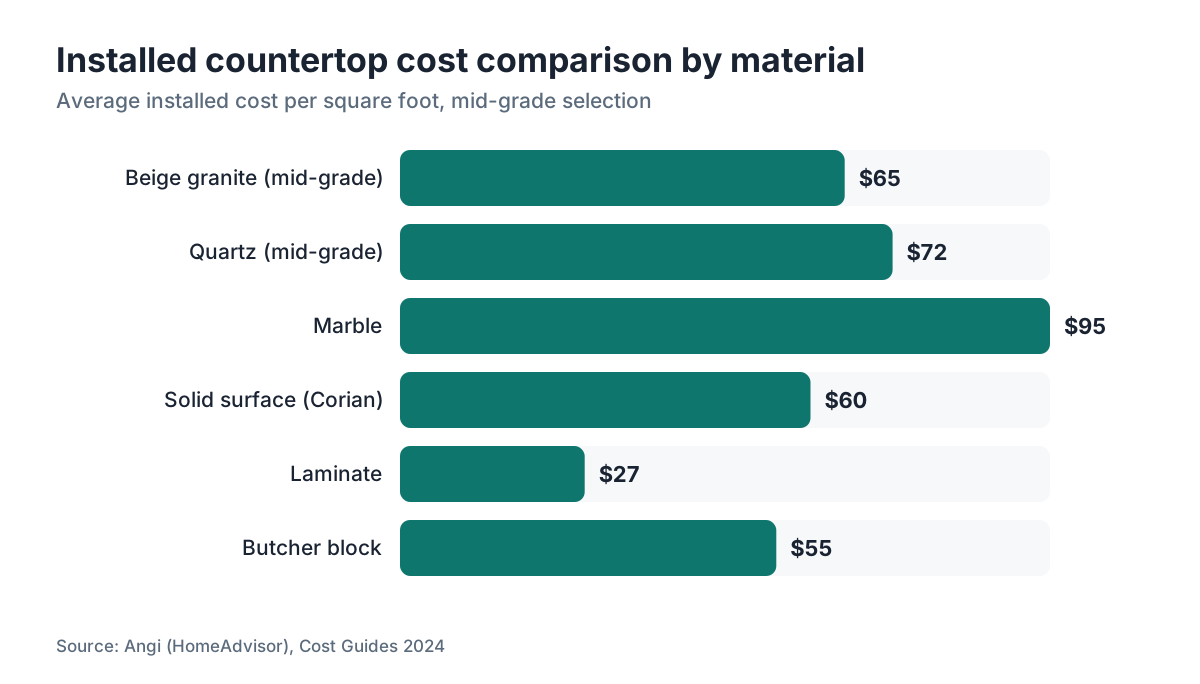
Installed cost runs roughly $40 to $100 per square foot for most beige granite, with the sweet spot for mid-grade stones landing around $55 to $75 per square foot installed [2]. That number includes material, fabrication (cutting, edging, polishing), and installation. It does not include demolition of old countertops, plumbing disconnect/reconnect, or backsplash work.
Several things push the price up or down:
Stone grade. Fabricators and distributors sort granite into tiers, often labeled Level 1 (or commercial grade), Level 2, and Level 3+. New Venetian Gold and Santa Cecilia are often Level 1 or 2, so they're on the affordable end. Rarer imported stones climb into the $80 to $150+ range for material alone.
Edge profiles. A standard eased or beveled edge is usually included in the base price. Ogee, waterfall, dupont, or full bullnose edges add $10 to $30 per linear foot for the extra machining time [3].
Cutouts. Each sink cutout typically adds $100 to $200. Cooktop cutouts run similar. A farmhouse apron-front sink requires careful templating and can add $150 to $300 depending on the shop.
Thickness. Most residential countertops use 3 cm (about 1.25 inches) slab, which is standard pricing. Some buyers choose 2 cm for islands with a laminated edge to fake the thickness, which can save a few dollars per square foot. The choice matters more for structural overhangs than for day-to-day durability.
Region. Labor rates vary a lot. Expect to pay toward the high end of ranges in coastal metro areas. Midwest and Southeast markets tend to run lower.
For fabricators running multiple jobs, quoting consistency matters as much as raw material cost. Software like SlabWise helps shops calculate edge linear footage, cutout counts, and material waste automatically, which keeps job-level margins from slipping on larger projects.
A rough budget for a typical 40-square-foot kitchen (average US kitchen counter area) at $65 per square foot installed is about $2,600. Add two edge cutouts and upgraded edges, and you're looking at $3,000 to $3,500 all in.
How does beige granite compare to quartz, marble, and other countertop materials?
The honest comparison starts with what you're actually giving up or gaining.
Beige granite vs. beige quartz. Quartz (engineered stone) is non-porous, so it doesn't need sealing. Granite does. Quartz is more consistent in appearance because it's manufactured. Granite is natural, so it varies. On durability: both are hard. Quartz is slightly more flexible and less prone to chipping at edges. Granite is more heat-resistant. If you put a hot pan directly on granite, you'll almost certainly be fine. Do the same with most quartz, and you risk cracking or discoloring the resin. For busy cooking households, that's a real practical point in granite's favor.
Cost-wise, entry-level quartz and entry-level granite are often within $5 to $15 per square foot of each other installed. Premium designer quartz like Cambria runs $80 to $150+ installed and is priced above most granite.
Beige granite vs. marble. Marble is softer (typically 3-4 on the Mohs hardness scale vs. granite's 6-7) [4] and etches on contact with acids, meaning orange juice, wine, and lemon will leave dull marks that aren't technically stains but are highly visible. Beige granite does not etch. For a working kitchen where people cook rather than photograph, granite is the more practical choice. If aesthetics are the priority and you're willing to maintain it carefully, marble countertops have a look granite doesn't replicate.
Beige granite vs. laminate or butcher block. Laminate countertops cost $15 to $40 installed and are serviceable but not resalable value drivers. Butcher block countertops cost similar to entry granite but need regular oiling and are vulnerable to water damage around sinks. Granite wins on longevity and resale.
Beige granite vs. Corian or solid surface. Solid surface scratches more easily but can be sanded and refinished. Granite can't be refinished short of professional honing. For households with young kids who drag things across counters, solid surface is worth considering.
The table below summarizes the key differences across common materials.
| Material | Installed cost ($/sq ft) | Needs sealing | Etches with acids | Heat-resistant |
|---|---|---|---|---|
| Beige granite | $40, $100 | Yes, annually | No | Yes |
| Quartz (mid-grade) | $50, $90 | No | No | Moderate |
| Marble | $60, $150 | Yes, frequently | Yes | Yes |
| Laminate | $15, $40 | No | No | No |
| Butcher block | $35, $75 | Yes (oil) | No | No |
| Solid surface (Corian) | $40, $80 | No | No | Low |
What cabinet and flooring colors work with beige granite?
Beige granite is a warm neutral, and that warmth is both its strength and the thing to design around. It generally doesn't work well with cool-toned everything, because the stone will fight the cabinets rather than complement them.
Dark espresso or walnut cabinets pair well with lighter beige granites like Ivory Fantasy or Giallo Ornamental. The contrast reads elegant without being harsh.
White or off-white painted cabinets work with almost all beige granites, but be careful with pure bright white. The granite will look dingy next to it unless the stone leans cream rather than tan. Antique white, linen, and warm white are safer companions.
Honey oak or natural wood cabinets match best with New Venetian Gold and other warm gold-tone beige granites, because the undertones match. This combination reads traditional to some buyers, but in a farmhouse or craftsman kitchen it works well.
Gray cabinets are a mixed bag. Cool gray fights warm beige. If you have cool gray cabinets, you'd be better served by Kashmir White or another beige granite with gray undertones rather than gold ones.
Flooring matters too. Warm beige granite with warm hardwood floors and warm cabinets creates a monochromatic scheme that can feel heavy or dated. Breaking it up with a cooler backsplash tile or painted cabinets helps. Light gray tile floors or white oak hardwood both work well as floor choices with most beige granite.
The bottom line: pick your granite slab first, bring a cabinet door sample to the stone yard, and hold them together in natural light. Photos and online swatches are not reliable for color matching stone.
How do you seal and maintain beige granite countertops?
Granite is porous to varying degrees, and most beige granite falls in the moderate-porosity range. Unsealed, it will absorb oils, wine, and dark liquids over time, leaving stains that are difficult to remove. A properly applied penetrating sealer fills those pores and buys you time to wipe up spills.
How often to seal. The standard guidance from stone care manufacturers is once a year for moderate-use kitchen granite [5]. A simple test: put a few drops of water on the surface. If the water beads for several minutes, the sealer is still working. If it absorbs in under 3-4 minutes, it's time to reseal.
What sealer to use. Penetrating (impregnating) sealers are the right choice for granite. They soak in below the surface rather than coating it. Topical sealers sit on top, alter the sheen, and peel. Look for sealers explicitly rated for granite, with active ingredients like fluoropolymers or siloxanes. Common retail products like Tuff Duck, Stone Tech Bulletproof, and 511 Impregnator all work. Apply thin, wipe off the excess within 5 minutes, and let it cure for a few hours before heavy use.
Daily maintenance. Mild dish soap and warm water on a soft cloth is all you need for daily cleaning. You do not need specialty stone cleaners for everyday use. Avoid bleach, ammonia-based cleaners, and vinegar. Vinegar is mildly acidic and won't etch granite the way it etches marble, but it degrades sealers faster with repeated use.
For deeper cleaning guidance on stone surfaces, the how to clean stone countertops guide covers poulticing for stains and what to do when soap film builds up.
Oil stains are the most common problem with beige granite because the light background shows them clearly. A poultice of baking soda and acetone, left on the stain overnight and sealed with plastic wrap, pulls most oil stains out of granite. It takes patience, not expensive products.
Does beige granite add value to a home?
Granite countertops generally show up on real estate listings as a positive feature, and buyers respond to them. The National Association of Realtors' "Remodeling Impact" report has tracked kitchen upgrades and their resale return for years. Their 2022 edition found that a complete kitchen upgrade (which includes countertops) recovers about 67% of its cost at resale [6]. That's not a one-to-one return, but countertops are one of the first things buyers notice in kitchen photos.
Beige specifically ages well from a resale standpoint because it's neutral. It doesn't impose a strong style on a buyer's vision the way a very dramatic or unusual stone might. The same reason interior designers sometimes dismiss it as "boring" is the reason it doesn't alienate buyers.
There's a ceiling effect to keep in mind. If you put a $90-per-square-foot granite into a kitchen in a $250,000 home, you probably won't get that back. Match the material quality to the home's price tier. Mid-grade beige granite at $55 to $70 installed fits most homes reasonably. Going premium on material makes more sense when the rest of the home supports it.
Beige granite also photographs better than very light or very dark stones in typical real estate conditions. It doesn't blow out or go completely black under bright overhead lighting, which helps listing photos.
What should you ask a fabricator before buying beige granite?
The buying experience for granite is different from buying quartz. The process has more variables, and the right questions save money and prevent disappointment.
Can I see the actual slabs? Always say yes to this. Most fabricators work with local stone distributors who let customers visit their warehouses and tag specific slabs. You're buying this particular piece of stone, not the stone by name. Two New Venetian Gold slabs can differ noticeably.
What's included in your price? Get clarity on: edge profile (which one is included, what upgrades cost), number of cutouts included, delivery/installation, and whether sealing is included or extra.
How do you template? Digital templating with a laser (CNC) is standard at most professional shops and produces more accurate cuts than paper templates. Ask about it.
What's your lead time? Most jobs take 1 to 3 weeks from template to installation. If a shop is quoting you 5 to 6 weeks, they're busy or understaffed. If they're quoting you 3 days, they're either very small or cutting corners somewhere.
Do you offer remnant slabs? For smaller projects like a bathroom vanity or a kitchen island, a remnant from a previous job can cut material cost significantly. Beige granite remnants are common because it's such a popular stone.
For a full walkthrough of the installation process, the countertop installation guide covers what happens from template to final inspect.
Fabricators running multiple jobs should be tracking these details systematically. SlabWise is countertop fabrication software built for shops that want accurate quotes and better slab utilization, which is relevant when you're nesting beige granite slabs and trying to minimize waste.
Is beige granite a good choice for bathrooms?
Yes, and in some ways it's a better environment for granite than a kitchen. Bathrooms see less daily abuse from cooking and heavy traffic. The main concern in a bathroom is water pooling around the faucet, which can eventually degrade unsealed granite.
Beige granite vanity tops are popular in master baths and guest baths alike. The warm tones work well with the creamy or neutral palettes common in bathroom design. Because bathroom countertops are smaller than kitchen countertops, the cost stays manageable even at higher price tiers. A 24-inch by 48-inch vanity top at $65 per square foot installed runs about $520 for material and labor, which is accessible for most budgets.
One practical note: bathroom vanity tops often ship with pre-cut sink holes and are available as prefabricated units, which costs less than custom fabrication. For standard oval or rectangular undermount sinks, a prefab unit in Santa Cecilia or New Venetian Gold may run $150 to $300 at home improvement stores, though the selection and edge options are limited.
What are the downsides of beige granite countertops?
There are real trade-offs, and nobody should spend $3,000 on countertops without knowing them.
It shows grease and oily residue. Beige backgrounds make cooking oil splatter visible in a way dark granite doesn't. It's not a stain in the sealer-failure sense, just a visual smear that requires more frequent wiping than a darker stone.
It needs sealing and maintenance. This is a commitment. If you're away from home for months at a time or you don't want to think about it, engineered quartz is more forgiving.
It can look dated. New Venetian Gold and Santa Cecilia have been installed in millions of American homes since the early 2000s. Buyers who associate those patterns with builder-grade construction from 20 years ago may have a negative first impression. If resale is a concern in a high-end market, a less common stone or a move to quartz might serve you better.
Slabs vary. If you don't see the actual slab, you may get something that looks very different from what you expected. This is the most common source of customer dissatisfaction in granite jobs, and it's entirely avoidable by visiting the stone yard.
It can crack under impact. Granite is hard but brittle. A heavy pot dropped at exactly the wrong spot on an edge can chip or crack the stone. Repairs are possible but visible on light-colored stone. This is less a reason not to buy granite than a reason to handle heavy cookware carefully.
How do fabricators price beige granite jobs?
If you're a fabricator rather than a homeowner, the pricing logic for beige granite follows the same structure as any granite job, but beige has a few wrinkles worth knowing.
Beige granite slabs in popular grades (Level 1-2) run $25 to $50 per square foot wholesale at most distribution yards. Material cost is the floor. On top of that, you're pricing fabrication (typically $15 to $25 per square foot for cutting and polishing), edge work (linear footage times your edge rate), and installation labor.
Waste is a real variable. Beige granite often has quieter patterns, which means seaming locations are more flexible than with heavily directional stones. That's a fabrication advantage: you can nest the pieces more efficiently and waste less slab. On a job with complex layouts or multiple cutouts, tight nesting on a 120x66 slab versus a wasteful layout can be the difference between a profitable job and a break-even one.
For shops tracking material utilization across jobs, the waste percentage on light, pattern-neutral granites like Ivory Fantasy or Giallo Ornamental tends to run lower than on book-matched or directional stones. If you're not tracking yield by stone type, you don't actually know your real margin on those jobs.
Edge upsells matter on beige granite specifically because the buyer is often looking at a traditional kitchen and is more receptive to classic edge profiles like ogee or dupont. Edge upsells at $15 to $25 per linear foot on a 40-linear-foot perimeter add $600 to $1,000 in revenue on a job that might otherwise be thin.
Frequently asked questions
What is the most popular beige granite for kitchen countertops?
New Venetian Gold is probably the most installed beige granite in the United States over the past two decades. It comes from Brazil, has a warm cream base with gold and reddish-brown veining, and pairs well with most cabinet colors, from honey oak to painted white. Santa Cecilia and Giallo Ornamental are close behind in sales volume. All three are widely available through stone distributors and home improvement stores.
How long does beige granite countertop installation take?
The installation itself usually takes two to four hours for a typical kitchen. The total project timeline from template to install runs one to three weeks at most professional fabrication shops. Templating happens first, then cutting and fabrication at the shop, then installation. Plumbing under the sink should be disconnected before the fabricator arrives and reconnected after, which can add a couple of hours if you're paying a plumber.
Does beige granite stain easily?
With a properly maintained sealer, beige granite resists most stains from everyday use. The vulnerabilities are cooking oil, red wine, and dark liquids left to sit. Beige backgrounds show oil residue more visibly than dark granite does, so it needs more frequent wiping. Most stains on sealed granite come off with a damp cloth. Stubborn oil stains respond to a baking soda and acetone poultice left overnight.
Can you use beige granite in an outdoor kitchen?
Yes, granite holds up outdoors. It handles heat, UV exposure, and rain without degrading. Beige granite used outdoors will need more frequent sealing, perhaps twice a year, because outdoor exposure breaks sealers down faster. Avoid granite with high iron content if you're in a very wet climate, because iron minerals can rust. Ask your stone supplier about the specific stone's composition before committing to outdoor use.
How do I know if my beige granite needs to be resealed?
Put a few drops of water on the surface and wait four minutes. If the water still beads up, the sealer is intact. If the water absorbs and darkens the stone, it's time to reseal. Most beige granite in active kitchens needs resealing once a year. In a lower-traffic bathroom, every two years may be enough. Use a penetrating impregnating sealer rated for granite.
What edge profiles work best with beige granite?
Eased and beveled edges are standard and lowest cost. For traditional or transitional kitchens where beige granite is most common, ogee and dupont edges are popular upsells and look appropriate with the style. Waterfall edges work on islands. Pencil round and half-bullnose read clean on more modern kitchens. Your fabricator should show you profile samples before you commit, since the edge dramatically changes how the counter reads.
Is beige granite heat-resistant?
Granite is highly heat-resistant and won't scorch from hot pots or pans under normal cooking conditions. A searing pan set directly on granite won't damage the stone. The thermal shock risk, a very cold slab hit by something very hot, is theoretical at normal cooking temperatures. In practice, granite is one of the safest countertop surfaces for heavy cooking use, far more so than quartz, laminate, or solid surface.
How thick should beige granite countertops be?
Three centimeters (about 1.25 inches) is the residential standard and what most fabricators quote by default. It's strong enough for standard overhangs up to about 10 to 12 inches without additional support. Two-centimeter slabs are thinner, slightly less expensive, and sometimes used with a laminated edge to add visual thickness. For islands with seating overhangs beyond 12 inches, structural support or corbels are needed regardless of thickness.
Can I put beige granite in a small kitchen without it feeling heavy?
Yes. Beige is lighter than darker granites and tends to open up a small space rather than close it in. Kashmir White and Ivory Fantasy, both on the lighter end of the beige spectrum with subtle gray veining, work particularly well in small kitchens. Pair them with light cabinets and good lighting and the counters won't dominate the space. Busy patterns like Typhoon Bordeaux are harder to manage in smaller rooms.
What's the difference between beige granite and quartzite?
Granite is igneous rock; quartzite is metamorphic, formed from sandstone under heat and pressure. Quartzite is typically harder and less porous than granite but also more expensive. Some trade names sold as beige granite are actually quartzite. The practical difference: quartzite is more resistant to etching and generally needs sealing less frequently. Ask your stone supplier to confirm the rock type, especially for stones like Taj Mahal or White Macaubas.
How much does a beige granite remnant cost?
Remnants (leftover pieces from larger slab cuts) for beige granite typically run $150 to $500 for a piece large enough for a bathroom vanity or small island. The price depends on size, stone grade, and whether fabrication is included. Remnants are often the best deal in countertop buying for small projects. Ask fabricators directly, since most shops accumulate remnants but don't always advertise them.
Does beige granite work with stainless steel appliances?
Yes, well. The warm neutral tones of beige granite don't clash with stainless steel the way very warm or very cool stones sometimes do. New Venetian Gold and Giallo Ornamental in particular look clean next to stainless refrigerators, ranges, and dishwashers. The metal's cool tone actually provides a slight contrast to the warm stone that reads well in most kitchen styles from traditional to transitional.
Is beige granite good for a bathroom vanity?
Beige granite is a solid choice for bathroom vanities. The warm tones suit the creamy, neutral palettes common in bath design, and the smaller square footage keeps costs manageable. A 24x48-inch vanity top runs roughly $400 to $600 installed at custom rates, or $150 to $300 as a prefabricated unit. Seal around the faucet area carefully, since standing water is the main risk in bathrooms.
What kitchen styles go best with beige granite countertops?
Traditional, transitional, and farmhouse kitchens are the natural fit for most beige granites. The warm tones and natural variation in the stone align with styles that emphasize warmth and organic materials. It's harder to make beige granite work in a very minimalist or industrial kitchen, where the pattern and warmth can feel out of place. For contemporary kitchens, leaning toward the quieter beige granites like Ivory Fantasy or Kashmir White gives you more design flexibility.
Sources
- U.S. Geological Survey, Mineral Resources Program: Granite and Quartzite: Granite is an igneous rock and quartzite is a metamorphic rock; they are geologically distinct materials with different porosity and hardness characteristics.
- HomeAdvisor (Angi), Granite Countertop Cost Guide: Installed granite countertop costs average $40 to $100 per square foot depending on stone grade and region.
- HomeAdvisor (Angi), Countertop Edge Profiles Cost: Upgraded edge profiles add $10 to $30 per linear foot above the standard eased or beveled edge.
- Marble Institute of America (MIA+BSI), Care and Maintenance of Natural Stone Surfaces: Penetrating sealers on moderate-porosity granite in kitchen use should be reapplied approximately once per year.
- National Association of Realtors, 2022 Remodeling Impact Report: A complete kitchen upgrade recovers approximately 67% of its cost at resale according to the 2022 NAR Remodeling Impact Report.
- U.S. Geological Survey, Dimension Stone Statistics and Information: Granite is the most commonly quarried dimension stone in the United States, with Brazil being a major import source for residential countertop slabs.
- HomeAdvisor (Angi), Countertop Installation Cost Guide: Average US kitchen has approximately 30 to 40 square feet of countertop surface; sink cutouts typically add $100 to $200 per cutout.
- National Kitchen and Bath Association (NKBA), Kitchen and Bath Market Index 2023: Granite and quartz remain the top two countertop materials specified in US kitchen remodels, with price parity between entry-level versions of each.
- Tile Council of North America (TCNA), Stone and Tile Reference Guide: Penetrating impregnating sealers with fluoropolymer or siloxane chemistry are recommended for granite surfaces versus topical coatings.
Last updated 2026-07-09