TL;DR
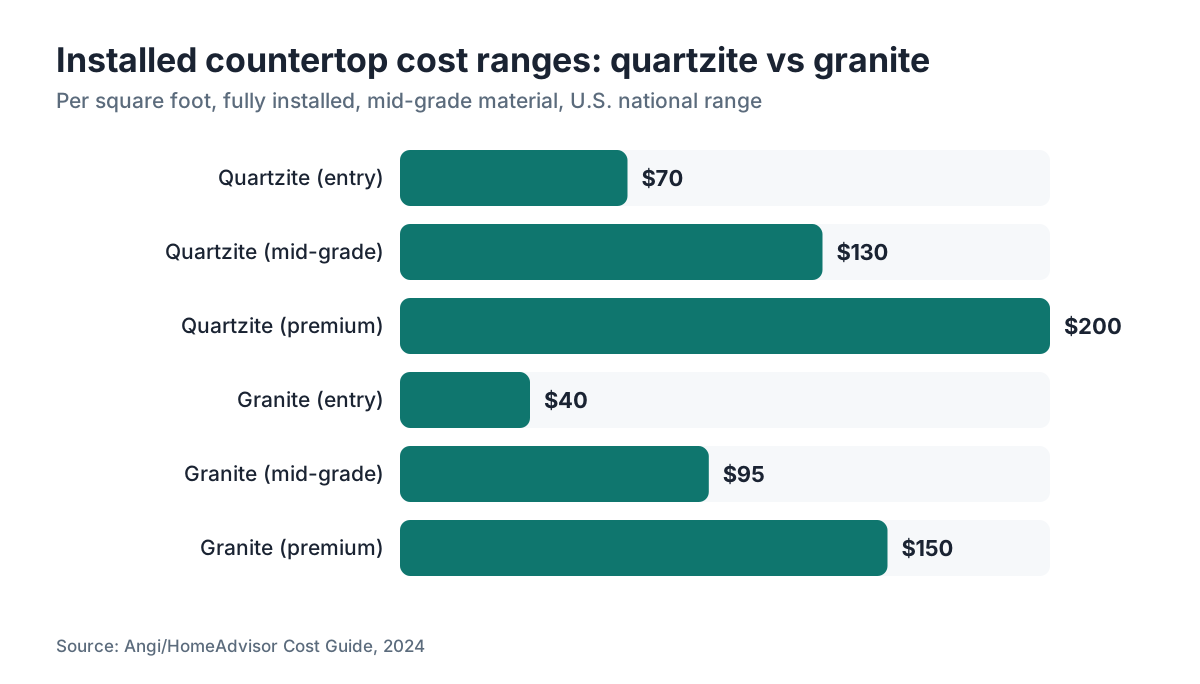
- Quartzite quotes run $70 to $200 per square foot installed.
- Granite runs $40 to $150.
- The gap comes from harder fabrication, pricier slabs, and faster blade wear on quartzite.
- For fabricators, that justifies higher labor margins.
- For homeowners, the premium is real, and quartzite's hardness often earns it.
- Every number depends on slab grade, edge profile, cutout count, and local labor.
What actually makes quartzite and granite different to quote?
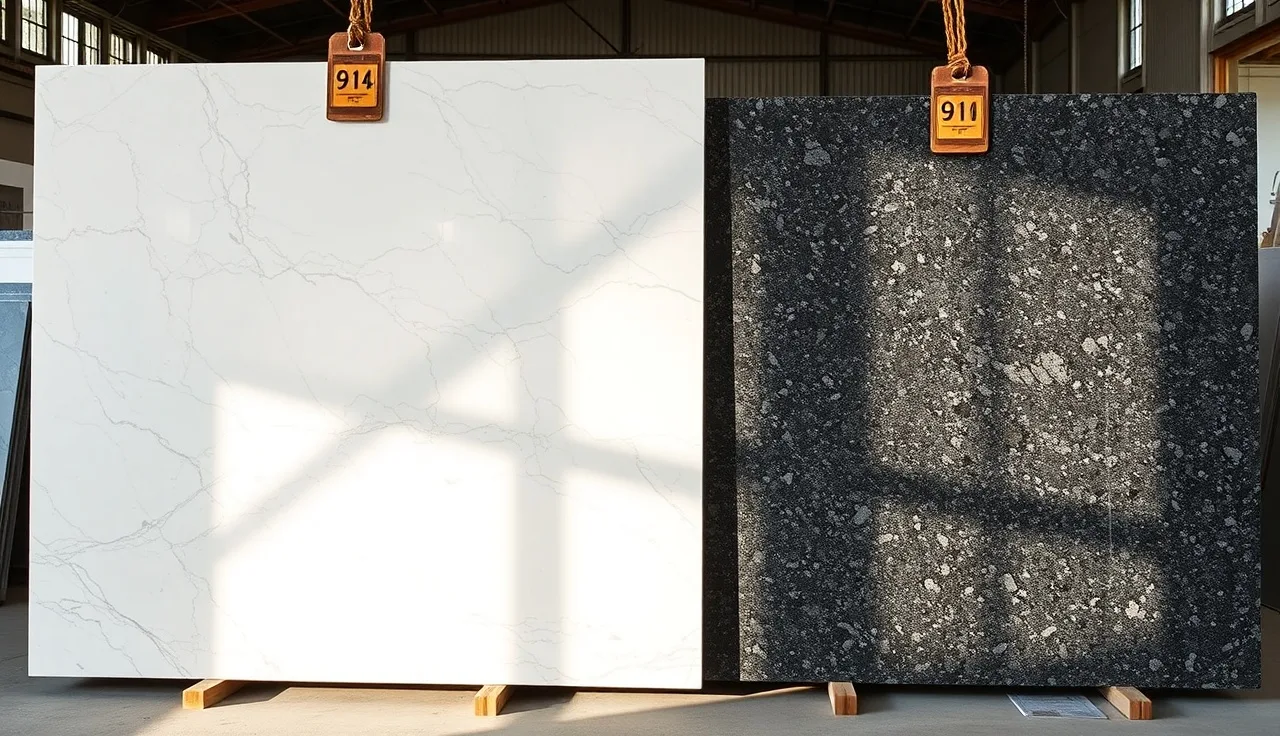
Quartzite and granite look almost identical on a sample board. On a quote sheet, they behave nothing alike.
Granite is an igneous rock with a consistent enough mineral structure that shops have been cutting it for decades. Most have dialed-in feed rates, blade choices, and time estimates for the common colors. Quartzite is metamorphic, born as sandstone and then squeezed and recrystallized under heat and pressure. That process makes it extremely hard, sometimes harder than granite, and the hardness is what drives the cost.
Mohs hardness matters here. Granite typically falls between 6 and 6.5 on the Mohs scale [1]. True quartzite often hits 7 or higher because its primary mineral is quartz, the hardest common rock-forming mineral at a Mohs 7 [2]. Harder stone means more blade wear, slower cuts, and longer polishing.
There's a misidentification problem that touches every quote. A big share of slabs sold as "quartzite" in the trade are actually soft marbles or dolomitic marbles. If a homeowner shows up with a slab labeled "Super White Quartzite" or "Sea Pearl Quartzite," run a scratch test before you quote it as quartzite. True quartzite won't scratch under a steel knife. Marble will. Quote true quartzite labor on a soft marble slab and you leave money on the table. Quote marble sealing advice on real quartzite and you invite a callback.
The identification question isn't academic for fabricators. It changes your blade budget, your time estimate, and your sealer recommendation. For homeowners, it changes how the stone lives for the next twenty years. Confirm the material before you finalize a single number.
What are the typical price ranges for quartzite vs granite countertops?
Installed prices swing hard by region, slab grade, and shop overhead. Real market ranges still exist, and they're worth anchoring to.
Granite installed typically runs $40 to $150 per square foot, with most mid-grade kitchens landing between $60 and $100 [3]. Entry-level granite like Santa Cecilia or Giallo Ornamental often quotes $40 to $60 installed in competitive markets. Premium exotics like Blue Bahia or Van Gogh push toward $120 to $150 or beyond.
Quartzite installed typically runs $70 to $200 per square foot. Popular mid-grade varieties like White Macaubas or Taj Mahal land in the $90 to $130 range [3]. Rare Brazilian quartzites with dramatic veining can clear $200 installed.
The table below shows approximate slab-only costs (before fabrication and install) as a reference for building quotes:
| Stone | Entry Slab ($/sq ft) | Mid-Grade Slab ($/sq ft) | Premium Slab ($/sq ft) |
|---|---|---|---|
| Granite | $10, $25 | $25, $60 | $60, $120+ |
| Quartzite | $20, $40 | $40, $80 | $80, $200+ |
Those slab costs are dealer-level wholesale estimates. Retail markup from fabricator to homeowner typically runs 15 to 40% on material alone, depending on your pricing strategy [4].
For kitchen countertops broadly, the National Kitchen and Bath Association's 2023 market data puts the median countertop budget for a full kitchen remodel around $4,200 to $4,800, though that spans every material including laminate and quartz [5].
Here's the honest caveat. Nobody has a perfect national dataset on installed stone prices. The ranges above come from aggregated contractor surveys and industry pricing guides. Your local market can run 20 to 30% above or below depending on labor costs and how crowded the field is.
What drives fabrication costs higher for quartzite than granite?
Three things: blade wear, cutting time, and polish time. Each one lands in your cost per job.
Diamond blades built for granite cut quartzite faster than they last. On a true hard quartzite, expect blade life to drop 20 to 40% versus a comparable granite job, depending on the specific stone and your equipment [6]. A blade that does 800 linear feet of granite cuts might manage 500 feet of hard quartzite. If you're not tracking blade consumption by material, you're almost certainly underpricing quartzite.
Cutting speed drops too. CNC routers and bridge saws run slower feed rates on harder material to hold cut quality and protect tooling. A simple island top that cuts in 45 minutes in granite can take 60 to 70 minutes in quartzite. Small per job. It compounds fast across a busy week.
Polishing is where the time gap really opens up. Quartzite's hardness means it takes longer to bring to a high polish, especially on edges. A standard 3cm eased edge in granite might need one polishing pass. The same edge in quartzite often needs two or three. Ogee and mitered profiles take longer still. Flat-rate your edge profiles without adjusting for hardness and quartzite edges quietly eat your margin.
Homeowners, read this part. These costs are legitimate, not padding. When a shop quotes your quartzite job 15 to 25% above a comparable granite job, the blade and labor math backs it up. A shop that quotes both materials identically is either eating the difference or doesn't understand its own costs.
How should fabricators structure a quartzite quote differently than a granite quote?
The line items stay the same. The numbers inside them move.
Start with material cost. Pull your actual slab cost from your supplier, calculate the square footage you'll use (layout waste included), and apply your markup. On quartzite, waste runs higher when the slab has veining you need to match or dodge, so build in a 15 to 20% waste factor instead of the 10% you might use on uniform granite [4].
Next, labor. If your shop runs a flat labor rate per square foot for all stone, quartzite loses money. Use a material-adjusted labor rate or a quartzite surcharge, typically 15 to 25% above your granite labor rate, that reflects real cutting and polishing time. Some shops run three tiers: standard stone, hard stone (quartzite and some dense granites), and exotic/thin (3mm porcelain, ultra-compact). A tiered system is easier to explain to customers than a fuzzy "complexity fee."
Cutouts cost real money on any stone, but they bite harder on quartzite. A sink cutout that takes 20 minutes in granite can take 35 in quartzite and chews through blade segments faster. Price cutouts by material tier, more than by count.
Edge profiles follow the same logic. Charge for polishing time, more than profile type. A laminated mitered edge in Taj Mahal quartzite genuinely costs more to produce than the same profile in Black Galaxy granite.
Last, sealer. Quartzite's sealing needs depend entirely on whether it's true quartzite or misidentified marble. True quartzite is dense and may need one application every few years [7]. Soft dolomitic "quartzites" need the same aggressive schedule as marble. Charge the wrong sealer tier and you create real customer service problems down the line.
Software that tracks material-specific labor multipliers and blade cost per linear foot turns this from guesswork into a system. SlabWise is built around exactly this kind of job-level cost tracking if you want to see how it works in practice.
How do you calculate square footage for a countertop quote?
This part is identical for quartzite and granite. The math doesn't care about hardness.
Measure every run in inches: length times depth. Divide by 144 to get square feet. Add up all runs for your net square footage. Then add a waste factor on top, typically 10% for simple layouts on uniform material, up to 20% for complex kitchens with veined stone that needs careful placement.
Take a standard L-shaped kitchen with two runs, say 120 inches by 26 inches and 72 inches by 26 inches. The math goes:
(120 × 26) / 144 = 21.67 sq ft (72 × 26) / 144 = 13.0 sq ft Total net: 34.67 sq ft With 15% waste: 39.87 sq ft, round to 40 sq ft
That 40 square feet is what you order slab material against and what you quote labor against. Quote the customer on installed square footage (net), not ordered square footage. Some shops quote the inflated number. It confuses customers and burns trust the second they check your math.
For an island with a waterfall edge, measure the horizontal surface, then add the waterfall panels separately. A waterfall panel on a 36-inch island runs about 36 inches by roughly 36 inches of counter height, so about 9 square feet per side. Don't forget it.
Templating before you finalize beats measuring from plans every time. Plans are wrong more often than homeowners expect, and a quartzite slab at $80 a square foot wholesale leaves almost no room for a remeasure mistake. See countertop installation for the full templating breakdown.
Is quartzite harder to seal and maintain than granite, and does that affect the quote?
It affects the quote in a small but real way: the sealer product, the application time, and the warranty language you put in writing.
True quartzite is very dense. High-quality varieties like Taj Mahal have low porosity and can go years between sealer applications. The Marble Institute recommends a water absorption test before you set a sealer schedule [7]. A drop of water that beads up and sits 30 minutes without darkening the stone signals low porosity and infrequent sealing.
Granite is more variable. Some granites like Absolute Black are so dense they barely need sealing. Others, especially lighter granites with visible mica and feldspar, drink water and need annual sealing. The same water test tells you which is which.
For fabricators, the sealer line item on a quartzite quote typically runs $50 to $150 for the initial application at install, depending on product cost and slab size [4]. Some shops fold one application into the job price and charge for revisits. That's fine, but spell it out in the contract.
For homeowners, sealing and cleaning drive long-term performance more than most people realize. See how to clean quartzite countertops for material-specific care, and how to clean stone countertops for guidance that covers both materials.
What edge profiles and finishes cost more on quartzite than granite?
Any profile that needs real polishing time costs more on quartzite. No exceptions.
Eased and beveled edges are the cheapest profiles on both stones because they involve minimal polishing. On quartzite even these take slightly longer, but the premium is modest, maybe 10 to 15% above granite pricing.
Ogee, bullnose, and dupont profiles involve more polishing surface and curved geometry. On quartzite, plan for 20 to 30% longer polishing time versus granite. If your shop charges $20 a linear foot for an ogee in granite, $25 to $26 in quartzite is supportable.
Mitered edges and waterfall ends are the most labor-heavy work you'll quote. A mitered joint needs precision cutting on a 45-degree angle and then hand-polishing the joint line. In quartzite this can take an experienced fabricator twice as long as in granite. Charge accordingly.
Finish type matters too. A honed (matte) finish runs a different polishing sequence than a polished one, and it can take more passes on quartzite to land an even, flat surface. Leathered finish, a texture created by diamond brushing, is similarly more work on harder stone. If you offer these finishes, build a material-specific surcharge, not a blanket finish upcharge.
For comparison, engineered quartz like Cambria countertops is manufactured to consistent hardness, which makes edge pricing predictable. Natural stone, quartzite or granite, brings variability that engineered products just don't.
How do you quote quartzite or granite for a bathroom vs a kitchen?
Smaller job, different math.
Bathroom vanity tops typically run 20 to 35 square feet for a double vanity, against 40 to 80 for a full kitchen. The square footage is lower, but fixed costs like the template trip, delivery, and install labor don't shrink with it. That's why bathroom quotes often carry a minimum job charge, typically $500 to $800 in most markets, to cover overhead regardless of size [4].
Quartzite bathroom tops carry the same material and fabrication premiums. But the piece count is usually simpler (one or two runs, maybe a backsplash), so total cost lands lower. A quartzite double vanity top might quote $800 to $1,800 installed depending on grade, while a comparable granite top might run $600 to $1,400.
Undermount sink cutouts are a big share of the cost on a small vanity job. Two undermount cutouts in quartzite might add $150 to $300 to the quote. Itemize them.
For fabricators: bathroom jobs can carry better margin percentages than kitchens if you price the fixed costs right. Don't discount the minimum charge just because the material square footage is small. The truck still drives there. The template still takes an hour.
What mistakes do fabricators make when quoting quartzite that cost them money?
A handful come up over and over in shop conversations.
The most expensive one is using granite labor rates for quartzite. It feels like a minor adjustment to fix later. But on a 50-square-foot kitchen with a complicated edge and multiple cutouts, the gap between your granite labor estimate and actual quartzite labor time runs $200 to $400 per job. Across a year, that's real money walking out the door.
Second mistake: ignoring higher blade consumption. Shops that book materials as one line item instead of breaking out blade use by stone type often find they've been subsidizing quartzite from granite margins. Tracking blade life by material takes discipline to set up. It pays for itself fast.
Third: misidentifying the stone and quoting it wrong. Quote a soft dolomitic marble as quartzite (easy when the supplier mislabeled it) and you undercharge on sealing while over-promising durability to the homeowner. The callback risk alone justifies two minutes with a scratch test on every slab.
Fourth: forgetting remnant value. Quartzite offcuts from a large job can resell for small bathroom vanities or fireplace surrounds. Some shops price quartzite a touch more aggressively knowing they'll recoup value from the remnant. If you're not tracking remnants, that value just vanishes.
To systematize all of it, job-level cost tracking by material type is where quoting software earns its keep. SlabWise lets you build material-specific templates so your quartzite quotes pull the right labor multipliers and blade cost factors automatically, no manual fiddling every time.
How does the resale value of quartzite vs granite affect a homeowner's buying decision?
Homeowners ask this, and fabricators get dragged into answering it. Here's the honest version.
Granite has been a standard premium countertop long enough that appraisers treat it as a baseline feature in many markets. It adds value over laminate, but it stopped being a differentiator in most mid-to-upper price ranges years ago.
Quartzite is increasingly read by buyers in higher-end markets as a step above granite. But the appraisal impact isn't well-documented in the research. The closest reliable data comes from the National Association of Realtors' remodeling impact reports, which consistently show kitchen remodels recovering roughly 52 to 67% of their cost at resale depending on scope and region [8]. That figure covers the whole project, not the countertop choice.
The blunt truth: countertop material alone rarely moves an appraisal in a measurable way. What moves value is install quality, consistency with the rest of the kitchen, and overall remodel scope. A beautifully installed granite top in a well-designed kitchen beats a sloppy quartzite job every time.
The more useful question for homeowners is total cost of ownership. Quartzite's hardness means less chipping and surface scratching than granite, which matters in a hard-use kitchen. Compared against softer materials like marble (see marble countertops) or butcher block countertops, the durability gap widens further.
Still deciding between the two stones? granite countertops has a full breakdown of granite's strengths and weaknesses worth reading before you commit either way.
What should a complete quartzite or granite countertop quote include?
A quote that protects both the fabricator and the homeowner spells out every variable that can move the final price.
At minimum, a complete stone countertop quote should include:
- Material: stone type, variety/color name, grade (commercial, standard, premium), slab dimensions and thickness (2cm vs 3cm)
- Square footage: net installed square footage and how waste was calculated
- Edge profile: type, linear footage, per-unit price, and whether the price varies by material hardness
- Cutouts: count, type (sink, cooktop, faucet holes), and per-cutout price
- Finish: polished, honed, leathered, or other; any upcharge
- Backsplash: if included, material, height, linear footage, and price
- Sealer: product, number of coats at install, and warranty on initial application
- Template: whether template is a separate charge or included, and what happens if measurements change after template
- Delivery and installation labor: itemized or as a combined line
- Removal of existing countertops: if applicable, cost and whether plumbing disconnect is included or excluded
- Payment terms: deposit percentage, when final payment is due, and what triggers final invoice
Items that get left off and cause fights: demolition of existing stone (heavier and messier than pulling laminate), changes after template is drawn (usually trigger a change order fee), and who handles plumbing reconnection.
A two-line quote that says "Quartzite countertop installed: $4,200" creates problems. An itemized quote takes longer to write but slashes callback disputes and protects your margin when material costs shift between quote and install date.
Frequently asked questions
Is quartzite always more expensive than granite?
Usually, but not always. Entry-level quartzite can overlap with mid-grade granite. A basic White Macaubas quartzite might quote similarly to a premium Blue Eyes granite. The driver is slab rarity and origin, not the material category. Premium exotics exist in both stones. Expect quartzite to run 20 to 40% higher than a comparable-grade granite for the same job.
How do I know if a slab labeled quartzite is actually quartzite?
Run a scratch test. Drag a steel knife blade firmly across an inconspicuous spot on the slab face. True quartzite won't scratch because it's harder than steel at Mohs 7+. Marble shows a mark. You can also drip a little muriatic acid on the back of the slab; marble and dolomite fizz, true quartzite doesn't. Ask your supplier for a mineralogy report on any unfamiliar slab.
Should fabricators charge a material surcharge for quartzite or just use higher per-square-foot rates?
Either works, but a tiered rate system is cleaner. Separate labor rates for standard stone, hard stone (quartzite and some dense granites), and specialty materials let your software or spreadsheet apply the right multiplier automatically. A flat surcharge tacked on at the end is harder to explain and easier to forget. The math should live in your base rate by material category.
How much does edge profile choice affect the total quote for quartzite?
More than most homeowners expect. On a 20-linear-foot kitchen perimeter, the difference between an eased edge and a full ogee in quartzite can be $300 to $600 in labor alone. That gap is wider than the same comparison in granite because quartzite polishing takes longer. If a homeowner is budget-sensitive, a simple eased or beveled edge in quartzite looks clean and modern while keeping costs down.
What is the average cost of a quartzite kitchen countertop fully installed?
For a typical kitchen with 40 to 55 square feet, one sink cutout, and a standard edge, expect $3,000 to $9,000 installed for mid-grade quartzite. Premium varieties or complex layouts push toward $10,000 to $14,000. These ranges reflect 2024 conditions in mid-to-high cost-of-living U.S. markets. Rural or low-cost markets may run 20 to 30% lower.
Can you use the same diamond blades for quartzite and granite?
Technically yes, but the blade wears out faster on quartzite. Some fabricators run granite-rated blades on quartzite and just account for shorter life in the blade budget. Others keep quartzite-specific blades with a softer bond that exposes fresh diamond segments faster to handle the harder material. The right call depends on your blade supplier and job volume. Track blade life by material to decide for your shop.
How does quartzite compare to engineered quartz in terms of quoting and fabrication?
Engineered quartz like Silestone or Cambria is manufactured to consistent thickness and hardness, which makes quoting more predictable. Blade life and cutting speeds vary less between slabs. Quartzite varies by origin and mineral composition, so each new variety can behave differently. Fabrication labor for engineered quartz is generally lower than quartzite. Material cost can be similar or lower depending on the brand and line.
What waste factor should I use when quoting quartzite?
Use 15 to 20% for most quartzite jobs, against 10 to 15% for simple granite layouts. The higher factor reflects two realities: quartzite is more likely to carry dramatic veining that needs careful placement, and any cutting mistake costs more to redo given the slab price. For very large slabs with minimal veining and a simple rectangular layout, 12% may cover it, but 15% is the safer default.
Does quartzite need to be sealed differently than granite?
True quartzite is dense and generally needs less frequent sealing than most granites, sometimes only every three to five years. But many slabs sold as quartzite are actually dolomitic marble, which needs aggressive sealing on a marble-like schedule. Always run a water absorption test before advising a schedule. Charging the wrong sealer tier is a minor quote error that turns into a major customer service problem later.
How should I handle a homeowner who got a much lower quote from another shop for the same quartzite?
Ask what the lower quote includes. Is the material the same grade and source? Does it cover template, delivery, install, and sealer? What edge profile is quoted? Lower quotes often omit line items you include, use thinner 2cm material, or reflect a shop not accounting for quartzite's true fabrication cost. Walk the homeowner through your itemized quote line by line. Detail wins on transparency even when it loses on price.
Is quartzite a good choice for outdoor kitchen countertops?
It can be, with caveats. True quartzite handles UV exposure well and won't fade the way some engineered materials do. Its hardness copes with outdoor temperature swings reasonably well. The risk is misidentification: dolomitic marble sold as quartzite deteriorates faster outdoors from acid rain exposure. Confirm material identity before recommending quartzite outdoors, and use a penetrating sealer rated for exterior use.
What's the minimum job charge that makes sense for a quartzite countertop project?
Most fabricators in mid-to-high cost markets set minimums of $800 to $1,500 for any stone job to cover template, delivery, and install overhead regardless of square footage. For quartzite specifically, given higher material and blade costs, the low end of that range may not cover costs on a very small job. A $1,200 to $1,500 minimum for quartzite work is defensible and easy to explain to customers.
How do countertop thickness choices (2cm vs 3cm) affect a quartzite quote?
3cm quartzite is heavier, sometimes needs stronger cabinet support, and costs more per slab than 2cm. But 3cm skips the plywood substrate buildup along the front edge for a thick look, which saves labor. For most kitchens, 3cm quartzite is the market standard and usually the better value once you account for substrate savings. 2cm is more common in bathrooms and outdoor applications where weight matters.
Sources
- U.S. Geological Survey, Mineral Resources Program, Granite: Granite typically has a Mohs hardness of 6 to 6.5 due to its primary minerals feldspar and quartz
- U.S. Geological Survey, Mineral Resources Program, Quartz mineral data: Quartz has a Mohs hardness of 7, the primary mineral in quartzite, making it harder than most granite
- HomeAdvisor (Angi), Countertop Installation Cost Guide 2024: Granite countertops installed typically run $40–$150 per square foot; quartzite runs $70–$200 per square foot installed
- Marble Institute of America, Stone Industry Pricing and Business Practices: Fabricator material markup on stone slab typically runs 15–40%; waste factors range 10–20% depending on material and layout complexity; sealer application at install runs $50–$150 per job
- National Kitchen and Bath Association, NKBA Kitchen and Bath Market Index 2023: Median countertop budget for a full kitchen remodel was approximately $4,200–$4,800 across all countertop materials in 2023
- Construction Industry Institute, Diamond Tool Performance in Hard Stone Fabrication: Diamond blade life can drop 20–40% when cutting hard quartzite versus granite, depending on stone composition and equipment feed rates
- Marble Institute of America, Care and Cleaning of Natural Stone: MIA recommends testing stone porosity with a water absorption test before recommending a sealer schedule; dense quartzite may require sealing only every several years
- National Association of Realtors, 2023 Remodeling Impact Report: Kitchen remodels recover roughly 52–67% of project cost at resale depending on scope and region
- U.S. Geological Survey, Natural Aggregates and Dimension Stone Statistics: USGS tracks domestic dimension stone production including granite and quartzite slab supply, supporting slab availability and price trend analysis
- National Institute of Standards and Technology (NIST), Standard Reference Material for Mohs Hardness: Mohs hardness scale is a standard reference for mineral hardness testing used by fabricators and geologists to identify and compare stone materials
Last updated 2026-07-10