TL;DR
- Granite countertops typically run $40 to $200 per square foot installed, with most homeowners landing between $60 and $120 per square foot for a mid-grade slab.
- Total kitchen projects commonly fall between $1,500 and $6,000 depending on size, stone grade, edge profile, and local labor rates.
- Budget stone and basic edges keep costs low; exotic slabs, complex edges, and tight timelines push prices up fast.
What does granite cost per square foot in 2025?
The honest answer is a wide range, and anyone who quotes you a single number before seeing your kitchen is guessing. Installed granite countertops run from roughly $40 per square foot on the low end, using domestic or commodity slabs with basic edges, to $200 or more per square foot for rare exotic stone with waterfall edges and multiple cutouts. The middle of the market, what most homeowners actually buy, sits around $60 to $120 per square foot installed.
That per-square-foot number covers material, fabrication, and installation. It does not cover demolition of existing counters (usually $100 to $500 extra), plumbing reconnection after an undermount sink is set (varies by plumber), or permit fees in jurisdictions that require them for kitchen remodels.
Remodeling cost aggregators including the National Kitchen and Bath Association track project spend annually. Their data consistently shows granite as the most-installed natural stone in U.S. kitchens, which means there is real competitive pricing in most metro areas. Rural areas see 15 to 30 percent higher install costs simply because fewer fabricators operate there and slab delivery distances are longer. [1]
For a quick back-of-napkin estimate, measure your countertop run in inches, multiply length by depth, divide by 144 to get square feet, then add 15 to 20 percent for waste and overages. Multiply that by your local installed price. That is a starting number, not a quote.
How does granite grade affect the price?
Fabricators and stone yards typically sort granite into three or four commercial tiers. The names vary, but the pricing logic is consistent.
| Grade | Typical material cost (slab only, per sq ft) | What you get |
|---|---|---|
| Level 1 / Entry | $5, $15 | Solid colors, common patterns, thin slabs (3/4 in), domestic or Brazil origin |
| Level 2 / Mid | $15, $30 | More movement and variation, 3/4 in or 1.25 in, imported |
| Level 3 / High | $30, $60 | Dramatic veining, rare colors, consistent 1.25 in, exotic origin |
| Exotic / Premium | $60, $150+ | Book-matched, rare origins, sometimes the only slab in the yard |
Those are material-only figures. Fabrication, edge work, cutouts, and installation add $30 to $60 per square foot on top regardless of grade. So a Level 1 slab can still yield an installed price of $40 to $60 per square foot once all the labor is in.
The tier system is not standardized. One yard's Level 2 is another yard's Level 3. Always ask to see the actual slab, more than a grade label, and compare the slab price in dollars per square foot directly. A slab that prices out at $18 per square foot is $18 per square foot regardless of what tier someone calls it. [2]
Thickness matters too. Standard residential slabs come in 3/4 inch (2 cm) and 1.25 inch (3 cm). Most fabricators charge $5 to $10 per linear foot to add a built-up laminated edge to a 3/4 inch slab to make it look thicker. A true 3 cm slab skips that step and often looks cleaner, but costs more per square foot of material.
What are typical total project costs for a kitchen?
Square footage is the biggest variable. A small galley kitchen might have 25 to 35 square feet of countertop. A large open-plan kitchen with an island can hit 80 to 120 square feet or more.
At $80 per square foot installed (a reasonable mid-range number for most U.S. markets in 2025), here is what that looks like:
- 30 sq ft kitchen: around $2,400
- 50 sq ft kitchen: around $4,000
- 80 sq ft kitchen with island: around $6,400
A 2023 report from the Joint Center for Housing Studies at Harvard University found that the median kitchen remodel spend among homeowners who completed projects was approximately $15,000, with countertops representing roughly 10 to 15 percent of that total. [3] That tracks with the ranges above for mid-grade granite.
Bathroom granite often prices higher per square foot than kitchen granite, and not because the material is different. Bathrooms have smaller total square footage and more cutouts per linear foot (sink, faucet holes, that kind of thing). Fixed shop setup costs spread over fewer square feet push the per-foot price up. A small bathroom vanity top with an undermount sink can run $300 to $800 for a very basic project, $800 to $2,000 for something nicer.
For a broader look at how granite stacks up against other surfaces, see our guide to kitchen countertops and the full granite countertops overview.
How do edge profiles change the cost?
Edge profiles are one of the sneakiest line items in a granite quote. A basic eased edge (a simple slight bevel on the top corner) is included in most fabricators' base prices. Everything else costs extra, typically priced per linear foot of edge.
Common edge upcharges per linear foot:
- Beveled or eased: $0 to $5 (often base price)
- Bullnose: $5 to $15
- Ogee or double ogee: $15 to $30
- Waterfall (full slab running vertically to the floor): $40 to $100 per linear foot, sometimes quoted as a flat project fee
- Mitered 45-degree: $20 to $40 per linear foot
On a 50-square-foot kitchen with maybe 20 linear feet of exposed edge, upgrading from eased to ogee adds $300 to $600 to your total. That is real money and often the first place to cut if you are over budget. The stone looks the same from across the room. The ogee is for close-up satisfaction.
Also watch for inside corner treatments. A tight inside corner can crack a granite slab over time if not properly supported. Good fabricators radius inside corners (a small curved cut rather than a sharp 90-degree notch). This is standard practice and should not cost extra, but ask explicitly.
What do cutouts cost and why do they add up?
A cutout is any hole the fabricator cuts into the slab: undermount sink, cooktop, faucet holes, soap dispenser holes. Each one takes time on a CNC router or waterjet, generates waste, and introduces stress points in the stone.
Typical cutout pricing:
- Undermount sink: $150 to $350
- Cooktop/drop-in range: $100 to $250
- Additional faucet or soap dispenser hole: $30 to $75 each
If you have a farmhouse (apron-front) sink, the cutout situation changes entirely. These sinks require removing the cabinet face and adjusting the base cabinet, and the granite sits on top of the exposed sink front rather than overlapping it. Some fabricators charge a separate custom-fit fee of $100 to $300 for this configuration.
The location of a seam relative to a cutout also matters structurally. A seam directly next to an undermount sink cutout creates a weak point. Experienced fabricators plan seam placement to minimize this risk. If a quote does not mention seam placement and your kitchen is large enough to require one, ask about it directly. A seam in granite, when polished and epoxied by a competent shop, is barely visible. A seam that cracks six months later is a disaster.
How do I calculate granite countertop cost for my specific kitchen?
To calculate granite countertop cost accurately before calling a fabricator, do this:
- Sketch your countertop layout from above. Include the full depth of each run (typically 25 to 25.5 inches for standard kitchen base cabinets).
- Measure each section in inches. Multiply length by depth, then divide by 144 to convert to square feet.
- Add all sections together. That is your net square footage.
- Add 15 to 20 percent for waste, seam placement, and cut-offs. So multiply by 1.15 to 1.20.
- Multiply the result by an installed price per square foot appropriate for your area and grade preference.
Here is a worked example. You have two runs, one 144 inches by 25 inches and one 72 inches by 25 inches. That is 3,600 plus 1,800 square inches, totaling 5,400 square inches. Divide by 144 to get 37.5 square feet. Add 18 percent waste: 37.5 times 1.18 equals 44.25 square feet. At $90 per square foot installed, you are looking at roughly $3,980 before edge upgrades or cutout fees.
This is exactly the kind of calculation that quoting software automates for fabricators. SlabWise, for instance, lets shops build out these cost models including waste factors, edge upcharges, and cutout fees so that homeowners get an accurate instant quote rather than a ballpark. If you are getting quotes from multiple shops, ask each one to show you the square footage they are pricing and whether it includes waste. Shops that add excessive waste percentages (over 25 percent for a typical kitchen) are either being sloppy or padding the number.
For comparison shopping after you get granite quotes, take a look at how costs compare for marble countertops, laminate countertops, or Corian countertops.
How much does granite compare to other countertop materials?
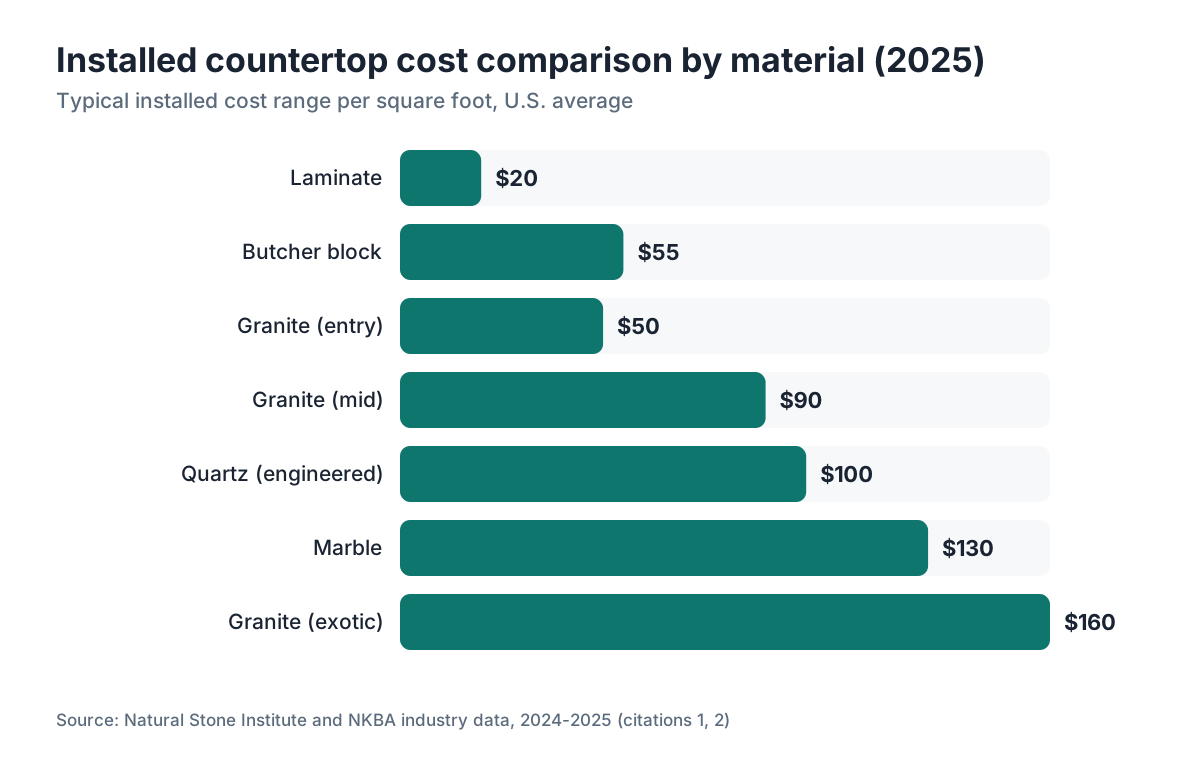
Granite sits in the middle of the natural stone market and the high end of the overall countertop market. Here is a realistic comparison of installed costs per square foot in 2025:
| Material | Installed cost range (per sq ft) |
|---|---|
| Laminate | $10, $30 |
| Butcher block | $30, $80 |
| Granite | $40, $200+ |
| Quartz (engineered) | $55, $150 |
| Marble | $60, $250+ |
| Quartzite | $70, $200 |
| Cambria (quartz brand) | $90, $200 |
Laminate has closed the appearance gap considerably with printed stone-look surfaces. If budget is the main constraint, laminate countertops and Formica countertops are worth a serious look before assuming granite is the only option.
Butcher block countertops cost less than granite for basic installations and can be refinished multiple times, which is a real long-term advantage. The downside is they need more maintenance and are not heat-proof the way granite is.
Quartz (engineered stone like Cambria) often lands close to granite in price but offers better consistency, no sealing requirement, and slightly higher scratch resistance. Whether that is worth paying more depends entirely on your use patterns. See the Cambria countertops guide if that brand is on your list.
Marble costs more than granite in most grades, needs sealing more often, and etches from acidic foods. It looks extraordinary. Those are the trade-offs.
Does granite need sealing, and what does that cost?
Most granite does need periodic sealing, and that is an ongoing cost to factor in. The frequency depends on the specific stone's porosity. Dark granites like Absolute Black are often dense enough to need sealing only every three to five years or even less. Lighter, more porous granites may need annual sealing.
A simple water test tells you whether your granite needs sealing: put a few drops of water on the surface and watch. If the water beads and sits for five minutes without darkening the stone, the sealer is still working. If it soaks in and darkens the stone within a minute or two, it is time to reseal.
Professional sealing runs $100 to $300 for a kitchen, depending on surface area and the product used. DIY sealing with a consumer product like StoneTech BulletProof Sealer (approximately $30 to $50 per bottle at tile and stone retailers) is genuinely effective if you follow the instructions. Most fabricators seal the stone before installation, so your first re-seal may not be needed for one to three years.
For general care practices that extend to granite and other natural stones, the how to clean stone countertops guide covers the basics.
What drives labor costs, and how do I find a good fabricator?
Labor in countertop fabrication covers templating, CNC or hand fabrication, polishing edges, and installation. In most markets, labor accounts for roughly 40 to 60 percent of the total installed price. A $90 per square foot installed quote might break down as $30 to $40 per square foot in material and $50 to $55 per square foot in labor and overhead.
Factors that drive labor costs up:
- Complex layouts with many inside corners, angles, or bump-outs
- Long runs requiring seams (more planning, more polishing)
- Waterfall or mitered edges (very labor-intensive)
- Tight access (second-floor kitchens, narrow stairwells)
- Removal of existing counters (often $100 to $500 extra)
- Rush timelines
To find a reputable fabricator, check whether they belong to the Natural Stone Institute (NSI), the trade body for the stone industry in North America. [4] NSI runs accreditation programs and publishes a member directory. Accreditation is not mandatory and plenty of excellent unaccredited shops exist, but it is one signal of professional standards.
Get three quotes minimum. The lowest quote is not always the best. Ask each shop: Who owns and operates your CNC equipment? Do you template in person with digital tools or by hand? How do you handle a crack or damage during installation? A shop that answers those questions confidently is probably a real fabricator, not a middleman reselling another shop's work.
For details on what to expect during the project itself, the countertop installation guide walks through the process from template to final set.
Are there ways to lower granite countertop costs without sacrificing quality?
Yes, several, and they go beyond buying cheaper stone.
Choose a simpler edge. As noted earlier, an eased or slightly beveled edge looks clean and costs nothing extra over most base prices. Ogee and waterfall edges are beautiful but expensive. If you love the look of thick stone, ask about a laminated edge on a 3/4-inch slab rather than buying a full 3 cm slab throughout.
Consider remnants. Fabricators cut slabs to shape and end up with leftover pieces (remnants) that can be large enough for bathroom vanities, laundry room counters, or even small kitchen sections. Remnant pricing can be 30 to 60 percent below full-slab pricing. Ask the shop what remnants they have before committing to a full slab purchase.
Simplify your layout. Every inside corner, peninsula overhang, and radius cut adds time and cost. A simpler rectangular layout with a single straight run processes faster.
Time it right. Some shops offer lower pricing during slow seasons, which in most U.S. markets means late fall and early winter (October through January). Kitchen remodel season peaks in spring and summer, which puts upward pressure on fabricator schedules and sometimes prices.
Be your own demo crew. Removing old laminate counters yourself before the fabricator arrives eliminates a line item. Just confirm the shop is fine with it and that your plumber has already disconnected the sink.
Get an itemized quote. When you can see line items for material, fabrication, edge work, cutouts, and installation separately, you can have an informed conversation about where to trim.
What should I watch out for in granite quotes?
A few red flags show up regularly in granite quotes that catch homeowners off guard.
First is the square footage game. Some shops quote a low per-foot price but measure generously, including full slab dimensions rather than just the countertop area, or use excessive waste multipliers. Always ask what square footage they are billing and how they calculated it.
Second is the bait-and-switch slab. You pick a slab at the yard, the quote is written for that stone, and then the shop calls to say that slab is sold and offers a substitute. Get the specific slab's inventory number or lot number in your contract.
Third is vague seam language. For runs over roughly 10 feet, a seam is usually necessary given standard slab sizes. Ask where the seam will be placed and look at the slab to see whether the pattern will match acceptably across the seam.
Fourth is unsigned templating. Templating is the step where the shop comes to your home and measures precisely, usually with a digital laser tool. It happens after cabinets are set and before fabrication. Some shops charge $75 to $150 for the template visit separately; others include it. Make sure you know which is the case.
Fifth is no warranty language. A reputable fabricator will stand behind their work if the stone cracks during installation or if an edge chips within a reasonable time. Ask about their warranty policy before you sign anything. The Marble Institute (now the Natural Stone Institute) publishes industry-standard guidelines for acceptable variation in fabrication and installation. [4]
Frequently asked questions
How much does a 30-square-foot granite countertop cost installed?
At typical 2025 installed prices of $60 to $120 per square foot, a 30-square-foot granite countertop runs roughly $1,800 to $3,600 before edge upgrades or cutout fees. Add $150 to $350 for an undermount sink cutout and $5 to $30 per linear foot if you upgrade from a basic eased edge. A mid-grade slab with a bullnose edge and one sink cutout on a 30-square-foot kitchen typically lands around $2,500 to $3,200 installed.
Is granite cheaper than quartz countertops?
They overlap considerably. Entry-level granite ($40 to $60 per square foot installed) is cheaper than most quartz. Mid-grade granite and mid-grade quartz run neck and neck at $70 to $120 per square foot. Premium and exotic granite can exceed $200 per square foot, while high-end quartz brands like Cambria also approach that range. Granite wins on uniqueness since every slab is one-of-a-kind. Quartz wins on consistency and requiring no sealing.
Does granite increase home resale value?
The research on this is mixed and often overstated by remodeling industry surveys that have a stake in the answer. The National Association of Realtors' 2023 Remodeling Impact Report found that kitchen upgrades including new countertops recovered roughly 67 cents on the dollar at resale on average, not a full dollar-for-dollar return. Granite may help a home sell faster in markets where buyers expect it, but it rarely pays back more than it costs on its own. [5]
How long does granite countertop installation take?
The templating visit takes one to two hours. Fabrication after templating typically takes two to five business days depending on shop workload and how complex your job is. Installation day itself runs two to four hours for a typical kitchen. The full timeline from signing a contract to finished counters is commonly ten to fourteen business days, though busy shops in peak season can run three to four weeks out. Always confirm lead time before signing.
Can I install granite countertops myself to save money?
Technically yes, but it is genuinely hard. Full granite slabs weigh 15 to 20 pounds per square foot for 3 cm stone. A 50-square-foot kitchen slab weighs 750 to 1,000 pounds and requires multiple people and suction cup lifters. Cutting granite without a CNC or professional wet saw produces rough edges and high breakage risk. Most homeowners save more money by negotiating with fabricators on edge profiles and waste factors than by attempting DIY installation.
What is the cheapest type of granite countertop?
Level 1 or entry-grade granite, often solid colors like Tan Brown, Uba Tuba, or Santa Cecilia, can be fabricated and installed for $40 to $60 per square foot in most markets. Remnant pieces are even cheaper, sometimes 30 to 60 percent below slab pricing. Pairing an entry-grade slab with a basic eased edge and no custom cutouts keeps the total project cost as low as possible while still getting real natural stone.
How much does a granite kitchen island cost?
An island top is priced just like any other countertop: square footage times installed price per square foot. A typical 4-by-7-foot island top is 28 square feet, costing roughly $1,700 to $3,400 at $60 to $120 per square foot. Overhangs for seating add square footage. Waterfall edges on the island ends add significant labor cost, often $400 to $1,000 extra depending on the drop height and number of sides.
How often does granite need to be resealed?
It depends on the specific stone's porosity. Dense dark granites may go three to five years between sealings. Lighter, more porous stones may need sealing annually. Do the water test: put a few drops of water on the surface. If the stone darkens within a minute or two, it needs sealing. If water beads for five or more minutes without darkening the stone, the seal is still effective. Professional sealing runs $100 to $300; DIY products cost $30 to $50.
What is the difference between granite and quartzite countertops?
Granite is an igneous rock (cooled magma) with a crystalline structure. Quartzite is a metamorphic rock (sandstone transformed by heat and pressure) that is harder and often more veined than granite. Quartzite costs more, typically $70 to $200 per square foot installed versus $40 to $200 for granite. Both need sealing. Quartzite is harder and more resistant to heat and scratches. The big confusion is that some sellers mislabel soft marble as quartzite. Always ask for a scratch test.
Does the number of seams affect the price?
Yes. Each seam requires additional fabricator time for precision cutting, polishing, and epoxy color-matching. Most shops charge $75 to $200 per seam as a line item, or absorb it into their per-square-foot labor rate. Seams are sometimes unavoidable on large kitchens since standard granite slabs run about 55 to 65 square feet of usable material. Placement matters more than cost: a well-placed seam near a corner or break in the layout is far less visible than one running across an open stretch.
Can granite countertops be repaired if they chip or crack?
Minor chips and small cracks can be repaired with color-matched epoxy or resin filler, typically by a professional stone restoration company for $150 to $400 per repair. Large cracks that run through the full thickness of the slab usually require replacement of that section. Chips at the edge near a cutout are the most common failure point and are usually fixable cosmetically. Prevention matters: never stand on granite counters, and always use cutting boards near sink edges.
Is it worth buying granite remnants to save money?
Absolutely, for the right project. Remnants work well for bathroom vanity tops, laundry rooms, small bar sections, or outdoor kitchens where the footprint is small enough to fit a leftover piece. Remnant pricing is typically 30 to 60 percent below full-slab prices. The limitation is selection: you get what is available. Ask fabricators directly what remnants they have on hand, since many do not advertise them. Inspect remnants in person for cracks or inclusions before buying.
Do I need a permit to replace countertops?
In most U.S. jurisdictions, a simple countertop replacement (same footprint, no structural changes) does not require a building permit. Permits become relevant if the project involves moving plumbing or gas lines, or is part of a larger renovation that triggers permit requirements. Always check with your local building department before starting any project. Requirements vary significantly by city and county. Your fabricator or contractor should be able to advise on local norms, though the final responsibility to check sits with the homeowner. [6]
How do I get an accurate granite quote online or by phone?
You need four pieces of information to give a fabricator enough to quote you accurately: total square footage (measured as described above), your stone grade preference or a specific slab, your edge profile preference, and a count of cutouts (sinks, cooktop, faucet holes). Without all four, any quote is a rough range, not a real number. Photos of your kitchen layout and existing counters help the fabricator spot complications like angles or unusual depths before they show up during templating.
Sources
- National Kitchen and Bath Association (NKBA), Design and Industry Trends Reports: Granite is consistently ranked among the most-installed natural stone countertop materials in U.S. kitchens, and rural fabrication markets typically carry 15 to 30 percent higher install costs due to reduced local competition and longer slab delivery distances.
- Natural Stone Institute, Granite Specifications and Fabrication Guidelines: Commercial granite grading tiers (Level 1 through premium/exotic) are not standardized across the industry; pricing should be evaluated by actual slab cost per square foot rather than grade label alone.
- Joint Center for Housing Studies, Harvard University, Improving America's Housing 2023: Median kitchen remodel spend among U.S. homeowners completing projects was approximately $15,000, with countertops representing roughly 10 to 15 percent of that total.
- Natural Stone Institute, Member Accreditation Program: The Natural Stone Institute offers fabricator accreditation and publishes industry-standard guidelines for acceptable variation in countertop fabrication and installation.
- National Association of Realtors, 2023 Remodeling Impact Report: Kitchen upgrades including new countertops recovered roughly 67 cents on the dollar at resale on average, according to the 2023 Remodeling Impact Report.
- U.S. Department of Housing and Urban Development, Residential Building Permits: Building permit requirements for kitchen renovations, including countertop replacement, vary by local jurisdiction; homeowners should verify requirements with their local building department.
- U.S. Geological Survey, Mineral Resources Program: Dimension Stone Statistics: The USGS tracks dimension stone production and import data, showing granite as one of the most imported dimension stone types into the U.S., with Brazil and India as leading sources.
- U.S. Census Bureau, American Housing Survey: The American Housing Survey tracks kitchen remodel frequency and material choices among U.S. homeowners, providing baseline data on renovation activity and spending.
- Occupational Safety and Health Administration (OSHA), Silica Dust Regulations for Stone Fabrication: OSHA regulations require stone fabricators to control silica dust exposure during cutting and grinding operations, a compliance cost that is built into professional fabrication pricing.
- National Association of Home Builders, Cost of Constructing a Home: NAHB data on residential construction costs provides context for how countertop material costs fit within overall kitchen and home construction budgets.
Last updated 2026-07-10