TL;DR
- Entry-level granite countertops run $40 to $60 per square foot installed, including basic edge work and cutouts.
- The cheapest slabs are Level 1 stones with simple movement patterns, sourced in high volume from importers in Brazil, India, and China.
- You cut costs further with stock edges, fewer seams, and remnants.
- Real granite at these prices lasts decades.
- The tradeoffs are looks, not strength.
What does inexpensive granite actually cost per square foot?
Entry-level granite runs $40 to $60 per square foot installed in most U.S. markets as of 2024 to 2025. That number covers the stone, fabrication (cutting, polishing, edge profile), and basic installation with standard sink and cooktop cutouts. Supply chain swings push prices higher in some metros, and rural shops often quote lower because their overhead is smaller.
The slab itself is only part of the bill. A typical kitchen with 40 square feet of counter space might carry a material cost of $8 to $15 per square foot for a budget stone, but fabrication adds another $15 to $25, and installation adds $10 to $20. The slab price your stone yard advertises is never the final number.
For a full kitchen, the realistic installed range for inexpensive granite is $1,600 to $2,400 on that 40-square-foot job, assuming one sink cutout and a standard eased edge. Add a fancy edge profile, an undermount sink cutout, or an island with seams, and the cost climbs. [1]
Compare that to laminate countertops, which install for $15 to $40 per square foot, and granite's floor price is clearly higher. But granite handles heat and heavy use in a way laminate can't, and it reads as real stone to buyers, which is why the gap pays off in busy kitchens.
What makes some granite cheaper than others?
Granite gets sorted into tiers, usually called Level 1, Level 2, and Level 3 (or higher for exotic slabs). These tiers are not official standards set by any government body. They are informal industry labels that shift from supplier to supplier. The exact same stone can be Level 1 at one yard and Level 2 at another.
Level 1 stones share a few traits. They come from large, consistent quarries (often in Brazil, India, or China) that produce high volume. They have simpler color patterns with less dramatic veining. And they are thinner, usually 3/4 inch (2 cm) instead of the premium 1-1/4 inch (3 cm) thickness. Common names in this tier include Uba Tuba, Giallo Ornamental, Santa Cecilia Light, and Venetian Gold. None of these is inferior granite in hardness or durability. They are just less dramatic to look at and easier to find.
Thickness moves the cost two ways. Thinner slabs (2 cm) cost less per square foot at the yard, but fabricators often build a plywood substrate underneath for support, which adds labor. A 3 cm slab usually skips the substrate. Depending on your fabricator's labor rate, the 3 cm slab can end up costing the same or less to install even though the raw stone price is higher. Ask about this before you pick.
Supply chain efficiency drives a lot of the difference too. Imported granite from India and Brazil got much cheaper after the late 2000s as container shipping costs fell and those countries poured money into quarrying. The U.S. Geological Survey tracks domestic and imported stone volumes every year, and imported stone makes up the majority of U.S. slab sales. [2]
How do granite prices compare to other countertop materials?
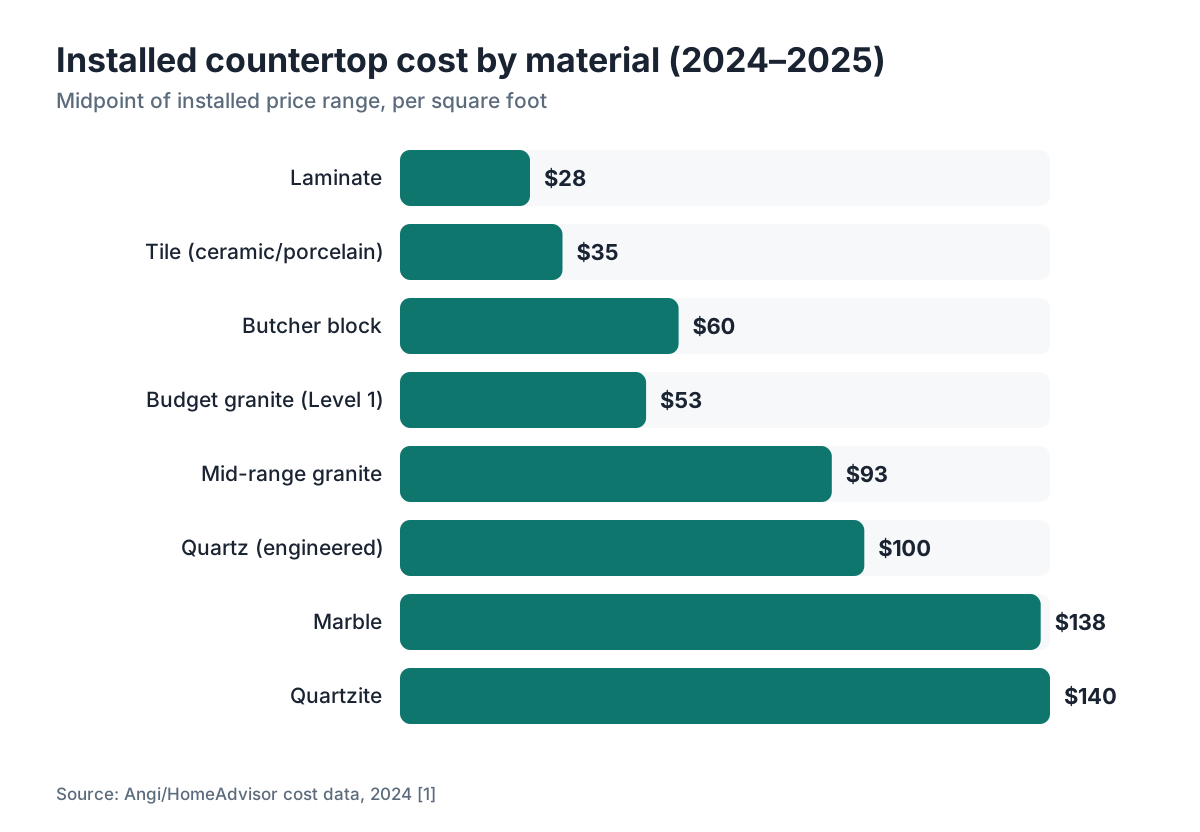
Here is a realistic installed cost comparison across common countertop materials as of 2024 to 2025. These are midpoint estimates for a standard kitchen. Your quotes will vary by region and shop.
| Material | Low (installed $/sq ft) | High (installed $/sq ft) | Notes |
|---|---|---|---|
| Laminate | $15 | $40 | Cheapest option; not heat-resistant |
| Tile (ceramic/porcelain) | $20 | $50 | Grout lines are a maintenance issue |
| Butcher block | $35 | $85 | Needs oiling; water-sensitive |
| Budget granite (Level 1) | $40 | $65 | Durable; limited color range |
| Mid-range granite (Level 2-3) | $65 | $120 | More movement and color options |
| Quartz (engineered) | $70 | $130 | Consistent pattern; no sealing needed |
| Marble | $75 | $200+ | Beautiful; etches easily |
| Quartzite | $80 | $200+ | Harder than marble; often misidentified |
| Cambria quartz | $90 | $150 | Premium engineered brand |
Budget granite sits in a genuinely competitive spot. It costs more than laminate or tile, but it takes heat, lasts decades with almost no fuss, and adds real resale value. [3] For a kitchen countertop that sees daily cooking, it often beats materials at the same price on longevity.
Picking between Level 1 granite and butcher block countertops at a similar price usually comes down to how you live. Butcher block looks warmer but wants regular oiling and hates standing water near the sink. Granite ignores both problems.
Where can you actually buy cheap granite slabs?
Cheapest to priciest, your options run: remnant lots at fabrication shops, wholesale stone distributors open to the public, big-box stores like Home Depot or Lowes (their countertop programs use regional fabricators), and finally traditional full-service countertop shops.
Remnants are the single best way to get real granite at a steep discount. When a fabricator cuts a countertop from a full slab, the leftover piece (the remnant) goes into a yard pile. A piece big enough for a small bathroom vanity or a single run of kitchen counter can often be had for $50 to $200 total, not per square foot. Call local shops and ask specifically about their remnant lot. Many never advertise it.
Wholesale distributors like MSI International and Bedrosians run showrooms in major metros that sell to trade and public buyers. [4][10] Pricing is more open than a traditional shop, and you can compare slabs side by side. The catch: you still hire a fabricator separately, so line up that relationship before you buy a slab.
Big-box programs are convenient and priced fairly, but the selection sticks to the most popular entry-level stones. You won't find anything unusual there. The upside is an all-in price, which kills surprises.
One underrated option: Craigslist and Facebook Marketplace. Homeowners with leftover slabs, or people tearing out a kitchen, sometimes list full countertops or partial slabs. If the stone is in good shape, buy it and pay a fabricator to cut it to your measurements. Verify the thickness and check for cracks before you commit.
What are the most popular cheap granite colors and why are they cheaper?
A handful of stones show up on every fabricator's budget list. Uba Tuba is a dark greenish-black granite from Brazil with tight, even speckle. It has been imported by the container-load for decades, which keeps the price down. Giallo Ornamental is a warm cream and gold stone, also from Brazil, and also everywhere. Santa Cecilia shows amber and gold tones with some movement. Venetian Gold has a lighter cream background with gold and burgundy veining.
These stones are cheap for one plain reason: volume. The quarries behind them have run at industrial scale for years, the material is predictable, and distributors stack it deep. There is almost no price premium for uniqueness because you are not buying uniqueness.
That is not a knock. Uba Tuba is an excellent kitchen stone. It hides crumbs, water spots, and light scratches better than pale stones, and it pairs cleanly with white or light-wood cabinets.
Want something with a bit more going on without leaving the budget tier? Ask about Bianco Romano (white with dark speckle and some movement), Baltic Brown (dark brown with amber crystals), or Tropic Brown. These pop up in the $50 to $70 per square foot installed range depending on what your region stocks.
Does cheap granite have any real downsides compared to premium granite?
Structurally, no. Granite is granite. Hardness (about 7 on the Mohs scale), heat resistance, and scratch resistance don't change with the price tier. [6] A Level 1 slab won't crack, chip, or etch faster than a Level 3 slab. The minerals are the same.
The real differences are visual and logistical. Budget slabs have quieter patterning, which some people love (easier to match with everything else) and some people find boring. They are sometimes thinner, which means extra substrate work as noted above. And because they are mass-produced, you are more likely to spot the same stone in your neighbor's kitchen.
Sealing needs are identical across all natural granite. Granite is porous and does better sealed once a year, or whenever water stops beading on the surface. That holds for a $40 stone and a $200 stone alike. [8] See our full guide on how to clean stone countertops.
One honest caveat: quality control varies more on budget slabs. Because they come from high-volume operations, you sometimes see more natural fissures, pitting, or color variation than the small showroom sample suggested. Look at the actual slab you are buying before you sign off. Never approve stone from a 4-inch chip sample alone.
How do you get the lowest possible price from a fabricator?
The biggest levers you control are edge profile, number of cutouts, job size, and timing.
Edge profiles swing fabrication time, and time is money. An eased edge (a softened square edge) or a standard bullnose adds little. Ogee, dupont, or multi-step profiles can add $10 to $30 per linear foot. On a kitchen with 25 linear feet of exposed edge, that is $250 to $750. Straight eased is the smart budget pick, and it looks clean and modern.
Cutouts for sinks and cooktops cost extra, usually $100 to $200 each. An undermount sink costs more to cut than a drop-in because the polished reveal has to be precise. If your budget is tight and you haven't bought the sink yet, a drop-in or overmount saves you twice: the cutout charge is lower and the sink itself usually costs less.
Job size matters because fabricators set a minimum. A 10-square-foot bathroom vanity might carry a $500 to $800 minimum even though the math says $400. Bundle that vanity with your kitchen at the same time and the fabricator has enough square footage to make the trip worthwhile, which often earns you a better per-square-foot rate.
Timing helps too. January and February are slow for kitchen remodels across most of the country. Some fabricators discount modestly in the off-season, and you are more likely to get the A crew instead of the summer-rush scramble.
Shops running modern quoting and nesting software (tools like SlabWise are one example) can calculate exactly how much of a slab your job uses and how much becomes remnant. That efficiency sometimes shows up as better pricing on smaller jobs, so ask whether a shop optimizes its material use.
Is granite good for bathrooms and can you get it cheap there?
Bathroom vanity tops are the best home for remnant granite because the square footage is small. A standard 48-inch vanity top runs about 8 to 10 square feet, which fits easily on a remnant. You can get a nicely fabricated granite vanity top for $200 to $500 all-in if you shop remnants at local fabrication shops.
Granite handles bathroom moisture well once it is sealed. The spot to watch is around the faucet holes and sink cutout. Skip sealing for years and water can work into micro-fissures over time. Annual sealing with a penetrating stone sealer (most cost $15 to $30 per bottle and cover 100 to 200 square feet) keeps that from ever becoming a problem. [8]
A full master bath with a double vanity plus a small shelf or bench might reach 20 to 30 square feet, still a small job by fabricator standards. Bundle it with your kitchen quote for the best number.
What questions should you ask a fabricator before signing a quote?
Most homeowners don't know what to probe for, and fabricators don't always volunteer the details that move the final cost. Here are the questions that matter.
First: is the price per square foot based on your actual measured square footage or on the full slab size? Some shops charge for the whole slab even if your counter uses 60 percent of it. Others charge only for what lands in your kitchen. The gap can be big.
Second: what does the edge profile include? Confirm the quote assumes an eased edge and get the upgrade cost for other profiles in writing.
Third: how many sink cutouts are included, and what sink type does the price assume? Drop-in versus undermount changes the quote.
Fourth: is removal and haul-away of your old countertops included? Some shops include it. Many charge $150 to $400 extra.
Fifth: what is the turnaround from template to install? Typical is 5 to 10 business days after templating, but busy shops stretch to 3 weeks.
Sixth: can you see the actual slab before fabrication starts? Any reputable shop says yes. If they say no, walk.
Seventh: what warranty covers seams, cutouts, and installation? Get it in writing. A one-year labor warranty is reasonable. Lifetime claims on natural stone are marketing, not reality.
For more on the install itself, the countertop installation guide walks through what happens on the day of your install.
How does buying granite compare to alternatives like Formica, Corian, or engineered quartz on a budget?
At the absolute low end, Formica countertops and other high-pressure laminates win on price. Laminate installed runs $15 to $40 per square foot and looks far better today than it did 20 years ago. If your budget can't reach $40 to $50 per square foot, laminate is an honest answer, not a failure.
Corian countertops and other solid-surface materials install for $45 to $85 per square foot. They repair in ways granite can't (scratches sand out), but they scorch under hot pans. Budget granite beats solid surface on heat, which matters in an active kitchen.
Engineered quartz from brands like Cambria prices above budget granite, usually $70 to $130 installed. Cambria countertops sit at the premium end of that band. Quartz needs no sealing, which is a real maintenance win, but the price premium is real too. If your installed budget is $50 to $60 per square foot, you are buying granite or laminate, not quartz.
Marble countertops at any price ask for more care than granite. Marble etches from acid (lemon juice, wine, vinegar) and stains more easily. Budget marble is a false economy in a kitchen. The ongoing care makes it more expensive over time. Granite shrugs off kitchen chemistry.
The clean framing for price-shoppers: laminate for the tightest budgets, budget granite for mid-range budgets that want stone durability, and engineered quartz for people who can stretch and want near-zero maintenance.
What are the hidden costs of granite that change the total budget?
Backsplash material is often left out of countertop quotes and adds $5 to $25 per square foot in labor and materials. Some homeowners run a granite tile backsplash from countertop offcuts, which is a genuinely good move if your fabricator will do it. Ask upfront.
Plumbing reconnection after install is rarely included. A plumber charges $100 to $300 to disconnect and reconnect a sink and garbage disposal. Plenty of homeowners do this themselves. Reconnecting supply lines and a drain P-trap under a new counter isn't hard if you are comfortable under a sink.
Cabinet leveling sometimes has to happen before granite can go in. If your cabinets aren't level within about 1/8 inch, the templater flags it, and you may need a carpenter to shim before install day. That adds $150 to $400 in typical markets. Industry standards recommend proper substrate support and a level base for slabs under 3 cm. [7]
Sealing after install is rarely in the fabricator's price, and fresh granite should be sealed before you use the kitchen. A penetrating sealer applied the day of or day after install protects the stone. Budget $20 to $50 for sealer and 30 minutes of your time.
One last surprise: check whether your current countertops have tile running up to their height on the wall. If someone tiled to the old countertop but not above it, pulling the counter exposes an untiled band that needs drywall repair and paint, or new tile, before the granite goes in. This catches a lot of first-time remodelers and adds $300 to $1,000 depending on scope.
Can you install granite countertops yourself to save money?
DIY granite install is possible but genuinely hard and risky. Granite weighs 15 to 18 pounds per square foot in 3 cm stone. [6] A single 8-foot run can top 200 pounds, and stone is brittle. One wrong move drops it and cracks it.
Most fabricators won't sell you a fabricated slab without installing it, because the liability is too high. The shops that do sell to DIY buyers usually charge a damage waiver or make you sign a release. Break it during install, and you buy another.
Where DIY actually saves money: templating (some homeowners build a cardboard and MDF template, though fabricators usually prefer their own), prep work (leveling cabinets, tearing out old counters, disconnecting plumbing), and sealing after install. These steps save $300 to $600 on a typical kitchen and carry no structural risk.
Remnant vanity tops are the most realistic DIY project. A 10-square-foot piece weighs about 150 pounds in 3 cm, which two careful people can move. The fabricator does all the cutting and polishing. You set it and secure it with silicone adhesive at the cabinet top. If you handle basic home repair, this one is doable.
Frequently asked questions
What is the cheapest type of granite countertop you can buy?
Level 1 or entry-level granite, often stones like Uba Tuba, Giallo Ornamental, or Santa Cecilia, runs the lowest because it comes from high-volume quarries with predictable output. Remnant pieces from fabrication shops are cheaper still, since you are buying leftover cuts. Expect $40 to $60 per square foot installed for new Level 1 stone, or $50 to $200 total for a remnant big enough for a bathroom vanity.
Is cheap granite as durable as expensive granite?
Yes. Granite's durability comes from its mineral makeup, and that doesn't change with price tier. All granite ranks about 7 on the Mohs hardness scale, takes heat from hot pans, and resists scratches under normal kitchen use. Budget stones just have quieter patterns and sometimes come in thinner slabs. The difference is aesthetic and logistical, not structural.
How much does a 10-foot granite countertop cost?
A 10-foot run of standard 25-inch-deep counter is about 21 square feet. At $40 to $60 per square foot installed, that comes to roughly $840 to $1,260. Add $150 to $200 for a sink cutout and you land in the $1,000 to $1,450 range for a basic kitchen run. Prices rise with complex edge profiles or a second cutout.
What are the best granite colors for kitchens on a budget?
Uba Tuba (dark greenish-black) is consistently one of the least expensive options and works well because it hides water spots and crumbs. Giallo Ornamental (warm cream and gold) and Santa Cecilia (amber tones) are close behind in price and pair well with white or natural-wood cabinets. Venetian Gold and Tropic Brown also show up regularly in the budget tier.
Can you get granite countertops at Home Depot or Lowes for less money?
Big-box countertop programs price competitively with full-service shops and sometimes run promotions that beat local quotes. The selection is limited to the most popular entry-level stones. They use regional fabricators for the actual cutting and installation, so quality depends on who they partner with in your area. Read local reviews for the specific contractor doing the work, more than the store's overall rating.
How much does it cost to seal granite countertops?
A bottle of penetrating stone sealer runs $15 to $30 at hardware stores and covers 100 to 200 square feet per application. Most kitchens need one bottle. The job takes about 30 minutes: clean the surface, apply the sealer with a soft cloth, let it soak in for 15 to 20 minutes, then wipe off the excess. Reseal annually, or whenever water stops beading on the surface.
Are granite remnants worth buying?
Absolutely, for the right job. Remnants are leftover pieces from larger fabrication jobs and sell for a fraction of full-slab pricing, sometimes $50 to $200 per piece regardless of square footage. They work perfectly for bathroom vanities, laundry counters, bar tops, or small kitchen peninsulas. Call fabrication shops directly and ask to see their remnant lot. Many never list this inventory online.
How thick should budget granite countertops be?
Budget slabs often come in 2 cm (3/4 inch), while premium slabs are typically 3 cm (1-1/4 inch). The 3 cm slab is self-supporting across cabinet spans. The 2 cm slab usually needs a plywood substrate underneath for rigidity. Your fabricator should tell you which applies. In some cases the added substrate labor makes the 2 cm slab's price advantage smaller than it looks.
Does installing cheaper granite hurt home resale value?
Budget granite still reads as stone to buyers and appraisers, which beats laminate or tile on perception. The National Association of Realtors tracks kitchen remodel return on investment and consistently lists stone countertops as a selling point. The resale gap between Level 1 and Level 3 granite is unlikely to be meaningful. The gap between granite and laminate can be.
What edge profile is cheapest for granite?
An eased edge (a softened 90-degree edge) or a standard bullnose is included in most base quotes and adds little or no charge. Complex profiles like ogee, dupont, or waterfall edges eat machine time and add $10 to $30 per linear foot. On a typical kitchen with 25 linear feet of exposed edge, choosing eased over ogee saves $250 to $750.
How long does it take to get granite countertops installed after you order them?
The process has two main steps: templating (a fabricator measures your cabinets precisely) and then fabrication and install. Most shops template within a few days of the order, then take 5 to 10 business days to fabricate. Total lead time is usually 1 to 3 weeks from signing the contract. Spring and summer push the back end of that range. January and February are the fastest.
Is granite better than quartz for the money?
At $40 to $65 per square foot installed, budget granite is cheaper than most engineered quartz, which starts around $70 and climbs fast. Quartz needs no sealing and has a perfectly consistent pattern. Granite needs annual sealing but is natural stone with real character. For a strict budget, granite wins on price. If you can reach $70 to $80 per square foot and want zero maintenance, quartz is worth the stretch.
What is the difference between granite and quartzite, and which is cheaper?
Granite is an igneous rock formed from cooled magma. Quartzite is a metamorphic rock formed from sandstone under heat and pressure. Quartzite tends to be harder and often more dramatic, which is why it prices higher, usually $80 to $200 per square foot installed. Granite owns the budget tier. Quartzite is frequently mislabeled in showrooms, so if a low price shows up on something called quartzite, confirm it with an acid test before buying.
Sources
- HomeAdvisor (Angi), Granite Countertop Cost Guide: Installed granite countertop pricing ranges approximately $40 to $100 per square foot depending on stone grade and region
- U.S. Geological Survey, National Minerals Information Center, Dimension Stone data: Imported granite makes up the majority of U.S. dimensional stone slab sales; USGS tracks domestic and import volumes annually
- National Association of Realtors, Remodeling Impact Report: Kitchen remodels including stone countertops return value at resale and are cited by agents as a positive selling point
- MSI International, Stone Products: MSI is a major wholesale stone distributor with showrooms open to trade and public buyers in major U.S. metros
- U.S. Geological Survey, Mohs Hardness Scale reference: Mohs hardness scale is used to rank mineral scratch resistance; quartz (a major granite component) ranks 7
- Tile Council of North America, Stone Installation Standards: Industry standards recommend substrate support for stone tiles and thin slabs under 3 cm
- Natural Stone Institute, Care and Maintenance Guidelines: Granite and other natural stone countertops benefit from sealing with a penetrating stone sealer; resealing frequency depends on use and porosity
- U.S. Bureau of Labor Statistics, Consumer Price Index, household furnishings: Building material and home improvement costs tracked by BLS CPI; countertop installation is classified under household operations
- Bedrosians Tile and Stone, Wholesale stone pricing: Bedrosians is a regional wholesale distributor selling granite slabs to trade and retail customers in U.S. markets
- National Kitchen and Bath Association, Kitchen Design Cost Survey: NKBA surveys kitchen remodel costs annually; countertop material is typically 10 to 15 percent of total kitchen remodel budget
Last updated 2026-07-09