TL;DR
- Granite countertops come in roughly 20 color families, from white and cream to black, blue, and red.
- The most popular kitchen colors are white, grey, beige, and black.
- Price varies more by origin and rarity than by color, but exotic blues and greens typically cost $20-$50 more per square foot than common whites.
- Undertones, movement, and finish type matter as much as the base color.
What color families does granite actually come in?
Granite forms when magma cools slowly deep in the earth, and the mineral mix at the time of cooling determines the color. The main mineral players are feldspar (white, pink, grey), quartz (glassy, translucent), biotite mica (black, dark brown), hornblende (black, dark green), and occasionally exotic minerals like riebeckite (blue) or fuchsite (green). Because those minerals occur in different proportions worldwide, granite genuinely spans almost every color a kitchen designer might want.
The broad color families are: white and cream, grey, beige and tan, gold and yellow, pink and salmon, red and burgundy, brown, black, blue, green, and multi-color exotic. Within each family there are dozens of named slabs, and quarry operators regularly introduce new trade names for the same material, so two slabs sold as different names can look nearly identical while two slabs sold under the same name can look different if they came from different quarry faces [1].
A few things worth knowing before you pick a color. Granite is a natural stone, so every slab is unique. The sample chip at the showroom gives you the color family and the general pattern, but you should always view and approve the actual slab you will receive before it gets cut. This is especially true for heavily veined or high-movement stones where a 3-inch sample tells you almost nothing about how the full slab will look on a 10-foot island.
Which granite colors are most popular for kitchen countertops?
White and grey dominate residential kitchen sales in the United States. The shift toward lighter cabinetry and open-plan kitchens over the past 15 years pulled those two color families to the top, and they have stayed there. A 2023 survey by the National Kitchen and Bath Association found that white or off-white surfaces remained the top kitchen countertop color choice across all material types, with grey a close second [2].
Within white granite, the most commonly specified stones are Alaska White, Colonial White, White Ice, and Bianco Romano. They all have grey or black speckling that reads as clean and neutral from a distance. Bianco Romano adds a bit more movement with fine grey veining.
Grey granite countertops colors range from the very light (Viscount White, which is more of a pale grey with white and black crystals) to the dramatic (Steel Grey, a nearly uniform dark grey from India that is one of the most cost-efficient stones in the market). Luna Pearl sits in the middle, with a soft salt-and-pepper pattern that pairs well with almost any cabinet color.
Black granite is the third pillar of kitchen popularity. Absolute Black from India is the benchmark, an almost perfectly uniform black with minimal variation. It looks sharp, hides most stains, and costs less than many exotic stones because it is quarried in large, consistent quantities. Black Galaxy adds gold and silver mineral flecks that sparkle under recessed lighting.
Beige and gold tones, including Venetian Gold, Santa Cecilia, and Giallo Ornamental, dominated kitchens in the 2000s and early 2010s. They are less trendy now but are not gone. They pair naturally with honey-colored oak or cherry cabinets and warm-toned flooring. A homeowner redoing a kitchen with existing warm-wood elements often finds these stones are still the most harmonious choice.
How do grey granite countertop colors differ from each other?
Grey is probably the most confusing category because the name covers an enormous range. Light grey stones like Viscount White and Bianco Antico have a warm, slightly beige undertone that reads grey in cool light and almost cream in warm light. That warm undertone pairs well with white or light grey cabinets but can clash with very blue-grey cabinetry.
Mid-grey stones like Luna Pearl, River White (which has more white with grey veining), and Salinas White have a cooler undertone. They photograph well and are flexible across cabinet colors. Steel Grey from India is a deep, cool grey with a very tight, consistent crystal pattern that reads almost like a solid color from a distance. It's one of the more affordable grey options at fabricator pricing, often in the $40-$60 per square foot installed range depending on region [3].
Cashmere Gold and Typhoon Bordeaux blur the line between grey and beige, with grey backgrounds that carry cream, gold, or burgundy movement. These read as grey on the internet but in person the warm tones are more dominant. Always view these in your actual lighting conditions before committing.
Dark grey stones like Black Pearl (deep charcoal with silver mica flecks) and Baltic Brown (dark brown-grey with pink and black crystals) skew more toward brown or black depending on the light. If you want a true grey, Steel Grey and Luna Pearl are the safest bets.
What do white and cream granite countertops look like in a kitchen?
White granite is rarely pure white. Almost every white or cream granite has some movement, speckling, or veining. The whitest granites available are stones like Arctic White (nearly uniform white with very faint dark speckling) and White Spring (white with gold and brown flecks, definitely not a cool white).
Colonial White is one of the most widely available white granites in the US. It has a white background with grey and dark mineral speckling and occasional burgundy crystal clusters. It works well in both traditional and transitional kitchens. Alaska White is similarly popular, with a brighter white background and light grey veining that gives it a marble-like quality at a lower price point than actual marble [4].
If you want a white granite that reads closest to Carrara marble, River White and White Ice are the usual recommendations. Both have soft grey veining on a white background. The veining is not as bold or dramatic as real marble, but the stone is harder, less porous, and easier to maintain.
White granite does show fingerprints on polished finishes more than darker stones. That is mostly a cleaning nuisance, not a durability problem, and a honed finish on a white stone reduces the fingerprint issue while giving a matte look that is currently very popular in modern and transitional kitchens.
What about exotic granite colors like blue, green, and red?
Exotic-colored granites are real, they are just rare. Blue in particular is a geologically unusual color for granite because it requires the mineral riebeckite or hauyne to be present. Azul Bahia from Brazil is the most famous blue granite, with a deep sky-blue background and white and black mineral intrusions. It is genuinely expensive, typically $80-$150 per square foot or more depending on slab quality, and availability can be inconsistent because it comes from a small quarry region [5].
Blue Pearl from Norway is more affordable and more consistently available. It has a dark grey-blue background with iridescent silver-blue labradorite mineral flecks. It catches light in a way that most granites do not.
Green granites include Uba Tuba (dark forest green with gold and black flecks, very popular and relatively affordable), Emerald Pearl from Norway (similar labradorite effect to Blue Pearl but in deep green), and Verde Butterfly (medium green with white and black movement). Uba Tuba is particularly widely specified because it is dark enough to hide use marks and affordable enough that it does not blow out a budget.
Red and burgundy granites such as Imperial Red, Baltic Brown, and Balmoral Red can be striking but are kitchen-specific in their use. They work well in traditional kitchens with dark wood cabinetry or can be used as an accent on an island against white perimeter cabinets. They are a harder sell for a whole-kitchen application unless the homeowner is very confident in the commitment.
For fabricators tracking material costs across these ranges, quoting software that ties material categories to price tiers saves real time during estimating. SlabWise lets shops set tier pricing by stone group, which keeps exotic stones from getting accidentally quoted at standard rates.
How does granite color affect price?
Color is a proxy for rarity and origin, not a direct price driver. A common white granite like Colonial White costs less than a rare blue granite like Azul Bahia because the supply of Colonial White is large and consistent while Azul Bahia comes from limited quarry faces in one region of Brazil. But the actual cost mechanism is supply chain depth and transportation distance, not the color itself.
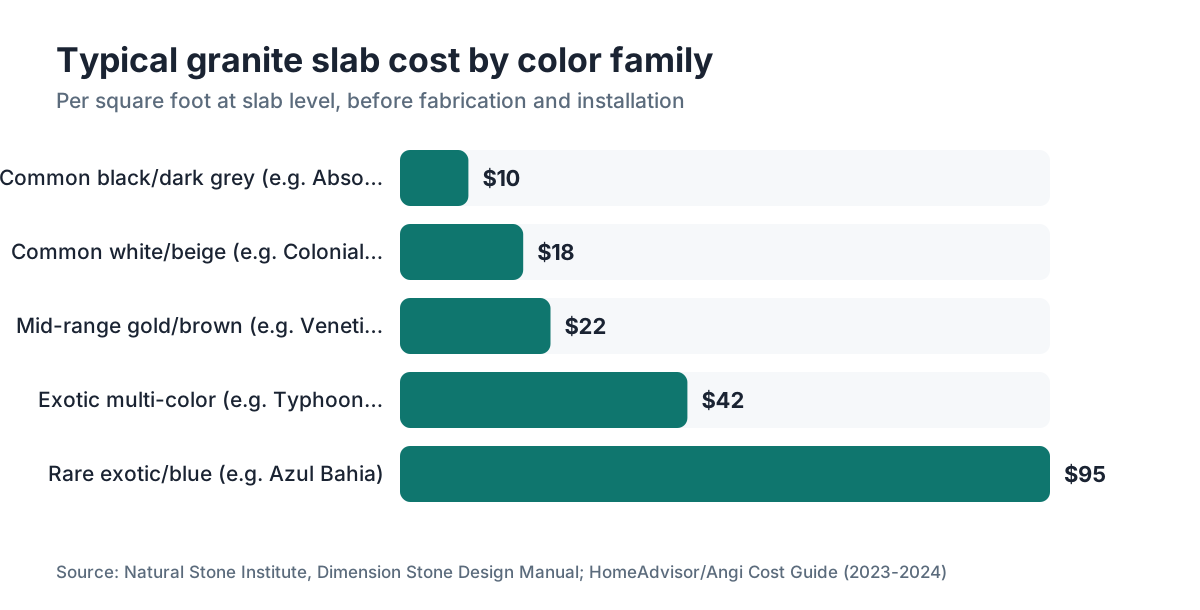
That said, there are real price patterns by color family. Common grey and black stones from India (Steel Grey, Absolute Black, Black Galaxy) tend to be among the most affordable choices, frequently $5-$15 per square foot at the slab level. Common white and beige stones from Brazil (Colonial White, Santa Cecilia, Giallo Ornamental) sit in the mid-range, roughly $10-$25 per square foot at slab level. Exotic blues, greens, and large-format rare stones from Brazil, Norway, or Madagascar push into $40-$100+ per square foot at the slab level [3].
Installed price adds fabrication, edge profiles, cutouts, and labor. The Marble Institute of America (now part of Natural Stone Institute) historically reported installed granite countertop costs in the range of $40-$200 per square foot depending on stone rarity, edge complexity, and region. Most homeowners in a mid-tier market pay $70-$120 installed for a commonly available stone [3].
| Granite color family | Typical slab cost (per sq ft) | Common examples |
|---|---|---|
| Common black/dark grey | $5-$15 | Absolute Black, Steel Grey |
| Common white/beige | $10-$25 | Colonial White, Santa Cecilia |
| Mid-range gold/brown | $15-$30 | Venetian Gold, Giallo Ornamental |
| Exotic multi-color | $25-$60 | Blue Eyes, Typhoon Bordeaux |
| Rare exotic (blue, rare green) | $40-$150+ | Azul Bahia, Blue Pearl, Emerald Pearl |
Note: slab prices vary significantly by region, supplier, and slab quality (commercial vs. first-choice vs. premium). These ranges reflect broadly reported industry data [3][6], not a guarantee of current pricing.
How do different finishes change the look of a granite color?
The same slab can look very different depending on how it is finished. Polished is the most common and the most reflective. It intensifies color depth, especially in dark stones like Absolute Black or Steel Grey, and makes the grain pattern pop. It is also the easiest to clean because the surface is very dense and non-porous after polishing.
Honed finish removes the gloss but keeps the color relatively deep. The result looks more matte and feels slightly softer. White and grey granites with a honed finish are popular in contemporary and Scandinavian-influenced kitchens right now. One honest trade-off: honed surfaces are slightly more susceptible to oil absorption and etching from acids on some stones, so sealing matters more.
Leathered or brushed finishes have become a popular option over the past decade. The surface has a subtle texture that feels like leather, hides fingerprints better than polished, and adds visual depth. It is particularly effective on dark granites like Absolute Black and Uba Tuba where the texture creates a richness that polished surfaces do not have. Not every stone takes a leather finish well, so ask your fabricator which of their current inventory actually looks good leathered.
Flamework (thermal) finish is less common in residential work. The surface is rougher and more matte, and the color tends to lighten compared to polished. It is mostly used for flooring and exterior applications.
Which granite countertop colors hide dirt, stains, and seams best?
This is a practical question that does not always get a straight answer in design-focused content. Dark stones with tight, consistent crystal patterns hide daily crumbs and dried water spots best. Absolute Black and Steel Grey are the top performers here. The trade-off is that light-colored flour or powdery residue shows up clearly against a dark background.
Mid-tone stones with high movement, meaning lots of visual variation in pattern, are the best at concealing seams and hiding incidental staining. Santa Cecilia, Venetian Gold, and Typhoon Bordeaux are classic examples. The varied pattern draws the eye away from seams and small marks. Uniform stones like Absolute Black actually make seams more visible because any slight color variation at the seam line stands out against the flat field.
Light stones with heavy speckling, like Colonial White or Bianco Antico, fall in the middle. The speckling breaks up visual uniformity, which helps hide seams, but coffee and red wine will show against a light background if not wiped promptly.
Honed finishes on dark stones are a particularly practical combination. The texture hides fingerprints and smears that would show on polished dark granite while still giving you the pattern-hiding benefits of a dark color.
How do you match granite color to cabinet color?
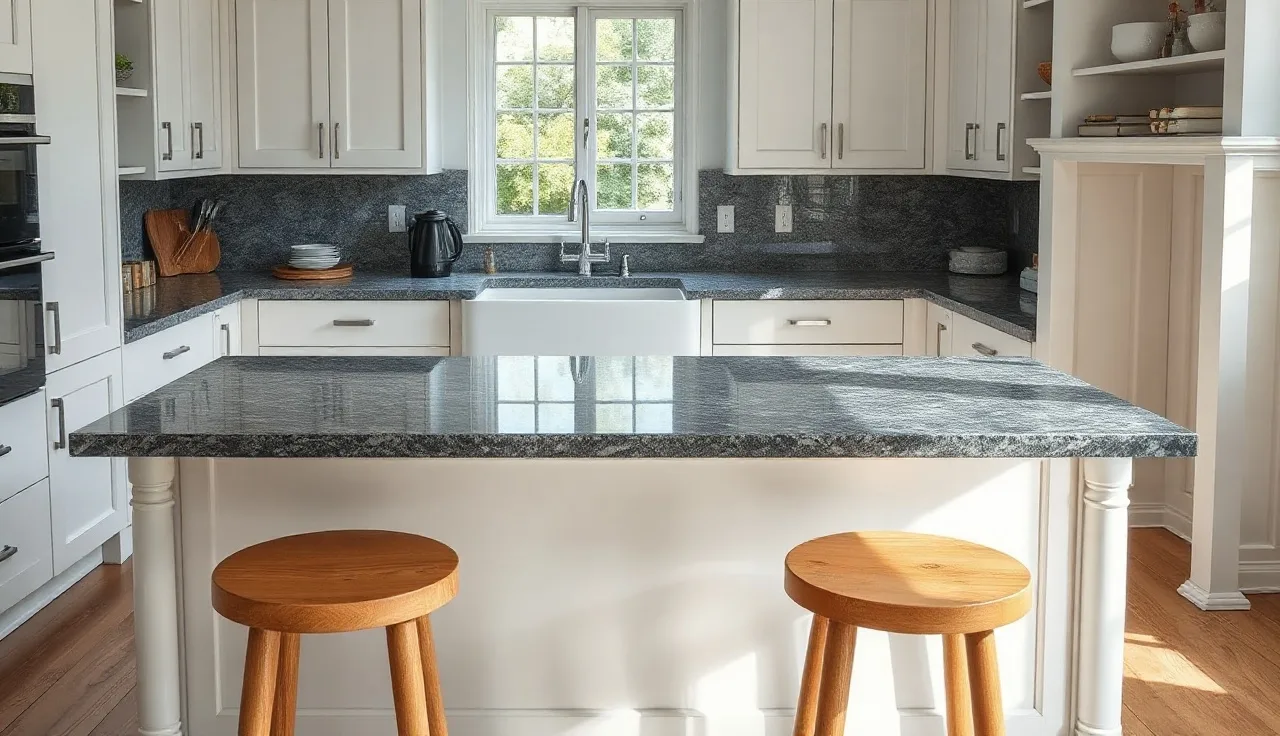
The basic logic is contrast without conflict. If your cabinets are a very light color (bright white, cream, or light grey), you have the widest range of countertop options because both dark and light granites create contrast or harmony respectively. White cabinets with a dark granite island is a classic combination that photographs well and functions even better because the contrast makes the workspace visually clear.
With dark cabinets, lighter granites work best for contrast. White, cream, and light grey granite against navy, charcoal, or dark green cabinets gives each element visual breathing room. Very dark countertops on dark cabinets can feel heavy and make the kitchen look smaller, though in a large, well-lit kitchen with high ceilings this can work as a moody, dramatic choice.
Medium-toned wood cabinets like natural oak, walnut, or maple are flexible. They pair naturally with beige, gold, and brown granites that share their warm undertones. They also work with a stark white or light grey granite if the goal is a brighter, more modern feel.
Undertone matching matters more than people expect. A cool blue-grey cabinet paired with a warm beige-undertone white granite will look off even if both are technically neutral. Check undertones by looking at the stone and cabinet sample side by side in your actual kitchen lighting. Showroom lighting is often very different from residential lighting, which is why something that looked perfect at the store can look wrong once installed.
For kitchen countertops planning, consider the flooring too. Flooring undertones can either harmonize or fight with both the granite and the cabinets, so look at all three together before you commit.
What granite countertop colors work well in bathrooms?
Granite works in bathrooms and the same principles apply, but scale matters more. A bathroom vanity top is typically 20-25 square feet at most, so a bold exotic stone that would feel overwhelming in a kitchen can be entirely appropriate and even elegant in a small bathroom.
For a primary bathroom, white and grey granites remain popular for their clean look. River White, Bianco Antico, and Viscount White are all commonly specified in bathroom applications. Blue and green exotic stones like Azul Bahia or Emerald Pearl appear in bathrooms more than in kitchens because the smaller scale makes the higher cost more manageable and the boldness less overwhelming.
In powder rooms, where the surface is small and statement-making is acceptable, a dramatic stone is often a better choice than a conservative neutral. A deep red, a rare blue, or a high-movement multi-color stone that would be exhausting in a full kitchen can be exactly right in a 15-square-foot powder room vanity.
How should you care for granite countertops to preserve their color?
Granite color is stable, it does not fade. What changes over time is the sealer, not the stone itself, and a deteriorating sealer can allow staining that makes the stone look dull or discolored. The practical maintenance answer is: seal the stone on the right schedule and clean up acidic spills promptly.
Sealers on granite do not last forever. Most penetrating impregnating sealers on a polished granite need refreshing every 1-3 years depending on stone porosity and use. Darker granites tend to be denser and less porous (Absolute Black, for example, barely needs sealing), while lighter, more granular stones like White Ice absorb more and need more frequent sealing [7].
The simple test: put a small puddle of water on the counter and watch it. If the stone absorbs it within a few minutes, it is time to reseal. If the water beads for 15-20 minutes, the sealer is still working.
For daily cleaning, a pH-neutral stone cleaner or just warm water and a soft cloth is sufficient. Acidic cleaners (vinegar, lemon juice) can dull polished finishes over time. For ongoing care of any natural stone, the principles in our guide on how to clean stone countertops apply directly to granite.
Fabricators can refer clients to the Natural Stone Institute's care guidelines, which state that granite should be cleaned with neutral, non-acidic cleaners and sealed with a quality impregnating sealer, with reapplication intervals based on a water absorption test rather than a fixed calendar schedule [7].
How does granite compare to quartz and other materials by color range?
Granite and quartz countertops overlap significantly in the white, grey, and black color space. Quartz has a broader range of engineered solid colors (true bright white, true solid black) because it is manufactured with pigments. Granite cannot produce a perfectly uniform solid white slab because the mineral formation process always creates some variation. If you want a countertop that looks like a perfectly consistent white panel, quartz gets you there and granite does not.
Granite has advantages in exotic and complex natural patterns that engineered quartz cannot fully replicate. The depth, mineral glitter, and three-dimensional crystal quality of a stone like Blue Pearl or Lemurian Blue comes from the actual mineralogy. High-end quartz products do a reasonable job mimicking marble-like veining, but the random organic complexity of true granite movement is hard to fake at scale.
Marble countertops overlap with granite in the white and grey space but offer a different aesthetic quality: softer, more fluid veining vs. granite's more crystalline, speckled character. Marble is more susceptible to etching and staining, which is why many homeowners who want the look choose a white granite instead.
Laminate countertops and Formica countertops now offer granite-look prints at a fraction of the cost. They are credible at a distance but do not have the depth or texture of real stone. Corian countertops and concrete countertops fill different aesthetic niches entirely.
If granite color options do not meet your needs and you want something in a completely different direction, butcher block countertops bring warmth that no stone achieves.
How do fabricators manage color consistency across a multi-slab job?
This is where the homeowner's perspective and the fabricator's perspective converge in practical ways. On any job that requires more than one slab, color consistency is not automatic, even within the same granite name.
Granite slabs from the same quarry lot are called book-matched or lot-matched when they come from adjacent cuts of the same block, and they will have very similar coloration and pattern direction. But two slabs of Colonial White from different lots, even from the same quarry, can be noticeably different in the warmth of the background or the density of the grey speckling.
For kitchens with long runs of countertop, fabricators should source all slabs from the same lot. The way to verify this is to look at the bundle number on the back of the slab or in the supplier's inventory system. When quoting a job, noting the required slab count and marking the slabs as reserved is basic practice but surprisingly often skipped, resulting in a mismatch when the second slab is pulled from a new bundle weeks later.
Fabricators running an organized shop track slab inventory, lot numbers, and job assignments in their job management or quoting system. SlabWise includes slab tracking in the quoting workflow so remnants and lot numbers are tied to specific jobs rather than floating loose in the yard.
For perimeter counters meeting an island, the standard practice is to run the visible grain or pattern direction consistently and to place the seam in a less-visible location, usually near a corner or a sink. On high-movement exotic stones, some designers intentionally mismatch the slabs slightly to create a bookmatched effect that reads as intentional design rather than accidental inconsistency.
Frequently asked questions
What is the most popular granite color for kitchen countertops right now?
White and grey granite are the most popular kitchen countertop colors as of recent NKBA survey data. Within white, Colonial White, Alaska White, and White Ice are consistently among the most specified. Within grey, Luna Pearl and Steel Grey are the most widely stocked at distributors nationwide. Beige and gold tones like Santa Cecilia have cooled in popularity but remain widely available.
Does granite color affect how much sealing it needs?
Yes, because color loosely tracks density and porosity. Dark granite like Absolute Black is very dense and barely needs sealing. Lighter, more granular granites like White Ice or Colonial White are more porous and need sealing every 1-2 years. The reliable test: puddle water on the surface and see if it absorbs within a few minutes. If it does, reseal. If it beads for 15-20 minutes, you are fine.
Which granite colors show seams the most?
Uniform dark granites like Absolute Black and Steel Grey show seams the most because even a slight color or polish variation at the seam line is visible against a flat dark field. High-movement stones with lots of pattern variation, like Santa Cecilia, Venetian Gold, or Typhoon Bordeaux, hide seams much better. White granites with heavy speckling, like Colonial White, fall in between.
What is the cheapest granite countertop color?
Common black and dark grey granites from India, particularly Absolute Black and Steel Grey, are typically among the lowest-cost granite options at slab level, often $5-$15 per square foot. Common beige and white granites from Brazil like Santa Cecilia and Colonial White are in the $10-$25 range. Installed prices are much higher once fabrication and labor are added, usually $40-$80 per square foot for these entry-level stones depending on region.
Can you get blue granite countertops and what do they cost?
Yes. Azul Bahia from Brazil is the most famous and can cost $80-$150 per square foot at slab level due to limited quarry supply. Blue Pearl from Norway is more accessible, typically $25-$50 per square foot at slab level. Both are real granites (or granitic rocks with similar mineral composition). Blue color in granite comes from rare minerals like riebeckite or labradorite, which is why the stones command a premium.
What granite colors work best with white cabinets?
Almost any granite color works with white cabinets because white is neutral. For contrast, dark grey or black granites like Steel Grey or Absolute Black are classic and clean. For a softer look, white or light grey granites like River White or Colonial White create a tone-on-tone effect. For warmth, gold and beige stones like Venetian Gold or Santa Cecilia bring color into a white kitchen without competing with the cabinetry.
Do granite countertop colors look different in person than online?
Almost always, yes. Granite samples and slab photos vary depending on lighting conditions, camera white balance, and screen calibration. Warm-background stones like White Spring or Typhoon Bordeaux often look more neutral online than they do in person. Always view the actual slab you will receive under your kitchen's lighting conditions before approving the cut. Showroom lighting is typically brighter and cooler than residential kitchen lighting.
What is the difference between grey granite and quartzite?
Granite is an igneous rock formed from cooled magma with a crystalline, speckled appearance. Quartzite is a metamorphic rock formed from sandstone under heat and pressure, and it tends to have more linear, marble-like veining. Grey quartzite like Silver Cloud or Taj Mahal can look similar to grey granite at a glance but has a different surface character. Quartzite is typically harder and less porous than granite but can be more expensive.
How do you pick a granite color that will not go out of style?
Stick to stones with natural, moderate movement in white, grey, or black. These have been specified in kitchens for decades and do not read as trendy. Avoid stones that are popular specifically because they mimic a current trend (extremely bold veining trying to look like a specific exotic marble, for example). The most timeless granites are the ones that look like granite rather than trying to look like something else.
Is green granite a good choice for a kitchen?
It can be. Uba Tuba is the most commonly used green granite in residential kitchens, and it is a strong practical choice: dark enough to hide daily use marks, rich in pattern so it hides seams, and priced competitively because it is widely quarried. Brighter, more saturated greens like Emerald Pearl are better suited for a statement island or a bathroom vanity where the intensity of the color has visual room to breathe.
What granite colors are hard to find or special order?
True blue granites like Azul Bahia and rare exotics from Madagascar and Brazil are the most difficult to source consistently. Stock levels at US distributors can be thin, and lot availability varies. If you are set on a rare color, identify and reserve your slabs before your project goes to contract. With common colors like Colonial White or Absolute Black, same-week availability from regional distributors is typical.
Do granite countertop colors fade over time?
No. Granite color is determined by its mineral composition and does not fade from light exposure or normal use. What can change over time is the surface: a polished finish can dull if cleaned with acidic products, and an unsealed or poorly sealed stone can absorb stains that alter its apparent color. Proper sealing and neutral-pH cleaners preserve the surface and keep the original color looking as it did when installed.
What granite countertop color hides the most dirt and fingerprints?
Dark stones with a leathered or honed finish are the best at hiding fingerprints and daily crumbs. Absolute Black and Uba Tuba in a leathered finish are frequently recommended for high-use kitchens. Polished dark stones show fingerprints clearly. High-movement mid-tone stones like Venetian Gold and Santa Cecilia hide incidental marks well because the pattern variation draws the eye away from small imperfections.
Sources
- Natural Stone Institute, Stone Identification and Properties: Granite trade names can be applied inconsistently across quarry sources; the same name may refer to slabs with notably different appearance from different origins.
- National Kitchen and Bath Association, 2023 Design Trends Report: White and off-white countertop colors remained the top choice across all countertop material types in residential kitchens in 2023, with grey a close second.
- Natural Stone Institute, Dimension Stone Design Manual: Installed granite countertop costs historically range from approximately $40 to $200 per square foot depending on stone rarity, edge complexity, and regional labor rates.
- USGS, Mineral Resources Program: Granite and Crushed Stone: Brazil is one of the largest exporters of dimension granite to the United States, accounting for a significant share of white and beige granite slabs in the US market.
- USGS, Dimension Stone Statistical Compendium: Exotic-colored granites including blue varieties have limited quarry sources, primarily in Brazil and Norway, contributing to supply constraints and higher prices.
- HomeAdvisor (Angi), Granite Countertops Cost Guide: Slab-level granite prices range from approximately $5-$15 per square foot for common dark granites to $40-$150 per square foot for rare exotic colors.
- Natural Stone Institute, Care and Maintenance of Natural Stone: The Natural Stone Institute recommends cleaning granite with neutral, non-acidic cleaners and using an impregnating sealer, with reapplication intervals based on a water absorption test rather than a fixed calendar schedule.
- USGS Mineral Resources, Feldspar and Quartz Mineral Statistics: The mineral composition of granite, primarily feldspar, quartz, and mica, directly determines the rock's color, with exotic minerals like riebeckite responsible for rare blue coloration.
- National Kitchen and Bath Association, Kitchen Design Survey 2022: Grey countertop colors gained market share in residential kitchens between 2018 and 2022 as white cabinetry became the dominant cabinet color choice.
- Natural Stone Institute, Sustainability and Sourcing Guidelines: Natural stone including granite is quarried globally, with major producing countries including Brazil, India, China, Italy, and Norway each contributing distinct color families to the US market.
Last updated 2026-07-09