TL;DR
- Concrete countertops cost roughly $65 to $135 per square foot installed, depending on complexity, colorants, and finishing.
- Fabricators cast them from cement, aggregates, and pigment, then seal them against stains.
- Done well, they look warm, sculptural, and one of a kind.
- Done badly, they crack and stain fast.
- This guide covers materials, methods, costs, maintenance, and the honest tradeoffs.
What exactly are concrete countertops and how are they made?
Concrete countertops are cast from a mix of Portland cement, fine aggregates (sand, sometimes glass or stone chips), water, and pigments. The result isn't the poured-in-place stuff on your sidewalk. It's a controlled mix with a very low water-to-cement ratio, reinforced with fiberglass fibers or steel mesh, then ground and polished to the finish you want.
There are two broad methods. Precast means the slab gets made off-site in a shop, cured for several weeks, then transported and installed. Cast-in-place means the mix gets poured right onto the cabinets in your kitchen. Most professional fabricators go precast. They can control curing, flip the piece for a glass-smooth face (called a knockout), and reject a bad slab before it ever enters your house. Cast-in-place is harder to pull off and rarely looks as clean.
The cement is usually Type I or Type II Portland, the same binder in all structural concrete [1]. What sets a countertop mix apart is precision. Water-to-cement (w/c) ratios below 0.40 are standard in good shop work, because higher ratios add porosity that later shows up as stains and cracks. Some fabricators add pozzolans like fly ash or silica fume to cut permeability further [8].
Pigment goes in as iron oxide powder. It gives every slab a custom color that runs all the way through, instead of sitting on the surface. You can add decorative aggregates too: crushed recycled glass, shells, river pebbles, set into the face mold before the pour. That's how fabricators build the ultra-custom looks that made concrete a design staple in the early 2000s and keep it popular in modern and industrial kitchens now.
How much do concrete countertops cost?
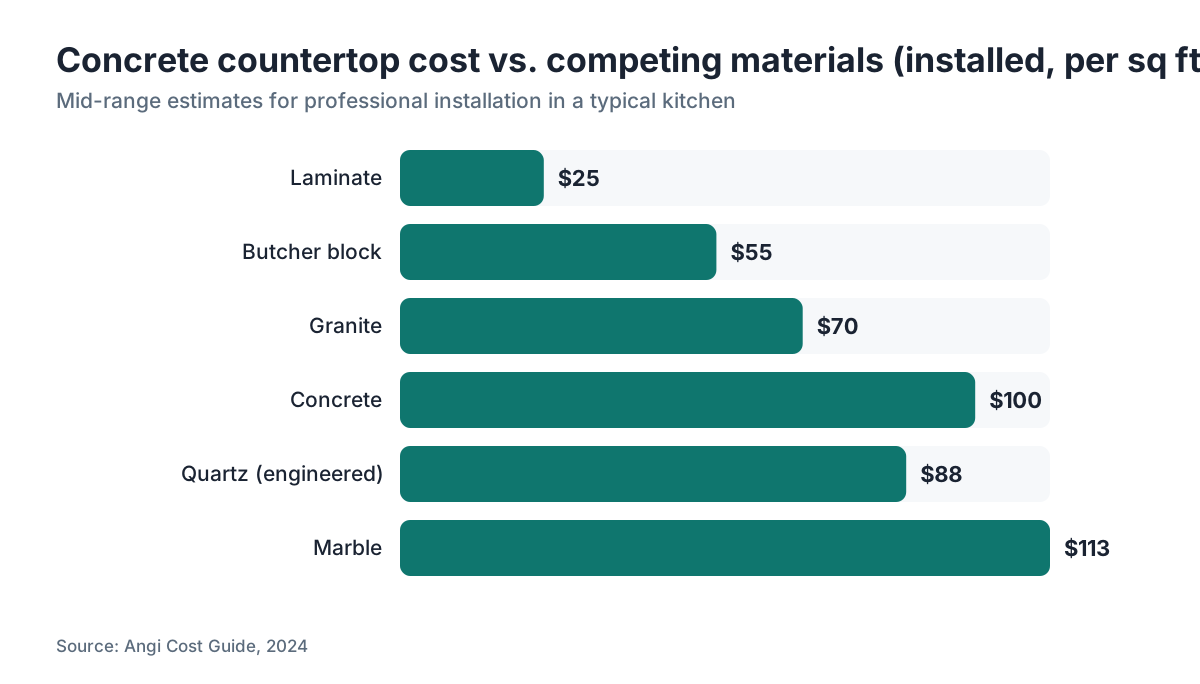
Expect $65 to $135 per square foot installed for professionally made concrete countertops [2]. The wide range is real. A plain charcoal rectangle with no cutouts sits at the low end. A waterfall-edge island with two sink cutouts, embedded aggregate, and a matte acid-stained finish pushes the top.
A typical kitchen with 40 square feet of counter runs $2,600 to $5,400 before any demo or plumbing work. That's the same neighborhood as mid-range quartzite or high-end quartz, and more than granite or laminate countertops.
Here's where the money actually goes on a precast shop job:
| Cost driver | Approximate share of total |
|---|---|
| Labor (forming, casting, finishing) | 50 to 60% |
| Materials (cement, aggregates, pigment, sealer) | 15 to 20% |
| Overhead and transport | 10 to 15% |
| Profit margin | 10 to 15% |
DIY drops the cost to $10 to $25 per square foot in raw materials if you own or rent the forms and grinders [2]. But the labor is real, curing takes weeks, and a botched slab is expensive to rip out. I'd only push DIY for an outdoor bar, a laundry room, or somewhere a small crack doesn't ruin your day.
Fabricators pricing concrete face different math than stone. You can't compare against a slab cost per square foot, because the value lives in the custom labor. Shops that try to undercut quartz on price usually lose. Shops that sell concrete as artisan custom work and price it that way do fine.
How do concrete countertops compare to granite, quartz, and other materials?
Concrete sits in an odd spot. It's heavy like stone, customizable like nothing else, and more maintenance-prone than any engineered option on the shelf.
| Material | Installed cost ($/sq ft) | Hardness | Stain resistance | Maintenance | Heat resistance |
|---|---|---|---|---|---|
| Concrete | $65, $135 | 6 to 7 Mohs (sealed) | Moderate (depends on sealer) | Annual resealing | Good (up to ~400°F) |
| Granite | $40, $100 | 6 to 7 Mohs | Good (sealed) | Occasional resealing | Excellent |
| Quartz (engineered) | $55, $120 | ~7 Mohs | Excellent | Low | Poor (can crack above 300°F) |
| Marble | $75, $150 | 3 to 4 Mohs | Poor | High | Good |
| Laminate | $10, $40 | N/A | Moderate | Low | Poor |
| Butcher block | $35, $75 | N/A | Poor (unsealed) | High | Poor |
Hardness figures come from the Mohs scale: granite runs 6 to 7, marble a soft 3 to 4, and cured Portland cement lands around 6 to 7 [6]. Against granite countertops, concrete gives you more design freedom and asks for more upkeep. Against marble countertops, it's about as maintenance-hungry but far more forgiving of heat. Against engineered quartz like Cambria countertops, concrete demands an actual sealing commitment you have to keep.
Here's the blunt version. Concrete is for people who want something genuinely custom and will put in a little care every year. If a client wants a surface that looks cool and never needs a thought again, send them to quartz.
What does concrete countertop sealing actually involve?
Sealing is the part homeowners underestimate, and it's why some concrete counters look rough after two years while others still look great at fifteen.
Concrete is porous. Unsealed, it soaks up red wine, coffee, and oil in minutes and stains for good. Three sealer categories show up in countertop work:
Topical sealers (polyurethane, epoxy, acrylic) sit on top and form a film. They resist stains and etching well but can scratch, peel over time, and often change the look by adding a plastic sheen. Epoxy topcoats are tough but yellow under UV.
Penetrating sealers (silane-siloxane, fluoropolymer) soak into the concrete and repel water and oil from inside. They keep the natural matte look but give up some protection against acid etching compared to a good topcoat.
Wax (carnauba or beeswax based) goes over a topical or penetrating sealer. It isn't a sealer on its own. It adds a soft luster and a sacrificial layer you renew every few months.
Most experienced kitchen fabricators use a penetrating sealer during fabrication, a food-safe topical finish over it, and sometimes a wax maintenance coat on top. Buddy Rhodes, one of the early American concrete countertop specialists, built hybrid sealer systems in the 1990s that shops still reference today [3].
A concrete counter in a busy kitchen needs its topical sealer refreshed every 1 to 3 years, depending on product and use. Your job as the owner: wipe spills fast (acids first), use cutting boards, and wax every few months. That's more work than quartz and less than most people fear, if you build the habit early.
For fabricators, the sealer you send out with the job matters as much as the concrete. Handing a client a cheap hardware-store sealer after months of shop work is a callback waiting to happen.
How do you actually make a concrete countertop? Step-by-step process
This is the full professional workflow. Homeowners get to see what they're paying for. Fabricators new to concrete get a process map, not a substitute for hands-on training.
1. Template and design. The fabricator measures the cabinet layout down to the millimeter, including sink and cooktop cutouts. Every dimension counts, because concrete has no margin for on-site trimming the way stone does.
2. Build the mold (form). Melamine-coated particleboard is the standard. The mold gets built upside down, so the face-down side becomes the show surface. Sink knockout forms are secured inside. Edge profiles get built into the mold walls. Precision here decides everything downstream.
3. Mix design. A typical shop mix runs about 1 part Portland cement, 1.5 to 2 parts fine sand, a 0.35 to 0.40 w/c ratio, plus pigment (iron oxide at 1 to 6% by cement weight) and admixtures like plasticizers that improve workability without adding water. AR glass fiber (usually 1/2 inch) goes in for crack resistance.
4. Pour and consolidate. Mix goes into the mold in layers, vibrated or tapped to knock out voids. For face mixes with embedded aggregate or glass, the decorative layer gets packed at the bottom of the mold first.
5. Cure. Concrete hits about 70% of design strength in 7 days and near full strength at 28 days [1]. Most shops demold at 24 to 48 hours and keep curing under plastic or wet burlap. Rushing the cure is a top cause of cracking.
6. Grind and polish. Starting with 50- or 80-grit diamond pads on a wet polisher, the fabricator grinds the face to expose aggregate and close surface porosity. Progressive grits (100, 200, 400, 800, 1500, 3000) build toward the target finish. Matte stops around 400 to 800 grit; high gloss goes to 1800 to 3000. Wet grinding controls the respirable silica dust that OSHA and EPA both flag as a serious hazard, so wet methods and PPE aren't optional [7].
7. Fill and recoat. Pinholes and bug holes get a slurry coat of matching cement and pigment, then a re-grind. This step tests your patience.
8. Seal. Penetrating sealer first, topical finish next, optional wax last.
9. Install. These slabs are heavy. A 1.5-inch concrete slab runs about 18 to 20 pounds per square foot [4]. A 40-square-foot kitchen is 720 to 800 pounds. Cabinets have to be solid. Transport needs padded supports and two to four people, depending on piece size.
For shops running concrete alongside stone, quoting this labor accurately is the real business challenge. Software that handles both stone and custom pour work in one system saves genuine time. SlabWise is one option shops use to quote concrete and stone in a single workflow.
See the full guide to countertop installation for what happens once the slab reaches the job site.
Do concrete countertops crack, and can you prevent or repair it?
Yes, concrete cracks. Saying so upfront is the right move for fabricators and homeowners both. The real questions: is a given crack structural or cosmetic, and how likely is it with good practice?
Hairline cracks (under 1/16 inch wide) are common and mostly cosmetic. They come from plastic shrinkage during curing, thermal expansion, or slight cabinet movement. They don't weaken the slab. You fill them with a matching cement slurry or a colored epoxy filler.
Structural cracks (wider, running across the slab) are rarer and usually trace to three causes: weak reinforcement, a bad mix with too much water, or cabinets that flex or sit unlevel. A low w/c ratio, proper fiberglass or steel reinforcement, and solid cabinet support kill most of that risk.
Prevention checklist:
- Keep the w/c ratio at or below 0.40
- Use AR (alkali-resistant) glass fiber at the manufacturer's dosage
- Cure fully before demold
- Get cabinet frames level and rigid before install
- Avoid unsupported spans past about 24 to 30 inches without a substrate or corbel
Repair works. For hairline cracks that show up after installation, a penetrating sealer sometimes hides them. For more visible ones, a colorant-matched epoxy filler, tooled in and sanded flush, does the job. Here's the honest part: the repair usually stays visible up close in raking light. Concrete's character includes the chance of imperfection. That's exactly why some people love it and others can't stand it.
What finishes and colors are available for concrete countertops?
This is where concrete earns the customization reputation. The design range beats any natural stone or engineered product.
Color. Iron oxide pigments cover the whole spectrum, from warm creams and tans to deep charcoals and blacks, with earthy reds, ochres, and greens between. You can blend to match almost any interior. Because the pigment runs through the full slab, chips and wear don't expose a different color underneath. Acid stains (usually hydrochloric acid mixed with metallic salts) go on after the grind to create mottled, variegated tones that read like aged stone or leather.
Surface finish. The grinding progression sets the look:
- Salt-and-pepper (ground to 100 to 200 grit): matte, shows aggregate, closest to the classic concrete look
- Honed (400 to 800 grit): smooth, low sheen, clean and contemporary
- Polished (1500 to 3000 grit): glass-like, shows depth in the aggregate, high-maintenance but dramatic
Edge profiles. Since concrete gets cast in a mold, edges are limited only by what you can build in melamine. Eased, bullnose, beveled, waterfall, ogee, cove, all possible. Curved and irregular edges that need expensive CNC work in stone are pretty simple in concrete.
Embedded objects. Glass chunks, stone pebbles, shells, fossils, tiles, coins, steel fibers, mother of pearl. All have gone into concrete faces. Purely a design call, with no structural downside as long as the objects bond into the cement matrix.
From pigmented precast to acid-washed cast-in-place, almost any look is on the table. The tradeoff never changes: every custom choice adds labor time and cost.
How do you maintain and clean concrete countertops day to day?
Daily care is easy. Wipe spills fast, acids first (citrus, vinegar, wine), because even sealed concrete can etch under long contact. Use mild dish soap and warm water for routine cleaning. Skip abrasive pads; they scratch topical sealers. Skip bleach and ammonia cleaners, which break down sealer chemistry over time.
Ongoing maintenance:
- Apply a quality carnauba paste wax every 3 to 6 months. Buff it in, let it haze, wipe it off. Fifteen minutes, and it makes a real difference in stain resistance between topical reseals.
- Inspect once a year for sealer wear: water stops beading, the surface feels rougher, small stains start showing. When you see those signs, it's time to reapply topical sealer.
- A full topical reseal is a half-day job for a handy homeowner following the manufacturer's directions. Clean thoroughly, dry completely, apply the sealer in thin even coats, and let it cure per the spec before use.
Heat resistance is good, not unlimited. Concrete takes a hot pan better than quartz (which can crack above 300°F), but sustained direct heat can discolor or degrade the sealer and leave a dull patch. Use a trivet. It takes 30 seconds.
The cleaning logic here overlaps with stone. See how to clean stone countertops for the parallel approach.
Is DIY concrete countertop casting realistic for homeowners?
It's realistic for the right project. Outdoor bars, basement wet bars, laundry rooms, a simple rectangular bathroom vanity top, all good candidates. A kitchen with multiple cutouts, complicated edges, and 40-plus square feet is a bad first concrete project.
Here's the honest difficulty map.
Easy parts: Mixing concrete isn't hard. The ingredients are cheap and everywhere. YouTube has thousands of hours of instruction.
Hard parts: Grinding and polishing take wet angle grinders, diamond pads from 50 to 3000 grit, and patience. Rental gear exists, but you'll still spend $200 to $400 on consumables and tools for a small project. The grind-and-fill cycle runs far longer than first-timers expect. Sealing needs the right products applied in the right temperature and humidity, or they fail fast. And grinding cement throws respirable silica dust, so wet methods, a respirator, and ventilation are mandatory, not optional [7].
For a DIY bathroom vanity top (under 10 square feet, no undermount sink), budget $300 to $500 in materials and 2 to 3 weekends of real work. For a kitchen, get three quotes from local fabricators first. The gap between DIY materials and a professional installed price is often smaller than people guess once you count grinding consumables, sealer, and the cost of redoing whatever goes wrong.
If you go DIY, the Portland Cement Association and the American Concrete Institute both publish mix design guidance that applies to countertop work [1][5]. Cheng Concrete and Buddy Rhodes publish detailed countertop-specific instructions commercially.
For kitchen countertops specifically, professional installation is worth it unless your tolerance for a learning-curve result is genuinely high.
What are the pros and cons of concrete countertops? The real list
After all of the above, here's the blunt summary.
Real pros:
- Unlimited color and texture customization. No other material comes close.
- Unique look. Two concrete counters are never identical.
- Heat resistant (better than quartz or butcher block countertops) with the right sealer.
- Integrated sinks and drainboards, no seam.
- Refinishable in place. Grind and reseal a concrete counter 10 years later and get a fresh surface.
- Long life. A well-made, well-sealed counter can last as long as the house.
Real cons:
- More maintenance than quartz or granite. Full stop.
- Hairline cracks are common. Cosmetic, but real.
- Heavy. Cabinets need a load check.
- Price. At $65 to $135 per square foot installed, it's no budget option.
- Fabricator quality swings wildly. A badly mixed or badly sealed counter is a nightmare.
- Lead time. Precast shops usually need 4 to 8 weeks from template to install [10].
For fabricators, concrete isn't for every shop. It needs specific gear (wet grinder, diamond pads, vibrator, curing space) and a skilled operator. Shops that win with concrete either specialize in it or run enough volume to keep a skilled hand efficient. Bolting it on as an afterthought next to high-volume quartz usually breeds subpar work and callbacks.
Shops quoting concrete alongside stone jobs can keep pricing consistent using tools like SlabWise, which handles the labor-heavy custom side of quoting without making you run two separate estimating systems.
How do fabricators price and quote concrete countertop jobs?
Concrete pricing doesn't follow the sq-ft-times-material-cost formula that works for stone. The labor is front-loaded and highly variable, and the materials are cheap next to the finished value.
A workable framework for shops:
Base rate. Set a base price per square foot that covers overhead and a standard complexity level. Most shops land in the $80 to $110/sq ft range as a baseline for precast kitchen work [2].
Upcharges (per piece or per linear foot):
- Each sink cutout: $150 to $300
- Undermount sink integration (knockout form): $100 to $200
- Each mitered edge (waterfall or full profile): $100 to $250
- Decorative aggregate or embedded objects: $5 to $20/sq ft added
- Specialty acid stain finish: $10 to $20/sq ft added
- Tight color match to an existing element: $50 to $150 setup
Minimums. Most concrete shops carry a project minimum of $500 to $1,500, because the setup cost for one small piece is substantial.
Lead time disclosure. Build 4 to 6 weeks minimum into every quote. Rushing cure time to hit a client deadline is how cracks happen.
On the back end, track your actual hours per project for the first 20 concrete jobs. The gap between estimated and actual labor is where most shops bleed money on concrete until they've done enough to calibrate. Jobs that look simple on the design sheet often hide form-building complexity that adds hours you never quoted.
Frequently asked questions
How long do concrete countertops last?
A properly made and sealed concrete countertop can last 20 to 30 years or more. The limiting factor isn't the concrete, which is very durable, but the sealer. Without regular maintenance (wax every few months, topical sealer refresh every 1 to 3 years), the surface stains and degrades. Maintained well, concrete outlasts most other surface materials.
Are concrete countertops food safe?
Yes, once sealed with a food-safe topical finish. Unsealed concrete is porous and harbors bacteria, so sealing isn't optional. Most professional-grade topical sealers for countertops are NSF-compliant or equivalent once fully cured. Check the data sheet for your specific sealer. Don't use the surface before the cure is complete, which is typically 72 hours to 7 days depending on the product.
How heavy are concrete countertops compared to granite?
Concrete at 1.5 inches thick runs about 18 to 20 pounds per square foot. Granite at 3/4 inch (standard) runs about 13 pounds per square foot, and at 1.25 inches about 18 pounds per square foot. So a 1.5-inch concrete slab weighs roughly the same as thick granite. A 40-square-foot kitchen counter comes to 720 to 800 pounds. Check cabinet load capacity before install.
Can you put hot pans directly on concrete countertops?
Concrete itself handles heat well, but the sealer on top doesn't. A hot pan can discolor or soften topical sealers, leaving a dull patch that's hard to fix without resealing the whole surface. Use a trivet or pot holder. Concrete beats quartz on heat (quartz can crack above 300°F) but loses to bare granite or stainless steel.
Do concrete countertops stain easily?
Unsealed concrete stains within minutes from red wine, oil, coffee, or citrus. Properly sealed concrete resists most stains if you wipe spills quickly. Quickly is the key word. Acids can etch even sealed concrete if left to sit. A concrete countertop's stain resistance is basically a function of sealer quality and how fast you respond to spills. Annual maintenance keeps the protection working.
How thick should a concrete countertop be?
The standard range is 1.5 to 2 inches for kitchen counters. Thinner than 1.5 inches raises crack risk, especially over unsupported spans. Some fabricators pour to 1.25 inches with heavy fiberglass reinforcement to save weight, but 1.5 inches is the safe minimum for typical kitchen use. Bathroom vanity tops can go as thin as 1 inch if well-reinforced and the spans are short.
How do you remove stains from concrete countertops?
For fresh stains, wipe immediately with a damp cloth. For set stains on sealed concrete, try a paste of baking soda and water left for 30 minutes, then wiped clean. For oil stains, a poultice of baking soda or powdered chalk left overnight draws oil out of the sealer. Deep stains that reach a degraded sealer may need grinding and resealing, which is a fabricator job. Regular waxing prevents most of this.
What's the best sealer for concrete countertops?
There's no single answer, because the right sealer depends on your finish goals and how much maintenance you'll do. For most kitchens, a penetrating silane-siloxane sealer applied at the shop, followed by a water-based polyurethane or epoxy topcoat, balances stain resistance and maintainability well. Skip solvent-based topicals in enclosed spaces without serious ventilation [11]. Always follow the specified cure time before use. Wax over any topcoat extends its life a lot.
How do you repair a cracked concrete countertop?
Hairline cracks (under 1/16 inch) get filled with a thin cement-pigment slurry matched to the countertop color, pushed into the crack, cured, then sanded flush and resealed. Wider cracks need a two-part epoxy filler tinted with universal colorant to match. Repairs are almost always visible under raking light. Structural cracks that open or grow need a fabricator's assessment to decide whether the piece needs replacement.
Can concrete countertops be refinished or resurfaced?
Yes, and it's one of concrete's real edges over stone and quartz. A concrete counter can be wet-ground in place with a hand-held polisher and diamond pads to remove scratches, surface stains, and old sealer, then resealed fresh. Results depend on how deep the damage runs and whether embedded aggregates need re-exposing. A skilled fabricator can refinish an in-place counter in half a day for most residential kitchens.
How long does it take to get concrete countertops made and installed?
Allow 4 to 8 weeks from template to install for a professional precast job [10]. Concrete needs at least 7 days to reach 70% strength and ideally 28 days for full cure before grinding and sealing. Add form-building, grinding, sealing, and scheduling, and 4 to 6 weeks is realistic for a straightforward job at a busy shop. Rush jobs that skip full cure time are how you get cracked counters.
Are concrete countertops worth the price compared to quartz?
It depends on what you value. Quartz is lower maintenance, more consistent in color, and slightly cheaper at similar quality. Concrete is unique, customizable, repairable, and carries a warmth and handmade quality engineered stone can't fake. If you want something nobody else has and you'll maintain it, concrete is worth it. If you want a set-it-and-forget-it surface, quartz wins.
How do concrete countertops hold up in bathrooms versus kitchens?
Bathrooms are a gentler environment for concrete than kitchens. Lower heat, fewer acidic spills, and lighter use mean the sealer lasts longer and maintenance drops. Concrete vanity tops look great with an undermount sink cast right in. The main bathroom risk is standing water around faucet holes, so keep those areas waxed and sealed carefully to prevent sealer failure at the penetrations.
What questions should I ask a concrete countertop fabricator before hiring them?
Ask to see finished work at least 2 years old. Ask what mix design they use and what their w/c ratio is. Ask what sealer system they recommend and how they apply it. Ask for references from past kitchen clients. Ask about their warranty on cracking. A fabricator who can't answer the mix and sealer questions in detail is one to avoid. Concrete quality varies more than almost any other countertop material.
Sources
- Portland Cement Association, cement.org: Portland cement concrete reaches approximately 70% of design compressive strength at 7 days and near full strength at 28 days; Type I/II Portland cement is the standard binder for structural and decorative concrete.
- Angi, Concrete Countertop Cost Guide: Professionally installed concrete countertops cost $65 to $135 per square foot; DIY material costs run $10 to $25 per square foot.
- Buddy Rhodes Studio: Buddy Rhodes developed hybrid penetrating-and-topical sealer systems for concrete countertops widely adopted by professional shops.
- American Concrete Institute (ACI), ACI 318 Building Code Requirements for Structural Concrete: Normal-weight concrete weighs approximately 145 to 150 pounds per cubic foot, equating to roughly 18 to 20 pounds per square foot for a 1.5-inch slab.
- American Concrete Institute (ACI), Mix Design Resources: ACI publishes mix design guidance applicable to decorative and countertop concrete applications, including w/c ratio recommendations for reduced permeability.
- U.S. Geological Survey (USGS), Mohs Hardness Scale: Granite measures 6 to 7 on the Mohs hardness scale; marble measures 3 to 4; cured Portland cement concrete measures approximately 6 to 7 Mohs.
- U.S. Environmental Protection Agency (EPA): Concrete grinding produces respirable crystalline silica dust, classified as a significant occupational health hazard requiring PPE, wet methods, and ventilation controls.
- National Institute of Standards and Technology (NIST): Pozzolans including fly ash and silica fume reduce concrete permeability when substituted for a portion of Portland cement, improving durability in countertop applications.
- Concrete Countertop Institute, Professional Fabrication Training: The Concrete Countertop Institute documents standard shop practices for mix design, mold construction, grinding progression, and sealer application used by professional fabricators.
- This Old House, Concrete Countertops Guide: Concrete countertops installed by professionals typically carry a 4 to 8 week lead time from template to installation.
- U.S. Consumer Product Safety Commission (CPSC): Solvent-based concrete sealers emit VOCs during application and cure; CPSC advises adequate ventilation when applying solvent-based finishes in enclosed residential spaces.
Last updated 2026-07-10