TL;DR
- Quartz countertops are engineered slabs made from roughly 90 to 95% ground quartz bound with polymer resin.
- They cost $50, $150 per square foot installed, never need sealing, and shrug off most stains.
- They scorch under a hot pan and can't go outdoors.
- White is the most popular color family, and quartz outsells every other countertop material in North American kitchens.
What exactly are quartz countertops and how are they made?
Quartz countertops are engineered stone, not quarried stone. Manufacturers grind natural quartz crystals, which are rated 7 on the Mohs hardness scale and rank among the hardest minerals in the Earth's crust [5], then bind that material with polyester or epoxy resins (typically 7 to 10% by weight) and pigments. The mixture gets compressed under vacuum and vibration, then cured in an oven. What comes out is a slab that is denser and more consistent than most natural stone. The Natural Stone Institute puts the standard composition at "90 to 95% quartz aggregate with 7 to 10% polyester or epoxy resin binders by weight" [9].
The finished product has almost no porosity. Natural granite, by contrast, is porous enough that it needs periodic sealing to resist stain absorption. Quartz skips that maintenance step entirely because the resin fills the gaps the crystals would otherwise leave.
The biggest brands you'll see at slab yards are Cambria (the only major brand that quarries its own quartz in the US [7]), Caesarstone (Israeli-founded, manufactured in multiple countries), Silestone (Spanish, owned by Cosentino), and Viatera (LG). Dozens of overseas manufacturers, primarily in China, supply the mid-market slabs you'll find at big-box stores under various house brands. Quality varies meaningfully across that range, mostly in thickness consistency, color uniformity, and resin formulation.
Standard slab size is roughly 55 by 120 inches, though jumbo slabs (63 by 126 inches or larger) exist for long kitchen runs with fewer seams. Typical thickness options are 1.2 cm, 2 cm, and 3 cm. Most residential countertop installations use 3 cm because it's stiff enough to skip a plywood substrate, which saves on material and labor.
How much do quartz countertops cost installed?
The honest installed cost range for quartz countertops is $50 to $150 per square foot, and most mid-range residential kitchens land between $65 and $100 per square foot [1]. That range is wide because it folds in material grade, edge profile complexity, sink cutouts, local labor rates, and whatever the slab yard's overhead looks like.
Here's roughly how the cost breaks down:
| Cost component | Typical share of total |
|---|---|
| Slab material | 40 to 55% |
| Fabrication (cutting, polishing, edge work) | 25 to 35% |
| Installation (templating, delivery, set) | 15 to 20% |
| Cutouts and extras (sinks, faucet holes) | 5 to 10% |
A standard kitchen with about 50 square feet of countertop (not unusual for a modest U-shape) runs $3,250 to $5,000 at mid-range pricing. Larger kitchens with islands and complex layouts can push past $10,000 before you blink.
Premium designer lines from Cambria or Caesarstone, the visually complex slabs with thick veining, hit $100, $150/sq ft or beyond just for material. Basic big-box quartz, the stuff you pick up at Home Depot or Costco, starts closer to $40, $60/sq ft for supply only, but you still need a fabricator to cut and install it.
DIY installation is technically possible and rarely smart. A 3 cm quartz slab weighs roughly 18 to 20 pounds per square foot, so a 50-square-foot kitchen means moving nearly 1,000 pounds of fragile material. One bad seam ruins a slab that costs hundreds of dollars. Most homeowners who try it once don't try it twice.
For fabricators building quotes, the variables that eat margin fastest are edge profiles (a full bullnose on a long perimeter takes real time), mitered edges (the 45-degree cuts that make a thick-looking waterfall edge), and unusual sink configurations. Quote those by hand and that's where mistakes hide. Quoting software like SlabWise automates those line items so nothing gets missed, which matters on thin-margin jobs.
What are the most popular quartz countertop colors?
White quartz countertops have been the dominant color choice in North American kitchens for close to a decade, and the trend hasn't reversed. White quartz pairs with any cabinet color, photographs well for listings, and reads as clean in a way that makes kitchens feel bigger.
The white quartz countertop category breaks into a few distinct looks:
- Solid or near-solid white (think Silestone Blanco Zeus or Caesarstone Pure White): very clean, suits modern cabinetry, shows crumbs and water spots more than you'd expect
- White with gray veining (Calacatta or Carrara lookalikes like Caesarstone Calacatta Nuvo, MSI Calacatta Laza): mimics marble without marble's porosity or price premium
- White with gold or warm veining: popular in warmer design schemes, pairs well with natural wood cabinetry
White quartz countertops colors from the major manufacturers now number in the dozens within that one hue family. Cambria alone lists over 20 white and off-white options. The sheer number can be paralyzing, which is why most fabricators tell you to get physical samples rather than choose from a screen. Screens vary too much in color calibration.
Beyond white, the next most popular families are:
- Concrete and charcoal grays: strong in modern and industrial kitchens
- Soft beiges and creams: holding on in traditional and transitional designs
- Deep blacks: dramatic, unforgiving of dust and fingerprints
- Greens and blues: a smaller but growing segment as homeowners get more adventurous
Colors of quartz countertops vary by manufacturer, and not every color ships in every thickness. If you fall in love with a specific slab, check stock before committing to a cabinet color. Backordered material has killed more than a few kitchen timelines.
How does quartz compare to granite, marble, and other countertop materials?
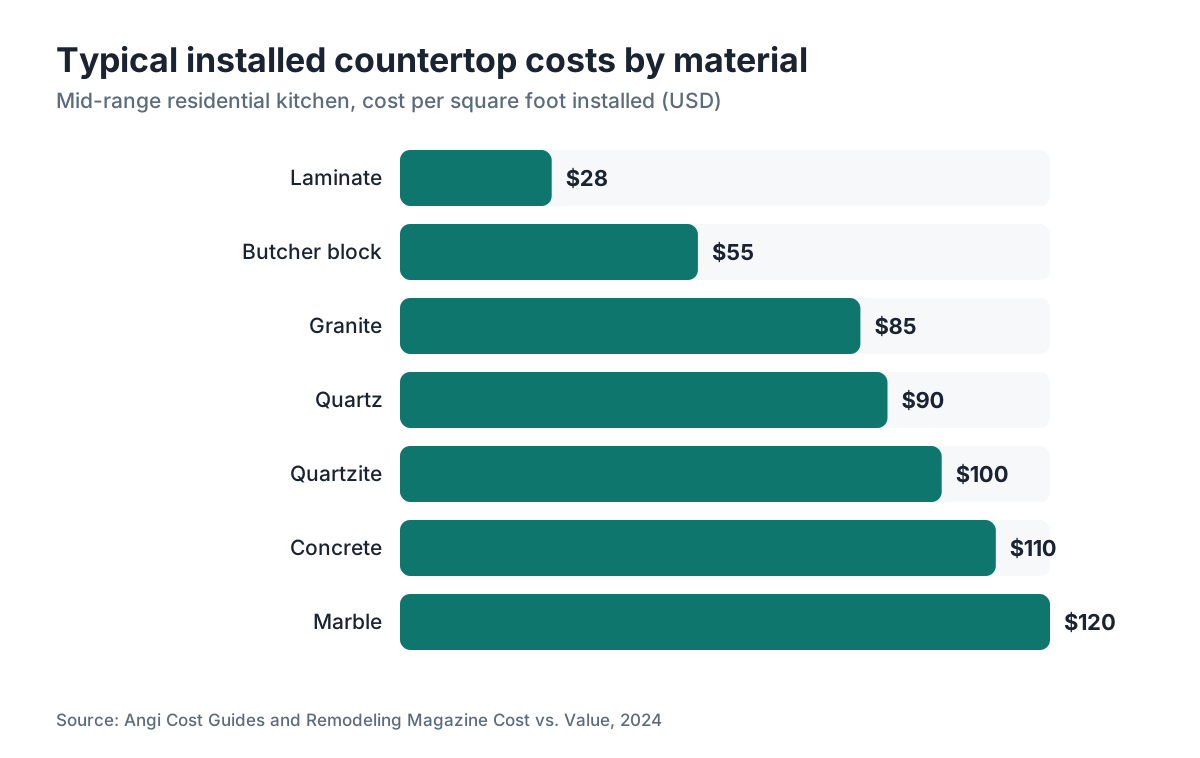
The comparison that comes up most is quartz versus granite, because they sit in the same price bracket and buyers usually choose between the two. Granite countertops are natural stone, so no two slabs are alike. That randomness is the point for some buyers. Quartz patterns repeat within a product line, though premium manufacturers vary them better than budget lines.
Granite needs sealing every one to three years depending on the stone's porosity. Quartz doesn't. Granite can crack if a heavy object hits it at the edge; quartz can too, but the resin binder makes it slightly more flexible. Both are hard enough to dull knives if you cut directly on them.
Marble is the other big comparison, mostly because so many quartz products are designed to look like Calacatta or Carrara. Real marble countertops are beautiful, but they etch from acids, stain from oils, and scratch more easily than quartz. In a kitchen with heavy use, quartz that mimics marble usually performs better than the real thing at a similar or lower cost.
Laminate countertops and Formica countertops cost far less, typically $15, $40/sq ft installed, but they aren't heat resistant, they can't be re-polished if scratched, and they read as less premium at resale. Butcher block countertops have a warmth quartz can't fake, but they need oiling and they hate standing water. Concrete countertops are custom and heavy, with a one-off look that requires sealing and occasional waxing.
Here's a side-by-side of the main options:
| Material | Installed cost ($/sq ft) | Needs sealing | Heat resistant | Stain resistant |
|---|---|---|---|---|
| Quartz | $50, $150 | No | Poor (scorches) | Very good |
| Granite | $45, $130 | Yes (annually) | Good | Moderate |
| Marble | $60, $180 | Yes (frequently) | Moderate | Poor |
| Quartzite | $60, $150 | Yes | Good | Moderate |
| Laminate | $15, $40 | No | Poor | Good |
| Butcher block | $30, $80 | Yes (oiling) | Poor | Poor |
| Concrete | $75, $150 | Yes | Good | Moderate |
Quartzite deserves a quick note because it gets confused with quartz constantly. Quartzite is natural metamorphic stone, not engineered. It behaves much more like marble on maintenance. The how to clean quartzite countertops guide covers that in detail.
Is quartz heat resistant, and can you put hot pans on it?
No. This is the mistake people make with quartz more than any other, and it's worth being blunt about.
The resin binders in quartz engineered stone typically soften or discolor at sustained temperatures between 150°C and 300°C (roughly 300 to 570°F) depending on the formulation [2]. A cast iron pan pulled from a 450°F oven will almost certainly cause discoloration, surface crazing, or a permanent mark if set directly on quartz. The damage isn't structural, but it's permanent and not covered by most manufacturer warranties.
Caesarstone's warranty documentation explicitly excludes damage from excessive heat exposure, and most major manufacturers say the same thing in their care instructions [3]. A trivet or silicone mat costs $10 and prevents a problem that costs hundreds to fix (which usually means replacing the damaged section of slab, because you can't resurface quartz).
The resin also rules quartz out for outdoor installations. UV exposure degrades polyester resins over time, causing yellowing and surface breakdown. A few manufacturers have tried outdoor formulations with UV-stable resins, but the general rule holds: quartz belongs inside.
Does quartz need sealing or any special maintenance?
Quartz countertops never need sealing. That's one of the main reasons buyers pick them over natural stone.
Day-to-day cleaning is simple: warm water, a soft cloth, and mild dish soap handle almost everything. For dried-on food, a plastic scraper works without scratching the surface. For grease or adhesive residue, a little isopropyl alcohol on a cloth does the job. The EPA's Safer Choice program certifies surface cleaners that won't degrade resin binders, if you want a labeled product [10].
Things to avoid: abrasive scrubbing pads, bleach-based cleaners used repeatedly (they can dull the resin over time), and solvents like nail polish remover or paint thinner, which attack the resin binder. Some manufacturers also warn against very high-pH cleaners.
The how to clean stone countertops guide covers general principles that apply here too, though the porosity-related advice doesn't apply to quartz.
One thing homeowners notice after a few years: the area around the kitchen sink can develop a dull ring from repeated water exposure and soap scum. That's not the quartz degrading; it's mineral deposits from hard water. A little white vinegar on a cloth cuts through it, but don't leave acidic cleaners sitting on the surface for more than a minute or two.
Most major manufacturers offer a 10-year residential warranty covering manufacturing defects. It won't cover chips, burns, or bad installation, which is another reason a good fabricator matters.
What are the real downsides of quartz countertops?
Quartz isn't perfect, and any article that pretends otherwise is selling something.
Heat sensitivity is the biggest practical limit, as covered above. If your cooking style involves sliding pans across the counter from burner to cutting board, you'll need the trivet habit.
Seams show more in quartz than in some natural stones. Because quartz patterns are engineered, the pattern repeat is predictable, and a skilled fabricator can hide a seam reasonably well with good color-matching. But quartz doesn't have the randomness of granite that lets a seam disappear into natural variation. On large, boldly veined quartz, a seam that crosses a vein is hard to make invisible.
Repairability is limited. You can't sand, hone, or re-polish quartz the way you can some natural stones. A deep chip can be filled with a color-matched epoxy filler by a professional, but it's a patch, not a restoration. Corian countertops (solid surface) have an edge here because scratches can be buffed out.
The environmental picture is messy. Quartz uses natural quartz, a plentiful mineral, but the manufacturing runs energy-intensive, the resin binders come from petrochemicals, and slabs shipped from overseas carry a real carbon footprint. Some manufacturers are working on greener resin formulations, but nobody has published solid third-party lifecycle data at scale yet.
Last one: quartz looks consistent. For buyers who want the drama of a truly unique natural slab, engineered stone will always feel a little manufactured. That's baked into the product.
How is quartz countertop thickness measured and what should you specify?
Quartz slabs come in three standard thicknesses: 1.2 cm, 2 cm, and 3 cm. For kitchen countertops, 3 cm is the standard recommendation and what most fabricators default to.
3 cm slabs are rigid enough to install without a plywood underlayment, which saves $3, $6 per square foot in substrate cost and keeps the total profile thinner (no ply peeking out at the edge). They also look more substantial, which photographs better and reads higher-end.
2 cm slabs were the older standard and still show up in some bathroom vanity applications where the lighter weight matters. For kitchens, 2 cm usually needs a plywood backing, which adds back most of the savings, so the math rarely works.
1.2 cm is mostly for vertical applications: backsplashes, furniture fronts, shower walls. Using it flat as a countertop isn't recommended.
When you see mitered-edge waterfall islands priced high on quotes, now you know why. A waterfall island in 3 cm quartz requires cutting precise 45-degree mitered pieces for the vertical faces, wasting material from each cut, then gluing and finishing the joint invisibly. It's labor-intensive and burns through a lot more slab than a standard countertop run.
How long does quartz countertop installation take from order to finish?
The typical residential quartz project runs three to six weeks from signed contract to finished install, though timelines swing with local fabricator capacity and whether your slab is in stock.
Here's the rough sequence:
- Slab selection at the yard (1 to 3 days, or longer if you're deciding)
- Contract and deposit (same day, usually)
- Templating visit: a fabricator technician measures your cabinets precisely with either a digital laser templater or physical sticks (30 to 60 minutes on site, often one to two weeks after contract)
- Fabrication: cutting, edge profiling, polishing, cutouts. Typically one to two weeks after templating at a busy shop.
- Installation day: a crew brings the finished pieces, sets them on the cabinets with adhesive and silicone, then fills and polishes seams. A standard kitchen takes three to six hours.
- Plumber reconnects sink and faucet (usually scheduled separately, same day or next day).
The constraint is almost always fabrication capacity, not the install itself. A shop running full can stretch timelines to four weeks or more. If you're renovating on a hard deadline, confirm your fabricator's current lead time before picking a slab. Don't assume it moves faster because your project is small.
What do fabricators need to know about quartz to quote and cut it accurately?
Quartz is more predictable to cut than natural stone because there's no grain orientation to manage and no natural fissures hiding in the slab. It still has its own quirks.
The resin content makes quartz slightly softer than granite on blade wear, but polishing takes longer because resin and quartz polish at different rates. A shop moving from mostly granite to quartz needs its polishing parameters dialed in for the material, or the finished edge comes out with a hazy resin look instead of clean gloss.
Color consistency within a batch matters. Quartz from different production runs can vary slightly in color even for the same SKU. A project needing multiple slabs (a big kitchen, or an island plus perimeter) should pull all slabs from the same lot or at least verify a close visual match before cutting.
Nesting cuts differently on quartz. It wastes more at the edges than granite because of the consistent color. With granite, a less-than-ideal remnant is often salvageable as a bathroom vanity top in a different finish. With quartz, off-cuts from one job are harder to sell if the color is unusual. Accurate nesting software pays for itself fast here. Shops running tight material utilization use digital nesting to squeeze remnants into secondary jobs before they hit the bin.
Seam placement is a joint call between fabricator and homeowner, but on patterned quartz (especially large-vein designs), the fabricator needs to show the homeowner exactly where seams will fall before cutting, not after. Surprises at installation about seam placement create refund disputes. SlabWise's quoting tools include seam layout visualization for exactly that reason.
For kitchen projects, always confirm final cabinet height and levelness before templating. Quartz doesn't forgive out-of-level cabinets the way a flexible laminate sheet does. And because engineered quartz meeting ANSI/NSF 51 is rated for food contact [6], you can reassure clients the surface is safe where they prep.
How does quartz affect kitchen resale value?
Quartz countertops read as a value-positive upgrade for kitchen resale, though the actual return depends heavily on the neighborhood, the buyer pool, and what the competition looks like.
Remodeling Magazine's Cost vs. Value report has historically shown minor kitchen remodels (which include countertop replacements) recouping 70 to 85% of cost at resale in many markets, though the specific quartz numbers vary by year and region [4]. White quartz kitchen countertops are especially safe from a resale standpoint because they appeal to the widest buyer range. A bold dark countertop can turn off as many buyers as it attracts.
The bigger question is timing. Replacing countertops right before listing returns more than replacing them years earlier, simply because buyers discount visible wear. A well-maintained quartz surface from five years ago shows fine; one with a heat mark or a chip near the sink draws attention and negotiation.
For fabricators, this means homeowners often walk in around listing prep with urgent timelines and fixed budgets. A clear quote turned around the same day matters more in that context than it does on a full renovation.
Frequently asked questions
Are quartz countertops the same as quartzite?
No. Quartz countertops are engineered stone: ground quartz crystals bound with resin. Quartzite is a natural metamorphic rock formed when sandstone gets cooked under heat and pressure. Quartzite behaves more like marble, needing sealing and etching from acids. Quartz needs no sealing. The names sound alike, which causes real confusion at slab yards, so always confirm which material you're looking at before pricing.
Can quartz countertops stain?
Quartz is very stain-resistant, not stain-proof. Prolonged exposure to highly pigmented liquids like red wine, turmeric, or beet juice, especially overnight, can leave a faint stain in the resin. Most fresh spills wipe clean. The real vulnerability is in the seams and around sink cutouts, where liquids sit longer. Wipe up spills the same day and you'll rarely have a problem.
What's the best white quartz countertop for a kitchen?
There's no single best, but for a kitchen that sees heavy use, look for a white quartz in 3 cm thickness with a matte or honed finish if fingerprints worry you, or a polished finish if you prefer easier cleaning. Caesarstone Calacatta Nuvo and Cambria Torquay review well in the marble-look category. For solid white, Silestone White Storm or MSI Calacatta White hold up. Always get physical samples; screens lie about white tones.
How thick should quartz countertops be?
3 cm (about 1.25 inches) is the standard for kitchen countertops and the right call for most residential projects. It's stiff enough to span cabinets without a plywood substrate, looks substantial, and matches what most fabricators have dialed in their polishing process. 2 cm works for bathroom vanities where weight matters more. Skip 1.2 cm for any horizontal countertop.
Can you cut on quartz countertops?
Technically yes, the surface won't stain from cutting. But it's bad for your knives. Quartz is hard enough (Mohs 7) to dull a steel blade quickly. You'll also eventually leave fine surface scratches, especially with a serrated knife. Use a cutting board. It's the same answer you'd give someone asking about granite: protect the tool, not the stone.
Why do quartz countertops turn yellow?
Yellowing usually comes from one of two sources: UV exposure degrading the resin binder (which is why quartz isn't rated for outdoor use) or a chemical reaction from certain cleaning products, particularly bleach or high-pH cleaners used repeatedly. Lighter colors, especially whites, show it most. To avoid it, keep quartz out of direct extended sunlight and stick to manufacturer-approved cleaners.
How do you fix a chip in a quartz countertop?
Small chips can be filled with a color-matched epoxy or cyanoacrylate filler by a professional stone repair tech. The results are decent, but the repair is always a patch, not invisible. Deep chips near edges, where they most often happen, are harder to hide because the edge profile shape is disrupted. You can't re-polish or resurface quartz the way you can solid surface like Corian. Not putting hard objects down hard near edges is genuinely the better strategy.
What's the difference between cheap and expensive quartz countertops?
Price tracks a few things: brand premium, pattern complexity, manufacturing origin, and thickness consistency. Budget quartz from overseas can look similar in photos but may have less consistent thickness (which makes installation harder), less uniform color batching, and weaker resin that yellows faster or shows more surface porosity. Premium brands like Cambria also offer longer warranties and better installer networks. For a rental, budget quartz is fine. For a primary kitchen you'll use 15 years, the mid-to-upper tier earns its cost.
Is quartz countertop installation a DIY project?
Rarely, honestly. A 3 cm slab weighs roughly 18 to 20 lbs per square foot, so a 50-sq-ft kitchen means moving close to 1,000 lbs of fragile material. Templating demands precision because slabs are cut to fit before delivery, and a measurement error ruins a slab. Seaming takes skill and the right epoxy. Most fabricators won't sell slab only over liability concerns. The economics don't pencil out the way they do with laminate or tile.
How do I choose between quartz and granite for a kitchen countertop?
Want no maintenance and consistent color? Choose quartz. Want unique natural patterning and don't mind sealing once a year or so? Granite is great. Both hold up in daily kitchen use. Granite handles direct heat better. Quartz handles staining better. At similar price points, it comes down to whether you prefer engineered consistency or natural variation. Neither is wrong. See the full comparison at our granite countertops guide.
Do quartz countertops increase home value?
Generally yes, as an upgrade from laminate or tile. Remodeling Magazine's Cost vs. Value data suggests minor kitchen remodels, including countertop upgrades, recoup roughly 70 to 85% of cost at resale in many markets. Quartz reads as a premium material to buyers. White quartz countertops tend to be the safest choice for broad appeal. The return shrinks if you pick an unusual color or pattern that narrows your buyer pool.
How long do quartz countertops last?
With normal use and proper care, quartz countertops last 25 years or more without degradation. The surface doesn't wear, dull, or need refinishing the way wood or concrete does. The main risks to longevity are heat damage, edge chipping from impact, and prolonged UV exposure (for outdoor or skylight-adjacent installs). Most manufacturer warranties cover 10 to 15 years for residential use. The product typically outlasts the warranty by a wide margin.
What edge profile should I choose for quartz countertops?
Eased edge (a simple 90-degree with a slightly softened corner) is the most popular and most cost-effective. It reads modern and clean. Beveled edges add a small design detail without much cost. Bullnose (fully rounded) is softer but shows the full slab thickness. Ogee and dupont profiles are more traditional and take more fabrication time, raising the price. Mitered waterfall edges cost the most because they need multiple precise angled cuts and careful seaming. Match the profile to the cabinet style and your budget.
Sources
- HomeAdvisor / Angi: Quartz Countertops Cost Guide: Installed quartz countertop costs typically range from $50 to $150 per square foot for residential kitchen projects
- Caesarstone: Care and Maintenance Guide: Quartz resin binders can discolor or soften at sustained temperatures above 150°C; direct contact with hot cookware is not recommended
- Caesarstone: Warranty Documentation: Caesarstone warranty explicitly excludes damage resulting from excessive heat exposure
- Remodeling Magazine: Cost vs. Value Report 2024: Minor kitchen remodels including countertop upgrades recoup approximately 70 to 85% of cost at resale in many US markets
- USGS National Minerals Information Center: Silica: Quartz (silicon dioxide) is one of the most abundant minerals in the Earth's crust and is rated 7 on the Mohs hardness scale
- NSF International: ANSI/NSF 51 Food Equipment Materials: Engineered quartz surfaces meeting ANSI/NSF 51 standards are rated safe for food contact in kitchen applications
- Cambria Surfaces: Product and Warranty Information: Cambria is the only major quartz countertop manufacturer that quarries its own quartz in the United States; the company offers a lifetime residential warranty
- Silestone by Cosentino: Technical Specifications: Silestone quartz slabs are manufactured in Spain under the Cosentino Group and contain approximately 90% natural quartz by weight
- Natural Stone Institute: Quartz Surface Products Standard: Industry standard composition for engineered quartz surfaces is 90 to 95% quartz aggregate with 7 to 10% polyester or epoxy resin binders by weight
- EPA: Safer Choice Program, Surface Cleaners: EPA's Safer Choice program certifies surface cleaners that are safe for engineered stone surfaces without degrading resin binders
- Remodeling Magazine: 2024 Cost vs. Value National Averages: National average material and installation costs across countertop categories for 2024 residential kitchen projects
Last updated 2026-07-09