TL;DR
- Labradorite countertops run $150 to $300 per square foot installed, near the top of the natural stone price ladder.
- The stone is genuinely hard (Mohs 6 to 6.5) and shrugs off scratches, but it needs sealing once a year and pH-neutral cleaning to keep its color-shifting labradorescence intact.
- Buy it as a statement surface, not a workhorse.
What is labradorite and why does it look like that?
Labradorite is a feldspar mineral, a calcium-rich plagioclase that forms in igneous and metamorphic rocks. Its chemical formula runs roughly (Ca,Na)(Al,Si)AlSi2O8, and it sits in the same mineral family as anorthite and albite. That family connection matters in a kitchen: labradorite shares the hardness and porosity profile of other feldspar stones, so you can predict how it behaves before it ever hits your counter.
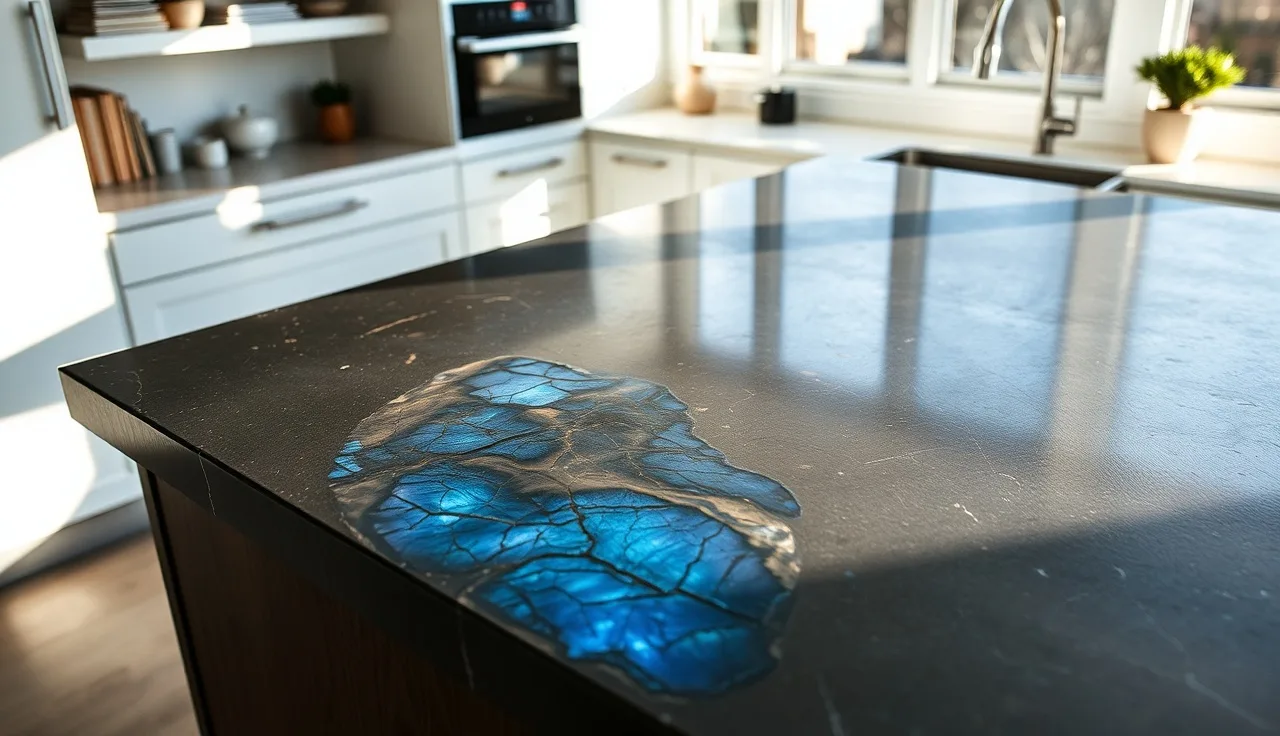
The thing that makes labradorite unmistakable is labradorescence. It's a blazing optical effect that shifts through blues, greens, golds, oranges, and sometimes reds as your viewing angle changes. The color comes from light scattering off very thin, alternating layers of two slightly different feldspar compositions inside the crystal, a phenomenon named the Schiller effect. Those layers run about 100 to 300 nanometers thick. Light hits them, certain wavelengths amplify through constructive interference, and the stone erupts into color. No dye. No coating. No treatment. The color lives inside the stone.
Slabs sold as labradorite countertops usually come from two overlapping rock types. The first is a nearly monomineralic labradorite rock called larvikite (from Larvik, Norway) or Blue Pearl granite in the trade. The second is true labradorite-rich anorthosite, quarried in Canada, Madagascar, Ukraine, and Finland [9]. Norwegian larvikite was the dominant commercial slab material for decades. Canadian and Malagasy sources now supply much of the North American market. The trade names at stone yards include Blue Pearl, Volga Blue, Labradorite Blue, and Baltic Brown, though the chemistry and look of each vary more than the marketing lets on.
How does labradorite compare to granite, quartzite, and marble as a countertop?
A side-by-side comparison settles the decision faster than any vague talk about "exotic stone." Here's the whole field on one grid.
| Stone | Mohs hardness | Porosity (typical) | Acid resistance | Avg. installed cost/sq ft | Sealing frequency |
|---|---|---|---|---|---|
| Labradorite | 6.0 to 6.5 | Low-medium | Good | $150, $300 | Annually |
| Granite | 6.0 to 7.0 | Low | Good | $40, $200 | Every 1 to 3 years |
| Quartzite | 7.0 to 7.5 | Low-medium | Good | $60, $200 | Annually |
| Marble | 3.0 to 4.0 | Medium-high | Poor | $40, $200 | Every 6 to 12 mo |
| Soapstone | 1.0 to 2.0 | Very low | Excellent | $70, $120 | Oil monthly |
Hardness: labradorite sits in the same range as standard granite countertops, so it resists knife and cookware scratches about as well as a mid-range granite. Quartzite beats both. Marble is far softer and scratches visibly with daily use.
Acid resistance: feldspars handle mild acids reasonably well, far better than marble or limestone. Lemon juice sitting for ten minutes won't etch labradorite the way it eats calcite-based stones. Strong acids (muriatic, full-strength vinegar, some drain cleaners) will attack any silicate stone over time. Treat it as acid-resistant, not acid-proof.
Porosity: labradorite is not as dense as quartzite or engineered quartz. Left unsealed, it absorbs water, oils, and staining liquids. The USGS describes feldspar rocks as having moderate porosity relative to denser metamorphic quartzite [2]. Sealing matters here.
Cost is where labradorite breaks from the pack of kitchen countertops options. You pay a premium for rarity and the visual effect, not for durability that beats granite. Want the dark iridescent look without the price? Cambria countertops and other engineered quartz mimic it with less upkeep, though no manufactured surface reproduces real labradorescence.
What does a labradorite countertop actually cost?
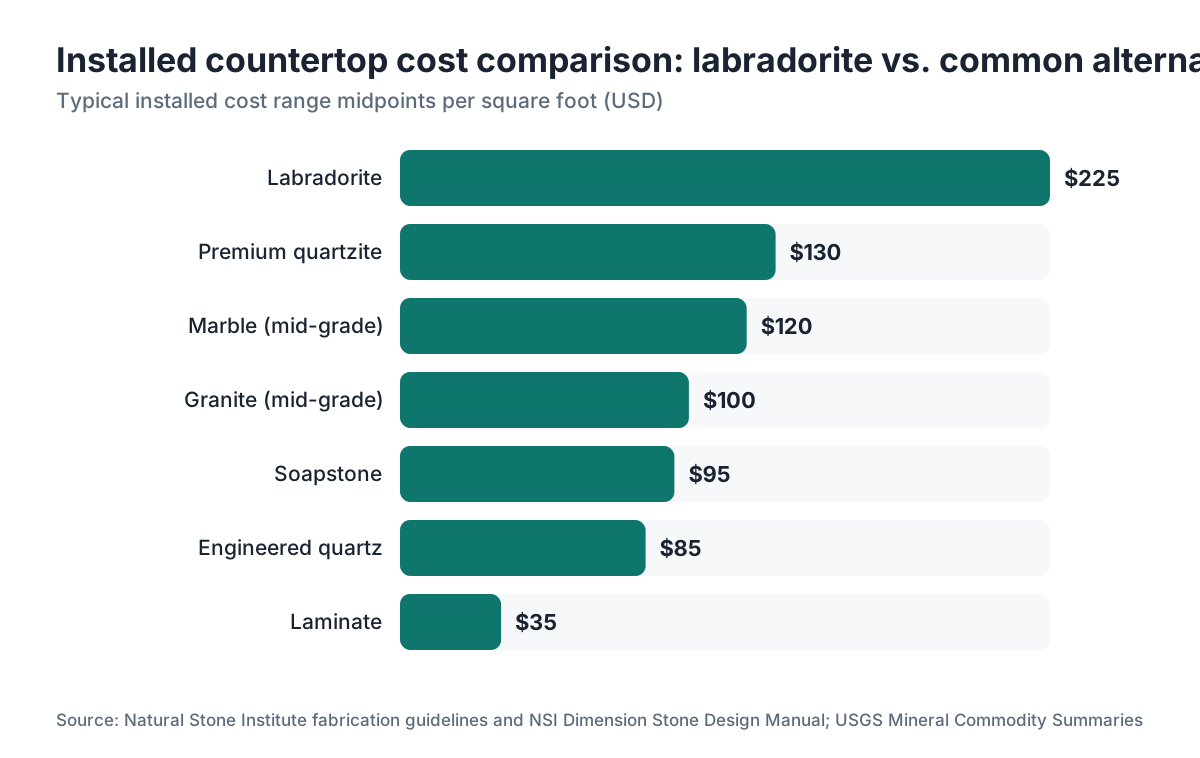
Installed cost runs about $150 to $300 per square foot for most residential jobs, with the midpoint near $200 to $225. Several variables compound to land you in that band.
Material cost at the slab yard: figure $80 to $160 per square foot for the raw slab, depending on thickness (2cm vs. 3cm), origin, and how intensely the stone flashes. Norwegian larvikite tends to run lower, around $80 to $120/sq ft. Madagascar and Canadian anorthosite with exceptional color can hit $150 to $200/sq ft or more at wholesale. Retailers typically mark slabs up 30 to 60 percent over wholesale.
Fabrication cost: cutting, edging, polishing, and cutouts for sinks and cooktops add $35 to $80 per square foot, driven by edge complexity and your local market. A waterfall island edge adds cost. A simple eased edge costs the least. Labradorite is harder to fabricate than marble but close to granite, so fabrication pricing tracks standard granite-shop rates.
Installation: $15 to $30 per square foot is typical for standard counter runs. Complex layouts, seams, and cabinet leveling push that higher.
Total for a typical 50-square-foot kitchen: somewhere between $7,500 and $15,000 installed. That's a wide band on purpose. A modest larvikite slab in a simple layout can land under $10,000. A premium Madagascar labradorite with waterfall edges and multiple cutouts can top $18,000.
Keep the neighbors in view. Standard granite installed averages $40 to $150/sq ft, and quartzite runs $60 to $200/sq ft for most residential grades. Labradorite's high end overlaps only with the rarest granites and premium quartzite. Marble countertops can cost less than labradorite while looking just as dramatic, though marble demands far more babysitting.
One budget trap: fabricators sometimes misquote labradorite because it isn't in their standard pricing matrix. Ask them to itemize slab cost, fabrication, and installation separately so you can compare bids apples to apples. Fabricators running software like SlabWise pull accurate per-square-foot job costs from their material and waste data, which keeps both sides off the surprise-overrun train.
Is labradorite durable enough for a kitchen countertop?
Durability is the right question before you commit $10,000 in stone. Here's the honest picture.
Scratch resistance: at Mohs 6.0 to 6.5, labradorite won't scratch from normal kitchen use. Steel knives run 5.5 to 6.5 on the Mohs scale [3], so a carbon steel blade won't reliably scratch it, though high-chromium stainless or ceramic blades can. In practice this is a non-issue because you should be using a cutting board anyway. The real risk is glass objects, quartz grains in grit, and some ceramic cookware bases leaving surface marks.
Heat resistance: labradorite handles heat well. As a high-temperature igneous mineral, it won't scorch or crack from a hot pan set down briefly. Thermal shock from repeatedly dragging a 500-degree cast iron pan straight from oven to counter can stress any stone over time, so use a trivet as a habit, not a rule.
Impact resistance is the weak point. Labradorite, like all feldspar stones, has cleavage planes running in two directions at nearly 90 degrees. A hard, direct hit at the wrong angle can pop a clean cleavage fracture, especially at corners and near sink cutouts. Thin overhangs past 8 to 10 inches without support carry real fracture risk. Your fabricator should already know this. Ask about support corbels or rod reinforcement if you're doing a large island.
Porosity and staining: unsealed, labradorite drinks red wine, cooking oil, and dark sauces. A sealed surface resists most staining for 12 to 18 months. Skip sealing for several years and you'll see darkening near the sink and cooktop. Manageable, not a dealbreaker.
So where does it land? Labradorite is a reasonable kitchen counter if you treat it like a premium natural stone, not like engineered quartz. It won't demand the obsessive daily care of marble. It isn't as forgiving as soapstone or as tough as quartzite. Put it in roughly the same durability tier as a mid-grade granite.
How do you seal and maintain a labradorite countertop?
Sealing is the one maintenance task that matters, and it's easy. The whole job takes about an hour once a year.
Choose an impregnating (penetrating) sealer rated for feldspar or granite. These sink into the stone's pore structure and bond to the mineral surfaces without leaving a film on top. Film-forming topical sealers can make labradorite look cloudy and can peel. Go with a fluoropolymer-based impregnating sealer. Tenax Proseal, Miracle 511 Impregnator, and Aqua Mix Sealer's Choice are all common in the trade. None of them are specialty products. Your local stone supplier stocks them.
Application: clean the surface with a pH-neutral stone cleaner and let it dry 24 hours. Apply the sealer with a clean cloth in a thin, even coat. Let it penetrate 3 to 5 minutes (follow the product's dwell time, not a guess). Buff off the excess before it hazes. A second coat run perpendicular to the first improves coverage on more porous slabs. Cure 24 hours before heavy use.
Water test: pour a few tablespoons of water on a clean, dry, sealed surface and watch it for 10 to 15 minutes. Beads up with no darkening? The seal is good. Stone darkens under the water? Reseal. The Natural Stone Institute (formerly the Marble Institute of America) describes this water-drop test as the standard field check for adequate sealer coverage [4].
Daily cleaning: pH-neutral stone cleaner, or plain warm water and a microfiber cloth. That's it. Skip vinegar (acidic), Windex (ammonia), bleach, and anything sold as a "grease-cutting" dish soap for routine use. They're fine in emergencies, but regular use strips the sealer faster and dulls the polish over time. The general care approach is nearly identical to how to clean stone countertops.
Optical care: the labradorescence is a property of the stone's internal structure and won't fade with normal cleaning. What dulls it is micro-scratching of the polished surface, which scatters light before it can reach the mineral layers. If the surface looks less vivid after years of use, a stone polishing compound applied by a fabricator (or a patient homeowner with a variable-speed polisher) restores the shine. For most people, that's a professional job.
Does labradorite need to be sealed, and how often?
Yes, labradorite needs sealing. The only open question is frequency.
Most labradorite slabs absorb enough liquid to benefit from an impregnating sealer once a year. Some denser larvikite slabs, especially tightly crystalline Norwegian material, stretch to 18 to 24 months between sealings. More porous Malagasy or Canadian anorthosite may want resealing every 9 to 12 months in a busy kitchen.
The water-drop test from the last section is the only reliable way to know whether your specific slab still has coverage. Don't trust the calendar alone.
Compare this to how to clean quartzite countertops: quartzite and labradorite run similar sealing schedules, though the denser quartzites sometimes beat labradorite on absorption. Engineered quartz and solid surface materials like Corian countertops need no sealing at all, a genuine edge if you want a lower-maintenance kitchen.
What are the best uses for labradorite in a home?
Labradorite earns its price where the labradorescence can actually be seen and enjoyed. It's a visual material first, everything else second.
Island tops are the best application by a wide margin. You view an island from every angle, so the color shift triggers constantly as people move around it. A large labradorite island under decent ambient and task lighting is spectacular. It justifies the cost in a way perimeter counters, which you mostly see from one angle, never quite do.
Bathroom vanity tops: low-traffic, low-stress, visible from multiple angles. This is the best value-per-dollar use of labradorite in a home. The slab is small (low total cost) and the visual impact is high. A 30-square-foot bathroom vanity might run $4,500 to $9,000 installed, a very different conversation than a full kitchen.
Fireplace surrounds: no cutting boards, no grease, no acids. Labradorite on a fireplace surround gets to look beautiful and faces almost zero durability demands. Works well.
Accent walls and book-matched panels: fabricators can book-match labradorite slabs (slicing and mirroring them like pages of a book) for walls. The effect is striking and the stone carries no functional stress on a wall.
Perimeter kitchen counters: workable, but not the highest-value use. The labradorescence on a straight wall-adjacent counter usually gets seen from one angle under one light source. You're paying full exotic-stone price for a surface you'll mostly view in a narrow angular range. If budget is tight, put the labradorite on the island and run a cheaper complementary material on the perimeter. Darker granite or a quality laminate countertops option bridges the cost gap without hurting the overall look.
What I'd avoid: labradorite in a high-abuse commercial setting, as a butcher block substitute (use an actual butcher block countertops for heavy cutting), or in any spot where you plan to be lazy about maintenance. The stone rewards attention and quietly punishes neglect.
How do you choose a labradorite slab at the stone yard?
Buying labradorite isn't like buying granite. You're buying a visual effect, so selection matters more than it does with almost any other stone.
See the slab in multiple light conditions. Labradorescence changes dramatically with the light source and the viewing angle. Pull the slab off the rack (yards will do this for you) and walk around it. Look at it under the yard's overhead fluorescents, then take it to natural daylight if you can. A slab that reads flat and grey in rack-pack lighting can be extraordinary in motion. Never buy off a racked view alone.
Check for internal fractures. Hold a strong flashlight at a low, raking angle across the surface. Natural fissures show up as bright lines. Some are cosmetic and stable. Others mark planes where the slab could crack during fabrication or in service. Ask the yard's slab manager to assess anything you find. A fabricator who knows labradorite can usually tell you which fissures are a problem and which are just character.
Thickness: 3cm (about 1.25 inches) is standard for kitchen countertops and strongly recommended for labradorite [10]. The cleavage vulnerability is worse in 2cm slabs, especially across larger spans or at cutouts. The upcharge from 2cm to 3cm is real, and it's worth it for structural security.
Book-matching and vein direction: doing a large island with a seam? Ask the yard whether they have consecutive slabs from the same block. Labradorite's flash isn't as obviously vein-matched as marble, but consecutive slabs carry more consistent color and flash intensity. Mismatched slabs can read like two different stones across the seam.
Ask about origin. Norwegian larvikite, Canadian anorthosite, Malagasy labradorite, and Ukrainian sources all look somewhat different. Knowing the origin tells you what maintenance and hardness profile to expect, and lets you compare prices accurately across yards.
Fabrication notes: when your fabricator quotes the job, ask how they plan to handle the sink cutout and any inside corners. Those are the high-stress points. Good shops rod-reinforce sink cutouts in harder, cleavage-prone stones. If the fabricator has never touched labradorite, that's worth a conversation, not necessarily a dealbreaker. Shops that log material behavior per stone type handle these projects better. Tools like SlabWise let fabricators record per-stone notes and job outcomes, which pays off when you're working outside the standard granite-marble-quartz rotation.
What are the pros and cons of labradorite countertops?
Here's the honest ledger, both columns.
Pros:
Visual uniqueness is unmatched. No other countertop material produces labradorescence. Engineered quartz can approximate it, but real stone does something no manufactured product fully copies. Want a conversation-piece kitchen? Labradorite delivers.
Scratch resistance is solid. Mohs 6.0 to 6.5 handles normal kitchen use without showing wear on any timeline that matters.
Acid resistance is good. No panic over citrus or light cleaners the way there is with marble.
It's genuinely rare, so your kitchen won't look like your neighbor's.
Cons:
Cost. $150 to $300/sq ft installed is a real premium. You're paying for rarity and the effect, not for durability that beats granite or quartzite.
Sealing is required and can't slide. If your household forgets annual maintenance, the stone eventually shows it.
Impact vulnerability at cleavage planes. A hard direct hit, dropped cast iron, or a swung cabinet door edge can chip or fracture corners and sink cutouts in ways granite shrugs off.
Limited supplier availability. Most yards stock granite and marble in depth. Labradorite may mean a trip to a specialty slab importer or a wait for an order. Fabricators in smaller markets may never have touched it.
Lighting dependency. The flash you fell for in a bright showroom can read flat and grey in your kitchen if the lighting is weak. That's not a defect. It's how the effect works. Plan your kitchen lighting alongside your stone, not after.
Net call: labradorite is right if the visual effect is the reason you're buying it and you'll maintain it. It's wrong if you're hoping it's dramatically easier to live with than marble (it's easier, but not by a mile) or if you expect quartzite-level toughness (you won't get it). Buy it for what it is.
How does labradorite perform in bathrooms versus kitchens?
The bathroom is where labradorite makes the most economic sense for most people.
In a kitchen you're buying 50 to 80-plus square feet of an expensive stone and handing it daily abuse: oils, acids, heavy objects, constant cleaning. The maintenance regime is real and never stops. The visual payoff is high on a large island, but so are the cost and the risk.
In a bathroom vanity you're buying 25 to 35 square feet of the same stone and subjecting it to toothpaste, hand soap, and water. The abuse profile is far gentler. Soaps run pH-neutral or slightly alkaline, and neither aggressively attacks labradorite. The maintenance requirement is identical (annual sealing) but the odds of a staining incident are far lower.
For care guidance on other natural stone in wet spaces, the approach mirrors how to clean soapstone countertops: wipe spills fast, use the right cleaners, seal on schedule.
The visual payoff in a bathroom is arguably better than in a kitchen too. A vanity gets direct, close-range light (usually sconces flanking a mirror), and users stand right over the surface at shifting angles. That's the exact setup that makes labradorescence look its best. For roughly $4,500 to $8,000 installed, a labradorite vanity can be the single most striking surface in the house at a fraction of a full kitchen's cost.
What should fabricators know about cutting and installing labradorite?
Fabricators working labradorite for the first time sometimes treat it like granite. It isn't quite the same animal.
The cleavage issue is real. Plagioclase feldspar has two cleavage directions at roughly 86 and 94 degrees [5]. Cut or grind near a natural fissure that runs parallel to a cleavage plane and the material can split along that plane instead of following your blade. Inspect the slab orientation against the cut plan, and don't bridge a fissure with an inside corner or a cutout.
Blades and tooling: diamond blades rated for granite work fine on labradorite. Keep water flow high. Labradorite dust contains crystalline silica, and OSHA sets the permissible exposure limit at 50 micrograms per cubic meter as an 8-hour time-weighted average for general industry [6]. Wet cutting is standard practice and required for worker safety [11].
Sink cutouts are where labradorite fractures. The relief cut inside a tight radius, plus any hidden natural fracture, is a high-risk geometry. Best practice: use a bridge saw or CNC with a smooth, low-stress routing path. Skip hand grinding inside corners. Rod-reinforce across the cutout with stainless or fiberglass rods epoxied into routed slots on the underside. That's standard in good shops for any stone with moderate cleavage risk.
Edge polishing: labradorite takes a high gloss, and the labradorescence often appears on polished edge profiles, which is a genuine feature. Run the polisher at moderate speed to avoid heat buildup that can micro-fracture the surface.
Seam placement: keep seams out of high-stress zones near sink cutouts and inside corners. Color-match the seam adhesive to the stone. Labradorite ranges from dark charcoal to near-black in some base colors, so test the epoxy tint on an offcut before you commit.
Lifting and transport: 3cm labradorite slabs are heavy, roughly 19 to 20 pounds per square foot [8], and their cleavage makes them slightly more fracture-prone than granite in transit if support is sloppy. Transport and store vertically with consistent support along the full slab length. Never flat-rest on an unsupported span.
For new fabricators quoting these jobs: exotic stones like labradorite eat more time per square foot, carry higher material waste potential (especially around cutouts), and pull you into more back-and-forth with the homeowner on slab selection and lighting. Build that time into the quote. Underquoting an exotic stone is one of the fastest ways to bleed margin on what should be a premium job.
Frequently asked questions
Is labradorite the same as blue pearl granite?
Commercially, often yes. Blue Pearl is a trade name for Norwegian larvikite, a labradorite-dominant feldspar rock. Technically "labradorite" is the mineral species and larvikite is the rock. They're closely related, but slabs from Canada, Madagascar, and Ukraine sold as labradorite can look and behave somewhat differently from Norwegian Blue Pearl. Ask the yard for the origin before you compare prices across yards.
Can labradorite countertops crack?
Yes. Labradorite has natural cleavage planes in two directions, so a hard direct impact at the wrong angle can cause a clean fracture, especially near sink cutouts, inside corners, and unsupported overhangs past 8 to 10 inches. The risk is manageable with proper fabrication (rod reinforcement at cutouts, no thin overhangs), but it's real. The stone is not as fracture-resistant as quartzite or engineered quartz.
Does labradorite etch like marble?
No, not the same way. Marble etches because calcite, its main mineral, reacts with acids and leaves dull spots. Labradorite is a silicate and resists mild acid far better. Light citrus contact or a vinegar splash won't immediately etch it. Concentrated acids over long contact can still cause damage, but labradorite's acid resistance is closer to granite than to marble.
How do you clean labradorite countertops daily?
Warm water and a microfiber cloth handle everyday cleaning. A pH-neutral stone soap or cleaner works for heavier residue. Avoid vinegar, ammonia sprays, bleach, and abrasive scrubbers. They strip the sealer faster than normal use and dull the polished surface over time. Wipe spills promptly, especially oils and dark liquids, and doubly so if you're overdue on sealing.
What lighting brings out the labradorescence best?
Directional light at a low angle to the surface triggers the most dramatic color shift. Warm LED downlights set 30 to 45 degrees from vertical, recessed cans directly above the island, and under-cabinet lighting that rakes across the surface all work well. Natural daylight at a low sun angle is spectacular. Diffuse overhead fluorescent light flattens the effect. Plan lighting before or alongside slab selection, never after.
Is labradorite safe for food contact?
Yes. Labradorite is a natural silicate with no toxic components under normal kitchen use. Seal the surface properly to prevent bacteria settling into micro-pores, a hygiene concern common to all porous natural stones and not specific to labradorite. Use a food-safe impregnating sealer, which all reputable stone sealers are. Don't cut directly on any stone surface. Use a cutting board.
What edge profiles work best with labradorite?
Simple edges (eased, beveled, or straight polished) show the labradorescence on the edge face most clearly, since the effect appears in the crystal faces exposed by polishing. Ogee and bullnose profiles look clean but involve more grinding, which can occasionally follow a cleavage plane unexpectedly. Waterfall edges, where the slab folds vertically to the floor, look striking with labradorite because the vertical face catches light from multiple room angles all day.
How heavy is a labradorite countertop and can my cabinets support it?
At 3cm thickness, labradorite weighs roughly 19 to 20 pounds per square foot, comparable to granite at the same thickness. Standard North American cabinets built to KCMA guidelines are rated for this load [12]. Unusually long spans, heavily cantilevered sections, or older cabinetry in poor shape may need reinforcement. Your fabricator should check cabinet condition during templating and flag any concern before installation.
What's the difference between labradorite and spectrolite?
Spectrolite is a high-quality labradorite from Finland that shows an unusually full spectral range, including rare violet and red flashes on top of the common blues and greens. It commands a real price premium over standard labradorite and is less commonly available in slab form for countertops. Most "labradorite" countertop slabs are not spectrolite-grade material.
Can I use labradorite as an outdoor kitchen countertop?
With caution. Labradorite handles heat well but has moderate freeze-thaw vulnerability: water absorbed into micro-pores expands when it freezes and can cause surface spalling over many cycles. In hard-winter climates, outdoor labradorite needs aggressive sealing and protection from standing water during freeze cycles. In warm climates with no freeze risk it's more practical. UV exposure doesn't affect the flash, since labradorescence is an optical property of the mineral structure.
How do fabricators price labradorite jobs compared to standard granite?
Most fabricators charge 15 to 30 percent more in labor for exotic stones like labradorite versus standard granite, reflecting higher material risk, slower cutting near fissures, and more time on slab inspection and seam planning. The slab cost itself is the bigger variable. Always get an itemized quote that separates slab material, fabrication labor, edge work, and installation so you can actually compare bids across shops.
Does labradorite go with white kitchen cabinets?
Yes, very well. The dark base color (charcoal to near-black) of most labradorite slabs throws strong contrast against white cabinetry, and the color-shifting blues and greens read as cool accent tones that complement white without competing with it. The pairing is common in contemporary and transitional kitchens. Match with brushed nickel or matte black hardware to sidestep the brass-versus-cool-stone contrast issue.
Is labradorite a good investment for resale value?
Nobody has reliable data specifically on labradorite resale ROI. The closest analog is exotic stone counters generally. The National Association of Realtors periodically surveys remodeling projects for cost recovery, and kitchen remodels typically recover 50 to 75 percent of cost on resale [7]. Labradorite may appeal strongly to design-forward buyers and neutrally to buyers who don't recognize it. It won't hurt resale, but it probably won't command the premium sellers hope for.
Sources
- USGS, Mineral Resources Program: Feldspar: Feldspar rocks have moderate porosity relative to denser metamorphic stones like quartzite
- USGS, Mohs Hardness Scale reference, Minerals Resources: Steel knife blades typically measure 5.5 to 6.5 on the Mohs hardness scale
- Natural Stone Institute (formerly Marble Institute of America), Technical Manual: The water-drop test is the standard field test for assessing adequate sealer coverage on natural stone countertops
- Mineralogical Society of America, Handbook of Mineralogy: Plagioclase: Plagioclase feldspar has two cleavage directions at approximately 86 and 94 degrees
- OSHA, Occupational Exposure to Respirable Crystalline Silica, 29 CFR 1910.1053: OSHA sets the PEL for crystalline silica at 50 micrograms per cubic meter as an 8-hour time-weighted average for general industry
- National Association of Realtors, Remodeling Impact Report: Kitchen remodels typically recover 50 to 75 percent of project cost on home resale
- Natural Stone Institute, Fabrication Safety and Stone Properties Reference: 3cm natural stone slabs weigh approximately 18 to 20 pounds per square foot depending on stone density
- USGS, Mineral Commodity Summaries: Feldspar production and trade: Labradorite and anorthosite are quarried commercially in Norway, Canada, Madagascar, Finland, and Ukraine
- Natural Stone Institute, NSI Dimension Stone Design Manual: 3cm thickness is the recommended standard for natural stone kitchen countertops due to structural integrity at sink cutouts and spans
- OSHA, Silica: Construction and General Industry Guidance: Wet cutting methods are required for stone fabrication to suppress respirable crystalline silica dust
- Kitchen Cabinet Manufacturers Association (KCMA), ANSI/KCMA A161.1 Standard: Standard kitchen cabinets built to KCMA guidelines are designed to support standard stone countertop loads at 3cm thickness
Last updated 2026-07-09