TL;DR
- Most granite countertops need a penetrating (impregnating) sealer every 1-3 years, and the reapply schedule depends on how porous your stone is.
- Topical sealers look shiny but wear badly under kitchen use.
- A single quart runs $20-$60 for DIY.
- Some granites are dense enough that sealing barely helps.
- Test with a water drop before you buy anything.
What does granite countertop sealer actually do?
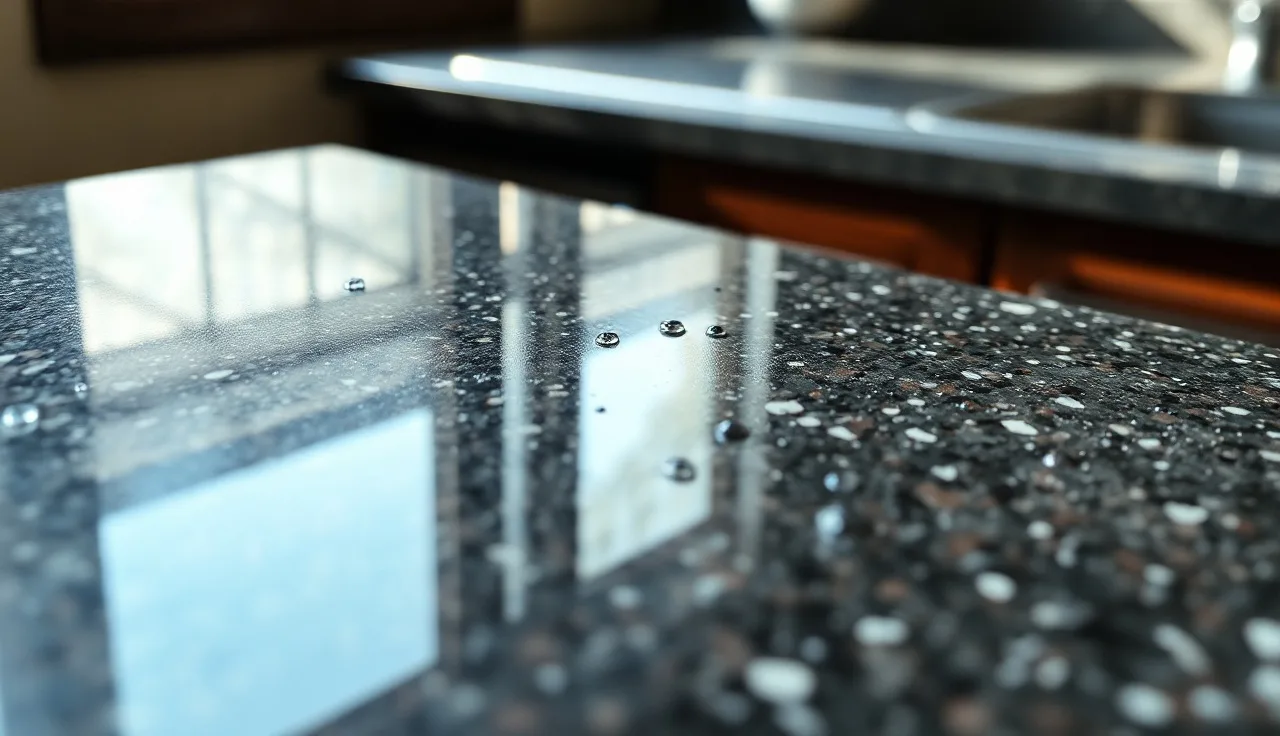
Granite has microscopic pores. Those pores absorb liquids, and if olive oil or red wine sits long enough, it stains. Sealer soaks into the pores and makes them hydrophobic, so liquids bead up instead of soaking in. You get more time to wipe a spill before it does damage. That's the whole job.
The word "seal" suggests total protection, and that's misleading. A properly sealed granite counter still needs prompt cleanup. Acidic cleaners, hard scrubbing, and puddles left sitting will still cause problems over time. Sealer buys you a margin of error, not a permanent shield.
There are two families: penetrating (impregnating) sealers and topical sealers. Penetrating sealers work below the surface by filling the pores. Topical sealers sit on top and form a film. For granite countertops, penetrating sealers are almost always the right call. Topical coatings wear unevenly under kitchen use, peel, and force you to strip the old layer before reapplying. Every major stone trade group recommends penetrating sealers for kitchen stone [1].
How do penetrating sealers and topical sealers compare?
The difference matters more than product marketing lets on. Here's the straight comparison:
| Feature | Penetrating (Impregnating) | Topical (Film-forming) |
|---|---|---|
| Where it works | Inside the pores | On the surface |
| Appearance change | Little to none | Adds gloss or sheen |
| Durability on counters | 1-5 years depending on stone | Months; wears unevenly |
| Reapplication | Clean surface, apply new coat | Must strip old film first |
| Heat resistance | Generally good | Often poor; can cloud |
| Best use | Kitchen/bath countertops | Some floors, specialty uses |
| DIY-friendly | Yes | Harder due to stripping step |
The carrier (what carries the active resin into the stone) is either water-based or solvent-based. Solvent-based penetrating sealers historically went deeper into dense stone, but water-based formulas have caught up. Solvent-based products carry higher VOCs and need better ventilation [2]. For a homeowner doing a kitchen counter, a water-based penetrating sealer is safer to work with and performs well.
Fluorocarbon sealers (sometimes labeled "fluoropolymer") repel both water and oil, because the chemistry blocks polar and nonpolar liquids. Standard silicone or siloxane sealers repel water well but shrug off oil less. Cook with a lot of olive oil or butter? A fluorocarbon sealer is worth the extra few dollars [1].
Does your granite actually need sealing?
Not every slab needs sealing, and some barely benefit at all. Density varies wildly across granite types. A tight absolute black is so dense that water essentially can't enter, so sealing it does almost nothing. A beige or gold granite with visible crystalline texture can be thirsty and really does benefit.
The field test takes about 15 minutes. Put a few drops of water on an inconspicuous spot, like near the sink edge, and watch it for 10 to 15 minutes [3]. If the water still beads after 15 minutes, the stone is either already sealed or naturally dense enough that sealing isn't urgent. If it darkens fast, say within 5 minutes, the stone is drinking moisture and sealing makes sense.
You can test with a drop of cooking oil too. Oil stains are harder to pull out than water stains, so if the oil darkens the surface within a few minutes, that stone needs sealing and steady maintenance.
The Marble Institute of America (now part of the Natural Stone Institute) has published porosity guidance noting that granite ranges from very low to moderate porosity depending on origin and mineral makeup [1]. No single rule covers all granites. The water test is the honest starting point before you spend a dime on product.
How often should you reseal granite countertops?
The honest answer: it depends on the stone and the sealer, and you should test instead of following a fixed calendar. Most fabricators and stone care pros suggest resealing every 1-3 years for kitchen counters that see moderate to heavy use [1][4].
Light-use surfaces like a bathroom vanity can go longer. A very porous stone in a busy kitchen might need annual attention. A high-density granite that got sealed only as a precaution might go 5 years without any issue.
The water drop test tells you when. If water on the counter absorbs within 5 minutes and darkens the surface, it's time. If it still beads, you're fine. Run the test once a year and let the stone tell you what it needs.
What degrades sealer faster than time: acidic cleaners (vinegar, lemon juice, many "natural" cleaners), abrasive pads, heavy daily wiping with hot water, and commercial degreasers. A gentle pH-neutral cleaner stretches the sealer's life a lot. Our guide on how to clean stone countertops has product-by-product picks.
How do you apply granite sealer step by step?
This is a real DIY project that takes about an hour plus drying time. Here's what actually works.
Clean the counter first. Wipe off any grease, residue, or cleaning product. Let the surface dry completely, which usually means waiting at least 30 minutes after cleaning. Sealing over a damp or dirty surface traps contaminants and blocks penetration.
Apply the sealer in sections. Pour a small amount onto the surface (or spray it if the product has a bottle) and spread it evenly with a lint-free cloth or applicator pad. Work a manageable area, maybe 2 to 3 square feet at a time, so the sealer doesn't dry before you can spread it.
Let it dwell. Most penetrating sealers need 5 to 20 minutes of contact time to soak in. Check the label, because this varies. The surface should look wet but not puddle.
Buff off the excess before it dries completely with a clean dry cloth. This step matters. Any sealer left sitting on top after the dwell time dries into a hazy film that's a pain to remove. Small sections let you buff before it sets.
Apply a second coat for highly porous stone. After the first coat penetrates and you've buffed, wait 30 minutes, then repeat. Dense granites rarely need more than one coat.
Cure time before normal use: most products say 24 to 48 hours before water exposure and 72 hours before heavy use [3][4]. Rushing this is common and cuts effectiveness.
Ventilation matters. Even water-based sealers release some VOCs during application and cure. Open windows or run a fan pointed outward [2].
What do granite sealers cost, and how much product do you need?
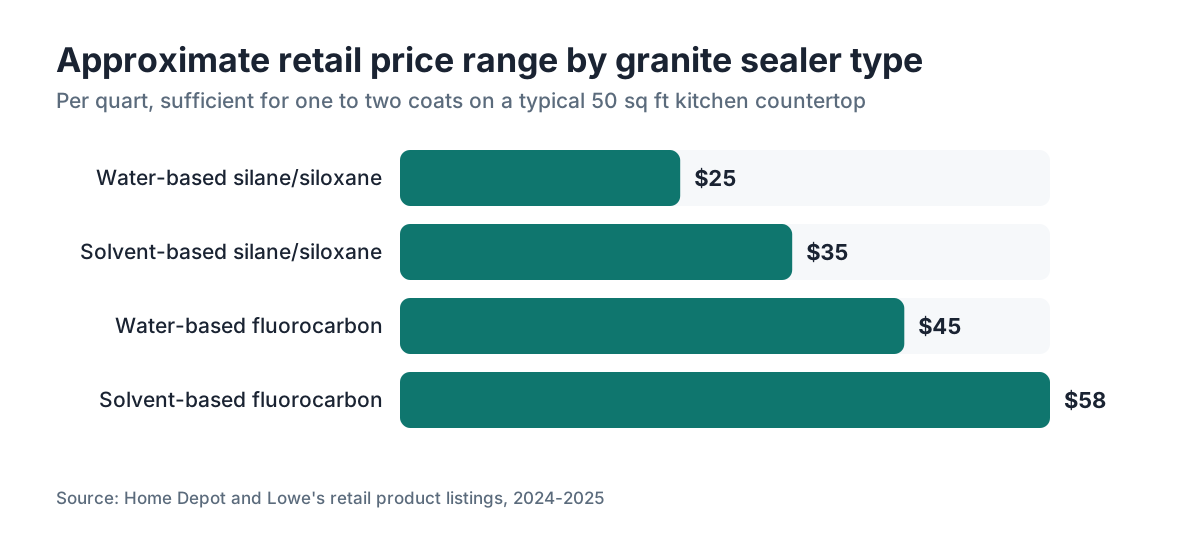
For a standard kitchen with 40 to 60 square feet of granite, one quart is almost always enough for two coats with some left over. A quart of quality penetrating sealer runs $20-$60 depending on brand and chemistry [5]. Fluorocarbon sealers sit at the high end.
Hiring someone to seal it runs $1-$3 per square foot for labor plus product, so $50-$200 for a typical kitchen. Some fabricators fold a first sealing into the install price. Ask specifically whether that's the case before your counters go in.
Stone restoration companies sometimes sell annual sealing contracts at $150-$300 a year. For most residential kitchens, that's hard to justify when DIY takes an hour and $30 in product. The exception is very porous stone with a staining history, or you just don't want to think about it.
The chart below shows approximate retail price ranges by sealer type. These come from widely available products across hardware and stone-specialty retailers as of 2024-2025 [5].
Which granite sealer products are worth buying?
Instead of ranking brands (formulas change and regional stock varies), learn what label language to hunt for. Look for "impregnating sealer" or "penetrating sealer." That tells you the product works inside the pores, not on top.
"Enhancing sealer" is a variation that also deepens color slightly, which some people like on darker granites. "Topical sealer" or "coating" is what you avoid for kitchen counters.
Check whether the product is "food-safe" or states it meets California Proposition 65 requirements once cured [6]. Most reputable penetrating sealers are inert once dry, but confirm it for surfaces where you prep food.
Look for a clear coverage number on the label. A quart should cover 100 to 250 square feet for average stone. If a label claims dramatically more, the concentration may be low and you'll burn through extra coats.
Brands the stone trade references often include StoneTech (a Laticrete brand) and Aqua Mix. The Natural Stone Institute publishes care and maintenance guidance that lists product categories without endorsing specific brands, which is a solid neutral reference [1].
Fabricators who run quoting and job-management software like SlabWise sometimes include sealer specs in the customer handoff docs. If a shop installed your counter using that kind of system, check whether they left a care sheet with product suggestions.
Can you over-seal granite, and what are the signs?
Yes, you can apply too much, and over-sealing is a common problem. It shows up as cloudiness, streaks, or a slightly sticky, tacky feel. What's happening is excess sealer sitting on top of the stone rather than inside it, forming an uneven film.
If you see haze after sealing, the fix is usually a sealer remover or a solvent like mineral spirits (test in a hidden spot first), gentle scrubbing, then wiping the surface clean. Some products come with an "etch remover" that handles this too. Annoying, but fixable.
Piling on more coats than the stone can absorb adds no protection. Once the pores are full, extra sealer has nowhere to go. One or two well-applied coats on a clean, dry surface is almost always enough. More isn't better.
When you move into a home, you sometimes inherit this problem from a previous owner who applied sealer and skipped the buffing step. The haze can look like mineral deposits or hard-water etching. Cleaning with a dedicated stone cleaner and a mild abrasive pad sometimes clears light haze. Deeper films usually need a professional stone restoration service.
How does granite sealing compare to caring for other stone surfaces?
Granite is one of the more forgiving natural stones for kitchen use, partly from its density and partly because it doesn't etch from acids the way marble does. Marble countertops etch (lose surface polish) from lemon juice, vinegar, or wine, sealed or not. Sealer doesn't prevent etching. It prevents staining. That distinction is worth repeating.
Quartzite needs sealing attention like granite, but it varies even more by origin. Some quartzites are quite porous. If you're caring for quartzite, our guide on how to clean quartzite countertops covers the specifics.
Quartz countertops (engineered stone) need no sealing at all. The resin binders fill any porosity during manufacturing, so the material is essentially non-porous [7]. If an installer or store clerk tries to sell you a quartz sealer, skip it.
Soapstone has its own routine. The traditional treatment uses mineral oil rather than a penetrating sealer, because soapstone's mineralogy responds differently. The how to clean soapstone countertops guide covers that separately.
Butcher block countertops use food-safe oil and wax systems, not stone sealers. Concrete countertops are quite porous and usually get a topical sealer or wax, since their surface behaves differently from stone. Sealer choice is stone-specific. Using a granite sealer on concrete or quartzite isn't necessarily harmful, but the results won't be great.
What common mistakes cause granite sealing to fail?
The biggest one is sealing over a dirty or damp surface. Grease, cleaning residue, or trapped moisture blocks proper penetration and can cause cloudiness or poor adhesion. Cleaning and fully drying the surface first is not optional.
The second most common mistake is not buffing off excess before it dries. Read the dwell time on your product label. Manufacturers disagree, but 10 to 20 minutes is typical. Let it sit too long and the excess cures on the surface as a film.
Using the wrong product is a real issue. Grabbing a generic "stone sealer" at a big-box store without reading whether it's penetrating or topical can leave you with a surface film that peels within months.
Applying sealer to wet stone after a water-heavy cleaning is common too. Water in the pores physically blocks the sealer. Wait at least 30 minutes, longer in humid conditions.
And expecting sealer to fix an existing stain. Sealer is preventive. It won't lift an oil stain or lighten an etched area. For existing stains, a poultice (a drawing paste made from a fine absorbent powder and a solvent) is the standard approach [4][8]. The Natural Stone Institute's care publications describe poultice methods for different stain types.
Is granite sealing safe? What you should know about VOCs and food contact
Most penetrating sealers sold for residential counters are safe once fully cured, typically 24 to 72 hours after application [4]. During application and the cure period, keep the area ventilated. Solvent-based sealers carry meaningful VOC levels and need more airflow than water-based versions [2].
The EPA regulates VOC content in architectural coatings and surface preparations under the National Volatile Organic Compound Emission Standards [2]. Solvent-based stone sealers fall under these rules, and compliant products sold in the U.S. must meet the applicable VOC limits. California runs stricter standards under CARB (California Air Resources Board) [6], which is why some products note "meets CA requirements" on the label.
Once cured, most silane, siloxane, and fluoropolymer impregnating sealers are chemically inert. They don't leach into food at room temperature. That said, no federal food-contact rule specifically certifies stone sealers as food-safe the way, for instance, cutting board oils get certified. The FDA regulates food-contact materials under 21 CFR [9], but it doesn't certify or list specific countertop sealers. Manufacturers claiming "food-safe" are relying on the inert chemistry of cured fluoropolymers, not an FDA certification of the product itself.
If that distinction matters to you, choose a sealer that explicitly states food-safe status post-cure, and keep food prep off the stone for the full cure period regardless.
How do fabricators think about sealing at installation?
From the shop side, sealing at installation is standard for most granite jobs. Freshly fabricated stone is clean, dry, and in the best condition it will ever be. Sealing before the counter sees kitchen traffic makes sense technically and takes the first-year maintenance burden off the homeowner.
Most fabricators apply one or two coats of a water-based penetrating sealer as part of final finishing. Some charge separately, some include it. Getting a quote for new counters? Ask flat out: "Does the price include sealing, and what product do you use?"
Shops that run on software managing job specs, cut lists, and customer documentation can attach sealer specs and care instructions right to a job file, so the homeowner gets product details at handoff. If your fabricator uses SlabWise for estimating and shop management, ask them to include sealer info in your job documentation.
The fabrication trade generally follows Natural Stone Institute guidelines for care product recommendations when advising customers [1]. For kitchen countertops specifically, the consensus is a penetrating sealer, a pH-neutral daily cleaner, and a reapply schedule set by water-drop testing rather than a fixed calendar.
Frequently asked questions
How do I know if my granite needs sealing?
Do the water drop test. Put a few drops of water on the surface and wait 10 to 15 minutes. If the water beads and doesn't darken the stone, you're either already sealed or your granite is dense enough that sealing is optional. If it soaks in and leaves a dark spot within a few minutes, sealing is worth doing. Repeat the test annually to decide when to reapply.
What's the difference between a granite sealer and a marble sealer?
The categories overlap. Many impregnating sealers marketed for granite work on marble too, since both are natural stones with pores. The bigger difference is that marble etches from acid contact (sealer doesn't prevent that), while granite generally doesn't etch. Check that a sealer states compatibility with both stone types before using it on marble. On marble, use pH-neutral cleaners regardless of sealer status.
Can I use a regular household cleaner on sealed granite?
Avoid acidic cleaners (vinegar, citrus-based), bleach, and abrasive scrubs on sealed granite. These degrade the sealer faster and can etch some granites over time. A pH-neutral stone cleaner or mild dish soap diluted in water is fine for daily use. Rinse with clean water and dry with a soft cloth. Frequent harsh cleaners will shorten your resealing interval noticeably.
Does sealing granite change how it looks?
A good penetrating sealer changes the appearance very little or not at all. You may see a slight deepening of the stone's natural color, especially on dark granites. "Enhancing" sealers are formulated to deepen color more; if you want that look, pick one on purpose. Topical sealers add visible gloss, but those aren't ideal for kitchen counters.
How long does granite sealer take to dry?
Most penetrating sealers dry to the touch in 1 to 4 hours and reach usable status for light contact in 24 hours. Full cure, the point where you shouldn't worry about water or food on the surface, is typically 48 to 72 hours. Check the product label, because cure times shift with humidity and temperature. Colder kitchens slow the cure; warmer conditions speed it up.
Is it better to seal granite before or after installation?
Both work. Sealing at the shop or before installation ensures the stone is clean, dry, and flat, which is ideal. Many fabricators do this as standard practice. If your counters arrived unsealed, apply sealer yourself after installation, once any adhesives or caulking have fully cured (usually 24 to 48 hours after install). Don't seal over fresh silicone or adhesive.
Do dark granites need sealing?
Dark granites, especially absolute black varieties, are typically very dense and often don't absorb water in any real way. Do the water drop test before sealing a dark stone; you may find water sits on top for 15+ minutes without absorbing. If so, sealing adds little protection. Lighter, more porous granites (tans, beiges, some whites) usually benefit more.
Can you reseal granite without stripping the old sealer?
Yes. With penetrating sealers you generally don't need to strip the old sealer before reapplying. Clean the surface well, let it dry completely, and apply the new coat. The fresh sealer fills whatever pore space has opened up since the last application. Stripping is only required if you're switching from a topical sealer to a penetrating one, or removing a cloudy topical film.
What if sealer left a hazy film on my granite?
Haze usually means excess sealer dried on the surface instead of getting buffed off during the dwell time. Try a small amount of mineral spirits on a soft cloth in a hidden spot first. Commercial sealer haze removers work too. Rub gently, let it sit briefly, then wipe clean. For stubborn haze, a professional stone restoration technician can polish it out without harming the stone.
Do engineered quartz countertops need sealing?
No. Engineered quartz is made with resin binders that fill the pores, so the material is essentially non-porous. Sealing quartz does nothing useful and may leave a slight residue. If a retailer or installer recommends sealer for quartz, skip it. Same goes for solid surfaces like Corian. Only natural porous stones like granite, marble, and some quartzites genuinely benefit from sealing.
How much does it cost to have granite countertops professionally sealed?
Expect $1-$3 per square foot for professional sealing labor plus product cost, putting a typical 50-square-foot kitchen at roughly $100-$200. Some fabricators include sealing in the install price. Annual or biannual service contracts from stone restoration companies run $150-$300 per visit for residential kitchens. DIY with a quality product and one hour of your time costs $20-$60 in materials.
Can granite sealer prevent stains from oil or grease?
A fluorocarbon impregnating sealer offers better oil resistance than a standard silicone or siloxane sealer. Standard water-based silane/siloxane sealers repel water well but give only moderate protection against oil. If your kitchen sees a lot of cooking with oils, a sealer labeled oil-repellent or a fluoropolymer formula gives meaningfully better protection, though prompt cleanup is still required.
Will sealing granite make it fully stain-proof?
No. Sealing slows absorption, giving you more time to wipe a spill before it stains, but it doesn't make the surface impervious. A glass of red wine left overnight can still mark sealed stone. Highly acidic liquids may etch certain granites regardless of sealing. Expect significantly reduced stain risk with prompt cleanup, not complete immunity.
Sources
- Natural Stone Institute, Marble and Stone Slab Certification and Care Guidelines: Penetrating impregnating sealers are recommended for kitchen granite; granite porosity varies widely by origin and mineral composition; resealing every 1-3 years for kitchen surfaces is standard guidance
- U.S. EPA, National Volatile Organic Compound Emission Standards for Architectural Coatings: Solvent-based stone sealers are regulated under EPA VOC emission standards for architectural coatings; adequate ventilation required during application
- University of Minnesota Extension, Stone Countertop Care: Water drop test (15-minute observation) is the standard field test for granite porosity; 48-72 hour cure time recommended before heavy use
- Marble Institute of America (now Natural Stone Institute), Care and Cleaning for Natural Stone Surfaces: Poultice method for existing stains; resealing schedule should be based on water absorption testing rather than fixed calendar; 24-72 hour cure before normal water exposure
- Home Depot and Lowe's retail product listings for penetrating stone sealers, 2024-2025: Quart of quality penetrating stone sealer retails for $20-$60; fluorocarbon formulas at the higher end of the range
- California Air Resources Board, Consumer Products Regulation: California has stricter VOC standards for consumer stone sealers than federal EPA standards; products meeting CA requirements state so on the label
- Marble Institute of America, Quartz Surface Fabrication and Maintenance: Engineered quartz countertops are manufactured with resin binders that make the material essentially non-porous; sealing is not required or beneficial
- Natural Stone Institute, Stain Removal Guide for Natural Stone: Poultice method (absorbent powder plus solvent) is the standard industry approach for removing existing oil and organic stains from granite
- U.S. FDA, 21 CFR Part 175-178, Indirect Food Additives: Surface Coatings: FDA regulates food-contact surface coatings under 21 CFR; no specific FDA certification process exists for countertop stone sealers as a category
- National Terrazzo, Tile and Marble Association, Stone Maintenance Guidelines: Professional stone maintenance organizations recommend pH-neutral cleaners to preserve sealer life; acidic cleaners measurably reduce sealer durability
Last updated 2026-07-09