TL;DR
- Cracks in granite countertops come in two kinds: fissures (natural, harmless) and true structural cracks.
- Professional epoxy repair runs $200 to $650 depending on length and location.
- DIY kits cost $20 to $60 but rarely match stone color well.
- Cracks near cutouts, sinks, or unsupported spans are the serious ones.
- Get a fabricator to assess those before you touch them.
Is that actually a crack, or just a fissure?
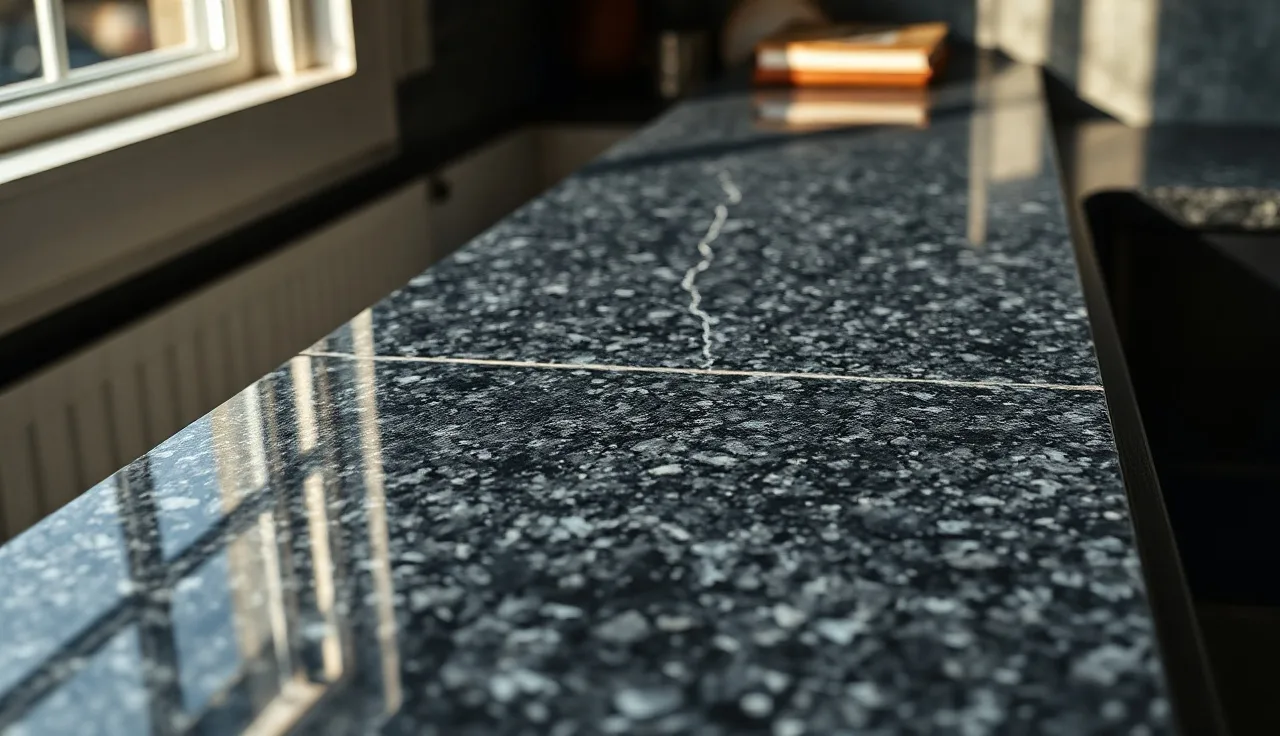
Before you panic, figure out what you're looking at. Granite forms under enormous heat and pressure, and the stone often carries natural fissures, thin lines within the crystal structure that were there before the slab left the quarry. A fissure is smooth when you drag a fingernail across it. It doesn't catch. It follows the mineral grain rather than cutting straight across a span.
A true crack feels different. Run your fingernail over it and you hit a ridge or a gap. The line crosses multiple mineral veins instead of tracing them. In a structural crack, the two sides of the stone have actually separated. Water gets in. Bacteria hide in it. Under load, it spreads.
The Marble Institute of America (now part of the Natural Stone Institute) has long held that fissures are an inherent characteristic of natural stone and not a defect [1]. That exact language shows up in plenty of fabricator contracts and purchase agreements. So if your installer or stone yard told you fissures were fine, they were telling the truth.
Here's the test I use. Press gently on each side of the line with your thumb. Any flex or movement means a structural crack. Dead rigid on both sides means you're almost certainly looking at a fissure. Then check it in raking light, which is just a flashlight held nearly parallel to the surface. Fissures tend to vanish in raking light. Cracks throw a tiny shadow because the edges are raised or pulled apart.
What causes cracks in granite countertops?
Granite is hard (Mohs 6 to 7) [2] but it doesn't bend. Real cracks follow a short, predictable list of causes, and support is at the top of it.
Unsupported overhangs and spans cause a big share of field cracks. Industry guidelines cap unsupported overhangs at 10 to 12 inches for 3 cm (1.25") material without steel underneath [3]. A breakfast bar or island overhang past that limit flexes over time, and the stone loses. This is physics, not bad luck: granite's compressive strength (150 to 300 MPa) dwarfs its tensile strength (7 to 25 MPa), so any span that puts the underside in tension is asking to crack [7].
Cutouts concentrate stress. The inside corners of sink cutouts, cooktop cutouts, and faucet holes are classic crack starters. Every good fabricator asks for rounded interior corners (a small radius, never a sharp 90-degree notch) because a sharp corner is a stress riser. If your crack runs from a sink corner toward the edge, you've found your cause.
Thermal shock is real but overblown in online forums. Granite shrugs off normal cooking heat. What occasionally cracks a slab is a cold stone dropped onto something very hot, or boiling water poured onto a cold section. The coefficient of thermal expansion is low enough that ordinary kitchen use almost never does damage.
Bad installation is the cause fabricators hate to own. If the cabinets aren't level and the crew shims unevenly, the slab bridges a small void. Every time someone sits on that spot or sets down a heavy pot, the stone bends in a way it was never built for. Compression, fine. Tension, not fine.
Heavy impact cracks granite too. A cast-iron pan dropped on edge will do it. So will dropping the slab during install. Impact cracks look sudden and chaotic instead of running a clean line from a cutout.
How much does it cost to repair a crack in a granite countertop?
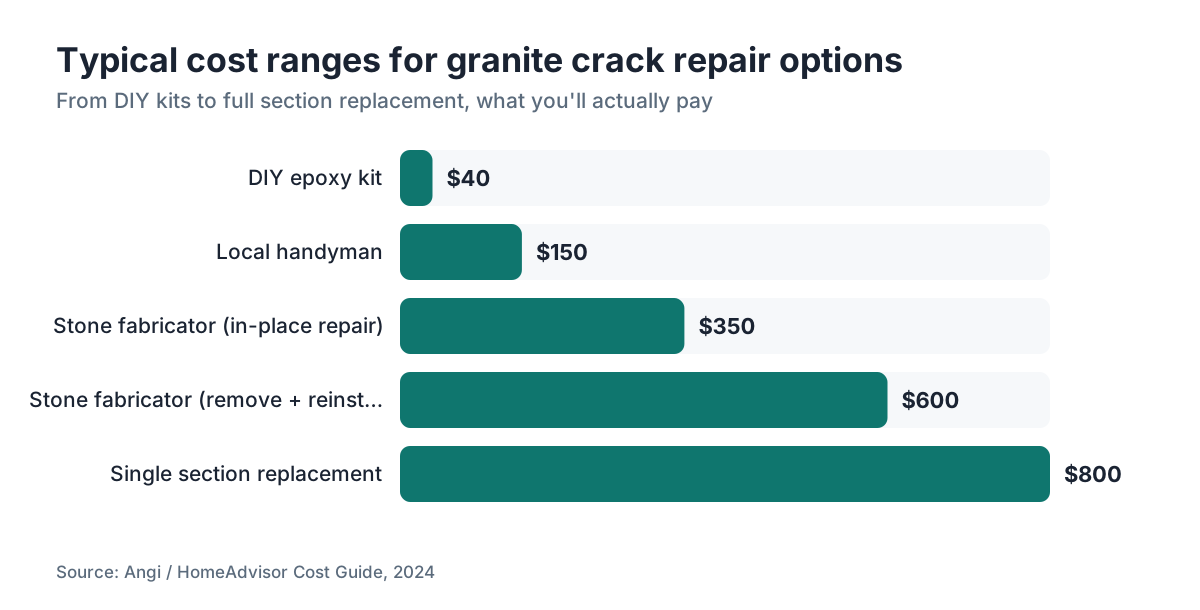
Professional repair for a single crack runs $200 to $650, and most homeowners land between $250 and $400 for a crack 6 to 18 inches long on a kitchen counter [4]. Price moves with crack length, location (edges and sink corners are harder to reach), color-matching difficulty, and your local labor rates.
A longer crack running the full depth of a section, say 24 to 30 inches from sink to edge, can push toward $500 to $800, especially when the fabricator injects epoxy in several passes and waits for each one to cure.
DIY kits with two-part epoxy and stone-matching pigments sell for roughly $20 to $60 at hardware stores and online [4]. The chemistry is sound. The epoxy bonds the crack fine. The hard part is color. Granite gets polished to a high finish, and epoxy even slightly off in tint or sheen shows. Most people who go DIY end up with a crack that's sealed but visible under direct light.
Here's how the options stack up.
| Repair type | Typical cost | Color match quality | Who should use it |
|---|---|---|---|
| DIY epoxy kit | $20 to $60 | Fair to poor | Low-traffic areas, replacing soon |
| Local handyman | $100 to $200 | Varies widely | Simple surface cracks, tight budget |
| Stone fabricator repair | $200 to $500 | Good to excellent | Main kitchen surface, visible areas |
| Full section replacement | $400 to $1,200+ | Perfect (new stone) | Structural crack, slab over 50% damaged |
Repairing a crack almost always costs less than replacing the slab. The exception: a structural crack running through a high-stress zone like a sink cutout, in a premium exotic stone where matching a remnant is hard or impossible. That's when the math flips toward replacement.
If you're weighing repair against starting fresh, SlabWise's instant quote tool gives you a baseline on replacement cost so you can see which way the numbers point.
Can you repair a cracked granite countertop yourself?
Yes, within limits. A hairline crack or a short surface crack in a low-visibility spot (inside a cabinet run, near the backsplash, under an appliance) is a fair DIY candidate. A crack on the main prep area in front of the sink, or one that's actively widening, is not.
The standard DIY method uses two-part polyester or epoxy resin with pigment tints mixed to approximate the stone. The process goes like this:
- Clean the crack with acetone to strip grease, water, and debris. The bond fails on a dirty surface.
- Tape off both sides of the crack to catch overflow.
- Mix the resin per the label. Add pigment slowly, and err lighter than the stone, because epoxy usually darkens a touch as it cures.
- Work the resin into the crack with a razor blade or plastic spreader. Press it in, don't just smear it over the top.
- Let it cure fully. 24 hours minimum, 48 is better.
- Shave the excess off with a fresh razor blade held nearly flat.
- Wet-sand starting around 400 grit, up through 800, 1500, then finish with a polishing compound matched to your stone's sheen.
The sanding and polishing step is where most DIY repairs come apart. The factory polishes granite with diamond abrasives to a specific finish, and matching that by hand takes patience and the right compounds. Honed or leathered finishes are actually easier to match than a high polish.
For a structural crack, the kind where you felt movement when you pressed, skip the DIY. The stone needs to be stabilized and the support problem solved first. Filling a crack on an unsupported span just buys a little time and hands you a false sense of safety.
When should you replace instead of repair?
Repair makes sense when the crack is surface-level, stays clear of cutout corners, and the stone on both sides is stable. Replacement wins in a few specific cases.
When the crack runs from a sink or cooktop cutout corner all the way to an edge, that section's structural integrity is gone. Epoxy won't restore the tensile strength of the stone, and the section can fail under load. A fabricator would typically cut and replace the affected piece or recommend a full slab swap.
Multiple cracks point at the support or the installation. Fixing them one at a time without touching the root cause is throwing money into a hole.
Discontinued or hard-to-source colors change the math too. A patch stands out against undamaged stone, so replacement with a matching remnant (if one exists) or a fresh material starts to look better.
And if the counter is already old, heavily etched, or neglected and you're remodeling anyway, repair rarely earns its keep. This is the moment to ask whether you even want more granite. Options like marble countertops, Cambria countertops, or Corian countertops each handle damage in their own way and might suit how you actually use the kitchen.
Does a crack affect the resale value of your home?
A visible crack in a kitchen counter is a negotiating point, and it will come up in a home inspection nearly every time. The inspector won't call it dangerous unless it's an obvious structural failure, but they'll note it, and buyers spot cracked countertops on their own without any help.
The dollar hit is hard to pin down because it rides on your local market, the rest of the kitchen, and how prominent the crack is. In a hot market where buyers waive inspections, it may not register at all. In a slow market packed with comparable homes, a buyer might ask for $1,000 to $3,000 in credits or make the repair a condition of sale.
Here's the practical call. If you're selling within two years and the crack sits on the main prep surface or shows from the kitchen entry, repair it. A $300 professional repair returns more than almost any other pre-sale fix. If the crack is minor and truly hidden, disclose it and price accordingly.
Seller disclosure rules are set at the state level. Most states require sellers to disclose known material defects, and a structural crack in a countertop qualifies under most interpretations [5].
How do you prevent cracks in granite countertops?
Most crack prevention happens at install, long before you're reading this. But there's plenty you can still do to lower the risk going forward.
Don't sit or stand on the countertop. Sounds obvious. Granite sees more of that than homeowners admit. The overhang on an island is the weak spot, because unsupported stone goes into bending stress the second it takes concentrated weight.
Use a cutting board. Knives won't crack granite, but a heavy blade dropped point-down onto a thin fissure can start one.
Skip extreme thermal gradients. A hot pan on solid, cold granite is low risk, but don't set one down over a fissure or an existing hairline. Use a trivet.
Watch the plumbing work. A plumber who overtightens a sink clip or leans on the underside near a cutout can start a crack. If you've got sink work happening, remind them the stone doesn't flex like a wood substrate.
For fabricators, the boring stuff prevents almost all field cracks: continuous substrate support, level cabinets, respected overhang limits, and rodded or mesh-backed slabs on spans over 24 inches. The Natural Stone Institute's installation standards spell out those support requirements directly [8].
Sealing won't prevent cracks. Sealer handles porosity and stains, not structure. If a salesperson tells you regular sealing stops cracking, they're wrong.
What's the right epoxy or filler for granite crack repair?
Two product families do this work: polyester-based fillers and epoxy-based fillers. Both work. They behave differently.
Polyester resin is cheaper and cures fast, sometimes 30 to 60 minutes to handling strength. It's more brittle once cured, which matters on a crack that might see any movement. Most stone yard touch-up kits are polyester for the speed and price.
Epoxy resin cures slower, typically 6 to 24 hours depending on the formula, but it grips stone harder and stays more flexible. For a structural crack or a high-use area, epoxy is the better call.
For color, use universal tint concentrates or pigments made for stone repair. Most granites come down to combinations of black, white, brown, and sometimes a warm gold or green. Mix small test batches on scrap cardboard and let them cure before you compare to the stone, because the color shifts on cure.
Low-viscosity formulas (water-thin) soak deeper into narrow cracks. High-viscosity ones (gel-like) suit wider gaps that would swallow thin resin. A lot of fabricators run a thin fill first to penetrate, let it partially cure, then lay a thicker second coat over the remaining surface void.
For polishing after the fill, work through wet-dry sandpaper up to 1500 or 2000 grit, then finish with a granite-specific polishing compound. Products from Tenax and Akemi are common in the trade and sold to consumers too.
If you're maintaining other stone around the house, the same care logic applies. Our guide on how to clean stone countertops covers the surface habits that keep stone in repair-worthy shape.
How do fabricators assess and price a granite crack repair?
A fabricator sizing up a crack checks four things: does it go through the full thickness of the slab, does it touch a cutout or edge, is there any movement across it, and can the color be matched with the epoxy tints on hand.
Full-thickness cracks through the back and front of a 3 cm slab are the worst case. The fabricator injects resin from both faces, often clamping to draw the crack shut as far as it'll go while the epoxy cures. Slow, skilled work.
Most shops price by the job, not by the inch. A crack that takes two to three hours of shop time (pull the countertop, repair it in the shop, reinstall) costs more than an in-place fix that takes an hour. Expect removal-and-reinstall jobs to add $150 to $300 over the base repair.
A straight-shooting fabricator tells you upfront whether the repair will show. White and light gray polished granites are brutal to repair invisibly, because any color drift in the epoxy reads loud and clear. Dark, heavily figured granites forgive almost anything, since the busy pattern swallows the repair.
If you run a shop and track repair jobs against your main production, job costing tools like the ones in SlabWise show you whether your repair pricing actually covers the time you're burning.
Get the assessment in writing with a clear statement of the expected outcome. "Structurally sound, some visual evidence of repair" is a different promise than "invisible repair," and both are honest depending on the stone.
How does a granite crack compare to damage in other countertop materials?
Granite cracks differently from most other counter materials, and that shapes how you think about repair versus replacement.
Quartz (engineered stone) chips and cracks too. Because it's made with resin binders, it can be more prone to thermal cracking near cooktops. Repair uses similar epoxy methods, but some quartz makers void warranties if the wrong filler goes in.
Marble, softer at Mohs 3 to 4 [2], chips more than it cracks, and it carries natural fissures like granite does. It etches easily, which people constantly mistake for cracking. Real cracks in marble get repaired the same way as granite.
Laminate countertops and Formica countertops don't crack like stone. They chip at edges and delaminate. The repair is a different animal.
Corian countertops and other solid surface materials sand and buff clean, which beats stone on repairability. A deep scratch or crack in Corian often disappears with no trace.
Butcher block countertops split along the grain but usually fill with wood glue and sand flat.
Granite's hardness works against it in repair. You can't sand the surface back to flat without diamond abrasives and careful polishing, which is exactly why professional repairs cost what they do. The durability edge over softer materials is real. It just comes bundled with that repair complexity.
What should you tell your insurance company about a cracked granite countertop?
Standard homeowners policies cover sudden and accidental damage but exclude gradual damage, maintenance issues, and settling. A crack from a heavy object falling on the counter might be covered under the sudden accidental damage provisions of a standard HO-3 policy [6]. A crack that grew over months from an unsupported overhang almost certainly won't be.
The Insurance Information Institute lists "sudden and accidental" damage among covered perils on many standard homeowner policies, but the burden sits on you to show the damage was sudden and accidental rather than gradual [6]. The Consumer Product Safety Commission also advises restricting use of a damaged structural surface until a qualified professional assesses it, which is worth documenting if you file [10].
If you do file, get a written assessment from a stone fabricator naming the likely cause. A fabricator who can tie the crack to a single impact event, with photos, gives your claim its best shot. A crack that looks like it crept over weeks is much harder to get covered.
For most repairs in the $200 to $500 range, filing isn't worth it once you subtract your deductible (commonly $1,000 to $2,500) and factor a possible rate bump from a paid claim. Run the numbers first.
If the damage is bigger, say a full slab failure needing $1,500 to $3,000 in replacement [9], a claim gets more reasonable depending on your deductible and terms.
Frequently asked questions
Can a crack in granite spread or get worse over time?
Yes. A structural crack can propagate, especially near cutouts or unsupported spans. Every thermal cycle and heavy load stresses the cracked zone. A surface crack filled with epoxy and stable is much less likely to grow. A crack that moves when you press on it needs a fabricator's eyes quickly, because it almost always gets worse on its own rather than better.
How can I tell if my granite crack is structural or cosmetic?
Press gently on both sides of the crack. Any flex, shift, or movement means structural. Run a fingernail across the line too: a structural crack catches or shows a ridge, while a fissure (natural, harmless) stays smooth. Hold a flashlight at a very low angle to the surface. Structural cracks throw a small shadow because the edges are raised or separated. Fissures tend to disappear in that raking light.
Is it safe to use a cracked granite countertop?
A stable cosmetic surface crack is generally fine for normal use. Don't cut directly over it, and seal it promptly so bacteria and moisture don't collect in the gap. A structural crack is a different story, especially near a sink or on an unsupported overhang. Those can fail under load. Restrict use of that section and get a professional assessment before it sees heavy activity.
How long does a granite crack repair last?
A proper epoxy repair on a stable crack, done by a skilled fabricator with good surface prep, can last the life of the countertop. The bond between cured epoxy and granite is strong. The catch: if the underlying cause (unsupported span, flexing cabinet) isn't fixed, the repair fails and the crack reopens, sometimes wider than before. Fix the root cause first, then repair.
Does granite crack repair work on colored or exotic granites?
The structural repair works on any granite. The cosmetic result varies a lot. Busy, dark, or heavily figured stones (Blue Bahia, Volga Blue, Ubatuba) hide epoxy repairs very well. Light, uniform stones like white or light gray granites are much harder to match invisibly. A fabricator who handles that specific stone daily gives you the best odds of a clean color match.
Can I use super glue (cyanoacrylate) to fix a granite crack?
Super glue (cyanoacrylate) works surprisingly well on very narrow hairline cracks, because it wicks into tight gaps by capillary action and bonds hard surfaces. It won't color-match and won't fill wider cracks. Treat it as an emergency stop-gap to keep water out and slow crack growth while you line up a proper repair. Don't make it your final answer on a main prep surface.
Will sealing granite prevent cracks?
No. Sealer is a surface treatment that fills pores to cut staining and moisture absorption. It has no structural effect and does nothing against cracking from impact, thermal stress, or unsupported spans. Apply sealer on the schedule your fabricator recommends (usually every 1 to 3 years depending on granite density), but don't expect it to help with crack prevention at all.
Does homeowners insurance cover a cracked granite countertop?
Maybe. Standard HO-3 policies cover sudden and accidental damage, so a crack from a single impact event might be covered after your deductible. Cracks from gradual stress, settling, or bad installation are typically excluded as maintenance. For repairs under $500, a claim usually isn't worth filing once you count your deductible and a possible premium bump. Document with photos and get a fabricator's written assessment before calling your insurer.
Can a granite countertop crack from a hot pan?
Thermal shock cracking from a hot pan is possible but uncommon on solid, well-supported granite. Risk is highest when a very hot pan meets a cold stone that already has a fissure or a thin section near a cutout. Don't make a habit of setting scorching pans directly on the stone, not because it'll definitely crack, but because repeated thermal cycling over fissures adds up over years. Use a trivet and you'll never think about it.
How do I find a qualified person to repair a granite crack?
Start with the fabricator who installed the countertop, if you know who it was. They know the stone and have the best shot at color matching. If that's not an option, look for stone restoration companies (search 'granite repair' plus your city), or ask a local stone yard for a referral. The Natural Stone Institute keeps a member locator at naturalstoneinstitute.org that helps you find qualified pros.
What is the difference between a crack and a chip in granite?
A crack is a linear fracture running through or across the slab. A chip is localized material loss, usually at an edge or corner where the stone hit something hard. Chips are generally easier to repair because they don't compromise the slab's structural integrity. Both use similar epoxy and color-matching techniques, but a chip repair usually takes less time and costs less than a long crack repair.
How much does it cost to replace just one section of a granite countertop?
Replacing one section (say, the sink run) instead of the full countertop costs $400 to $1,200 or more, depending on section size, material cost, and whether a matching remnant exists [9]. The labor to remove, cut, and reinstall a single section is often nearly as much as a full install, and matching your existing granite is frequently the hardest part. Get quotes for both repair and full replacement before deciding.
Do granite cracks cause sanitation or mold problems?
An unsealed crack can harbor bacteria and moisture, which over time can grow mold in the gap, especially near a sink. That's a hygiene concern more than a structural one. Clean and seal any crack the moment you find it, even if a full repair is weeks away. A bead of food-safe caulk or a thin coat of countertop sealer worked into the crack stops moisture in the short term.
Sources
- Natural Stone Institute, 'Fissures vs. Cracks' industry guidance: Fissures are an inherent characteristic of natural stone and are not a defect; this position is reflected in NSI member guidance and standard fabricator contract language.
- Mohs hardness scale, mineral hardness reference: Granite rates Mohs 6 to 7 in hardness; marble rates a softer Mohs 3 to 4.
- Natural Stone Institute, 'Dimensional Stone Design Manual': Industry guidelines recommend unsupported granite overhangs be limited to 10 to 12 inches for 3 cm material; beyond that, steel or bracket support is required.
- Angi / HomeAdvisor, 'Cost to Repair a Granite Countertop' consumer cost guide: Professional granite crack repair typically costs $200 to $650; DIY epoxy repair kits sell for $20 to $60.
- National Association of Realtors, seller disclosure guidance: Most U.S. states require sellers to disclose known material defects including structural damage; a structural crack in a countertop would qualify as a material defect in most state interpretations.
- Insurance Information Institute, 'Homeowners Insurance Basics': Standard HO-3 homeowner policies cover sudden and accidental damage but exclude gradual damage and maintenance-related deterioration; deductibles commonly range $1,000 to $2,500.
- National Institute of Standards and Technology (NIST), stone properties reference: Granite's compressive strength (150 to 300 MPa) is far higher than its tensile strength (7 to 25 MPa), explaining why unsupported spans that create bending stress cause cracking while the same material resists crushing loads easily.
- Marble Institute of America (now Natural Stone Institute), residential countertop installation standards: Proper countertop installation requires continuous substrate support, level cabinets, and mesh or rod backing on spans exceeding 24 inches to prevent field cracking.
- Angi / HomeAdvisor, countertop replacement cost guide: Replacing a single granite countertop section costs $400 to $1,200 or more depending on material availability, section size, and labor rates in the local market.
- U.S. Consumer Product Safety Commission (CPSC), home safety resources: Structural failures in kitchen fixtures including countertops can constitute a safety hazard; homeowners are advised to restrict use of damaged structural surfaces until assessed by a qualified professional.
Last updated 2026-07-09