TL;DR
- A 10-foot granite countertop costs roughly $400 to $2,000 installed, depending on the stone tier, edge profile, and your market.
- That works out to about 25 square feet with a standard 25-inch depth.
- Entry-level granite starts around $40 per square foot installed; premium slabs with complex edges can hit $80 or more.
- Material alone is $15, $50 per square foot before any labor.
How much does a 10 foot granite countertop cost?
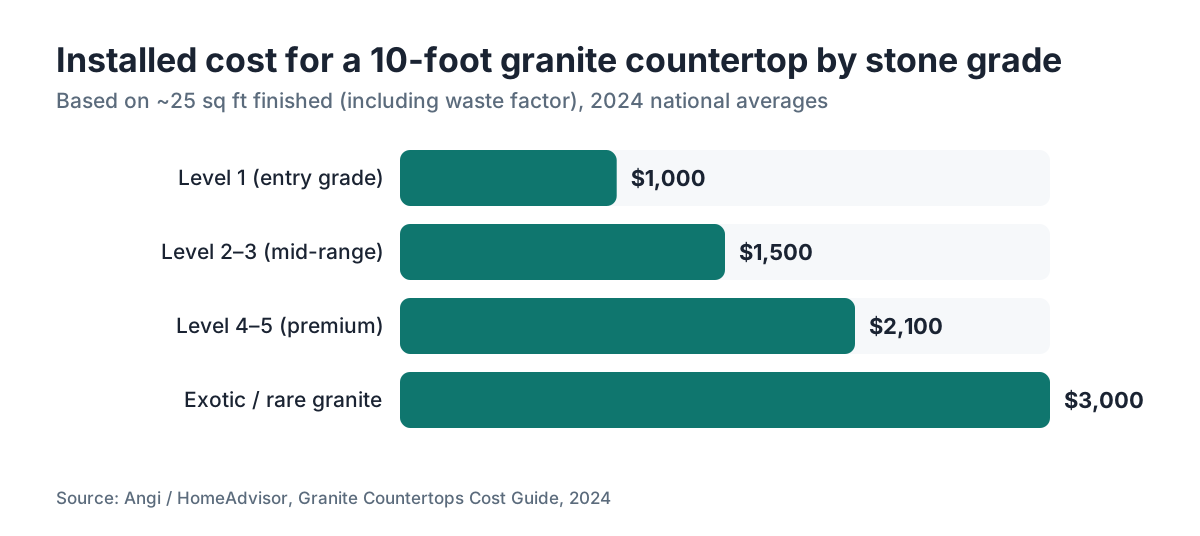
A 10-foot run of granite at the standard 25-inch depth covers roughly 20.8 square feet. Round up to 25 square feet once you account for overhang, sink cutouts, and the fabricator's material waste. At $40 to $80 per square foot installed, that puts most kitchens between $1,000 and $2,000. [1]
But you can spend less. Basic-grade granite (Level 1 or 2 at most shops) in a straight rectangular run with an eased edge can land near $400 to $700 total if you're in a lower-cost market or buying from a remnant. You can also spend a lot more. Exotic stones like Blue Bahia or Calacatta Macchiato granite, or any slab that needs extra seams and heavy edge work, push past $2,500 for a single 10-foot section.
The honest range is wide because "granite countertop" covers everything from commodity Uba Tuba to rare quarried stone that costs more per slab than some used cars. The grade system moves the price more than almost anything else.
For comparison, a 6 foot granite countertop covering about 12 to 15 square feet runs $480 to $1,200 installed at the same per-square-foot rates. Scale up to a 12 foot granite countertop and you're looking at 25 to 30 square feet, or $1,000 to $2,400 installed and up. The math is proportional. The variables are the same.
What is included in the installed price per square foot?
When a fabricator quotes an installed price per square foot, that number should cover the raw slab, fabrication (cutting, grinding, polishing edges), templating, delivery, and installation. Some shops bundle everything and some don't. You have to ask.
Templating alone runs $100 to $200 as a separate line item at shops that unbundle it. [2] Delivery and installation together add $150 to $400 depending on distance, the weight of the stone, and how many pieces need to get into the house. A 10-foot slab of 3/4-inch granite weighs roughly 18 to 20 pounds per square foot, so 25 square feet is around 450 to 500 pounds. That takes at least two installers, sometimes three.
Edge profiles often get quoted separately. A standard eased or beveled edge is usually included. Ogee, dupont, and waterfall edges add $10 to $30 per linear foot on top of the base price. [1] For a 10-foot run with 10 linear feet of exposed edge, that's an extra $100 to $300.
Sink cutouts run $75 to $200 each depending on whether it's an undermount (harder) or a drop-in. Cooktop cutouts are similar. Faucet holes are usually $20 to $50 each.
Sealer is sometimes in the quote, sometimes not. A professional sealing costs $50 to $100 per application and should be reapplied every one to three years depending on the stone's porosity and the sealer used. [3]
What drives the price difference between granite grades?
Fabricators sort granite into three to five tiers, usually labeled Level 1 through Level 5 or called entry, mid, premium, and exotic. The tier changes the material cost per square foot. It barely touches the labor.
Level 1 or entry granite ($15, $25/sq ft material) is usually pre-fabricated in standard sizes, thinner (sometimes 3/8 inch rather than 3/4 inch), and sourced from high-volume quarries in India or Brazil. Common colors: Uba Tuba, New Venetian Gold, Santa Cecilia. These are good stones. If you want low maintenance and a tight budget, Level 1 is not a compromise. It's a smart choice.
Level 2 and 3 granite ($25, $50/sq ft material) covers the bulk of what most kitchens use. More color and pattern variation, thicker slabs, more quarry sources. Think Black Galaxy, Bianco Romano, Tan Brown.
Level 4 and 5 or "exotic" granite ($50, $100+/sq ft material) includes rare stones with dramatic movement, unusual color combinations, or difficult extraction. Pricing here also reflects scarcity and transport from remote quarries. [4]
Labor doesn't change much across grades. A skilled fabricator charges the same hourly rate whether they're cutting Uba Tuba or Blue Bahia. What changes is the material cost and, sometimes, the waste factor. Exotic slabs with strong directional veining need more careful layout, which means more waste and a higher price per finished square foot.
For a full picture of how granite compares to other natural stone, the granite countertops guide walks through the tradeoffs.
How does a 10 foot countertop compare in price to shorter and longer runs?
Here's the honest math across common countertop lengths, using a mid-range installed price of $60 per square foot and a 25-inch standard depth.
| Length | Approx sq ft | Installed cost (mid-range) | Installed cost (low) | Installed cost (high) |
|---|---|---|---|---|
| 6 ft | ~12.5 sq ft | ~$750 | ~$500 | ~$1,250 |
| 8 ft | ~16.7 sq ft | ~$1,000 | ~$667 | ~$1,667 |
| 10 ft | ~20.8 sq ft | ~$1,250 | ~$833 | ~$2,083 |
| 12 ft | ~25 sq ft | ~$1,500 | ~$1,000 | ~$2,500 |
| 16 ft | ~33 sq ft | ~$2,000 | ~$1,333 | ~$3,333 |
The per-square-foot rate stays roughly constant across lengths. There's one exception: very short runs. A 6 foot granite countertop sometimes costs more per square foot than a 10-foot run, because the minimum charge for a fabricator's time (templating, delivery, setup) gets spread over fewer square feet. Many shops set a minimum job size of $300 to $500 regardless of actual square footage. [2]
Going the other way, a 12 foot granite countertop may require a seam if the slab width won't accommodate it in one piece. Standard granite slabs run 55 to 65 inches wide and 100 to 130 inches long. [4] A 144-inch (12-foot) run exceeds most slab lengths, so the fabricator joins two pieces. The seam adds $100 to $200 in labor and, if the stone has strong pattern, may cost more for book-matching.
A 10-foot run often lands in the sweet spot. It fits on a single slab with room to spare, no seam required, and there's usually enough remnant left for a small bathroom vanity.
What does granite cost compared to other countertop materials?
Granite sits in the middle of the countertop market. Here's how it stacks up against the main alternatives at the 10-foot / 25 square foot scale.
| Material | Installed cost per sq ft | 25 sq ft total |
|---|---|---|
| Laminate (Formica) | $20, $40 | $500, $1,000 |
| Butcher block | $30, $80 | $750, $2,000 |
| Entry granite | $40, $55 | $1,000, $1,375 |
| Mid-range granite | $55, $75 | $1,375, $1,875 |
| Quartz (engineered) | $60, $100 | $1,500, $2,500 |
| Marble | $70, $120 | $1,750, $3,000 |
| Premium granite / exotic | $80, $150+ | $2,000, $3,750+ |
Sources: HomeAdvisor / Angi national averages, 2024 [1]; NKBA cost report, 2023 [5].
Laminate countertops and Formica countertops are genuinely less expensive and worth a look if budget is the main driver. They've improved a lot in the last decade, and the best laminates now mimic stone convincingly.
Marble countertops cost more than entry granite and demand more maintenance, since marble is softer and etches from acids. Cambria countertops (engineered quartz) are non-porous, need no sealing, and carry a lifetime warranty, but they cost more than most mid-grade granite.
Granite's durability is genuinely good. The USGS puts granite at 6 to 7 on the Mohs hardness scale, which sits well above most kitchen wear. [6] No honest comparison hides the fact that granite needs periodic sealing while quartz doesn't. If you'd rather never think about maintenance, quartz is the better call even when it costs more.
What are the hidden costs most homeowners miss?
The quote you get is almost never the final price. Here's where the surprises hide.
Demolition and disposal of old countertops runs $100 to $300 depending on the material and your market. Some fabricators include it. Most don't. Ask directly.
Cabinet leveling matters a lot. Granite is unforgiving. If your cabinets are out of level by more than 1/8 inch, the fabricator either shims the stone (adds cost) or wants a carpenter to fix the cabinets first. Cabinet work to correct level can run $100 to $500. [7]
Plumbing reconnection after a new undermount sink goes in is real work. Most fabricators don't include it, and neither do most installers. A plumber charges $100 to $250 to disconnect and reconnect supply lines and the drain. [8]
Permits are rarely required for a countertop swap alone. If the work is part of a larger kitchen remodel, the general contractor's permit may cover it, or your jurisdiction may want separate pulls. Check with your local building department. Most municipalities don't require a permit for a straight countertop replacement. [9]
Tax. Many states apply sales tax to fabricated stone products. That's 5% to 10% on top of your material cost. On a $1,500 installed job, that's $75 to $150 you might not see until the final invoice. [9]
Then there's seam location. If your layout needs a seam (common with L-shaped kitchens or any run over 10 to 11 feet), the fabricator picks where it goes. Premium placement, like hiding it behind the faucet, sometimes costs extra. Ask where the seam will land before you sign.
How do fabricators calculate the price for a 10 foot granite countertop?
Most fabricators price by the square foot of finished stone, not by the linear foot or the slab cost. The calculation goes roughly like this.
First, they measure the actual countertop footprint. A 10-foot run at 25.5 inches (standard depth including a 1.5-inch overhang) gives 21.25 square feet. They add a waste factor of 15% to 25% for cutouts, edge losses, and unusable slab remnants. That brings the billable square footage to 24 to 27 square feet even though your countertop is only 21 square feet.
Then they add line items: edge profile, cutouts, delivery, install. The total is your quote.
Shops running estimating software, like SlabWise's quoting tool, can run slab nesting calculations that cut waste and give you a tighter number faster. That sometimes means a better price, because a shop that knows exactly how much stone it's using doesn't have to pad the waste factor as hard. If your quotes vary wildly, ask each shop to show you the square footage calculation. The variance usually comes from different waste assumptions, not different material costs.
For a standard 10-foot run with one sink cutout, one eased edge on the front, and standard installation, a well-run shop should be able to give you a firm quote from your measurements alone. A template visit confirms the dimensions before fabrication starts, and reputable shops won't start cutting until after template.
Is buying a granite remnant a good way to save money on a 10 foot run?
Remnants are leftover slab pieces from larger jobs. A 10-foot countertop at 25 inches deep needs a piece roughly 120 by 26 inches. Most granite slabs are 55 to 65 inches wide and 100 to 130 inches long. [4] A true remnant (anything under about 30 square feet) won't cover a 10-foot run in one piece unless it's unusually large.
That said, some fabricators carry overstock slabs or partial slabs that fit a 10-foot run. These are different from remnants but often priced similarly. Material savings can run 20% to 40% compared to buying off the full slab. The catch: you get what's available. Color and pattern selection is limited to what's in the yard that day.
If you have flexibility on stone and can visit a fabricator's remnant yard, it's worth checking. Ask to see anything in the 15 to 35 square foot range. Bring your measurements. The best remnant deals go fast.
Remnants are also why a 6-foot granite countertop can sometimes be very cheap. A 6-foot run needs a piece roughly 72 by 26 inches, a common remnant size. Fabricators will sometimes price remnant stone at a steep discount just to clear inventory.
How do I get accurate quotes and avoid getting overcharged?
Get three quotes. That's the baseline. Countertop fabrication is a local market, and pricing varies more than you'd expect even within one metro area, because raw material costs, overhead, and local labor rates all differ.
Measure your countertop footprint before you call anyone. Length times depth in inches, divided by 144, gives square feet. Know whether you have an undermount or drop-in sink, how many faucet holes, and whether you want any specialty edges. That info lets shops quote apples to apples.
Ask each shop to break out the quote line by line: material (grade and stone name), edge profile, cutouts, delivery, installation, templating, sealing, and tax. A shop that refuses to itemize is a shop that doesn't want you to compare prices. Red flag.
Check reviews for installation quality more than price. A $200 savings from a cheaper shop evaporates the day a seam opens up six months later.
For countertop installation specifics, that guide covers what good work looks like and how to judge the finished job.
Timing matters a little. Many fabricators are slower in January and February. A job you can schedule in the winter slow season sometimes gets you a modest discount, 5% to 10%, because shops would rather keep crews busy than idle.
Don't pay 100% upfront. A typical deposit is 50% at contract signing, with the balance due at installation. Paying everything in advance leaves you no room to push if something goes wrong.
How long does it take to get a 10 foot granite countertop installed?
The timeline from first call to installed countertop runs two to four weeks at most shops under normal conditions. Here's how the time breaks down.
Quoting takes a few days for the shop to prepare a written quote after your first contact. Some shops quote over the phone or by email if you send measurements. Others want a preliminary visit.
Templating happens after you sign the contract and pay the deposit. It takes one to two hours in your home. The fabricator uses either a physical template (strips of cardboard or luan) or a digital laser templating tool to get exact dimensions. [2] Digital templating is faster and often more accurate.
Fabrication follows templating. Most shops run a queue. In busy spring and summer seasons, fabrication lead time can be one to three weeks. In slower months, some shops turn a job in three to five business days.
Installation day for a 10-foot run usually takes two to four hours, including cleanup. The crew brings the slab pre-cut and polished, sets it on the cabinets with adhesive and mounting hardware, and does final fitting on site.
Total: plan for two weeks minimum, three to four weeks in busy season. If a shop promises faster than one week from template to install, ask how. Rush jobs sometimes skip quality checks.
After installation, the adhesive that attaches the stone to the cabinets needs 24 hours to cure. Most installers tell you not to put heavy loads on the countertop or reconnect the sink until the next day.
How do I maintain granite after installation?
Granite needs sealing, but not as often as people think. The Marble Institute of America recommends testing your specific stone every year: put a few drops of water on the surface and watch how long before the stone darkens. If it darkens in under four minutes, seal it. If it takes ten minutes or more, you probably have a dense granite that doesn't need sealing yet. [3]
For routine cleaning, mild dish soap and water work fine. Acidic cleaners (vinegar, lemon-based products) can dull the polish over time on some stones, though granite resists acid better than marble or limestone. [6] For care of stone surfaces, the how to clean stone countertops guide covers daily cleaning and stain removal.
Avoid dropping heavy cast iron directly onto granite. It's hard stone, but a concentrated impact on a thin edge or near a cutout can chip or crack. The edges of undermount sink cutouts are the weakest point in any granite countertop.
Scratches are rare on granite because of its hardness. Heat resistance is genuinely good. Most granite handles hot pans briefly, but thermal shock from extreme cold to extreme hot (setting a pan from a 500-degree oven onto a cold wet stone) can crack it in rare cases. Use a trivet if you want to play it safe.
Chip repairs are possible. A fabricator can fill small chips with color-matched epoxy for $75 to $200. Large cracks that run through the slab are harder to fix and may mean slab replacement.
Frequently asked questions
How much does a 10 foot granite countertop cost installed?
Expect $800 to $2,000 installed for a 10-foot granite countertop covering roughly 20 to 25 square feet. Entry-level granite (Level 1 or 2) at $40 to $55 per square foot brings the total closer to $800 to $1,375. Mid-range stone at $55 to $75 per square foot puts you at $1,100 to $1,875. Exotic granite can push past $2,500. Your market, edge choice, and sink cutouts all move the number.
How many square feet is a 10 foot granite countertop?
A 10-foot run at the standard 25-inch depth (including a 1.5-inch overhang) is about 20.8 square feet of finished surface. Fabricators bill a higher number, typically 24 to 27 square feet, because they add a waste factor of 15% to 25% for cutouts, edge losses, and unusable portions of the slab. Always ask your fabricator to show you the square footage calculation on the quote.
What is the cheapest granite option for a 10 foot countertop?
Level 1 granite (Uba Tuba, New Venetian Gold, Santa Cecilia) at a high-volume shop or from a remnant yard. Material runs $15 to $25 per square foot for Level 1 stone. Installed with a basic eased edge and no specialty cutouts, a 10-foot run can come in at $500 to $800 in a competitive market. Buying from a fabricator's remnant inventory can cut the material cost by another 20% to 40%.
Does a 10 foot countertop need a seam?
Usually no. Standard granite slabs run 100 to 130 inches long, so a 120-inch (10-foot) run typically fits on one slab with some margin. The fabricator still needs a slab wide enough to accommodate the depth. L-shaped kitchens or kitchens with islands are a different story: the total linear footage is usually over 10 feet and will require seams. Ask your fabricator to show you the layout plan before fabrication.
How much does a 12 foot granite countertop cost?
A 12-foot granite countertop covers 25 to 30 square feet at standard depth and runs $1,000 to $2,500 installed at mid-range granite prices. The key issue at 12 feet is seaming: a 144-inch run may exceed the usable length of many slabs. The seam adds $100 to $200 in labor and, for patterned stone, may require a premium for careful matching. Get the seam location in writing before work begins.
How much does a 6 foot granite countertop cost?
A 6-foot granite countertop covering 12 to 15 square feet costs $480 to $1,250 installed at the same per-square-foot rates as larger runs. The catch: many fabricators have a minimum job charge of $300 to $500, which can push the effective per-square-foot rate higher on small jobs. A 6-foot run is also a good size to source from a fabricator's remnant yard, which can lower material cost significantly.
What edge profile should I choose for a granite countertop?
Eased (slightly rounded) and beveled edges are the most popular and usually included in the base price. Ogee, waterfall, and dupont profiles are decorative but add $10 to $30 per linear foot. For a 10-foot countertop with 10 feet of exposed front edge, that's $100 to $300 extra. Ogee edges look formal and traditional; eased edges work in any style kitchen. Choose what fits your design, not what the fabricator upsells.
How long does granite countertop installation take?
Installation day for a 10-foot run takes two to four hours. The full timeline from first call to installed stone is typically two to four weeks: a few days for quoting, template day after you sign and pay deposit, one to three weeks for fabrication, then install day. Busy spring and summer seasons push lead times longer. Budget 24 hours of cure time after install before putting the sink back in service.
Do I need to seal my granite countertop after installation?
Most granite benefits from sealing at installation, then periodically after. The Marble Institute of America recommends the water test annually: if water darkens the stone in under four minutes, reseal it. Many dense granites go three to five years between sealings. Some Level 1 stones are dense enough that they rarely need it. Sealant application costs $50 to $100 done professionally, or you can do it yourself with a store-bought impregnating sealer.
How do granite countertop prices compare to quartz?
Entry and mid-range granite ($40 to $75 per square foot installed) is generally cheaper than engineered quartz ($60 to $100 per square foot installed). At the premium tier they overlap. Quartz has no sealing requirement and is non-porous, which matters if you hate maintenance. Granite has genuine stone variation and a repair path (chip filling) that quartz lacks. The price difference for a 10-foot run is roughly $250 to $750 in quartz's favor at the mid-market.
What questions should I ask a granite fabricator before signing?
Ask for an itemized quote (material, fabrication, edge, cutouts, delivery, install, templating, sealing, tax). Confirm the granite grade and slab name or SKU. Ask where any seams will land. Ask whether demolition and disposal of old countertops is included. Confirm the templating process (laser or manual). Ask about the warranty on fabrication and install. And ask for references from recent jobs, more than online reviews.
Can I save money by buying my own granite slab and hiring a fabricator to cut it?
Sometimes, but the savings are often smaller than expected. Fabricators buy stone at wholesale; you'll pay retail or near-wholesale at a stone yard. More importantly, many fabricators charge a higher labor rate if they didn't supply the material, because they carry no margin on the stone and have less control over quality. Get a quote both ways before deciding. The real savings opportunity is buying a remnant directly from the fabricator's own yard.
Is granite still a good investment for resale value?
Granite countertops consistently show up in real estate research as a positive feature. The National Association of Realtors has periodically reported that kitchen upgrades, including natural stone countertops, recover 50% to 70% of their cost in home value. But recouping the full cost of a premium countertop through resale alone is not realistic in most markets. The better argument for granite is that it lasts decades and you'll enjoy it daily while you own the home.
What is the difference between granite and quartzite countertops?
Granite is an igneous rock (cooled magma); quartzite is a metamorphic rock formed from sandstone under heat and pressure. Both are natural stone. Quartzite is generally harder than granite (7+ on the Mohs scale vs. granite's 6 to 7) and often has more dramatic veining that resembles marble. Quartzite typically costs more: $70 to $130 per square foot installed vs. $40 to $80 for most granite. Quartzite still needs sealing, sometimes more often than dense granite.
Sources
- Angi (formerly HomeAdvisor), Granite Countertops Cost Guide, 2024: Granite countertops cost $40 to $80 per square foot installed nationally, with specialty edges adding $10 to $30 per linear foot.
- National Kitchen and Bath Association (NKBA), Planning and Installation Guidelines: Templating and minimum shop charges for countertop fabrication; typical minimum job charges and template visit costs.
- Marble Institute of America (MIA), Care and Cleaning for Natural Stone Surfaces: Recommends the water drop test annually to determine if granite needs resealing; water darkening in under 4 minutes indicates resealing is needed.
- Natural Stone Institute, Dimension Stone Design Manual, 2023: Standard granite slab dimensions run 55 to 65 inches wide and 100 to 130 inches long; exotic granite pricing reflects quarry rarity and transport.
- National Kitchen and Bath Association (NKBA), Kitchen and Bath Market Index, 2023: Installed countertop cost ranges by material including quartz at $60 to $100 per square foot and mid-range granite at $55 to $75 per square foot.
- U.S. Geological Survey (USGS), Mineral Resources Program, Granite: Granite has a Mohs hardness of 6 to 7, making it resistant to kitchen wear; acidic substances can dull softer stone but granite is relatively resistant.
- International Residential Code (IRC), Section R702, Interior Covering: Cabinet and surface flatness tolerances relevant to stone countertop installation; structural support requirements for heavy stone applications.
- HomeAdvisor / Angi, Plumber Cost Guide, 2024: Plumber cost to disconnect and reconnect kitchen sink supply lines and drain during countertop replacement runs $100 to $250.
- National Conference of State Legislatures (NCSL), State Sales Tax on Services and Construction: Most states apply sales tax of 5% to 10% to fabricated stone products; permit requirements for countertop replacement vary by jurisdiction.
- National Association of Realtors (NAR), Remodeling Impact Report, 2022: Kitchen upgrades including natural stone countertops recover approximately 50% to 70% of their cost in home resale value.
Last updated 2026-07-10