TL;DR
- Corian solid surface averages $45, $65 per square foot installed, while granite ranges from $40 to $200+ depending on slab grade.
- Granite costs more at the high end and needs sealing, but it takes heat and adds resale value.
- Corian is repairable, joins with near-invisible seams, and needs almost no maintenance.
- For most mid-budget kitchens, the two land within $10, $20/sq ft of each other.
What does Corian actually cost per square foot?
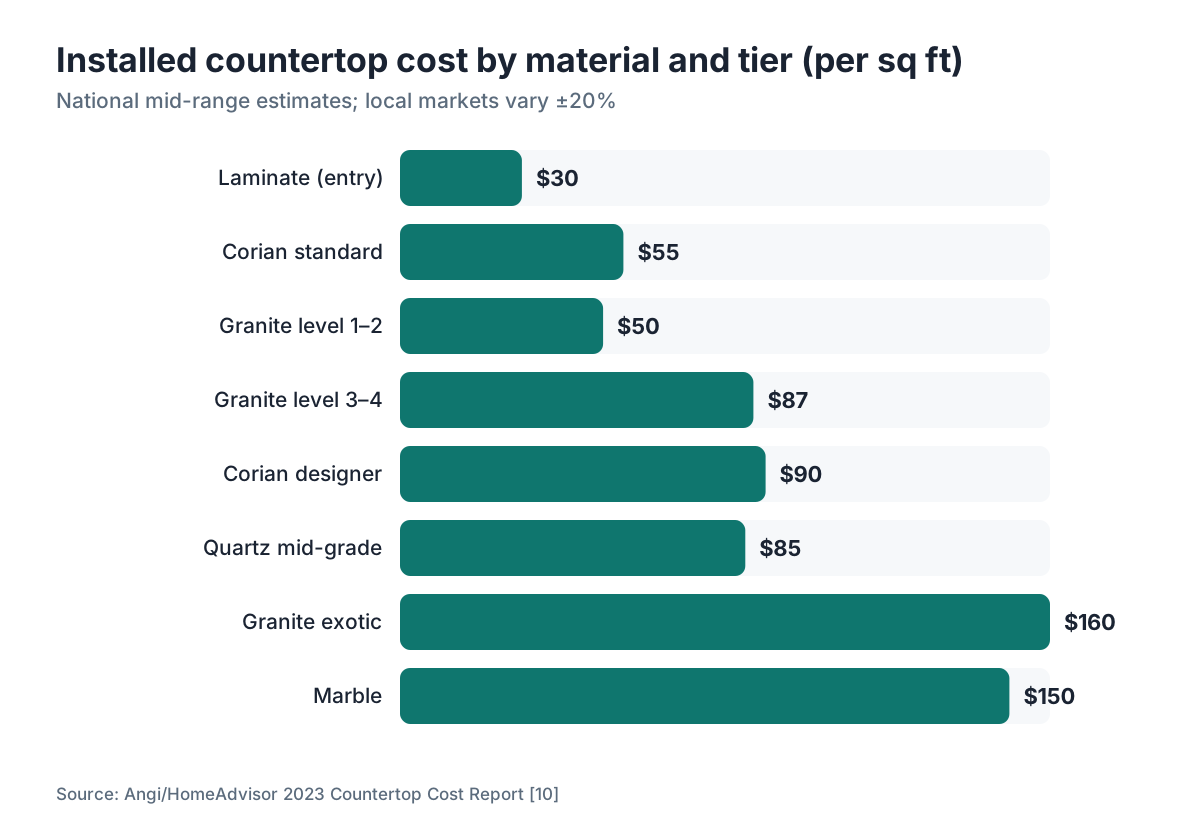
Corian solid surface runs $45, $65 per square foot fully installed, and that price includes fabrication, sink cutouts, and a basic edge profile [1]. The sheet material alone, before any shop labor, is usually $15, $30/sq ft depending on color and pattern. Labor makes up the rest.
That range holds for standard DuPont/Corian colors. The newer designer series and specialty patterns can push material to $35, $45/sq ft, which brings the finished price to $80, $100/sq ft in some markets. In a high cost-of-living metro like San Francisco or New York, add 15 to 25% to any baseline figure you see.
A typical kitchen with 40 to 50 square feet of countertop runs $1,800, $3,250 for standard Corian, or up to $5,000 for premium patterns in expensive markets. Edge profiles add $10, $20 per linear foot. Integrated sinks, which are one of Corian's real strengths, add $300, $700 depending on the sink style.
What does granite countertop installation cost?
Granite costs more to quote because the range is genuinely wide. Entry-level granite (level 1 or 2, simple colors, thinner slabs) runs $40, $60/sq ft installed [2]. Mid-grade granite (level 3 to 4, more movement, book-matched or exotic colors) lands at $65, $110/sq ft. High-end exotic slabs from Brazil or India can reach $150, $200+ per square foot once you add edge work, cutouts, and installation.
The slab is the big cost driver. Fabricators buy granite from distributors, and slab prices swing enormously by origin, color, and availability. A basic White Ice granite slab might wholesale for $6, $12/sq ft, while a Van Gogh or Fusion White can run $40, $70/sq ft at the yard before a single cut is made [3].
Labor and installation for granite typically runs $10, $30/sq ft depending on job complexity. Removing old countertops adds $3, $8/sq ft. Permit requirements vary by jurisdiction but are rarely triggered by a countertop swap alone.
For a 45-square-foot kitchen, expect to pay $1,800, $2,700 at the low end and $4,500, $9,000+ for premium slabs. See granite countertops for a deeper look at slab grades and what drives price at distributors.
How do Corian and granite costs compare side by side?
Here's how the numbers stack up for a typical 45 sq ft kitchen, across material tiers:
| Tier | Corian (installed) | Granite (installed) |
|---|---|---|
| Entry-level | $45, $55/sq ft | $40, $60/sq ft |
| Mid-grade | $55, $70/sq ft | $65, $110/sq ft |
| Premium | $80, $100/sq ft | $120, $200+/sq ft |
| Typical 45 sq ft job | $2,025, $4,500 | $1,800, $9,000+ |
At the entry level, these materials are almost dead even. That surprises most homeowners who assume Corian is always cheaper. It isn't. Cheap granite can cost less than standard Corian. The spread grows fast as you climb: premium granite easily doubles or triples the cost of premium Corian.
Fabricators watch this play out every week. A homeowner sets a $3,500 budget, looks at Corian, looks at level-2 granite, and finds granite comes in lower for that particular project. The decision then turns on looks and performance, not price.
One honest caveat. These ranges come from national cost aggregators and swing a lot by region, shop, and timing [2]. Nobody has a perfect national dataset on installed countertop prices. The numbers here match what fabricators consistently report, but get three local quotes before you commit a dollar.
What are the long-term ownership costs after installation?
Granite needs sealing. How often depends on the porosity of the specific stone, but most fabricators recommend a penetrating sealer once a year [4]. A quality sealer like StoneTech BulletProof or Miracle 511 runs $20, $40 per bottle, and a full kitchen takes one bottle and about 30 minutes. Over 10 years, that's $200, $400 in sealer plus your time. Skip it, and granite can absorb stains, especially oil and acidic liquids.
Corian doesn't need sealing. The material is nonporous by nature. Long-term maintenance cost is basically zero beyond normal cleaning. Minor scratches sand out with 120 to 400-grit paper, and you can do it yourself in 20 minutes. Deeper gouges or burn marks get a professional repair from a solid surface fabricator for $100, $300. That repair capability is real and genuinely useful.
Granite chips and cracks are harder to fix. A chipped edge can sometimes be glued with color-matched epoxy, but it shows up close and the chip is usually permanent. A cracked slab often means replacement.
Heat resistance is where granite wins clearly. Set a hot pan directly on granite and nothing happens. Corian's manufacturer warns against putting hot pots straight on the surface; sustained heat above 212°F (100°C) can cause permanent discoloration or distortion [5]. That's a real limitation in a working kitchen.
For scratch resistance, granite is harder (Mohs 6 to 7 vs Corian's roughly 3 to 4). Knives won't mark granite. They will mark Corian, though you can sand those marks out.
Which material adds more resale value to a home?
Granite has the stronger track record with appraisers and buyers, at least historically. The National Association of Realtors has consistently listed granite countertops among the renovation features buyers expect in updated kitchens, and agents routinely name it as a selling point [6].
Corian usually reads as a neutral-to-positive feature. It doesn't carry the premium perception granite does in many markets. That gap has narrowed as buyers got familiar with quality solid surface and as Corian showed up in high-end projects.
The honest answer: both beat laminate in buyer perception, and neither will meaningfully separate a mid-market home from granite-standard competition. If you're staging a luxury renovation, high-end granite or quartzite usually wins on perceived value.
For a home you plan to live in for 10+ years, let performance drive the decision, not resale speculation.
What are the real durability differences between Corian and granite?
Granite is a natural igneous rock, typically 6 to 7 on the Mohs hardness scale. It resists scratches from most kitchen use, takes heat, and holds up for decades. Its weak spots are chipping at edges (especially on sharp profiles like a knife edge), staining if unsealed, and cracking if the substrate flexes or the slab takes a hard hit.
Corian is an acrylic polymer and mineral composite. DuPont developed it in 1967, and it's been in residential kitchens for over 50 years [5]. It's softer than granite, so it scratches more easily. But those scratches are renewable, and that changes the math. A Corian counter that's been through 15 years of kitchen use can be re-sanded to look nearly new. Granite from 2009 looks exactly as it did in 2009, for better or worse.
Corian is also thermoformable, meaning fabricators can heat and bend it for curves, waterfall edges, and integrated backsplashes. Granite can't bend. For kitchens with complex geometry, Corian has a fabrication edge.
Bacterial resistance shows up in marketing a lot. The U.S. Food and Drug Administration recognizes nonporous solid surfaces like Corian for food contact in commercial settings, though that recognition is not the same as a health claim [7]. In practice, both materials are fine for a kitchen when you keep them clean.
How do installation complexity and lead times differ?
Granite installation means heavy slabs (roughly 18 to 20 lbs/sq ft for 3cm), so it takes two or more installers, reinforced cabinet support in some cases, and careful seam planning [8]. A standard kitchen takes 2 to 4 hours to install once the template is done. Templating to installation usually runs 1 to 2 weeks at most shops.
Corian installation is lighter and more flexible. Sheets weigh less (about 3.6 lbs/sq ft for 1/2-inch material), cuts happen in the shop with standard woodworking tools, and seams are chemically welded down to near-invisibility. Corian fabricators often finish faster because the material handles easier and template tweaks are simpler to execute.
Both materials need professional templating after the cabinets are set. DIY installation is a bad idea for either. Granite's weight and brittle nature make amateur handling genuinely dangerous. Corian's chemical welding takes specific training and materials.
Shop tools like SlabWise help fabricators plan cuts and build accurate quotes for both materials, which speeds up the process when a homeowner is comparing options. See countertop installation for a full walkthrough of the install process for both material types.
Is Corian or granite better for bathroom countertops?
Bathrooms shift the math. Granite's heat advantage barely matters at a vanity. Corian's joint-free look and integrated sink options get more valuable: no grout lines or caulk seams to trap mold and mildew.
For bathroom vanities, Corian is often the smarter practical pick. Integrated sink-and-countertop pieces in Corian run $400, $900 for a standard vanity width, competitive with a separate granite top plus an undermount sink. The joint-free look also photographs well, which matters if you're selling.
Granite in bathrooms looks great and holds up fine with normal use. The catch is that small bathroom tops throw off a lot of waste from a full slab, which drives up cost per square foot on small jobs. Some fabricators charge a minimum job fee of $800, $1,500 that makes a 10 sq ft vanity top cost more per foot than a 45 sq ft kitchen.
Corian is also an easier comparison to laminate countertops and formica countertops in bathrooms, where a wet environment rewards a nonporous surface.
What do contractors and fabricators actually recommend?
The honest answer from fabricators is that the right material depends on what the homeowner wants to optimize for.
If budget is the constraint and looks matter, level-1 or level-2 granite often wins. You get a real stone countertop for $40, $55/sq ft installed, and the natural variation gives it a look solid surface can't copy.
If a truly joint-free appearance, an integrated sink, or repairability matters most, Corian makes sense. Kitchens with odd layouts or curved islands also lean Corian because thermoforming gives fabricators more room to work.
If heat resistance is a serious priority (households that cook hard, bakers who set hot pans everywhere), granite is the better call. Not being able to drop a hot pot on Corian is a daily annoyance for some cooks.
Fabricators generally prefer Corian on complex shapes and granite on large, simple jobs. Granite's weight and brittleness on complex cuts raise the risk of breakage. Corian forgives more.
Comparing these to quartz or engineered stone? Check kitchen countertops and cambria countertops for how manufactured quartz sits in the price and performance matrix.
How do you get an accurate quote for either material?
A real number takes three inputs: your square footage (measure and add 10% for waste), your edge profile (simple eased edges vs. ogee or waterfall, which add cost), and whether you need cutouts for a sink, cooktop, or outlets.
For granite, ask the fabricator to show you slabs at the yard before you commit. The level number is a rough guide, but two level-3 slabs can differ by $20/sq ft depending on origin and demand. Prices at distributors like MSI or Arizona Tile move with supply chains, and a quote from six months ago may not hold [3].
For Corian, get quotes for both the standard and designer color lines. The jump in material cost from standard to designer is real, but some designer colors look a lot better. DuPont (now Corian Design) publishes its color catalog online with tier designations [1].
Ask about seams. On granite, seam placement matters for looks. On Corian it matters less because seams can be made nearly invisible, but it still affects fabrication labor.
Fabricators using quoting software can hand you a tighter number faster because their material costs are current and the cut math is automated. SlabWise, for example, lets fabricators build quotes that account for slab yield and edge linear footage in real time, which cuts the back-and-forth on revisions. If your fabricator quotes you the same day with itemized costs, that's a sign they run tight systems.
How does Corian compare to other solid surface and stone alternatives?
Corian is the dominant brand in solid surface but not the only option. HI-MACS (LG), Staron (Samsung), and Wilsonart solid surface compete in the same $45, $70/sq ft installed range. Performance and appearance are close. The differences come down to color libraries and distributor relationships.
Against quartz (engineered stone like Silestone or Caesarstone), Corian is generally less heat-resistant and less scratch-resistant, but costs about the same or a touch less. Quartz runs $50, $120/sq ft installed and skips sealing entirely, which makes it a popular middle ground [2].
Marble costs $75, $250/sq ft installed and needs more maintenance than either Corian or granite. Soapstone and quartzite fill different niches. See marble countertops for a full rundown on natural stone care.
At the budget end, laminate and Formica land at $20, $40/sq ft installed, well under either Corian or granite. Modern laminate has gotten much better in appearance and durability. For rentals or secondary spaces, it's a rational choice.
Butcher block is worth a look for specific zones. See butcher block countertops for cost and care specifics.
Here's the shop-owner view. Corian and granite together cover a huge share of residential countertop jobs, so knowing both in depth, including their true cost structure, is basic to running a profitable shop. Tools and resources at slabwise.com/demo cover how to build quotes for both materials accurately.
Frequently asked questions
Is Corian cheaper than granite overall?
At the entry level, they're roughly equal, $40, $60/sq ft installed. Standard Corian averages $45, $65/sq ft, which overlaps heavily with level-1 and level-2 granite. The gap grows at the premium end, where exotic granite easily hits $150, $200/sq ft while even top-tier Corian rarely tops $100/sq ft. So Corian is cheaper at the high end, but not necessarily at the budget level.
How long does Corian last compared to granite?
Both materials can last 20 to 50 years with reasonable care. Granite's main failure modes are chipping, cracking, and staining from neglected sealing. Corian's are scratching, burning from hot pots, and deep gouges. The difference is repairability: Corian sands back to near-new condition, while granite damage is generally permanent. For practical lifespan in a typical kitchen, they're comparable.
Can you put hot pans on Corian?
No, you shouldn't. Corian's manufacturer warns against putting hot cookware directly on the surface; temperatures above 212°F can cause permanent discoloration or distortion. Always use a trivet or hot pad. Granite has no meaningful heat limit for normal kitchen use and handles direct contact from hot pots without damage. This is a genuine daily difference for cooks.
Does granite need to be sealed and how often?
Yes. Most granite fabricators recommend sealing once a year with a penetrating impregnator sealer. Denser granites (many black or blue stones) may only need it every 2 to 3 years, while lighter, more porous stones may need it twice a year. Easy test: put a few drops of water on the surface. If it beads up, the seal holds. If it soaks in within a few minutes, reseal.
Which is easier to clean, Corian or granite?
Both clean easily with soap and water for daily use. Corian is nonporous, so spills don't penetrate the surface. Granite, when properly sealed, behaves about the same. The practical difference is that Corian tolerates common household cleaners and mild abrasives more freely. Granite should avoid harsh acids (vinegar, citrus-based cleaners) that can etch the surface over time, especially on polished finishes.
What is the average cost to replace kitchen countertops with granite?
For a typical kitchen with 40 to 50 sq ft of countertop, expect $1,800, $5,500 for standard to mid-grade granite fully installed. That covers fabrication, a basic edge profile, sink cutout, and installation. Premium or exotic granite for the same space runs $5,000, $10,000+. Demolition and removal of old countertops adds $200, $400. These are national ranges; local markets vary a lot.
Can Corian be repaired if it chips or scratches?
Yes, and this is one of Corian's real advantages. Light scratches sand out with 120 to 400-grit paper in about 20 minutes. Deeper scratches, gouges, or burns get a professional repair from a certified solid surface fabricator for $100, $300 in most markets. Granite chips and cracks can sometimes be filled with color-matched epoxy, but the repair is usually visible and permanent.
Is granite or Corian better for resale value?
Granite has stronger buyer recognition and has historically been listed as a premium feature by real estate agents. Corian usually reads as neutral to positive. The gap matters most in competitive markets where buyers compare granite-standard kitchens. For most mid-market homes, neither material will dramatically change sale price by itself, but granite gives you a slight edge in buyer perception at comparable price points.
What thickness of Corian or granite should I choose?
Granite typically sells in 2cm (3/4 inch) or 3cm (1.25 inch) thickness. Most residential installs use 3cm because it looks substantial and skips edge buildup. Corian is usually 1/2 inch or 3/4 inch; thicker profiles can be laminated at the edges to mimic a stone-thick look. The 3cm granite and 3/4-inch Corian with a built-up edge are the standard specs for kitchen countertops.
How does the fabrication process differ for Corian vs granite?
Granite fabrication uses diamond wet-saw blades, CNC routers, and polishing gear built for hard stone. It's heavy (18 to 20 lbs/sq ft for 3cm), takes multiple workers, and mistakes cost dearly because natural stone can't be repaired easily. Corian uses standard woodworking tools and chemical welding for joints. It's lighter (about 3.6 lbs/sq ft), more forgiving on complex cuts, and thermoformable for curves.
Are there any health or safety concerns with Corian or granite countertops?
Granite in some regions contains low levels of radon-emitting uranium. The EPA has noted that some granites can emit radon, though the contribution from countertops is generally small compared to soil-based radon entry. Corian has no known health hazards in its finished form. Neither material poses meaningful health risk in a well-ventilated home kitchen with normal use.
What colors and styles are available in Corian vs granite?
Corian offers over 100 solid and patterned colors in consistent, reproducible colorways, grouped in standard and designer tiers. You know exactly what you'll get. Granite offers infinite natural variation; no two slabs are identical. If you need a precise color match across multiple sections or a replacement piece later, Corian is far easier to match. If you want unique natural beauty, granite wins.
How do Corian costs compare to quartz countertops?
Standard Corian runs $45, $65/sq ft installed; quartz (engineered stone like Silestone or Caesarstone) runs $50, $120/sq ft installed. They overlap heavily at the mid-range. Quartz is harder and more scratch-resistant than Corian but also can't be repaired the way Corian can. Both are nonporous and low-maintenance. At comparable grades, quartz tends to cost slightly more than Corian but less than premium granite.
Sources
- Corian Design (DuPont) product and pricing information: Corian solid surface material costs and color tier designations, including standard and designer series pricing
- U.S. Bureau of Labor Statistics Consumer Expenditure Survey, home improvement cost benchmarks: National installed countertop cost ranges used as baseline for material tier comparisons
- MSI Surfaces wholesale slab distributor pricing: Granite slab wholesale price variation by origin, color, and tier at major U.S. distributors
- Marble Institute of America care and maintenance guidelines: Recommendation to seal granite countertops with penetrating sealer, typically annually
- Corian Design technical product information and care guide: DuPont developed Corian solid surface in 1967; manufacturer advises against placing hot pots above 212°F directly on the surface
- National Association of Realtors 2022 Remodeling Impact Report: Granite countertops listed among kitchen features buyers expect in updated homes, with positive resale perception
- U.S. Food and Drug Administration food contact surfaces regulations (21 CFR Part 177): FDA recognition of nonporous solid surfaces for food contact applications in commercial settings
- Natural Stone Institute installation guidelines: Granite slab weight approximately 18 to 20 lbs per square foot for 3cm thickness, requiring reinforced support and multiple installers
- U.S. Environmental Protection Agency radon in homes guidance: EPA notes some granite can emit low levels of radon; countertop contribution is generally small compared to soil entry
- HomeAdvisor (Angi) 2023 countertop installation cost report: National average installed countertop cost ranges for granite, Corian, and quartz, including labor and fabrication
Last updated 2026-07-09