TL;DR
- A 30-square-foot granite countertop costs roughly $1,200 to $3,300 fully installed, or about $40 to $110 per square foot depending on granite grade, edge profiles, cutouts, and your region.
- Material alone runs $15 to $50 per square foot.
- Labor and fabrication add another $25 to $60 per square foot.
- Entry-level slabs with a simple straight edge sit at the low end.
- Exotic stone with ogee edges and multiple cutouts pushes toward the high end.
What is the total cost for 30 sq ft of granite countertop?
Expect to pay between $1,200 and $3,300 for a fully installed 30-square-foot granite countertop. That range sounds wide. It collapses fast once you nail down three things: the granite grade you want, the number of cutouts (sinks, cooktops), and whether you need a plain flat edge or something fancier like a bullnose or ogee.
The national average for installed granite lands around $50 to $70 per square foot according to HomeAdvisor's cost data, which puts 30 square feet at roughly $1,500 to $2,100 for a mid-grade project [1]. The low end assumes Level 1 granite, one undermount sink cutout, and a basic eased edge. The high end assumes Level 3 or Level 4 exotic stone, two cutouts, and a decorated edge profile.
Buying material only and hiring someone else to install it? Budget $450 to $1,500 for the slab portion alone. Most shops bundle fabrication and installation together, and that adds another $750 to $1,800 for a 30-square-foot job.
What does granite cost per square foot, and how does that scale to 30 sq ft?
Granite gets priced in tiers the industry calls levels, though no universal standard exists for what puts a slab in Level 1 versus Level 4. Each shop sets its own tier definitions. Always ask to see the actual slab before you trust a tier number.
Here's how the per-square-foot math works out at 30 square feet:
| Grade | Material only | Installed (material + fab + install) | 30 sq ft installed total |
|---|---|---|---|
| Level 1 (entry) | $15 to $25/sq ft | $40 to $55/sq ft | $1,200 to $1,650 |
| Level 2 (mid) | $25 to $40/sq ft | $50 to $75/sq ft | $1,500 to $2,250 |
| Level 3 (premium) | $40 to $60/sq ft | $70 to $95/sq ft | $2,100 to $2,850 |
| Level 4+ (exotic) | $60 to $100+/sq ft | $90 to $110+/sq ft | $2,700 to $3,300+ |
These figures line up with the range reported by the National Kitchen and Bath Association in its annual cost survey [2]. Labor and fabrication costs don't scale in step with stone grade, which is why the gap between material cost and installed cost shrinks at the high end.
One thing to watch: fabricators cut from whole slabs. A standard granite slab runs roughly 50 to 70 square feet. For a 30-square-foot job, you'll often pay for around 35 to 38 square feet of material because the shop accounts for waste from cuts and layout. Always confirm whether your quote uses net square footage or gross square footage.
What factors push the price up or down on a small 30 sq ft job?
Several things move the needle on a project this size, and a few of them matter more than the stone grade itself.
Cutouts. Each sink or cooktop cutout typically costs $100 to $250 extra [1]. A 30-square-foot kitchen or bathroom counter might have one undermount sink. A prep island with a cooktop adds another. Two cutouts can add $300 to $500 to the quote without changing a single thing about the stone.
Edge profiles. A basic eased or beveled edge is usually included in the fabrication price. Step up to a bullnose and you might add $10 to $20 per linear foot. An ogee or dupont edge can run $20 to $40 per linear foot [3]. A 30-square-foot counter might have 10 to 15 linear feet of finished edge, so the choice matters.
Thickness. Most residential granite comes in either 3/4-inch (2 cm) or 1.25-inch (3 cm) slabs. The 3 cm material costs more per square foot but skips the plywood substrate, which offsets some of the price difference. Most fabricators now default to 3 cm for kitchens.
Finish. Polished is standard and typically included. A leathered or honed finish costs $5 to $15 per square foot extra because it takes more processing time at the shop.
Region. Granite prices in the Northeast and California run 15 to 30% higher than the national average, largely due to labor costs and shop overhead [1]. In the Southeast and Midwest, you'll often land closer to the low end of every range above.
Sealing. Some fabricators include one sealing application in the install price. Others charge $50 to $150 separately. Ask.
How much of that cost is material versus labor and fabrication?
On a typical 30-square-foot project, the split looks roughly like this: material accounts for 35 to 50% of the total installed cost, while fabrication and installation take the rest.
Fabrication covers the shop work: cutting the slab to your template dimensions, machining the edge profile, cutting sink and cooktop holes, and polishing. Installation covers hauling the finished pieces to your home, removing old counters (sometimes), setting the stone, and doing final seam work and caulking.
For a $2,000 installed job on 30 square feet, you might see $700 to $900 in material, $700 to $900 in fabrication, and $300 to $400 in delivery and install. Fabrication is where shops vary most, and it's the hardest piece to comparison-shop because quotes come bundled.
Work with a fabricator directly rather than through a big-box store and you can sometimes negotiate material and fabrication separately, which shows you where the money actually goes. Big-box retailers like Home Depot and Lowe's typically mark up material 20 to 40% compared to buying direct from a fabricator or stone yard [4].
Is 30 sq ft a lot or a little for a kitchen or bathroom?
Thirty square feet is on the small side for a full kitchen but very common for a bathroom vanity, a small galley kitchen, or a kitchen island. Here's a reference point. A typical U-shaped kitchen runs 50 to 80 square feet of countertop. A standard 24-inch-deep base cabinet with 8 linear feet of run gives you exactly 16 square feet. So 30 square feet covers roughly one wall of a modest kitchen or a decent-sized island.
For bathroom vanities, a double-sink vanity at 60 inches wide and 22 inches deep is about 9 square feet. A 30-square-foot bathroom project usually means a very long double vanity or includes a separate piece for a window seat, tub surround, or shelf.
Your actual square footage matters because fabricators often have a minimum charge, commonly $300 to $500, that applies no matter how small the job is [3]. A 10-square-foot piece might cost nearly as much to fabricate as a 30-square-foot piece once the shop's setup time is factored in.
How does granite compare to other countertop materials at this size?
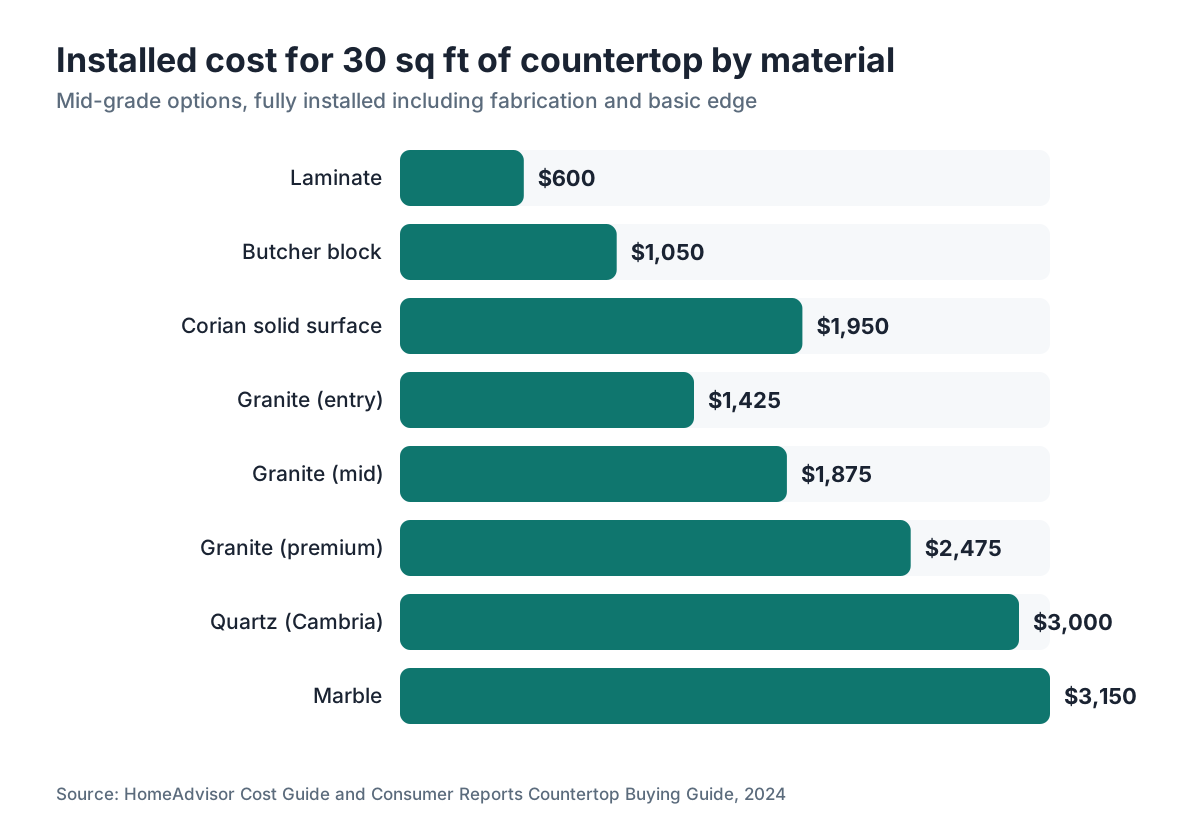
Here's an honest side-by-side for a 30-square-foot project, fully installed, using mid-grade options for each material:
| Material | Installed cost (30 sq ft) | Notes |
|---|---|---|
| Laminate | $300 to $900 | Cheapest option, good durability for the price |
| Butcher block | $600 to $1,500 | Needs oiling, warm look, softer surface |
| Granite | $1,200 to $3,300 | Natural stone, needs periodic sealing |
| Marble | $1,800 to $4,500 | More porous, etches easily, higher maintenance |
| Cambria quartz | $2,100 to $3,900 | No sealing needed, engineered consistency |
| Corian solid surface | $1,200 to $2,700 | Repairable, one continuous surface with no seams, but scratches more easily |
Granite sits comfortably in the middle of the price spectrum. For the money, it gives you a mix of hardness, heat resistance, and resale appeal that's hard to beat in the $1,500 to $2,250 range. Quartz edges it out on maintenance simplicity, but granite beats it on authenticity and, at the entry level, on price.
Tight budget and you still want the stone look? Ask fabricators about remnant slabs. For a 30-square-foot project, a remnant from a larger job might cover your whole layout at a 30 to 50% discount off full-slab pricing.
What does the installation process actually involve for a project this size?
The process for a 30-square-foot granite job typically runs four to six weeks from first contact to finished install, though fast-moving shops with remnant inventory can sometimes do it in under two weeks.
First, a templater comes to your home and creates an exact digital or physical template of your cabinet layout. This visit usually takes 45 to 90 minutes and is either free or costs $50 to $100, sometimes credited toward the job. The template captures every dimension, the sink location, and any odd angles or walls that aren't perfectly square.
Next, the shop programs your cuts using CNC equipment and a bridge saw. For a 30-square-foot job, actual cutting and edge processing takes about two to four hours of machine and labor time. That's why there's often a minimum charge: the setup cost is nearly the same for a small job as a large one.
Installation day involves two or three crew members carrying the finished pieces in and setting them on the cabinets. Granite at 3 cm thickness weighs roughly 18 to 19 pounds per square foot, so 30 square feet is roughly 540 to 570 pounds [5]. The crew uses construction adhesive and, for seams, color-matched epoxy. Seams get polished level. Caulk goes in at the wall and around the sink. The whole install for 30 square feet usually takes two to three hours.
For a fuller look at what installation day involves, see the guide on countertop installation.
How do fabricators actually calculate the price for a job like this?
Most fabricators work from a per-square-foot rate that bundles material, fabrication, and sometimes installation. That rate varies by stone level, and the shop then adds line-item charges for extras: cutouts, edge upgrades, backsplash pieces, and special finishes.
A clean quote for a 30-square-foot job should break out:
- Square footage used (net vs. gross)
- Stone grade and specific slab name or origin if possible
- Edge profile and any upcharge
- Number and type of cutouts
- Delivery and installation fee
- Sealing (included or separate)
- Old counter removal if applicable
If you're a fabricator building quotes at scale, tools like SlabWise can automate the per-square-foot math, track remnants, and produce professional quotes faster than a manual spreadsheet. That matters when you're running 30 to 50 jobs a month and small errors in square-footage calculations pile up.
For homeowners collecting quotes from multiple shops, the most common surprise is the gap between quoted square footage and actual square footage. Ask each shop how they measure and whether they're quoting net or gross. A shop quoting 32 square feet gross for your 30-square-foot layout isn't padding. It's accounting for real waste.
What questions should I ask a fabricator before signing a quote?
Getting three quotes is the standard advice, and it's correct. But three quotes only help if they cover the same scope. Here's what to pin down with each shop:
What slab exactly? Ask for the slab name, origin country, and thickness. "Mid-grade gray granite" means nothing. "Colonial White from Brazil, 3 cm" means something.
Is the quote gross or net square footage? Some shops quote net (your actual layout) and add a waste factor on the invoice. Others build waste into the rate. Either is fine. Just know which you're getting.
What's included in the edge price? Ask specifically which profiles are included at no charge versus which carry an upcharge, and get the upcharge in dollars per linear foot.
Who does the install? Some fabricators subcontract installation. That's not automatically bad, but you want to know who's on the hook if there's a chip or a seam issue after the install.
What's the warranty? Most fabricators warranty their workmanship for one year. Material defects (cracks from hidden fissures in the stone) can be trickier to negotiate.
Can I see the actual slab? Yes. Always. Never approve a job without seeing the specific slab your counter gets cut from. Photos help but don't replace an in-person look, especially for patterned or veined stones.
For care after installation, the guide on how to clean stone countertops covers what granite actually needs day to day.
Are there ways to cut costs on a 30 sq ft granite project without sacrificing quality?
A few strategies actually work. A few are false economies.
Remnant slabs. This is the biggest legitimate savings for a 30-square-foot job. Remnants are leftover cuts from larger projects that fabricators want to move. A remnant large enough to cover 30 square feet might sell at 30 to 50% below full-slab price for stone that's identical in quality. Call local shops and ask what remnants they have in stock.
Simplify the edge. Dropping from an ogee to a plain eased or pencil edge can save $150 to $400 on linear footage. That money is invisible once the counter is in.
Skip the big-box middleman. Pricing from national retailers typically runs 15 to 30% above what a direct fabricator charges for comparable stone [4]. The convenience is real, but so is the markup.
Batch timing. Some shops offer better pricing if you're flexible on the schedule and let them slot your job between larger ones. This works better for non-urgent projects like a bathroom vanity.
Avoid unnecessary thickness upgrades. If you're going 3 cm, you don't need a laminated edge to fake a thicker look. That laminated edge adds fabrication time and cost. Own the clean 1.25-inch profile.
What doesn't save money: buying unfinished stone and hunting for a separate installer. Shops price fabrication and install as a package, and a standalone installer who didn't cut the stone has less accountability if something fits wrong.
Does granite need sealing, and what does that cost over time?
Granite is porous to varying degrees depending on the specific stone. Most residential granite should be sealed at installation and then resealed every one to three years depending on how much cooking and water exposure the surface gets [6].
A DIY sealer like StoneTech BulletProof or Miracle Sealants 511 costs $15 to $40 for a quart, which covers 30 square feet several times over. Professional sealing, if you go that route, runs $50 to $150 for a job this size.
Total sealing cost over 10 years is roughly $50 to $150 DIY, or $500 to $1,500 if you always hire out. Real, but modest against the initial install cost.
Some granites, particularly darker stones and denser varieties like absolute black, need sealing rarely or not at all because they're so dense water can't penetrate meaningfully. Ask your fabricator to run the water test on the specific slab: pour a tablespoon of water on it and see how long it takes to darken the stone. If it doesn't absorb in 30 minutes, sealing is optional.
For day-to-day care, avoid acidic cleaners. Vinegar and lemon juice etch stone over time. A pH-neutral dish soap and warm water is all you need most days.
Frequently asked questions
How much does 30 square feet of granite cost at Home Depot or Lowe's?
Big-box stores typically charge $55 to $80 per square foot installed for mid-grade granite, which puts a 30-square-foot project at $1,650 to $2,400. Their quoted prices include basic installation but often carry 15 to 30% higher material costs than buying direct from a local fabricator. The tradeoff is convenience and a single point of contact for warranty issues.
What is the cheapest granite option for a small 30 sq ft countertop?
Entry-level Level 1 granite, sometimes sold as "standard black" or "uba tuba," runs $40 to $55 per square foot installed, or $1,200 to $1,650 for 30 square feet. A remnant slab from a local fabricator can push that even lower, sometimes to $900 to $1,200 for a simple layout with a basic edge profile and one cutout.
How long does it take to get a 30 sq ft granite countertop installed?
From first contact to installation day, expect three to six weeks at most shops. The timeline breaks into scheduling a template visit (one to two weeks), fabrication after templating (one to two weeks), and scheduling the install (one to two weeks). Shops with remnant inventory or open shop time can sometimes compress this to seven to ten days.
Is 30 sq ft enough granite for a small kitchen?
It depends on the layout. A single straight run of 24-inch-deep cabinets needs about 2 square feet per linear foot of cabinet. Fifteen linear feet of counter equals 30 square feet, which covers a modest galley kitchen or one full wall of a larger kitchen. Many kitchen projects run 50 to 80 square feet total, so 30 square feet usually covers just one section.
Do I pay for more than 30 sq ft even if that's my actual counter size?
Usually yes. Fabricators account for cutting waste, which typically adds 10 to 15% to the square footage you're billed. A 30-square-foot net layout often bills as 33 to 35 square feet. Shops that offer remnants sometimes waive the waste factor if the remnant is large enough to cover your layout with minimal cuts.
Can I install granite countertops myself to save money?
Technically yes, but it's hard at this weight. Granite at 3 cm weighs about 18 to 19 pounds per square foot, so 30 square feet is roughly 550 pounds. You'll need two to three helpers and equipment to carry slabs safely. The bigger risk is cracking during transport or installation. Most fabricators won't warranty stone they didn't install, so DIY installation voids workmanship coverage.
What edge profiles are available for granite and what do they cost?
Basic eased and beveled edges are typically included in the fabrication price. Bullnose adds roughly $10 to $20 per linear foot. Ogee and dupont profiles run $20 to $40 per linear foot. For a 30-square-foot counter with 12 linear feet of finished edge, upgrading from eased to ogee could add $240 to $480. Sticking with a simple profile is one of the easiest ways to keep costs in range.
How do I get an accurate quote for a 30 sq ft granite countertop?
Measure your cabinet run in inches, multiply length by depth, and divide by 144 to get square feet. Sketch the layout including sink location, appliance cutouts, and which edges will be exposed. Send that sketch to at least three local fabricators and ask each to quote the same stone grade, edge profile, and cutout count. Apples-to-apples quotes reveal real price differences.
Does granite increase home resale value enough to justify the cost?
Granite and natural stone countertops consistently rank among the upgrades buyers notice, but the return varies sharply by market. Remodeling Magazine's Cost vs. Value report has historically shown kitchen remodels recouping 60 to 80% of cost on resale, with countertop upgrades contributing to that figure [7]. In high-end markets, granite is almost expected. In starter-home markets, it's a plus but buyers won't pay a 1:1 premium for it.
What is the difference between granite levels or grades?
Granite levels are a pricing convention set by each individual shop, not an industry standard. Shops typically categorize by rarity, visual complexity, and country of origin. Level 1 usually means common colors like Santa Cecilia or Uba Tuba from large production quarries. Level 4 usually means exotic or rare material with heavy veining. Always ask what specifically puts a slab in a given level at that shop.
How much does it cost to remove old countertops before installing granite?
Old counter removal runs $100 to $300 for a 30-square-foot job when done by the fabrication crew. Some shops include it. Others treat it as a separate line item. If you remove the old counters yourself before the template visit, you save that cost and sometimes give the templater a cleaner look at the cabinet tops. Ask your fabricator what they prefer.
What's the difference in cost between granite and quartz for 30 sq ft?
At the mid-grade level, quartz runs $60 to $90 per square foot installed versus $50 to $75 for comparable granite, putting quartz 15 to 25% higher for 30 square feet. The premium buys you a factory-consistent pattern and no sealing requirement. Granite can match or beat quartz on price at the entry level, and some homeowners strongly prefer the natural variation of real stone.
Sources
- HomeAdvisor (Angi), Granite Countertops Cost Guide: National average for installed granite is $50, $70 per square foot; cutouts cost $100, $250 each; regional variation up to 30%
- National Kitchen and Bath Association, NKBA Design Trends and Cost Data: Installed granite pricing tiers and labor cost breakdowns by material grade
- Natural Stone Institute, Natural Stone Installation Guide: Edge profile upcharge ranges and fabricator minimum charges for small jobs
- Consumer Reports, Kitchen Countertop Buying Guide: Big-box retailers mark up countertop materials 15 to 30% compared to fabricator-direct pricing
- Natural Stone Institute, Stone Weight Reference: Granite at 3 cm thickness weighs approximately 18 to 19 pounds per square foot
- University of Minnesota Extension, Choosing and Caring for Stone Countertops: Granite should be sealed at installation and resealed every one to three years depending on porosity and use
- Remodeling Magazine, Cost vs. Value Report: Kitchen remodels historically recoup 60 to 80% of cost on resale; countertop upgrades contribute to that return
- U.S. Bureau of Labor Statistics, Construction and Extraction Occupational Wages: Tile and stone finisher labor wage data used to benchmark regional installation labor cost variation
- U.S. Geological Survey, Dimension Stone Statistics and Information: Granite is the most commonly quarried dimension stone in the U.S.; import pricing from Brazil and India affects domestic slab costs
- U.S. International Trade Commission, Dimension Stone Imports Data: Import volumes and pricing trends for granite slabs from Brazil, India, and China affecting U.S. material costs
Last updated 2026-07-09