TL;DR
- Fake marble countertops include quartz, laminate, porcelain slab, sintered stone, and solid surface.
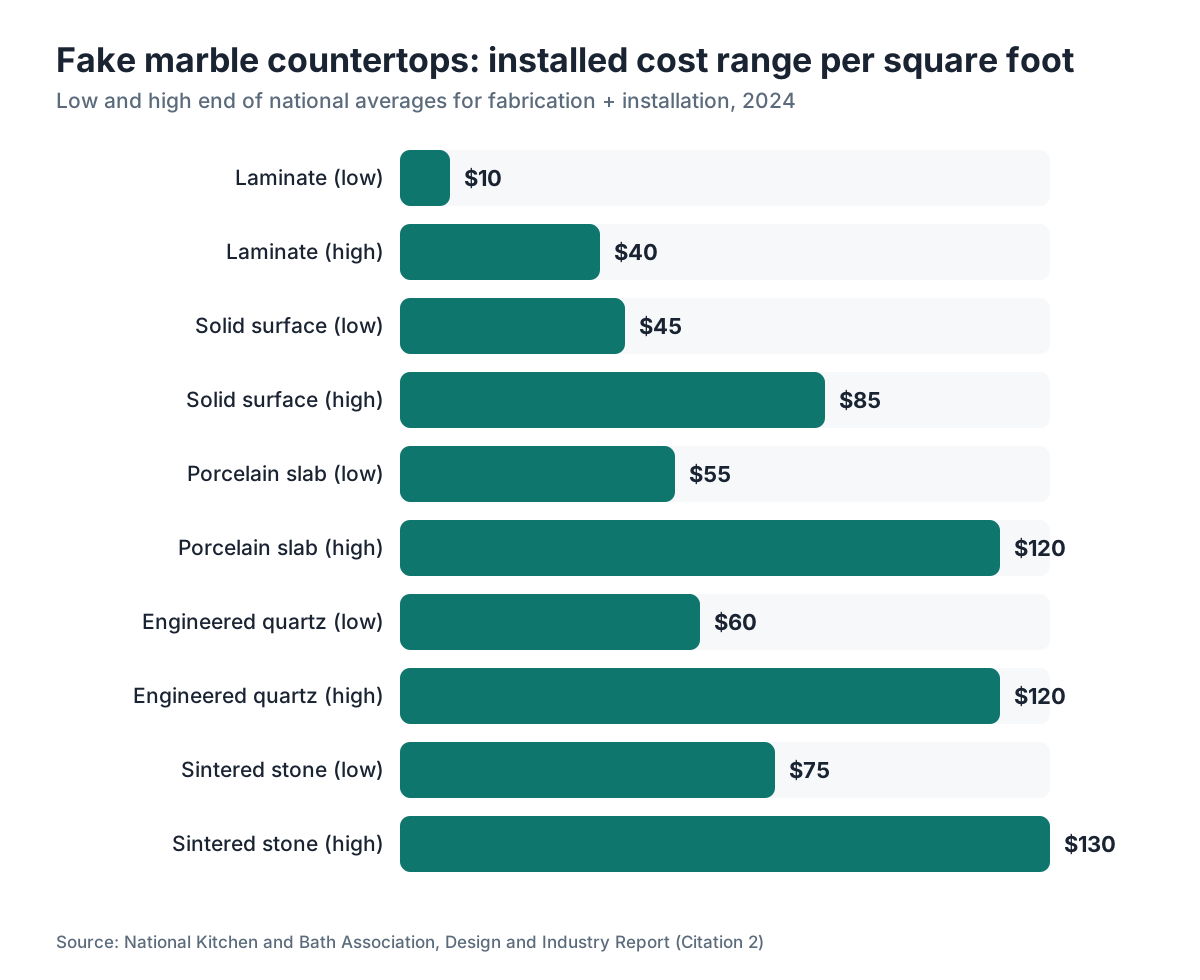
- Prices run from about $10 per square foot installed for laminate to $130 per square foot installed for high-end sintered stone.
- None need sealing, and all resist staining better than real marble.
- The right pick depends on your budget, how hard you cook, and how close you want the look.
What counts as a "fake marble" countertop?
A fake marble countertop is any surface engineered to mimic marble's veined, white-and-gray look without being quarried stone. The term gets thrown around loosely, so let's set the scope. Five categories fit: engineered quartz, high-pressure laminate, large-format porcelain slabs, sintered stone (sold under names like Dekton and Neolith), and solid surface materials like Corian.
Real marble countertops are calcium carbonate. That single fact explains marble's whole personality. It etches the second acid touches it, it scratches easily, and it needs sealing to keep liquids from soaking in. Every fake marble trades away some of that sensitivity for durability. How much you gain depends entirely on which category you pick.
These are not niche products. The engineered stone market was worth roughly $16.5 billion globally in 2023 and is projected to grow about 5.5 percent a year through 2030, driven largely by people who want the marble look without the marble babysitting [1]. That kind of demand is why the patterns have gotten so much better over the last decade.
What are the main types of fake marble countertops?
Each category has its own manufacturing method, feel, and weak spot. Here is the straight comparison.
| Material | How it's made | Typical installed cost (per sq ft) | Heat resistance | Acid/etch resistance | Needs sealing? |
|---|---|---|---|---|---|
| Engineered quartz | 90-93% crushed quartz + polymer resin, pressed | $60-$120 | Poor (resin burns >150°F) | Excellent | No |
| High-pressure laminate | Paper layers + photographic print + resin | $10-$40 | Poor | Good | No |
| Porcelain slab | Fired clay at very high temp | $55-$120 | Excellent | Excellent | No |
| Sintered stone | Minerals + heat + extreme pressure, no resin | $75-$130 | Excellent | Excellent | No |
| Solid surface (e.g., Corian) | Acrylic or polyester resin + mineral filler | $45-$85 | Poor | Good | No |
Those costs are U.S. national averages for fabrication and installation. Raw slab prices and regional labor can move the numbers 20 to 30 percent in either direction [2].
Engineered quartz is the most popular by a wide margin. Lines like Calacatta Gold from Caesarstone or Cambria's Brittanicca press vein patterns into the surface with realism that keeps improving. The catch is the polymer resin binder. Hot pans can discolor or crack it, and years of direct sun can yellow it.
High-pressure laminate is the oldest look-alike. Formica has printed marble patterns since the 1950s. Modern digital printing makes the reproduction convincing from a few feet away. The substrate is particleboard or MDF, so edges need post-forming or banding, and moisture in a seam or chip swells the core over time. For a rental or a tight budget, nothing beats it at $10 to $40 installed [2].
Porcelain slabs are fired above 1200 degrees Celsius, which makes a surface harder than granite and basically immune to acid, heat, and stains [3]. Fabrication is the problem. Porcelain chips at the edges during cutting and drilling, it demands diamond tooling and steady hands, and plenty of shops don't touch it. Expect to pay a premium for one that does it regularly.
Sintered stone products like Dekton and Neolith go a step further, bonding minerals under heat and pressure with no polymer resin at all. The result is extremely dense, close to zero porosity, and rated for outdoor use in most manufacturer specs [11]. These are the most convincing large-format marble looks you can buy. They're also the priciest.
Solid surface materials like Corian countertops are poured or thermoformed, so seams bond invisibly and the material wraps around curves. Scratches sand right out. The marble patterns have improved, but solid surface still reads a little artificial up close because it lacks the translucency of real veining.
How much do fake marble countertops cost installed?
Material and labor together are the number that matters for budgeting. Here are realistic totals for a 40-square-foot kitchen, roughly the average countertop footprint in a moderate-sized U.S. kitchen [2].
Laminate at $10 to $40 installed puts the total at $400 to $1,600. That is a real number, not a floor-sample outlier.
Quartz at $60 to $120 installed lands the same kitchen at $2,400 to $4,800. Premium slabs with wide veining can push materials alone past $5,000 in a larger kitchen.
Porcelain slab at $55 to $120 runs $2,200 to $4,800, close to quartz but with higher fabrication labor if your shop charges a porcelain premium.
Sintered stone at $75 to $130 runs $3,000 to $5,200, more if you want continuous veining matched across several pieces.
Solid surface at $45 to $85 runs $1,800 to $3,400, and the invisible seams are worth real money in a complicated layout.
These estimates line up with pricing tracked by the National Kitchen and Bath Association in its annual design survey [2]. Regional swing is large. A fabricator in Manhattan charges roughly 40 to 60 percent more in labor than one in rural Tennessee.
Want a fast estimate from your actual measurements? Fabricators using tools like SlabWise can build a detailed quote from a digital template instead of a rough square-footage guess, which tends to price oddly shaped kitchens more accurately.
Edge profiles are the cost factor people forget. A basic eased edge usually comes with the quoted price. An ogee or waterfall edge on a sintered stone island adds $15 to $40 per linear foot. On a 10-foot island with three exposed edges, that gets expensive fast.
Which fake marble option looks most like the real thing?
This is the question everyone actually cares about. The honest ranking: sintered stone first, high-end quartz right behind it, then porcelain, then solid surface, then standard laminate.
Sintered stone makers like Cosentino (Dekton) pour money into digital printing that maps vein patterns across full 126-by-63-inch slabs, with color variation that copies how marble actually forms. A well-matched Dekton install with continuous veining running down a waterfall island is hard to tell from Calacatta marble unless you touch it and know what to feel for.
High-end quartz from brands like Cambria countertops has closed most of the visual gap. The Brittanicca Warm and Brittanicca Gold lines mix real mineral particles with printed backgrounds to build some depth. Where quartz still loses is repetition. Its veins run more uniform and repeat across the slab, while real marble is completely random.
Porcelain printed with digital inkjet can look stunning, but the surface is very smooth and slightly reflective, so it can read flatter than the crystalline face of real marble if you know the tell.
Laminate has come a long way, though the seams at corners and the hollow sound when you knock on it give it away. On a 24-inch bathroom vanity, modern laminate is surprisingly convincing. On a 10-foot island, less so.
One thing no fake marble copies yet is marble's slight translucency, the way a backlit slab seems to glow. No engineered product does that.
How do fake marble countertops hold up to daily use?
Real marble etches when lemon juice, vinegar, wine, or coffee sits on it, even for a minute. That is a chemical reaction with calcium carbonate, and no sealer stops it for good. Every fake marble here is either acid-resistant or far more resistant than stone.
Quartz's resin binder shrugs off most household acids. Testing summarized by the Marble Institute of America (now part of the Natural Stone Institute) finds engineered quartz is much more stain-resistant than natural marble under normal kitchen use [5]. Its weak spot is heat. Resin softens and can discolor permanently under a hot pan. Use trivets. That is not optional.
Porcelain and sintered stone lead on durability. The ASTM C373 water absorption test, the standard for ceramic and porcelain, measures porcelain below 0.5 percent absorption [3]. At that number, stains basically cannot penetrate. You can set a hot pan on Dekton or Neolith without a mark, per both manufacturers' specs [11].
Laminate scratches and chips. Once a chip exposes the MDF core to water, the swelling starts and there is no fixing it without replacing the section. For a laundry folding counter or a basement bar, laminate is fine. For a kitchen with heavy daily cooking, the edge and chip risk is real.
Solid surface scratches too, but the scratches sand out with fine-grit paper or a pro refinish, which no other material here can claim. It is not heat-resistant, though, and pan burns leave marks that often need sanding to clear.
Bathrooms are gentler on all of these. Less heat, less acid, less impact means even laminate holds up for years.
Is engineered quartz better than real marble for kitchens?
For most people who cook regularly, yes. This is not close.
Unsealed marble soaks up red wine, olive oil, and tomato juice within minutes. Even sealed marble stays vulnerable, because sealers wear off and because etching has nothing to do with porosity. The acid reaction happens right at the surface whether the stone is sealed or not.
Engineered quartz does not etch. It does not need sealing. Red wine or lemon juice you wipe up in the morning looks the same as if you had caught it right away. In a kitchen used every day, that is a real difference you feel.
Real marble still wins in a few cases: a baking station, where the cool hard surface helps with dough; a bathroom, where heat and acid barely register; or a homeowner who loves the idea of a living surface that patinas over time and accepts the upkeep with clear eyes.
For everyone else, quartz or sintered stone gives you 90 percent of the look for a fraction of the fuss. That is why quartz now substantially outsells marble in new U.S. kitchen installs [1].
See also: kitchen countertops for a full comparison across every material, marble looks and beyond.
How does fake marble compare to other popular countertop materials?
Marble-look is one aesthetic, but not every kitchen wants white stone. A few comparisons earn their keep.
Granite countertops are natural stone, but much harder and more acid-resistant than marble. Granite does not etch from household acids. Prices overlap quartz at $55 to $110 installed. Want natural stone that survives a busy kitchen? Granite beats marble there.
Laminate countertops in non-marble patterns (butcher block look, concrete look, solid color) often cost less than marble-patterned laminate and can photograph better in a modern or industrial kitchen. The material limits stay the same no matter the print.
Butcher block countertops are a whole different look, worth naming because they sit in the same price band as laminate ($40 to $100 installed) and handle knife work like nothing stone can.
Formica countertops, a brand of high-pressure laminate, deserve their own look if price drives the decision. Formica's Calacatta Marble in the 180fx line is one of the most realistic laminate marble looks around and costs a sliver of quartz.
If care and longevity matter to you, the guides on how to clean stone countertops and how to clean quartzite countertops cover practical maintenance for the natural stone alternatives.
What are the best brands making fake marble countertops?
Brand matters more here than in natural stone, because printing technology, resin formula, and slab consistency swing hard between makers.
Quartz: Caesarstone (Israeli, widely distributed in the U.S.) has a deep marble-look catalog and a long record for consistency. Cambria (American-made, Minnesota) carries a lifetime warranty and genuinely good vein depth. Silestone (from Cosentino, Spanish parent) added a surface treatment called N-Boost that the company says improves stain resistance [4]. MSI and Vicostone offer lower-price quartz that works fine, though the vein realism is shallower.
Sintered stone: Dekton (also Cosentino) and Neolith are the two main players, both with marble-look collections. Laminam (Italian) is a third, thinner at 3 to 5mm, used more for wall cladding but available for counters.
Porcelain slabs: Atlas Plan, Fiandre, and Florim are Italian makers whose large-format porcelain moves through U.S. tile distributors. The quality is high; the fabrication difficulty is real.
Laminate: Formica and Wilsonart dominate the U.S. market. Both make convincing marble patterns. Formica 180fx uses printed replication of actual stone surface texture, which adds a tactile edge flat laminate lacks.
Solid surface: Corian (DuPont, now Trinseo) is still the leader. HI-MACS (LG) is a close competitor at similar prices.
A note for fabricators: sintered stone and large-format porcelain need different blade speeds and wet-cutting setups than quartz or granite. Shops quoting these jobs have to account for tooling wear and the slower pace. Quoting software that tracks material-specific labor rates keeps margin surprises off these jobs.
Can you use fake marble countertops in bathrooms?
Yes, and bathrooms may be the best use of all. The abuse level is lower: less heat, less acid, fewer heavy impacts. Almost every fake marble performs well there.
Laminate is a reasonable bathroom pick as long as seams stay sealed and away from the sink cutout. Moisture at a poorly sealed sink edge is the main way it fails. A good installer using waterproof adhesive and sealing the sink perimeter carefully gets many years out of a laminate vanity.
Solid surface suits bathrooms especially well because it thermoforms into an integrated sink, killing the seam at the sink rim entirely. That seam is where most water damage starts, so losing it stretches the lifespan a lot.
For a master bath built to look high-end, a sintered stone or quartz vanity top in a marble pattern is indistinguishable from real Carrara at the scale of a typical 24 to 60 inch vanity.
One thing to check: some laminate is not rated for full wet environments. Look for a Type I waterproof adhesive core if the vanity sees regular splash or high humidity.
What are the downsides of fake marble countertops nobody talks about?
Most articles in this space read like brochures. Here are the real limits.
Quartz is heavy, usually 20 to 25 pounds per square foot, and the resin that makes it tough also makes it unrepairable if it cracks. A crack in granite can often be filled and stabilized. A crack in quartz is a permanent defect that means replacing the piece. Heat damage from one forgotten pan leaves a white haze with no refinishing option.
Sintered stone's hardness cuts both ways for edge repair. If a corner chips (which happens during install or from a hard impact), filling it invisibly is very tough. The material is so dense that most repair compounds won't adhere or color-match.
Porcelain's fabrication difficulty means fewer shops do it well. Handing an unfamiliar shop a large-format porcelain job is a gamble. Chips at sink cutouts and cooktop holes are common when technique isn't dialed in.
Laminate's floor is its ceiling. It will never look as premium as quartz or porcelain to an educated eye, and at resale, buyers who know materials will spot it.
Solid surface shows scratches more than the stone-category materials. Near a cooktop or under prep work, it wears faster than quartz. The repairability helps, but you sand more often than with harder surfaces.
One more, and it is a fabricator issue, not a homeowner one. Some engineered quartz has drawn occupational health scrutiny over silica dust during cutting. OSHA sets a permissible exposure limit of 50 micrograms per cubic meter for respirable crystalline silica as an 8-hour average [6], and dry-cutting engineered stone can blow well past that without wet cutting and ventilation. This is a shop-safety matter, not a risk once the counter is installed, though it has pushed some countries to restrict engineered quartz fabrication.
How do I choose the right fake marble for my kitchen or bathroom?
A few questions narrow this fast.
What is your budget? If installed cost has to stay under $25 per square foot, the answer is laminate and only laminate. Nothing else gets near it.
How hard do you cook? If you regularly set pots straight on the counter, slide skillets off the stove, or bake with sheet pans, quartz is risky and you want porcelain or sintered stone. If you cook lightly and mind the heat, quartz is fine.
How much do seams bother you? Complex layouts show seams in quartz, porcelain, and sintered stone. Solid surface hides them better. If your design has a tight curve, a radius, or an integrated sink, solid surface is the most flexible material there is.
How long will you stay? For a 2 to 3 year flip or rental, laminate or entry-level quartz is the rational money move. For a 20-year home, the gap between laminate and mid-grade quartz ($800 to $2,000 on a typical kitchen) is small next to the durability you get.
What does the rest of the room look like? White marble looks pair beautifully with white or gray cabinets, warm wood, and brass or matte black hardware. Against dark cabinetry, the contrast can be striking. Against a busy backsplash or patterned tile, they fight. If your kitchen already carries a lot of texture, a restrained vein pattern beats the dramatic thick-vein Calacatta look.
For fabricators quoting these materials, the countertop installation guide walks the process from template to install for each type.
How do you maintain and clean fake marble countertops?
Easy upkeep is one of fake marble's best arguments. No sealing, no annual ritual, and most cleaning is soap and water.
For quartz, Caesarstone's care guide recommends mild dish soap and water for daily cleaning, and diluted isopropyl alcohol (up to 70 percent) for tougher stains [8]. Skip abrasive pads, full-strength bleach, and oven cleaner, all of which can wreck the resin surface.
For sintered stone and porcelain, the surfaces are basically inert, so your cleaning latitude is wide. Acetone, diluted bleach, even steam cleaners are generally safe. Dekton's guide specifically allows common household disinfectants [4].
For laminate, the same mild soap and water rule holds. The risk lives in the seams and edges. Standing water at a seam eventually gets in, so wipe up puddles around the sink quickly.
For solid surface, the one rule to take seriously: no abrasive cleaners, since they scratch the glossy areas permanently even though those scratches can later be sanded. Any general-purpose non-abrasive cleaner handles everyday work.
None of these need sealing. Ever. That is a categorical break from real marble, quartzite, limestone, and many granites. If a contractor tells you your quartz or laminate needs sealing, that is either a misunderstanding or an upsell.
Frequently asked questions
Is fake marble cheaper than real marble?
Almost always yes. Real Carrara marble installed runs roughly $75 to $150 per square foot. Marble-look engineered quartz costs $60 to $120 installed, laminate runs $10 to $40, and even sintered stone tops out around $130. Laminate and solid surface are far cheaper than any natural marble. High-end sintered stone can approach marble's price but still outperforms it on durability.
Can you tell fake marble from real marble?
Up close, yes. Real marble has random, continuous veining, slight translucency, and a cool, slightly soft feel. Engineered quartz is harder, more uniform, and has no translucency. Sintered stone and porcelain fool most people visually but feel harder and sound different when tapped. Laminate gives itself away at edges and seams. From across a room, high-end quartz and sintered stone are genuinely convincing.
Does fake marble scratch easily?
Depends on the material. Sintered stone and porcelain are harder than granite and scratch only with diamond-hard abrasives. Quartz scratches from ceramics and metal dragged hard. Solid surface scratches with regular use, but those scratches sand out. Laminate scratches from knives and keys. In practice, quartz in a kitchen shows almost no visible scratching under normal use, one reason it outsells everything else.
Does fake marble need to be sealed?
No. None of them, quartz, laminate, porcelain, sintered stone, or solid surface, need sealing. They are either non-porous by nature (porcelain, sintered stone) or carry a binder or surface layer that blocks liquid (quartz resin, laminate melamine). That is a big maintenance edge over real marble, quartzite, and many granites, which need sealing every one to four years.
What is the most durable fake marble countertop?
Sintered stone (Dekton, Neolith) and large-format porcelain lead on durability. Both are rated for heat resistance, UV stability for outdoor use, and near-zero porosity. They do not etch, stain, or need sealing. The trade-off is higher cost ($75 to $130 installed per square foot) and the need for an experienced fabricator, since both can chip during cutting if technique is poor.
What is the cheapest fake marble countertop option?
High-pressure laminate in a marble pattern is the cheapest by a large margin, at $10 to $40 installed per square foot. Formica's 180fx Calacatta Marble and Wilsonart's equivalents are widely available and use digital printing for convincing visuals from a few feet away. Laminate suits lower-traffic areas, rentals, or tight budgets where the durability trade-offs are acceptable.
Can fake marble countertops be repaired if they chip or crack?
Solid surface (Corian) is the most repairable: chips and scratches sand and buff out. Quartz chips can be filled with color-matched epoxy with moderate success, but cracks usually mean section replacement. Sintered stone and porcelain chips are very hard to fill invisibly because of the density. Laminate chips cannot be meaningfully repaired; the section gets replaced. For high-traffic areas, this repairability gap matters.
Is quartz the same as fake marble?
Not exactly. Quartz (engineered stone) is made from roughly 90 to 93 percent crushed quartz crystals bound with polymer resin. Marble-look quartz copies marble's appearance, but the underlying material is completely different: harder than marble, non-porous, and acid-resistant. So quartz is one kind of fake marble when it comes in marble-look patterns, but it also comes in concrete, stone, and solid-color patterns that have nothing to do with marble.
Do fake marble countertops add value to a home?
Quartz, porcelain, and sintered stone in good shape typically hold or add resale value versus worn or damaged natural stone. Exact ROI is hard to pin down, but Remodeling Magazine's Cost vs. Value report consistently shows kitchen countertop upgrades (usually to stone or stone-look surfaces) recovering 60 to 80 percent of their cost at sale [10]. Laminate adds less than stone-look materials, but its low cost keeps the ROI math working.
Are there environmental concerns with fake marble countertops?
Engineered quartz contains petrochemical-based polymer resin, which makes it non-recyclable at end of life. Sintered stone and porcelain are mineral-based and more inert. Laminate uses formaldehyde-based resins, though products sold in the U.S. must meet CARB Phase 2 limits on formaldehyde emissions from composite wood [9]. If sustainability is a priority, sintered stone and porcelain have a cleaner lifecycle profile than resin-bound quartz or laminate.
Can you put a hot pan on fake marble countertops?
Only on sintered stone and porcelain. Quartz, solid surface, and laminate all use organic binders or surface layers that can discolor, warp, or crack under direct heat above roughly 150 degrees Fahrenheit. Both Dekton and Neolith rate their surfaces as heat-resistant in manufacturer specs. For quartz, laminate, and solid surface, use trivets. This is the most common and most expensive mistake people make with quartz.
What is sintered stone and is it better than quartz for a marble look?
Sintered stone is made by pressing and heating mineral particles under extreme pressure with no polymer resin. Brands include Dekton (Cosentino) and Neolith. It is denser and harder than quartz, heat-resistant, UV-stable for outdoor use, and rated for near-zero water absorption. Its marble-look patterns are among the most realistic sold. The downsides are cost ($75 to $130 installed) and the need for a fabricator experienced with the material.
How long do fake marble countertops last?
Quartz, sintered stone, and porcelain last 20-plus years with normal use. Most quartz brands offer lifetime residential warranties on the material, though coverage for heat damage or improper care varies by brand. Solid surface usually carries a 10-year warranty. Laminate is typically warranted 5 to 10 years, though a well-installed laminate counter in a low-traffic bathroom can last 20 years without trouble.
What is the most realistic-looking fake marble countertop available right now?
As of 2025, high-end sintered stone (Dekton Arga, Dekton Kreta, or Neolith Calacatta Gold) and premium large-format porcelain from Italian makers like Atlas Plan offer the most convincing marble replications. The best quartz patterns from Cambria and Caesarstone are close behind. The gap between these products and real marble has narrowed a lot since 2018, thanks to advances in digital printing and particle-mapping in manufacturing.
Sources
- Grand View Research, Engineered Stone Market Size Report 2023: Engineered stone market valued at roughly $16.5 billion globally in 2023, projected 5.5% annual growth through 2030
- National Kitchen and Bath Association, Design and Industry Report: National average installed countertop pricing ranges and 40 sq ft typical kitchen countertop footprint
- ASTM International, ASTM C373 Standard Test Method for Water Absorption of Ceramic Tile: Porcelain tile water absorption less than 0.5% per ASTM C373 standard
- Cosentino (Dekton/Silestone), Product Technical Specifications: Dekton permits common household disinfectants; Silestone N-Boost surface treatment improves stain resistance
- Natural Stone Institute (formerly Marble Institute of America), Technical Resources: Engineered quartz is significantly more stain-resistant than natural marble under typical kitchen conditions
- U.S. Occupational Safety and Health Administration, Crystalline Silica page (29 CFR 1910.1053): OSHA permissible exposure limit for respirable crystalline silica is 50 micrograms per cubic meter as an 8-hour TWA
- Caesarstone USA, Care and Maintenance Guide: Caesarstone recommends mild dish soap and water for daily cleaning and up to 70% isopropyl alcohol for tough stains
- California Air Resources Board, Composite Wood Products Program (CARB Phase 2): Composite wood products including laminate substrates must meet CARB Phase 2 formaldehyde emission limits for U.S. sale
- Remodeling Magazine, Cost vs. Value Report: Kitchen countertop upgrades to stone or stone-look materials recover 60-80% of cost at resale per annual survey
- Neolith by TheSize, Technical Data Sheet: Neolith sintered stone rated for heat resistance, UV stability, and outdoor use with essentially zero water absorption
Last updated 2026-07-09