TL;DR
- Carrara marble countertops run $40 to $100 per square foot installed, depending on slab grade and edge profile.
- The stone is softer and more porous than granite or quartzite, so it etches from acids and needs sealing every 6 to 12 months.
- It's a beautiful material with real trade-offs.
- Some owners live with the patina happily.
- Others regret the purchase.
What is Carrara marble and where does it come from?
Carrara marble is a white to blue-gray metamorphic limestone quarried in the Apuan Alps near Carrara, Italy. The city has shipped this stone for more than 2,000 years. Michelangelo carved his David from it. The look most people picture is a white or pale gray ground crossed by soft, feathery gray veining that runs in a fairly consistent direction. [1]
Not all white Italian marble is Carrara. Three names dominate the slab yard: Carrara, Calacatta, and Statuario. Carrara is the most common and the cheapest of the three. Calacatta comes from a different part of the same mountain range and has bolder, more dramatic veining on a brighter white background. Statuario is rarer still, with thick gray veins over a warm white ground. If a supplier calls something "Carrara" but the veining is thick and bold, ask to see the country-of-origin paperwork. Mislabeling happens.
The stone is almost pure calcite, which is why it's softer than granite or quartzite. On the Mohs hardness scale, calcite sits at 3, quartz at 7, and the minerals in granite range from 6 to 7. [2] That softness drives every maintenance concern below.
How much do Carrara marble countertops cost?
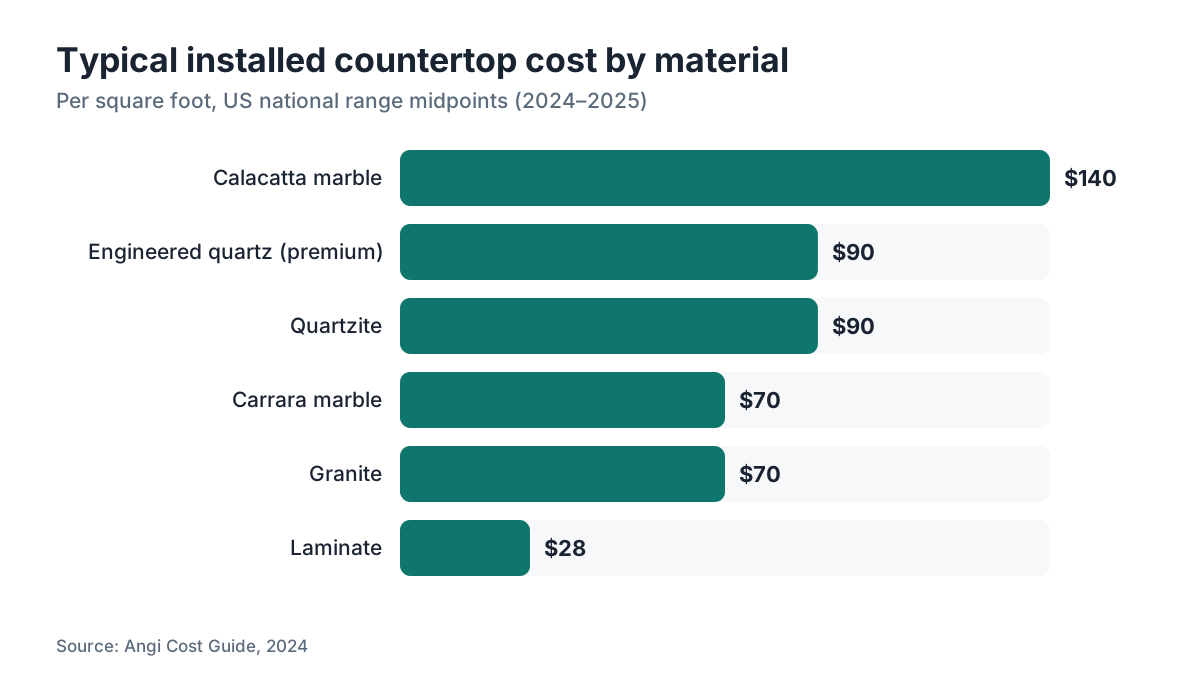
Installed Carrara marble countertops run $40 to $100 per square foot, with the national midpoint around $60 to $75 for a standard commercial-grade slab with a simple edge. That number is material plus fabrication (cutting, polishing edges, cutouts for sinks and cooktops) plus install labor. [3]
Grade moves the needle hard. Commercial-grade Carrara, sometimes called CD-grade, shows more color variation and visible filler repairs, and it sits at the bottom of the price band. Premium A-grade slabs are whiter and more uniform, and they can push past $100 per square foot installed in high-cost metros.
Here's how the main cost drivers stack up:
| Cost Driver | Typical Range | Notes |
|---|---|---|
| Slab material (supply only) | $10 to $40/sq ft | Grade, vein pattern, source country |
| Fabrication | $20 to $35/sq ft | Edges, cutouts, polishing |
| Installation | $10 to $20/sq ft | Complexity, layout, travel |
| Sealer (first application) | $1 to $3/sq ft | Often included by fabricator |
| Total installed | $40 to $100/sq ft | US average; higher in coastal metros |
Compare that to granite countertops, which also run $40 to $100 per square foot installed but are harder and shrug off acid. Or laminate countertops, which run $15 to $40 installed with none of the upkeep. Carrara sits mid-range for natural stone. You're paying for how it looks and the weight of its history, not because it's the toughest material at that price.
Want a fast estimate before you talk to a fabricator? A countertop quoting tool can ballpark your square footage in minutes. SlabWise has a free instant quote calculator homeowners use to sanity-check fabricator bids.
One number surprises people every time: fabricators usually charge for the full slab rectangle, not the net countertop area. Cutouts for sinks and cooktops remove stone but rarely lower the price, because the off-cuts go to waste. Ask how your fabricator calculates square footage before you sign anything.
Does Carrara marble etch, and how bad is it really?
Yes, and this is the one thing to understand before you buy. Etching is a chemical reaction, not a stain. When an acid touches calcite, it dissolves a thin layer of the surface and leaves a dull spot that reads like a water mark or a faint scratch. The acid doesn't have to be strong. Lemon juice, tomato sauce, vinegar, coffee, wine, and most common cleaning sprays will etch polished marble on contact if they sit more than a few seconds. [4]
How much it shows depends on the finish. Polished marble reveals etches clearly because the dull spot fights the shine. Honed marble (a matte finish) hides etches far better because there's less contrast between the etched spot and the surface around it. Plenty of kitchen designers push honed Carrara for exactly this reason. The trade-off: honed shows fingerprints and water more.
Habits cut the risk. Wipe spills fast. Use cutting boards. Slide a trivet under the citrus bowl. Keep vinegar-based cleaners off the stone. But you can't erase the risk in a working kitchen. Some people live happily with etched Carrara and treat the patina as character. Others find it maddening. Be honest about which camp you're in before you spend the money.
Etching is not staining. Stains are liquids soaking into the pores, which sealing helps prevent. Etching is surface mineral damage, and no sealer stops it. That distinction trips up a lot of buyers.
How often does Carrara marble need to be sealed?
Seal Carrara marble every 6 to 12 months in a kitchen, and every 12 to 18 months in a bathroom or low-traffic spot. [5] The stone is porous enough that an unsealed surface soaks up oil, wine, and colored liquids and turns them into permanent stains.
The test takes ten minutes. Put a few drops of water on the surface and wait. If the stone darkens under the droplet, it's drinking the liquid and needs sealer. If the water beads, the existing seal still works.
Buy a penetrating (impregnating) sealer, not a topical coating. Penetrating sealers soak into the pores and leave the look alone. Topical coatings sit on top, peel over time, and read as plastic. Tenax, Miracle Sealants, and Prosoco all make penetrating stone sealers the trade uses widely, though I won't push one specific product since performance shifts with stone porosity.
Sealing is an easy DIY job. Wipe it on with a clean cloth, let it dwell for the time on the label, then wipe the excess before it hazes. A standard kitchen takes under 30 minutes. Sealer costs $20 to $60 a bottle, and one bottle usually covers 100 to 200 square feet.
What finishes are available for Carrara marble countertops?
For countertops, the real choice is polished versus honed. A few shops offer leathered or brushed finishes on marble, but they're uncommon and not every fabricator has the tooling.
Polished has a high-gloss, mirror-like surface built up through progressively finer abrasive grinding. It makes the veining and color depth pop. It shows etches more, shows fingerprints less than honed, and wipes clean of oily residue easily.
Honed is ground to a smooth matte surface. The color reads softer and more muted. Etches nearly disappear because the finish is already flat. The catch is that honed shows oily fingerprints and food smudges faster than polished.
Leathered has a light texture, close to the feel of paper. It hides fingerprints well and looks less formal. Not all marble leathers cleanly, and Carrara's soft calcite means you should ask the fabricator whether they can promise a consistent result before you commit.
For a busy kitchen, honed is the smarter call. For a bathroom vanity or a lightly used island, polished Carrara looks gorgeous and the upkeep stays manageable with less daily traffic.
How does Carrara marble compare to quartz, quartzite, and granite?
This is the comparison most buyers need before they commit. Here's the honest breakdown:
| Material | Hardness (Mohs) | Etch risk | Stain risk (unsealed) | Typical installed cost |
|---|---|---|---|---|
| Carrara marble | 3 | High | Medium-high | $40 to $100/sq ft |
| Granite | 6 to 7 | Very low | Low | $40 to $100/sq ft |
| Quartzite | 7+ | Low | Low-medium | $60 to $120/sq ft |
| Engineered quartz | 7 | Very low | Very low | $55 to $120/sq ft |
| Calacatta marble | 3 | High | Medium-high | $80 to $200/sq ft |
Quartzite gets confused with marble at the yard because some quartzites are white with gray veining and look almost exactly like Carrara. Quartzite is much harder and doesn't etch. But some stone sold as "quartzite" is actually a softer dolomitic marble, so ask for a scratch test or an acid test before you buy anything sold as quartzite that looks like marble. [9] Our guide on how to clean quartzite countertops covers that distinction.
Engineered quartz like Cambria countertops gives you a marble look (some lines copy Carrara directly) with far better durability. If you want the Carrara aesthetic and can't tolerate the maintenance, quartz is the rational answer. The look isn't identical up close, but at normal viewing distance it holds up.
Granite at a similar price is harder, doesn't etch, and needs sealing less often. The knock against it is style: granite reads speckled and busy next to Carrara's clean, linear veining. If the Carrara look is the whole point, granite won't deliver it. The full granite countertops guide digs into that.
For people who want natural stone with better durability than marble, quartzite is the closest match. Budget $60 to $120 per square foot installed for a quality slab.
Is Carrara marble a good choice for kitchen countertops?
It depends entirely on how you cook and how you feel about patina. Straight talk: Carrara marble is not the most practical kitchen surface. Acids are everywhere in kitchen work. Lemons, tomatoes, vinegar dressings, coffee, wine, sparkling water. Any of those sitting on polished marble for 30 seconds leaves a visible etch.
And yet plenty of kitchens run Carrara counters and the owners love them. Pastry stations have used marble for centuries because it stays cool and rolls dough beautifully. Home bakers seek it out for that alone.
The owners happiest with kitchen Carrara share a few traits. They chose honed. They cook with awareness, meaning they reach for a cutting board on reflex and wipe spills in seconds. And they went in knowing the stone would build a patina over the years, and they were fine with that. Carrara in a 10-year-old kitchen looks different from day-one Carrara. Many people find the lived-in surface beautiful.
The ones who regret it bought for the look without accepting the upkeep, or they have young kids who are rough on everything.
For an island used mainly for prep, Carrara is more defensible than for a primary work surface. For a baking counter, it's genuinely excellent. For a bathroom vanity, it's close to ideal because acid exposure drops way down.
The broader kitchen countertops guide helps if you're still comparing.
How do you clean Carrara marble countertops day to day?
Daily cleaning is simple: warm water, a drop of pH-neutral dish soap, a soft cloth. That's the whole routine. The hard part is the list of things to avoid, and it's long.
No vinegar, no lemon juice, no citrus cleaner. No bathroom tile cleaner, grout cleaner, or most multi-surface sprays, which tend to run mildly acidic. No abrasive scrubbing pads. Plenty of products, including some marketed for "stone," carry acids or chelating agents that damage the surface. Read the label before anything touches the marble. [6]
For a deeper clean, use a stone-safe cleaner (pH-neutral, made for natural stone). The Marble Institute of America publishes free care guidelines worth reading. [5] Their guidance is blunt: "Do not use products that contain lemon, vinegar, or other acids on marble or limestone."
For a fresh etch, your options are limited. Light etches on honed marble sometimes respond to a marble polishing powder (tin oxide compound), worked in with a damp cloth. On polished marble, anything past a superficial etch usually needs a professional re-polish from a stone restoration company. Professional polishing runs roughly $3 to $8 per square foot depending on damage and region.
Stains (not etches) respond to a poultice: a paste of absorbent material (diatomaceous earth or baking soda) mixed with a cleaning agent matched to the stain type, spread on the mark, covered with plastic wrap, and left 24 to 48 hours. The poultice pulls the stain out of the pores as it dries. It doesn't always work all the way, but it works often enough to be the standard first move.
The how to clean stone countertops guide has a fuller protocol across stone types.
What edge profiles work best with Carrara marble?
Edge profile is part looks, part structure. Marble's softness makes sharp, thin edges more prone to chipping than the same profile cut in granite or quartzite. An eased edge (a slightly softened 90-degree corner) or a full bullnose (rounded top and bottom) holds up better than a knife-edge or a sharp miter in a busy kitchen.
For the classic Carrara look, an eased or slightly beveled edge is the common pick. It reads clean and modern without the fuss of an ogee or a cove. Ogee profiles look great on marble in bathrooms or period-style kitchens where the ornate line fits.
Mitered edges (two pieces joined at 45 degrees for a thick waterfall look) are popular on Carrara islands. They read high-end, and the chunky visual edge looks expensive. Just know that miter joints need very precise fabrication and become a weak point if the counter takes an impact.
Ask your fabricator about minimum thickness for the profile you want. Most shops work in 3/4-inch (2cm) or 1-1/4-inch (3cm) slabs. For countertops, 3cm is the better choice. It's stiffer, less prone to cracking over spans, and handles most edge profiles without laminating. 2cm is fine for vertical work like a full-height backsplash. [11]
How is Carrara marble installed and what should you watch for?
Marble countertop installation follows the same arc as other natural stone: template, fabricate, deliver, set. Shops cutting stone work under federal silica dust rules the whole time. [7]
Templating comes first. A technician measures your cabinets with a digital template tool or old-school sticks. Accurate templating is where the job succeeds or fails. Gaps, wrong sink cutouts, and bad seam placement all trace back to a templating mistake.
Fabrication happens at the shop. Your slab gets cut, the edges profiled, the cutouts made, and the surface finished to spec. A good shop calls you in to approve seam placement before they cut, especially on a patterned stone where vein direction matters.
Install day: the counters arrive in sections, since a single run rarely ships in one piece due to weight and length. The installer sets each piece, checks level, and joins sections with epoxy color-matched to the stone. Silicone caulk seals the joint between counter and wall or backsplash.
Watch a few things. Seam placement shouldn't fall directly over a dishwasher opening or at a high-traffic transition if you can avoid it. Supports under any span longer than about 18 inches (including overhangs for seating) should get discussed before fabrication, not discovered after. And confirm the first sealer application is in the job, not an add-on.
The full countertop installation guide walks through install day across all countertop types.
Shops that price in software (like SlabWise) tend to quote more accurately because the nesting and material math is automated instead of guessed by hand, which cuts the odds of a surprise cost bump after templating.
Does Carrara marble add value to a home?
This is genuinely hard to pin down. Natural stone counters are tied to higher-value kitchens and baths in general, and Carrara marble reads as a premium finish to most buyers. The National Association of Realtors publishes periodic remodeling impact reports showing kitchen upgrades recoup a variable share of cost at resale, though most surveys don't isolate the specific countertop material as a variable. [8]
The honest answer: Carrara sets a visual tone buyers respond to, especially in higher-price homes. In an entry-level house, you likely won't recoup the premium over laminate or tile. In a $600,000-plus home where buyers expect nice finishes, it meets the expectation and probably helps.
Condition at sale matters a lot. Heavily etched or stained marble works against you because it signals neglect. A well-kept honed Carrara counter shows beautifully. A polished surface ringed with etch marks and stains does not.
For bathrooms, the math is friendlier. Bath counters take far less abuse than kitchen surfaces, so a marble vanity top usually still looks sharp at resale even with modest care.
What are the most common problems fabricators run into with Carrara marble?
Fabricators who work Carrara regularly say the same things.
Fissures and voids are common in natural marble. These are gaps in the stone structure, not cracks from handling. A reputable shop fills them with clear or color-matched epoxy during fabrication. Ask to see the slab before they cut, and flag any fissure running through the planned sink cutout or seam. A fissure under a seam is manageable. A fissure running perpendicular to a cutout is a potential failure point.
Vein direction affects seam matching. Carrara's veining is fairly consistent compared to Calacatta, which makes matching easier, but it's not a guarantee. If vein continuity across a seam matters to you, ask for a book-match, meaning consecutive pieces cut from the same slab spot with one flipped so the veining mirrors. Book-matching burns more material and costs more.
Color variation between slabs is a real problem when a job needs more than one slab. Two slabs from the same quarry batch can read noticeably different in tone. If you're covering a big kitchen, buy all the stone at once and from the same lot if you can.
Polishing the edge to match the face is trickier on marble than granite because calcite polishes differently depending on cut direction relative to the crystal structure. A skilled finisher handles it fine, but it's one reason marble fabrication counts as more skill-intensive than granite.
Frequently asked questions
What's the difference between Carrara and Calacatta marble?
Carrara marble has a white to soft gray background with fine, feathery gray veining. It's quarried in high volume and is the more affordable of the two. Calacatta comes from a different section of the Apuan Alps and has a brighter white background with bolder, thicker veining. Calacatta is rarer, more dramatic, and typically costs two to four times as much per square foot.
Can Carrara marble countertops be repaired if they chip or crack?
Yes. Chips and small cracks get repaired with color-matched epoxy or polyester adhesive, which a stone restoration pro can blend into the surface so the fix is nearly invisible. Deep structural cracks are harder to hide but can be stabilized. Repair quality rides on the technician's skill and on how closely the filler matches the stone's specific background color.
Is honed or polished Carrara marble better for a kitchen?
Honed is almost always the better call for a working kitchen. Acid etches show far less on a matte surface than on a glossy one. Honed does pick up oily fingerprints more easily, but that's a minor trade. Polished Carrara is stunning and makes sense for a bathroom vanity or a low-traffic kitchen island where etch risk stays low.
How long does Carrara marble last as a countertop?
Structurally, indefinitely. Ancient marble buildings have stood for millennia. As a countertop, Carrara lasts the life of the home if it's kept sealed and cared for. The real question isn't longevity but appearance. A heavily used, unsealed polished surface will look etched and worn within a few years. A honed, well-sealed surface in a careful household can stay beautiful for decades.
Does Carrara marble need to be sealed before use?
Yes. Most fabricators apply a first seal at the shop before delivery, but confirm it rather than assume. If you're unsure whether your counter has been sealed, run the water drop test: put a small amount of water on the surface and wait 10 minutes. If the stone darkens where the water sits, it's absorbing liquid and needs sealing immediately before you use the surface.
What sealer should I use on Carrara marble?
Use a penetrating impregnating sealer made for natural stone. Skip topical coatings that sit on the surface and can peel or yellow. Many fabricators stock the brand they use in-shop and will sell you a bottle. Follow the product instructions exactly: apply, let it dwell for the specified time, and wipe all excess off before it hazes. Hazy dried sealer is removable but annoying.
Can I use Carrara marble for a bathroom countertop?
A bathroom vanity is one of the best uses for Carrara marble. Acid exposure runs much lower in a bathroom than a kitchen, so etch risk drops sharply. The main cautions: keep toothpaste (mildly abrasive and sometimes slightly acidic) off the surface, and dry pooled water before it leaves a mineral deposit. Otherwise, bath marble needs little beyond regular sealing.
How do I get rid of etch marks on Carrara marble?
Light etches on honed marble sometimes respond to a marble polishing powder (tin oxide) worked in with a damp cloth and light circular pressure. On polished marble, etches usually need professional stone polishing equipment to fully remove, costing roughly $3 to $8 per square foot. Living with a light patina of etching is a common, accepted reality for Carrara owners, especially in kitchens.
Is Carrara marble heat resistant?
Marble handles heat better than engineered quartz or laminate, but that doesn't mean you should set a hot pan on it. A rapid temperature swing can cause thermal shock that cracks or discolors the stone, and extreme heat can damage the sealer layer. Use trivets. Marble's real heat advantage is that it stays cool at room temperature, which is why bakers prize it for pastry work.
How thick should Carrara marble countertops be?
For kitchen counters, 3cm (about 1-1/4 inches) is the standard and preferred thickness. It's stiffer across spans, less likely to crack during install or use, and supports most edge profiles without needing a laminate buildup on the edge. 2cm slabs are lighter and cheaper but need extra support structure underneath for most countertop applications.
What's the average size of a Carrara marble slab?
Typical Carrara slabs run roughly 55 to 65 inches wide and 100 to 130 inches long, though it varies by quarry and batch. Slab yards measure and price by square foot. Before ordering, your fabricator calculates exactly how many slabs you need from your templated dimensions, accounting for waste, seam placement, and vein direction.
Can Carrara marble countertops be used outdoors?
Not recommended for outdoor counters in most climates. Marble is porous and absorbs water. In freeze-thaw climates, absorbed water expands as it freezes and can crack or spall the stone over time. UV exposure also fades and weakens the surface sealer quickly. For outdoor kitchens, porcelain tile, granite, or concrete counters are far more practical choices.
How do I choose a Carrara marble slab at the yard?
Go in person. View the full slab standing upright under daylight or full-spectrum light, not a small sample tile. Wet the surface lightly with water to make fissures visible. Check the background color (Carrara ranges from cool gray-white to warmer tones) and pick the veining that matches your design. Buy all slabs for the job from the same lot.
What's the difference between marble and quartzite countertops?
Marble is metamorphic limestone made mostly of calcite, which is soft and acid-sensitive. Quartzite is metamorphic sandstone made mostly of quartz, which is much harder and resists etching. Some white quartzites look nearly identical to Carrara, which drives constant confusion at slab yards. Ask for an acid test or scratch test if you're not sure which one you're looking at.
Sources
- USGS, National Minerals Information Center (Dimension Stone): Carrara marble is a metamorphic limestone quarried in the Apuan Alps near Carrara, Italy, exported for over 2,000 years
- USGS, National Minerals Information Center (Mineral hardness data): Calcite has a Mohs hardness of 3, versus quartz at 7 and granite minerals ranging 6 to 7
- Angi, Marble Countertops Cost Guide: Installed marble countertops typically cost $40 to $100 per square foot nationally
- Marble Institute of America (Natural Stone Institute), Care and Cleaning for Natural Stone Surfaces: Acidic substances including lemon juice, vinegar, and common cleaning products chemically etch polished marble surfaces
- Marble Institute of America (Natural Stone Institute), Natural Stone Care Guidelines: Sealing marble every 6 to 12 months is recommended for kitchens; pH-neutral cleaners are specified for daily care, and acids like lemon and vinegar are not to be used
- University of Florida IFAS Extension (EDIS): Many common multi-surface cleaners contain acidic or chelating compounds incompatible with natural stone surfaces including marble
- OSHA, Crystalline Silica Standard: Stone fabrication and cutting operations are subject to federal silica dust exposure standards during countertop fabrication
- National Association of Realtors, Research and Statistics (Remodeling Impact Report): Kitchen upgrades recoup a variable percentage of cost at resale; natural stone countertops are associated with higher-value kitchen finishes
- USGS, National Minerals Information Center (Stone, Dimension): Quartzite has a Mohs hardness of 7 or above, significantly harder than calcite marble at 3
- NIST, National Institute of Standards and Technology: Standard slab dimensions and thickness classifications for dimension stone used in building applications
- EPA, Radon: Natural stone building materials including marble are assessed for radon emissions; Carrara marble is generally classified as low-emission
Last updated 2026-07-09