TL;DR
- An ogee countertop edge is an S-shaped profile, concave on top transitioning to convex below, borrowed from classical architecture.
- It costs roughly $10, $30 per linear foot above a basic eased edge, depending on stone type and shop.
- It reads formal and works best on thick natural stone.
- On thin porcelain or laminate it can look forced and is harder to cut cleanly.
What exactly is an ogee edge profile?
An ogee is a continuous S-curve: the top half curves inward (concave) and the bottom half curves outward (convex), ending in a small flat fillet or returning straight to the underside. Run your finger along one and you feel the profile dip in, then swell out. That two-part curve is the whole idea.
The name comes from architecture. Ogee moldings show up on columns, door casings, and cabinetry going back to ancient Greece and Rome, so the edge carries a lot of stylistic baggage. When a fabricator says "full bullnose" or "bevel," those are geometric descriptions. When they say "ogee," they're pointing at a specific classical profile that has stayed in use for roughly 2,500 years [6].
There are a few common ogee variations. A standard ogee is the pure S-curve. An ogee cove (sometimes called an ogee cove granite countertop edge profile) adds a wider concave sweep at the top before the S transition, giving the edge a deeper shadow line. A double ogee mirrors the S-curve twice, which produces a more layered, ornate look that fabricators charge more to cut. Each variation needs a different diamond profile wheel on the CNC or edge polisher.
Thickness matters a lot. The profile needs enough material to cut both curves without breaking through to the underside. Most fabricators call 3/4 inch (2 cm) the floor and prefer 1-1/4 inch (3 cm) slab thickness [4]. On 2 cm material the curves get squeezed and the detail reads shallow. On 3 cm the profile has room to breathe and the shadow line shows up from across the room.
How does an ogee edge compare to other countertop profiles?
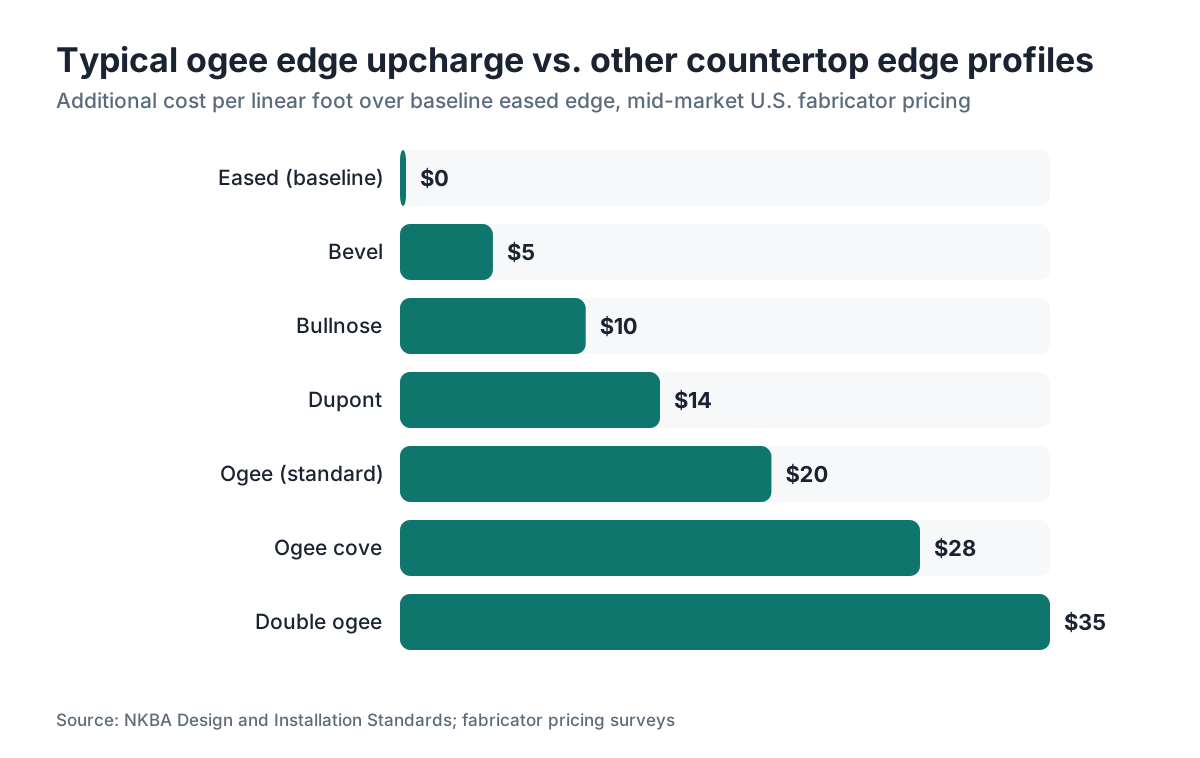
Put the ogee next to its neighbors on the profile menu and the tradeoffs get clear fast. The table below covers the most common options fabricators offer, comparing visual weight, difficulty, and typical upcharge over a basic eased edge.
| Profile | Shape summary | Visual weight | Typical upcharge (per lin. ft.) | Slab thickness needed |
|---|---|---|---|---|
| Eased (straight) | 90° corner, slightly softened | Very low | $0 baseline | 2 cm or 3 cm |
| Bevel | Angled flat cut at top corner | Low | $2, $8 | 2 cm or 3 cm |
| Bullnose | Full rounded half-circle | Medium | $5, $15 | 2 cm or 3 cm |
| Ogee | S-curve (concave + convex) | High | $10, $30 | 3 cm preferred |
| Ogee cove | Deeper concave sweep + S | Very high | $15, $40 | 3 cm required |
| Double ogee | Two S-curves stacked | Very high | $20, $50 | 3 cm required |
| Dupont | Raised flat top + bullnose | Medium-high | $8, $20 | 3 cm preferred |
Upcharge figures come from fabricator pricing surveys and regional shop quotes. The honest disclaimer is that prices swing widely by market, stone type, and whether a shop runs CNC or hand-polishes edges [1].
The ogee and the dupont are both traditional profiles that signal a formal kitchen. The difference is personality. A dupont has a raised flat plateau that catches light horizontally, while the ogee's shadow line runs diagonally. Side by side, the dupont reads a bit more restrained, the ogee a bit more baroque.
Simple profiles like eased and bevel dominate modern and Scandinavian-influenced kitchens right now. The ogee is the profile most tied to 1990s and 2000s granite kitchens, and that creates a real risk: clients who grew up seeing it in dated rooms may read it as old-fashioned. That's not a reason to avoid it (timeless and dated are different things), but know it before you commit.
What does an ogee edge cost in 2025?
The upcharge for an ogee edge typically runs $10, $30 per linear foot over the baseline eased edge, with complex variants (ogee cove, double ogee) reaching $30, $50 per linear foot in high-cost metro markets [1]. On a standard kitchen with roughly 25 to 35 linear feet of exposed edge, that adds $250, $1,050 to the countertop invoice.
Several things push the price. CNC shops that already own the right profile wheels can run an ogee fast and price it lower. Shops that hand-grind edges or need to custom-order a wheel charge more. Stone type matters too. Granite and quartzite take polish well and the ogee is straightforward. Marble is softer, takes a good edge, and usually prices comparably. Engineered quartz can chip on sharp inside curves if the wheel speed isn't managed, so some shops add a small premium for the extra care. Porcelain is the hardest case, and it gets its own section below.
Labor geography is the biggest variable. A kitchen and bath showroom in a high-cost coastal city may quote $30, $50 per linear foot for the exact ogee a Midwest fabrication shop runs at $10, $18. No national body sets these prices [2], so pulling three quotes for any complex profile is the only reliable way to calibrate your local market.
Machined edges versus hand-polished edges differ more in quality than in cost. CNC consistency is essentially perfect: every inch of a 30-foot run looks the same. Hand-polished edges can be beautiful but show subtle variation. For an ogee, which lives or dies on crisp curve transitions, CNC is usually the safer bet.
Which countertop materials work best with an ogee edge?
Granite is the material most tied to the ogee edge profile, and for good reason. Granite's hardness (Mohs 6 to 7) takes a high-gloss polish, the curves stay crisp over decades of use, and the stone's busy pattern plays well with the profile's detail. Granite is also the most commonly fabricated dimension stone for countertops in the United States [5]. A granite countertop in deep black or heavy movement often gains from the ogee's shadow line, which adds dimension a flat edge would kill.
Marble works just as well mechanically. The concern with marble countertops is the kitchen environment more than the edge shape. An ogee's inner concave curve can trap grease and cleaning solution, and marble etches from acidic cleaners. If a client is set on marble with an ogee, seal the concave section well and wipe it carefully.
Engineered quartz (Silestone, Caesarstone, Cambria countertops, and the rest) handles the ogee fine as long as the fabricator knows the material. Quartz is more brittle than granite at thin cross-sections, so the inside of the concave curve needs a slower wheel speed and careful coolant management.
Porcelain is the difficult case. Most porcelain slabs sold for countertops run 12 mm (roughly 1/2 inch) thick, though some reach 20 mm [7]. A 12 mm porcelain edge with an ogee is a problem: there just isn't enough depth for a full curve, so you get either a compressed, shallow version that reads as a ghost of the profile, or a mitered edge where two pieces of porcelain are laminated to fake thickness. Mitered ogee edges on porcelain exist, but they're expensive, prone to joint visibility, and demand precise fabrication. Most experienced fabricators will talk you out of an ogee on thin porcelain and steer you to a pencil, bevel, or eased edge.
Laminate, solid surface (Corian and similar), and butcher block countertops all accept a routed ogee. For wood, a router bit cuts the profile cleanly and it looks handsome. For laminate, the edge banding limits what's possible; a true ogee needs a wood or MDF substrate edge piece, which many laminate installs already use (a post-form or applied edge). Solid surface like Corian countertops machines well and produces a clean ogee, though the profile can read a little plastic next to natural stone.
Is an ogee edge profile a good fit for modern kitchens?
Honestly, no, not for most contemporary or transitional designs. The ogee carries strong ties to formal traditional style: raised-panel cabinetry, dark wood stain, ornate hardware. Drop an ogee into a flat-front white shaker kitchen with matte black fixtures and it will feel like a costume piece.
Design rules break well when you break them on purpose. An ogee on a kitchen island topped with a dramatic natural stone, surrounded by otherwise restrained cabinetry, can work as an intentional focal point. The question to ask is whether the edge detail adds something or just adds complexity.
For new construction and remodels in 2024 to 2025, the profiles getting the most spec attention are eased, mitered, and waterfall edges. Builder practice data shows simple eased and mitered profiles gaining share over ornamental profiles like the ogee between 2018 and 2023 [10]. The ogee is having a quiet revival in very formal traditional kitchens and in outdoor entertaining spaces with classical architecture, where the profile's lineage feels appropriate rather than dated.
Bathroom vanities are a place the ogee often works better than in kitchens. Vanity tops have fewer linear feet to fill, the formal quality suits a master bath, and there's less risk of the concave curve collecting cooking residue.
How does a fabricator actually cut an ogee edge?
Most production shops use a CNC machine or a dedicated edge polisher with a profiled diamond wheel. The ogee wheel is a shaped grinding wheel with the negative of the S-curve machined into its face. The operator programs the pass depth and feed rate, the wheel runs wet (water cooling prevents heat fractures and extends wheel life), and the machine finishes the profile in a single or double pass.
Hand shops work differently. A skilled edge finisher roughs the shape with a coarse diamond pad, then steps through finer grits (typically 60, 120, 220, 400, 800, 1500, 3000) to reach the final polish. It takes longer and costs more, but a practiced hand produces a profile with slight organic variation some clients prefer.
The inside concave curve is the technically tricky part. Convex curves polish easily because you can attack them from multiple angles. Concave curves force the tool (or the hand pad) to conform to the curve, which is why the right wheel profile or the right small-diameter drum sander matters.
Fabricators running quoting software (SlabWise, for one, tracks edge profiles as line items in job quotes) need to price wheel wear and machine time accurately, because a complex ogee runs a lot slower than a basic eased or bullnose and the profiled wheels themselves cost $150, $400 each [3].
For jobs with multiple edge profiles, separating the edge linear footage by profile type in the estimate is standard practice. A kitchen might carry an ogee on the perimeter but a simple eased edge on the sink cutout apron, and those price differently.
What are the practical pros and cons of an ogee edge for homeowners?
The case for the ogee is almost entirely aesthetic. It adds shadow lines, depth, and a sense of craft that a flat edge can't match. For a formal kitchen or a traditional bath, it finishes the look in a way cheaper profiles don't.
The case against is real. The concave inner curve traps crumbs, grease, and cleaning residue [9]. It takes longer to wipe than a bullnose or eased edge. This sounds minor and it is, but multiply it across years of daily cooking and it adds up. A client who hates cleaning fussy surfaces will eventually resent the edge.
Durability is the other consideration. The apex of the convex lower curve is the most exposed point on any countertop edge. On an eased or bullnose edge, a bump from a pot handle or a kid's toy hits a broad curved surface and the energy spreads out. On an ogee, that same bump can land right at the tightest part of the S-curve, where the geometry concentrates stress. Granite is hard enough that this rarely chips in normal use, but softer stones (some marbles, travertine) are more vulnerable at the high points of a complex profile.
Sealing is the maintenance point fabricators mention most. The concave section is harder to seal evenly than a flat or fully convex surface. A penetrating sealer brushed on works better than a spray here [8].
How does the ogee cove profile differ from a standard ogee?
The ogee cove adds a wider concave cove section above the S-curve. Where the standard ogee starts its inward curve right at the top arris of the slab, the ogee cove pulls back further and cuts a more pronounced shadowed channel before transitioning into the S.
The effect is more dramatic. The shadow line under good light is deeper and more visible. On a granite countertop with heavy movement, the ogee cove can look genuinely spectacular. It also needs more material depth than a standard ogee, which makes 3 cm (1-1/4 inch) slabs essentially mandatory and rules out 2 cm.
Fabricators charge more for ogee cove profiles because the wheel is more complex, the pass takes longer, and the risk of chipping on the deeper concave section climbs. Expect the ogee cove to price $5, $15 per linear foot above the standard ogee in most shops.
Cleaning difficulty rises right along with it. The deeper cove catches more debris. For a kitchen with heavy daily cooking, the ogee cove is a high-maintenance choice. For a formal dining room sideboard or a low-traffic bathroom vanity, that math looks completely different.
Can you get an ogee edge on porcelain or thin engineered stone?
This is one of the most common questions fabricators field, and the short answer is: possible, but usually not worth it.
Porcelain runs into a thickness wall. Most porcelain slabs used for countertops are 12 mm (about 1/2 inch). A few products hit 20 mm [7]. At 12 mm, a true ogee gets squeezed to the point where it looks like a faint suggestion of a curve. At 20 mm you have marginally more room, but you're still working with roughly half the thickness of a 3 cm granite slab.
The workaround is a laminated or mitered edge: two pieces of porcelain bonded together to build a thicker apparent edge, then the profile cut across the combined thickness. This leaves a seam line down the middle of the profile unless the porcelain is through-body material (same color and pattern all the way through, which most large-format porcelain slabs are not). On a veined porcelain ogee edge, that seam line often looks like a crack to people who don't know what they're seeing.
For thin materials, fabricators usually recommend a pencil edge, a 1/8-inch bevel, or a simple eased edge. Those profiles respect the material's geometry instead of fighting it. A porcelain slab with a clean eased edge and a mitered corner often looks more sophisticated than the same slab with a forced ogee.
Engineered stone at standard 2 cm (3/4 inch) is a borderline case. Some fabricators will run a shallow ogee on 2 cm quartz and the result is acceptable. Others argue it's better to laminate two pieces of 2 cm to simulate 4 cm and then cut a proper ogee. The laminated approach adds cost and the seam shows on some colors.
How do you pick the right edge profile for your countertop project?
Start with your cabinet style. Raised-panel, beaded-inset, and ornate cabinetry support the ogee naturally. Flat-front, shaker, and minimal cabinetry do not. If your cabinets sit in between (a transitional shaker with moderate detail), a simpler ogee variant or a dupont often reads better than the full cove ogee.
Consider the slab material next. If you're working with 2 cm material or thin porcelain, the ogee is fighting the material. Go eased or bullnose and spend the saved money elsewhere.
Think about where the edge lives. The perimeter next to seating, or anywhere people rest their arms, wants a softer, comfortable profile. A bullnose or eased edge feels better against your forearms than an ogee. The ogee is best appreciated with your eyes, not your skin.
Ask your fabricator for a physical sample, not a rendered image. Shadow line behavior changes with lighting; a profile that looks crisp in a bright showroom can disappear under under-cabinet lighting in a real kitchen. Most fabricators keep sample boards of their standard profiles.
For a homeowner building a first countertop budget, the kitchen countertops cost breakdown and the countertop installation process are both worth reviewing before you finalize the edge spec, because edge upgrades land on the quote at the end and can shift the total meaningfully.
Fabricators pricing jobs with multiple edge types gain from separating edge linear footage by profile in their estimates. Software that handles this as a line item (SlabWise tracks edge profiles separately in job quotes so CNC setup time and wheel wear are costed accurately) prevents the common mistake of blending edge pricing across a job and then bleeding margin on the complex sections.
What should you ask a fabricator before ordering an ogee edge?
A few questions worth asking before you sign off:
Do you have the profile wheel in-house, or will you outsource this edge? Outsourced edges add lead time and cut your ability to inspect quality before installation.
Can I see a sample of this profile on my specific stone? The ogee on a tight-grained absolute black granite looks nothing like the same profile on a heavily veined white marble. The profile reacts to the stone's movement and grain.
How do you handle the inside corners? Where two countertop runs meet at a wall corner, the ogee profile has to terminate cleanly. Some fabricators cut a mitered cope at inside corners; others blend the profile out and return to a flat face. Both are acceptable, but they look different, so see the shop's standard practice.
What sealer do you recommend for the concave section of the ogee? On natural stone, the inside curve needs attention at the sealing stage. A good fabricator will have an opinion.
What's the warranty or repair policy if the edge chips? Complex profiles are harder to repair in place than simple ones. If the most exposed point of the S-curve chips two years after installation, you want your options in advance.
For fabricators, edges carry real margin on any job. Running a 35-linear-foot kitchen at $25 per foot upcharge for an ogee is $875 in edge revenue alone. Getting the wheel in-house, training one operator to run it consistently, and quoting it confidently pays back the tooling investment.
Frequently asked questions
What is an ogee edge on a countertop?
An ogee edge is an S-shaped profile cut into the front face of a countertop slab: the top half curves inward (concave) and the bottom half curves outward (convex). The resulting shadow line gives the edge a traditional, formal look. It's one of the more complex profiles a fabricator can cut and costs $10, $30 per linear foot above a basic eased edge in most markets.
How much does an ogee edge cost compared to a regular edge?
A standard eased edge is typically included in the base countertop price. An ogee runs $10, $30 per linear foot above that baseline, depending on stone type, shop equipment, and region. An ogee cove or double ogee runs higher, $20, $50 per linear foot in some markets. On a 30-linear-foot kitchen, upgrading to an ogee adds roughly $300, $900 to the total invoice.
Is an ogee edge difficult to clean?
More difficult than a flat or bullnose edge, yes. The inner concave curve traps crumbs, grease, and cleaning residue that a quick wipe misses. You need to run a cloth into the curve on purpose. For a busy cooking kitchen, this is a genuine daily-use consideration. For a low-traffic bathroom vanity or a formal dining server, it's a minor issue.
What thickness slab do I need for an ogee edge profile?
Most fabricators recommend 3 cm (1-1/4 inch) as the minimum for a proper ogee, especially for the ogee cove or double ogee variants. A 2 cm (3/4 inch) slab can technically take a shallow ogee, but the curves get compressed and the detail reads weak. Thin porcelain at 12 mm is generally unsuitable for a true ogee profile.
Can you put an ogee edge on quartz countertops?
Yes. Engineered quartz handles an ogee well when the fabricator uses appropriate wheel speed and water cooling. Quartz is more brittle than granite at thin cross-sections, so the inside of the concave curve needs care. At standard 2 cm thickness the profile is somewhat compressed; 3 cm quartz gives a fuller result. Most major quartz brands work fine with the profile.
Does an ogee edge work on porcelain countertops?
Only with real compromises. Most porcelain slabs run 12 mm thick, too thin for a proper ogee. A laminated or mitered edge can simulate the needed thickness, but the seam through the profile shows on most porcelain. Experienced fabricators usually recommend a pencil, bevel, or eased edge on porcelain rather than forcing an ogee onto a material whose geometry doesn't support it.
What is the difference between an ogee edge and an ogee cove edge?
A standard ogee is a single S-curve, concave on top transitioning to convex below. An ogee cove adds a wider, deeper concave section above the S-curve, creating a more pronounced shadow line and a more ornate look. The ogee cove needs more stone thickness, takes longer to cut, and typically costs $5, $15 per linear foot more than the standard ogee.
Is the ogee edge profile out of style?
It depends on the context. The ogee is strongly tied to traditional formal kitchens, especially the granite-heavy designs common in the 1990s and 2000s. In a contemporary or transitional kitchen, it can read as dated. In a deliberately classical or formal setting (raised-panel cabinetry, ornate hardware, traditional architecture), the ogee still looks appropriate and intentional rather than old-fashioned.
What edge profile is best for a granite countertop?
There's no single best answer: it depends on your cabinet style and taste. For traditional kitchens, the ogee, ogee cove, and dupont profiles all complement granite well. For contemporary designs, a simple eased or mitered edge lets the stone's movement and color carry the room without competing detail. Granite's hardness and high polish mean it handles any profile well mechanically.
Can an ogee edge chip easily?
The apex of the convex lower curve is the most exposed point geometrically and the most likely to chip from an impact. On hard stones like granite, this is uncommon in normal kitchen use. Softer stones like some marbles or travertine are more vulnerable. The inner concave section rarely chips because it's recessed. Keeping heavy pots and tools away from the edge face lowers risk regardless of profile.
How do fabricators price ogee edges in job quotes?
Most shops price edge profiles as a per-linear-foot upcharge over the baseline eased edge. The ogee upcharge covers the profiled diamond wheel, slower machine run speed, and extra polishing steps. Shops that track edge types separately in their quoting software price accurately by profile; shops that average edge costs across a job often undercharge for complex profiles and lose margin.
What is a double ogee edge?
A double ogee stacks two S-curves, one above the other, across the face of the slab edge. The result is a highly detailed, layered look that reads as very ornate. It needs substantial slab thickness (3 cm minimum, more is better), takes longer to cut, and commands the highest edge upcharge in most shops, typically $20, $50 per linear foot above the baseline. It suits very formal traditional spaces.
Sources
- National Kitchen and Bath Association (NKBA), Design and Installation Standards: Edge profile upcharge ranges and fabrication pricing benchmarks for kitchen countertop installations
- U.S. Bureau of Labor Statistics, Producer Price Index: Cut Stone and Stone Products (NAICS 327991): No national governing body sets countertop fabrication pricing; regional variation in stone fabrication labor costs is documented in BLS PPI data
- Braxton-Bragg, Diamond Tools for Stone Fabrication (industry supplier catalog): Profiled diamond edge wheels for CNC and edge polishers cost $150, $400 each depending on profile complexity
- Natural Stone Institute (formerly Marble Institute of America), Dimension Stone Design Manual: 3 cm slab thickness is recommended for complex ornamental edge profiles including ogee and ogee cove; profile wheel requirements and CNC procedures for natural stone
- U.S. Geological Survey, Mineral Resources Program: Dimension Stone Statistics and Information: Granite is the most commonly fabricated dimension stone for countertop use in the United States
- International Masonry Institute, Classical Architectural Profiles Reference: The ogee molding profile originates in classical Greek and Roman architecture and has remained in continuous use in Western building traditions
- Tile Council of North America (TCNA), Handbook for Ceramic, Glass, and Stone Tile Installation: Porcelain tile and slab products used for countertops are commonly available at 12 mm and 20 mm thickness; edge treatment limitations for thin materials
- Natural Stone Institute, Care and Maintenance Guide for Natural Stone: Penetrating sealers applied by brush provide better coverage in concave edge profiles than spray application; sealing recommendations for ornamental edge profiles
- U.S. Environmental Protection Agency, Safer Choice Program: Cleaning product residue accumulation in textured and profiled stone surfaces; guidance on countertop surface maintenance
- Home Innovation Research Labs, Annual Builder Practices Survey: Edge profile preferences in new construction: simple eased and mitered profiles gained share over ornamental profiles like ogee between 2018 and 2023
Last updated 2026-07-09