TL;DR
- Countertop edge profiles run from a plain eased edge (flat, cheapest, usually free) to ornate ogee or waterfall styles that add $10 to $80 per linear foot.
- The right pick depends on your stone type, your cabinets, and how much exposed edge you have.
- Most kitchens do fine with an eased, bevel, or bullnose edge.
What is a countertop edge profile and why does it matter?
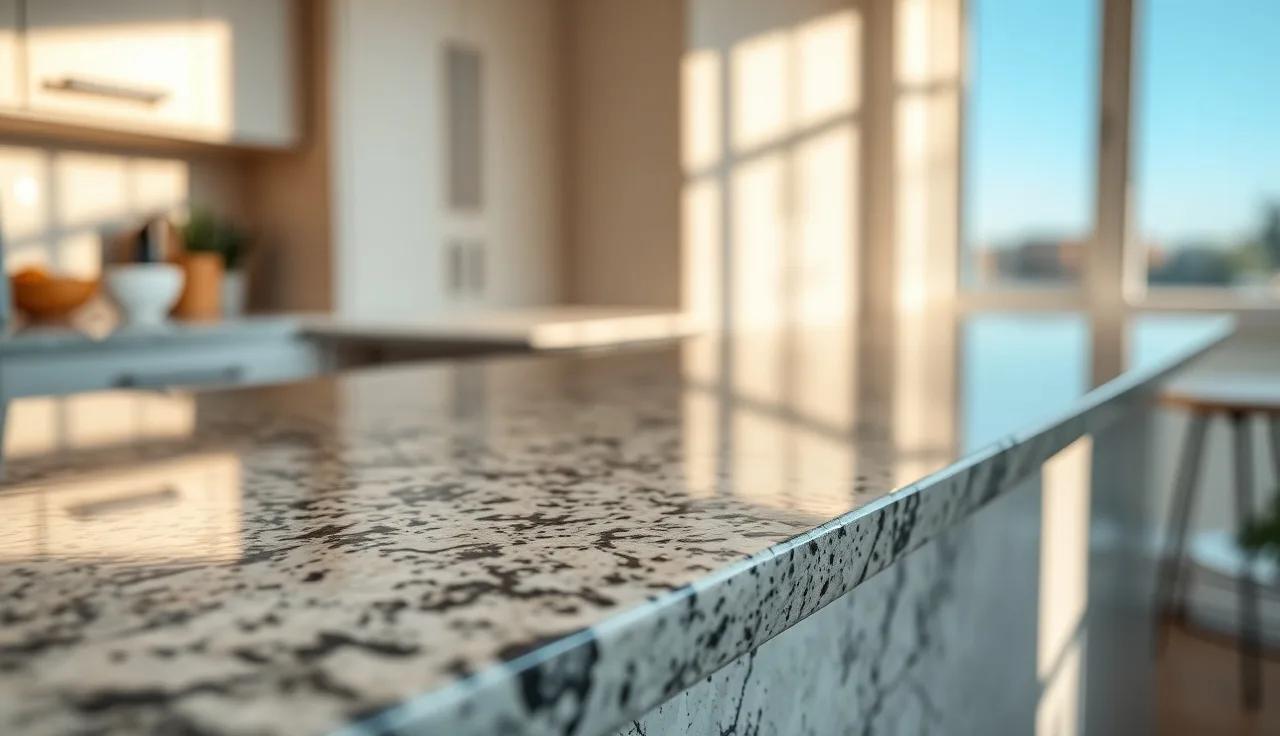
An edge profile is the shape cut into the exposed front edge of a countertop slab. It sounds like a small finishing detail. It changes how the counter reads from across the room, how fast it wipes clean, and whether chips show up over years of use.
The edge is the first thing your eye lands on when you walk into a kitchen. A thick slab with a sharp eased edge reads modern. That same slab with an ogee reads traditional. The profile also plays with your sense of thickness. A mitered waterfall edge can make a 3/4-inch slab look two inches thick.
For fabricators, edge profiles are a real cost driver. Complex profiles need multiple passes with a CNC router or hand time at the grinder, and those minutes add up fast across a full kitchen. For homeowners, the smart move is simple: ask your fabricator which profiles are in the base price and which cost extra.
What are the most common countertop edge profiles?
There are roughly a dozen profiles you'll see on most job tickets. Here's what each one looks like and where it shows up.
Eased edge (also called a straight edge or flat polish): The top corner is barely broken, maybe 1/16 of an inch of softening, and the face stays flat. It's the default on most slabs and nearly always included in base pricing. Works on any material.
Beveled edge: The top corner is cut at a set angle, usually 45 degrees. It looks intentional without being fussy, and it suits contemporary or transitional kitchens. Practical note: the angled face catches fewer crumbs than a rounded edge.
Bullnose (full bullnose): The whole edge rounds into a half-circle. Zero sharp corners, which is why it's common in homes with young kids. The catch is that a full bullnose on a thick slab can look heavy and dated, depending on the cabinets.
Half bullnose (demi bullnose): Only the top corner rounds; the bottom stays flat or square. Softer than an eased edge, less chunky than a full bullnose. It's one of the most-ordered basic profiles today.
Ogee: An S-curve that combines a concave and convex arc. It reads formal and traditional. Ogee is the classic pick for raised-panel cabinet kitchens and shows up most in granite work. It needs more machine time and is almost always a premium charge.
Dupont (or DuPont): Similar to an ogee but with a sharper step near the top. Less common now than in the early 2000s, still requested for traditional designs.
Cove (or cove dupont): A concave curve along the top that runs into a flat face. Subtle and clean. Good for people who want something other than flat without going full decorative.
Waterfall edge: The counter surface keeps going straight down the cabinet side, all the way to the floor. It's really a design feature more than a profile, but fabricators quote it as a line item because it needs a full extra slab section mitered at 90 degrees. Very popular in modern and minimalist kitchens.
Chiseled or leathered edge: The edge is textured to look rough and natural instead of polished smooth. Used mostly on granite or quartzite for a rustic or live-edge look.
Mitered edge: Two pieces of stone join at 45-degree angles to fake a thick edge from a thinner slab. Common for getting a 4-to-6-inch apparent thickness out of 3/4-inch material, without the weight or cost of a true thick slab.
Laminated edge: A strip of stone glues to the underside of the front edge to build up apparent thickness. Less labor than a full miter, and it still adds visual heft.
How much does each edge profile cost?
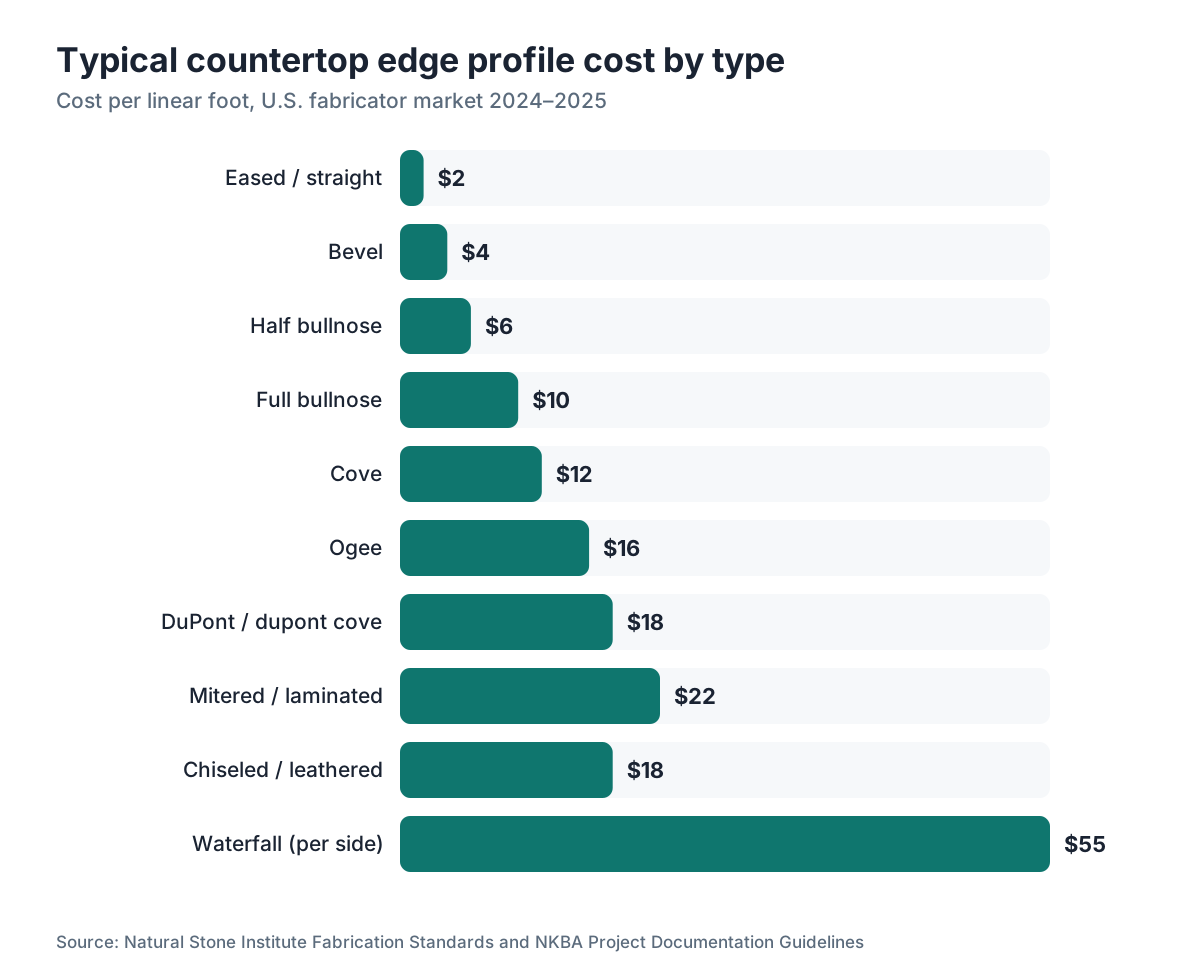
Edge pricing swings by fabricator, region, and material, but the ranges below match typical shop pricing in 2024 and 2025. All figures are per linear foot of finished edge.
| Profile | Typical cost range (per LF) | Complexity |
|---|---|---|
| Eased / straight | Included or $0, $3 | Low |
| Bevel | $0, $5 | Low |
| Half bullnose | $0, $8 | Low |
| Full bullnose | $5, $12 | Medium |
| Cove | $8, $15 | Medium |
| Ogee | $10, $20 | High |
| DuPont / dupont cove | $12, $20 | High |
| Mitered (laminated) | $15, $30 | High |
| Waterfall | $30, $80+ per side | Very high |
| Chiseled / leathered | $10, $25 | Medium-high |
A typical kitchen has 25 to 40 linear feet of exposed edge. Upgrade from a free eased edge to an ogee at $15 per linear foot and you've added $375 to $600 to the total. Not ruinous. Not trivial either.
Edge profiles are the line item shops forget or underprice most often during rush quoting. Software that tracks profile type per edge segment, like SlabWise, stops that margin leak by pinning the profile cost to each piece as you build the quote.
Material changes the math too. Quartzite and hard granite take longer to shape than softer stones, so some shops add a material surcharge on complex profiles for those specifically. Laminate countertops have the fewest profile options because the substrate limits what a router bit can cut cleanly. For more on that, see laminate countertops.
Which edge profiles work best for granite, quartz, and marble?
Each material behaves differently at the edge, and that should steer your pick.
Granite is hard, dense, and chips at thin cross-sections. A sharp thin bevel or a delicate pencil edge on granite can pick up micro-chips over time, especially at corners. Ogee has stayed popular in granite for decades partly because the curves spread impact stress better than sharp angles. Full bullnose holds up well on granite too, since there's no thin vulnerable point. Our granite countertops guide goes deeper on durability.
Engineered quartz (brands like Cambria) is consistent through the slab and machines predictably. You get more profile options without worrying about natural fissures or grain running the wrong way. Eased, bevel, and mitered profiles all look sharp on quartz because the color and pattern stay uniform.
Marble is softer and chips more readily than granite. Sharp edges on marble are a gamble in a busy kitchen. Bullnose and half bullnose are the safest calls for marble because they kill the corner entirely. Our marble countertops guide covers care after install.
Butcher block plays by its own rules since it's routed wood, not stone. Standard woodworking profiles (roundover, ogee, chamfer) all work, and the material forgives a change of mind because you can rework it. The main worry is sealing the exposed end grain on routed profiles. Our butcher block countertops article covers sealing in detail.
Formica and other plastic laminates are boxed in by the substrate. Most shops offer eased, beveled, or a post-form rounded edge. Exotic profiles need a buildup layer underneath and aren't always worth the extra cost on a laminate job. See Formica countertops for what's realistic.
Which edge profile is easiest to clean?
Flat profiles win. An eased or beveled edge has no crevice for food to lodge in. You wipe across a flat surface and you're done.
Ogee and dupont profiles have inside curves (the concave part of the S) that collect crumbs and residue. If you cook a lot and hate scrubbing edges, ogee is a poor pick no matter how good it looks in a showroom.
Bullnose profiles clean up reasonably well because the curve sheds debris instead of trapping it. The exception: the underside of a full bullnose can gather grime if your counter overhangs the cabinet face by more than an inch.
Chiseled and leathered edges are the hardest to clean, full stop. The texture that makes them look natural is the same texture that grabs oil, crumbs, and mineral deposits. Want that rustic look? Budget for more edge-cleaning time, or make peace with texture that shows use. Surfaces without recessed grooves or heavy texture stay cleaner and hold less bacterial buildup, which the U.S. Department of Housing and Urban Development notes in its Healthy Homes guidance on kitchen surfaces.
For general stone cleaning, our article on how to clean stone countertops covers sealers and daily care across all stone types.
Which edge profiles look modern vs. traditional?
This is subjective, but the patterns across kitchen design hold up.
Modern and contemporary kitchens lean almost entirely on eased, mitered, or waterfall edges. The logic is clean geometry: flat faces, sharp or barely-softened corners, no decorative curves. Waterfall edges have become a loud signal of a modern kitchen, especially when the vertical panel runs to the floor in a contrasting stone.
Transitional kitchens, the ones that blend modern and traditional, tend toward bevel, half bullnose, or a simple cove. These carry some character without shouting a historical style.
Traditional kitchens with raised-panel cabinets, crown molding, and ornate hardware look best with ogee or dupont. The edge detail echoes the cabinet profiles and ties the room together.
Farmhouse and cottage kitchens often reach for a thick bullnose or a hand-chiseled edge that leans into the handmade, imperfect look.
One honest warning: edge trends cycle. Ogee was everywhere in the early 2000s, then felt dated by 2015. Waterfall is riding high right now, which means it may feel overexposed in another decade. If you're likely to sell in five to ten years, a neutral profile like eased or half bullnose has broader appeal.
What edge profile should you choose for a kitchen island?
Islands take more traffic than perimeter counters, and all four sides may be on view. That shifts the math.
On the seating side, sharp or thin edges dig into forearms. A full bullnose or a thick bevel is far more comfortable at bar-height seating. The University of Minnesota Extension notes that rounded edge profiles reduce pressure discomfort at bar-height seating. Some designers spec a different profile for the seating edge than the work edge, which is completely legitimate and priced that way per linear foot.
On the work edges of an island, the same rules apply as for perimeter counters: eased and bevel for modern, bullnose or ogee for traditional.
Thicker apparent edges look great on islands because the island reads as a freestanding furniture piece. Mitered or laminated edges that fake a 2-to-3-inch thickness earn their premium on an island, even if you keep the perimeter counters at standard thickness.
For the full island layout, see our kitchen countertops overview.
How does slab thickness affect which edge profiles are possible?
Standard stone slabs come in two thicknesses: 2 centimeters (about 3/4 inch) and 3 centimeters (about 1-1/4 inch). A few specialty formats reach 6 cm, but that's the exception. The Natural Stone Institute lists 2 cm and 3 cm as the standard dimension-stone thicknesses.
3 cm slabs are thicker and stiffer. Most profiles work cleanly on 3 cm material because there's enough cross-section to hold the geometry. Complex ogee and dupont profiles look proportionally right on 3 cm stone.
2 cm slabs are thin enough that some profiles look spindly or leave a fragile edge. A full ogee on 2 cm granite can leave a very thin section at the top curve that chips easily. On 2 cm material, eased, bevel, and half bullnose are the safer bets. Or add a laminated or mitered buildup strip to a 2 cm slab to get the apparent thickness that supports fancier profiles.
For fabricators, spelling out profile relative to thickness in the quote heads off disputes. A customer who saw ogee on a showroom sample cut from 3 cm stone may be surprised when the same profile on their 2 cm slab looks different.
What are the different edge profiles for countertops that are good for bathrooms?
Bathroom vanity tops take less abuse than kitchen counters, so you have more room to play with looks.
Eased and half bullnose are the top choices in bathrooms because they're clean and match most vanity styles. Ogee shows up often in traditional master baths where the vanity cabinet has detailed woodwork.
One bathroom-specific wrinkle: undermount sinks. The front edge of an undermount sink cutout gets profiled too, and that inside curve is visible when you look into the basin. Complex inside profiles on undermount cutouts are harder to fabricate cleanly and cost more. A simple polished flat or half bullnose on the undermount edge is usually the right call, even if the outer perimeter gets something fancier.
Vanity tops are smaller than kitchen counters, so the edge premium per project is lower. If you've always wanted to try an ogee but balked at the kitchen price, a small vanity top is a low-risk place to do it.
Can you change a countertop edge profile after installation?
Technically yes. In practice it's painful.
A fabricator can bring grinding gear to your home and rework an edge in place. The process throws off a lot of stone dust, needs everything in the kitchen masked, and eats real time. In-place rework often costs close to fresh edge work on a full slab, because the labor is inefficient next to shop work.
The bigger limit: you can only go simpler, never more complex. Have a full bullnose and want an eased edge? A fabricator can grind it flat. Have an eased edge and want an ogee? There isn't enough material left to cut the ogee. The edge was already sized during fabrication.
So get the profile right before install. If you're unsure, ask your fabricator for a sample or a small off-cut with the profile run on it. Most shops have these in the remnant bin. Hold the physical profile in your hand for a week before you commit. That ask is worth it.
How do fabricators price and quote edge profiles accurately?
Edge pricing should be broken out per linear foot by profile type, not buried in a per-square-foot slab rate. A fabricator who folds all edges into the square footage price is either padding the slab rate or eating the cost of complex profiles. Neither builds a sustainable shop.
The accurate method measures each exposed edge run on its own, assigns the specified profile, and multiplies by the per-linear-foot rate for that profile. One kitchen might carry a perimeter eased edge on 30 feet of standard counter, a bullnose on 6 feet of island seating edge, and a waterfall on two 36-inch drops, each a separate line item.
For shops juggling several jobs at once, keeping edge profiles consistent within a quote, and flagging when a customer swaps an included profile for a premium one, is the operational detail that separates profitable shops from ones that bleed money on upsells. Quoting tools like SlabWise attach edge types to each slab piece during quote-building, so the math is automatic instead of a manual line people forget.
The National Kitchen and Bath Association publishes documentation guidelines that treat edge specifications as a standard part of a countertop contract [1]. Getting edge profiles in writing before fabrication starts protects both sides.
What edge profile is most durable for families with kids?
Full bullnose is the profile fabricators recommend most for homes with children, and the reason is simple: no sharp corners at all. A kid running into a bullnose edge meets a rounded surface instead of a 90-degree angle. The U.S. Consumer Product Safety Commission's home-safety guidance ties rounded edges to lower risk of laceration and blunt-impact injuries in household kitchens.
Half bullnose is nearly as good on the top corner, though the bottom edge stays flat. For a lot of families, half bullnose is the compromise that gives safety on the top strike zone without the heavy look of a full bullnose.
Eased edges with a tiny softening aren't much different from a sharp edge on impact, despite the name. If child safety is a real concern, don't assume eased means safe.
Island corners deserve extra thought. A rounded corner cut (a radius on the plan view of the slab, separate from the edge profile) cuts corner-impact injuries no matter which profile you pick. A 3/4-inch or 1-inch corner radius costs very little at fabrication and is worth writing into the contract.
Frequently asked questions
What is the most popular countertop edge profile right now?
Eased and half bullnose are the most commonly specified profiles across the U.S. for kitchens and baths, based on what fabricators report ordering most. Waterfall edges are the fastest-growing premium choice, especially in modern kitchens with quartz or porcelain slabs. Ogee ruled traditional remodels in the early 2000s but has fallen out of favor with younger buyers.
Does the edge profile affect countertop resale value?
Indirectly. A profile that dates the kitchen, like a heavy dupont ogee in an otherwise modern home, can make the space look older than it is, which shifts buyer perception. Neutral profiles like eased or half bullnose read as fresh across style cycles. If you plan to sell within a decade, avoiding trendy or overtly traditional profiles is the safer bet.
What edge profile is included for free with most countertop quotes?
Eased (straight) edge is almost always in the base fabrication price. Some shops also include a standard bevel or half bullnose at no extra charge. Anything that needs multiple router passes, like ogee, dupont, or mitered edges, is typically a line-item upcharge. Always ask your fabricator exactly what's included before you assume.
Can you mix edge profiles on different parts of the same kitchen?
Yes, and it's common. Designers often spec a simple eased or bevel on the perimeter counters and a bullnose or mitered edge on the island where it's more visible. The key is spelling out each edge run in the fabrication contract so there's no confusion at install. Mixing more than two profiles in one kitchen can start to look inconsistent.
What is a waterfall edge on a countertop?
A waterfall edge runs the countertop material continuously down the side of the cabinet to the floor, making a vertical stone panel. It needs a mitered joint at the top corner and a full extra slab section. Pricing usually runs $30 to $80 or more per waterfall side, depending on slab cost and miter complexity. It's a strong modern statement, especially on islands.
What is the difference between ogee and dupont edge profiles?
Both are decorative S-curve profiles, but the detail differs. An ogee has a smooth S-curve from top to bottom. A dupont (or DuPont) has a more pronounced step or shelf near the top before it eases into the curve. Dupont profiles tend to look heavier and more traditional. Ogee is the more common of the two in current stone work.
Are edge profiles different for quartzite vs. granite?
The available profiles are the same, but quartzite's extreme hardness means more machine time and sometimes a surcharge for complex profiles. Quartzite also has natural cleavage planes, so thin cross-sections on complex profiles can be risky. Rounded profiles like bullnose are generally safer on quartzite than thin sharp angles. Ask about material-specific pricing before committing to a complex edge on quartzite.
What edge profiles work on Corian and solid surface countertops?
Solid surface materials like Corian can be routed and shaped much like hardwood, so almost any profile is possible. The material also sands and finishes in place, so edges rework more easily than stone after install. Standard woodworking profiles (roundover, ogee, cove, chamfer) all apply. Inlaid or multi-color edge details work too, because solid surface pieces bond together invisibly.
How thick should a countertop be for a mitered edge?
Mitered edges are most often used with 2 cm or 3 cm slabs to fake an apparent thickness of 4 to 6 centimeters or more. The miter joint bonds the vertical face piece to the underside of the slab face. Structurally, the joint needs a good epoxy bond and sometimes an internal metal bracket. On a 3 cm slab, a mitered buildup creates a 6 cm apparent thickness, a common pick for high-end modern kitchens.
What is an eased edge vs. a straight edge on a countertop?
These terms get used interchangeably, but there's a subtle difference. A straight edge (or flat polish) is exactly 90 degrees with minimal corner treatment. An eased edge has a slight softening of the top and sometimes bottom corner, usually 1/16 inch, to prevent micro-chipping. In practice, most fabricators treat them as the same and include both in base pricing.
Do edge profiles cost more on thicker slabs?
Yes, usually. Thicker slabs (3 cm) have more material to shape and take more machine time or hand-finishing per linear foot than 2 cm slabs. The difference is modest for simple profiles and bigger for complex ones like ogee or mitered edges. A few fabricators charge a flat premium for all 3 cm edge work; others price by profile complexity regardless of thickness.
What countertop edge profile is easiest for DIY installation?
Eased or flat edges are the most forgiving for DIY countertop work, since they need the least precision shaping. True stone edge profiling requires diamond router bits, a wet grinder, and real skill, so most DIY homeowners stick to laminate (which uses standard woodworking router bits) or solid surface. Trying to shape a stone edge without proper equipment usually ends in chipping.
How do I specify edge profiles on a countertop contract?
Name the profile plainly ("half bullnose" or "3 cm eased"), spell out which edge runs get which profile, and confirm the linear-foot price for each. List the sink cutout edge treatment separately. Ask for a physical sample or shop photo of the profile in your stone type before you sign. Vague terms like "standard edge" cause most post-fabrication disputes.
Sources
- National Kitchen and Bath Association (NKBA), NKBA Professional Resource Library: Industry documentation standards for countertop contracts include explicit edge profile specifications as a required project component.
- Marble Institute of America (now Natural Stone Institute), Natural Stone Reference Manual: Standard stone slab thicknesses are 2 cm (approximately 3/4 inch) and 3 cm (approximately 1-1/4 inch); thicker material supports more complex edge profiles.
- Natural Stone Institute, Fabricator Technical Bulletins: Complex ogee and dupont profiles on 2 cm slabs create thin cross-sections vulnerable to chipping, particularly in hard granites and quartzites.
- U.S. Consumer Product Safety Commission, Safety in the Home kitchen and bath hazard data: Rounded countertop edges reduce risk of laceration and blunt impact injuries in household kitchens, supporting rounded profiles in child-occupied homes.
- National Association of Home Builders (NAHB), Residential Remodeling Index and Cost Data: Kitchen remodeling, including countertop upgrades, is among the top five home improvement expenditures tracked by NAHB annual surveys.
- Remodeling Magazine / Zonda Media, Cost vs. Value Report 2024: Kitchen countertop material and detail choices, including edge profiles, affect perceived kitchen quality and contribute to resale value assessments.
- University of Minnesota Extension, Kitchen Design Principles: Kitchen island edge comfort for seating applications is influenced by edge profile shape; rounded profiles reduce pressure discomfort at bar-height seating.
- U.S. Department of Housing and Urban Development, Healthy Homes Program: Surfaces without recessed grooves or complex texture profiles are easier to clean and maintain lower bacterial buildup in kitchen environments.
- Natural Stone Institute, Dimension Stone Design Manual (8th Edition): Mitered stone edge construction requires proper epoxy bonding and is specified as a standard fabrication technique for creating thick-appearing edges from standard 2 and 3 cm slabs.
- Marble Institute of America / Natural Stone Institute, Stone Fabrication Training Standards: Waterfall edges require a precise 45-degree miter cut and are classified as a high-complexity fabrication operation requiring CNC or highly skilled manual work.
- National Kitchen and Bath Association, Design and Installation Standards 2023: Island corner radii and edge profile selection are recommended components of kitchen safety planning per NKBA guidelines.
Last updated 2026-07-09