
TL;DR
- Caesarstone fabricators usually offer 10 to 14 edge profiles: eased, beveled, half-bullnose, full bullnose, ogee, waterfall, mitered, and more.
- A standard eased edge is almost always included in the base price.
- Decorative profiles like ogee or double waterfall add $10 to $30 per linear foot in most U.S.
- markets.
- Profile choice affects safety, cleaning effort, style, and total installed cost.
What edge profiles does Caesarstone offer?
Caesarstone is an engineered quartz brand that sells slabs to certified fabricators, who cut, polish, and install the countertop to spec. [1] The brand does not hand you a fixed menu of edges the way some laminate manufacturers do. It authorizes fabricators to offer any profile their shop equipment can produce in 2 cm or 3 cm quartz.
Most Caesarstone-certified shops offer somewhere between 10 and 14 profiles. The standard list almost always includes eased (also called slightly eased or 2mm eased), beveled at 45 degrees, half-bullnose (top rounded, bottom flat), full bullnose (top and bottom both rounded), ogee (an S-curve with a cove), reverse ogee, dupont (a squared top with a chamfered step below), waterfall (a beveled face that drops the surface line), double waterfall, cove, pencil round, and mitered (two slabs joined at 45 degrees to fake a thick slab). Some shops also do a chiseled or leathered edge on request, though that is less common.
Names drift from shop to shop. One fabricator calls it a "dupont." Another calls the same cut an "ease with step." Ask to see a physical edge sample, not a line drawing, before you commit.
Cement countertop edge profiles tend to be simpler, because poured concrete is shaped at the form stage rather than CNC-profiled after the fact. The same logic applies to laminate countertops and formica countertops, where the edge is usually a post-formed roll or a self-edge strip. Quartz gives you far more variety, because a diamond CNC router can trace any continuous curve you throw at it.
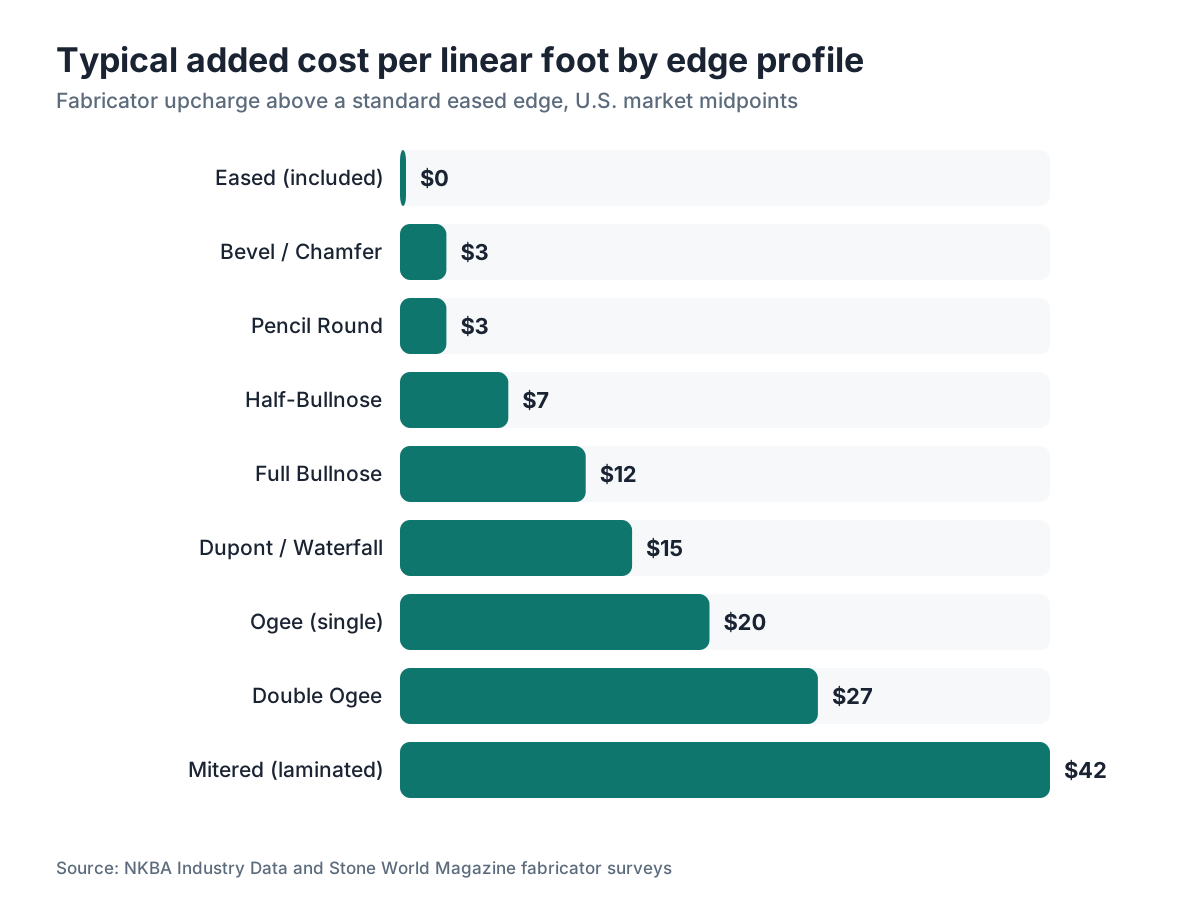
How much do different edge profiles cost on Caesarstone?
The fabricator sets edge pricing, not Caesarstone. Market norms are fairly consistent across the U.S., though, so you can budget with real numbers.
| Profile | Typical added cost per linear foot |
|---|---|
| Eased (2mm) | $0 (usually included) |
| Beveled / Chamfered | $0 to $5 |
| Pencil Round | $0 to $5 |
| Half-Bullnose | $5 to $10 |
| Full Bullnose | $8 to $15 |
| Dupont / Waterfall | $10 to $20 |
| Ogee (single) | $15 to $25 |
| Double Ogee / Double Waterfall | $20 to $35 |
| Mitered (laminated thick edge) | $25 to $60+ |
These ranges come from fabricator pricing guides and regional industry surveys. There is no single government database for countertop edge pricing, so treat the high and low ends as real-world anchors, not guarantees. [2][5]
A standard kitchen with roughly 25 linear feet of exposed edge adds somewhere between $250 and $750 to the total job if you pick a premium profile over a basic eased. That is a real budget swing, but not a huge one.
The mitered edge is the outlier. It laminates two pieces of quartz at 45-degree angles to fake a 4 cm or even 6 cm thick slab. Material cost climbs because you are using more quartz, and labor climbs because the joint is precise and slow. On a large island, a mitered edge can add $1,000 or more over a simple eased profile.
Shops that track quote line items in software already have edge profiles priced per linear foot as a selectable add-on. Tools like SlabWise let a shop attach exact edge upcharges to each quote, which keeps the estimator and the customer looking at the same number before fabrication starts.
Which edge profile is the most popular choice for quartz?
The slightly eased edge wins by a wide margin. Almost every fabricator reports it as their top seller, and the logic is simple. It costs nothing extra, it looks clean and contemporary, and it hides minor chip damage better than a sharp 90-degree edge because the corner is already lightly broken.
Full bullnose was the go-to in the 1990s and early 2000s. It softens a kitchen and is friendlier on hip bones. But it shows water stains and splash marks on the rounded face, which is a genuine maintenance gripe, and a lot of homeowners have walked away from it for that reason.
The mitered thick edge rules high-end renovations right now. It reads as a luxury statement, especially on a waterfall island where the quartz pours down the sides to the floor. If you are shopping marble countertops or cambria countertops, you will see the same mitered trend.
Ogee edges feel more traditional or ornate. They look great in transitional and classic kitchens and can feel dated in a very modern space. If your cabinets have raised-panel doors with decorative molding, an ogee ties the design together. If your kitchen is flat-front slab cabinetry, ogee fights the room.
The bevel (45-degree chamfer) is an underrated modern pick. It is cheap, it adds a slight visual sharpness, and it wipes clean in one pass.
What is the safest edge profile for families with young children?
Full bullnose is the safest standard profile. Every corner is rounded, and there is no exposed sharp geometry to catch a forehead. Sharp 90-degree edges and stepped cuts (dupont, waterfall with a step) are the profiles most likely to cause injury at counter height or, worse, at child head height. National injury surveillance data tracked through NEISS shows household surfaces and furniture edges are a common source of pediatric lacerations. [3][4]
Half-bullnose is the next best option. The top is soft, and a child is unlikely to hit the flat underside.
The slightly eased edge sits in the middle. The corner is broken just 1 to 2 mm, which takes off the worst of a knife-sharp 90-degree edge but is still firmer than a bullnose.
If child safety drives the decision, run full bullnose on the island, especially at lower bar height where small heads land. You can still run a sleeker eased edge on the perimeter counters where kids are less likely to collide with them. Mixing profiles on one job is fine, and many designers do it on purpose.
How does edge profile affect cleaning and maintenance?
Flat, simple edges clean in one wipe. Complex profiles trap grime. That is the whole story.
An ogee or cove edge has a concave pocket where water, food residue, and soap film collect. Cleaning it right means a corner of a cloth or a narrow brush worked into the recess. Over months and years, that pocket can pick up a gray tinge from buildup if nobody scrubs it.
The full bullnose collects water at the midpoint of the curve, where a splash drip pauses before falling off. It is not hard to clean, but you have to remember to wipe the side of the edge and more than the top.
The slightly eased or beveled edge has almost zero extra surface area. Wipe the top and you are done.
Caesarstone is non-porous and needs no sealing, which takes one variable off your plate. [1] Profile geometry still matters, though. The same rule holds for any quartz brand: simpler profiles mean less cleaning time over the life of the counter. If you are researching care for other stone, how to clean stone countertops and how to clean quartzite countertops show how edge geometry complicates maintenance on porous materials, where debris in an edge recess can also trap moisture.
What is the difference between a waterfall edge and a mitered edge?
People mix these up because both send quartz over the edge of the counter and down the side. They are not the same thing.
A waterfall edge (also called a waterfall countertop) is a design layout. A separate panel of quartz runs vertically down the end of an island or counter, from the countertop surface to the floor. The joint between the horizontal slab and the vertical panel is usually mitered at 45 degrees so the pattern appears to flow continuously. That miter joint is the fabrication detail that sells the effect.
A mitered edge profile is about the visible thickness of the front edge. A standard 3 cm (roughly 1.25 inch) slab looks thinner than a lot of homeowners expect. To fake a 5 cm or 6 cm slab, the fabricator cuts a strip of quartz and glues it under the front edge, both pieces cut at 45 degrees so the joint disappears from the front. The counter then looks like a thick, solid block.
So: waterfall is a full side panel running to the floor. A mitered edge profile is just a thicker-looking front edge. A waterfall island often carries a mitered edge at the top too, but those are two separate line items on a quote.
For kitchen countertops budgeting, the gap is large. A mitered edge on the perimeter might add $20 per linear foot. A waterfall end panel on an island can add $500 to $1,500 or more depending on ceiling height and whether the pattern needs book-matching.
Can you get a custom or non-standard edge on Caesarstone?
Yes, with caveats. Any profile the shop's CNC can run and its polishing setup can finish is theoretically on the table. Caesarstone slabs get cut and profiled by the fabricator with CNC routing equipment and polishing wheels, so the limit is the shop, not the brand. [5]
A custom profile usually means a custom router bit, which costs the fabricator real money to buy or grind, and most shops pass that cost along. Expect a custom edge to add $30 to $80 per linear foot over a standard profile, plus a setup fee of $150 to $400 for the bit or the CNC programming time. On a small accent area, that can make sense. On a full kitchen perimeter, it gets expensive fast.
Here is a practical middle ground. Many shops keep a library of specialty bits beyond their printed menu. Ask what they already own before commissioning something truly custom. The profile you want may already sit in a drawer.
One real constraint with quartz (versus granite countertops or concrete): the resin binders in engineered quartz can show stress lines in very thin or sharply radiused sections of a profile. A reputable fabricator will tell you when a requested shape sits at the edge of what the material handles well. Very deep ogee cuts with thin waists are the usual trouble spot.
How does edge profile interact with slab thickness (2 cm vs 3 cm)?
This matters more than most homeowners realize. Caesarstone slabs come in 2 cm (about 3/4 inch) and 3 cm (about 1 and 1/4 inch). [1] In the U.S., 3 cm has become the default residential choice because it skips the plywood substrate buildup and looks more substantial.
On a 2 cm slab, many profiles are either unavailable or look wrong. A full bullnose on 2 cm is a thin, almost coin-like round. An ogee on 2 cm barely has room to register. If you want a rich decorative profile, start with 3 cm.
For a mitered edge on 2 cm, the fabricator glues a strip underneath to build the visual thickness, but the math runs differently. The standard move stacks a 2 cm piece under a 2 cm top, miter-cut, for the look of a 4 cm slab. On 3 cm, the same technique simulates a 6 cm slab.
If you are torn between 2 cm and 3 cm mainly to get a certain edge look, pick 3 cm. The price difference per square foot usually runs $5 to $15 depending on the Caesarstone collection and the fabricator, and the profile flexibility earns that money back on a kitchen you will live with for 15 to 20 years. [7]
How do Caesarstone edge profiles compare to other countertop materials?
Different materials set different practical limits on edges. Quartz and granite give you the widest, most consistent range; laminate and cured concrete give you the least.
Granite and quartzite accept most of the same CNC profiles as quartz. The polishing steps differ, and some granites chip more on thin profile sections, but the design vocabulary matches. granite countertops buyers get the same menu of choices. [7]
Marble is softer (Mohs 3 to 4 versus quartz at 7) and chips more readily on sharp edges. Many marble fabricators steer you toward bullnose or eased profiles for exactly this reason. A sharp mitered corner on marble in a busy kitchen will chip eventually.
Butcher block countertops get routed like cabinetry. They take most shapes, but grain direction affects how cleanly an ogee or cove cuts. Standard picks are eased, roundover, and bevel; very complex profiles are rare.
Solid surface materials like Corian countertops are thermoformed and take almost any profile, including sharp inside corners that would chip stone.
Laminate countertops are the most limited. Post-formed laminate has a single built-in rolled edge. Self-edge laminate takes a bevel or square, but complex curves are impractical.
Cement countertop edge profiles get set at the form stage. You get whatever shape the mold creates: simple square, slight roundover, or a routed wood-form edge. Cutting a profile into cured concrete is difficult and rarely done.
How do fabricators quote edge profiles, and what should you watch for on your estimate?
Edge profiles get priced per linear foot of exposed edge, and not every edge is exposed. The edge against the wall gets no profile because it is hidden. The sink cutout interior edges usually fall under the sink cutout charge, not the linear foot rate.
Here is what to check on any Caesarstone quote:
- Is the base edge (eased) included in the square footage price, or is every edge extra?
- How many linear feet of exposed edge does the quote include? Measure it yourself: front of island, sides of island, exposed peninsula ends, windowsill ledge, and so on.
- Is the per-linear-foot price the same for all profiles, or does it step up by tier?
- Is a mitered edge quoted separately as a "laminated edge" line item, or buried in the edge rate?
- Does the waterfall panel (if any) have its own line, separate from the countertop square footage?
Quoting software calculates exposed linear feet straight from the drawing and attaches the right upcharge per profile. If you are comparing multiple bids, ask each shop to break out the edge linear footage and price on its own line. That is the cleanest way to run an apples-to-apples comparison. When fabricators build quotes on a platform like SlabWise, this per-profile breakdown is standard output, not something you have to pry loose.
Watch for "eased all around" language too. Some shops apply the free eased edge to every edge including the back wall as a standard step, then quote any profile upgrade separately. That is reasonable practice. Just confirm what you are paying for.
For the countertop installation phase, profile choice nudges install time. A mitered front edge needs more careful handling and support during transport and set. Your installer should already know this; most do.
How do you choose the right edge profile for your kitchen design?
Start with the cabinet door style. Flat-panel (Shaker or slab) cabinets pair best with eased, bevel, or mitered edges. Raised-panel or inset cabinets with visible decorative detail feel more at home with ogee or dupont. The profile is one more detail in the room, so it should rhyme with the cabinets, not shout over them.
Next, read the room's line language. Lots of horizontal lines (open shelving, running-bond tile, flat hardware) go with a simple eased or bevel. Lots of curves (arched doorways, a curved range hood, rounded cabinet corners) can pick up a bullnose or ogee.
Then get practical. High-traffic kitchen with kids? Full bullnose or eased, not a stepped profile with a sharp shadow line. Hate cleaning? Eased or bevel, full stop. Selling in two years? Eased is the safest neutral for resale. [10]
Get physical samples before you decide. Every fabricator should have a sample board with all their stock profiles in the actual Caesarstone color you are considering. Colors with strong movement, like a dramatic veined white, look different on a curved edge than on a flat one. A heavy ogee can over-dramatize a busy slab, while a plain eased edge on a simple solid-color quartz is almost always beautiful.
One useful test: hold the sample at hip height and look at the front edge the way you will see it every day standing at the counter. That is the real view. Not the overhead photo, and not the showroom display at eye level.
Frequently asked questions
Does Caesarstone include a specific edge profile in the price, or is it always extra?
Caesarstone itself does not set edge pricing. The fabricator does. Most fabricators include a slightly eased edge (sometimes called a 2mm eased) in the base square footage price as the standard option. Any decorative profile, from bullnose through ogee, is typically a per-linear-foot upcharge. Ask your fabricator which edge is included before you sign a quote.
What is the most durable edge profile for a busy kitchen?
The slightly eased or beveled edge is generally the most durable in daily use. The small break on the corner cuts chipping risk. Full bullnose is also durable, but the rounded geometry makes any chip more visible. Avoid thin-waisted profiles like a deep ogee in high-traffic areas; the narrow section is quartz's weakest point in any CNC-profiled edge.
Can you mix edge profiles on the same Caesarstone countertop?
Yes, and many designers recommend it. A common setup runs an eased edge on the perimeter walls and a mitered or bullnose on the island. As long as the fabricator is tooled for both profiles, there is no technical problem. It can also trim cost, because you pay the premium profile rate only on the linear footage that actually shows.
What is a dupont edge and does it work well on quartz?
A dupont edge has a flat top surface, a small step or cove cut partway down the face, and a flat bottom. It gives the counter a tiered, architectural look. It works fine on 3 cm quartz. On 2 cm quartz the proportions are tight and the profile can look pinched. It is a mid-tier upcharge, typically $10 to $20 per linear foot above a standard eased edge.
Is an ogee edge hard to keep clean on Caesarstone?
More work than a flat edge. The concave section of an ogee traps water, cooking grease, and soap residue. Caesarstone's non-porous surface means buildup will not stain the material, but it can look grungy if you skip scrubbing the recess. A narrow bottle brush or the corner of a cloth handles it. If cleaning effort weighs on you, choose a simpler profile.
How thick does Caesarstone need to be for a mitered edge?
A mitered edge works on either 2 cm or 3 cm Caesarstone. On 3 cm, the fabricator laminates a strip underneath the front edge to simulate a 5 to 6 cm slab. On 2 cm, a similar strip creates a 4 cm look. Most fabricators prefer 3 cm for mitered edges because the joint is more forgiving and the result is better proportioned.
What edge profile looks best on a waterfall island?
The mitered edge is the standard pick for a waterfall island because it keeps a continuous, uninterrupted line as the quartz turns from horizontal to vertical. A full bullnose technically works, but the rounded corner breaks the clean line. Any eased or square edge on the top surface transitions more cleanly into the vertical panel than a decorative profile.
How do Caesarstone edges compare to Silestone or Cambria edge options?
All three are engineered quartz brands cut by certified shops on the same CNC equipment. The profile menu comes from the fabricator's tooling, not the brand. In practice, you will see nearly identical profile lists at any shop certified for multiple quartz brands. Price differences by brand show up at the slab level, not at the edge profile level.
Does edge profile affect the resale value of a home?
No reliable study has isolated countertop edge profiles as a separate resale variable. Countertop material and condition matter to buyers; the edge profile is a detail most barely notice. If resale is your priority, choose a clean, neutral profile like eased or bevel that will not feel dated. Avoid fashion-forward or custom profiles that may look period-specific in ten years.
Can a fabricator change my Caesarstone edge profile after installation?
In theory yes, a fabricator can re-profile an installed countertop in place, but it is messy, slow work. The CNC router cannot reach an installed slab, so the polishing happens by hand with angle grinders and hand pads. It is expensive, hard to match at the same quality, and it throws silica dust through your home. OSHA flags countertop cutting as a real silica exposure hazard. [9] Getting it right before install is far easier and safer.
What edge profiles work best on bathroom vanity countertops versus kitchen countertops?
Bathroom vanities see less impact than kitchen counters, so decorative profiles like ogee and dupont are more practical there. A bullnose on a bathroom vanity is very traditional and holds up well. Kitchens get heavier daily use and more edge contact, which is why simpler profiles dominate there. The same Caesarstone product line runs in both rooms.
How long does edge profiling add to fabrication time?
A standard eased or beveled edge adds almost nothing beyond the basic cut. A decorative profile like ogee or dupont adds roughly 20 to 40 minutes of CNC routing and polishing per job depending on linear footage. A mitered laminated edge adds the most: cutting, gluing, clamping, and finish polishing can add two to four hours to a full kitchen job.
Are there edge profiles that are not recommended for Caesarstone specifically?
Caesarstone's technical documentation does not ban specific profiles, but fabricators consistently flag very sharp 90-degree exposed corners (no easing at all) and extremely deep ogee cuts as higher-risk. The resin in quartz is strong, but a true knife-edge corner with no break chips more easily than a lightly eased one. Most shops ease every corner at least 1mm by default, even if you never ask.
Sources
- Caesarstone, Product Technical Information: Caesarstone engineered quartz is non-porous, available in 2 cm and 3 cm thicknesses, and installed by certified fabricators.
- National Kitchen and Bath Association (NKBA), Design and Industry Data: Fabricator edge profile pricing norms and countertop industry cost benchmarks referenced from NKBA industry surveys.
- CDC / NCHS, National Electronic Injury Surveillance System (NEISS): Pediatric emergency data on furniture and household surface edge contact as a cause of lacerations in children.
- U.S. Consumer Product Safety Commission, NEISS Injury Data: CPSC NEISS tracks consumer product-related injuries including those from household surfaces and furniture edges.
- Stone World Magazine, Fabrication and Edge Profile Industry Coverage: CNC edge profiling techniques, bit types, and market pricing ranges for quartz fabrication shops.
- Natural Stone Institute, Standards for Stone Countertop Fabrication: Industry standard profiles and slab thickness conventions for stone countertop fabrication in the U.S.
- U.S. Bureau of Labor Statistics, Producer Price Index for Cut Stone and Stone Products: PPI data for cut stone and stone products used to contextualize real cost ranges for countertop edge fabrication.
- OSHA, Crystalline Silica in Construction: OSHA guidance on silica dust exposure during countertop cutting and profiling, including re-profiling in place.
- Remodeling Magazine, Cost vs. Value Report: Countertop material and kitchen renovation resale value data; edge profiles are not isolated as a separate variable.
- NKBA, Kitchen and Bath Market Index: Quartz is consistently a top-selling countertop material in U.S. kitchen renovations per annual NKBA surveys.
Last updated 2026-07-09