TL;DR
- The most popular quartz countertop edge profiles are eased, beveled, bullnose, ogee, and waterfall.
- Eased edges cost nothing extra and suit most kitchens.
- Decorative profiles like ogee or dupont add $10-$30 per linear foot.
- Safety, cleaning ease, and cabinet style should drive your choice more than trends.
- This guide compares every major profile with real cost ranges.
What is a countertop edge profile and why does it matter?
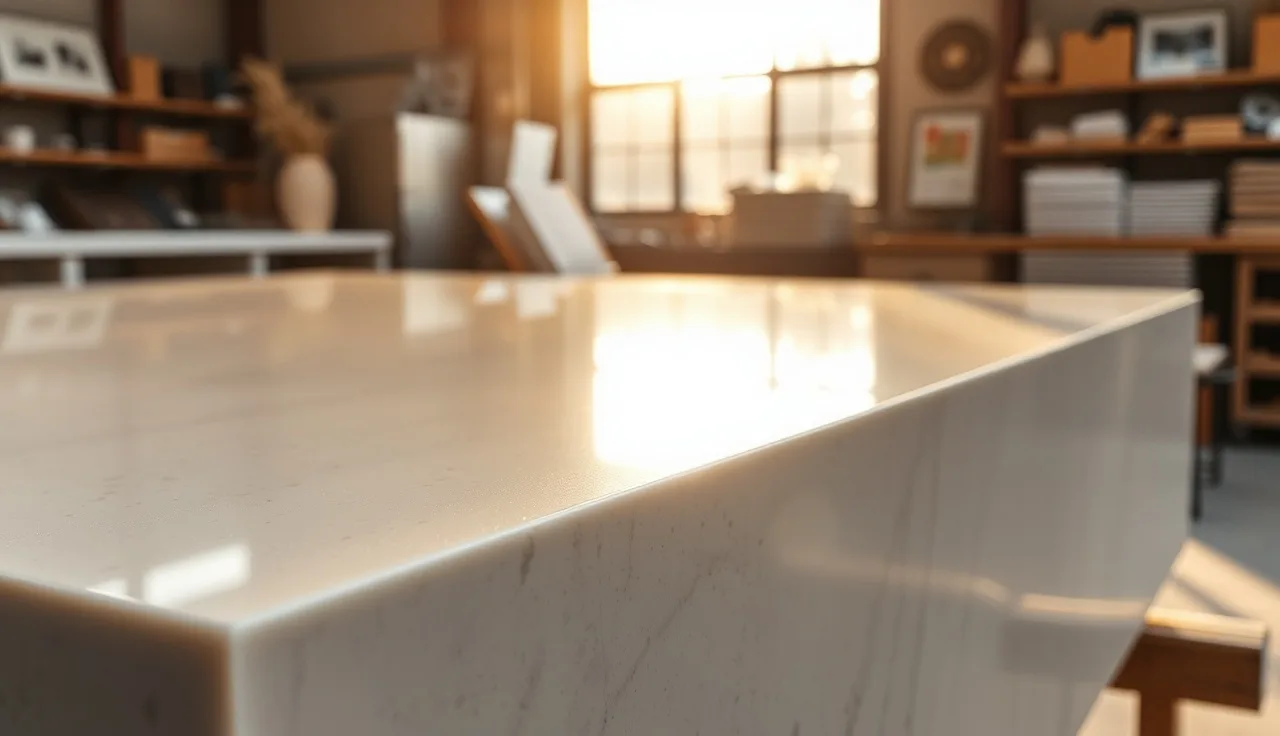
The edge profile is the shape cut along the exposed front edge of your countertop slab. It sounds minor. It is not.
The edge you pick affects how sharp the corner feels when you bump into it, how easy the surface is to wipe clean, how much the fabrication costs, and whether the finished counter looks like a $3,000 install or a $6,000 one. Fabricators cut edge profiles with CNC routers or hand-guided profile wheels, and the complexity of the shape drives labor time and therefore price [1].
For quartz specifically, the edge matters more than it does on laminate or tile because quartz slabs are thick (usually 3 cm, about 1.2 inches) and the exposed edge is a highly visible design element. A polished eased edge on white quartz looks clean and modern. That same slab with an ogee profile reads traditional. Same material, completely different room.
Homeowners often pick an edge at the showroom from a 6-inch sample and then regret it once it's installed across 40 linear feet of kitchen. This guide is here to stop that.
How much do different edge profiles cost on quartz countertops?
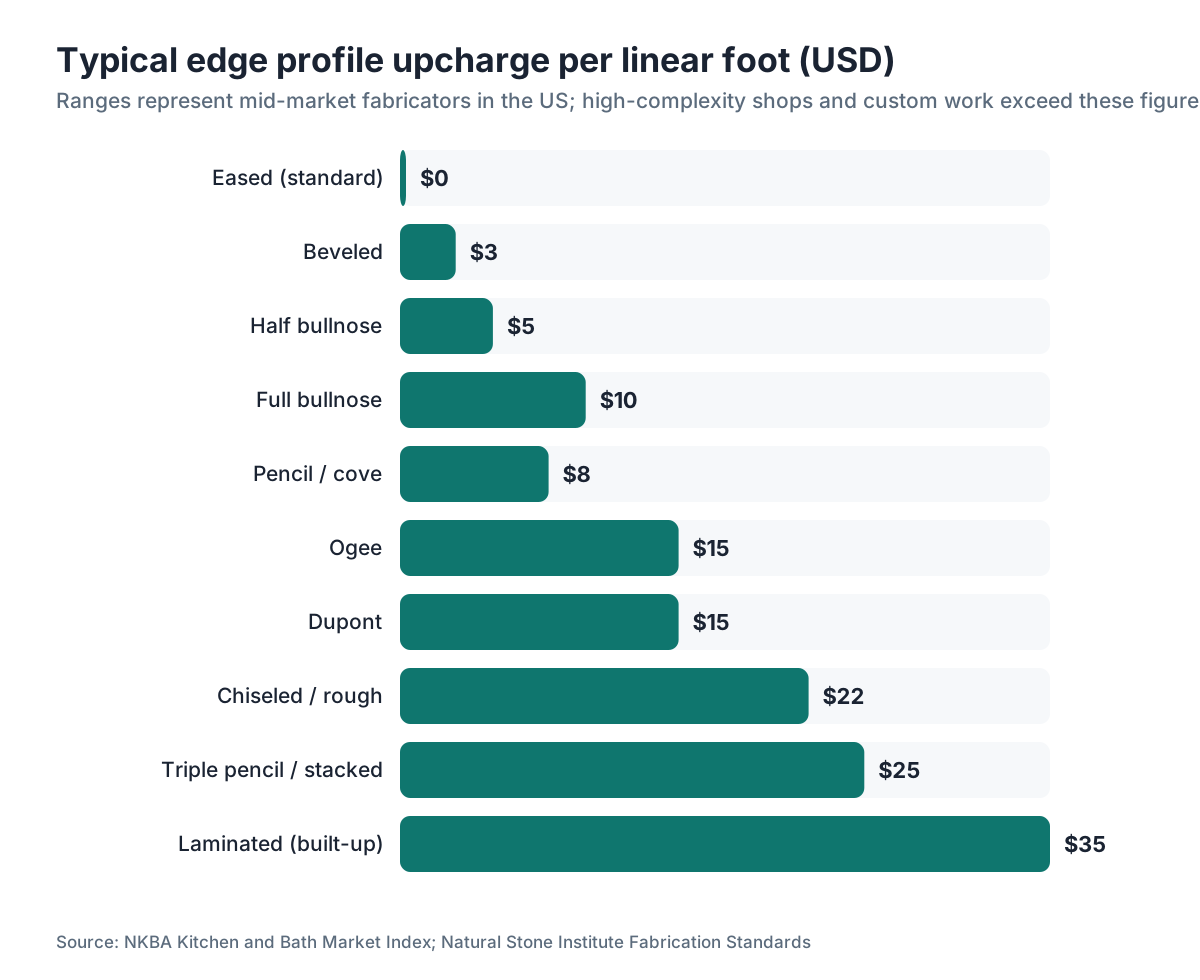
Edge profile pricing varies by fabricator, region, and CNC setup, but the ranges below track with National Kitchen and Bath Association survey data and what fabricators post publicly [2].
| Edge Profile | Typical Upcharge (per linear foot) | Complexity |
|---|---|---|
| Eased (straight with slight rounding) | $0 (standard) | Low |
| Beveled | $0-$5 | Low |
| Half bullnose | $0-$8 | Low |
| Full bullnose | $5-$15 | Medium |
| Ogee | $10-$20 | Medium-High |
| Dupont (reverse ogee) | $10-$20 | Medium-High |
| Waterfall (mitered) | $25-$60+ | High |
| Chiseled/Rough | $15-$30 | High |
| Triple pencil / stacked | $15-$35 | High |
| Laminated (built-up) | $20-$50 | High |
A typical kitchen has 25-40 linear feet of countertop edge. Choosing an ogee over a standard eased edge adds $250-$800 to the project at the midpoint. Waterfall edges, which require precision mitering of a vertical slab piece, can add $1,000-$2,500 to a standard kitchen job on their own [3].
Fabricators who run modern quoting and nesting software can price edge complexity faster and more accurately because the CNC tool-path time is already baked in. If your fabricator's quote seems vague on edge pricing, ask them to break it out per linear foot.
One honest note: these ranges carry real variance. A small shop doing everything by hand might charge more for complex profiles than a high-volume shop with a 5-axis CNC. Get line-item quotes.
What are the most common quartz edge profiles and what do they look like?
Here is a plain-English rundown of every profile you are likely to meet at a fabricator showroom.
Eased edge. A flat top and sides with just enough rounding on the top front corner to kill the sharp 90-degree angle. This is the default on most slabs. Clean, contemporary, easy to wipe. Most quartz manufacturers include it at no charge.
Beveled edge. The top corner is cut at an angle, typically 45 degrees, creating a distinct chamfer. Adds a little visual interest without going full decorative. Slightly harder to clean because the bevel catches crumbs at the transition point.
Half bullnose. The top edge is fully rounded but the front face stays flat and vertical. Softer look than eased, still simple to cut. Good for families with small children because there is no sharp top corner.
Full bullnose. Both the top and bottom corners round into a continuous curve. Very soft appearance. Popular in traditional kitchens. The rounded underside can feel awkward to grab when you are pulling open a drawer below the overhang.
Ogee. The S-curve profile. A concave scoop transitions into a convex roundover, usually finishing with a small flat or fillet at the top. This is the signature edge of formal, traditional, and Old World kitchens. It looks great on thick slabs and darker stones. It is the hardest standard profile to clean because the concave groove traps water, crumbs, and cleaning residue.
Dupont (reverse ogee). Similar to ogee but the curves run differently, with a stepped-down shelf appearance. Also traditional-leaning. Same cleaning caveats as ogee.
Waterfall edge. Not actually an edge profile in the traditional sense. The countertop slab continues vertically down the side of the cabinet all the way to the floor, requiring a precisely mitered joint at the corner. The result is an uninterrupted plane of stone. Very dramatic. Very expensive. Suited to modern and minimalist kitchens.
Chiseled (or rough) edge. The edge is left with a deliberately broken, textured finish, mimicking natural stone snapped along its cleavage plane. It works on quartz but looks more authentic on natural quartzite or granite. Hard to clean.
Pencil edge. A slight, tight roundover, almost like a hand-sanded corner. More subtle than half bullnose. Popular in contemporary designs.
Triple pencil / stacked profiles. Multiple decorative lines routed into the edge face. A traditional kitchen staple. The grooves are the enemy of anyone who cooks and actually gets the counter dirty.
Laminated (built-up) edge. Two or three layers of quartz get glued and finished together to fake a much thicker slab (sometimes 6 cm or more). Then any profile can be applied to the thicker blank. This is how you get that heavy, luxurious look on a 3 cm slab. Adds cost for both material and labor.
Which edge profile is safest for kids and high-traffic kitchens?
Sharp corners are a real injury risk, especially for children whose heads sit at counter height. The American Academy of Pediatrics recommends reducing corner and edge hazards in the home as part of general childproofing guidance [4].
For quartz, the safest profiles are half bullnose and full bullnose because the rounded top corner has no meaningful edge to cut or bruise against. Pencil edges and eased edges are acceptably safe for most households. Beveled edges create a firm corner at the base of the bevel that can bite depending on how aggressively the fabricator cuts the angle.
Ogee and dupont profiles have a more complex shape with some defined edges, but the corners themselves are usually rounded. They are not the problem profiles for safety.
The profiles to avoid if safety is the priority: any square (90-degree) edge with no rounding, and the bottom-front corner of any profile where the slab meets the cabinet face. Some fabricators leave that bottom front corner completely square even on otherwise rounded profiles. Ask specifically.
Waterfall edges are not more dangerous at counter level, but the exposed vertical slab edge running to the floor creates a sharp corner right where toddlers roam. That is a genuine hazard.
Which edge profiles are easiest and hardest to clean?
Cleaning ease is the practical concern showroom samples never communicate. Every groove, curve, and transition point in a decorative edge is a place where food, moisture, and cleaning products collect.
Easiest to clean, ranked:
- Eased edge (nearly flat, one wipe)
- Pencil / half bullnose (smooth curve, no groove)
- Beveled (one extra flat to wipe, small crumb ledge)
- Full bullnose (smooth, but the underside collects gunk in overhang situations)
- Waterfall (the mitered corner seam can trap debris if not perfectly sealed)
- Ogee and dupont (the concave groove is a grout-trap equivalent)
- Triple pencil / stacked profiles (multiple grooves)
If you cook real food, the kind that does not stay neatly on a cutting board, the ogee profile will frustrate you within six months. I would not install it in a working kitchen no matter how good it looks. A traditional aesthetic still works with a dupont or a simple cove profile that wipes clean far more easily.
Quartz itself is non-porous, so the material does not stain the way granite or marble can [5]. But the edge profile decides whether debris even gets to sit against the surface long enough to matter. For more on keeping stone surfaces clean, see how to clean stone countertops.
How does edge profile choice change by kitchen style?
There is a rough design logic to edge selection that most fabricators follow, and it tracks with what kitchen designers document in style guides.
Modern and contemporary kitchens almost always use eased, pencil, or waterfall edges. The goal is minimal visual distraction. A thick eased edge on a quartz slab with subtle veining is the current default in high-end modern builds. Beveled edges also work here.
Traditional and transitional kitchens suit ogee, dupont, full bullnose, or built-up laminated edges. If your cabinets have raised-panel doors, dentil molding, or decorative hardware, a plain eased edge will look wrong. The edge detail should echo the complexity of the cabinetry.
Farmhouse and cottage kitchens often use bullnose or a simple cove. The goal is soft and approachable, not dramatic.
Minimalist and Scandinavian-influenced kitchens almost always use a square or barely-eased edge. Some designers specify a completely square 90-degree edge, which forces a fabricator to leave the corner almost perfectly sharp. The visual effect is clean. The safety effect is less ideal.
For kitchen countertops generally, the edge profile is one part of a larger material and style decision. On a budget countertop like laminate countertops or formica countertops, edges are typically post-formed and the options are limited. One genuine advantage of quartz over laminate is the full range of CNC-cut edge options.
Brand-specific quartz lines, like Cambria countertops, sometimes include certain edge profiles at no upcharge depending on the collection.
Comparison of countertop edge profiles: quartz vs. granite vs. other materials
Edge profiles behave differently across stone types, and if you are choosing between quartz and other materials partly on the edge you want, this comparison matters.
Quartz. Engineered stone is very consistent in hardness across the slab, which makes CNC routing predictable. Almost any profile cuts cleanly. The material polishes to a uniform sheen on the edge that matches the face. Laminated edges are easier on quartz because the binding agents create a stable glue line.
Granite. Natural stone has grain variation, and some profiles look better on certain granites than others. Ogee and complex profiles can chip slightly at crystalline grain boundaries if the tool moves too fast. Granite countertops generally support the same profile range as quartz, but individual slabs may have spots that are harder to route cleanly.
Marble. Similar to granite on profile range. The softness of marble (Mohs hardness around 3-4) compared to quartz (7) means marble edges are more prone to chipping on ogee and other profiles with thin cross-sections [6].
Quartzite. Natural quartzite is very hard and profiles cleanly, though the cost runs higher than quartz because the material takes longer to machine.
Butcher block. Butcher block countertops use wood edge profiles that are either routed (for decorative shapes) or simply sanded. Options are more limited than stone. Bullnose and eased are the most common.
Solid surface (Corian, etc.). Corian countertops can be thermoformed, so edge profiles can include curves that stone cannot achieve. The material is softer and scratches more easily on exposed edges.
Laminate / Formica. Post-formed edges (the integrated rolled front edge) are the most durable option for laminate. CNC-cut profiles on laminate are possible, but the core material shows at the cut face unless it is banded.
What thickness of quartz slab works best for each edge profile?
Quartz slabs come in 1.2 cm (half-inch), 2 cm, and 3 cm thicknesses. The 3 cm slab is the current standard for kitchen countertops in the United States [10]. Edge profile options expand a lot at 3 cm.
1.2 cm and 2 cm slabs are too thin for complex profiles like ogee or dupont without laminating. The ogee needs a certain vertical depth to complete the S-curve. On a 2 cm slab, the result looks truncated and cheap. Eased, pencil, and beveled profiles suit thin slabs.
3 cm slabs support all standard profiles cleanly. The ogee looks correct. The bullnose has room for a full radius. The laminated edge, where a second strip glues to the front to create a 6 cm apparent thickness, becomes an option.
Laminated / mitered edges require precise cutting and joinery and add cost regardless of the base slab thickness. The resulting visual weight is substantial and suits large kitchens with heavy cabinetry better than small spaces.
One practical note: if your existing countertop is a 2 cm slab and you are replacing only a section, matching a 3 cm edge profile exactly is impossible. This is one case where a seemingly small decision about thickness has real downstream consequences for renovation work.
How do fabricators price and quote edge profiles?
Most fabricators price edges one of three ways: included in a flat square-foot price with a baseline profile, charged per linear foot as a separate line item, or priced in tiers (standard, premium, designer).
The linear-foot model is the clearest. You see exactly what the eased baseline costs and exactly what the ogee upcharge is. Ask for this format.
The tiered model is the most common in mid-market shops. Standard edges (eased, bevel, pencil) are included. Premium edges (bullnose, cove) add a flat upcharge. Designer edges (ogee, dupont, waterfall) sit at the top tier. The risk is that a tier can lump together profiles with very different CNC times.
When quoting complex jobs, shops that run fabrication management and quoting software (like SlabWise) can calculate edge linear footage automatically from the template, apply the correct per-foot upcharge, and show it as a discrete line item. That level of detail is worth asking for in any quote. It prevents the common situation where a homeowner agrees to an edge verbally and the upcharge shows up as a surprise on the final invoice.
For the full picture of what goes into countertop pricing, the countertop installation guide covers labor, template fees, and demo costs alongside material choices.
Are there edge profiles that go out of style quickly?
Yes. Some profiles carry a strong decade association and date a kitchen on sight.
The ogee peaked in the 1990s and early 2000s in American residential kitchens. It is not gone, but a new kitchen with ogee edges today reads as dated to most designers. If you are remodeling to sell, this matters. If you are building your forever home and love the traditional look, ignore the trend worry entirely.
The full bullnose had its own peak in the late 1990s, tied to the rounded, organic aesthetic of that era. It is still a solid practical choice for safety, but it reads soft and retro in a contemporary context.
Waterfall edges are at peak popularity in design media right now. They appeared relentlessly in renovation coverage through the late 2010s and early 2020s. Some designers think they are already tipping toward oversaturation, though they stay genuinely striking in the right space.
The eased edge is essentially timeless. It has been the default in modern architecture for decades and carries no era association. If you are unsure, eased is the answer.
One fabricator perspective worth noting: the profiles that generate the most rework calls are ogee (cleaning complaints) and waterfall (seam visibility when the miter joint is not perfect). Both are good profiles done right. Both demand extra care.
What should you ask your fabricator before choosing an edge profile?
Most homeowners pick an edge from a photo or a small showroom sample and then proceed. These questions reveal whether you are making a well-informed choice.
Can I see a full-length example of this edge on a slab similar to mine? A 4-inch sample does not show how the profile reads across a 10-foot run. Many profiles that look great at small scale look heavy or busy at scale.
What is the exact upcharge per linear foot, and how many linear feet are in my job? Get a total dollar figure, more than a per-foot number.
How will you handle the inside corners? Inside (or mitered) corners are where profiles can clash or look awkward. Some profiles do not turn inside corners cleanly.
What happens where the counter meets the wall or backsplash? The back edge is usually a straight square cut that butts against the wall. The profile only applies to exposed edges.
Is there a seam anywhere near the edge I am selecting? Seams on waterfall or laminated edges require precise color and finish matching. Ask to see photos of comparable seam work.
Does this profile need special maintenance I should know about? Mostly relevant to chiseled, rough, or deeply grooved profiles.
Frequently asked questions
What is the most popular quartz countertop edge profile right now?
The eased edge is the most commonly specified edge profile in American quartz installations. It is included as standard at virtually every fabricator, suits contemporary and transitional kitchens, and is the easiest to maintain. Waterfall edges and mitered profiles are the most visible in design media, but eased edges dominate actual installed volume by a wide margin.
Does the edge profile affect the resale value of my home?
Directly, probably not much. Buyers notice countertop material (quartz vs. laminate vs. granite) more than edge profile. Indirectly, a dated edge like a heavy ogee in an otherwise modern kitchen can make the whole space feel older than it is. If resale is the goal, eased or pencil edges are the safest choice because they do not date.
Can you change the edge profile on existing quartz countertops?
Yes, but it is expensive and logistically complex. A fabricator can re-profile an installed edge with handheld angle grinders and profile wheels, but removing material means you cannot go back to a wider or more complex shape afterward. The process works for simplifying an edge (ogee to eased) but not for adding material. Expect to pay $20-$50 per linear foot for rework.
What edge profile is best for a bathroom vanity in quartz?
Half bullnose and eased edges are the most practical for bathroom vanities. The vanity edge gets bumped and leaned against constantly, and a rounded profile handles that use better than a sharp bevel. For a decorative spa-style bath, a pencil or cove edge adds refinement without the cleaning problems of an ogee. Full bullnose also works well if the vanity top overhangs the cabinet.
How long does it take to cut a complex edge profile compared to a standard one?
On a CNC router, a standard eased edge might run at 15-20 linear feet per hour. A complex ogee or dupont profile can take two to three times as long per foot because of multi-pass tool changes and slower feed rates. On hand-guided equipment, the gap is wider still. That time difference is why complex edges cost more, not because the tooling is fancier.
Is the waterfall edge worth the extra cost?
If the kitchen has the design language to support it (minimal, high-contrast, modern cabinetry) and the fabricator has strong miter-joint experience, yes. If the quartz pattern is busy or heavily veined, the mitered corner can look chaotic where the horizontal and vertical patterns meet. Ask your fabricator to show you examples with the specific slab you are buying. The cost premium of $800-$2,500 for a typical kitchen island is real.
What is a laminated edge and is it worth doing?
A laminated (or built-up) edge glues a strip of quartz to the front face of the slab to fake a thicker slab, often 5-6 cm instead of 3 cm. The joint line is visible on close inspection. It adds $20-$50 per linear foot and is worth it if you want the heavy, substantial look of a thick slab without paying for full 4 cm or 5 cm material throughout.
Do different quartz brands limit which edge profiles you can choose?
The quartz material itself does not limit edge options. Your fabricator's CNC tooling determines what profiles are available. Some brands (like Cambria) offer certain edge profiles at no upcharge on specific product lines as a sales incentive, but that is a pricing policy, not a material limitation. Always confirm edge availability and pricing with your specific fabricator, not the brand.
What is the difference between an ogee and a dupont edge?
Both are traditional S-curve profiles with similar complexity and cleaning requirements. The ogee has a convex roundover at the top that flows into a concave cove below. The dupont (also called reverse ogee) starts with a flat or slight bevel at the top, then a concave section, then a small convex return at the bottom. The dupont has a slightly more architectural, stepped look. Both cost about the same to cut.
Can you use different edge profiles on different sections of the same kitchen?
Technically yes, but it usually looks like a mistake rather than a design choice unless the sections are clearly separated (like an island vs. perimeter counters). A common approach is a decorative edge on the island and a simple eased edge on the perimeter. If you do mix, keep the same profile family (all curved, or all geometric) so the combination reads as intentional.
How do I choose an edge profile for a dark quartz countertop?
Dark slabs make edge profiles more visible because the polished edge reflects light differently from the face. Complex profiles like ogee and dupont show up beautifully on dark stone and are worth considering if the kitchen style supports them. On very dark quartz, a waterfall edge can look dramatic and clean. Simple eased edges on dark stone read as intentional and modern.
Are rough or chiseled edges practical for quartz countertops?
Chiseled and leathered edges look better on natural stone like quartzite or granite, where the texture is authentic to the material. On engineered quartz, the rough edge exposes the interior composite material, which is a different texture and color than the face. Some fabricators can pull off a convincing chiseled look on quartz, but see a real example first. Maintenance is also harder because the texture traps debris.
Sources
- Natural Stone Institute (formerly Marble Institute of America), Dimension Stone Design Manual: CNC routing time and tool-path complexity directly determine edge profile fabrication cost
- National Kitchen and Bath Association (NKBA), Kitchen and Bath Market Index: Edge profile pricing ranges and consumer selection trends in kitchen and bath projects
- National Kitchen and Bath Association (NKBA), Design and Installation Guidelines: Waterfall countertop edges require precision mitered joints and carry significant labor upcharges
- American Academy of Pediatrics, Home Safety guidance: Reducing corner and edge hazards in the home is recommended as part of childproofing
- NSF International, NSF/ANSI 51 Food Equipment Materials Standard: Engineered quartz is non-porous and certified for food-contact surfaces, meaning it does not absorb stains through the face material
- U.S. Geological Survey, Mohs Hardness Scale mineral reference: Marble has a Mohs hardness of approximately 3-4; quartz rates 7 on the same scale, making marble edges more susceptible to chipping
- U.S. Census Bureau, American Housing Survey: Kitchen remodeling is among the most common home improvement projects tracked in housing survey data
- Occupational Safety and Health Administration (OSHA), Stone Fabrication Safety guidance: CNC routing and angle grinding of stone surfaces require specific safety controls including dust management
- Cambria Company LLC, Edge Profile product documentation: Cambria offers selected edge profiles at no upcharge on certain product collections as part of their standard fabrication service
- Natural Stone Institute, Fabrication Standards and Guidelines: Standard quartz slab thickness in the US residential market is 3 cm (approximately 1.2 inches); thinner 2 cm slabs are used in some applications
- Harvard Joint Center for Housing Studies, The Remodeling Market and Consumer Spending: Kitchen countertop replacement is among the highest-value individual remodeling line items in residential renovation spending
Last updated 2026-07-09