TL;DR
- Butcher block countertops take roughly eight standard edge profiles: eased, roundover, bevel, ogee, cove, dupont, waterfall, and live edge.
- Eased and roundover are the most common and the cheapest, usually baked into base pricing.
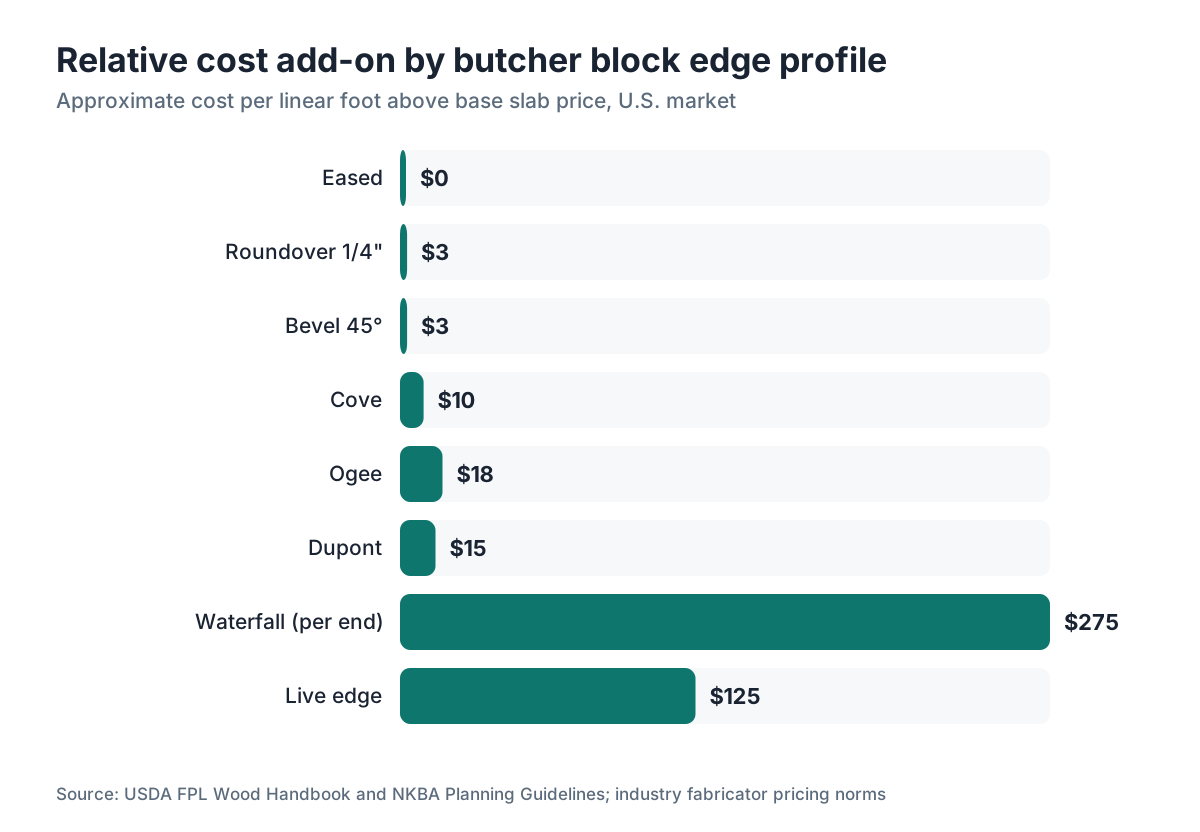
- Decorative profiles like ogee add $10 to $25 per linear foot.
- Your best pick depends on cabinet style, how hard the counter gets used, and whether you cut directly on the surface.
What edge profiles are available for butcher block countertops?
Wood is softer than stone, so a router or shaper can cut almost any profile into its face grain or end grain without the cracking risk you get with marble or quartzite. That freedom is one of wood's real advantages. Most fabricators and millwork shops keep eight profiles on the standard menu, and a good woodworker can grind a custom shape beyond those.
Here are the eight you'll see most, with a plain description of each.
Eased edge: The factory-square corner gets a light sanding so the 90-degree arris becomes a faint chamfer, maybe 1/16 inch. From across the room it reads as square.
Roundover (also called radius): A router rounds the top corner into a smooth arc. Common radii are 1/8 inch, 1/4 inch, and 1/2 inch. The bigger the radius, the softer the look.
Bevel (chamfer): The corner gets cut at 45 degrees, leaving a flat angled face instead of a curve. Usually 1/4 inch to 1/2 inch wide.
Cove: The reverse of a roundover. The top edge scoops inward in a concave arc. It shows up less on wood than on stone because that concave curve traps crumbs and moisture.
Ogee: An S-curve, convex on top and concave below, sometimes with a small flat step (a fillet) between them. It reads formal and traditional.
Dupont (also called eased dupont or stair-step): A two-step profile that drops down and then out, making a small shelf or ledge. Common on thicker slabs.
Waterfall: The countertop material keeps going vertically down the cabinet side to the floor, with a mitered corner up top. This is less a cut profile and more a decision about how the slab ends.
Live edge: One face of the slab keeps the natural tree edge, bark or irregular grain and all. It's a specialty item that starts with sourcing a wide slab that has a usable natural edge.
The table below sums up what you're choosing between.
How do butcher block edge profiles compare in cost, durability, and style?
| Profile | Relative cost | Durability | Style match |
|---|---|---|---|
| Eased | Included (base) | Very good | Modern, Shaker, transitional |
| Roundover 1/4" | Included or +$0-5/lf | Very good | Farmhouse, casual, any |
| Bevel 45° | Included or +$0-5/lf | Good | Contemporary, Arts & Crafts |
| Cove | +$5-15/lf | Fair (traps moisture) | Traditional |
| Ogee | +$10-25/lf | Good | Traditional, formal |
| Dupont | +$10-20/lf | Good | Transitional, modern |
| Waterfall | +$150-400 per end | Good if sealed well | Modern, minimalist |
| Live edge | +$50-200+/lf | Varies by species | Rustic, organic |
Those ranges are rough industry norms pulled from fabricator price lists and published millwork schedules. Your real quote swings on species (hard maple costs more to shape than pine or poplar), shop labor rates, and slab thickness. A 1.5-inch-thick maple top is the most common thickness for kitchen counters in the U.S., and most profile quotes assume that dimension [1].
Durability matters more on butcher block than on stone because wood moves. Wide profiles with deep concave sections pool water at the low point, which speeds up grain raise and can lead to finish failure or mold in a humid kitchen. A roundover or eased edge sheds water off the front face. That's the single biggest functional reason to keep the profile simple on a surface you actually work on.
On style, the honest answer is that eased and roundover edges go with almost anything. Ogee is a commitment. Put an ogee on flat-panel Shaker cabinets and it looks like you glued Victorian molding to a modern box. Pair it with raised-panel doors and ornate hardware and it's right at home.
Which edge profile is best for a butcher block island used for cutting?
If you cut directly on the wood, the edge profile hits two practical concerns: comfort on your wrists and how tight the edge stays as the wood swells and shrinks through the year. For an active prep surface, most experienced woodworkers land on a 1/4-inch to 3/8-inch roundover.
Here's why. Draw a knife toward you or press dough near the edge, and a sharp 90-degree corner digs into your forearm. A roundover kills that completely. An eased edge helps, but not as much.
Bevel edges are fine for cutting surfaces too, though they wear unevenly on softer woods like pine. The flat chamfer face takes nicks from knives that slide off the board and hit the edge.
Ogee and cove work on an island that gets chopped on, but they're a pain to refinish. When you sand and recoat a butcher block, a simple profile takes about the same time as the flat top. A deep ogee needs a profile sander or careful hand work to reach the cove section, which adds 30 to 60 minutes per linear foot of edge depending on how fussy the shape is. Refinish every year or two and that time stacks up fast.
One more factor. End grain butcher block, the type most often used as a cutting surface, has a more fragile edge than face grain or edge grain because the fibers run perpendicular to the face. Edge grain and face grain take the routing process better and hold a profile longer. End grain can chip at thin profile sections if the router bit isn't sharp [2].
How does edge profile choice affect sealing and maintenance?
Wood countertops need regular sealing with oil, wax, or a film finish like polyurethane or conversion varnish. The profile changes how that finish performs in two ways: film buildup in concave sections, and water runoff at the top corner.
Oil finishes (mineral oil, food-safe linseed, Rubio Monocoat) soak into the wood instead of sitting on top, so they follow any profile shape without buildup. They do need reapplication every few months under heavy use [3]. Profile shape is basically irrelevant to oil maintenance, because you just wipe oil into every surface.
Film finishes (polyurethane, varnish, lacquer) build up on the surface. On a cove or ogee, the concave section can pool finish and dry thick, which leads to crazing or uneven sheen. A skilled finisher thins the coats and keeps the panel moving, but it's more work. On a simple roundover or eased edge, film finishes brush on easy.
Water is the real trouble at the top corner no matter the finish. A square or lightly eased edge concentrates standing water right at the seam between the top face and the edge face. Over months, that can lift the finish at that corner. A roundover walks the water off the edge face and keeps the seam sealed longer. Not a dealbreaker. Just a reason to touch up that top corner once a year if you go square.
For fabricators pricing jobs, edge complexity is real shop time. A simple roundover on a router table takes one pass. An ogee on a 10-foot run of 1.5-inch maple takes 3 to 4 passes with setup, plus hand-sanding the profile. That time has to land somewhere in the quote.
What is a waterfall edge on butcher block and when does it make sense?
A waterfall edge isn't really an edge profile at all. Instead of shaping the corner, you miter the top slab at 45 degrees and attach a matching vertical panel that runs from countertop height down to the floor, covering the cabinet side.
On stone, waterfall ends are everywhere now. On butcher block they're rarer but completely doable, with one catch: wood moves. A 36-inch-tall waterfall panel in face grain maple can expand and contract 1/8 inch to 3/8 inch across the grain as humidity shifts through the seasons. Glue and nail it rigidly to the cabinet side and that movement will either crack the miter joint or cup the panel. Good millwork shops plan for it by floating the panel at the bottom and back, fixing it only at the top miter.
Waterfall butcher block looks best on thick slabs, 2 inches or more, with grain that reads dramatic from the side: heavily figured maple, or walnut with strong cathedral grain. On a clear, tight-grain maple island, the side panel is handsome but quiet.
Cost is the other factor. Plan on $150 to $400 extra per waterfall end depending on material thickness and shop labor. Some shops charge by the linear foot of miter cut, others quote a flat add-on. Ask specifically, because this is the item that quietly falls off a countertop quote and comes back as a surprise change order.
How much does edge profile routing add to the total cost of butcher block countertops?
Base butcher block pricing in the U.S. runs roughly $40 to $200 per square foot installed depending on species, thickness, and finish, with hard maple edge grain in the $60 to $100 range being the most common kitchen install [1][10]. Edge profile cost sits on top of that.
Simple profiles (eased, roundover, bevel) almost always come with the base slab price because they take one router pass. Some shops tack on a token $2 to $5 per linear foot to name the labor. Many just absorb it.
Decorative profiles cost real money:
- Cove: $5-15 per linear foot
- Ogee: $10-25 per linear foot
- Dupont: $10-20 per linear foot
- Custom profile (shop-ground router bit): $30-80 per linear foot plus a one-time bit cost of $50-200
A typical kitchen has 20 to 30 linear feet of exposed edge (island perimeter plus the fronts of the perimeter counters). At $15 per linear foot for ogee, that's $300 to $450 added. Not trivial. Not a budget-killer either.
Costs jump on end grain butcher block with complex profiles. End grain fights the cutter differently than face or edge grain, so chip-out at the corners is a live risk, and some fabricators charge a 20 to 30 percent premium for profile work on end grain slabs.
For fabricators using quoting software, edge profiles belong as their own line item, never buried in the slab price, because the linear footage swings hard between jobs and the margin hides in those details. SlabWise's quoting tool lets you set a price per linear foot for each profile type so the number shows up explicitly on every estimate.
For homeowners, the ask is simple: get an itemized quote that splits slab material, fabrication, edge profile, and installation. Any shop that can't break those out is harder to comparison-shop.
Can you change a butcher block edge profile after installation?
Yes, within limits. Because wood can be re-routed in place with a laminate trimmer or handheld router, you can turn a simple eased edge into a roundover or bevel after the countertop is installed. A skilled woodworker does exactly this when refinishing an old top.
What you can't easily do is jump from a simple profile to a more complex one in place, because complex profiles need a router table or shaper to come out consistent. In-place routing only works when the tool can register off the flat edge face.
Going the other direction, simplifying a complex profile to a plain one, is possible too. You can hand-plane or sand an ogee back to a roundover. It takes time, and you have to refinish the whole edge afterward.
Buying butcher block and genuinely unsure about the profile? Start with eased or roundover. You can always add shape later, either by hiring someone to re-rout or by grabbing a $30 to $50 roundover bit and a handheld router yourself. Cutting a complex profile down to a simple one is the harder road. This is the opposite of stone, where you cannot change the profile after fabrication without hauling the slab back to the shop.
How does the edge profile interact with undermount sink installation on butcher block?
This one trips up plenty of homeowners and some fabricators. An undermount sink on butcher block needs a finished, sealed edge at the sink cutout, because that inner edge sees water every single day.
The inner sink edge should be a simple cove or roundover, never a decorative ogee or dupont. The reason is sealing. The cutout edge gets a silicone bead and butts against the sink rim, and that silicone has to make clean contact with a consistent surface. A complex profile on the inner edge makes a watertight bead almost impossible.
The outer perimeter can carry any profile you want. Just spec them separately: "1/4 inch roundover on perimeter, simple cove on sink cutout," and make sure your fabricator quotes them as two operations.
One more note. Undermount sinks on butcher block split woodworkers. Some refuse to install them, pointing at the constant moisture at the cutout as a durability problem. The USDA Forest Products Laboratory, which publishes the standard reference on wood durability and moisture, notes in its Wood Handbook that prolonged wetting drives decay, and that exposed end grain absorbs water far faster than side grain [5]. A drainboard cut into the wood near the sink, plus a good film finish on the cutout edge, helps. If you want an undermount sink and a butcher block that lasts, choose species and finish carefully. Teak and hard maple hold up better than softer woods at sink cutouts. Wood is an accepted food-contact surface under the FDA Food Code, which lists hard maple and similar close-grained woods for cutting blocks and cutting boards [8].
What edge profiles work best with modern versus traditional kitchen styles?
Kitchen style is subjective, but the patterns are real.
Modern and contemporary kitchens (flat-panel cabinets, minimal hardware, tight color palette) look best with eased or bevel edges. The crisp line echoes the geometry of the cabinet faces. A waterfall end in thick walnut or maple also fits a modern kitchen, budget permitting.
Shaker and transitional kitchens are the most forgiving. Roundover and bevel both sit well. The slight softening of a 1/4-inch roundover matches the plain, functional character of Shaker design.
Traditional and farmhouse kitchens carry ogee and dupont profiles. Farmhouse in particular pairs butcher block with apron-front sinks, painted cabinets, and warm metals, and a soft ogee or a classic dupont reads naturally there.
The honest constraint: the edge profile is a minor detail next to wood species, color, and grain pattern. Walnut with any profile still looks like walnut. The perfect ogee won't rescue a wood selection that fights your floor. Get the species right first, then pick the profile.
For homeowners weighing butcher block countertops against other surfaces, this profile flexibility is one of wood's genuine wins over laminate countertops, where edge options are thin, or granite countertops, where complex profiles pile on stone-fabrication cost.
How do fabricators price and produce butcher block edge profiles in the shop?
Producing butcher block profiles differs from stone in one big way: wood gets routed dry with standard carbide or HSS router bits. No water, no diamond tooling. Setup is faster and the tooling is cheaper, but the work is dusty and the chip-out risk on end grain is real.
Most shops run butcher block edges one of three ways.
-
Router table: The slab edge rides a fence with the bit at fixed height. Best for consistent results on long runs. A standard 1/4-inch roundover bit costs $15 to $30 and makes thousands of passes before it dulls.
-
CNC router: Larger shops run butcher block on the same CNC they use for solid surface or MDF. More setup time, but complex profiles come out repeatable. CNC time on butcher block typically runs $60 to $120 per hour.
-
Handheld router with edge guide: Used for in-place refinishing or odd shapes. Results ride entirely on operator skill.
For shops running several butcher block jobs a week, the edge profile should be a named SKU in your quoting software with a cost per linear foot that covers bit wear, setup, and hand-sanding. Plenty of shops under-price edge work by absorbing it into a per-square-foot number, then wonder why butcher block margins run thin.
Run a shop and want to see how separating profile pricing tightens quote accuracy? Countertop installation cost breakdowns and quoting tools like SlabWise help you build it into a standard workflow.
For kitchen countertops generally, the edge profile is often the detail that separates a finished install from a builder-grade one. The production process on wood differs from stone, but the business logic is the same: know your cost per linear foot and price it out loud.
What are live edge butcher block countertops and how are they finished?
Live edge countertops use a slab where one or both long faces keep the natural tree edge: the curve of the trunk, the sapwood color shift, and sometimes the texture where bark came off. For a countertop you usually want one live edge facing the room and one straight-cut edge against the wall.
Live edge butcher block is almost always face grain, not end grain or edge grain, because you need a wide slab to net a usable natural edge across a 24 to 25 inch counter depth. The species that show up most are walnut, maple, cherry, and sycamore [4]. Wide slabs in these woods can run $30 to $80 per board foot raw, before any fabrication.
The natural edge forces finishing decisions that a straight edge never does. Bark removal is standard for a food-safe surface. After the bark comes off, the edge gets wire-brushed to clear loose fibers, then sealed with the same finish as the face. Some fabricators lay a thin coat of epoxy on the natural edge to stabilize checking (small cracks) before the finish coats go on.
Cost is the honest ceiling. A live edge walnut island top in a 3 by 6 foot size can run $2,000 to $6,000 or more depending on slab quality, region, and shop, before installation. Most homeowners who ask about live edge price it, then either buy it (because it really is stunning) or switch to a conventional face grain slab with a roundover.
For comparison, a face grain maple top the same size with a standard roundover edge runs roughly $600 to $1,500 installed in most U.S. markets [1][10].
Frequently asked questions
What is the most popular edge profile for butcher block countertops?
Roundover, usually in a 1/4-inch or 3/8-inch radius. It suits nearly every kitchen style, it's normally included in base pricing, it sheds water off the edge face better than a square corner, and it's comfortable against your wrists during prep. Eased edge is the default when you don't specify anything.
Can I get an ogee edge on butcher block or is that only for stone?
You can absolutely get an ogee on butcher block. Wood routes more easily than stone, so any profile a stone shop offers works in wood too. Ogee adds $10 to $25 per linear foot in most shops. The trade-off is that the concave section traps crumbs and moisture and takes more care when you refinish the top. For a heavy-use prep surface, simpler usually wins.
How thick should butcher block be for an island with a decorative edge profile?
A 1.5-inch minimum is standard for kitchen countertops, and most decorative profiles assume that thickness. For a dupont or waterfall edge, 2 inches or more reads better because the stepped or vertical section needs some mass to look substantial. Thinner material (3/4 inch) limits your profile options because the routing depth eats a big fraction of the board.
Does the edge profile affect how butcher block is supported or installed?
Not directly. The profile is a surface treatment and doesn't change structural support. Butcher block needs continuous support from the cabinet boxes below, with clips or screws that allow for seasonal wood movement. A waterfall end is the one exception: the vertical panel needs its own attachment plan so wood movement doesn't telegraph into the miter joint.
Can I rout a butcher block edge myself, or do I need a professional?
A confident DIYer with a handheld router and a decent bit can cut a clean roundover or bevel on a simple straight run. DIY breaks down on corners, curved sections, and complex profiles, which need a router table or CNC for consistent results. A slip with a handheld router on an installed countertop can blow out the edge, and that's very hard to fix.
What is the best edge profile for butcher block near kids or in a high-traffic kitchen?
Roundover. A fully rounded corner has no sharp edge to catch a child's head or a hip bump, and it's the most forgiving profile for minor nicks and wear. Ding the edge and a roundover touches up easily with a sanding block and re-oil. Complex profiles are much harder to repair in place.
How do I specify a butcher block edge profile when ordering?
Give the supplier the profile name, the size (for roundover, the radius; for bevel, the width and angle), and the location (perimeter only, or also sink cutout and other openings). Put it in writing on the purchase order. Vague verbal descriptions produce wrong profiles. If the shop has a profile sheet with photos, point to the one you want and confirm the per-linear-foot add-on cost.
Does the edge profile choice affect how long butcher block lasts?
Modestly. Profiles that shed water (roundover, bevel) keep the edge finish intact longer than profiles that hold water (cove, deep ogee). Species and finish type matter far more than profile for overall longevity. A well-oiled hard maple top with any profile will outlast a soft pine top with a perfect roundover.
Are there edge profiles that work better for edge grain versus end grain butcher block?
For end grain, stick to simple profiles. End grain chips more easily during routing because the cutter works against the fiber direction, not with it. A sharp 1/4-inch roundover bit on end grain gives clean results. Deep ogee or cove profiles on end grain risk tear-out at the concave section, especially on interlocked-grain woods like sycamore or some maples.
What is the difference between an eased edge and a standard square edge on butcher block?
A true square edge is exactly 90 degrees and will splinter at the corner almost immediately under normal use. An eased edge takes off just enough material there, usually a light 1/16-inch to 1/8-inch chamfer by hand or a light sanding pass, to kill the fragile arris with no visible change to the silhouette. Reputable suppliers ease the edge at minimum unless you say otherwise.
How does a dupont edge profile look on butcher block and who is it best for?
A dupont profile has a step: the top corner drops straight down a short distance, then kicks out horizontally to the front face, making a small ledge. On thick butcher block it looks substantial and architectural. It suits transitional kitchens better than ultra-modern ones. The ledge catches crumbs, so it takes a bit more attention to clean than a simple roundover.
Can butcher block have the same edge profile as the rest of my stone countertops in the kitchen?
Yes. Most profiles used on stone (eased, roundover, bevel, ogee, dupont) can be matched in wood. The visual result won't be identical because stone reflects light differently than wood grain, but the profile shape can match. This is a common goal in kitchens with stone on the perimeter and butcher block on an island.
Sources
- USDA Forest Products Laboratory, Wood Handbook: Wood as an Engineering Material (General Technical Report FPL-GTR-282): Standard butcher block countertop thickness in U.S. kitchens is 1.5 inches; face grain and edge grain construction details and species properties
- USDA Forest Products Laboratory, Wood Handbook, chapter on structure and function of wood: End grain wood surfaces have different fiber orientation than face grain, affecting cutting and routing behavior
- USDA Forest Products Laboratory, Wood Handbook, chapter on finishing of wood: Penetrating oil finishes on wood surfaces require periodic reapplication under heavy use conditions
- National Wood Flooring Association (NWFA), Hardwood Species Guide: Wide hardwood slabs in walnut, maple, and cherry used for countertop and live edge applications; species pricing ranges
- USDA Forest Products Laboratory, Wood Handbook, chapter on biodeterioration of wood: Prolonged moisture exposure drives wood decay, and exposed end grain absorbs water faster than side grain
- National Kitchen and Bath Association (NKBA), Kitchen and Bath Planning Guidelines: Standard countertop overhang, thickness, and finish specifications for kitchen installations
- U.S. Food and Drug Administration (FDA), Food Code (Materials for Food-Contact Surfaces): Wood is an accepted food-contact surface in specific uses including cutting blocks and cutting boards
- USDA Forest Products Laboratory, Wood Handbook, chapter on mechanical properties of wood: Hard maple is one of the more dimensionally stable domestic hardwoods, relevant to edge profile durability over time
- Home Innovation Research Labs (NAHB Research Center), Residential Construction Cost data: Countertop installed cost ranges by material type in U.S. residential construction
Last updated 2026-07-09