TL;DR
- Per square foot pricing charges you for the actual surface area of material used.
- Per linear foot pricing bundles a fixed counter depth into the rate, so you pay by how many feet of counter run along your walls.
- Most stone fabricators quote in square feet.
- Most big-box and laminate sellers quote in linear feet.
- Knowing the difference stops you from comparing apples to oranges across bids.
What does per square foot mean in a countertop quote?
Per square foot (written $/sq ft or $/SF) means the fabricator multiplies the actual surface area of your countertop by a unit price. Surface area is length times width, measured in inches and converted to square feet. A 10-foot run of counter that is 25.5 inches deep works out to 120 × 25.5 = 3,060 square inches, or about 21.3 square feet. Multiply that by, say, $65/sq ft for fabricated granite and you get roughly $1,380 for that section.
This is standard at most stone fabricators because slab material is priced by the square foot at the wholesale level. Quarries and distributors sell granite, quartz, marble, and quartzite in square feet, so shops pass that unit straight through to you [1]. The number quoted per square foot usually bundles the slab cost, the cutting and polishing labor, and often a standard edge profile.
Charges that stack on top of the square footage rate include cutouts for sinks and cooktops (typically $100 to $300 each), upgraded edge profiles (another $10 to $25 per linear foot of exposed edge), and seam work [2]. The per-square-foot number is the floor of your quote. It is never the ceiling.
What does per linear foot mean in a countertop quote?
Per linear foot ($/LF or $/lin ft) prices one dimension only: the length of your counter run. Depth gets assumed. Most retailers and manufacturers who use this method assume a standard 25-inch or 25.5-inch depth, which covers the typical 24-inch base cabinet plus a slight overhang [3].
A 12-foot kitchen counter quoted at $40/linear foot costs $480, full stop, whether the depth is 24 inches or 26 inches. That flat simplicity is exactly why big-box stores and laminate manufacturers like it. They sell a standardized product in standardized depths, so folding depth into the rate makes quotes fast.
You will see linear foot pricing most often with laminate countertops, post-form countertops (the ones with the curved front lip molded in), Formica countertops, and Corian countertops sold through dealers. You will rarely see it from an independent stone fabricator cutting natural slabs to custom dimensions.
How do you convert between linear feet and square feet?
The math is simple once you know the assumed depth. To compare a retailer's linear foot price against a stone shop's square foot price, use this:
Square feet = (linear feet × depth in inches) ÷ 144
Example: 20 linear feet at a standard 25.5-inch depth = (20 × 25.5) ÷ 144 = 510 ÷ 144 = 3.54. Wait, that is per foot done wrong. Do it as total inches: 20 feet is 240 inches long, so (240 × 25.5) ÷ 144 = 6,120 ÷ 144 = 42.5 square feet total. Each linear foot carries about 2.1 square feet.
To find the implied per-square-foot price, divide the linear foot price by 2.1. A laminate quote of $38/LF works out to about $18/sq ft. A granite fabrication quote of $75/sq ft on that same 42.5-square-foot job comes to $3,188 total, or about $159 per linear foot. Neither number is inherently better. They reflect completely different materials and fabrication.
The formula runs in reverse too: (price per sq ft) × (depth in inches ÷ 144) = implied price per linear foot. Anytime you hold competing quotes in different units, run the conversion first. Skipping it is the most common reason homeowners feel blindsided by a bid that only looked cheaper.
Which unit do most stone fabricators use, and why?
Nearly all custom stone fabricators price in square feet, whether they are cutting granite countertops, marble countertops, quartz, or quartzite. The reason is their raw material comes in slabs of irregular size. A granite slab might be 120 inches wide and 65 inches tall. The shop nests your pieces onto that slab, figures out how much material actually gets used, accounts for waste from cuts, and prices accordingly [4].
Linear foot pricing would hide all of that. An island with an odd shape or an extra-wide 30-inch depth gets systematically underpriced against a standard linear foot rate built for 25-inch depths. Shops would bleed money on non-standard jobs.
Fabricators also lean on square footage because it maps straight to material cost. If a slab runs $18/sq ft wholesale and the job needs 40 square feet, the math is clean. Their quoting software tracks slab yield, remnant use, and material cost in square feet because that is how they buy [4].
Square footage handles odd shapes gracefully too. L-shaped kitchens, curved islands, cut-in cooktops: the shop measures each polygon, adds the areas, applies the rate. Linear footage forces awkward workarounds on any layout that is not a straight run.
Does square foot or linear foot pricing give you a better deal?
Neither unit is cheaper on its own. Material and fabrication quality set the price. The unit is just how it gets expressed.
Linear foot pricing can hide value in two directions, though. If your counters are narrower than the assumed depth (a 22-inch bathroom vanity, say), you pay for material you never receive. If your counters run deeper than standard (a 28-inch island overhang for bar seating), a linear foot rate can work in your favor because the shop eats the extra material cost.
Square foot pricing charges you for exactly what you get. Wider counter, you pay more. Narrower counter, you pay less. Most experienced homeowners and contractors want square foot quotes from custom fabricators because the pricing is honest and adjusts to reality.
For budget materials like laminate or post-form, linear foot pricing is perfectly reasonable. The depth really is standardized, the product ships in pre-cut lengths, and there is no slab nesting to reckon with. The unit fits the product.
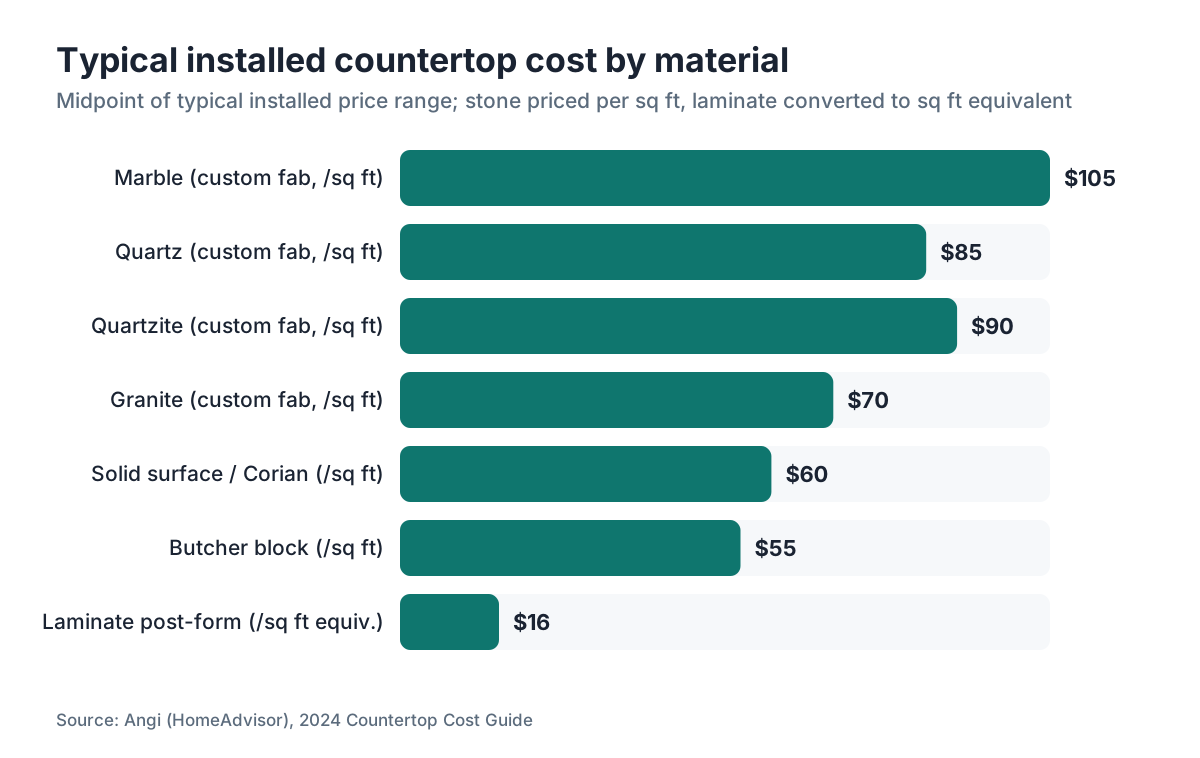
The table below shows typical installed price ranges by material and unit, drawn from home improvement cost data aggregators [2][5].
| Material | Typical unit used | Typical installed range |
|---|---|---|
| Granite (custom fab) | Square foot | $40 to $100/sq ft |
| Quartz (custom fab) | Square foot | $50 to $120/sq ft |
| Marble (custom fab) | Square foot | $60 to $150/sq ft |
| Quartzite (custom fab) | Square foot | $60 to $120/sq ft |
| Laminate / Formica | Linear foot | $20 to $60/lin ft |
| Post-form laminate | Linear foot | $15 to $40/lin ft |
| Solid surface / Corian | Linear foot or sq ft | $40 to $80/sq ft or $65 to $120/lin ft |
| Butcher block | Square foot | $30 to $80/sq ft |
How do fabricators actually measure your kitchen for a square foot quote?
A fabricator's templater comes to your home and takes precise measurements, either with a digital templating system or a paper-and-pencil layout. They record every section of counter: each wall run, the island, the peninsula, the bar top. For each section they measure length and depth, which can vary if your cabinets are not perfectly uniform.
The templater notes every sink location, cooktop cutout, and corner type (inside corners, outside corners, clipped corners). They flag where seams land, because slabs are only so big, typically 9 to 10 feet long and 5 to 5.5 feet wide for standard granite or quartz [1].
After templating, the shop lays your pieces out digitally on a virtual slab to trim waste. The square footage of material consumed, including waste from cutouts and odd offcuts, drives the slab cost. You pay only for the finished surface area (your actual countertops), but the shop's material cost sits higher because of waste. That waste is baked into the per-square-foot price.
A quote before templating is an estimate, nothing more. Final invoices from good shops rest on actual templated measurements, and the number sometimes shifts 5 to 15 percent from the original estimate depending on how accurate your hand measurements were.
This is one place quoting software earns its keep. Tools like SlabWise let fabricators build accurate square footage estimates from room dimensions before anyone schedules a template visit, so the estimate and the final number land much closer together.
Why do some quotes show both units?
Some fabricators and home improvement stores print both numbers, for example "$75/sq ft ($230/lin ft)," so you can sanity-check their math or line them up against a competitor's format. That is good practice, and you should ask for it when you are weighing stone quotes against laminate bids.
You may also see a hybrid quote where the slab material is priced per square foot but the edge profile is priced per linear foot of exposed edge. That is not an error. It is accurate. The edge is a one-dimensional feature (a cut down the perimeter) while the surface is two-dimensional. Charging edge work by the linear foot is more precise than burying it in a square foot rate, because a kitchen with a lot of exposed island edges needs more edge work than a kitchen with the same area but mostly wall-hugging counters.
Sink cutouts and faucet holes usually show up as flat fees because they are fixed amounts of labor regardless of countertop area. Look for those line items so you know what is and is not baked into the square foot rate.
What is the difference between gross square footage and net square footage in fabricator quotes?
Gross square footage is the bounding rectangle of a countertop section. If your L-shaped counter has a missing inside corner, some shops measure the whole bounding rectangle, which is larger than the actual countertop surface. Net square footage subtracts the inside corner void.
Industry practice is mixed. Many fabricators charge gross because they have to account for that full piece of slab even when part of it becomes scrap. Others charge net because they can reuse remnants from inside corners on other jobs. Ask which method your shop uses before you sign anything.
The gap is usually small on a standard kitchen, maybe 2 to 5 square feet on a typical L-shaped layout. On a complex kitchen with multiple inside corners it can hit 10 to 15 square feet, which at $80/sq ft is $800 to $1,200. Worth clarifying.
Sink cutouts are almost always left out of the net square footage calculation and billed as a separate flat fee, because the stone from a sink hole is scrap that cannot be reused.
How should you compare quotes that use different units?
Step one: get every quote on the same basis. Ask each shop or retailer for a total price for your specific layout, not a unit rate. Then compare totals.
Step two: confirm each total covers the same scope. One quote might include installation and another might not. One might include a standard edge and another might charge extra. Ask every vendor to itemize: material, fabrication, edge profile, cutouts, delivery, and installation.
Step three: check the depth assumption in any linear foot quote. If a laminate retailer assumes 25 inches and your counters are 25.5 inches, you may need a filler strip or a price adjustment.
Step four: run the conversion (length × depth ÷ 144) to get everything into square feet, then divide each total by square feet to find the effective square foot rate. Now a laminate bid and a granite bid sit on the same scale. Granite will still cost far more, but the numbers will make intuitive sense.
For a countertop project, getting at least three quotes is standard advice from consumer protection agencies [6]. With the conversion in hand, you can actually evaluate all three instead of guessing.
Do countertop prices vary by region in the US?
Yes, and by a lot. Labor drives most of the swing. Fabrication shops in high cost-of-living metros (San Francisco Bay Area, New York City, Seattle) charge 20 to 40 percent more than shops in mid-size inland cities for the same material and same square footage [2][5].
Material costs are more uniform because slabs ship nationally, though local distribution relationships and import volumes still nudge prices around. Quartz from a major manufacturer like Cambria (a US brand based in Minnesota) may be priced one way at a dealer near their plant and another way at a dealer across the country [7].
Season matters too. Spring and early summer are peak renovation months. Shops with full order books may quote higher prices or longer lead times from March through June. Fall and winter run slower, and some shops discount then.
If you live in a high cost area, call shops in nearby suburban or rural towns. The drive may cost less than the metro premium.
For more context on how materials stack up, the kitchen countertops guide covers a broader range of options side by side.
What are minimum square footage charges and why do they exist?
Most fabrication shops have a minimum order, typically 15 to 25 square feet, sometimes stated as a dollar minimum of $400 to $800 [2]. It covers their fixed overhead on any job: loading a slab, running it through the bridge saw, templating, and delivering.
A tiny bathroom vanity of only 10 square feet still eats nearly as much setup time as a 30-square-foot kitchen. The minimum keeps that small job worth doing for the shop.
For a small project, this means the effective per-square-foot rate on a vanity can run well above the advertised rate once the minimum kicks in. If a shop quotes $65/sq ft with a $650 minimum and your vanity is only 8 square feet, you are effectively paying $81.25/sq ft.
Ask about minimums upfront. Some shops waive them for remnant jobs, where they cut your small piece from a leftover slab already sitting in inventory. Remnant pricing can save 20 to 40 percent on small countertops [2].
How does countertop thickness affect square foot pricing?
Most residential quotes assume a standard thickness: 3 centimeter (about 1.25 inches) for stone and engineered quartz, or 2 centimeter (about 0.75 inches) for thinner applications. That standard is baked into the per-square-foot price.
Want a thicker profile, like 4 cm or a mitered edge that fakes extra thickness? That is usually an upcharge. Want thinner material? 2 cm is popular for a modern look and lighter weight, and the material cost per square foot drops, though so does some of the heft.
Butcher block is usually priced by the square foot too, and thickness (1.5 inches vs 2 inches vs 3 inches) moves the price directly, since you are literally buying more wood [8]. The butcher block countertops guide covers those variables in more detail.
When you compare square foot quotes, make sure every bid assumes the same thickness. A 2 cm quartz quote reads cheaper per square foot than a 3 cm quote for the same material, but 2 cm needs a plywood substrate underneath or it will flex.
Frequently asked questions
What is a linear foot of countertop?
A linear foot is 12 inches of counter length, measured in a straight line. It says nothing about depth or width. When a retailer prices countertops per linear foot, they fold an assumed standard depth (usually 25 to 25.5 inches) into that rate. You pay only for the length of counter you need.
Is per linear foot or per square foot cheaper for granite?
Stone fabricators almost never quote granite by the linear foot, so you rarely face this comparison for the same material. Convert a granite square foot price to a linear foot equivalent and granite typically runs $150 to $300 per linear foot installed. Laminate at $20 to $60 per linear foot is genuinely cheaper per unit, but it is a different material with a shorter lifespan.
How many square feet is a typical kitchen countertop?
A typical U-shaped or L-shaped kitchen has between 35 and 70 square feet of countertop, according to home cost data aggregators. A basic galley kitchen might be 25 to 35 square feet. An open kitchen with a large island can reach 80 to 100 square feet. Measure length times depth for each section and add them up.
Why do big-box stores use linear feet instead of square feet?
Big-box stores sell standardized post-form or laminate cut to length. Because the depth is always 25 or 25.5 inches, measuring only the length is all they need. The product ships at a fixed width, so bundling depth into the linear foot rate simplifies pricing for staff and shoppers alike. Custom stone fabricators handle variable dimensions, so they need the full two-dimensional measurement.
How do I measure my countertop square footage myself?
Measure the length and depth of each section in inches, multiply them, and divide by 144 to get square feet. Add up all sections. For L-shapes, measure each leg separately. Do not subtract for sink cutouts, since most fabricators charge gross area plus a cutout fee. A tape measure and a notepad are all you need.
Can I negotiate countertop price per square foot?
Yes, especially on material and edge profiles. Choosing a common granite or quartz colorway over an exotic import can drop the per-square-foot material cost by 20 to 40 percent. An eased or beveled edge instead of an ogee saves $10 to $20 per linear foot of edge. Bigger jobs often earn a slight per-square-foot discount because fixed overhead spreads over more area.
What is included in a per square foot countertop price?
It varies by shop, so always ask. Most stone fabricators include the slab material, cutting and polishing, and a standard edge profile (usually eased or beveled) in the per-square-foot rate. Sink cutouts, faucet holes, delivery, and installation commonly show up as separate line items. Some shops bundle installation, others do not. Get a written itemized quote before assuming anything is included.
How do I compare a laminate quote in linear feet to a quartz quote in square feet?
Multiply your linear footage by the assumed depth (25.5 inches for most laminate) and divide by 144 to get square feet. Then calculate both quotes as total installed prices and divide each by square feet for a comparable effective per-square-foot rate. Laminate will be far cheaper per square foot, but the durability, appearance, and resale value difference is real and worth weighing.
Do fabricators charge for the full slab or just the pieces I need?
Most fabricators charge for the finished countertop area (net or gross depending on their policy), not the full slab. Minimum charges often apply, and waste from cutouts and odd corners is baked into the per-square-foot price. If your job is small, ask about remnant pricing, where you buy a leftover piece and pay only for what you use, which can cut costs by 20 to 40 percent.
Is square footage the same as slab area for pricing purposes?
No. The slab is larger than your countertop. A full granite slab might be 50 to 60 square feet while your kitchen counter uses 40 of them. You pay for 40 square feet at the quoted rate, and the shop absorbs waste into its pricing model. Some shops will sell you a full slab if you want maximum material control, but most residential jobs are priced by finished area.
What is a countertop remnant and how does it affect pricing?
A remnant is a leftover piece of slab from a previous job. Fabricators often sell remnants at a discount, sometimes 30 to 50 percent below the full slab rate, because the material cost is already partly recovered. Remnants suit small bathrooms, laundry rooms, or bar tops under about 15 to 20 square feet. Selection is limited to whatever the shop has on hand.
Does the edge profile price affect linear foot or square foot calculations?
Edge profiles are priced separately by the linear foot of exposed edge, not by square footage. Your counter might have 30 square feet of surface but 18 linear feet of exposed front edge. A standard eased edge is often included in the base square foot rate. A decorative ogee or waterfall edge could add $15 to $40 per linear foot. Check which edge is included before comparing total quotes.
How accurate are online countertop price calculators?
They give rough ballpark estimates, usually within 20 to 30 percent for typical layouts. They rarely account for regional labor variation, specific slab grade, edge profile, cutout complexity, or minimum charges. Use them to budget a range, then get at least two or three real quotes from local fabricators for reliable numbers. Calculators are useful for setting expectations, not for signing contracts.
Sources
- Natural Stone Institute (formerly Marble Institute of America), Stone Industry Education: Natural stone slabs are sold and distributed by the square foot at the wholesale level; fabricators buy in square feet and price in square feet.
- Angi (HomeAdvisor), Countertop Installation Cost Guide: Typical installed countertop prices: granite $40-$100/sq ft, quartz $50-$120/sq ft, laminate $20-$60/lin ft; minimum charges of $400-$800 are common at stone fabricators.
- National Kitchen and Bath Association (NKBA), Kitchen Planning Guidelines: Standard base cabinet depth is 24 inches; countertop overhang convention brings finished counter depth to 25 to 25.5 inches, the assumed depth in linear foot pricing.
- Ceramic Tile and Stone Consultants (CTaSC), Slab Fabrication Best Practices: Fabricators use square footage to track slab yield and material cost because stone slabs are purchased and inventoried in square feet.
- US Bureau of Labor Statistics, Occupational Employment and Wage Statistics: Wages for stone and construction trades vary widely by metropolitan area, contributing to countertop labor cost differences of 20 to 40 percent between high-cost metros and inland cities.
- Federal Trade Commission, Hiring a Contractor consumer guidance: Consumer protection guidance recommends getting multiple written estimates and itemized quotes before hiring a contractor for home improvement work.
- Cambria, US-based quartz manufacturer (Le Sueur, Minnesota): Cambria is a US quartz manufacturer based in Minnesota; dealer pricing can vary by region and distribution distance from the plant.
- Forest Stewardship Council US, Wood Products Standards: Butcher block countertop pricing scales with board thickness; thicker slabs (2-3 inches) cost more per square foot because they contain more wood volume.
- US Bureau of Labor Statistics, Producer Price Index: Producer prices for cut stone products are tracked per square foot, reflecting the industry standard unit measurement for natural stone fabrication.
- International Code Council, International Residential Code: Standard kitchen base cabinets are specified at 24 inches depth; finished countertop depth including overhang is conventionally 25 to 25.5 inches.
Last updated 2026-07-09